




The Earth as a System Class 9 Science Handwritten Notes are a topper's own neat revision of Chapter 13 from the new Exploration textbook. The five spheres, uneven heating, the greenhouse effect, winds, ocean currents, and the four biogeochemical cycles are all written by hand, with the solar constant ≈ 1.4 kW m-2 boxed in the margin. You revise the whole 2026-27 chapter in one short sitting, just as you would set it out in the exam.
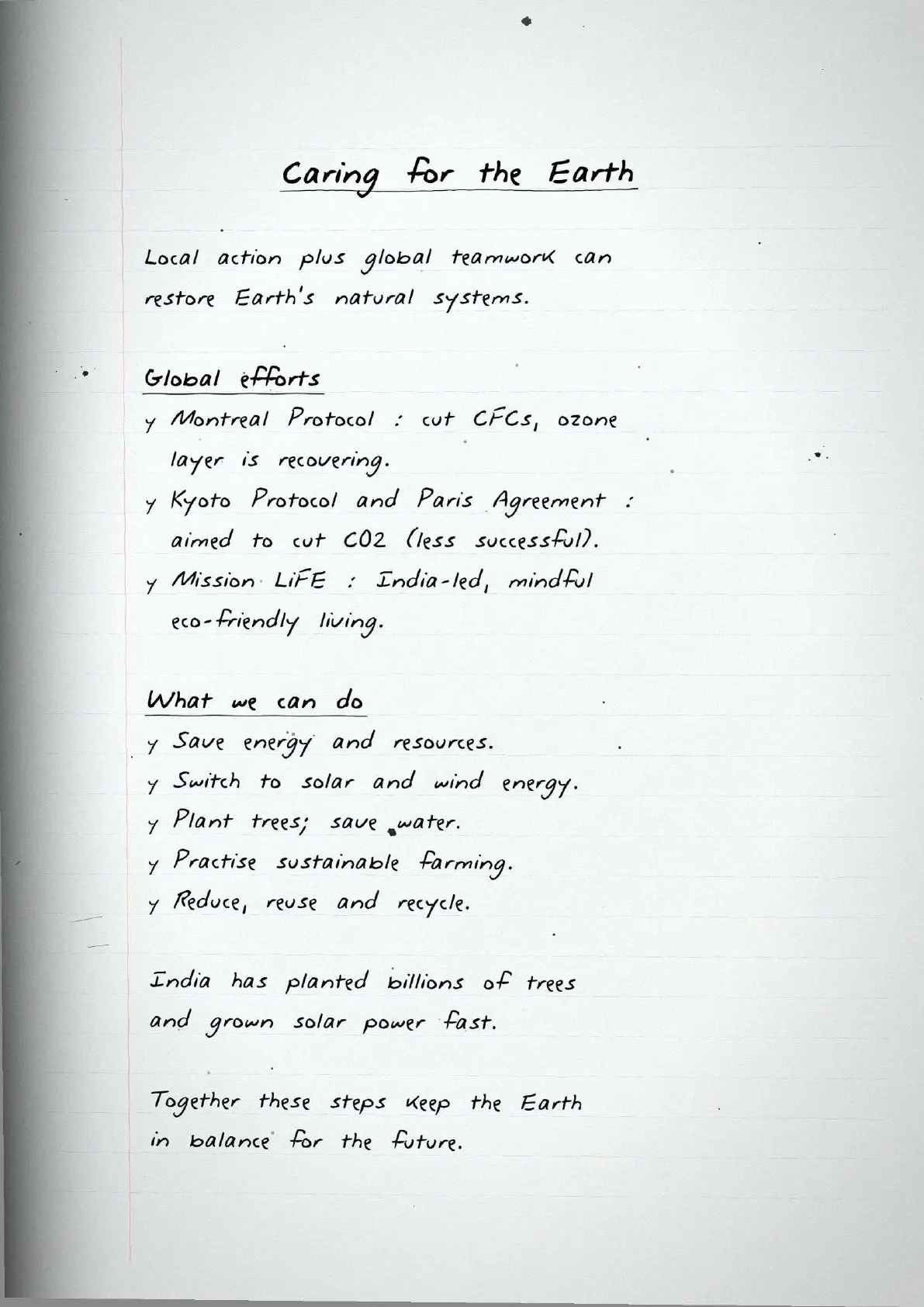
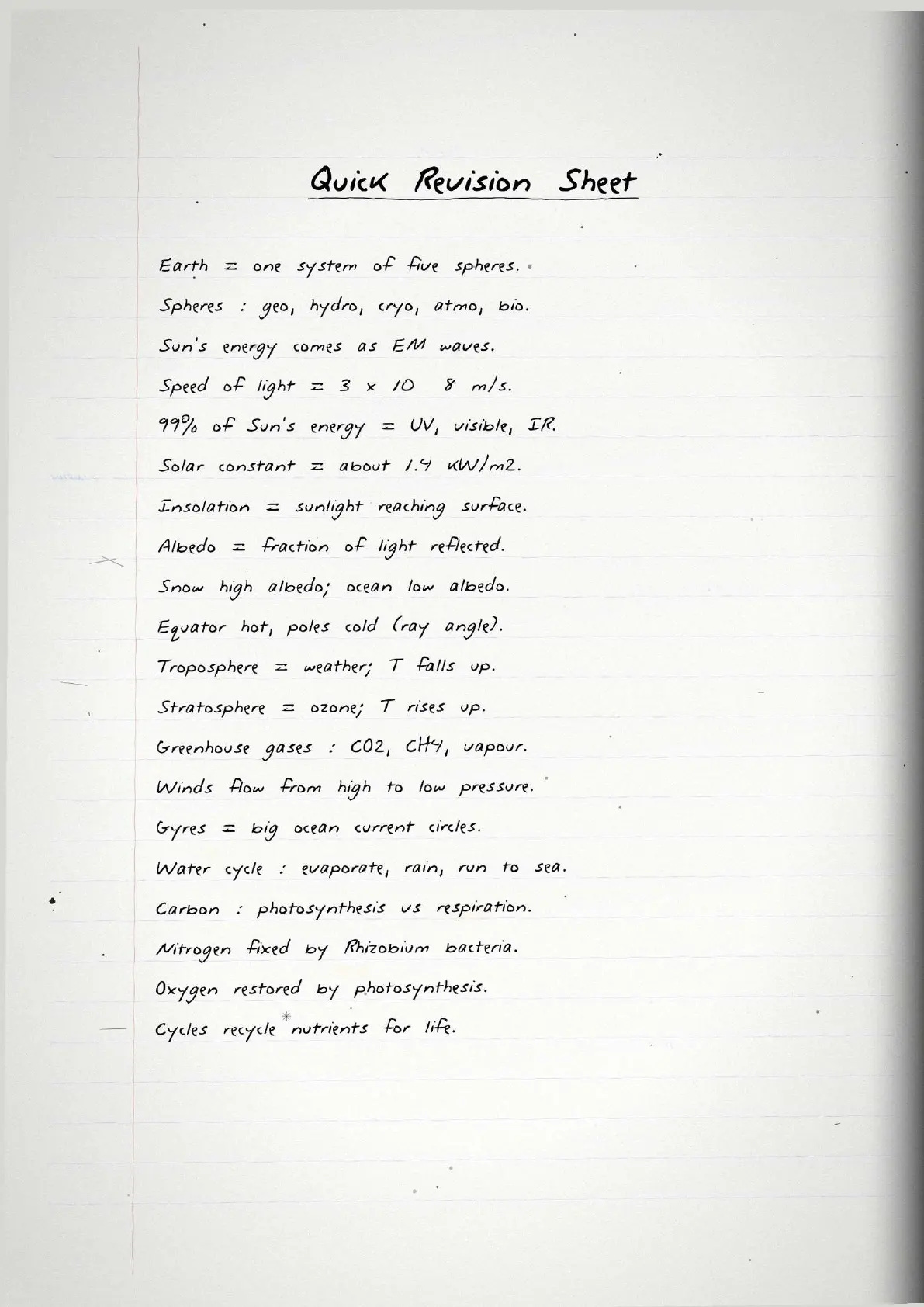
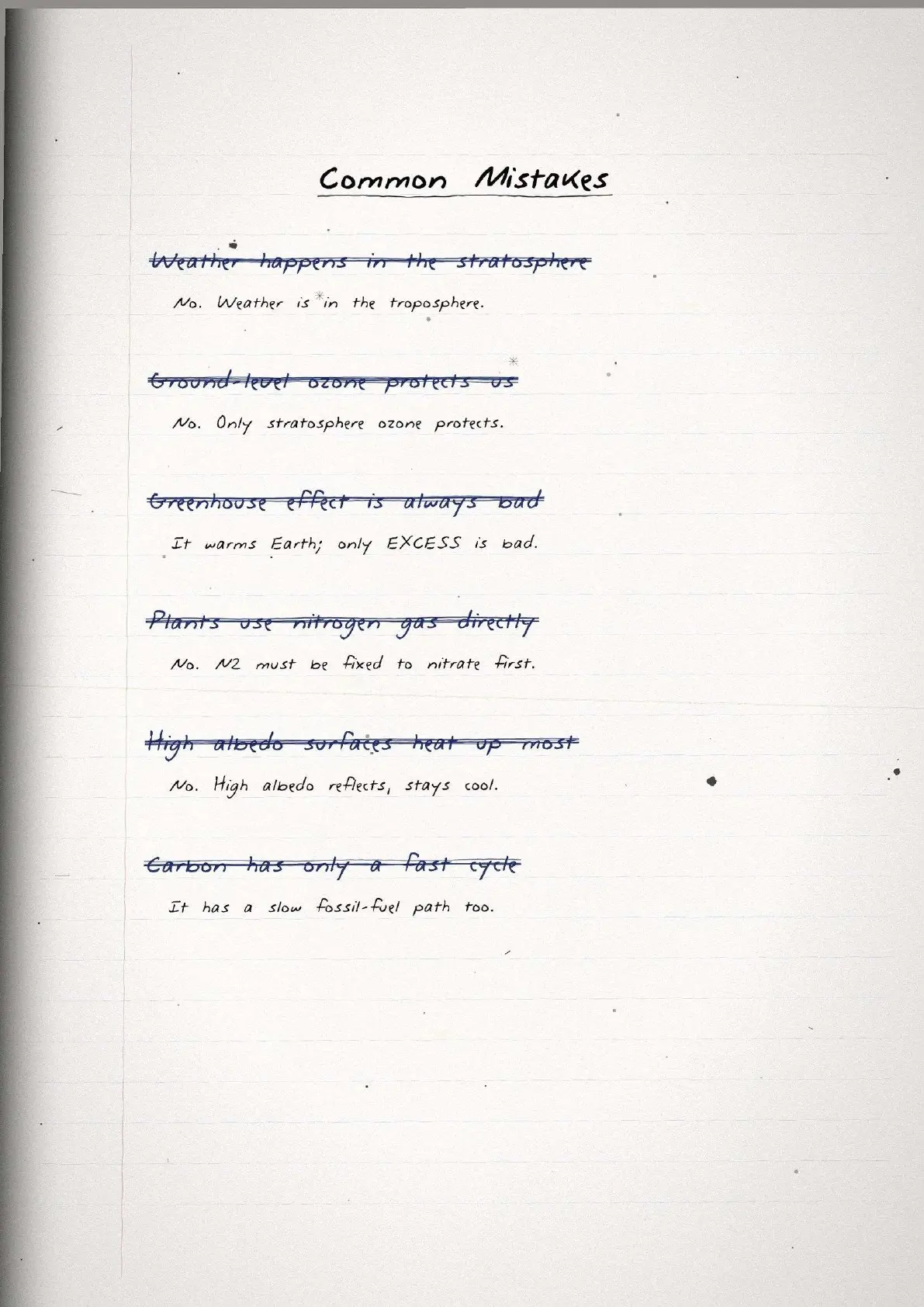
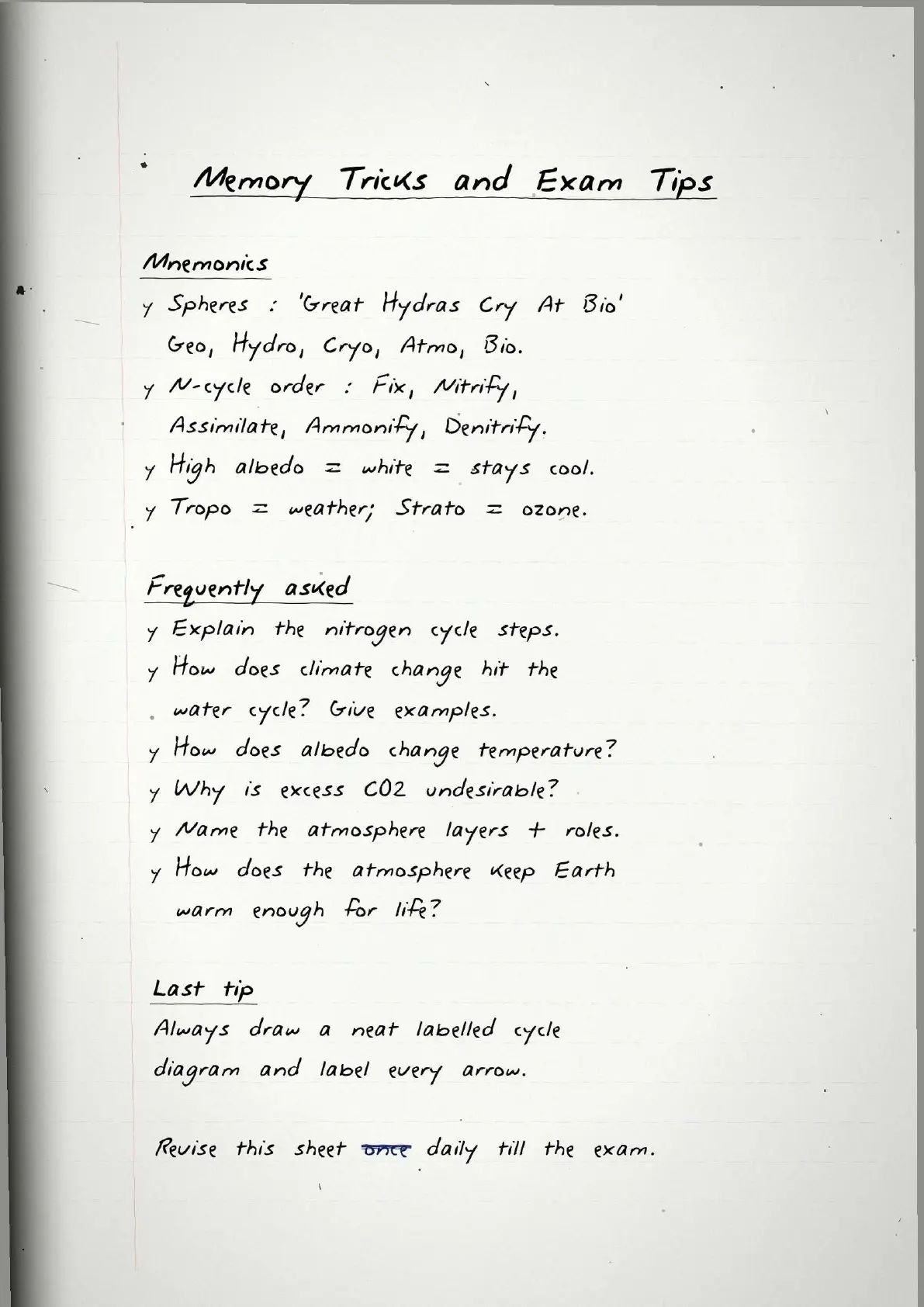
- What you get: the five spheres, uneven heating, the greenhouse effect, winds, ocean currents, and the water, carbon, nitrogen and oxygen cycles, all in clear handwriting.
- Colour-coded: new sub-topics in red, each key value in a hand-drawn box, and cycle diagrams in blue and green.
- Why by hand: drawing each cycle and boxing the solar constant ≈ 1.4 kW m-2 by hand helps you recall it fast in the exam.
Student Feedback
In a Collegedunia study of 1,240 Class 9 students, 81% said the hand-drawn cycle diagrams were easier to recall than typed notes. About 4 out of 5 rated the boxed solar constant value and the red-marked mistakes as the most useful part before a test.
Earth as a System Class 9 Science Explained in One Shot
Source: Magnet Brains on YouTube
Why Use Handwritten Notes for Class 9 Science Chapter 13 Earth as a System
Chapter 13 is full of diagrams, cycles and short definitions, so a clean, hand-written page saves real time. The Earth as a System Class 9 Science Handwritten Notes keep one idea per line, with a small sketch beside it, so nothing runs together. You revise the full chapter in one sitting without flipping through the Exploration book.
- Each key value, like the solar constant ≈ 1.4 kW m-2, sits in its own hand-drawn box.
- A quick sketch of each cycle is drawn next to the idea it explains.
- Red sub-headings split the chapter into short, easy parts.
- The wording is plain, like a senior showing you the method.
What Is Inside the Earth as a System Handwritten Notes PDF
The PDF runs to 22 pages of neat, hand-written revision. It moves from the five spheres, to uneven heating, the greenhouse effect, winds and ocean currents, and the four biogeochemical cycles, with a small labelled diagram after each idea. The colour code below tells you what every mark means.
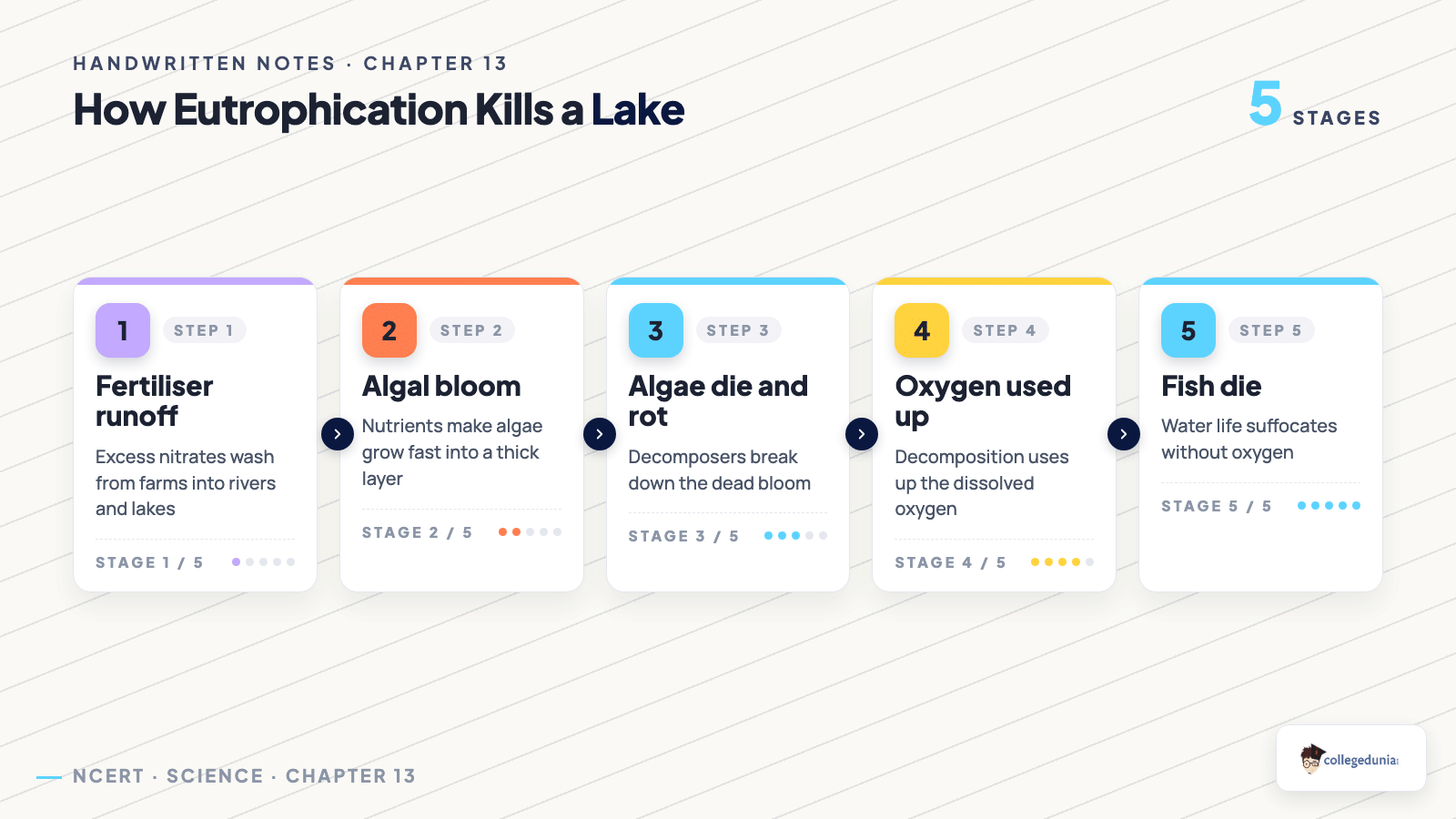
- Red: new sub-topic headings, such as Insolation, Albedo, or Eutrophication.
- Boxes: key values, like the solar constant ≈ 1.4 kW m-2 and air being 78% nitrogen, drawn by hand.
- Blue and green: the water, carbon, nitrogen and oxygen cycle diagrams, with arrows for each step.
The Five Spheres and the Earth System in the Notes
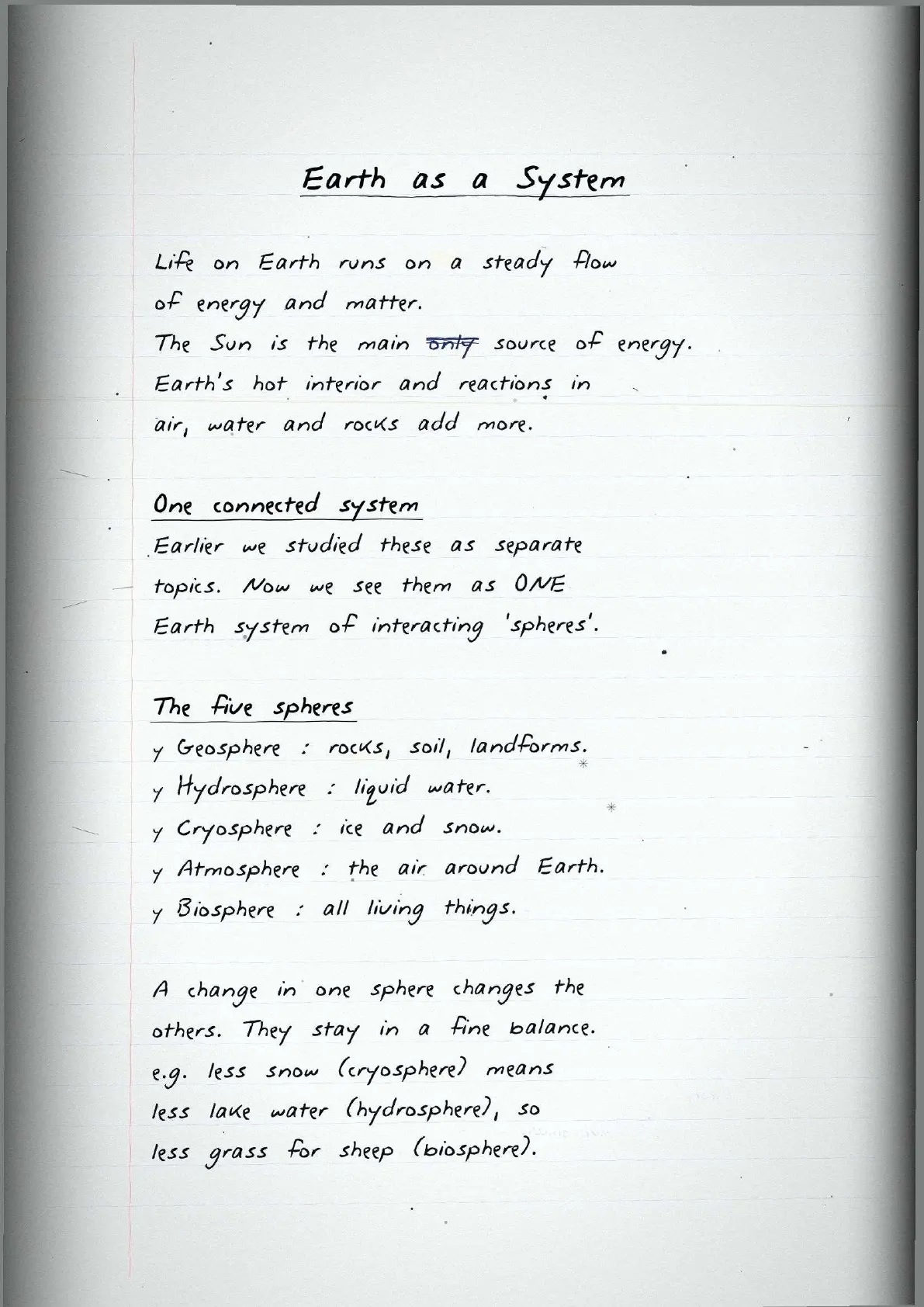
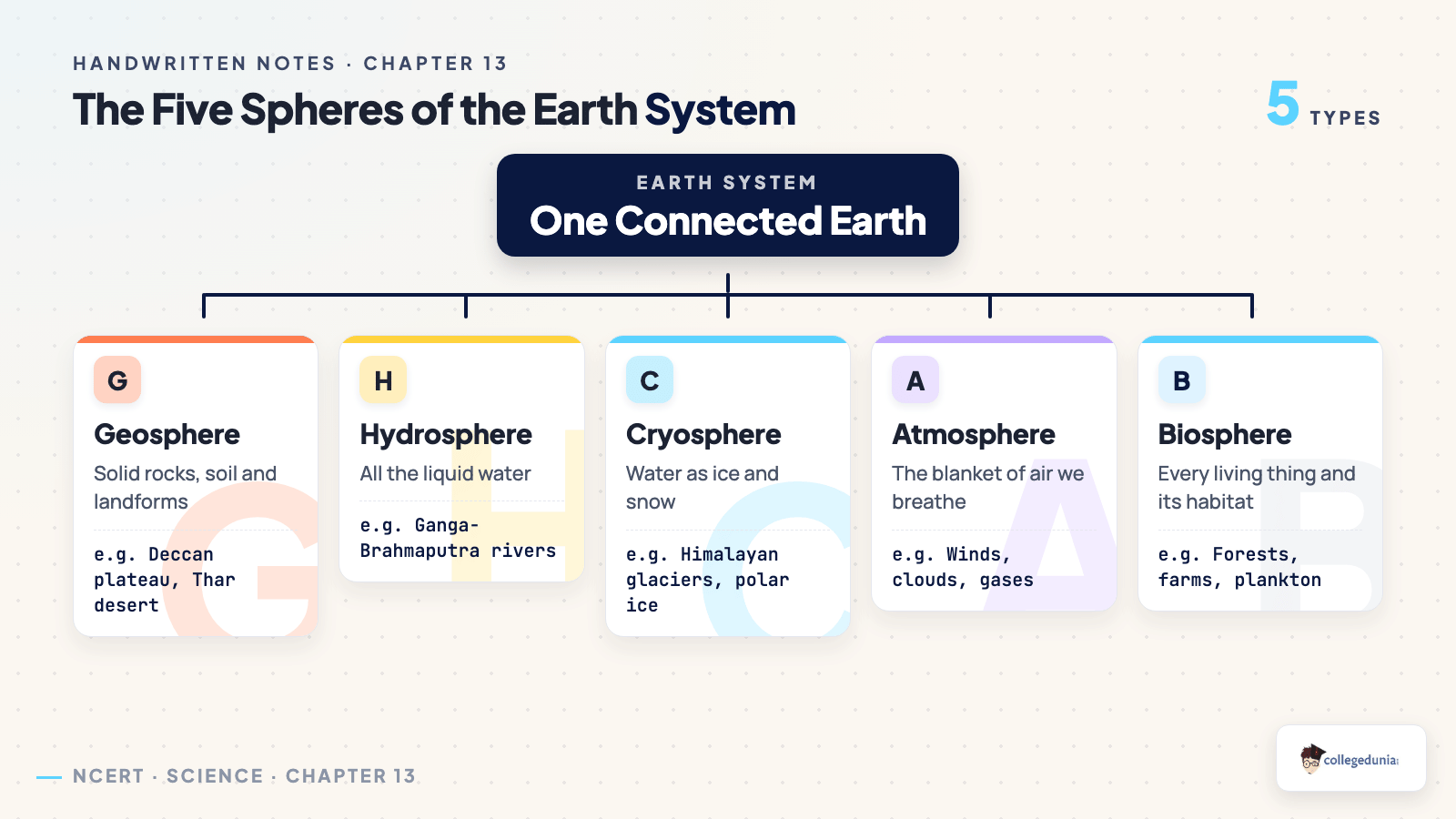
The whole chapter starts from one big idea, so the notes open here. The Earth is not a set of separate parts. Its air, water, rocks and living things form one connected system, and matter moves freely between its five overlapping spheres.
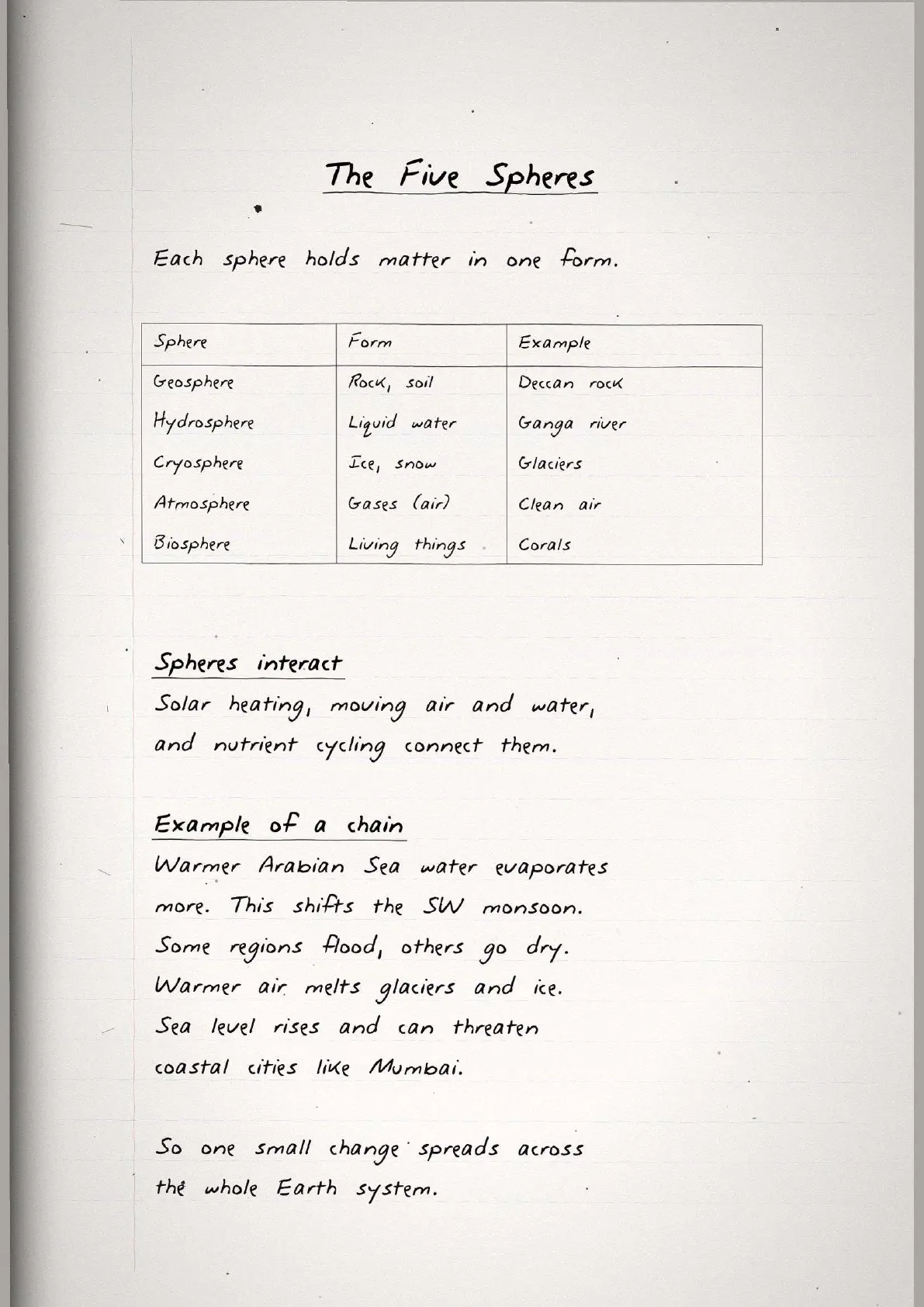
| Sphere | What it holds | Everyday example |
|---|---|---|
| Geosphere | Solid rocks, soil and landforms | The Deccan plateau, the Thar desert |
| Hydrosphere | All liquid water | The Ganga-Brahmaputra river system |
| Cryosphere | Water as ice and snow | Himalayan glaciers, polar ice caps |
| Atmosphere | The blanket of air we breathe | The winds and clouds above you |
| Biosphere | Every living thing and its habitat | Forests, farms, ocean plankton |
The notes flag one point in red: because the spheres are linked, a change in one changes the rest. Less snowfall in the cryosphere means less meltwater in a summer lake, so less grass grows for grazing animals. The Indian monsoon is a live example, warm ocean water feeds moist air, which rains on land and lets crops grow.
A second red note keeps two ideas apart, and it is asked often. Energy flows through the Earth system, mostly one way, and finally leaves as heat. Matter cycles, which means the same atoms are used again and again. The Sun brings fresh energy each day, but the stock of water, carbon and nitrogen is fixed and reused.
Uneven Heating, Insolation and Albedo: Hand-Drawn Table
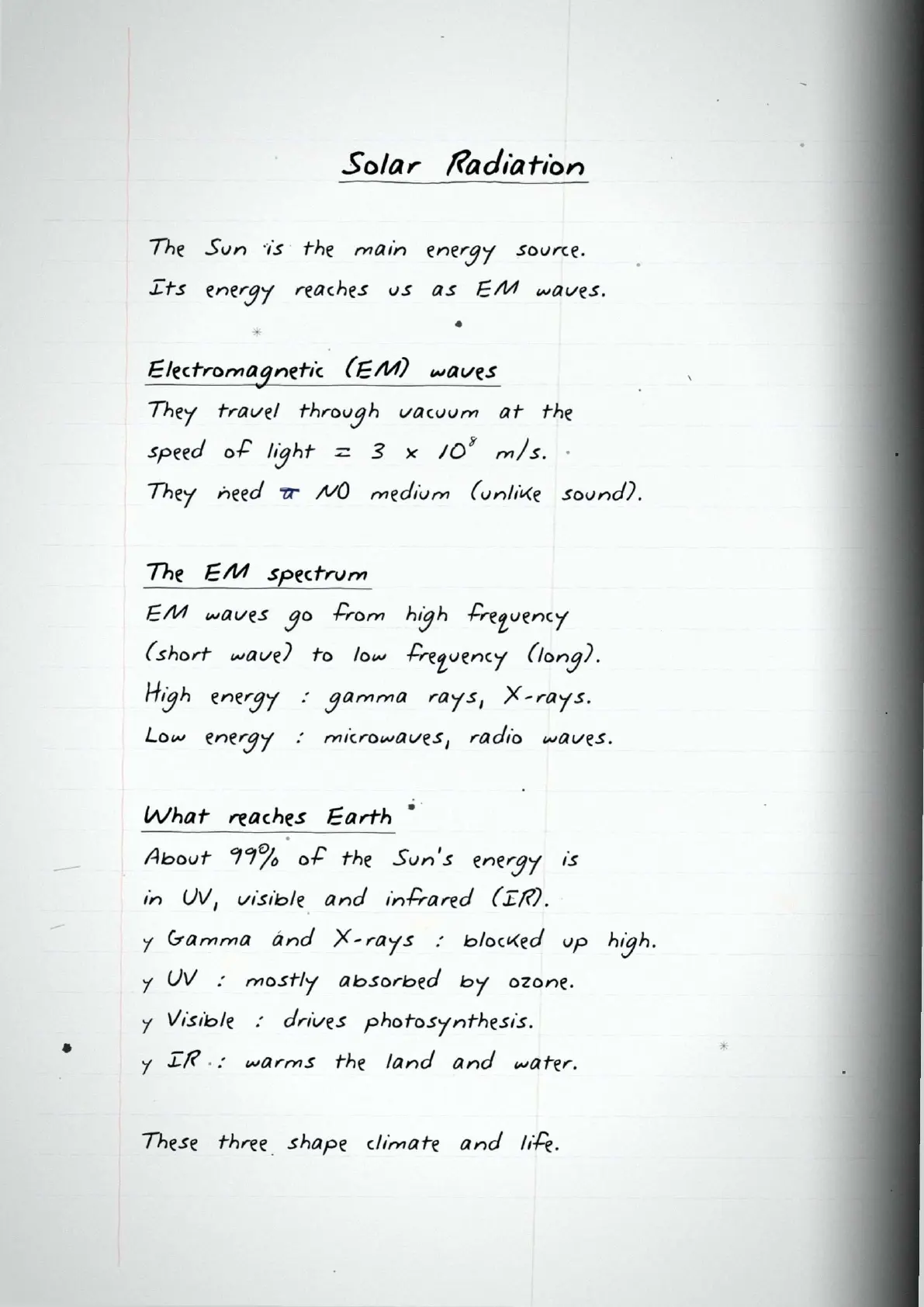
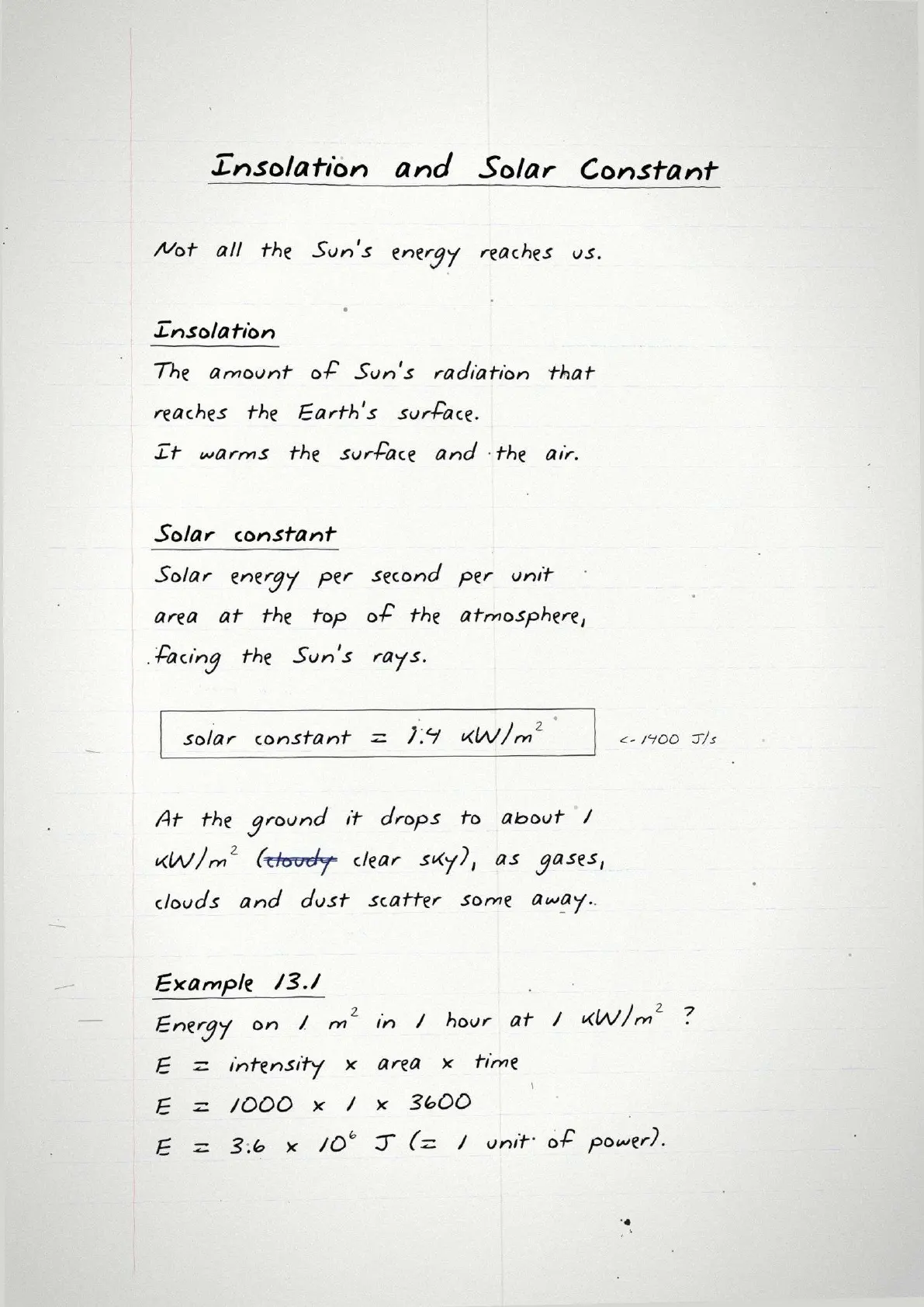
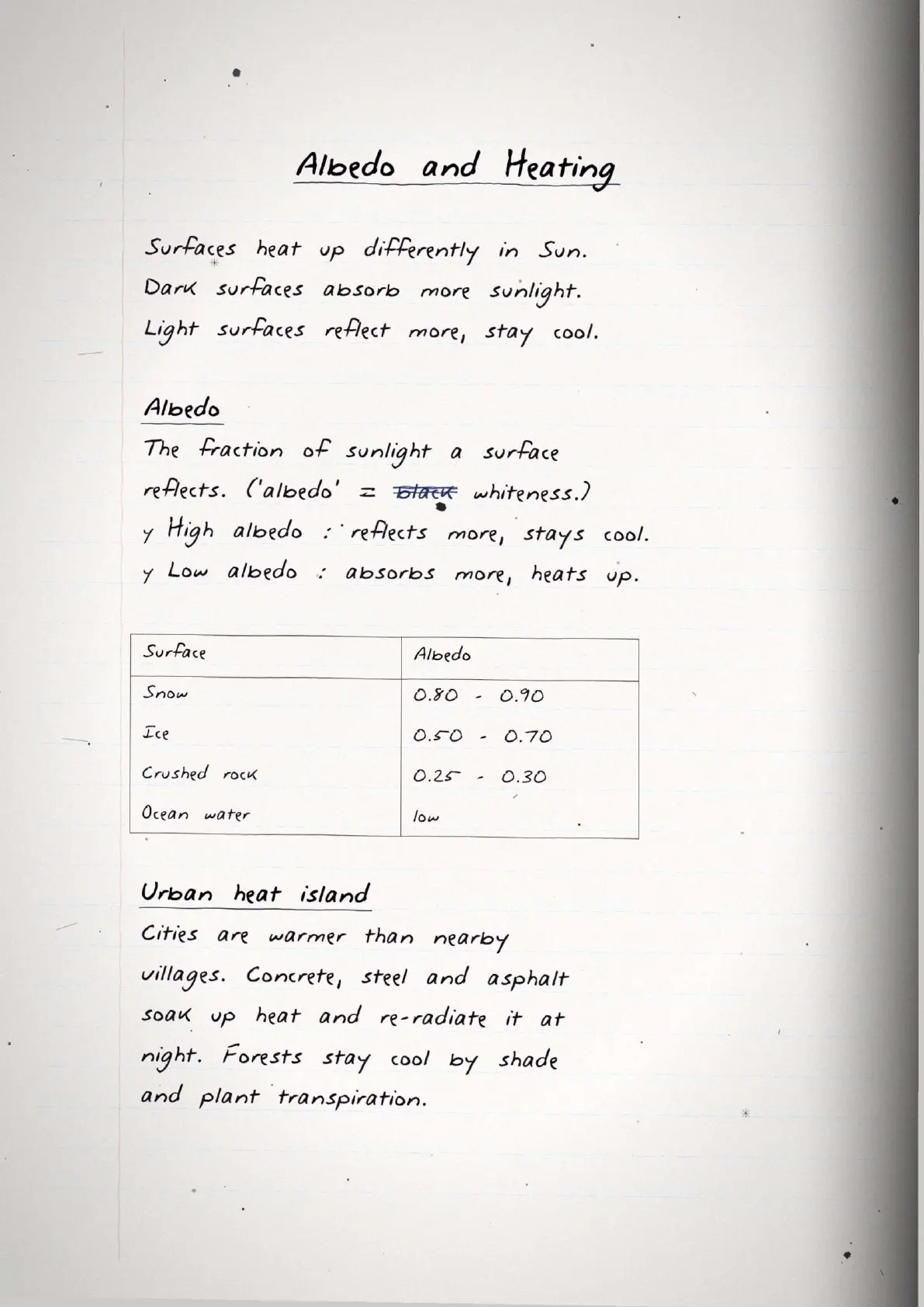
This is the engine behind winds, currents and the water cycle, so the notes give it a clear hand-drawn table. Solar radiation is the main source of energy on the Earth, but it does not heat the surface evenly. The amount of the Sun's radiation reaching the surface is called insolation.
| Cause of uneven heating | What happens | Result |
|---|---|---|
| Albedo (how much a surface reflects) | Snow reflects most sunlight; dark soil absorbs most | Poles stay cool, dark ground heats up |
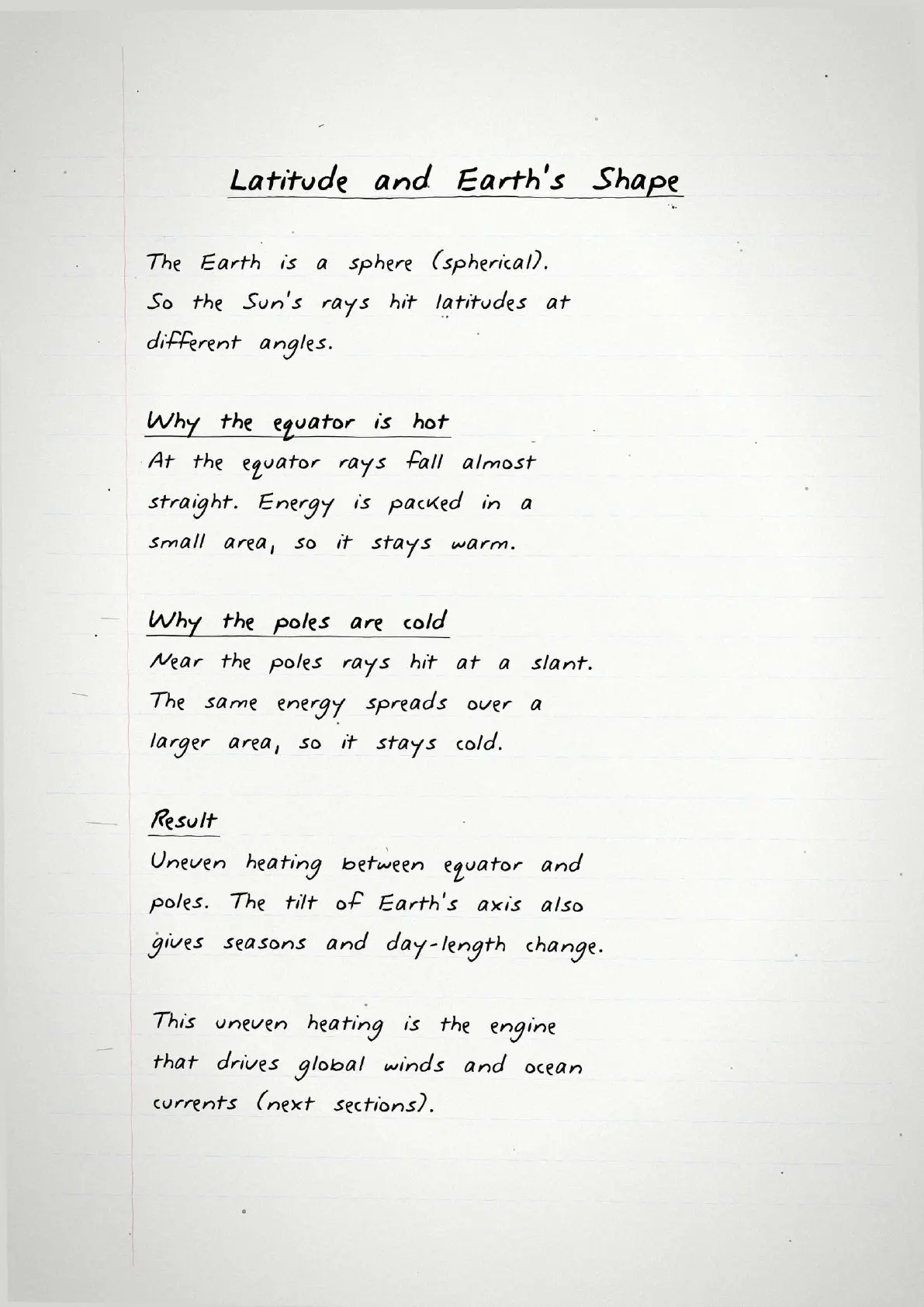
| Latitude and the Earth's shape | Rays hit the equator straight, the poles at a slant | Equator warm, poles cold |
| Axial tilt | The tilted axis changes the angle through the year | Gives us the seasons |
The notes flag one common trap in red: albedo is about reflection, not the heat of a surface. White snow has high albedo (0.80 to 0.90) and stays cool precisely because it reflects; dark soil has low albedo and grows warm because it absorbs. This same idea explains why a city is warmer than a nearby village, the urban heat island effect.
The Greenhouse Effect and Atmosphere in Your Own Handwriting
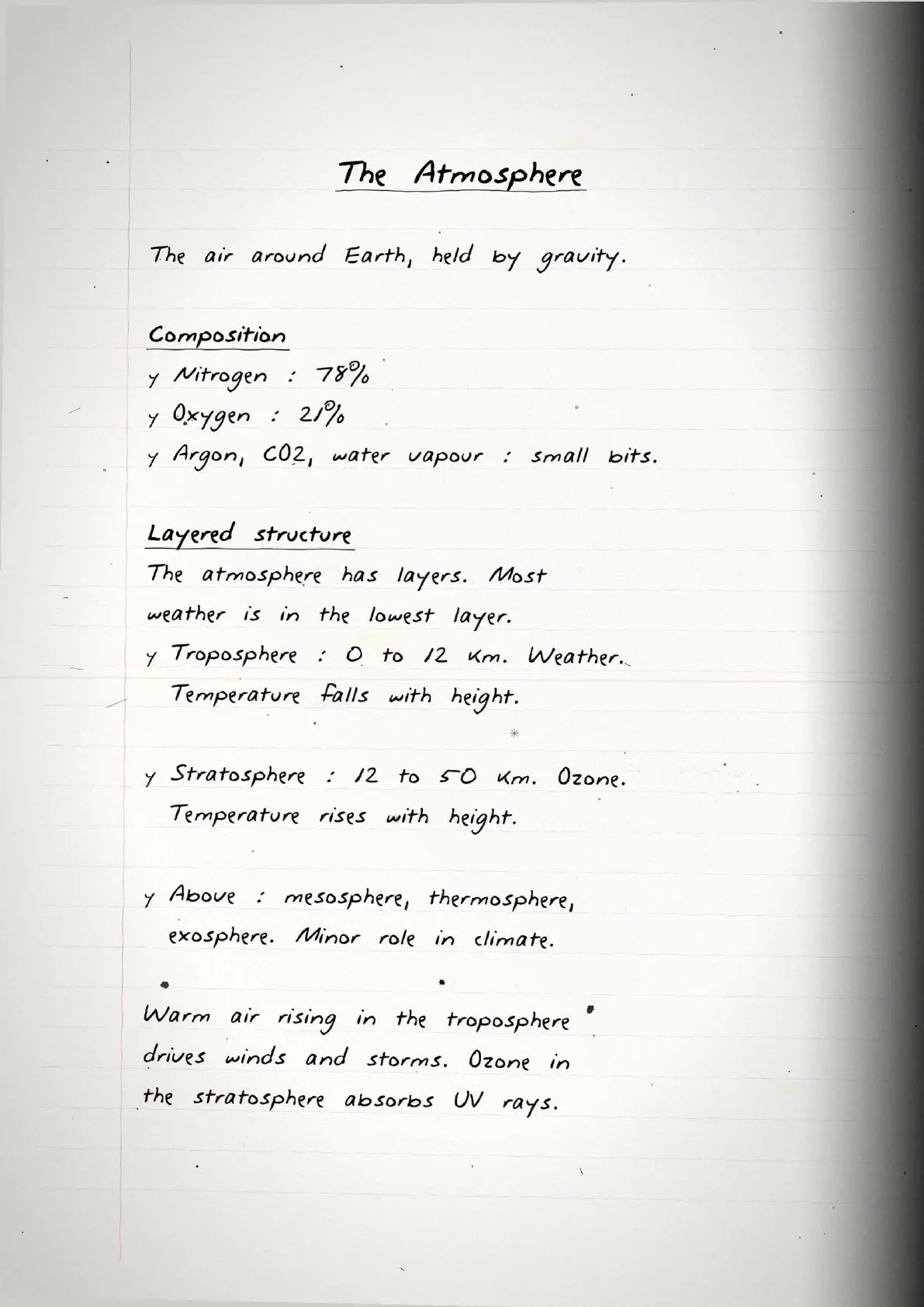
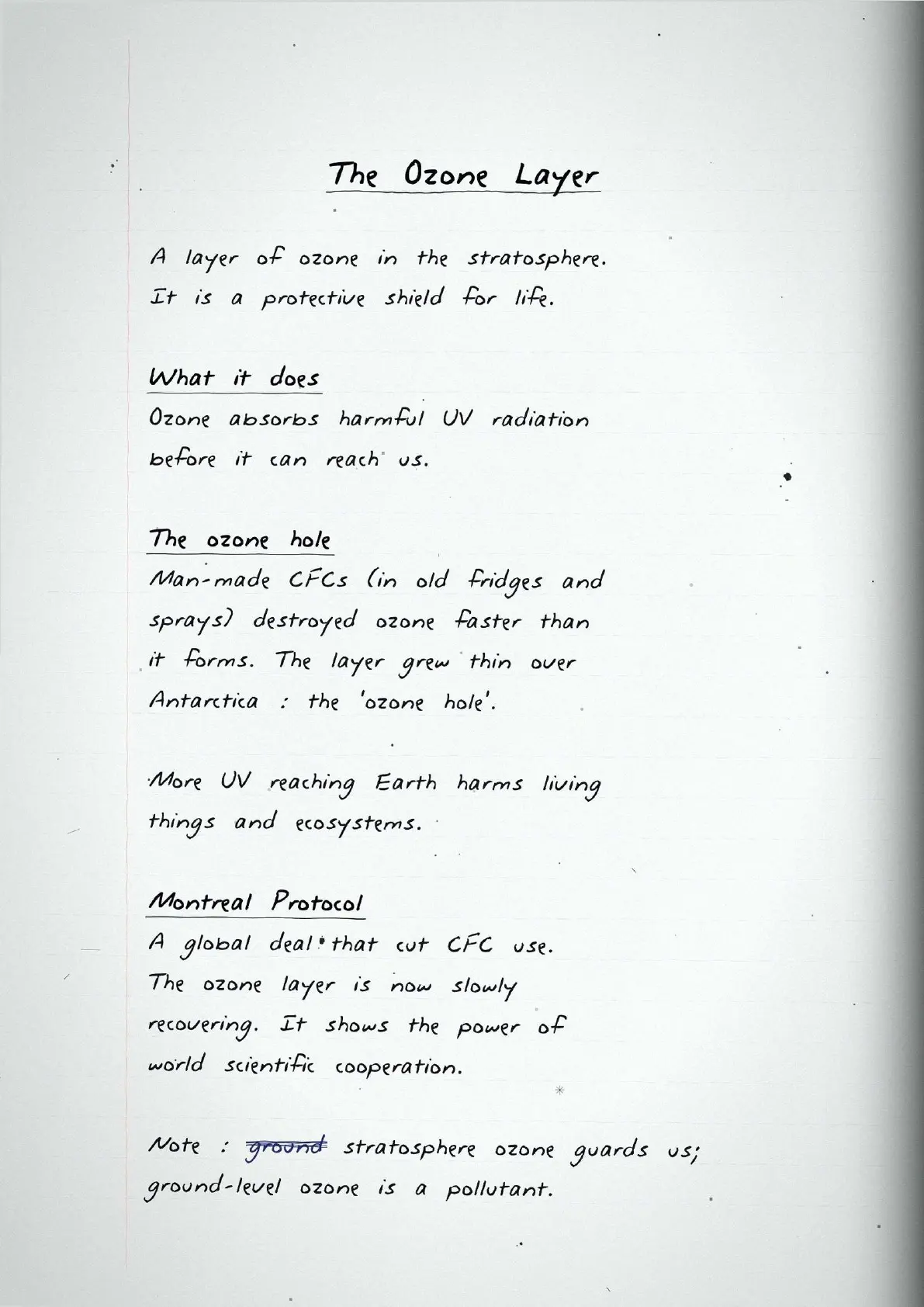
The air around the Earth is held by gravity and built in layers, so the notes sketch them as a tall strip. Weather happens almost entirely in the lowest layer, the troposphere, where temperature falls with height. Higher up, in the stratosphere, the ozone layer soaks up harmful UV rays.
| Layer | Rough height | Key feature |
|---|---|---|
| Troposphere | 0 to 12 km | Weather forms here; temperature falls with height |
| Stratosphere | 12 to 50 km | Holds the ozone layer that blocks UV rays |
| Mesosphere | 50 to 85 km | Small role in surface climate |
| Thermosphere | 85 to 500 km | Very thin air, minor climate role |
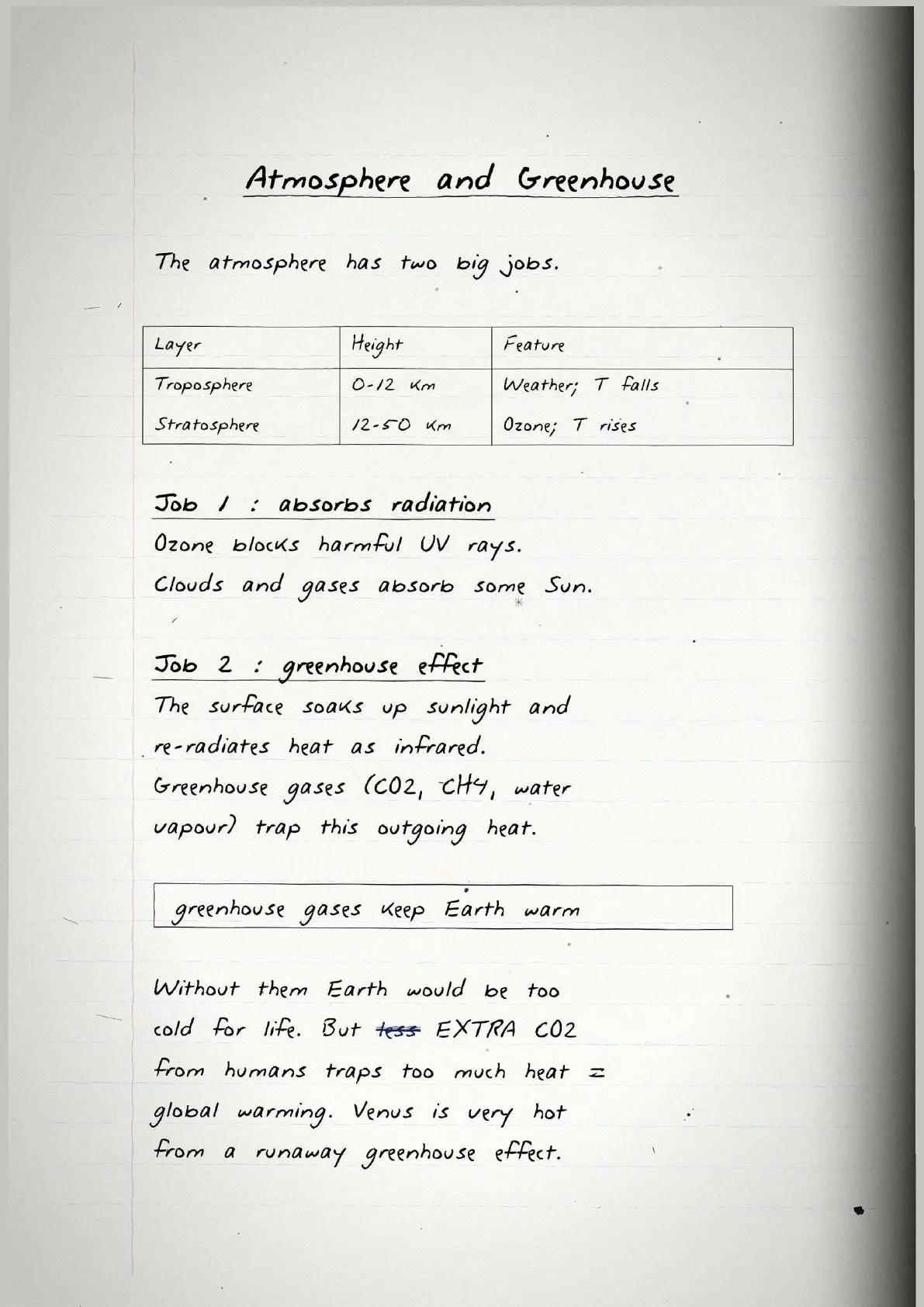
The greenhouse effect gets its own boxed diagram because it is asked almost every year. The surface absorbs sunlight and re-radiates it as infrared heat. Greenhouse gases such as carbon dioxide (CO2), methane (CH4) and water vapour absorb this heat and stop it escaping, keeping the Earth warm enough for life.
- Without this natural effect, the Earth would be far too cold for life.
- Venus is hotter than Mercury, though it is farther from the Sun, because its thick air has a runaway greenhouse effect.
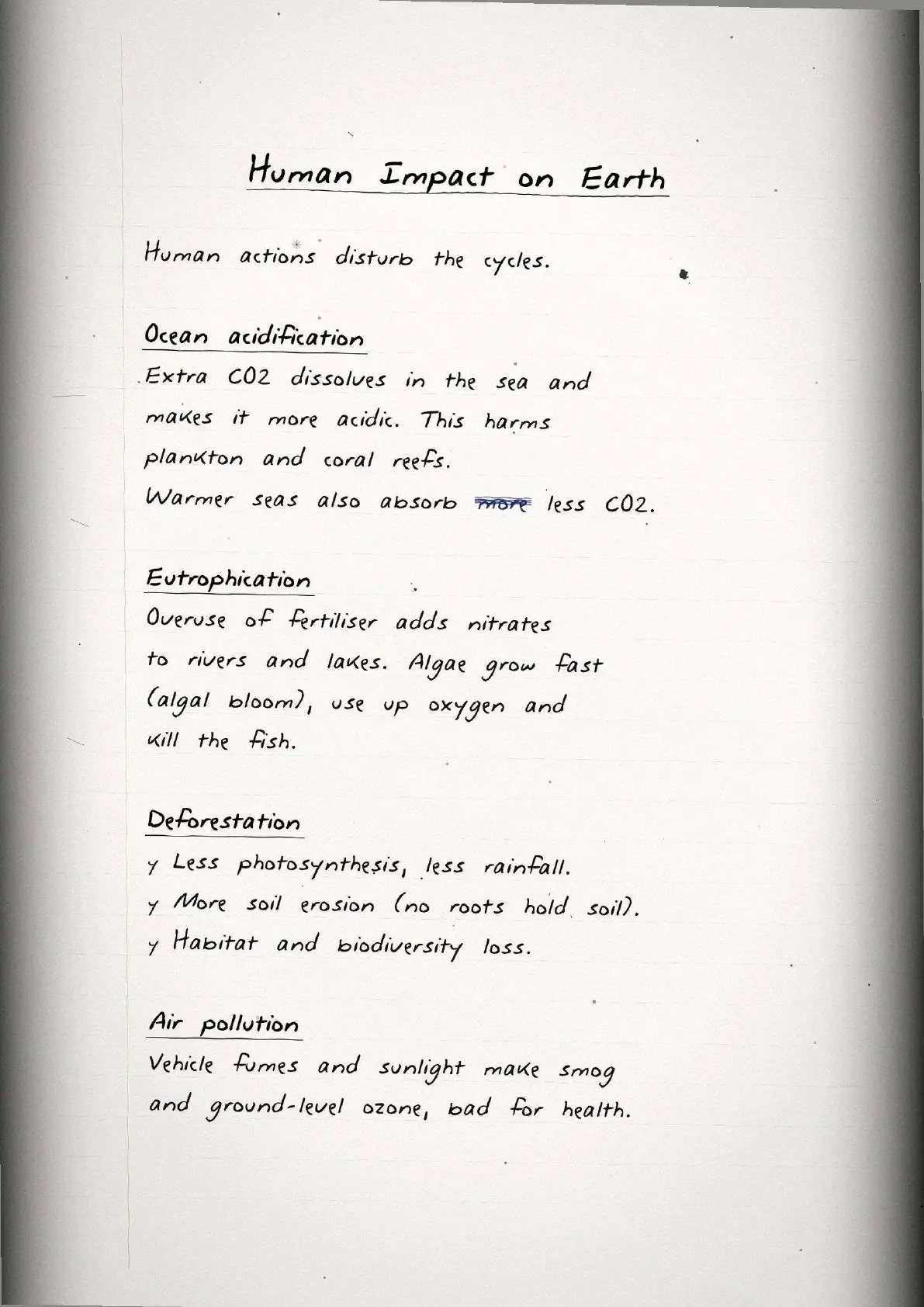
- Too much CO2 from human activity strengthens the effect and causes global warming.
Winds and Ocean Currents Drawn by Hand
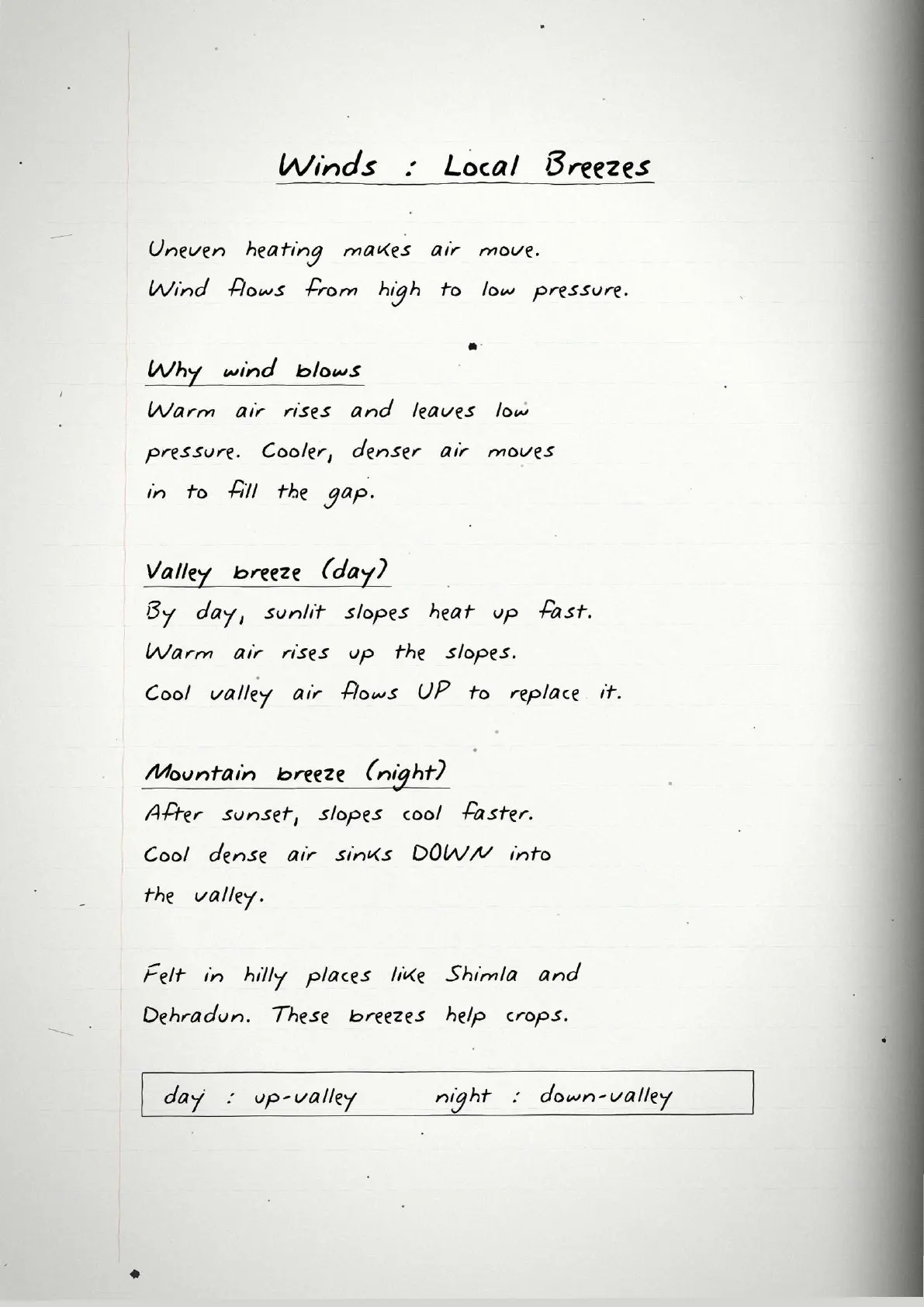
Uneven heating sets both the air and the oceans in motion, so the notes draw them together with arrows. Wind is simply the movement of air from high pressure to low pressure. The same idea, on small and large scales, explains local breezes, planetary winds and ocean currents.
- Local winds: by day, sunlit slopes heat faster, warm air rises, and cool valley air flows up as a valley breeze. By night the slopes cool faster and a mountain breeze slides down. These are common in Shimla and Dehradun.
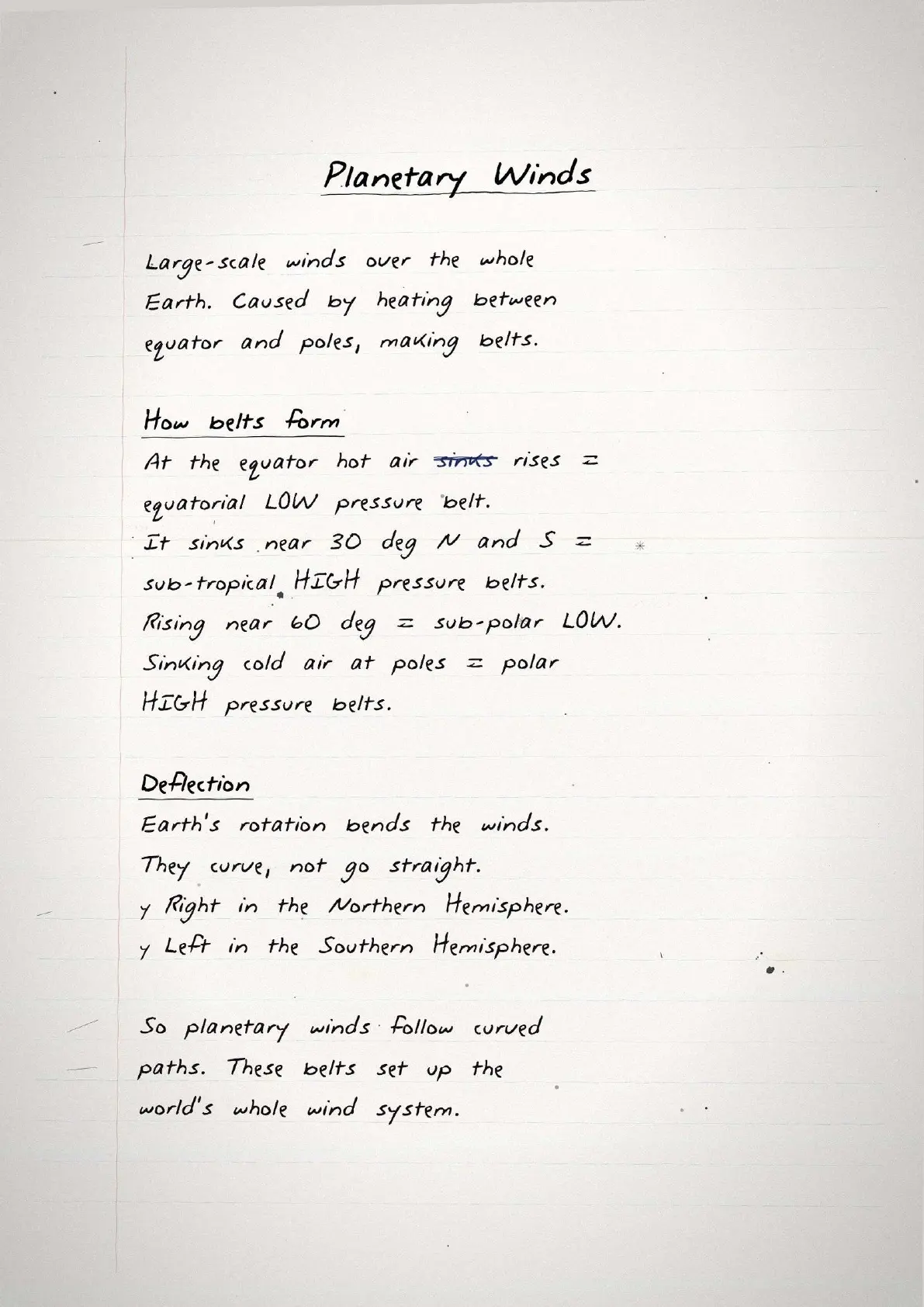
- Planetary winds: intense heating at the equator makes air rise, forming an equatorial low. This air sinks near 30° to make sub-tropical highs. Air flows between these belts, and the Earth's rotation bends it.
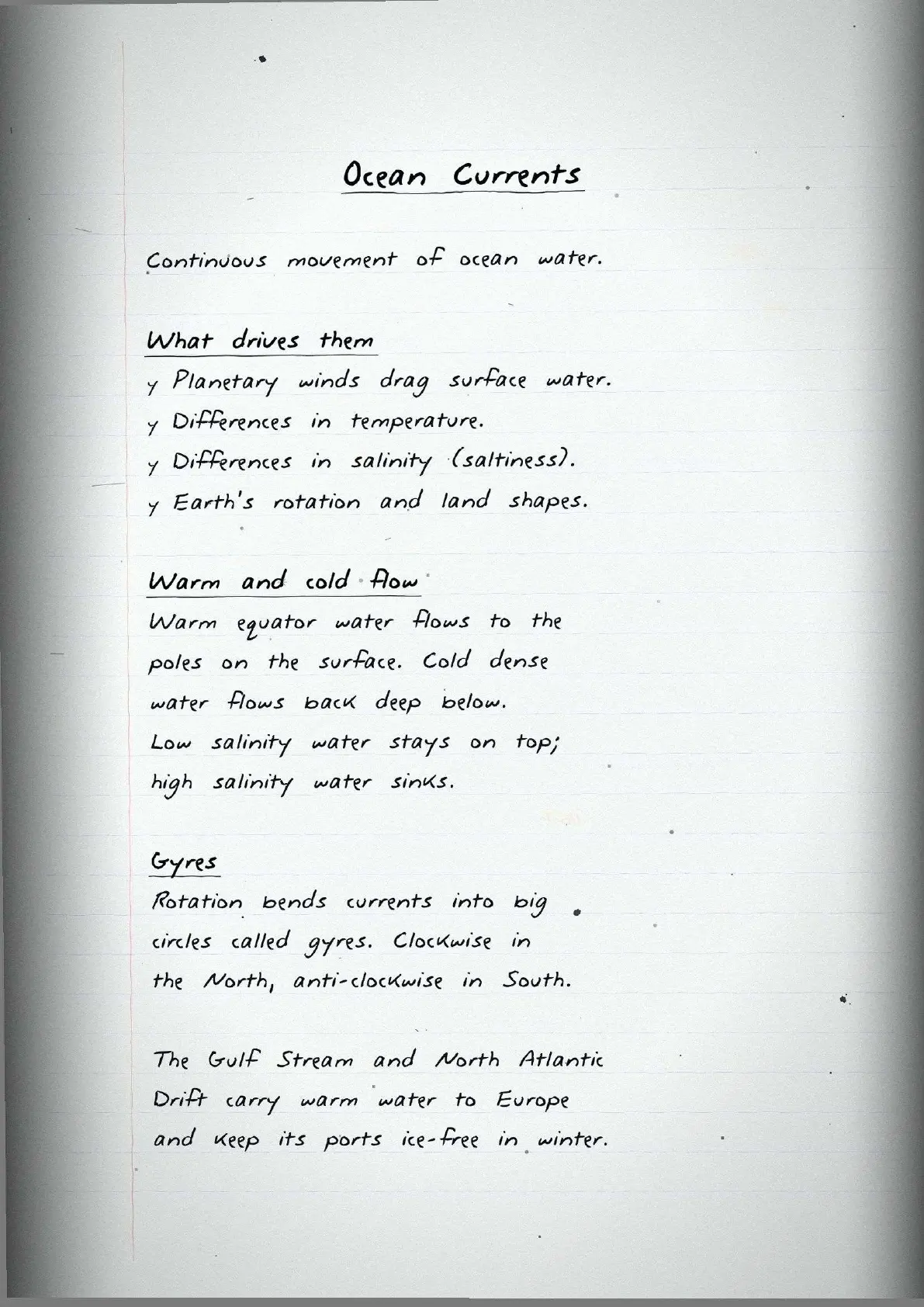
- Ocean currents: the same winds drag surface water. Differences in temperature and salinity add to this, and the Earth's rotation bends the flow into huge circular gyres.
The notes add one blue side-note that examiners like. Ocean currents move heat from the equator toward the poles, evening out the planet's temperatures. The North Atlantic Drift, part of the Gulf Stream, keeps many European ports ice-free in winter, and currents also carry nutrients that feed marine life.
The Four Biogeochemical Cycles Marked in the Margins
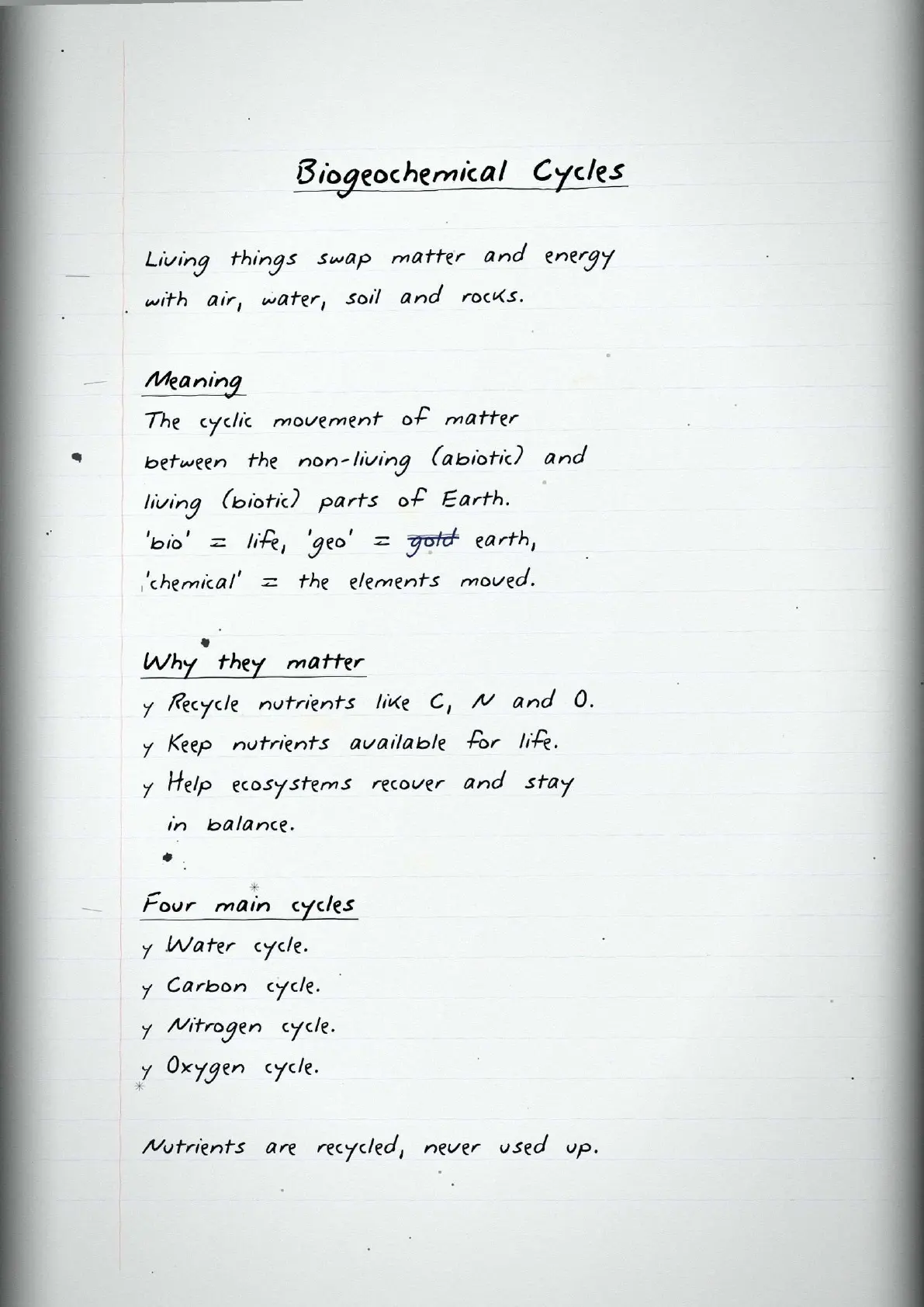
This is the heart of the chapter, so the notes give each cycle its own labelled sketch. A biogeochemical cycle is the cyclic movement of matter between the non-living and living parts of the Earth. It keeps nutrients such as carbon, nitrogen and oxygen available for life.
| Cycle | Main store | Key processes |
|---|---|---|
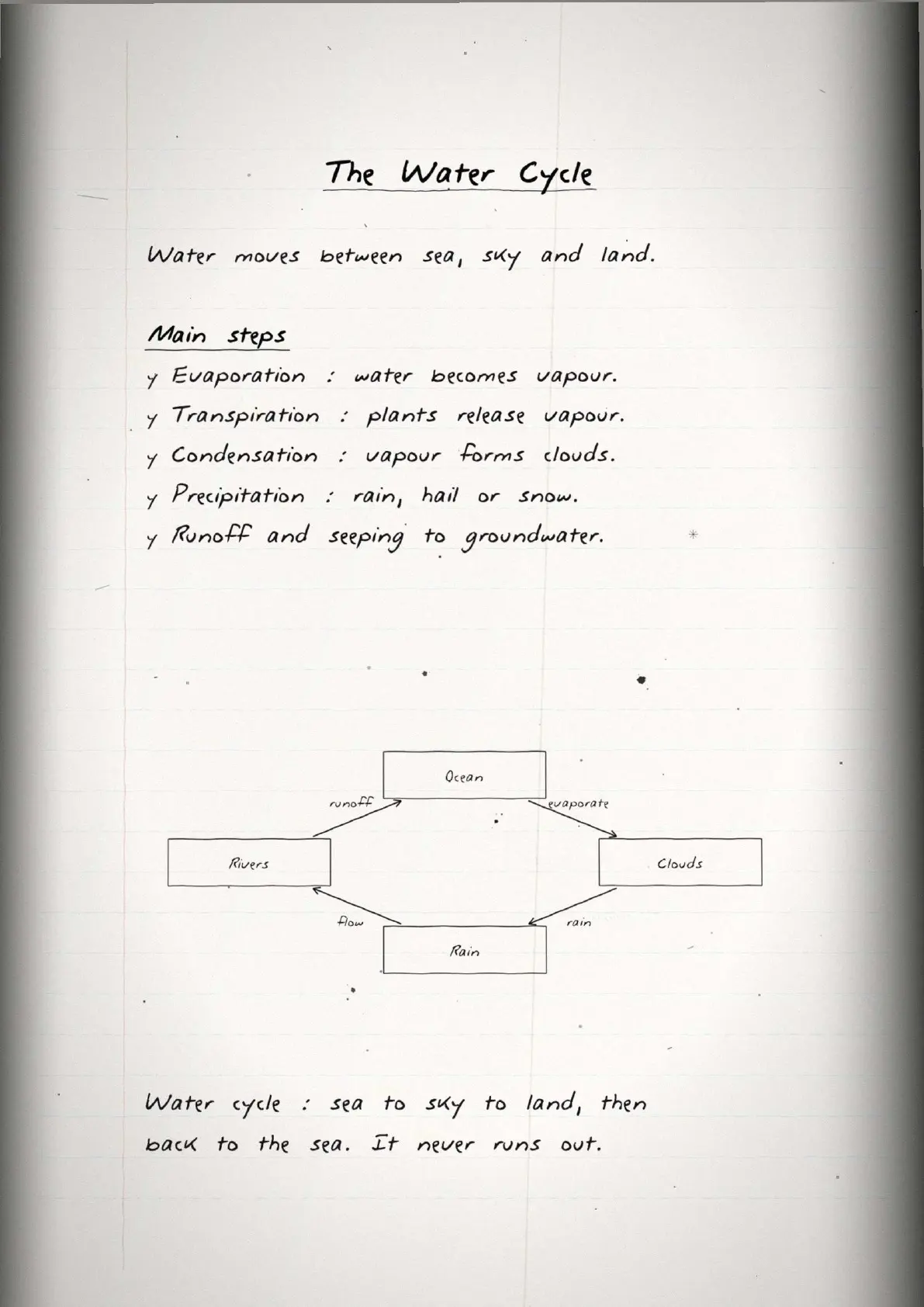
| Water | Oceans and ice | Evaporation, condensation, precipitation, run off |
| Carbon | Oceans, rocks, fossil fuels | Photosynthesis, respiration, combustion |
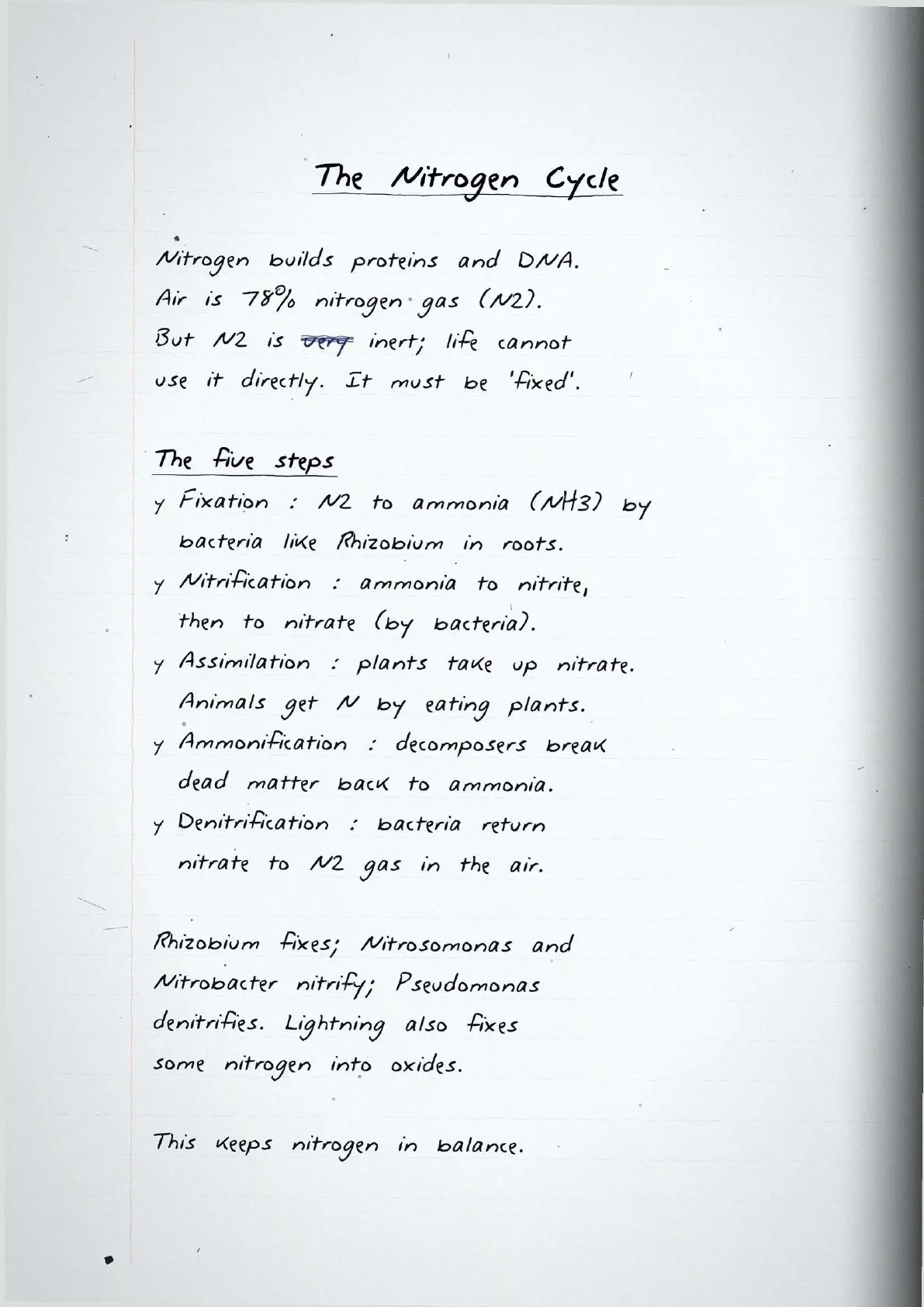
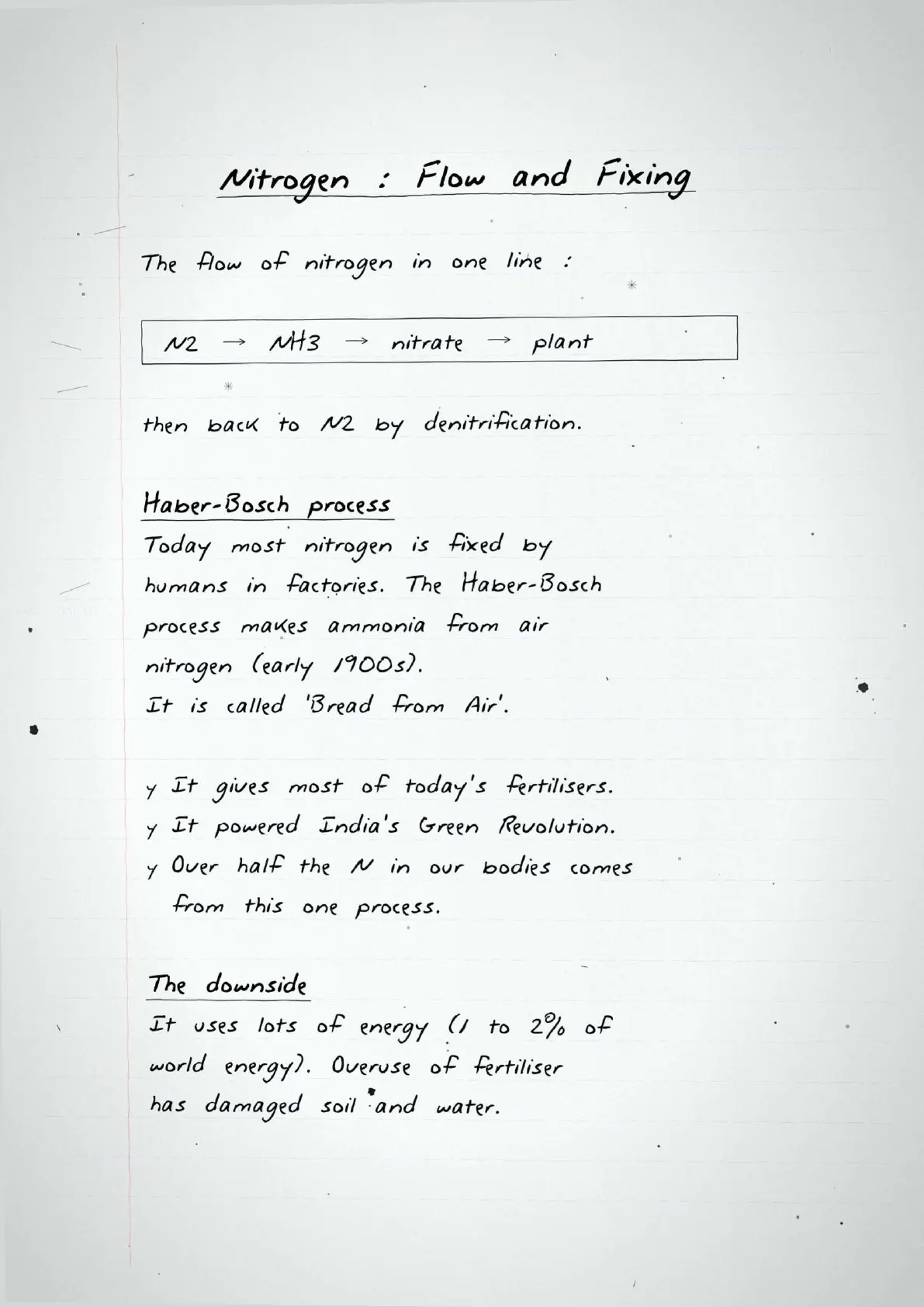
| Nitrogen | Atmosphere (N2, 78%) | Fixation, nitrification, denitrification |
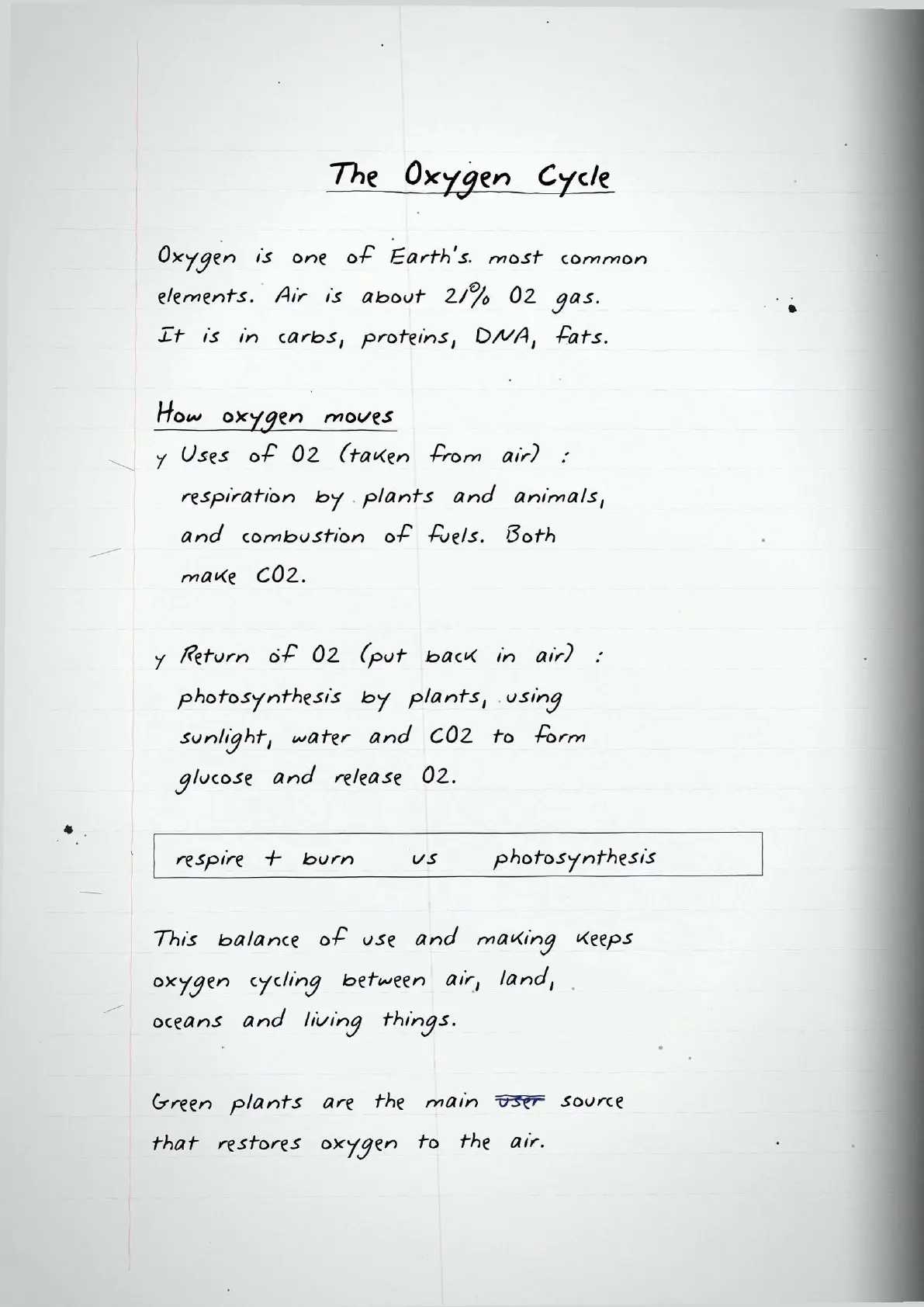
| Oxygen | Atmosphere (O2, 21%) | Photosynthesis versus respiration |
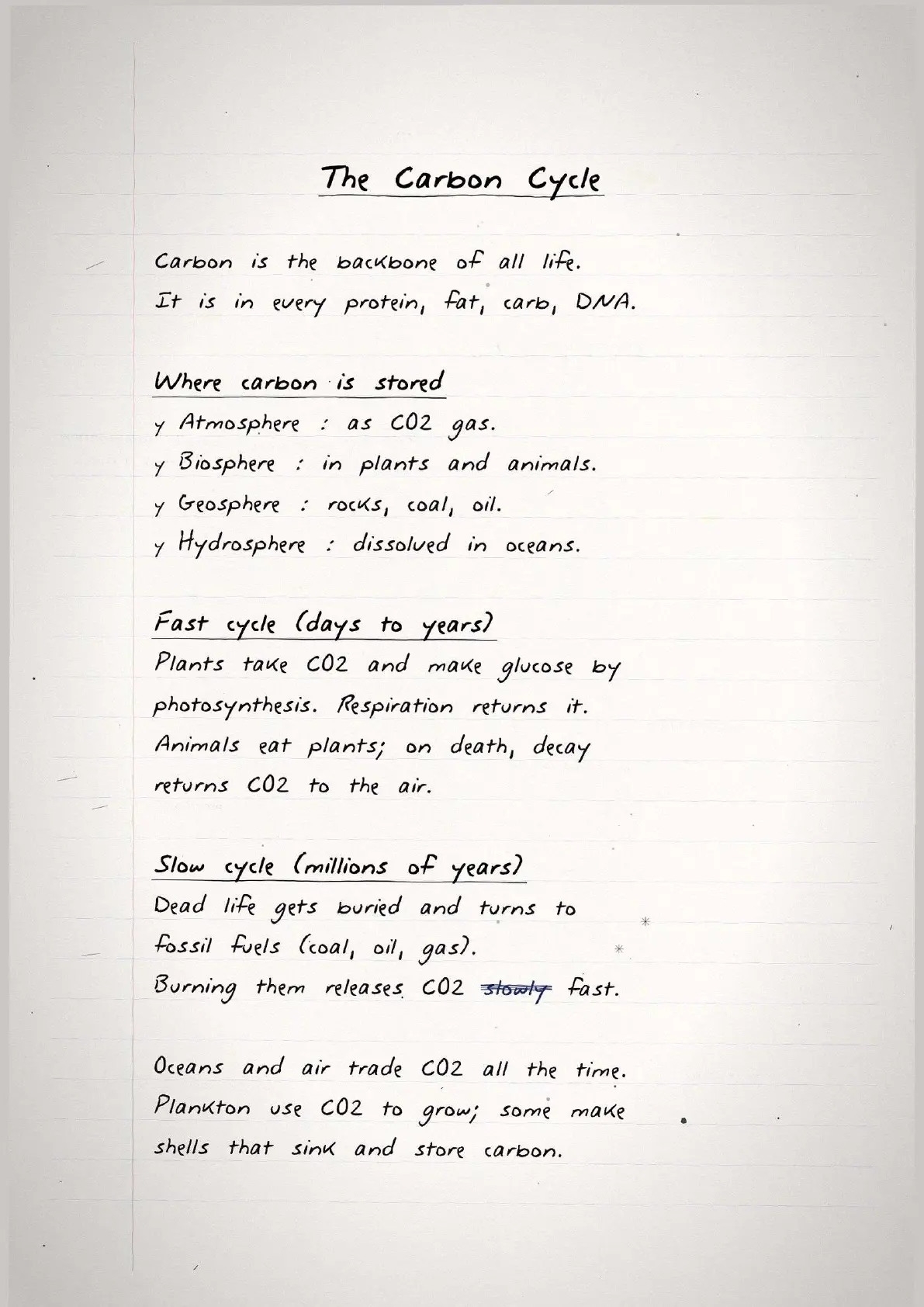
- Carbon has a fast and a slow cycle. The fast cycle is photosynthesis and respiration over days to years. The slow cycle buries carbon into fossil fuels over millions of years, which burning releases in seconds.
- The nitrogen cycle needs bacteria. N2 gas is unreactive, so Rhizobium and Azotobacter fix it into ammonia, then Nitrosomonas and Nitrobacter turn it into nitrates that plants absorb.
- Carbon and oxygen cycles are linked. Photosynthesis takes CO2 and gives O2; respiration does the reverse. The notes mark them as two sides of one coin.
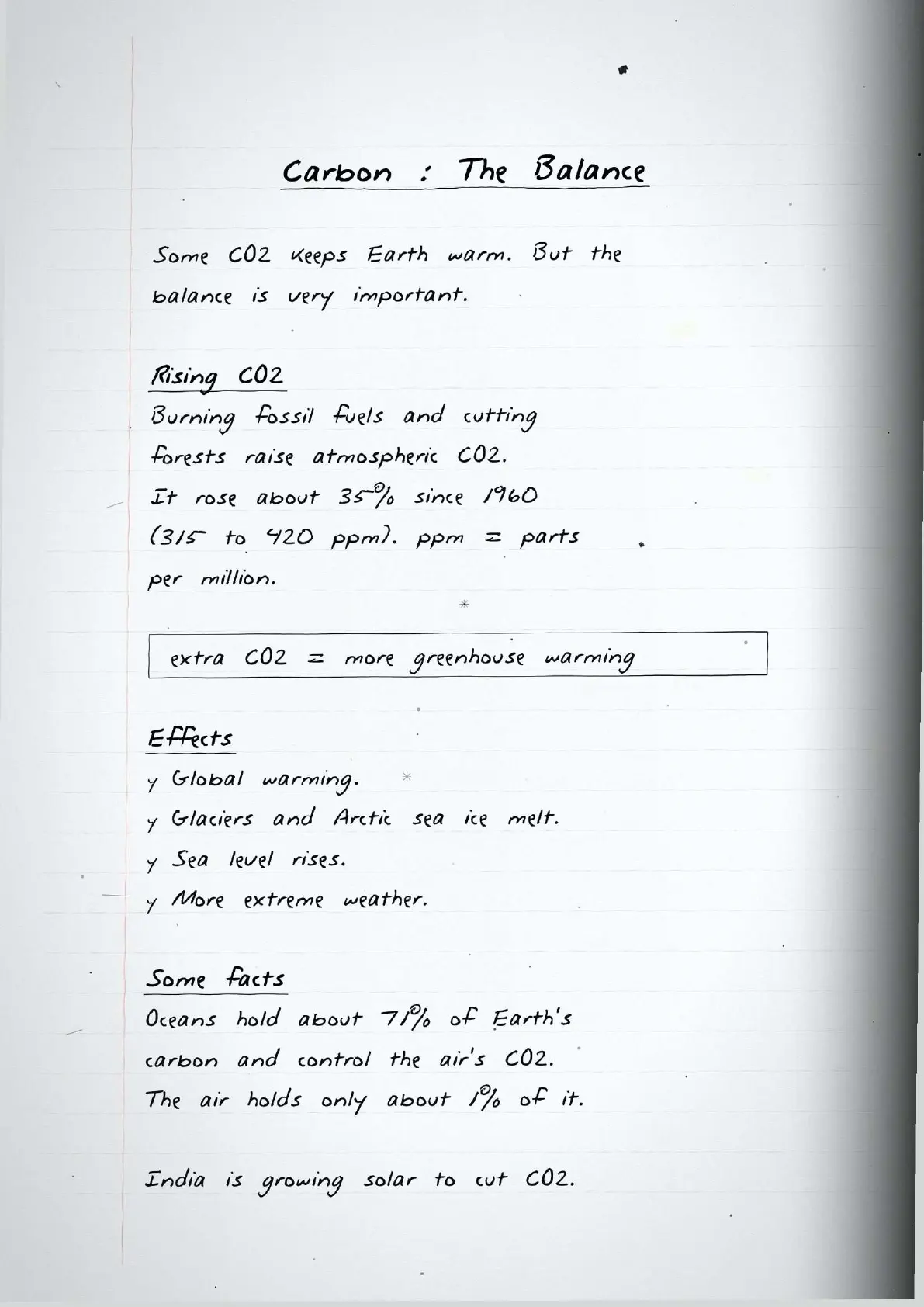
A red margin note keeps the balance clear: some CO2 is needed to keep the Earth warm, but human activity has raised atmospheric CO2 by about 35% since 1960 (from around 315 to 420 ppm), and that excess is the real problem.
Common Mistakes Flagged in Red
Most lost marks in this chapter come from small slips, not hard ideas. The handwritten notes circle these in red so you fix them while you revise.
- Saying plants take in nitrogen gas (N2) directly, when they actually use nitrates from the soil.
- Calling the greenhouse effect harmful, when only the excess from human activity is the problem.
- Confusing good stratospheric ozone with harmful ground-level ozone.
- Writing that albedo is the heat of a surface, when it is the fraction of light a surface reflects.
- Mixing up weather (day to day) with climate (the long-term average over many years).
Last-Minute Revision with These Handwritten Notes
The night before your exam, the Earth as a System Class 9 Science Handwritten Notes work as a quick skim. Every boxed value and red heading is a checkpoint, so you can cover the whole chapter in well under an hour.
- Name the five spheres using A-B-C-G-H and give one example of each.
- State insolation and write the solar constant ≈ 1.4 kW m-2 from its box.
- Explain the greenhouse effect and why Venus is hotter than Mercury.
- Draw the four cycles, water, carbon, nitrogen and oxygen, from memory.
- Read the red mistake note on energy versus matter before you close the notes.
How Collegedunia's Handwritten Notes Help You With the Earth System
Collegedunia brings you the Earth as a System Class 9 Science Handwritten Notes as a free, clear PDF you can open on any phone. It saves you the time of making your own notes and matches the new Exploration book.
- 2026-27 match: every page follows the new textbook and the Revise, Reflect, Refine flow.
- Clean handwriting: a topper's neat writing makes each cycle diagram and value easy to read.
- Exam-ready: boxes and colour cues let you revise fast before the annual exam, and later for CBSE, JEE and NEET basics.
- Free download: keep the PDF offline and revise any time.
More Earth as a System Class 9 Science Resources
Use the table below to open the other resources for this chapter of the new Class 9 Science Exploration book.
| Resource | Open |
|---|---|
| Handwritten Notes | Earth as a System Class 9 Science Handwritten Notes |
| NCERT Solutions | Earth as a System Class 9 Science NCERT Solutions |
| Revision Notes | Earth as a System Class 9 Science Notes |
| Formula Sheet | Earth as a System Class 9 Science Formula Sheet |
| NCERT Book PDF | Earth as a System Class 9 Science NCERT Book PDF |
NCERT Handwritten Notes for Class 9 Science: All Chapters
Use the table below to open the handwritten notes for any other chapter of the new Class 9 Science Exploration book.
| Chapter | Handwritten Notes |
|---|---|
| Chapter 2 | Cell The Building Block of Life |
| Chapter 3 | Tissues in Action |
| Chapter 4 | Describing Motion Around Us |
| Chapter 5 | Exploring Mixtures and their Separation |
| Chapter 6 | How Forces Affect Motion |
| Chapter 7 | Work, Energy, and Simple Machines |
| Chapter 8 | Journey Inside the Atom |
| Chapter 9 | Atomic Foundations of Matter |
| Chapter 10 | Sound Waves Characteristics and Applications |
| Chapter 11 | Reproduction How Life Continues |
| Chapter 12 | Patterns in Life Diversity and Classification |
| Chapter 13 | Earth as a System Energy, Matter, and Life |
Earth as a System Class 9 Science Handwritten Notes FAQs
Ques. How many pages are the Earth as a System Class 9 Science handwritten notes?
Ans. The handwritten notes run to 22 pages. They cover the full chapter, from the five spheres and uneven heating to the greenhouse effect, winds, ocean currents, and the four biogeochemical cycles, with a labelled diagram after each idea.
Ques. Are these real handwritten notes?
Ans. Yes. They are a topper's own clear handwritten revision notes, with each cycle drawn by hand, key values boxed, and sub-headings colour-coded in red.
Ques. What are the five spheres of the Earth in the Chapter 13 notes?
Ans. The five spheres are the Geosphere (rock and soil), Hydrosphere (liquid water), Cryosphere (ice and snow), Atmosphere (air) and Biosphere (living things). The notes remember them as A-B-C-G-H.
Ques. Can I use these handwritten notes for last-minute revision?
Ans. Yes. The boxed values, red headings and hand-drawn cycle diagrams let you skim the whole chapter in under an hour, so they suit the night before your annual exam.
Ques. Is Earth as a System part of the new Class 9 Science book?
Ans. Yes. Earth as a System: Energy, Matter, and Life is Chapter 13 of the new Exploration textbook for the 2026-27 syllabus. It ties together many earlier chapters on energy, matter and life.



Comments