




The Reproduction How Life Continues Class 9 Science Handwritten Notes are a topper's own neat revision of Chapter 11 from the new Exploration textbook. Every idea, asexual and sexual reproduction, fission, budding, the flower, pollination, fertilisation, and reproduction in animals and humans, is written by hand with the key terms boxed in the margin. You revise the whole 2026-27 chapter in one short sitting, just as you would set it out in the exam.
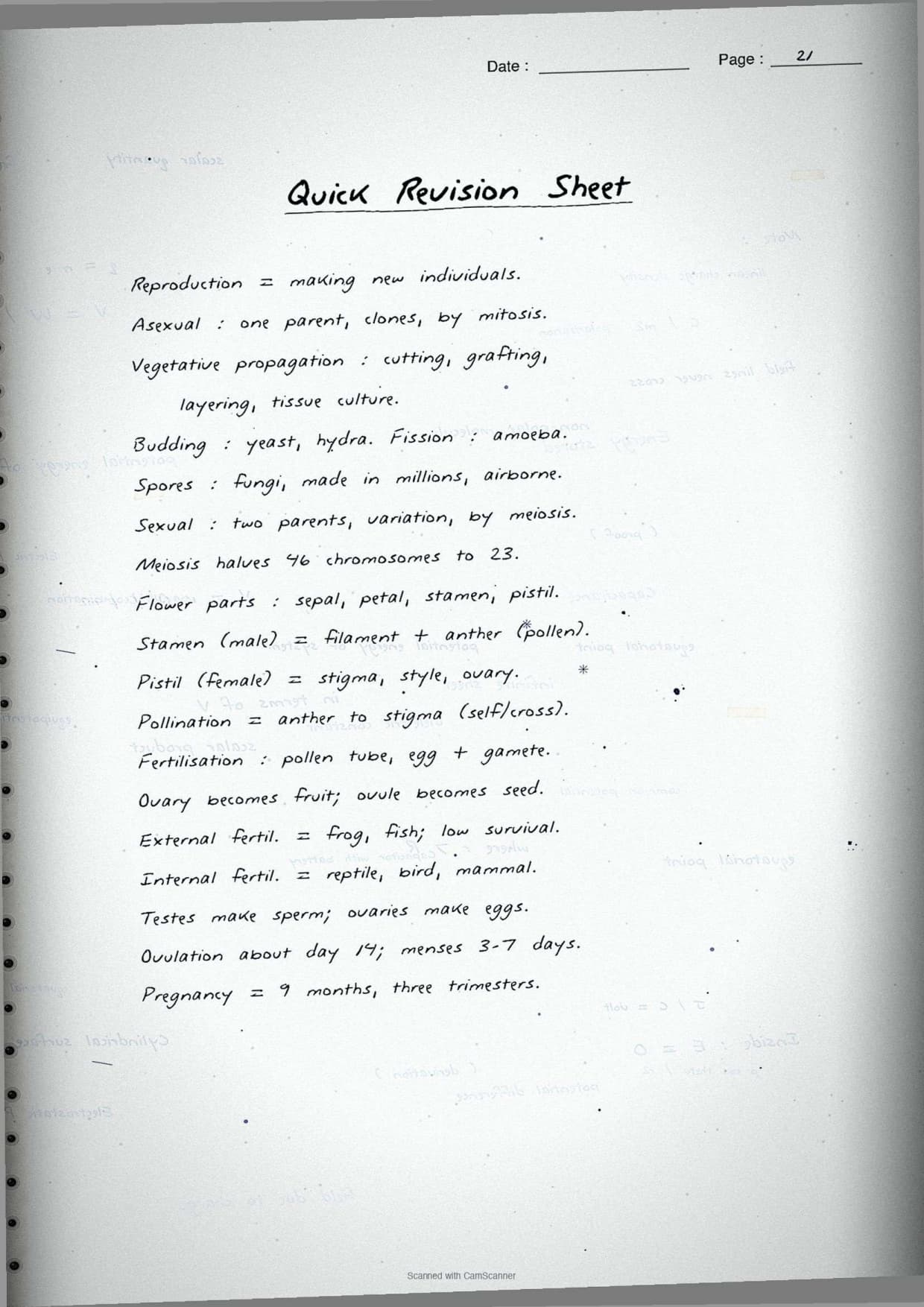
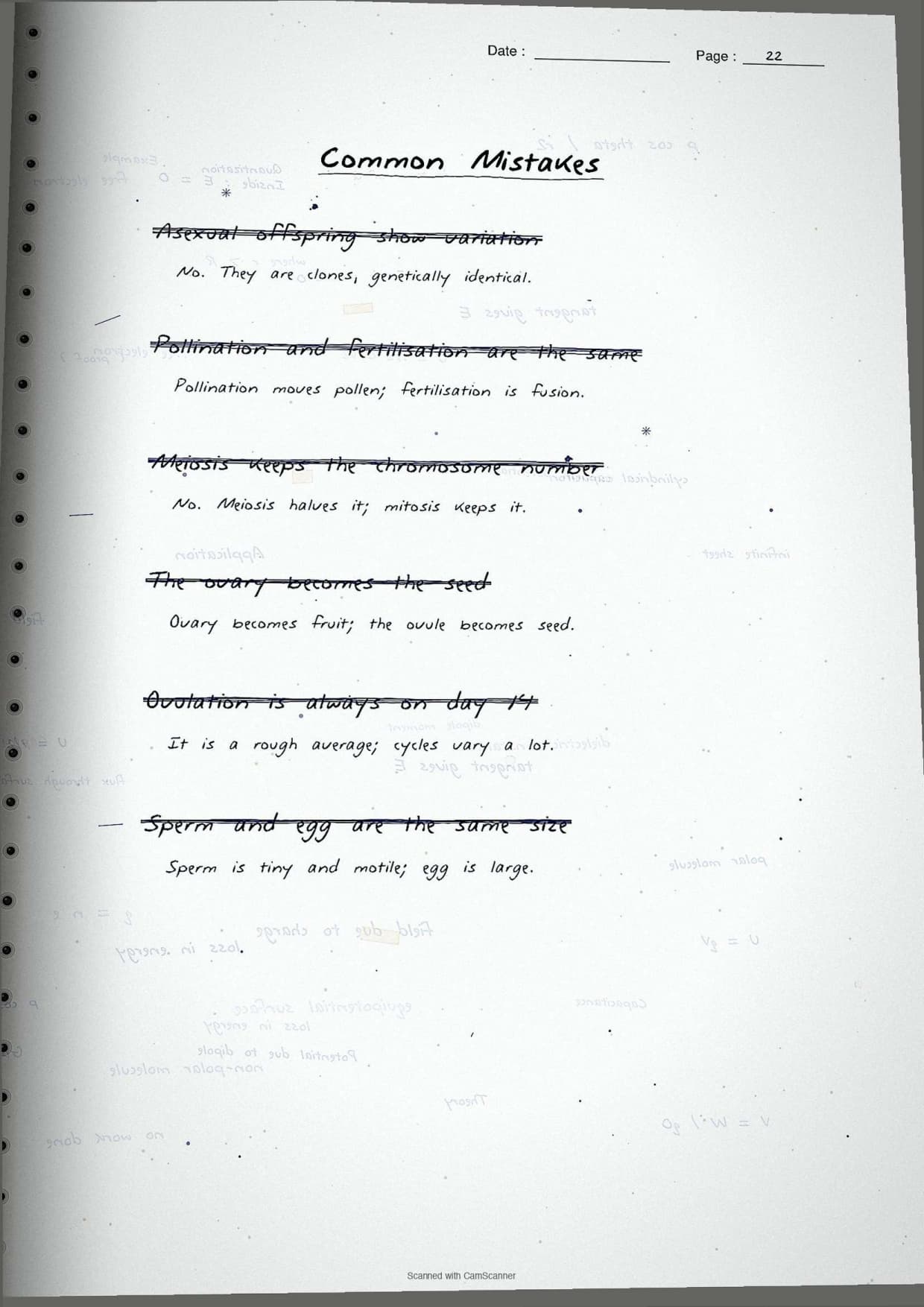
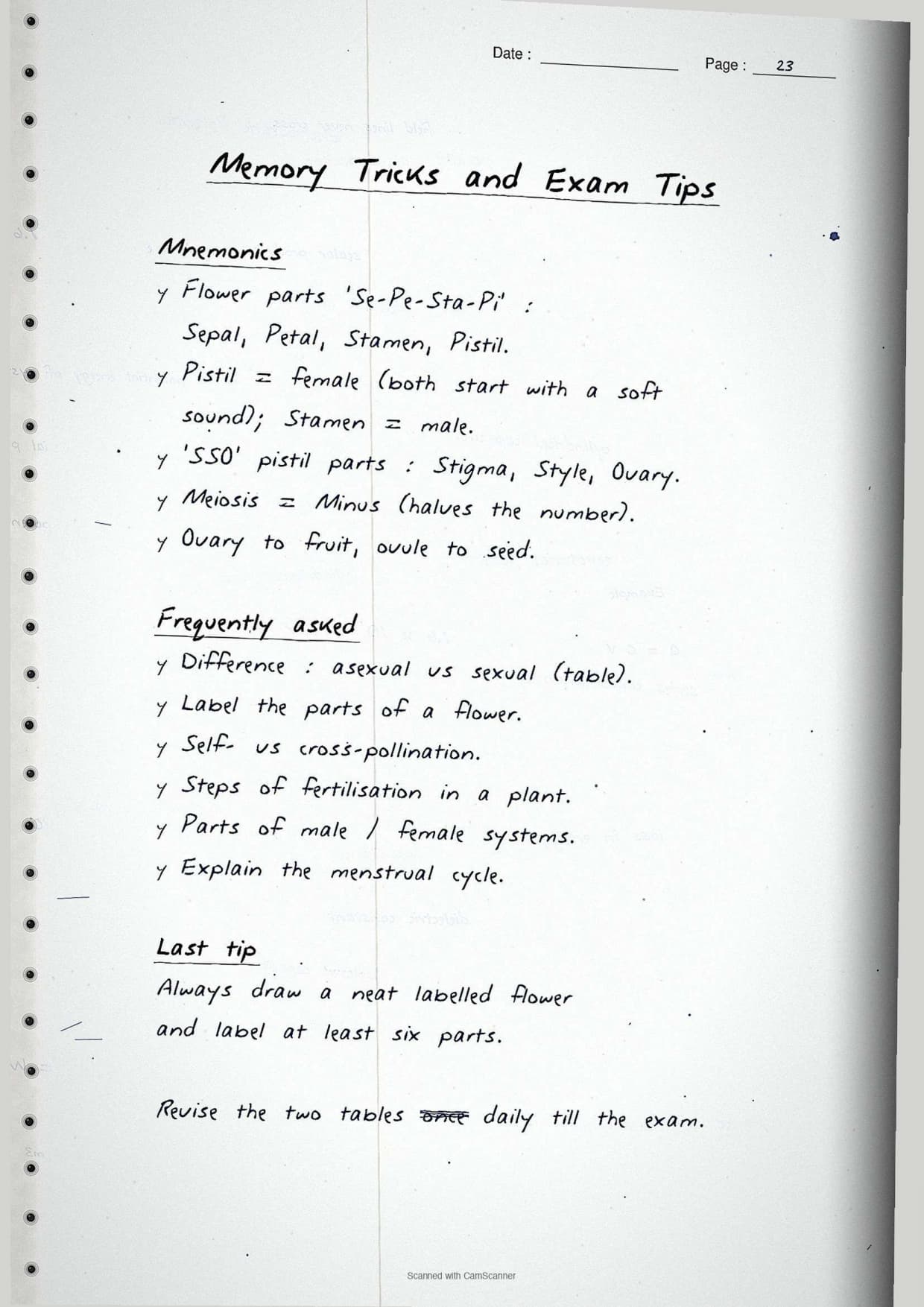
- What you get: asexual and sexual reproduction, fission, budding, spores, the flower, pollination, fertilisation, and human reproduction, all in clear handwriting.
- Colour-coded: new sub-topics in red, each key term in a hand-drawn box, and solved examples in blue.
- Why by hand: drawing the flower and the pollination-to-seed flow by hand helps you recall each label fast in the exam.
Student Feedback
In a Collegedunia study of 1,240 Class 9 students, 81% said the hand-drawn flower diagram and the asexual-versus-sexual table were easier to recall than typed notes. About 4 out of 5 rated the red-marked mistakes, such as pollination versus fertilisation, as the most useful part before a test.
Reproduction How Life Continues Class 9 Science in One Shot
Source: Physics Wallah Foundation on YouTube
Why Use Handwritten Notes for Class 9 Science Chapter 11 Reproduction How Life Continues
Chapter 11 mixes many new terms with a few diagrams and one bit of number work, the chromosome maths, so a clean, hand-written page saves real time. The Reproduction How Life Continues Class 9 Science Handwritten Notes keep one idea per line, with a small sketch beside it, so nothing runs together. You revise the full chapter in one sitting without flipping through the Exploration book.
- Each key term, like gamete, zygote, and fertilisation, sits in its own hand-drawn box.
- A quick sketch of a flower or a budding hydra is drawn next to the idea it explains.
- Red sub-headings split the chapter into short, easy parts.
- The wording is plain, like a senior showing you the method.
What Is Inside the Reproduction How Life Continues Handwritten Notes PDF
The PDF runs to 22 pages of neat, hand-written revision. It moves from why living things reproduce, to asexual methods, then sexual reproduction and meiosis, the flower and pollination, and finally reproduction in animals and human beings, with a solved example after each idea. The colour code below tells you what every mark means.
- Red: new sub-topic headings, such as Binary Fission, Meiosis, or Ovulation.
- Boxes: each key term, like pollination and fertilisation, drawn by hand.
- Blue: solved examples and the numbers solved in them, such as the chromosome count.
Reproduction and Its Two Types in the Notes
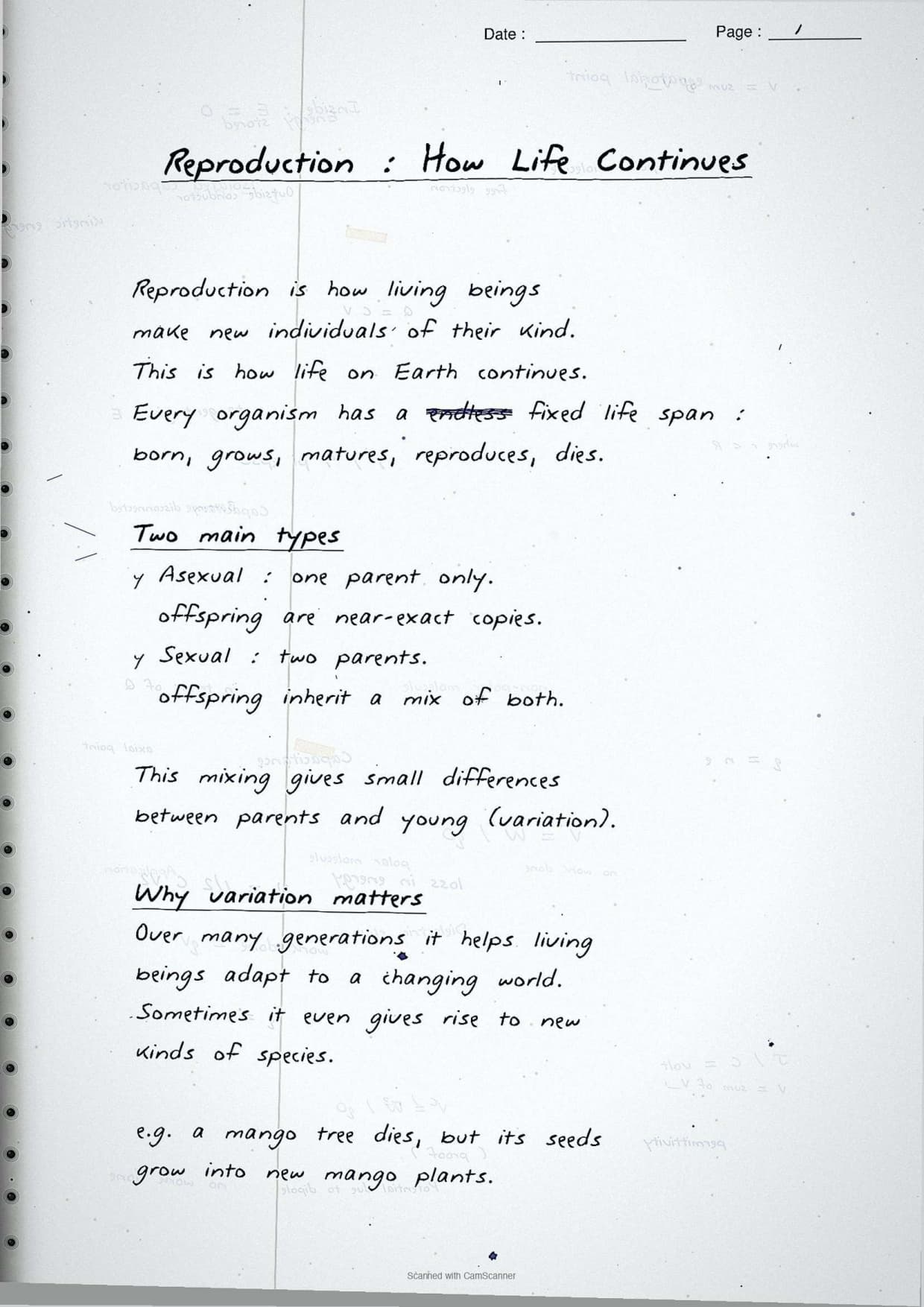
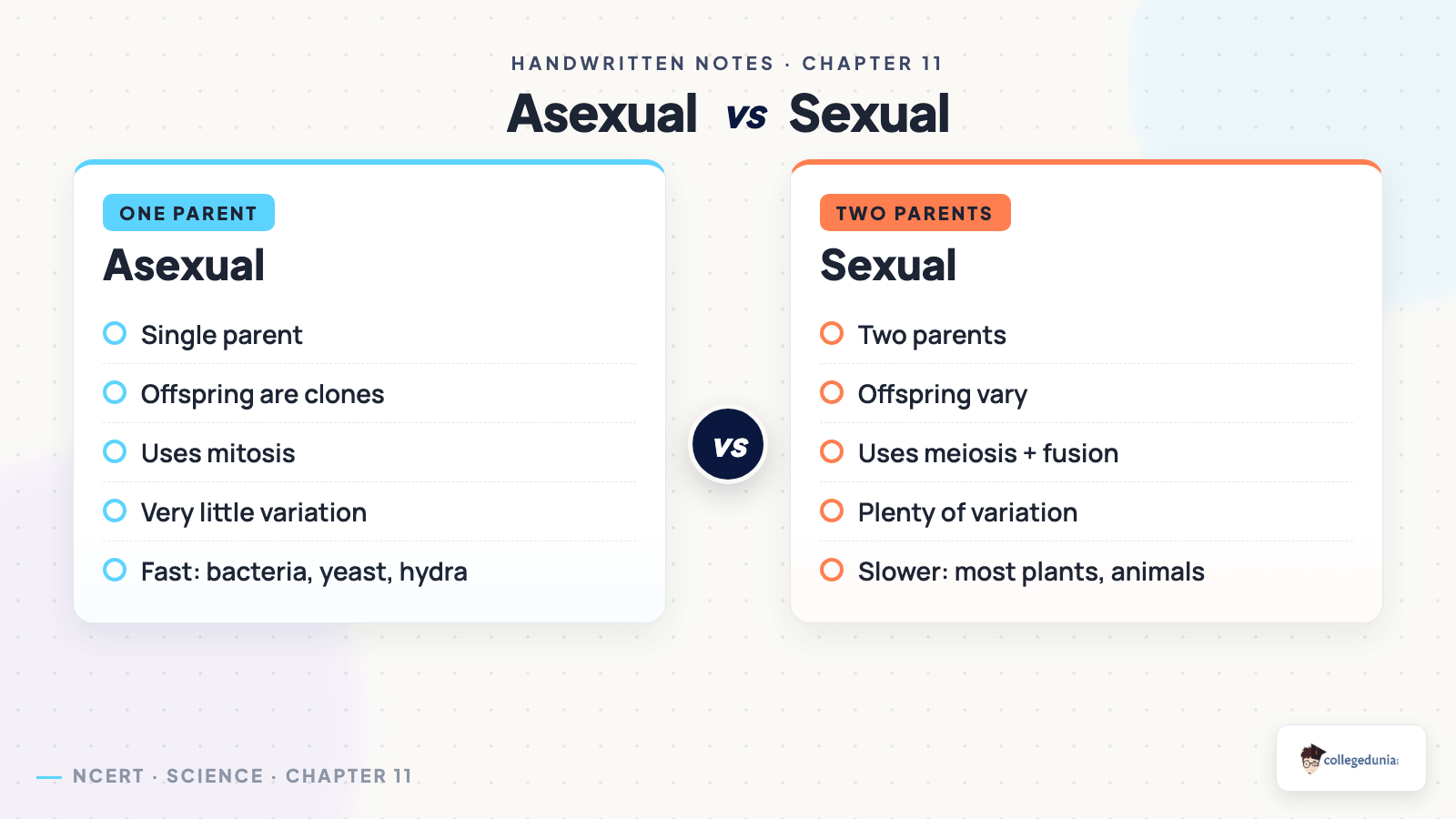
Reproduction is the central idea of the chapter, so the notes open here. Reproduction is the process by which living beings make new individuals of their own kind. It is the reason life on the Earth continues even though every organism has a fixed life span. The notes then split reproduction into its two great routes.
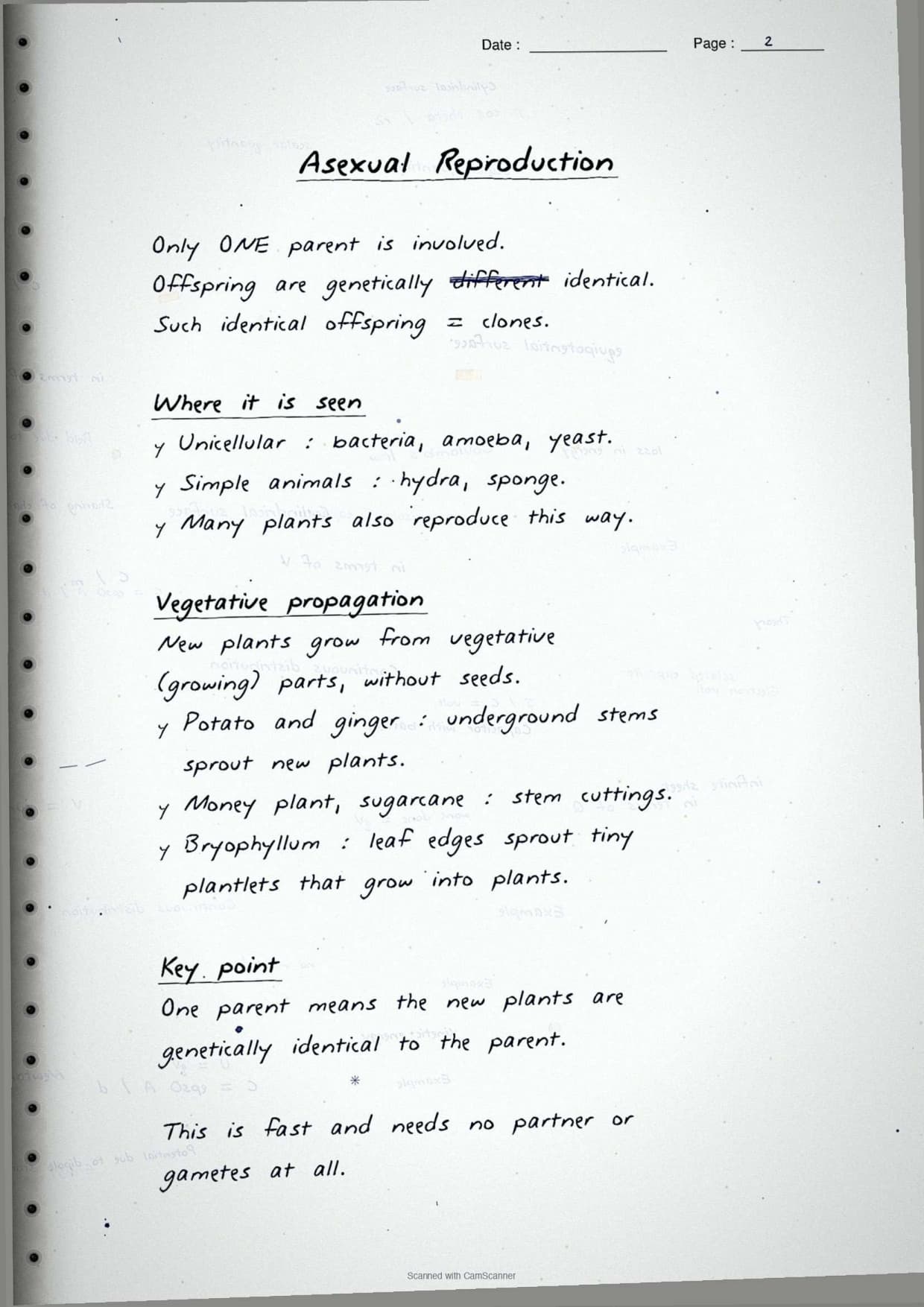
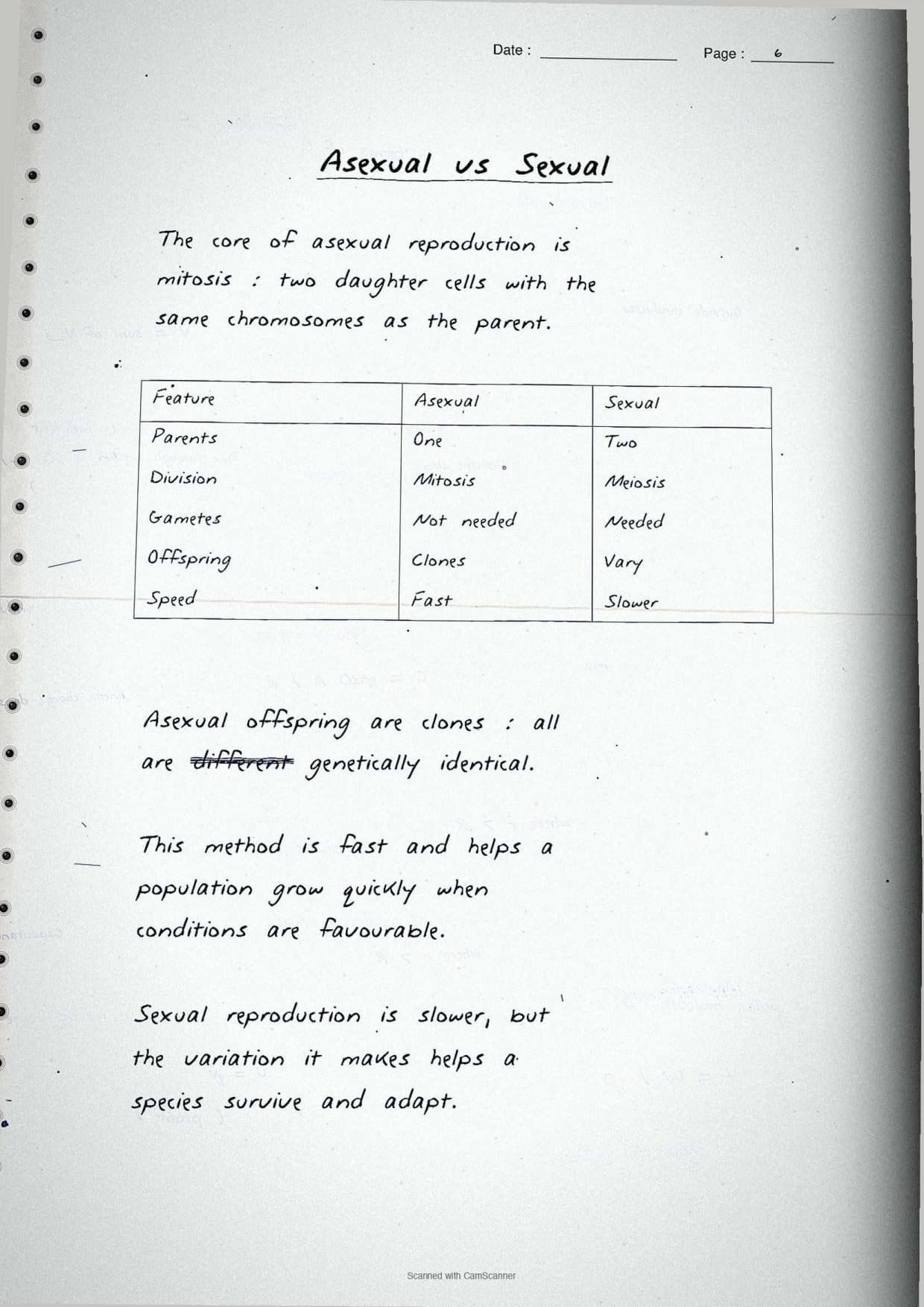
- Asexual reproduction: needs one parent, uses simple cell division (mitosis), and makes near-identical copies called clones.
- Sexual reproduction: needs two parents, uses a special division called meiosis and then fusion, and makes offspring that vary.
- Why variation matters: the notes mark this in red. Small differences help some individuals cope with heat, cold, or disease, and useful ones pass on across generations.
The hand-drawn comparison above is the fastest way to fix the difference. The notes teach you to count the parents first: one parent and a near-perfect copy means asexual, while two parents and a mixed child means sexual.
Asexual Reproduction Methods: Hand-Drawn Table
Asexual reproduction is common in bacteria, in simple animals like hydra, and in many plants, so the notes give it a clear hand-drawn table. Every method uses one parent and gives identical offspring, but the way the parent body divides changes from one organism to the next.
| Method | Organism | Key idea |
|---|---|---|
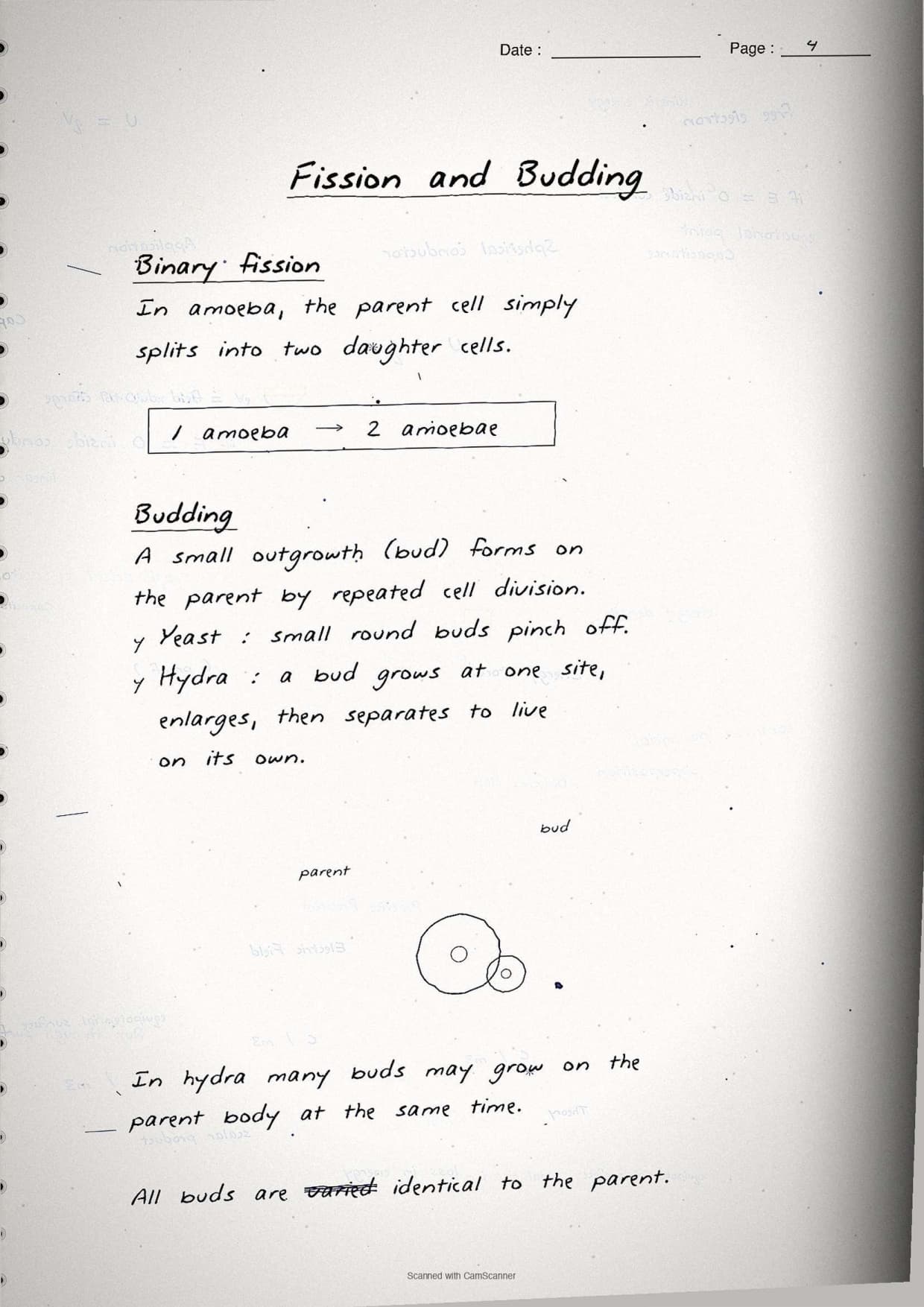
| Binary fission | Amoeba, bacteria | One parent splits into two equal cells. |
| Multiple fission | Malarial parasite | One parent splits into many cells at once. |
| Budding | Yeast, hydra | A bud grows on the parent, then breaks away. |
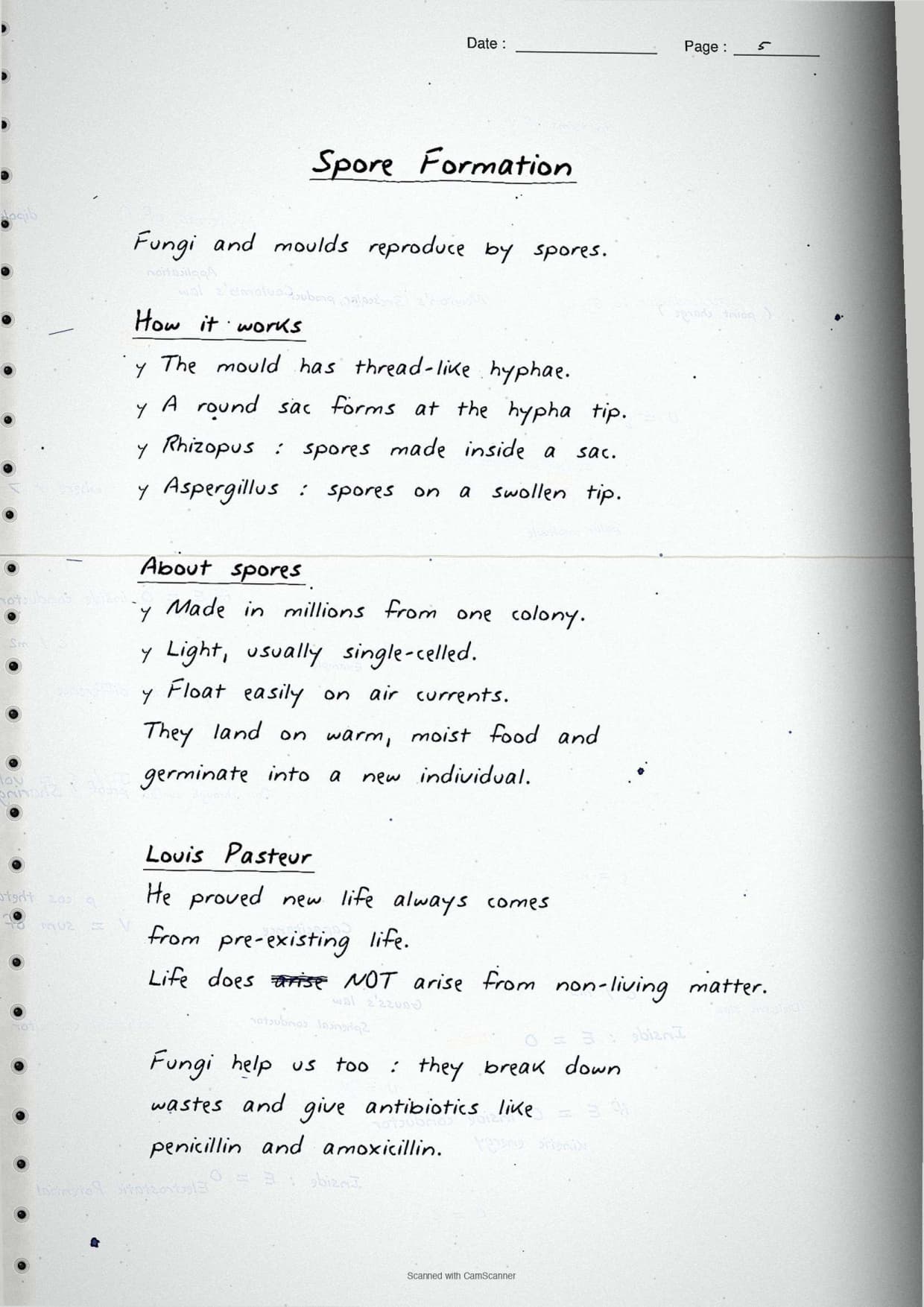
| Spore formation | Rhizopus, other fungi | Millions of light spores form and float away. |
| Fragmentation | Spirogyra | The body breaks into pieces that each grow. |
| Regeneration | Planaria | A cut part regrows a full body. |
| Vegetative propagation | Potato, Bryophyllum | A new plant grows from a root, stem, or leaf. |
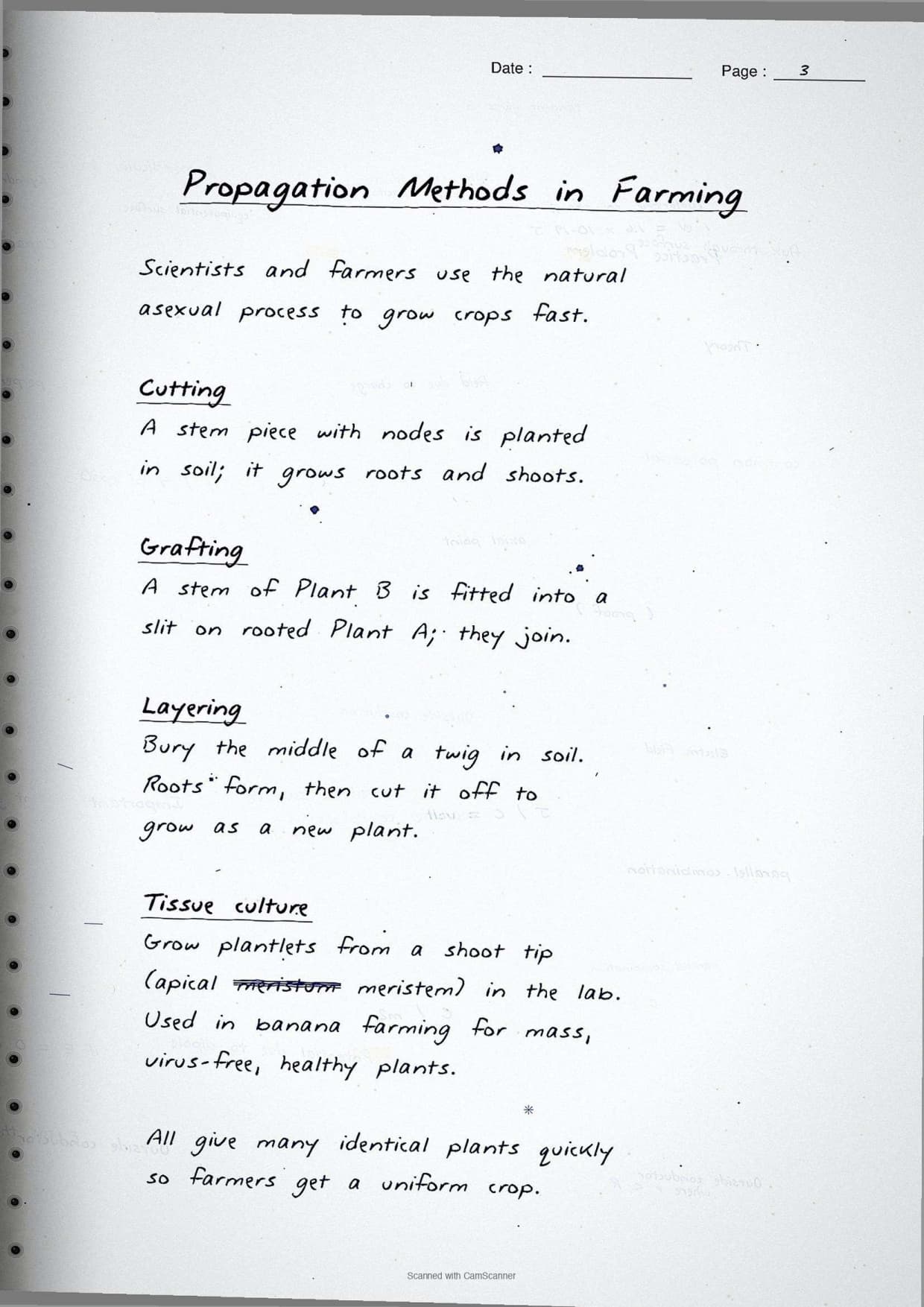
The notes give vegetative propagation extra space because gardeners copy it by hand. The four set methods, written out in blue, are cutting (a stem piece is planted), grafting (a scion is fixed onto a rooted stock), layering (a bent twig is buried until it roots), and tissue culture (cells from a shoot tip are grown into many plantlets).
Sexual Reproduction and Meiosis in Your Own Handwriting
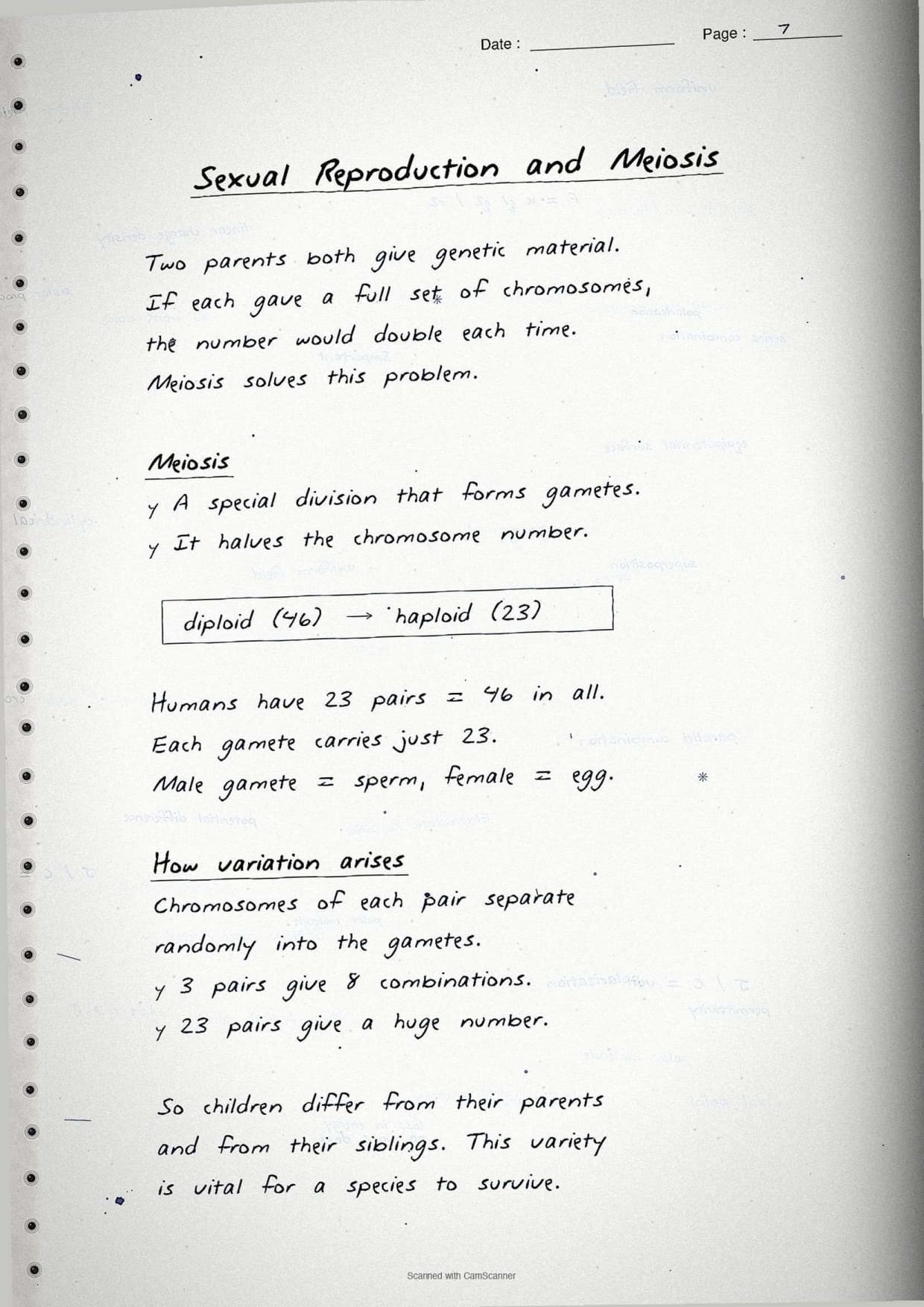
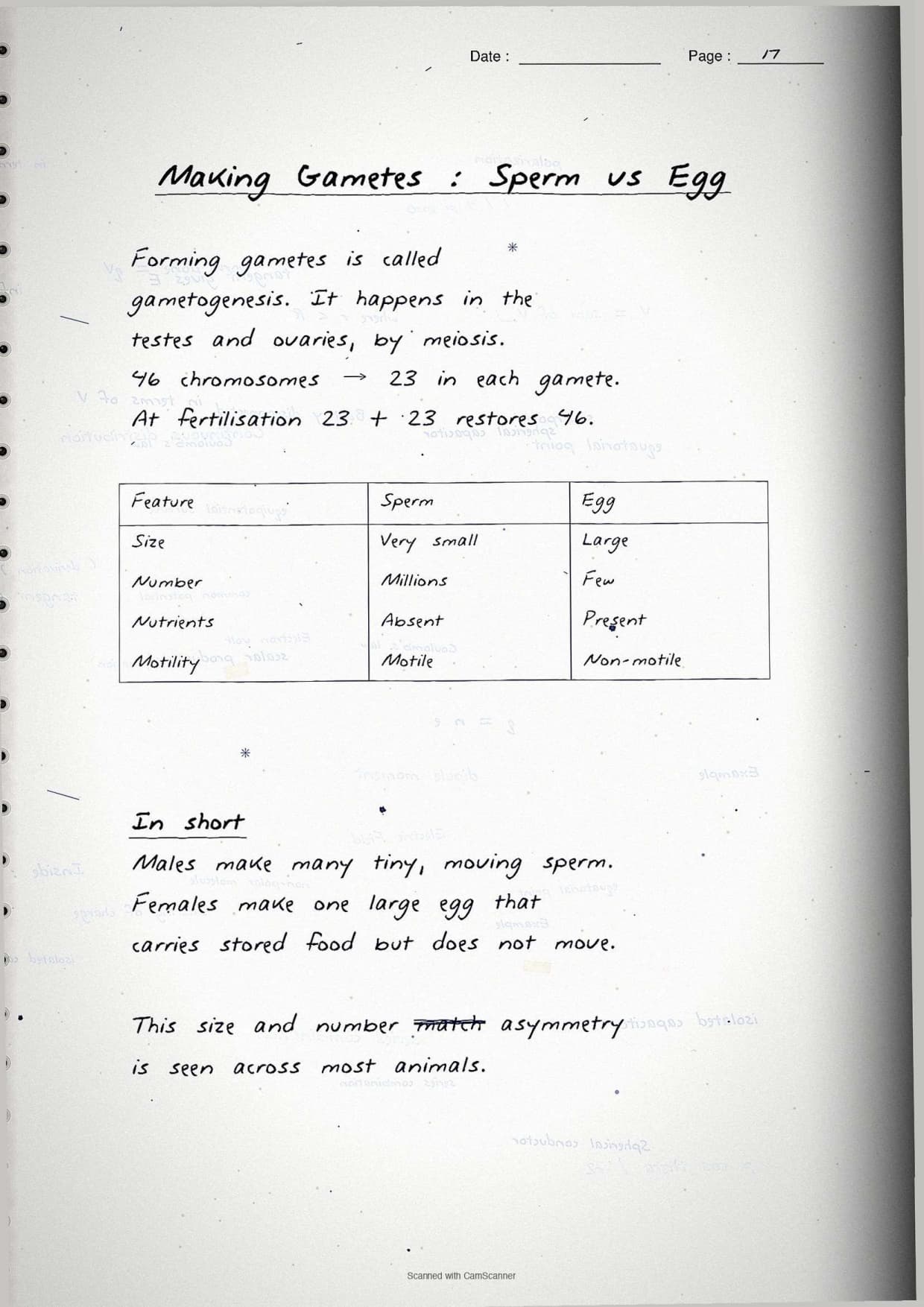
Sexual reproduction needs two parents, and each parent gives a special reproductive cell called a gamete. The notes box the three terms you must know, then use the chromosome maths to show why a special cell division is needed.
- Gamete: a reproductive cell with half the usual chromosome number. In animals the male gamete is the sperm and the female gamete is the egg; in plants the pollen carries the male gamete and the ovule holds the egg.
- Fertilisation: the fusion of a male and a female gamete. It produces a zygote, the first cell of a new individual.
- Meiosis: the cell division that halves the chromosome number to make gametes.
The blue solved example in the notes explains why meiosis is essential. A human body cell has 2n = 46 chromosomes. If both parents passed on a full set, the number would double every generation. Meiosis prevents this by halving the count.
The notes also mark, in red, that meiosis creates variation. As each pair of chromosomes separates, each gamete gets a fresh mix. With only three pairs of characters, eight combinations are possible; with all 23 pairs the number is enormous, so every child differs from the parents and from each other.
The Flower, Pollination and Fertilisation Drawn by Hand
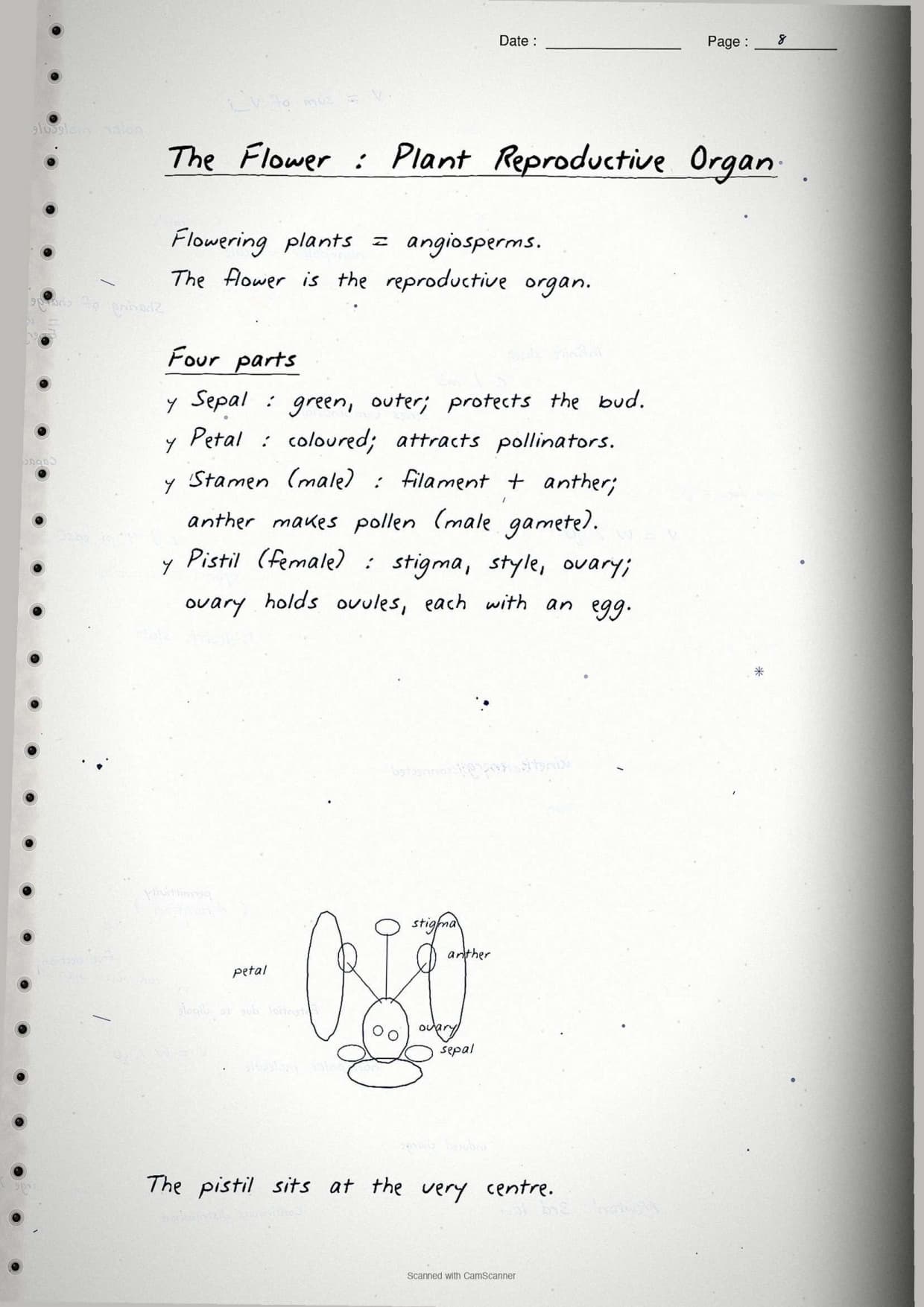
The flower is the reproductive organ of flowering plants, so the notes give it a full hand-drawn diagram with every part labelled. A complete flower has four whorls: the outer two protect and attract, and the inner two do the actual reproduction.
| Part | Type | Function |
|---|---|---|
| Sepal | Outer, green | Protects the flower in the bud stage. |
| Petal | Coloured | Attracts pollinators and shields the inner parts. |
| Stamen (male) | Anther and filament | The anther makes pollen grains with male gametes. |
| Pistil (female) | Stigma, style, ovary | Receives pollen; the ovary holds ovules with egg cells. |
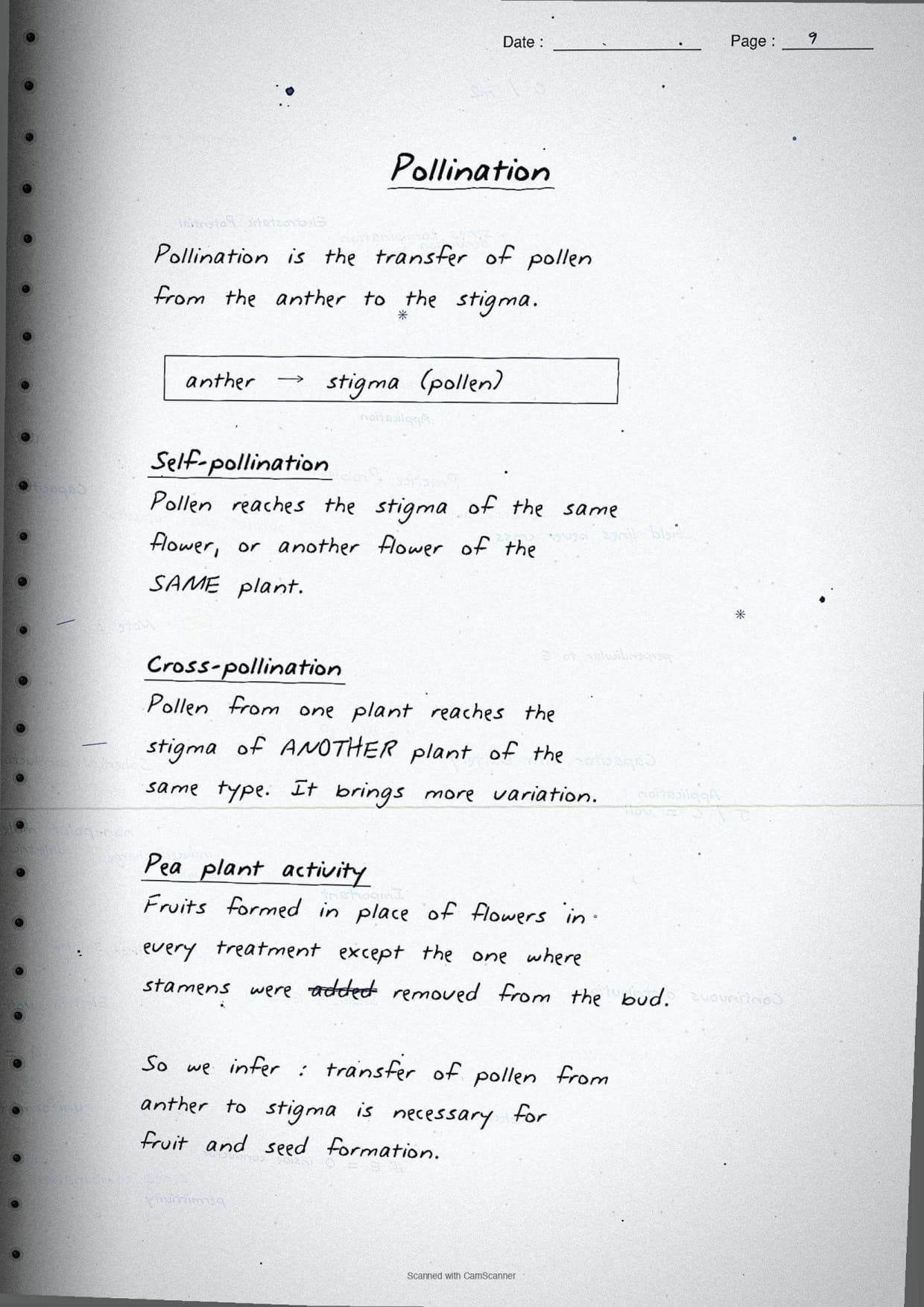
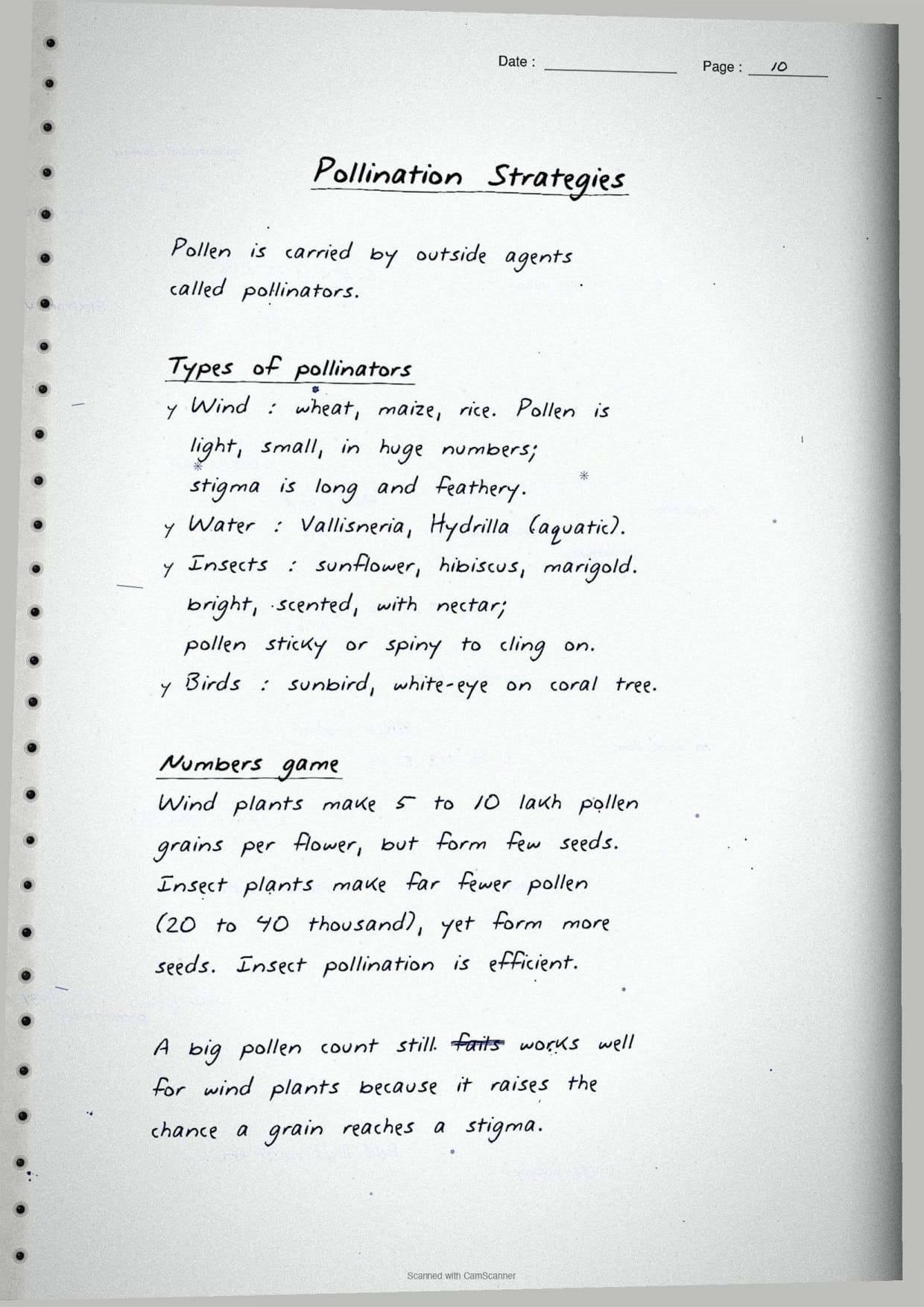
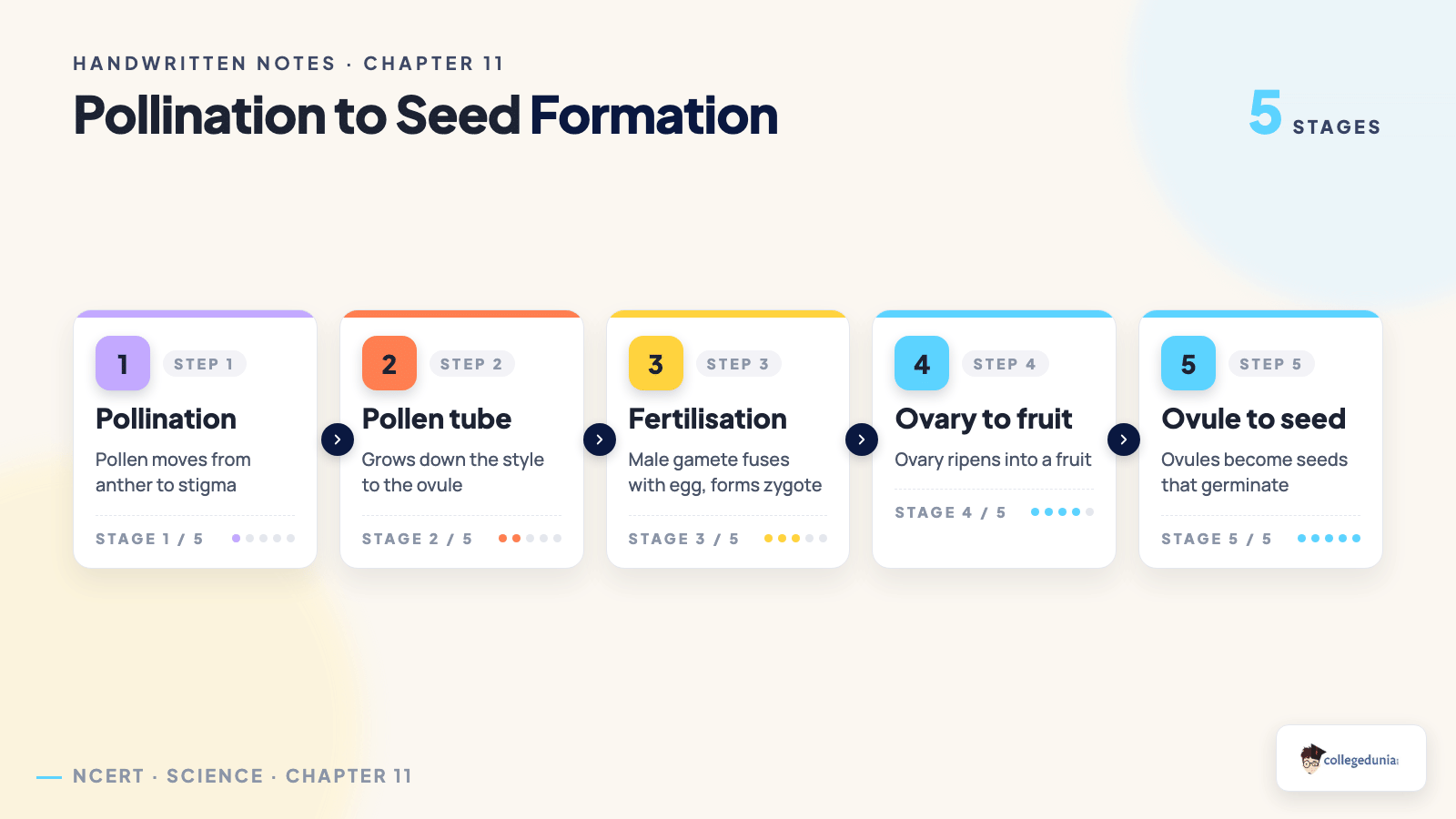
Pollination is the transfer of pollen from the anther to the stigma, and it must happen before fertilisation. The notes split it into two kinds: self-pollination, where pollen reaches the stigma of the same flower or plant, and cross-pollination, where pollen moves to a flower on another plant of the same type. Because plants cannot move, they use outside agents, and the flower's design matches its pollinator: wind carries light pollen for wheat, maize, and rice; water moves it for Vallisneria; and insects like bees visit bright, scented flowers such as sunflower and hibiscus.
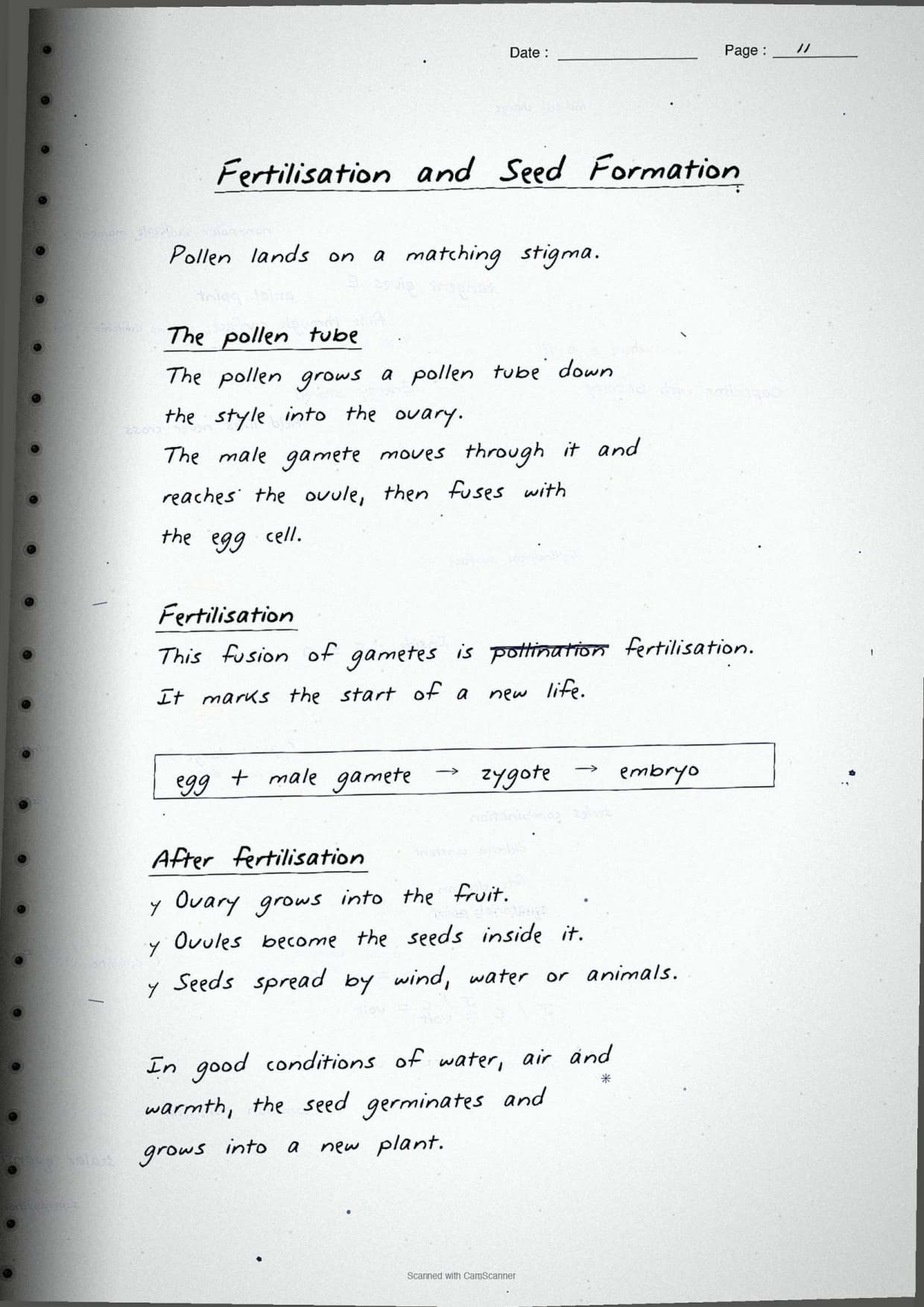
The hand-drawn flow above tracks what happens next, and the notes mark the ending pairs in red so you never reverse them: the ovary becomes the fruit and the ovule becomes the seed. When conditions are right, the seed germinates into a new plant.
Reproduction in Animals and Human Beings Marked in the Margins
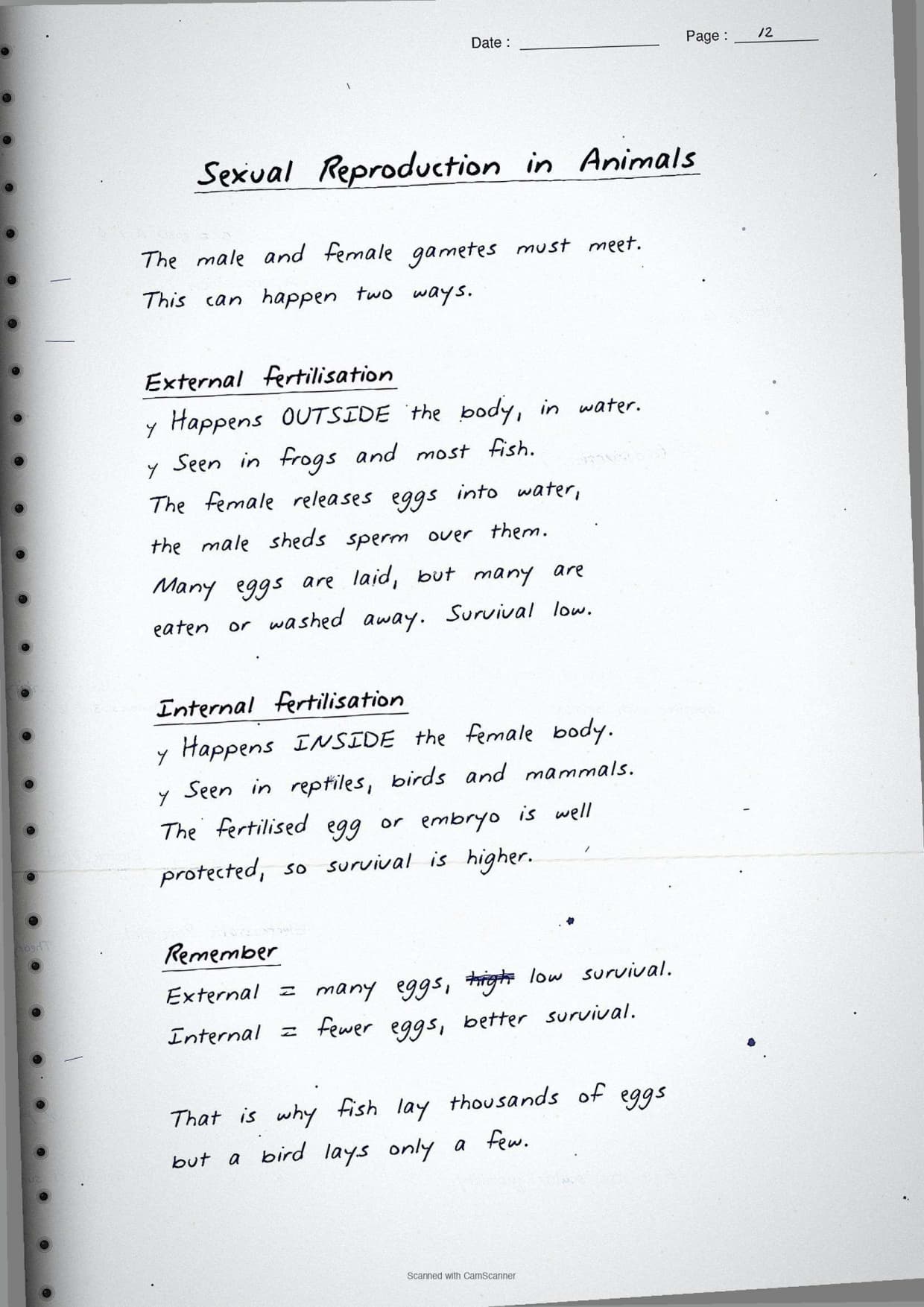
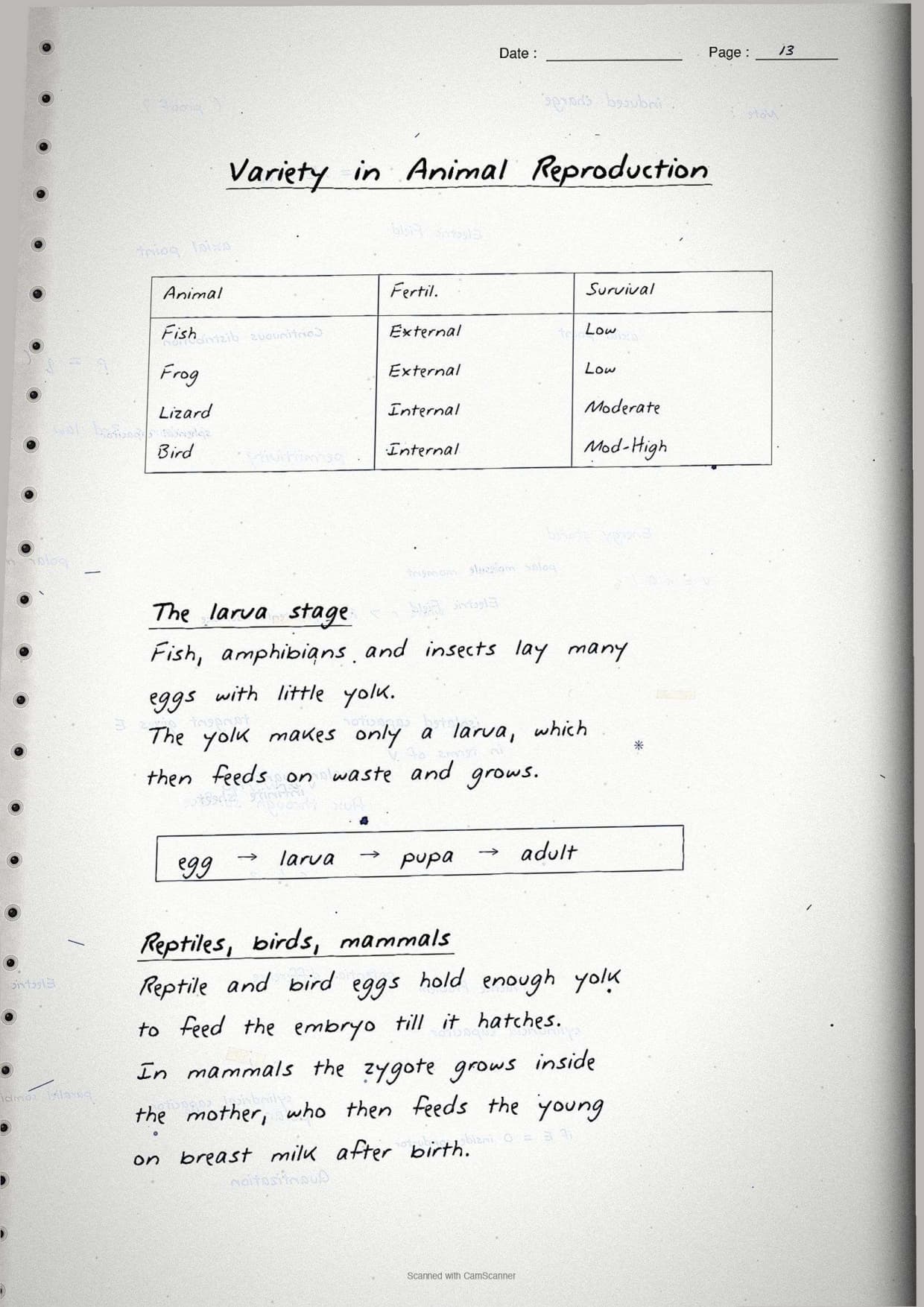
Animals face the same challenge: the male and female gametes must meet, and the young must survive to grow up. The notes compare the two ways fertilisation can happen, then close with a clear look at human reproduction.
| Feature | External fertilisation | Internal fertilisation |
|---|---|---|
| Where it happens | Outside the body, in water | Inside the female body |
| Eggs produced | Very many | Few |
| Survival of young | Low | Higher |
| Seen in | Most fish and frogs | Reptiles, birds, mammals |
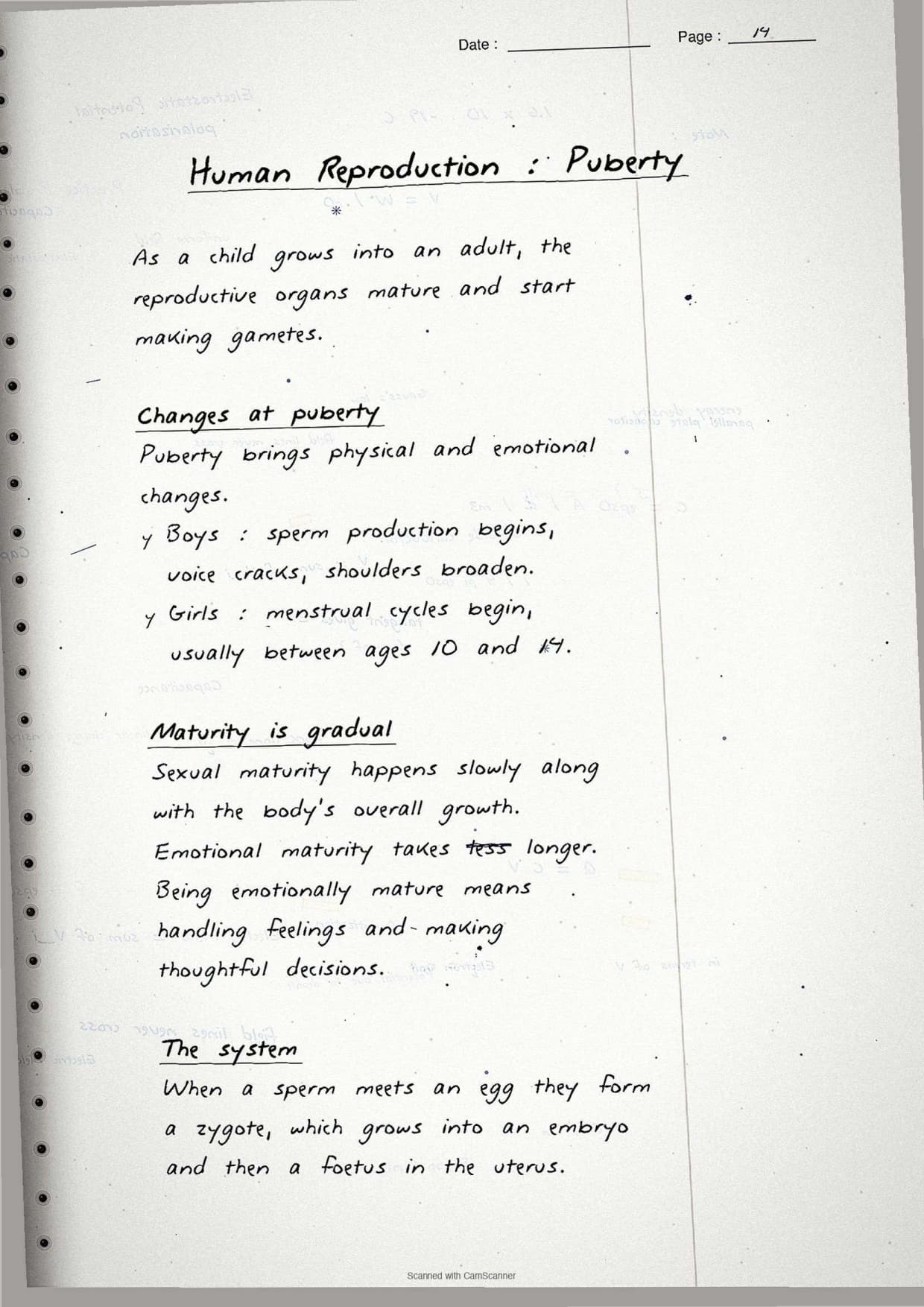
Humans reproduce sexually with internal fertilisation, and the reproductive organs mature at puberty. The notes pin the main parts in the margins so the labels stick.
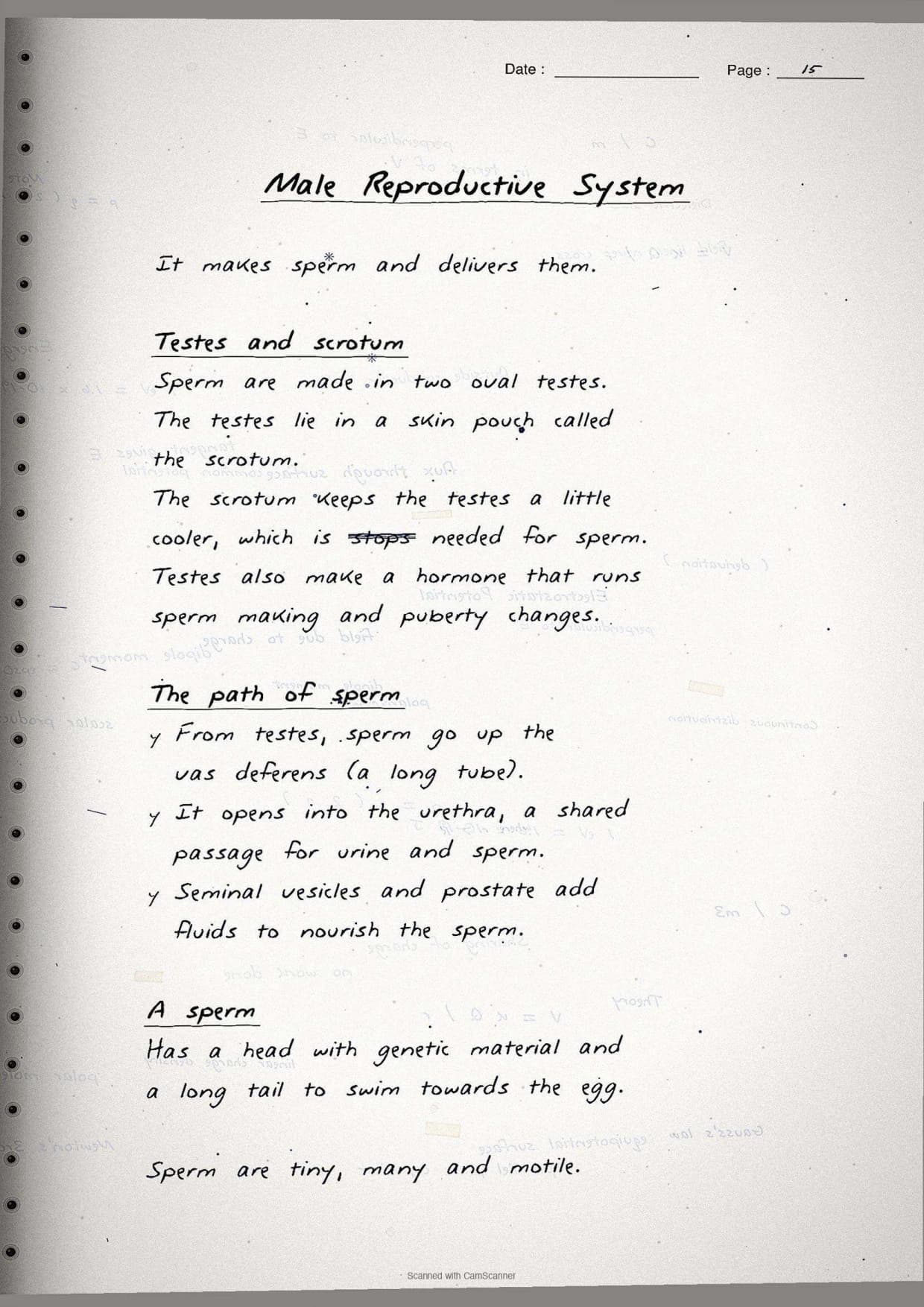
- Male system: the testes lie in a skin pouch, the scrotum, and make sperm plus a hormone. Sperm travel through the vas deferens into the urethra, and the seminal vesicles and prostate add fluids.
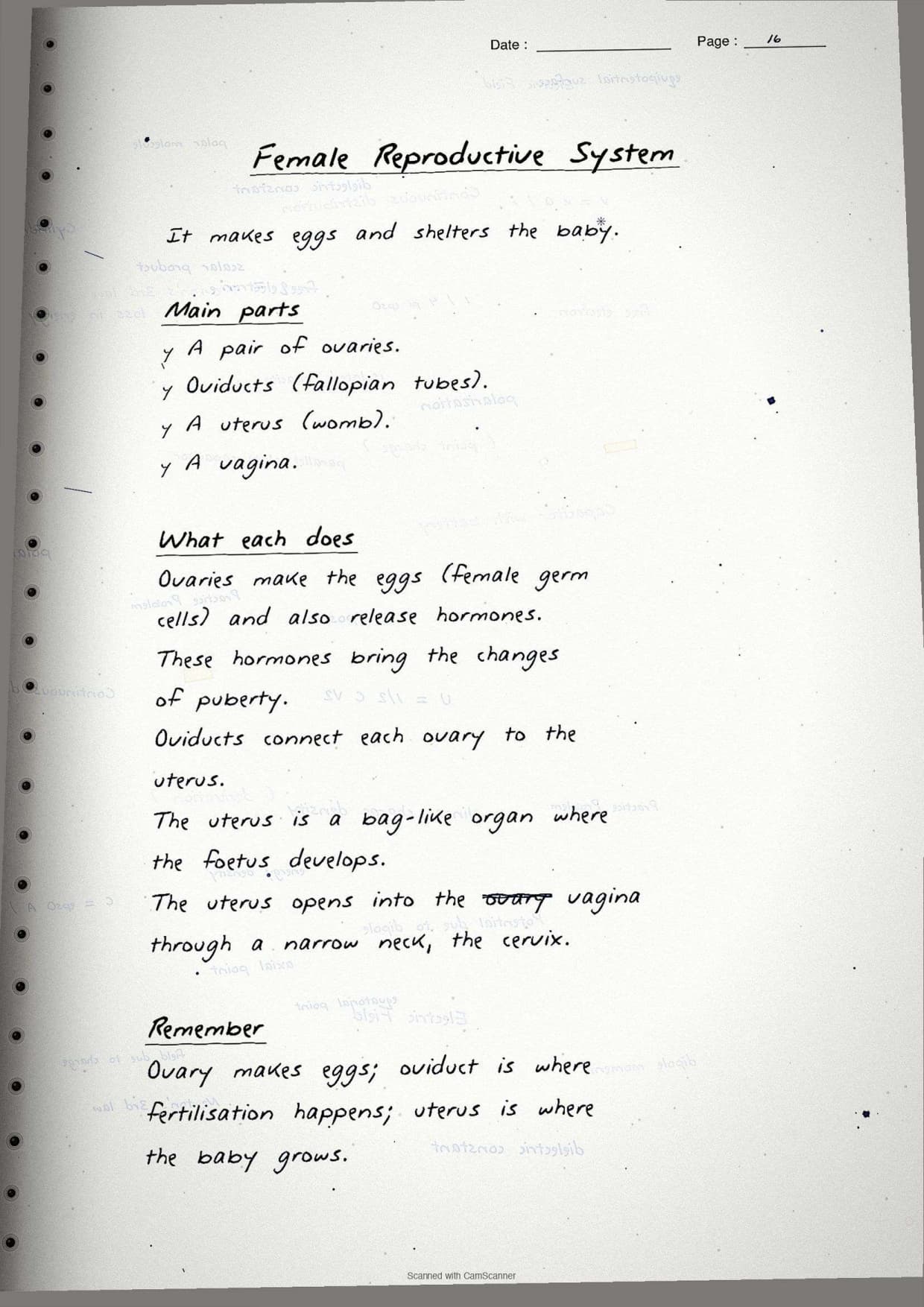
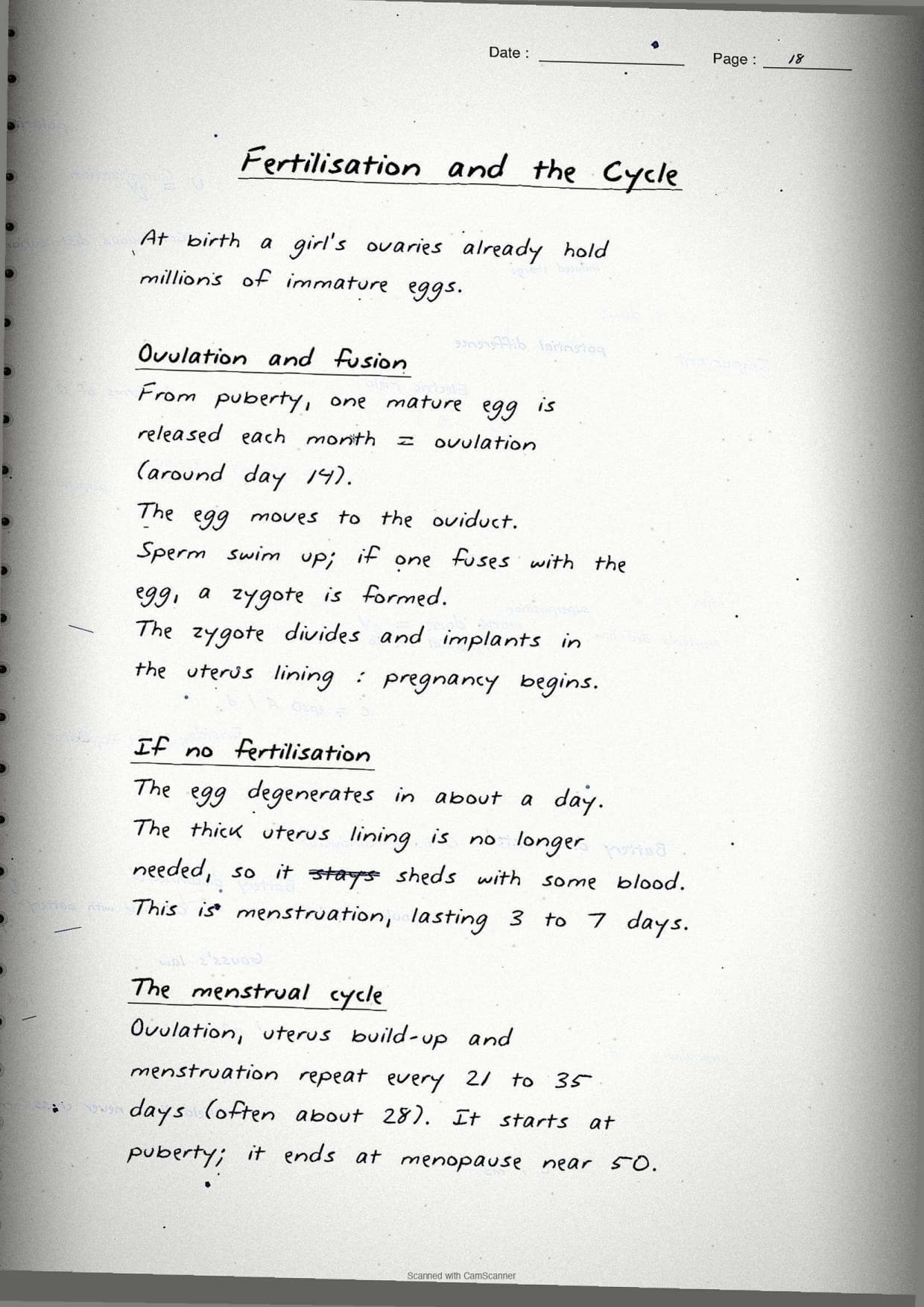
- Female system: the ovaries make eggs and hormones, the oviducts carry the egg and are where fertilisation usually happens, and the uterus shelters the growing baby.
- Menstrual cycle: an ovary releases an egg about once a month, an event called ovulation. If no fertilisation happens, the uterus lining sheds as menstruation, lasting about 3 to 7 days, and the cycle repeats roughly every 28 days.
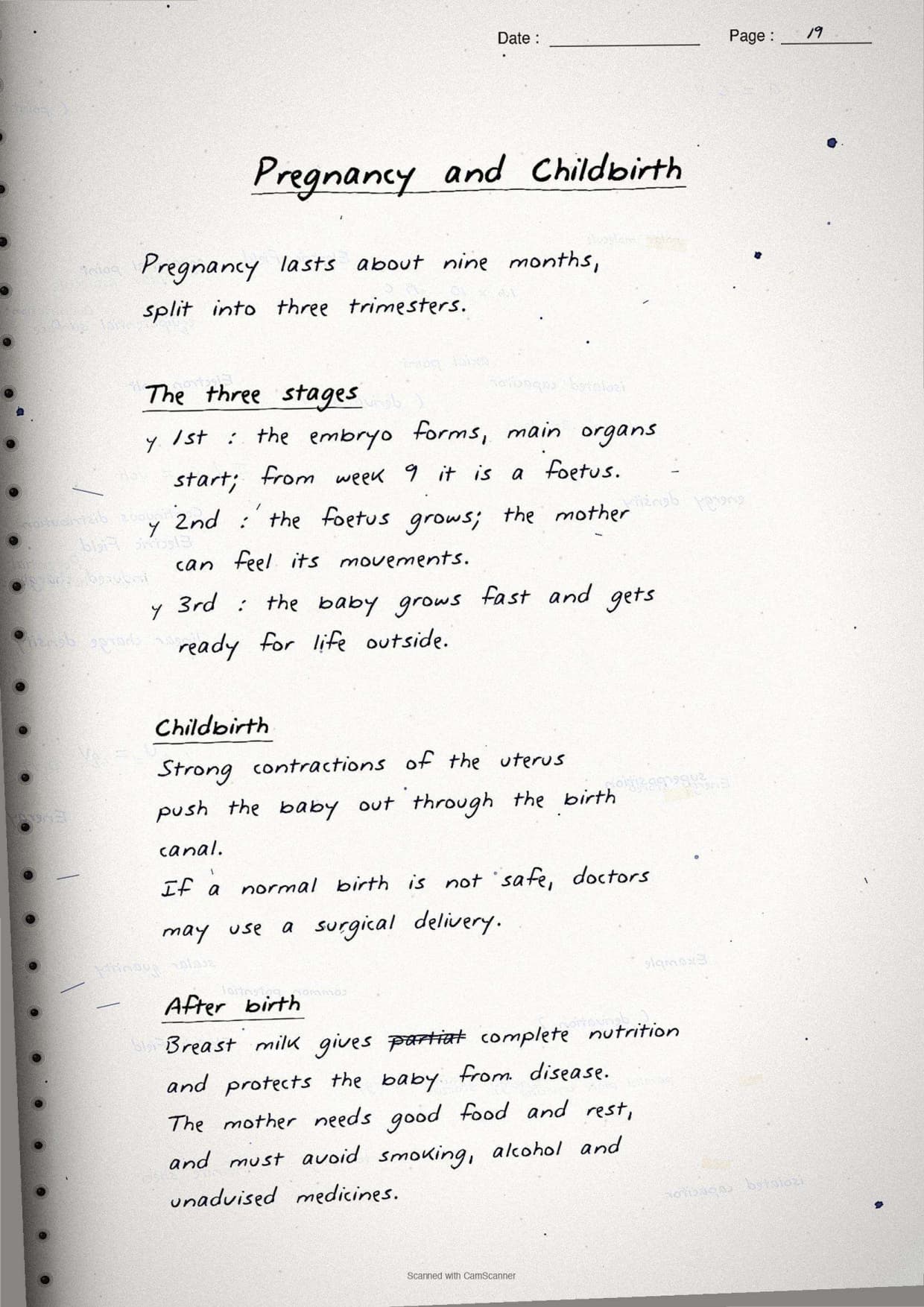
The notes add, in blue, that human pregnancy lasts about nine months, split into three trimesters, as the embryo grows into a foetus and then a baby.
Common Mistakes Flagged in Red
Most lost marks in this chapter come from small mix-ups of terms, not hard ideas. The handwritten notes circle these in red so you fix them while you revise.
- Saying asexual offspring vary. Asexual offspring are identical clones; only sexual offspring vary.
- Reversing the ending pairs. The ovary becomes the fruit and the ovule becomes the seed, not the other way round.
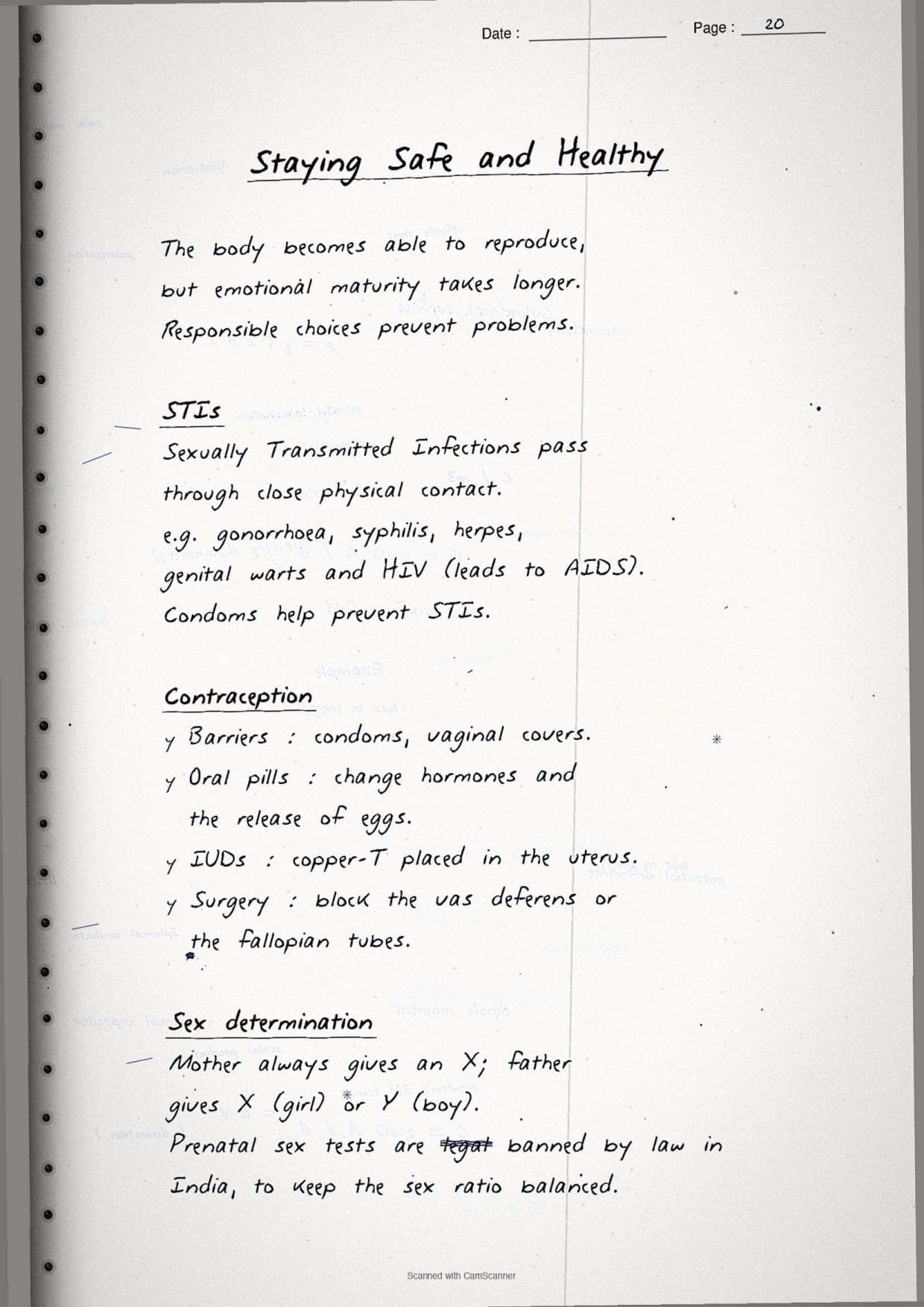
- Thinking the mother decides the baby's sex. The father's gamete carries either an X or a Y, so the father decides the biological sex.
- Confusing regeneration with normal reproduction. Complex animals cannot make a new individual from a chopped-off piece.
Last-Minute Revision with These Handwritten Notes
The night before your exam, the Reproduction How Life Continues Class 9 Science Handwritten Notes work as a quick skim. Every boxed term and red heading is a checkpoint, so you can cover the whole chapter in well under an hour.
- Give two differences between asexual and sexual reproduction.
- Name three asexual methods with one example each.
- Write the chromosome maths: 2n = 46 to n = 23 and back to 46.
- Label the four parts of a flower and state each job.
- Trace pollination to seed, and read the red mistake note before you close the notes.
How Collegedunia's Handwritten Notes Help You With Reproduction
Collegedunia brings you the Reproduction How Life Continues Class 9 Science Handwritten Notes as a free, clear PDF you can open on any phone. It saves you the time of making your own notes and matches the new Exploration book.
- 2026-27 match: every page follows the new textbook and the Revise, Reflect, Refine flow.
- Clean handwriting: a topper's neat writing makes each diagram and term easy to read.
- Exam-ready: boxes and colour cues let you revise fast before the annual exam, and later for CBSE, NEET, and AIIMS basics.
- Free download: keep the PDF offline and revise any time.
More Reproduction How Life Continues Class 9 Science Resources
Use the table below to open the other resources for this chapter of the new Class 9 Science Exploration book.
| Resource | Open |
|---|---|
| Handwritten Notes | Reproduction How Life Continues Class 9 Science Handwritten Notes |
| NCERT Solutions | Reproduction How Life Continues Class 9 Science NCERT Solutions |
| Revision Notes | Reproduction How Life Continues Class 9 Science Notes |
| Formula Sheet | Reproduction How Life Continues Class 9 Science Formula Sheet |
| NCERT Book PDF | Reproduction How Life Continues Class 9 Science NCERT Book PDF |
NCERT Handwritten Notes for Class 9 Science: All Chapters
Use the table below to open the handwritten notes for any other chapter of the new Class 9 Science Exploration book.
| Chapter | Handwritten Notes |
|---|---|
| Chapter 2 | Cell The Building Block of Life |
| Chapter 3 | Tissues in Action |
| Chapter 4 | Describing Motion Around Us |
| Chapter 5 | Exploring Mixtures and their Separation |
| Chapter 6 | How Forces Affect Motion |
| Chapter 7 | Work, Energy, and Simple Machines |
| Chapter 8 | Journey Inside the Atom |
| Chapter 9 | Atomic Foundations of Matter |
| Chapter 10 | Sound Waves Characteristics and Applications |
| Chapter 11 | Reproduction How Life Continues |
| Chapter 12 | Patterns in Life Diversity and Classification |
| Chapter 13 | Earth as a System Energy, Matter, and Life |
Reproduction How Life Continues Class 9 Science Handwritten Notes FAQs
Ques. How many pages are the Reproduction How Life Continues Class 9 Science handwritten notes?
Ans. The handwritten notes run to 22 pages. They cover the full chapter, from asexual and sexual reproduction to the flower, pollination, fertilisation, and reproduction in animals and human beings, with a solved example after each idea.
Ques. Are these real handwritten notes?
Ans. Yes. They are a topper's own clear handwritten revision notes, with each key term boxed, the flower and budding hydra drawn by hand, and sub-headings colour-coded in red.
Ques. What is the difference between pollination and fertilisation in Chapter 11?
Ans. Pollination is the transfer of pollen from the anther to the stigma. Fertilisation is the fusion of the male gamete with the egg to form a zygote. Pollination happens first, and fertilisation follows through the pollen tube.
Ques. Can I use these handwritten notes for last-minute revision?
Ans. Yes. The boxed terms, hand-drawn tables, and red headings let you skim the whole chapter in under an hour, so they suit the night before your annual exam.
Ques. Is Reproduction How Life Continues part of the new Class 9 Science book?
Ans. Yes. Reproduction: How Life Continues is Chapter 11 of the new Exploration textbook for the 2026-27 syllabus. This reproduction topic was moved from Class 10 to Class 9 under the new syllabus.



Comments