




Class 11 Economics Chapter 10 Indian Economy 1950-1990 notes cover every planning goal, agriculture policy, industrial policy and trade policy point that NCERT asks for in the 2026-27 syllabus. The PDF explains five year plans, Green Revolution, public sector leadership, import substitution and the policy criticism that led to 1991 reforms.
- Download the Indian Economy 1950-1990 notes PDF for quick revision.
- Revise planning goals, land reforms, industry and trade policy in one place.
- Use the tables for short-answer and long-answer exam framing.











Each Indian Economy 1950-1990 notes PDF is based on the 2026-27 NCERT chapter and checked for economic facts, policy sequence and syllabus-level explanation.
Student Feedback: More than 10,000 students use Collegedunia NCERT resources to revise Class 11 Economics. Students say this chapter becomes easier when planning goals are studied with agriculture, industry and trade policy together.
What Indian Economy 1950-1990 Covers
Indian Economy 1950-1990 explains how independent India used planning to build a mixed economy. The chapter begins with the choice between capitalism, socialism and mixed economy. It then moves to the four plan goals: growth, modernisation, self-reliance and equity.
| Area | NCERT focus | Exam clue |
|---|---|---|
| Planning | Five year plans and Planning Commission | Connect with welfare and resource use |
| Goals | Growth, modernisation, self-reliance and equity | Use all four in objective answers |
| Agriculture | Land reforms, Green Revolution and subsidies | Write achievements and limits |
| Industry | Public sector, IPR 1956 and small-scale industry | Explain why the state led industry |
| Trade | Import substitution, tariffs and quotas | Link protection with later criticism |
Indian Economy 1950-1990 Video Revision
Source: PW OnlyIAS Prarambh on YouTube
Planning Goals in Indian Economy 1950-1990
The four goals of five year plans were growth, modernisation, self-reliance and equity. NCERT does not ask students to memorise them as separate words only; each goal must be linked with a policy example. Growth is seen through GDP and production capacity. Modernisation includes new technology and a changed social outlook.

- Growth: increase in the capacity to produce goods and services.
- Modernisation: use of better technology and a more equal social outlook.
- Self-reliance: reducing avoidable dependence on imports.
- Equity: making sure development reaches poor sections too.
Agriculture: Land Reforms and Green Revolution
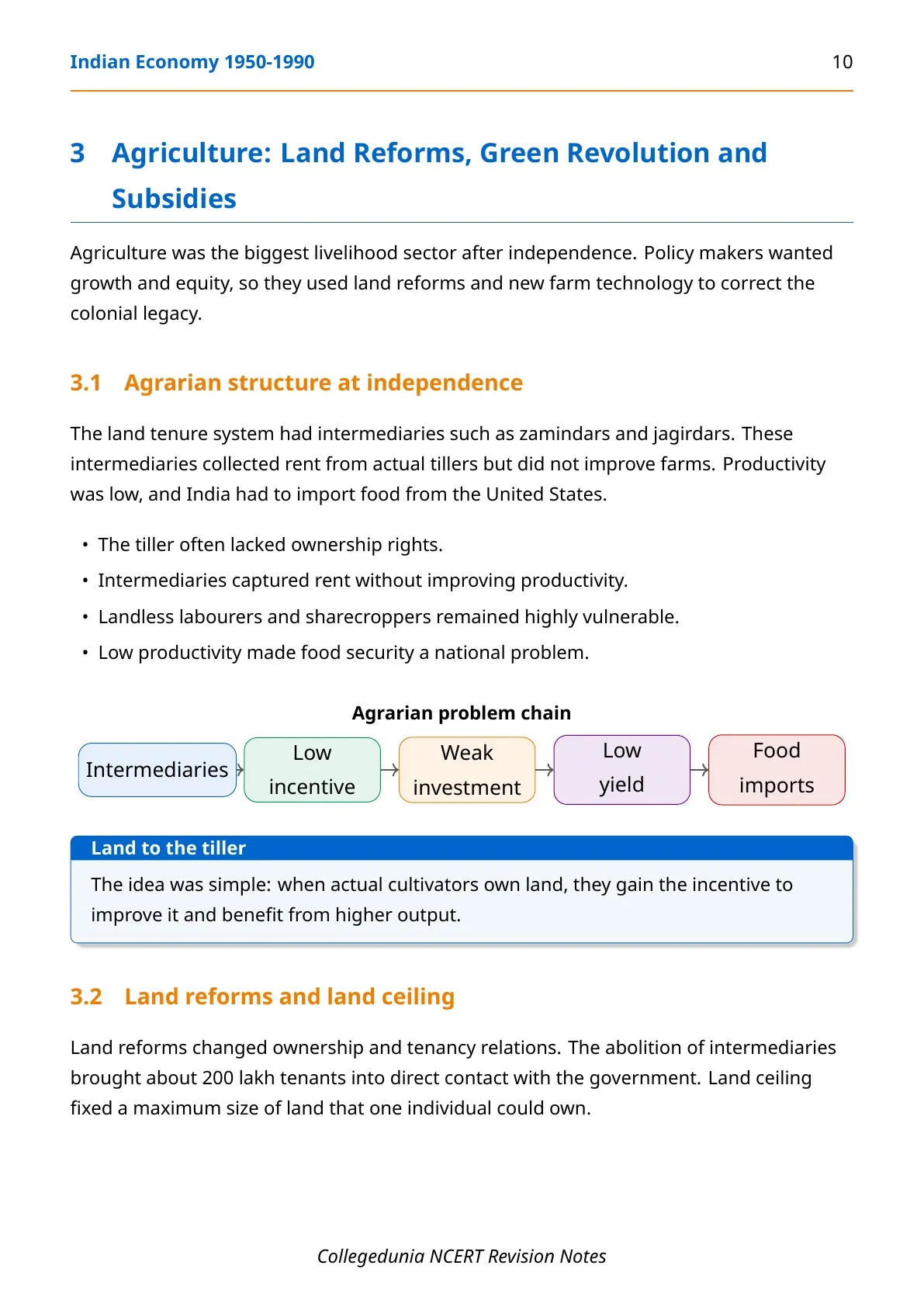
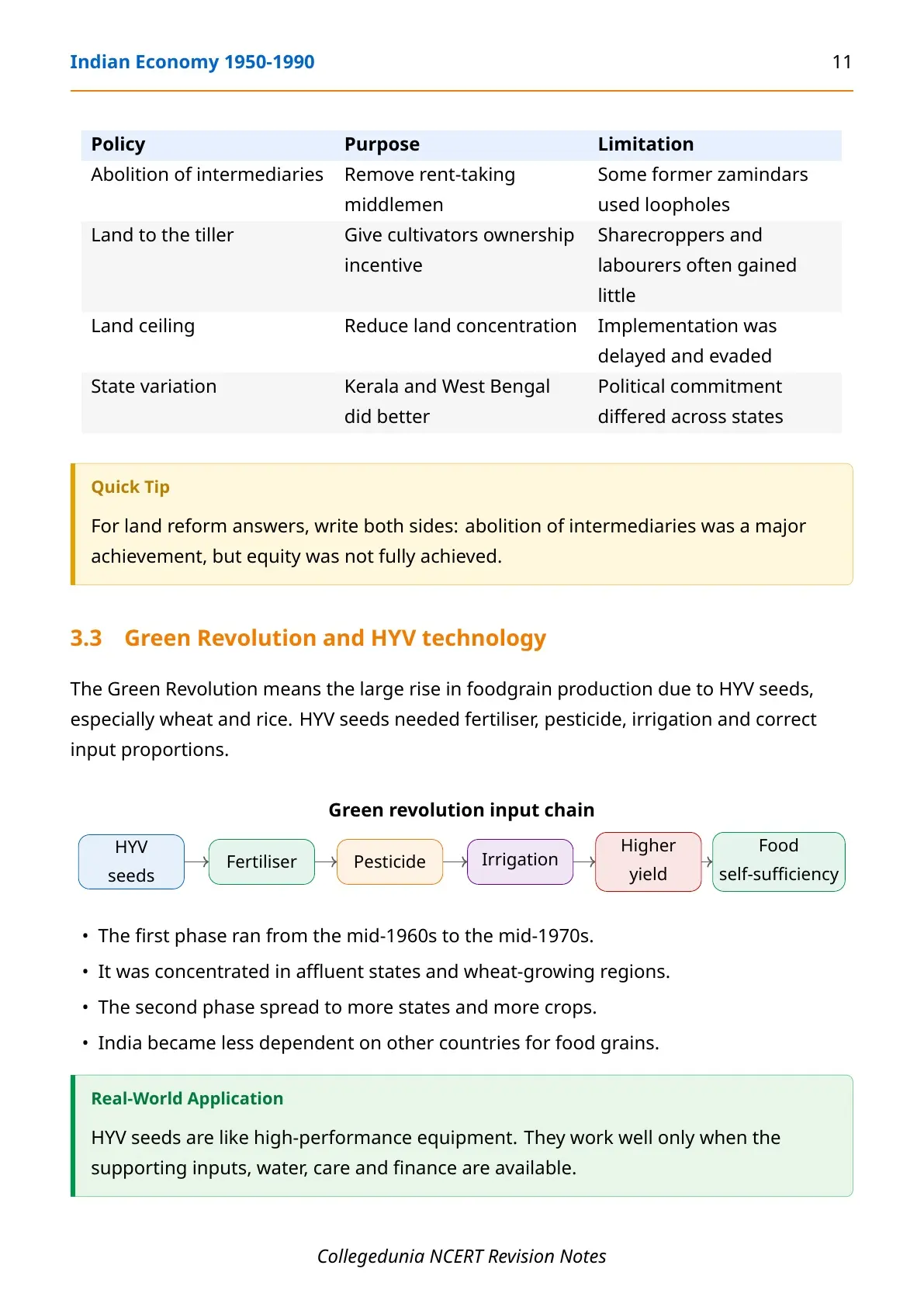
At independence, agriculture had low productivity and an unequal land structure. Land reforms tried to remove intermediaries and give ownership incentives to actual tillers. Land ceiling tried to reduce concentration of land ownership. These reforms worked better in states where governments were strongly committed to land to the tiller.
| Policy | Purpose | Limitation |
|---|---|---|
| Abolition of intermediaries | Remove zamindars and rent-taking middlemen | Some landowners used loopholes |
| Land to the tiller | Give cultivators incentive to improve farms | Landless labourers gained little |
| Land ceiling | Fix maximum land ownership size | Cases were delayed in courts |
| Green Revolution | Raise foodgrain output through HYV seeds | Early gains were regionally uneven |
The Green Revolution used HYV seeds, fertiliser, pesticide and irrigation to raise wheat and rice output. It helped India become self-sufficient in food grains. It also created a subsidy debate because support helped small farmers adopt new technology, but it also created fiscal pressure and leakage.
Public Sector and Industrial Policy Resolution 1956
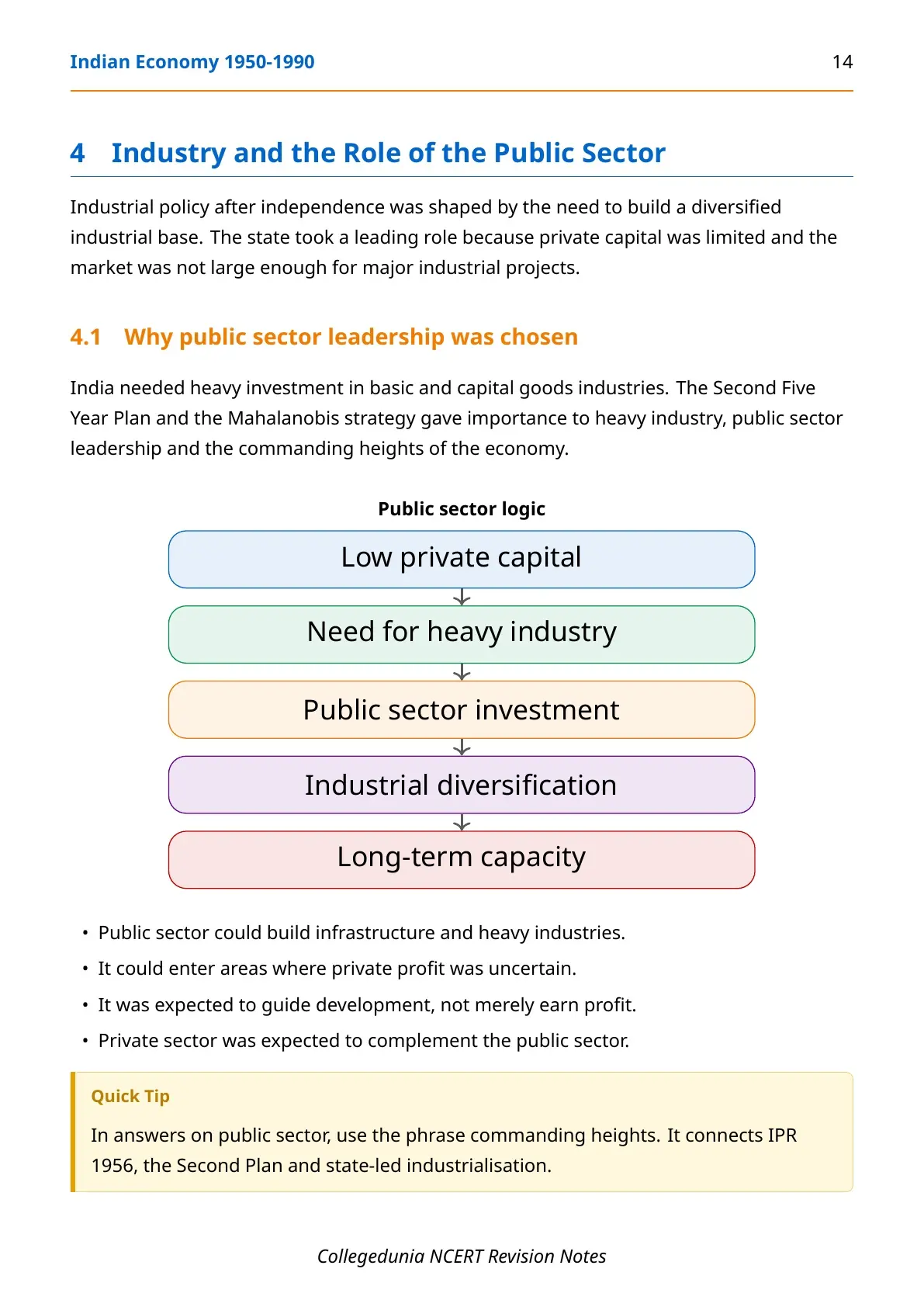
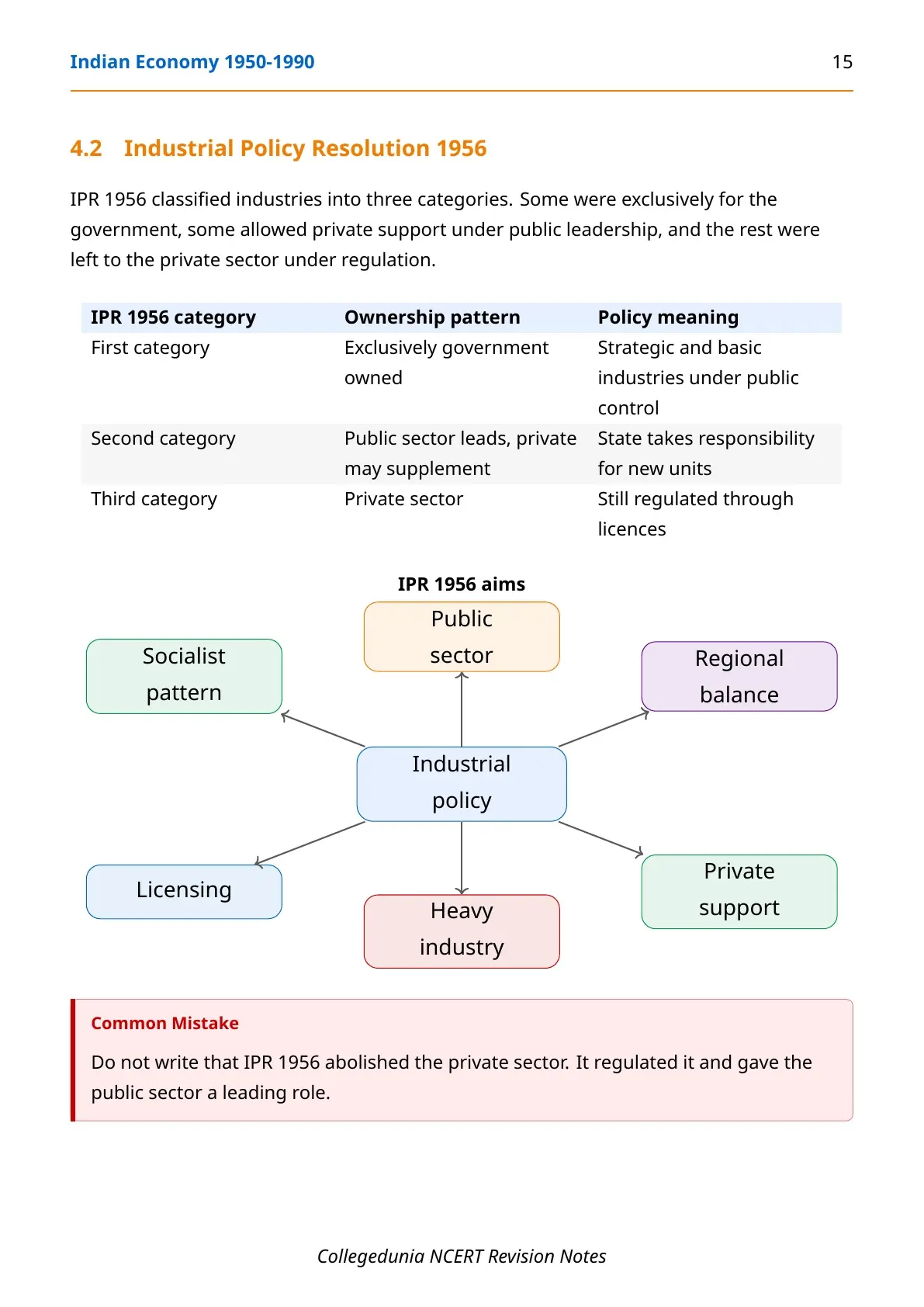
India needed a strong industrial base after independence, but private capital was limited. The public sector was given a leading role in heavy industry, infrastructure and areas called the commanding heights of the economy. IPR 1956 classified industries into government-owned, public-sector-led and private-sector categories.
- The public sector built industries where private investment was weak.
- Licensing controlled new industries, expansion and diversification.
- Backward areas received concessions to promote regional equality.
- Small-scale industries were protected because they created employment.
Trade Policy and Import Substitution
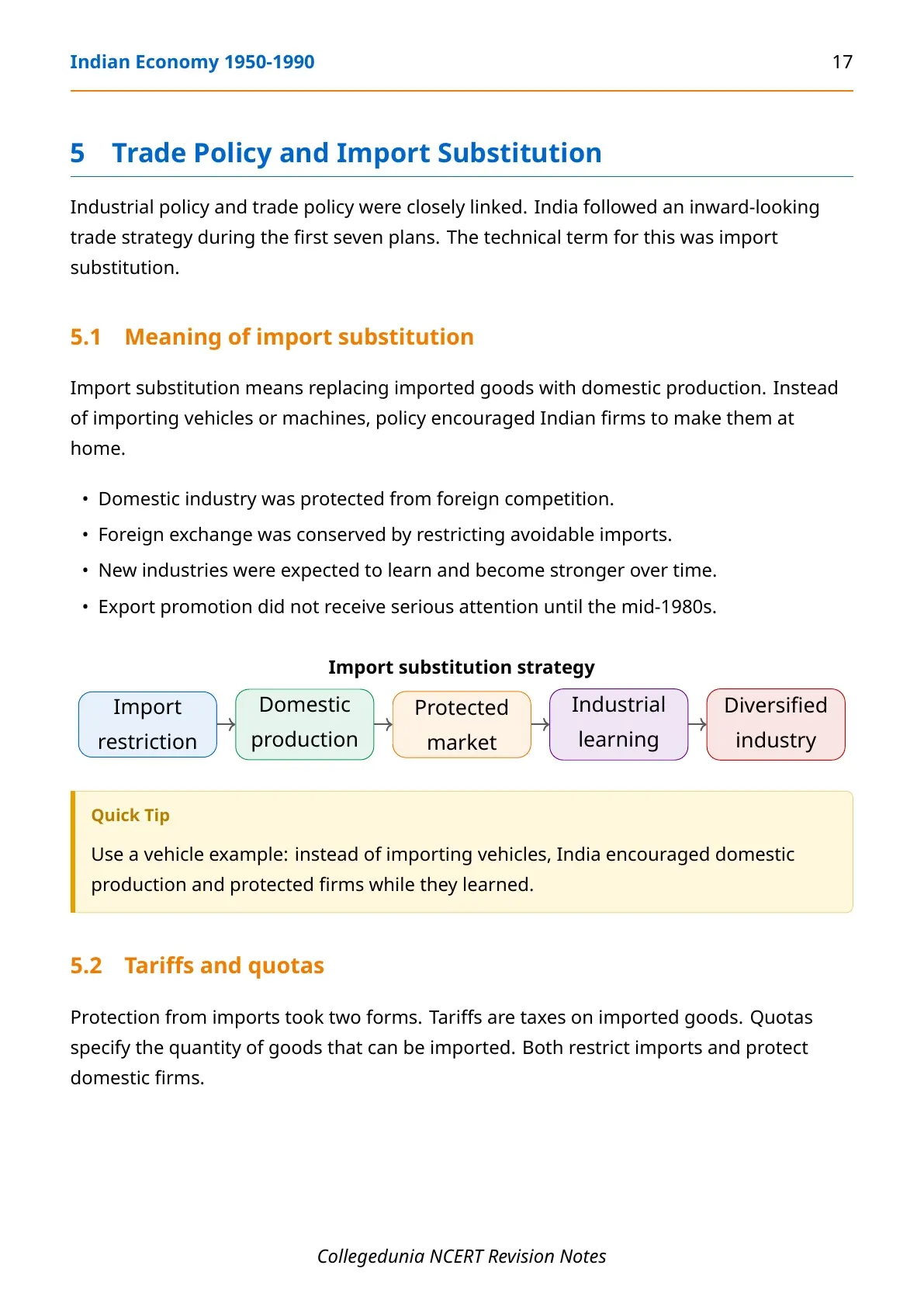
India followed an inward-looking trade strategy in the first seven plans. Import substitution meant replacing imported goods with goods produced inside India. Tariffs made imports costlier, while quotas limited the quantity that could be imported. The policy protected domestic industries while they learned to compete.
| Tool | Meaning | Effect |
|---|---|---|
| Tariff | Tax on imported goods | Makes foreign goods costlier |
| Quota | Quantity limit on imports | Restricts imported supply |
| Import substitution | Domestic replacement of imported goods | Supports local industry |
| Protection | Shielding domestic firms from foreign competition | Helps learning but can reduce quality pressure |
Achievements and Limits of Planning
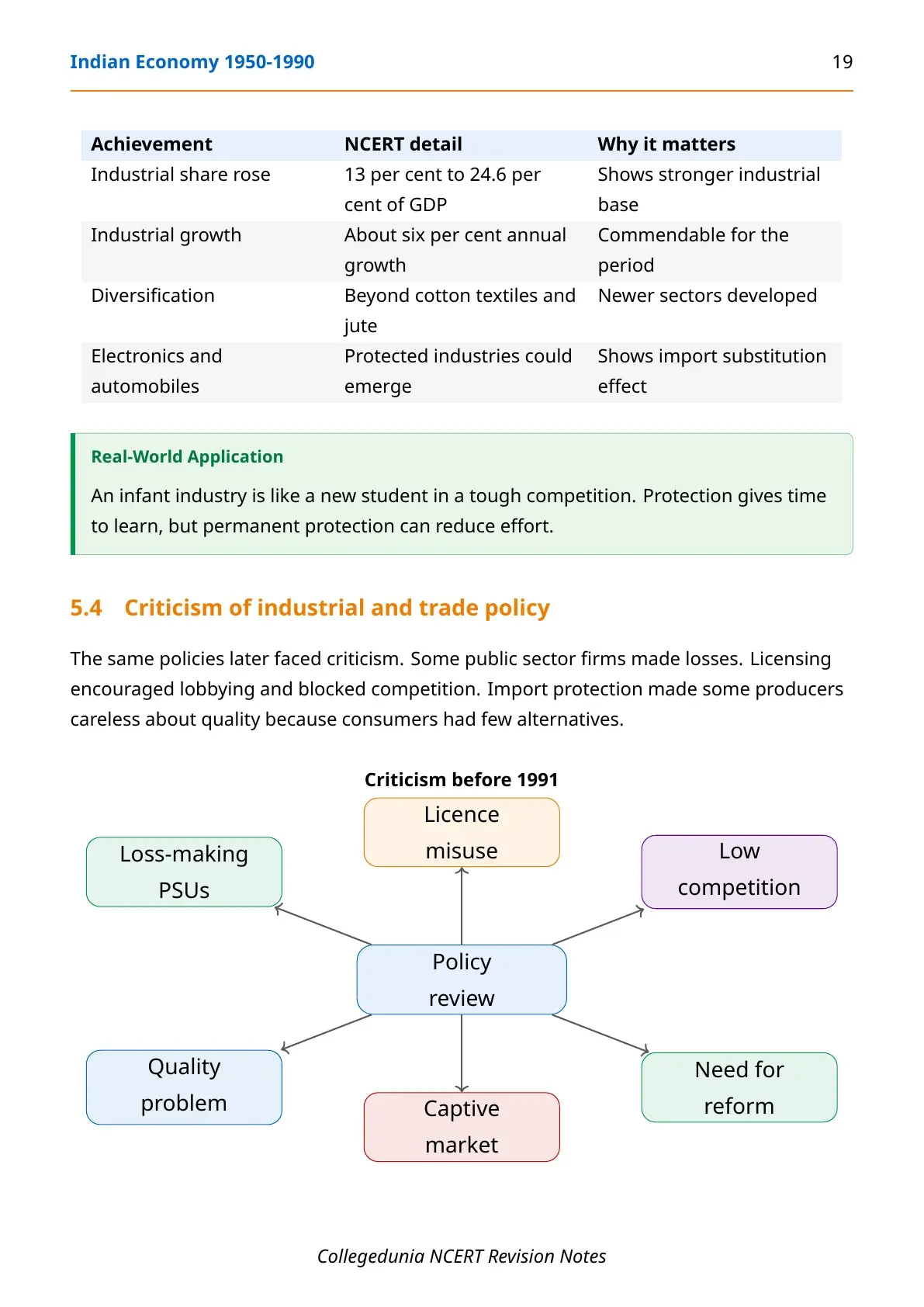
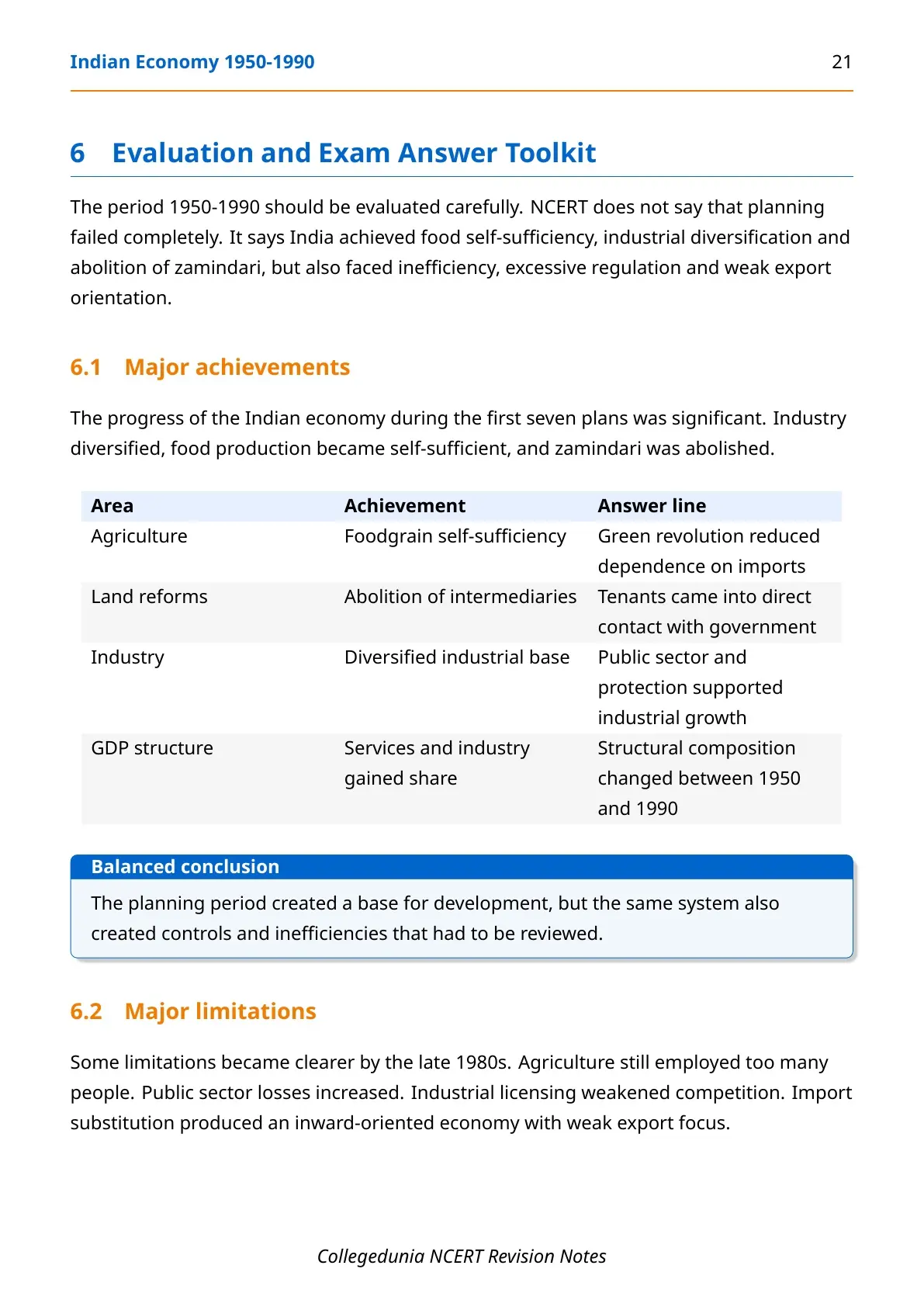
The 1950-1990 period had real achievements. India became self-sufficient in food grains. The industrial sector became more diversified. The public sector helped build a base that private industry could not create alone at that time. The balanced answer is not that planning failed; the balanced answer is that planning built capacity but also created controls and inefficiencies.
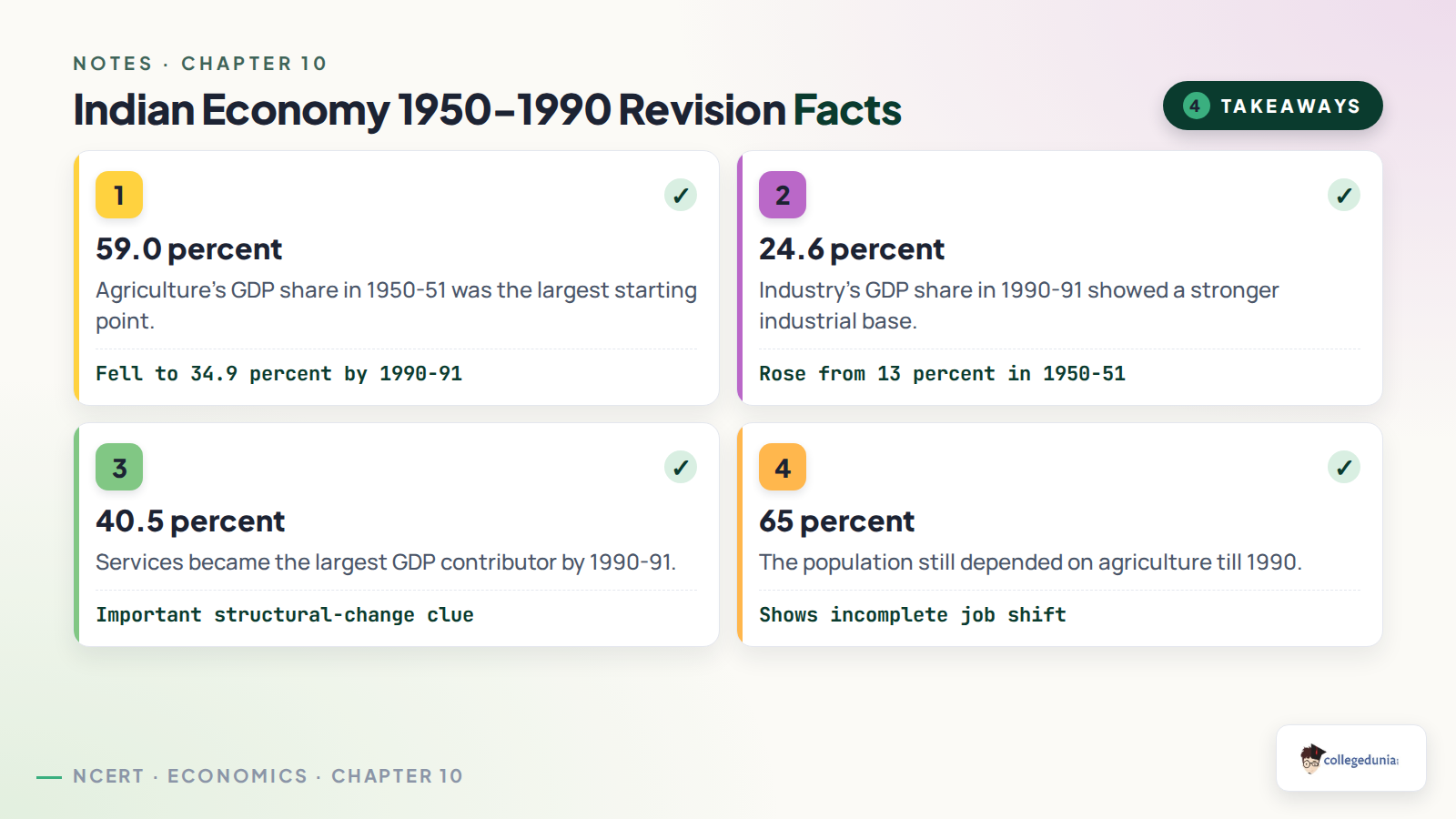
- Industry's GDP share rose from 13 percent in 1950-51 to 24.6 percent in 1990-91.
- Services became the largest GDP contributor by 1990-91.
- Public sector losses and licence misuse became major criticisms.
- Import protection reduced competition and quality pressure in some sectors.
How to Write Answers from Indian Economy 1950-1990
Use a define, explain, evaluate pattern. Start with the term or policy, add the NCERT point, then give the positive side and limitation. This pattern works for land reforms, Green Revolution, public sector, subsidies and import substitution.
| Question type | Start with | End with |
|---|---|---|
| Planning objective | Define the goal | Give one policy example and one trade-off |
| Green Revolution | Define HYV-led output rise | Mention food self-sufficiency and subsidy debate |
| Public sector | Explain heavy industry need | Mention losses and role review |
| Import substitution | Define domestic replacement of imports | Mention tariffs, quotas and quality criticism |
Related Class 11 Economics Resources for Indian Economy 1950-1990
Also Check: use these links when you need the same chapter in another format.
| Resource | Best used for | Link |
|---|---|---|
| NCERT Book PDF | Official chapter wording and exercises | Indian Economy 1950-1990 NCERT Book PDF |
| NCERT Solutions | Answers to textbook exercise questions | Indian Economy 1950-1990 NCERT Solutions |
| Handwritten Notes | Quick visual revision before tests | Indian Economy 1950-1990 Handwritten Notes |
Class 11 Economics Notes for All Chapters
| Chapter | Notes Link |
|---|---|
| Chapter 1 | Introduction Notes |
| Chapter 2 | Collection of Data Notes |
| Chapter 3 | Organisation of Data Notes |
| Chapter 4 | Presentation of Data Notes |
| Chapter 5 | Measures of Central Tendency Notes |
| Chapter 6 | Correlation Notes |
| Chapter 7 | Index Numbers Notes |
| Chapter 8 | Use of Statistical Tools Notes |
| Chapter 9 | Indian Economy on the Eve of Independence Notes |
| Chapter 10 | Indian Economy 1950-1990 Notes |
Indian Economy 1950-1990 Class 11 Economics Notes FAQs
Ques. What is covered in Class 11 Economics Chapter 10 Indian Economy 1950-1990 notes?
Ans. The notes cover planning, the mixed economy, plan goals, land reforms, Green Revolution, public sector, industrial licensing, small-scale industry and import substitution.
Ques. What were the four goals of five year plans?
Ans. The four goals were growth, modernisation, self-reliance and equity. Each goal guided policy choices during the first seven five year plans.
Ques. Why was the Green Revolution important for India?
Ans. It raised foodgrain output through HYV seeds and supporting inputs. This helped India move towards food self-sufficiency and build food stocks.
Ques. What is import substitution in Indian Economy 1950-1990?
Ans. Import substitution means replacing imported goods with domestic production. India used tariffs and quotas to protect local industries from foreign competition.



Comments