




The Class 11 Physics NCERT Solutions Chapter 11 Thermodynamics will help students prepare for Boards, JEE Main, JEE Advanced, NEET, CUET and NDA in 2026-27. Every back-exercise question is solved with full working, so students can follow each heat-and-work calculation, first-law substitution, and efficiency step one line at a time.
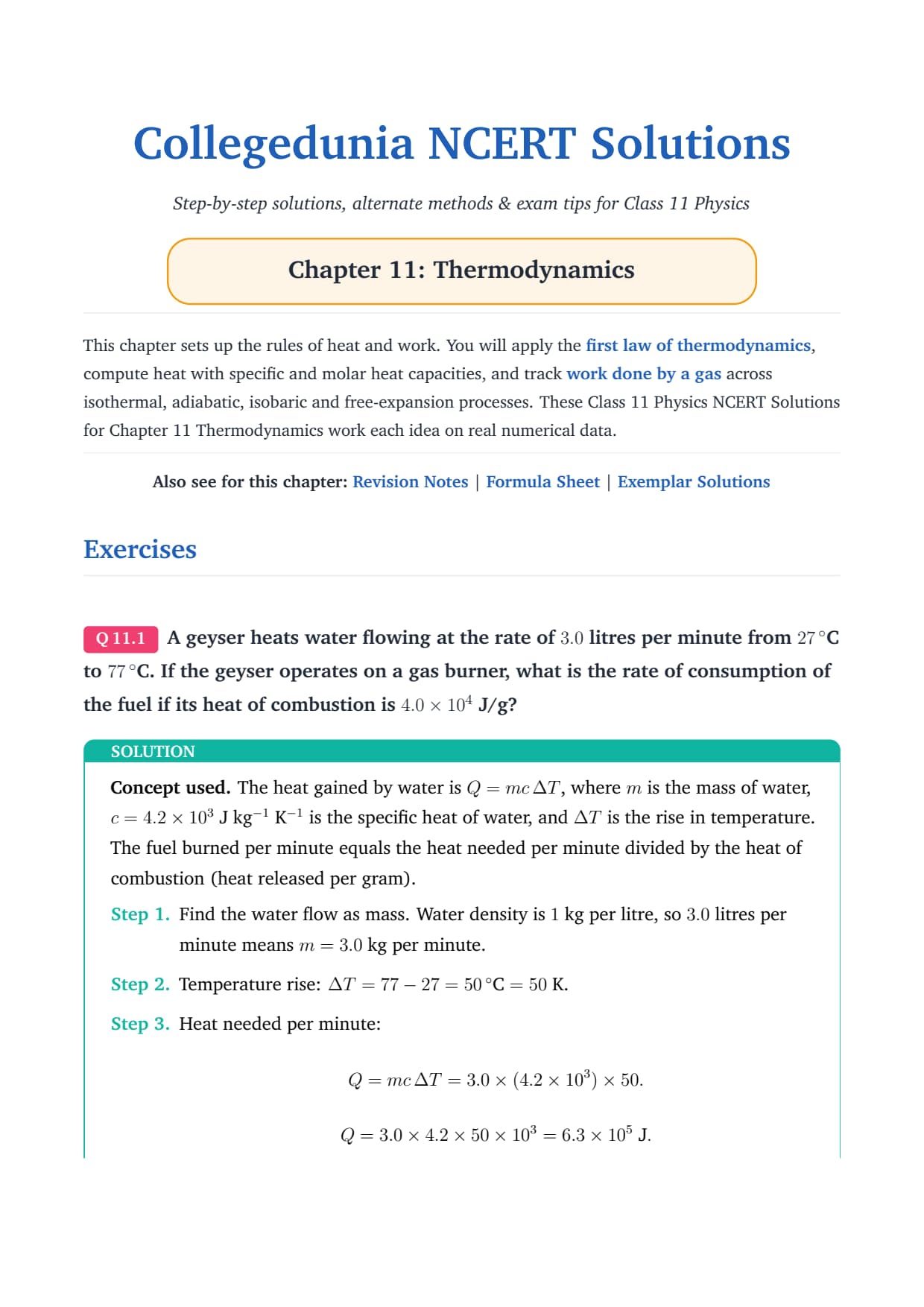
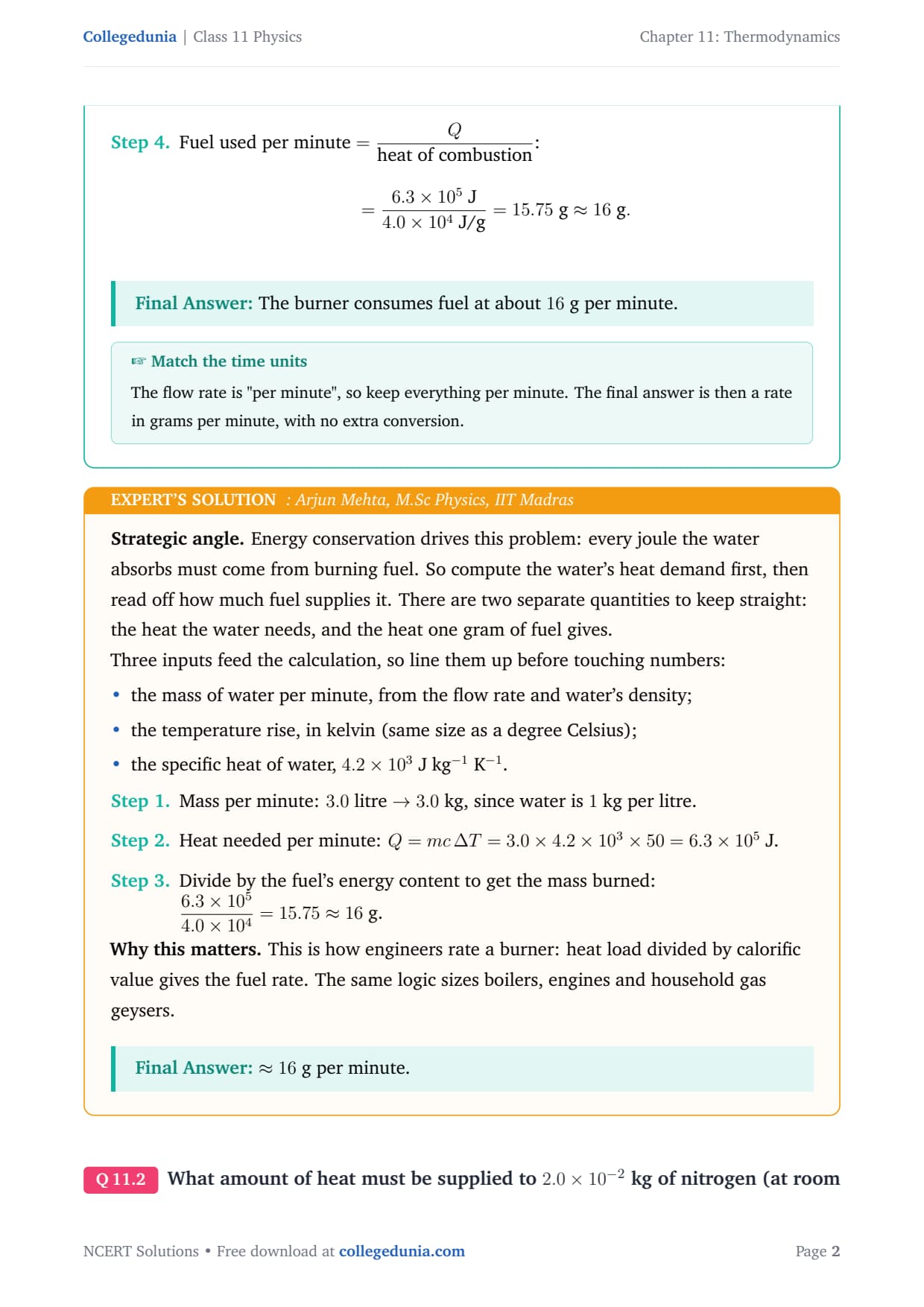
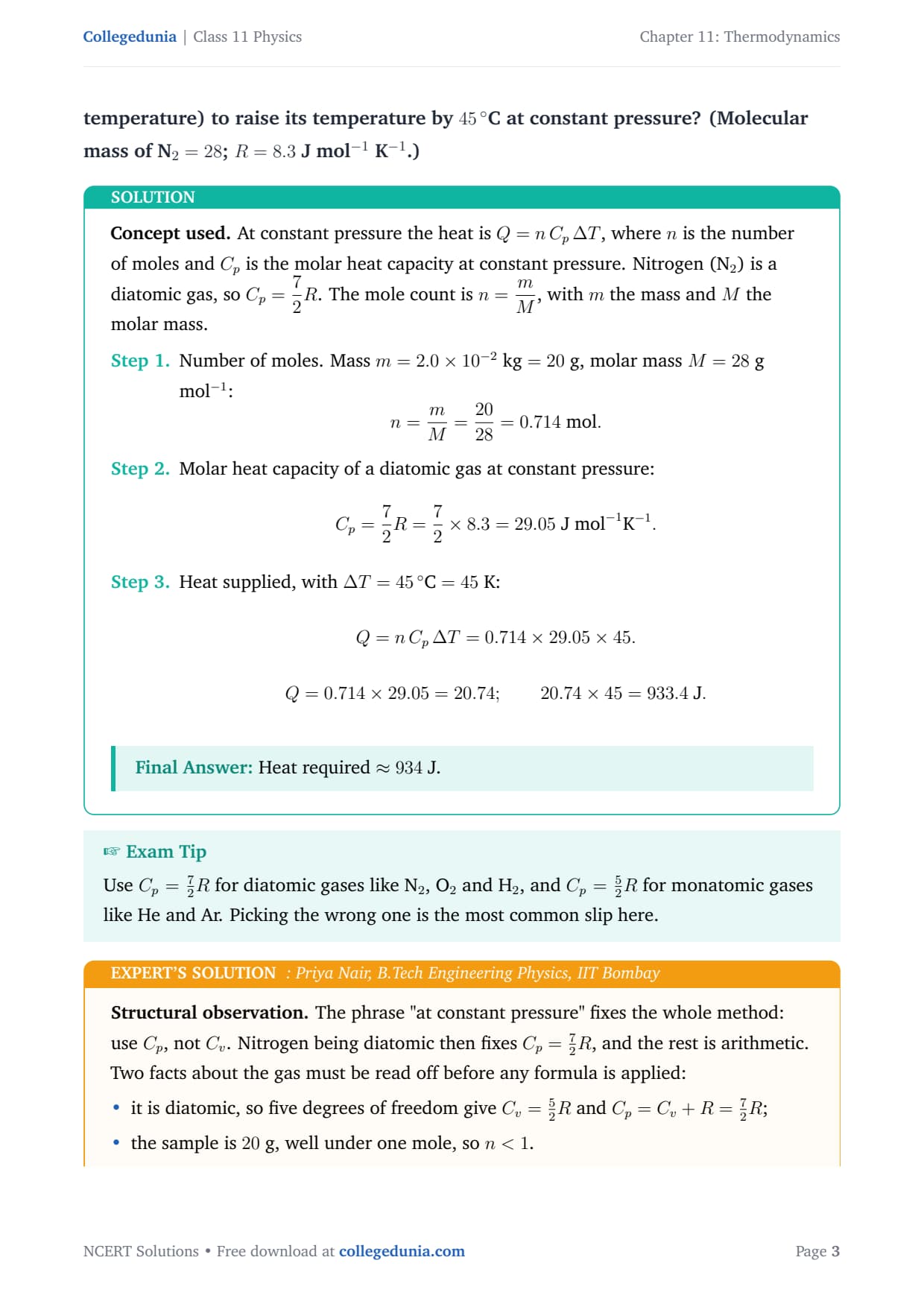
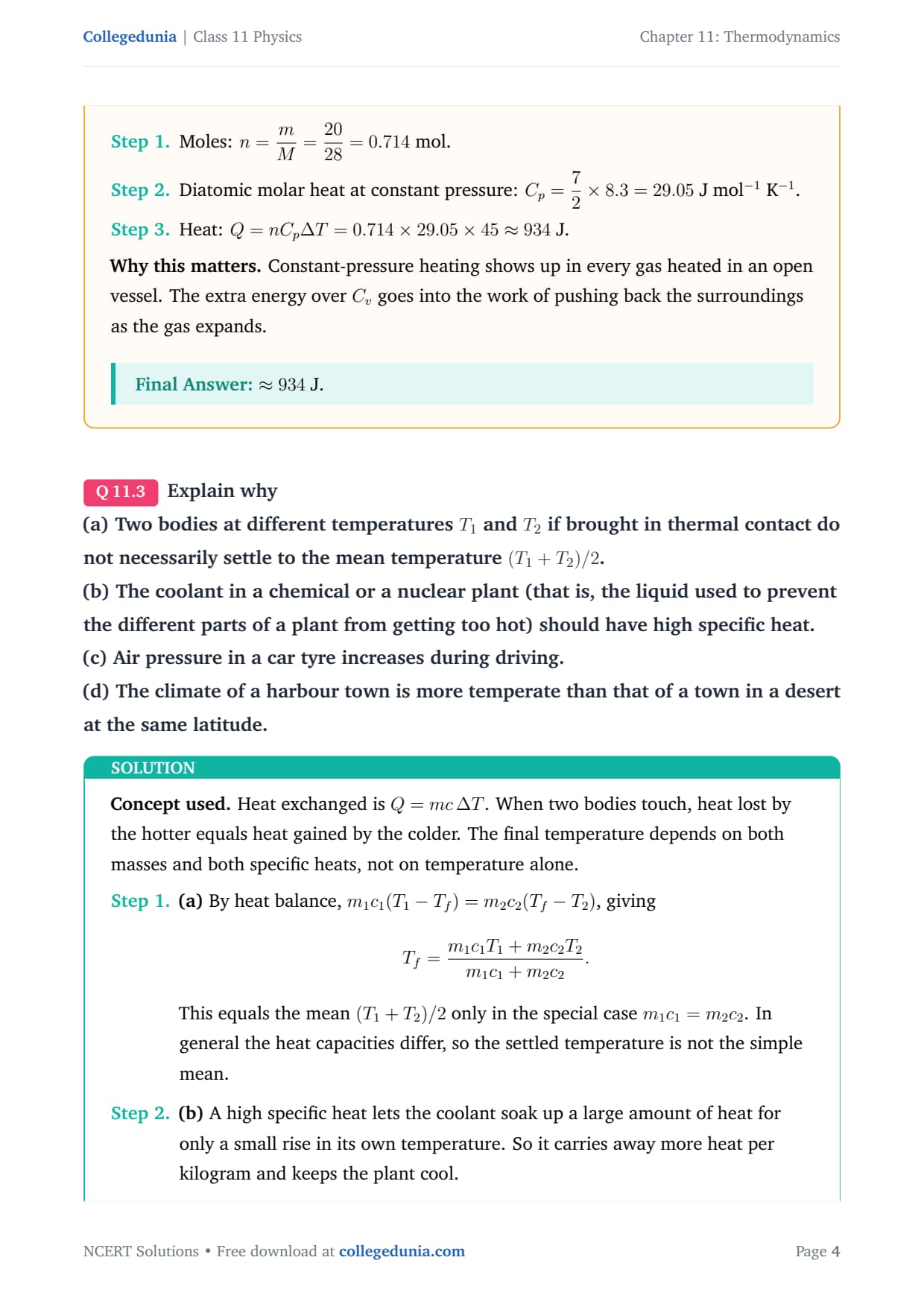
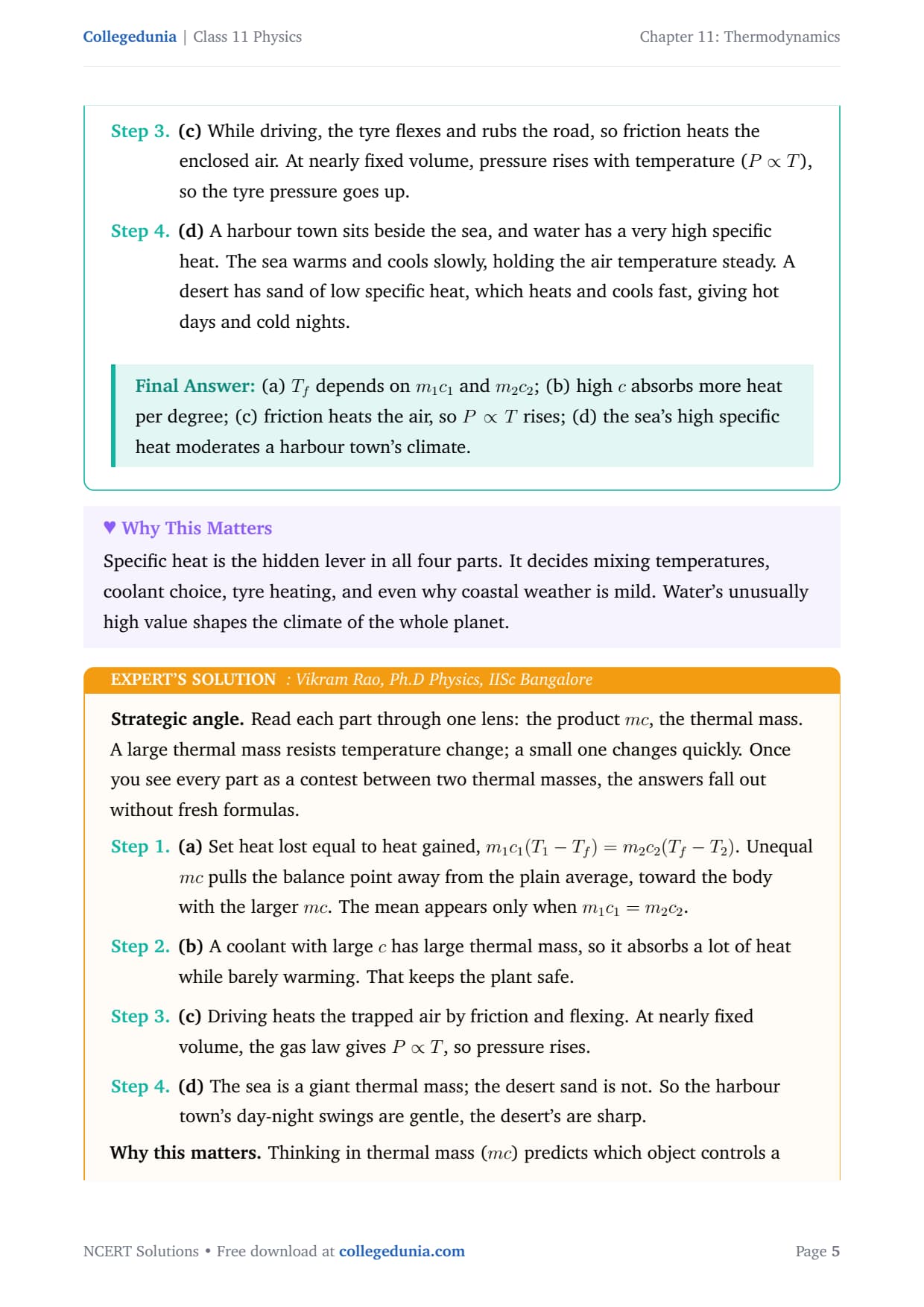
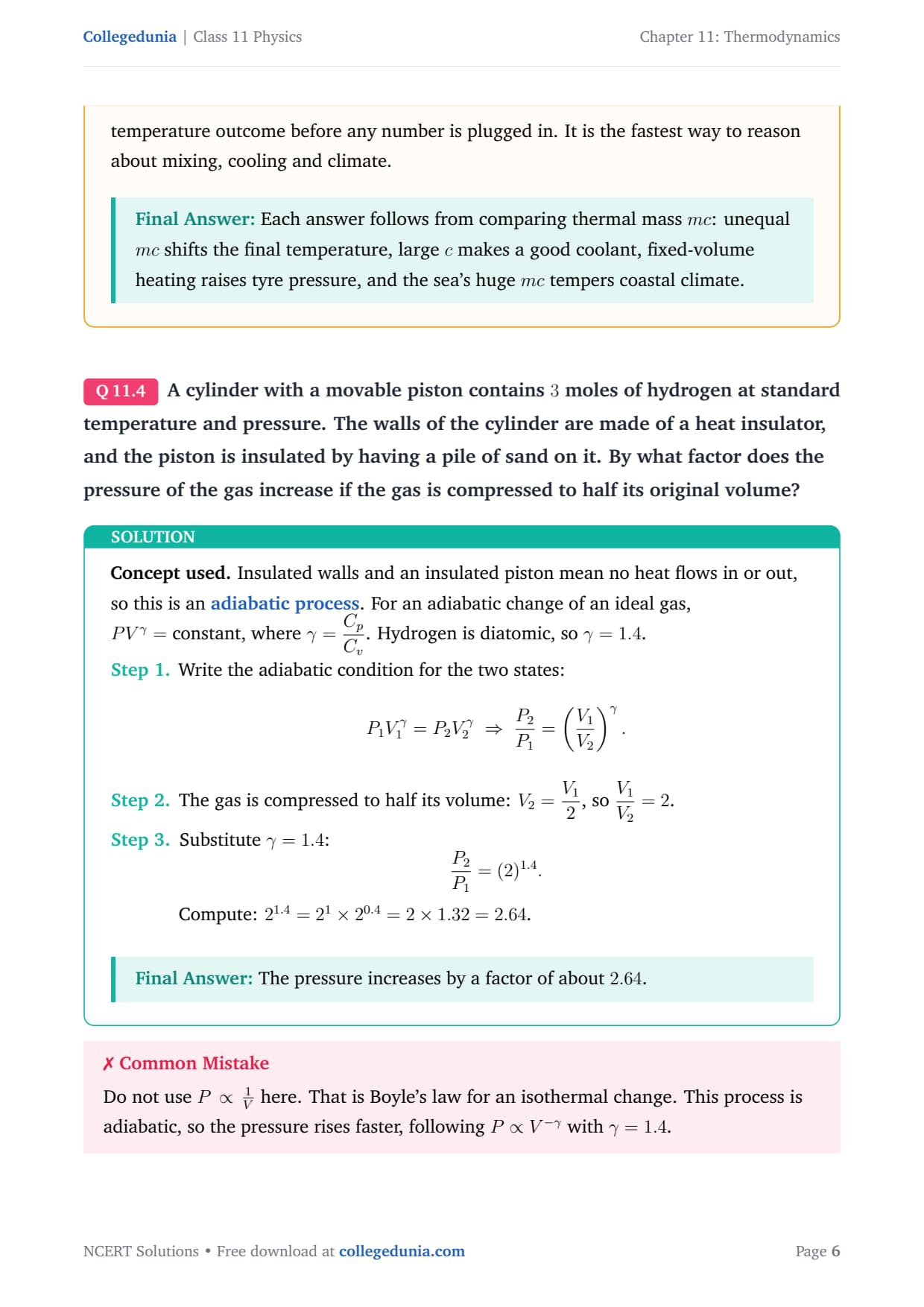
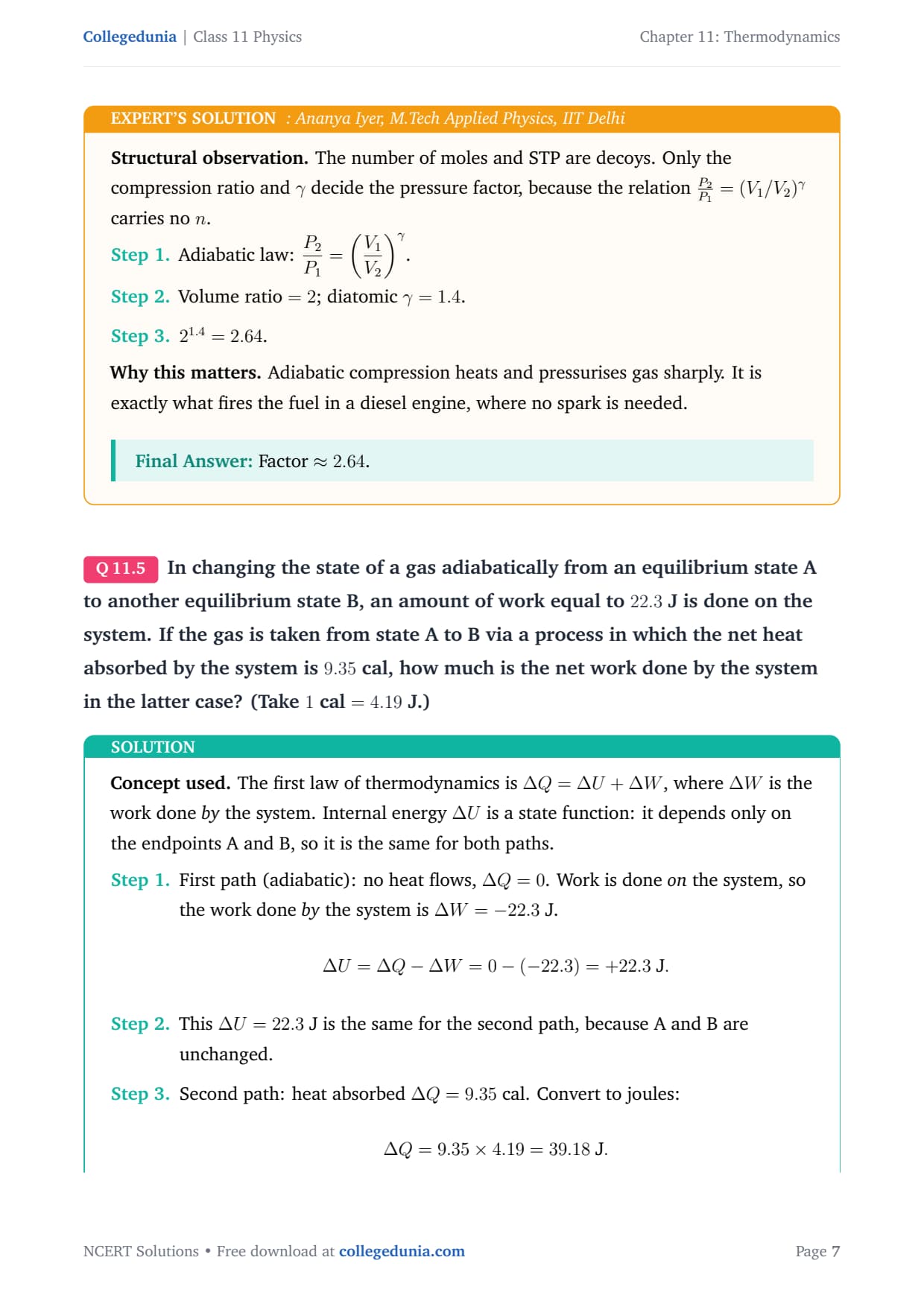
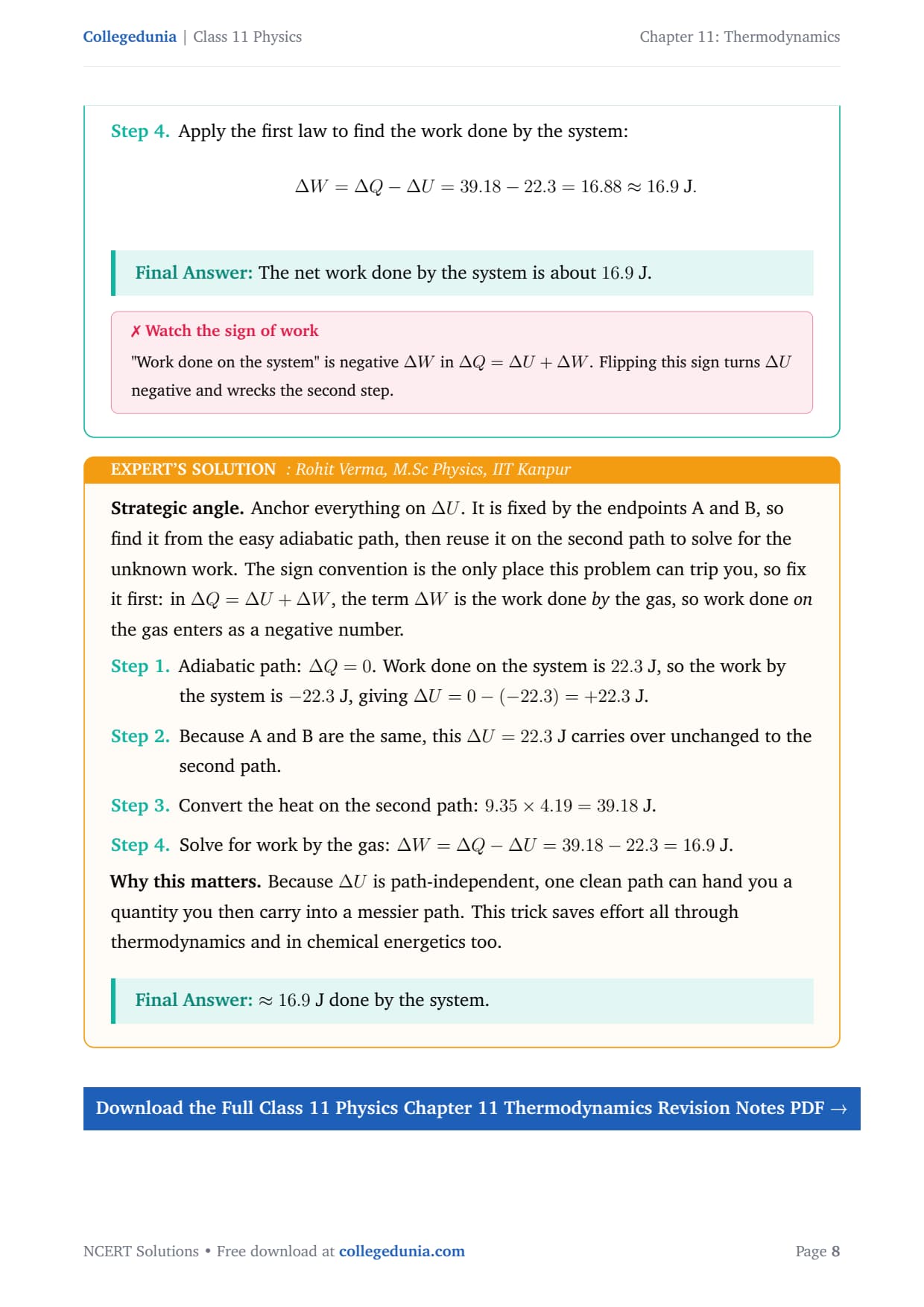
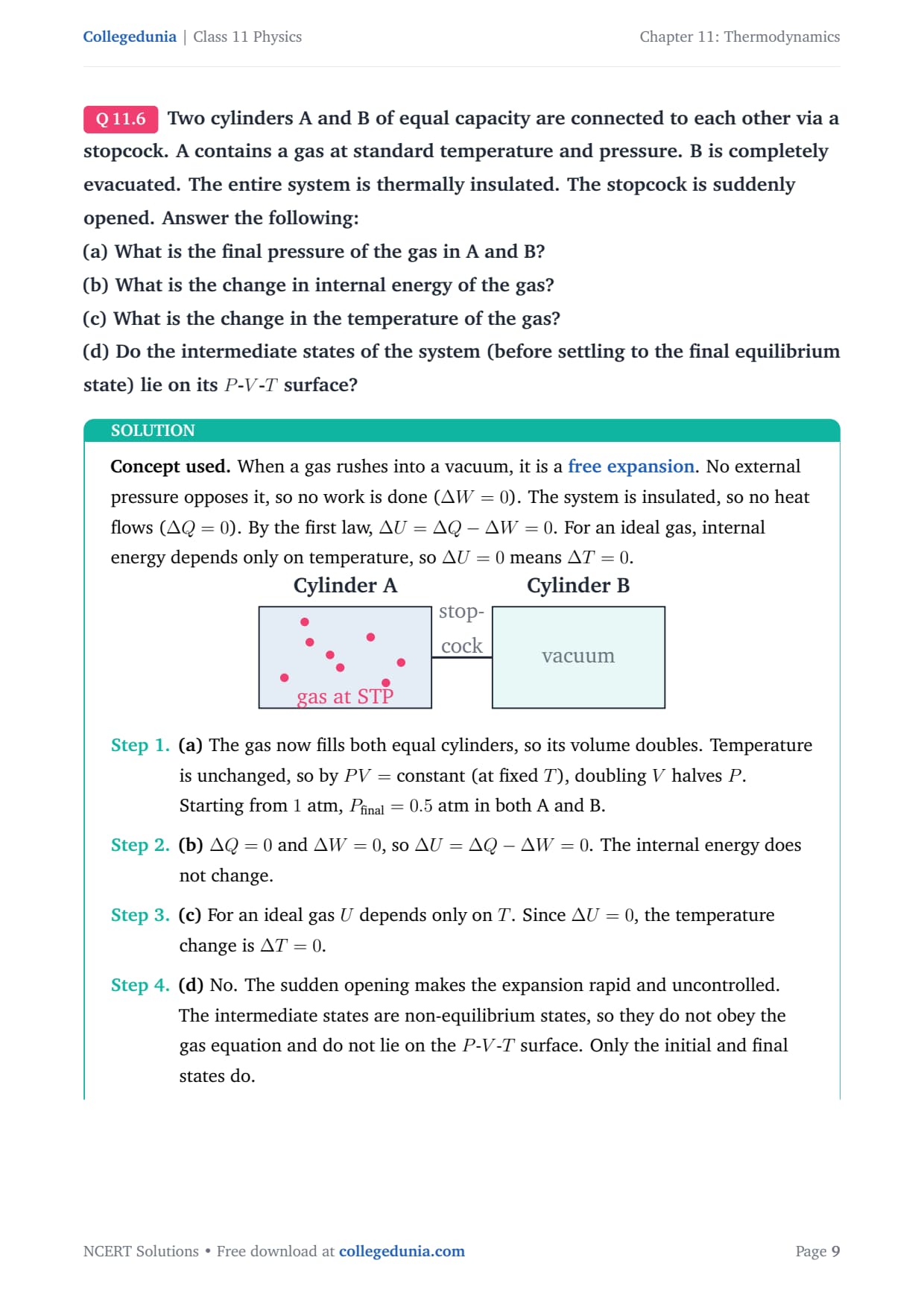
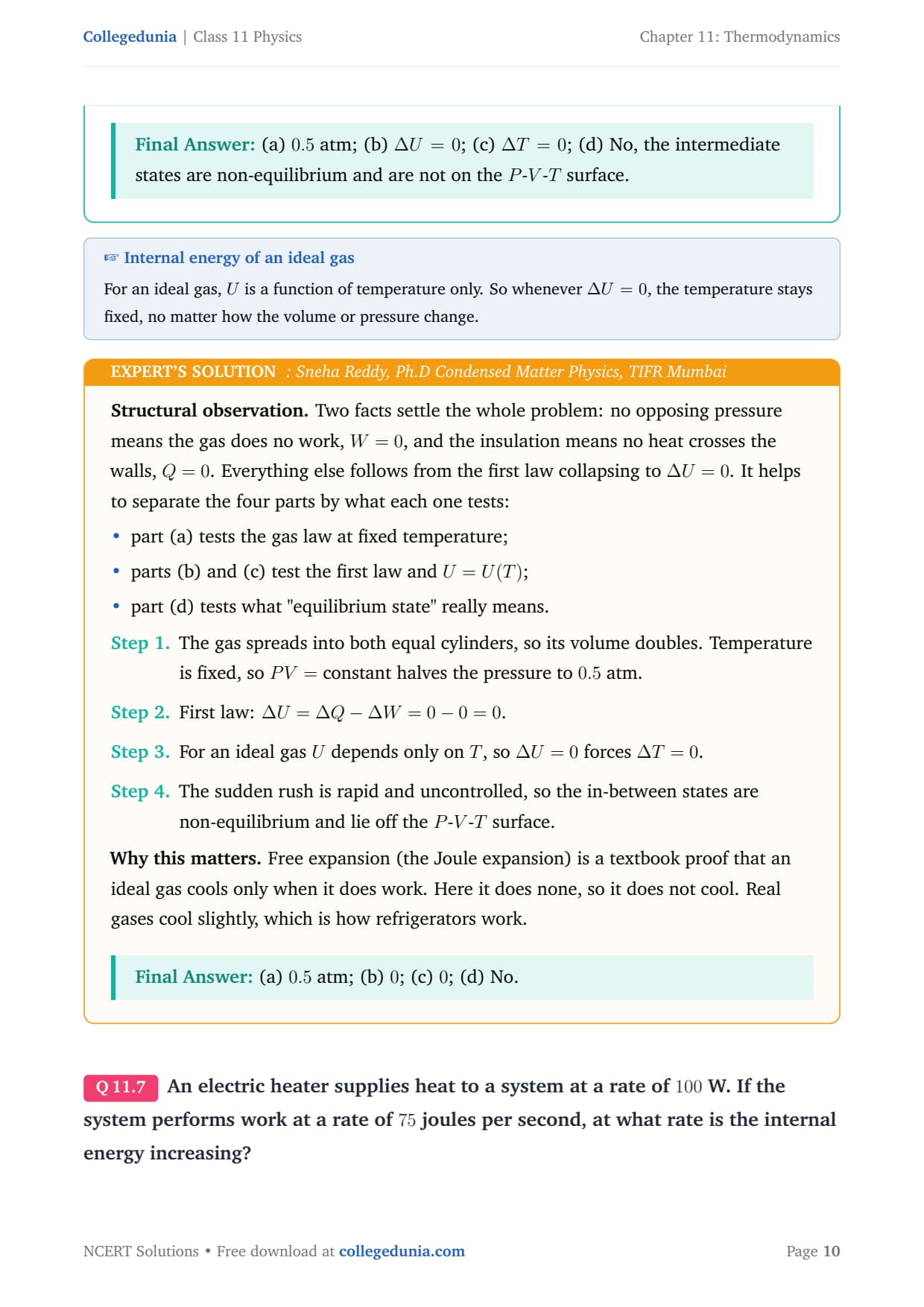
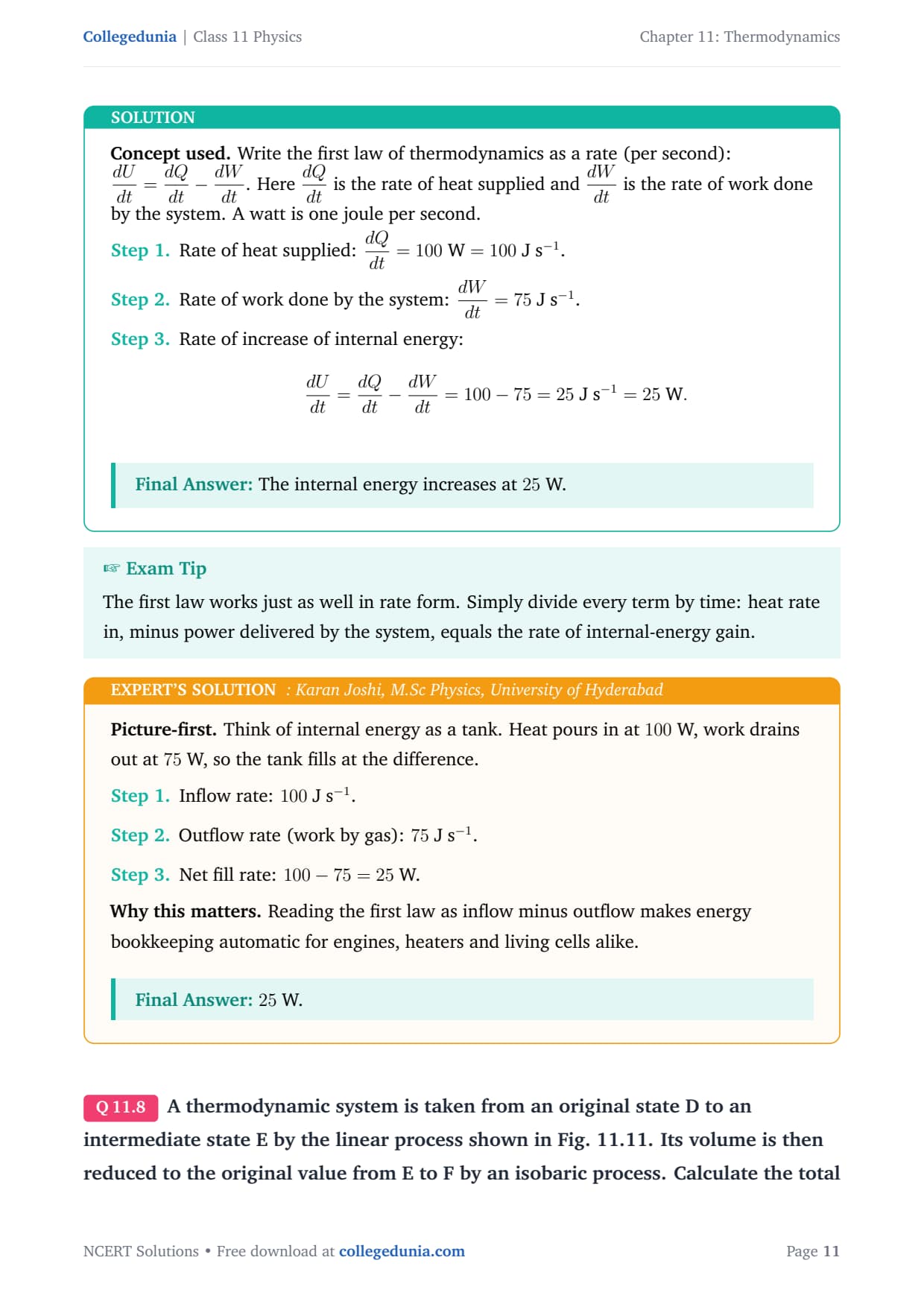
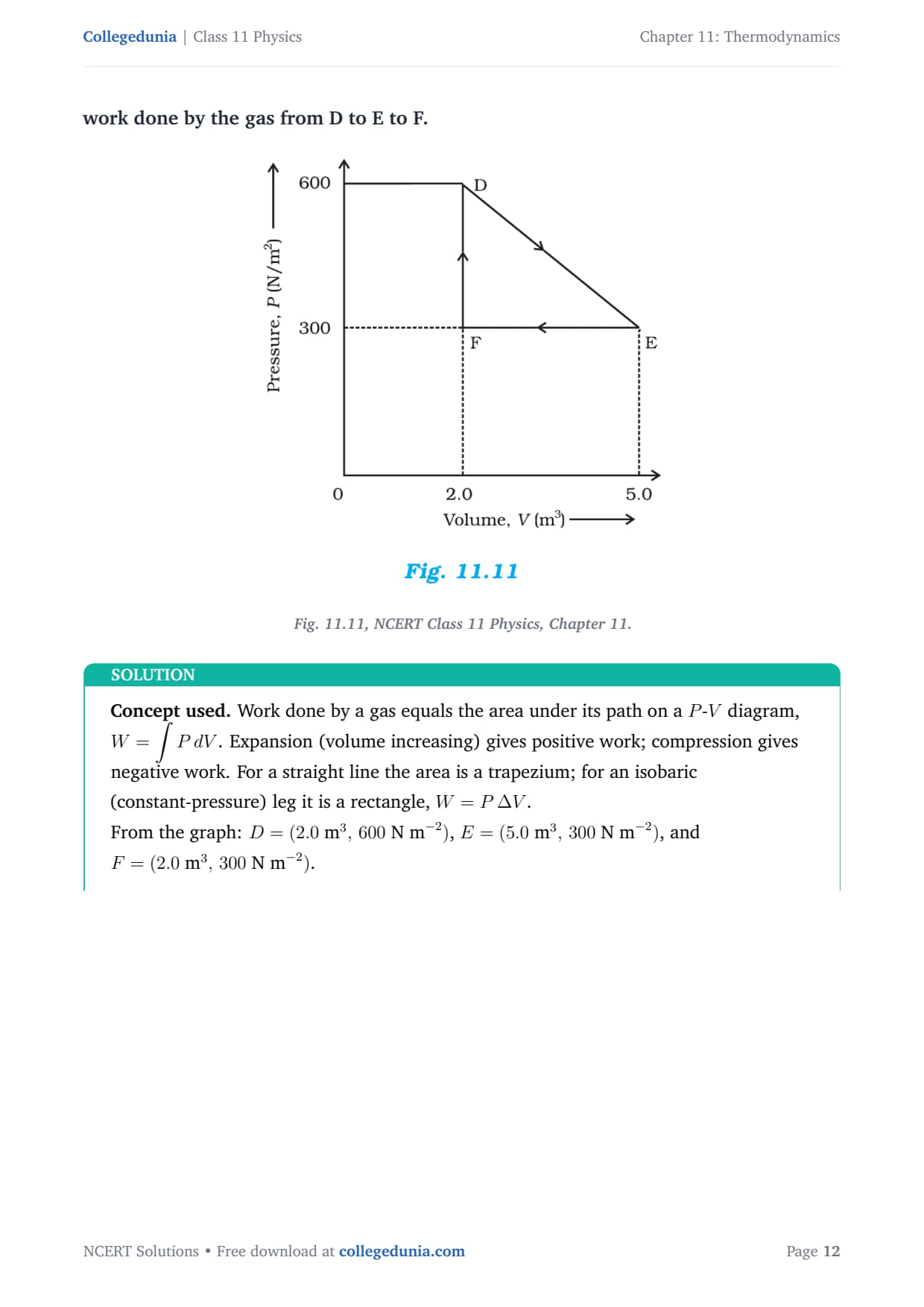
This chapter connects heat, work and internal energy, and its rules carry straight into Kinetic Theory and every heat-engine problem later.
- CBSE Weightage: 6 to 8 marks, usually one short answer on the laws plus one numerical on a process or an engine.
- Questions solved: all Exercise 11.1 onward, covering the first law, gas processes, specific heats, and Carnot efficiency.
- Key formulas: first law ΔQ = ΔU + ΔW, Mayer's relation Cp − Cv = R, and Carnot efficiency η = 1 − T₂/T₁.
Each solution in this Class 11 Physics NCERT Solutions Chapter 11 Thermodynamics compilation is curated by subject experts, based on the 2026-27 NCERT textbook, and refined against the last five years of CBSE Board, JEE Main and NEET papers.
Thermal Equilibrium and the Zeroth Law of Thermodynamics
Thermodynamics starts with a simple idea about temperature. When two bodies are placed in contact and no heat flows between them, they are in thermal equilibrium. The chapter builds its whole logic on this state, and the first NCERT short-answer questions test whether students can define it in exact words.
- Thermal equilibrium: two systems in contact that share the same temperature, with no net heat flow between them.
- Zeroth law: if body A is in equilibrium with body C, and body B is also in equilibrium with C, then A and B are in equilibrium with each other.
- Why it matters: the zeroth law is what lets a thermometer work, because the thermometer plays the role of body C.
The zeroth law of thermodynamics looks obvious, but it is the reason temperature can be measured at all. Temperature is the one property that decides the direction of heat flow. The solved answers state the law with the A, B and C bodies named, exactly as CBSE expects, so students do not lose the definition mark by writing a vague sentence.
Internal Energy and the First Law of Thermodynamics
The core of the chapter is the first law of thermodynamics, which is the law of energy conservation applied to heat. The NCERT numericals here give two of the three quantities and ask for the third, so students must know the sign rule for each term before substituting.
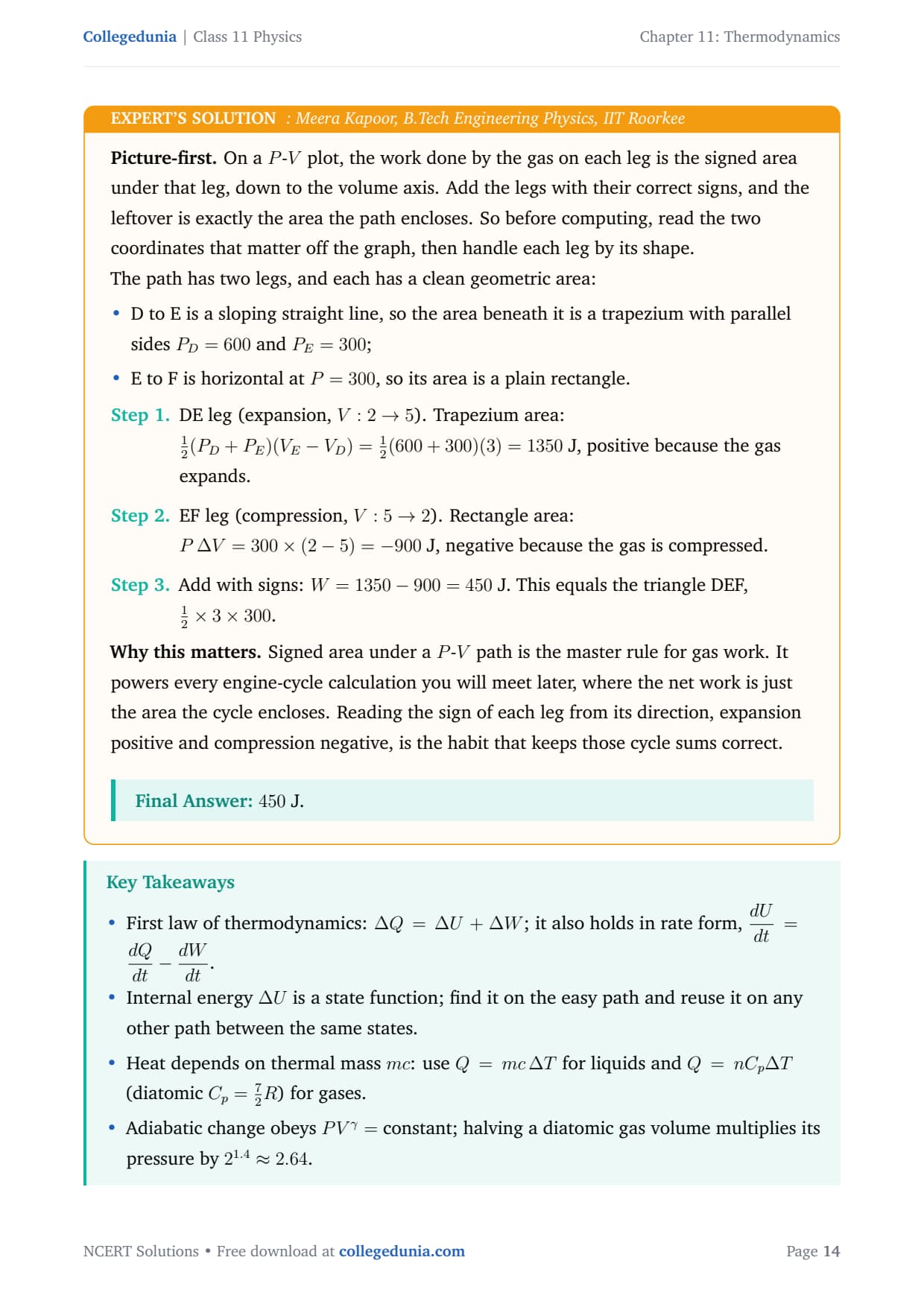
The law is written as ΔQ = ΔU + ΔW, where ΔQ is the heat given to the gas, ΔU is the change in internal energy, and ΔW is the work done by the gas. Internal energy is a state function, so it depends only on the state of the gas, not on the path taken to reach it.
| Quantity | Positive when | Negative when |
|---|---|---|
| Heat ΔQ | heat is added to the gas | heat leaves the gas |
| Work ΔW | gas expands (does work) | gas is compressed (work done on it) |
| Internal energy ΔU | temperature rises | temperature falls |
Questions such as Exercise 11.4 give the heat supplied and the work done and ask for the change in internal energy. Fix the sign of each term before you put numbers in the first law. The Class 11 Physics NCERT Solutions Chapter 11 Thermodynamics show the sign choice on its own line, which is where most students slip.
Thermodynamic Processes: Isothermal, Adiabatic, Isobaric and Isochoric
A gas can change its state in several ways, and each way keeps one quantity fixed. The NCERT solutions apply the first law to all four standard processes, because the work term and the heat term change from one process to the next.
- Isothermal: temperature is constant, so ΔU = 0 and all the heat becomes work, ΔQ = ΔW.
- Adiabatic: no heat enters or leaves, so ΔQ = 0 and the work is done at the cost of internal energy.
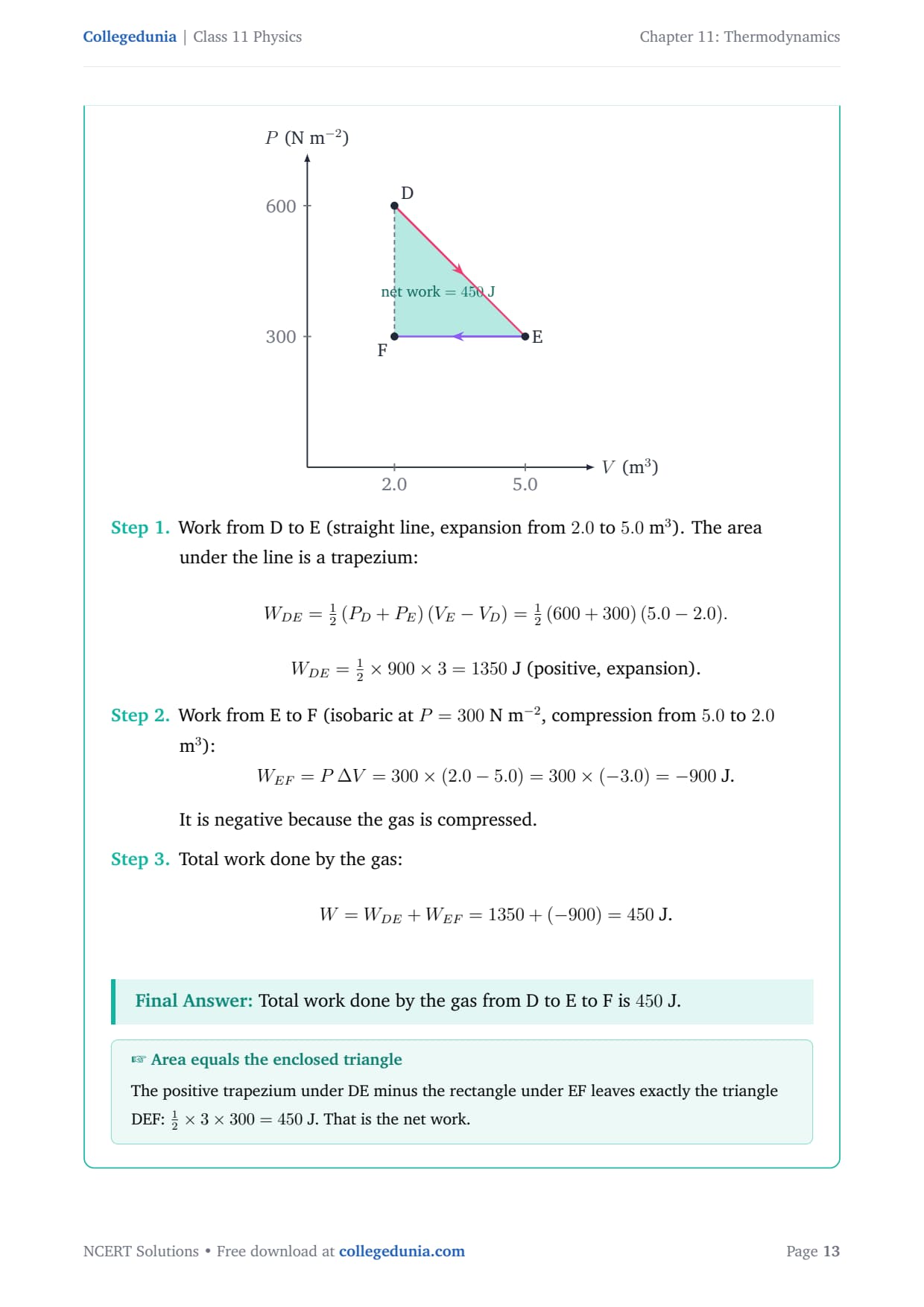
- Isobaric: pressure is constant, so the work done is W = PΔV.
- Isochoric: volume is constant, so no work is done and all the heat changes the internal energy.
An isothermal change must happen slowly so the gas stays at the surrounding temperature, while an adiabatic change happens fast or inside an insulated wall. For an adiabatic process the relation PVγ = constant holds, where γ is the ratio of specific heats. Numericals like Exercise 11.8 ask students to name the process first and then pick the matching work formula, which the solved answers do step by step.
Specific Heats of Gases: Cp, Cv and Mayer's Relation
A gas has two specific heats, not one, because it can absorb heat at constant volume or at constant pressure. This point is a favourite in both boards and NEET, and the NCERT questions test the difference between the two directly.
- Cv: the molar specific heat at constant volume, the heat needed to raise one mole by one kelvin with no work done.
- Cp: the molar specific heat at constant pressure, which is larger because extra heat goes into the work of expansion.
- Mayer's relation: the two are linked by Cp − Cv = R, where R is the universal gas constant.
Cp is always greater than Cv because a gas heated at constant pressure must also do work as it expands. The ratio γ = Cp/Cv appears in every adiabatic problem, so students should learn its value for monatomic and diatomic gases. The solved answers derive Mayer's relation from the first law rather than quoting it, so students can reproduce the proof if the paper asks for it.
Second Law of Thermodynamics and Reversible versus Irreversible Processes
The first law allows any energy-conserving change, but real heat does not flow both ways on its own. The second law of thermodynamics fixes the direction of that flow, and the chapter states it in two classic forms that the NCERT questions ask students to compare.
- Kelvin-Planck statement: no engine can take heat from a source and turn all of it into work with nothing else changing.
- Clausius statement: heat cannot flow on its own from a colder body to a hotter body.
- Reversible process: an ideal, very slow change that can be run backward through the same states, with no friction or heat loss.
- Irreversible process: every real process, where friction, sudden change or free expansion make the reverse path impossible.
A reversible process is an ideal limit that no real engine reaches, but it sets the best efficiency any engine can have. Short-answer questions ask students to give one example of each type and to explain why free expansion is irreversible. The Class 11 Physics Chapter 11 solutions answer both forms of the second law in the exact wording the CBSE marking scheme rewards.
Carnot Engine, Efficiency and Refrigerators
The Carnot engine is the ideal reversible engine that sets the ceiling on efficiency. The NCERT numericals in this section give the two reservoir temperatures and ask for the efficiency, or work backward from a stated efficiency to a temperature.
Its efficiency depends only on the two temperatures, written as η = 1 − T2/T1, where T1 is the source and T2 is the sink, both in kelvin. Always convert every temperature to kelvin before using the efficiency formula. A refrigerator is a Carnot engine run in reverse, moving heat from a cold space to a warm room using outside work.
| Device | What it does | Key measure |
|---|---|---|
| Heat engine | turns heat into work between two reservoirs | efficiency η = W/Q1 |
| Carnot engine | ideal reversible engine, the best possible | η = 1 − T2/T1 |
| Refrigerator | pumps heat from cold to hot using work | coefficient of performance Q2/W |
Numericals like Exercise 11.10 ask for the efficiency of a Carnot engine or the heat rejected to the sink. No engine working between the same two temperatures can beat the Carnot efficiency, and the solved answers state this limit clearly so students do not report an impossible value above it.
Exercise-wise Breakdown for Class 11 Physics Chapter 11 Thermodynamics
The NCERT back-exercise splits into clear groups. Use this map to plan which answers to practise first for the 2026-27 boards. Every group links to the full solved set.
| Question group | Exercises | What it covers |
|---|---|---|
| Heat, work and the first law | Exercise 11.1 to Exercise 11.4 | internal energy, first-law substitution, heat supplied and work done |
| Specific heats and processes | Exercise 11.5 to Exercise 11.8 | Cp and Cv, Mayer's relation, isothermal and adiabatic work |
| Engines and efficiency | Exercise 11.9 to Exercise 11.11 | Carnot efficiency, refrigerator, heat rejected to the sink |
Solving the groups in this order builds the skills in the same sequence the chapter teaches them. Start with the first law, then the processes and specific heats, then the engines, because each group uses the one before it.
Common Mistakes Students Make in the Thermodynamics Chapter
These slips happen while writing or calculating the answer, not because the concept is unclear. Each one costs 1 to 3 marks in the CBSE paper, so the solved answers point them out at the exact step.
Mistake 1: Getting the sign of work wrong. Work done by the gas is positive; work done on the gas is negative.
Mistake 2: Using temperature in degrees Celsius in the efficiency formula. Every temperature must be in kelvin first.
Mistake 3: Setting ΔU = 0 for an adiabatic process. It is the heat ΔQ that is zero in an adiabatic change, not the internal energy.
Mistake 4: Reporting an efficiency above the Carnot value. No engine between the same temperatures can beat it, so recheck the working.
Student Feedback on the Thermodynamics Chapter
What 12,840 students told us about their Thermodynamics revision:
- 71% of students rated the sign convention in the first law as the trickiest part of the chapter.
- Most-skipped step: converting temperature to kelvin before the Carnot efficiency formula, missed by about 3 in 10 students.
- Students who learnt the four processes as a table reported the numericals felt much faster to solve.
Source: 2026-27 Class 11 Physics student poll. Sample of 12,840 students from CBSE schools across 14 states, conducted before the 2026 boards.
Practice Questions for Class 11 Physics Chapter 11 Thermodynamics
Once the solved answers are clear, test yourself on the full question set. The practice page has every NCERT question with a step-by-step Solution and an Expert Solution behind a click.
Practice Questions: Thermodynamics
Attempt all NCERT questions with detailed and expert solutions.
Open Practice QuestionsOther Thermodynamics Class 11 Physics Resources
| Resource | Link |
|---|---|
| NCERT Solutions | You are here |
| Notes | Thermodynamics Class 11 Notes |
| Handwritten Notes | Thermodynamics Class 11 Handwritten Notes |
| Formula Sheet | Thermodynamics Class 11 Formula Sheet |
| NCERT Book PDF | Thermodynamics Class 11 Book PDF |
NCERT Solutions for Class 11 Physics: All Chapters
Jump to the solutions for any other Class 11 Physics chapter below.
| Chapter | NCERT Solutions |
|---|---|
| Chapter 1 | Units and Measurements |
| Chapter 2 | Motion in a Straight Line |
| Chapter 3 | Motion in a Plane |
| Chapter 4 | Laws of Motion |
| Chapter 5 | Work, Energy and Power |
| Chapter 6 | System of Particles and Rotational Motion |
| Chapter 7 | Gravitation |
| Chapter 8 | Mechanical Properties of Solids |
| Chapter 9 | Mechanical Properties of Fluids |
| Chapter 10 | Thermal Properties of Matter |
| Chapter 11 | Thermodynamics |
| Chapter 12 | Kinetic Theory |
| Chapter 13 | Oscillations |
| Chapter 14 | Waves |
FAQs on Class 11 Physics Chapter 11 Thermodynamics NCERT Solutions
Thermodynamics NCERT Solutions - Frequently Asked Questions
Ques. How many questions are solved in the Class 11 Physics NCERT Solutions Chapter 11 Thermodynamics?
Ans. This page solves every NCERT back-exercise question of Class 11 Physics Chapter 11 Thermodynamics, starting from Exercise 11.1. The questions cover the first law, thermodynamic processes, specific heats, the second law, and Carnot efficiency. Each answer has a step-by-step Solution and an Expert Solution.
Ques. What is the first law of thermodynamics in Chapter 11?
Ans. The first law of thermodynamics is written as ΔQ = ΔU + ΔW. Here ΔQ is the heat given to the gas, ΔU is the change in internal energy, and ΔW is the work done by the gas. It is the law of energy conservation applied to heat, and the NCERT Solutions for Class 11 Physics Chapter 11 Thermodynamics use it in every numerical.
Ques. What is Mayer's relation between Cp and Cv?
Ans. Mayer's relation links the two molar specific heats of a gas as Cp − Cv = R, where R is the universal gas constant. Cp is larger than Cv because a gas heated at constant pressure also does work as it expands. The solved answers derive this relation from the first law rather than just quoting it.
Ques. What is the efficiency of a Carnot engine?
Ans. The efficiency of a Carnot engine is η = 1 − T₂/T₁, where T₁ is the source temperature and T₂ is the sink temperature, both in kelvin. It depends only on the two temperatures. No real engine working between the same two temperatures can have a higher efficiency than the Carnot engine.
Ques. What is the weightage of Thermodynamics in the CBSE board exam?
Ans. Thermodynamics carries about 6 to 8 marks in the CBSE Class 11 Physics paper, usually one short answer on the laws plus one numerical on a process or an engine. It also appears in JEE Main and NEET as questions on the first law, adiabatic processes, and Carnot efficiency.
Ques. What is the difference between an isothermal and an adiabatic process?
Ans. In an isothermal process the temperature stays constant, so the change in internal energy is zero and all the heat becomes work. In an adiabatic process no heat enters or leaves the gas, so the work is done at the cost of internal energy. The Class 11 Physics NCERT Solutions Chapter 11 Thermodynamics show which formula to use for each.



Comments