




The Class 11 Physics NCERT Solutions Chapter 9 Mechanical Properties of Fluids will help students prepare for Boards, JEE Main, JEE Advanced, NEET, CUET and NDA in 2026-27. Every back-exercise question is solved with full working, so students can check each pressure calculation, buoyancy problem, Bernoulli application, and surface-tension numerical step by step.
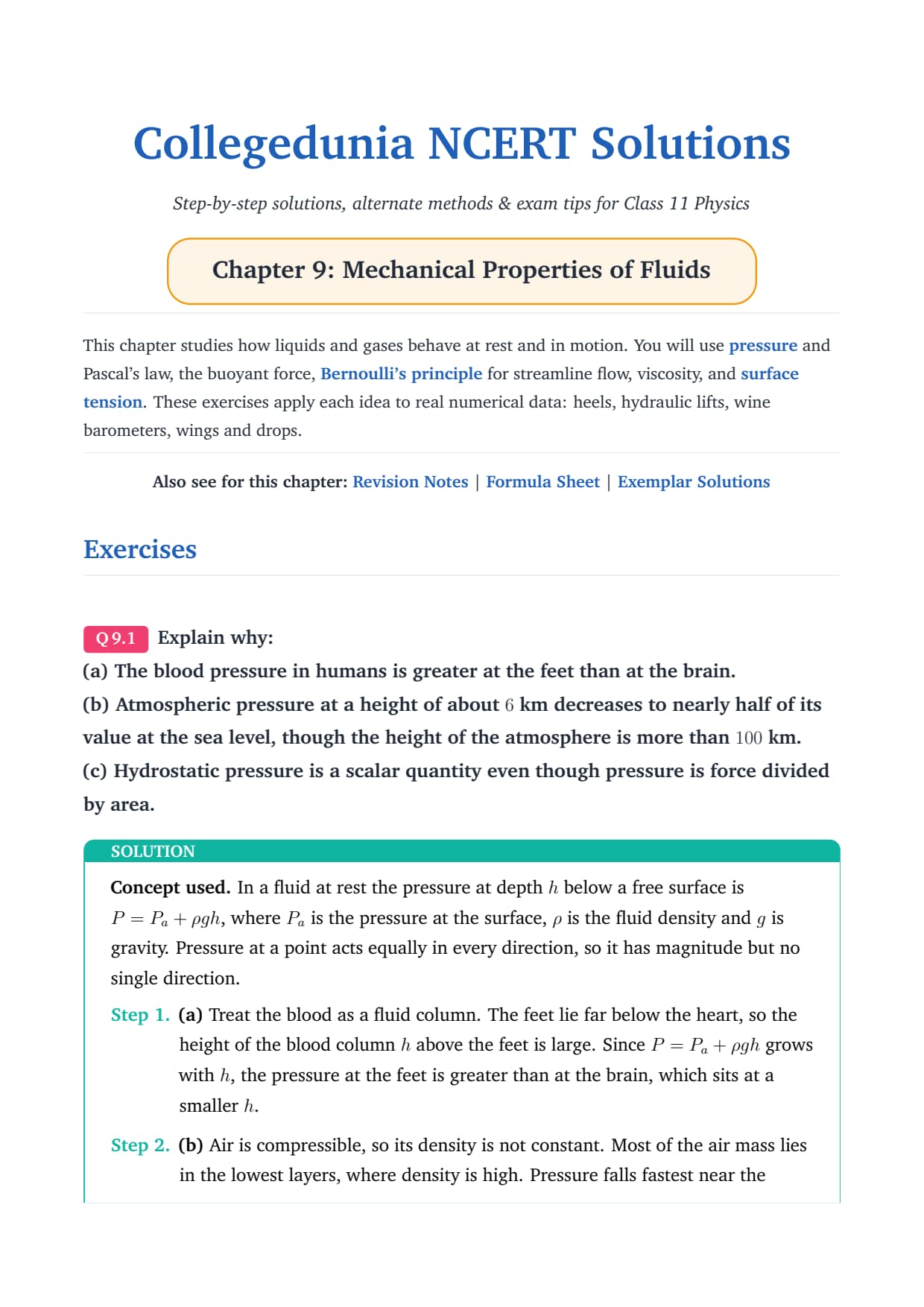
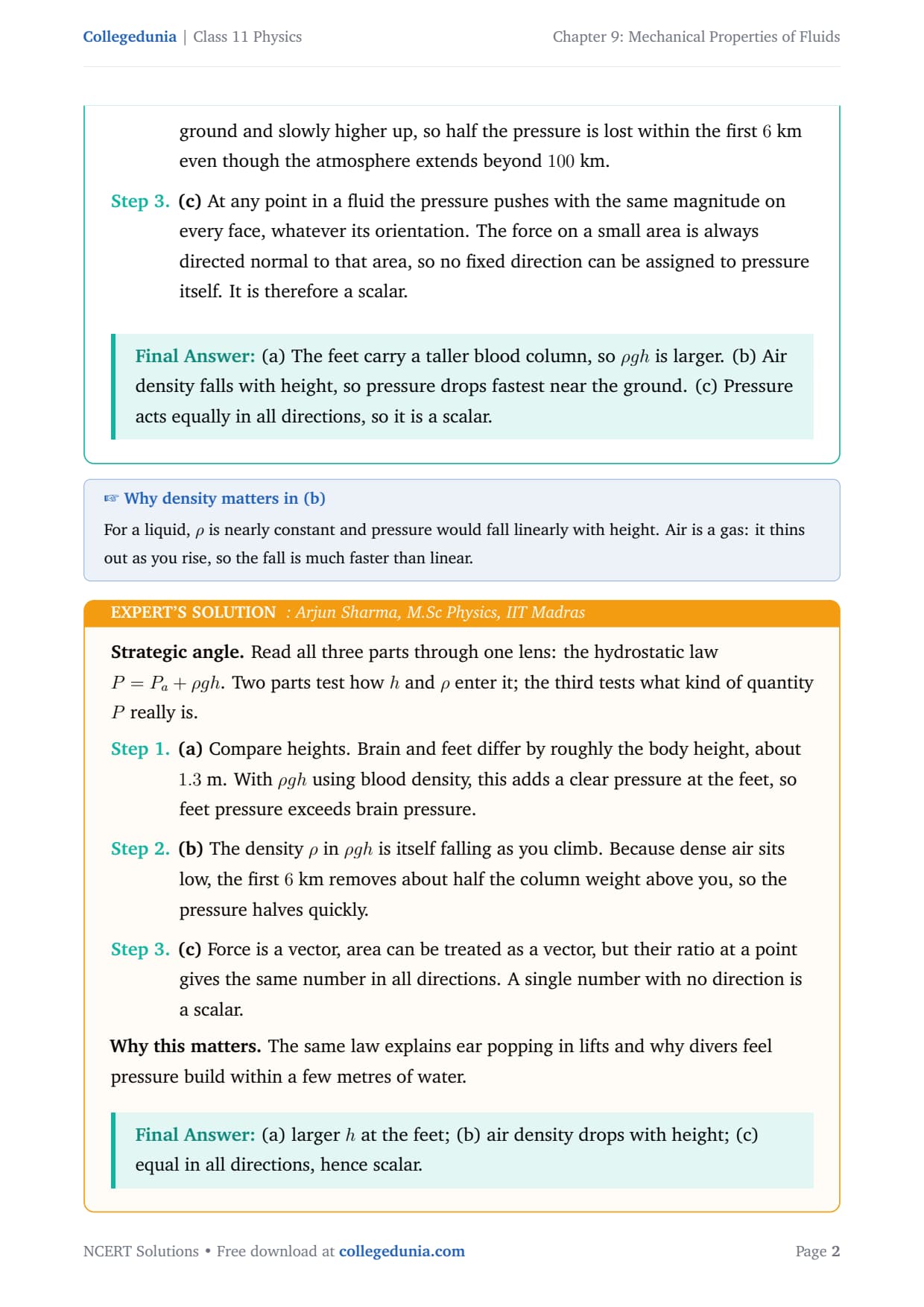
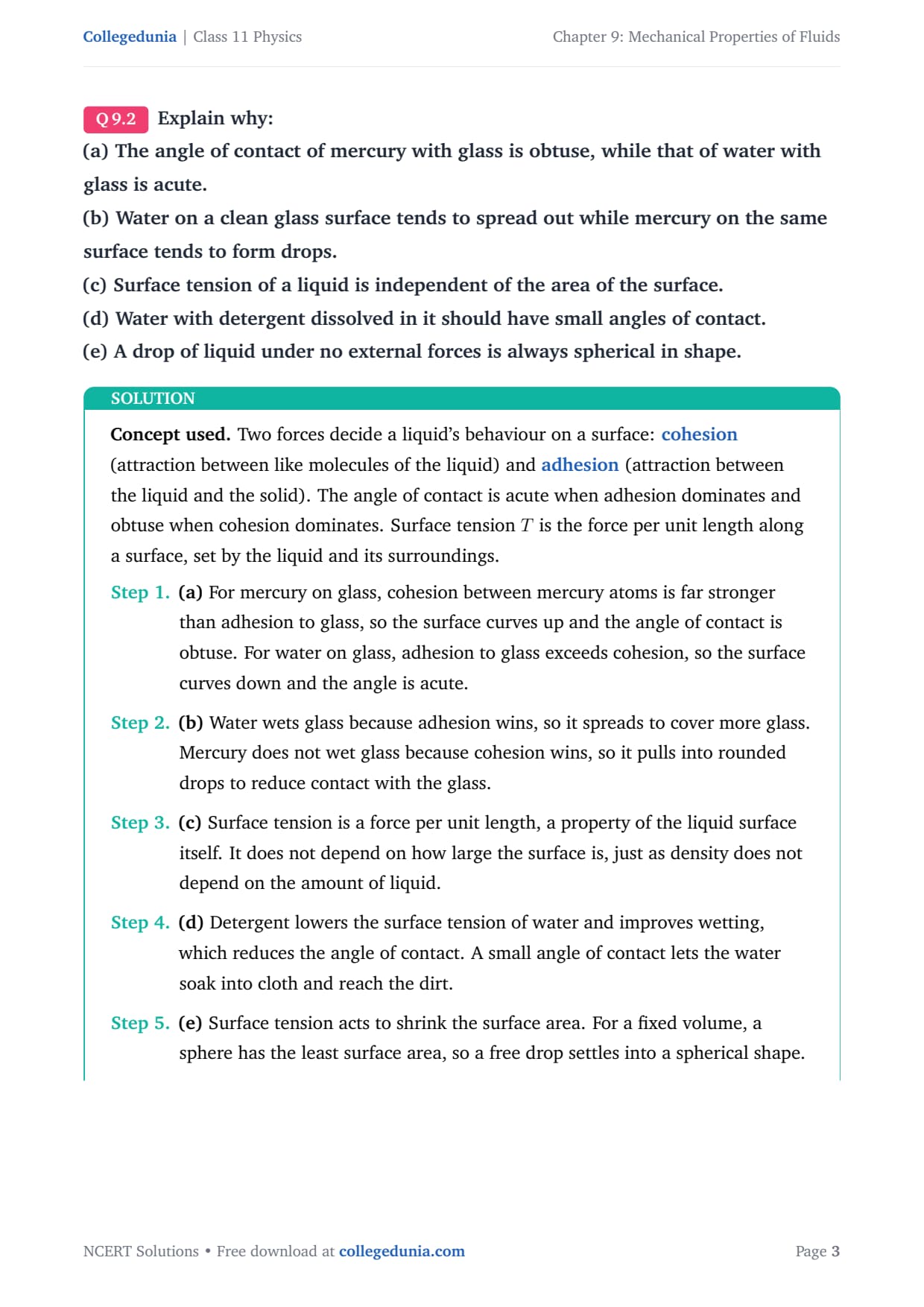
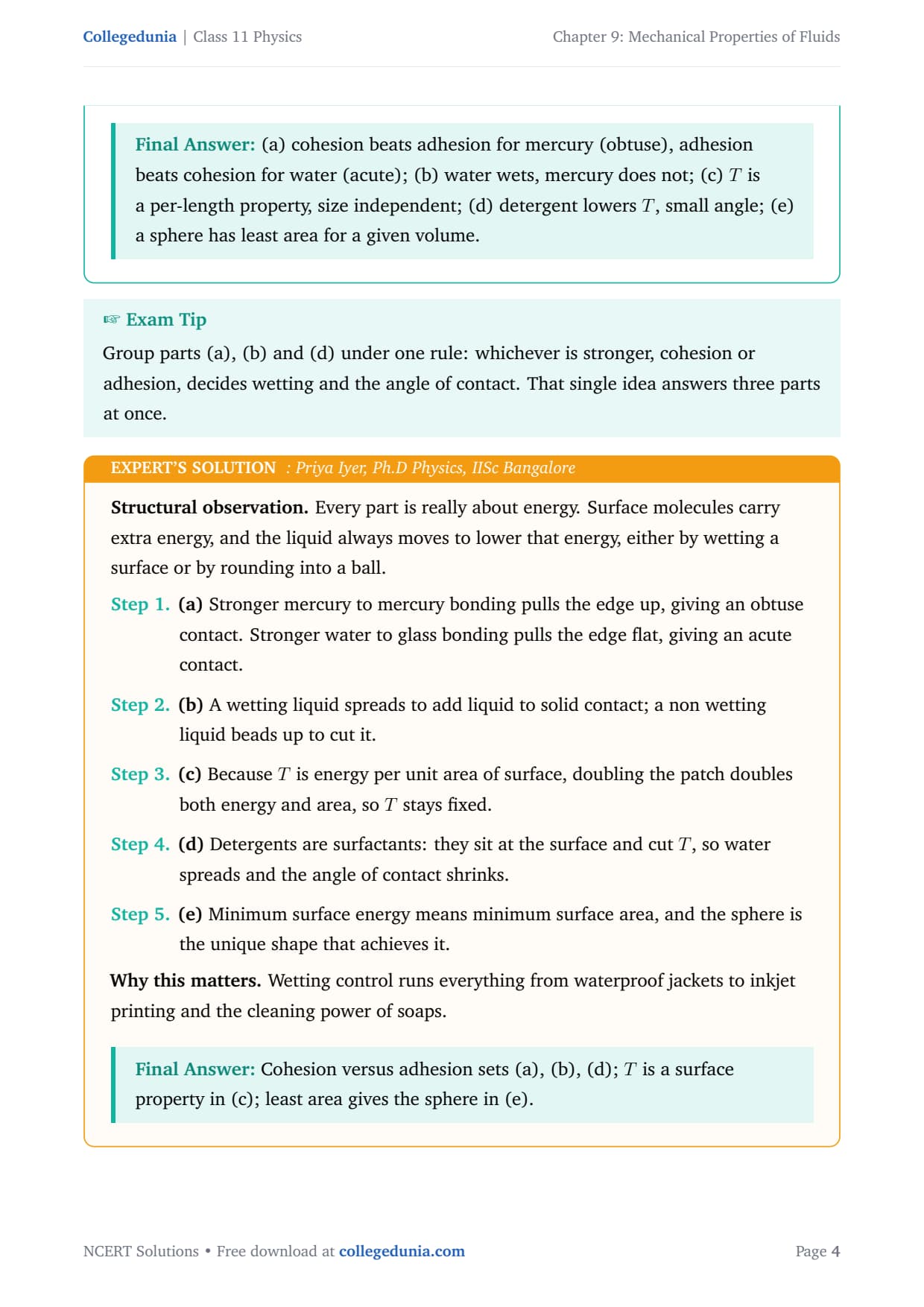
This chapter carries steady weightage in both the board paper and entrance tests, so a clean grip on it pays off across exams.
- CBSE Weightage: 4 to 6 marks, usually one short answer plus one numerical on pressure, Bernoulli, or surface tension.
- Questions solved: all Exercise 9.1 onward, covering pressure, buoyancy, fluid flow, viscosity, and surface tension.
- Key formulas: pressure with depth, Pascal's law, equation of continuity, Bernoulli's equation, Stokes' law, capillary rise.
Each solution in this Class 11 Physics NCERT Solutions Chapter 9 Mechanical Properties of Fluids compilation is curated by subject experts, based on the 2026-27 NCERT textbook, and refined against the last five years of CBSE Board, JEE Main and NEET papers.
Pressure in Fluids and Pascal's Law of Transmission
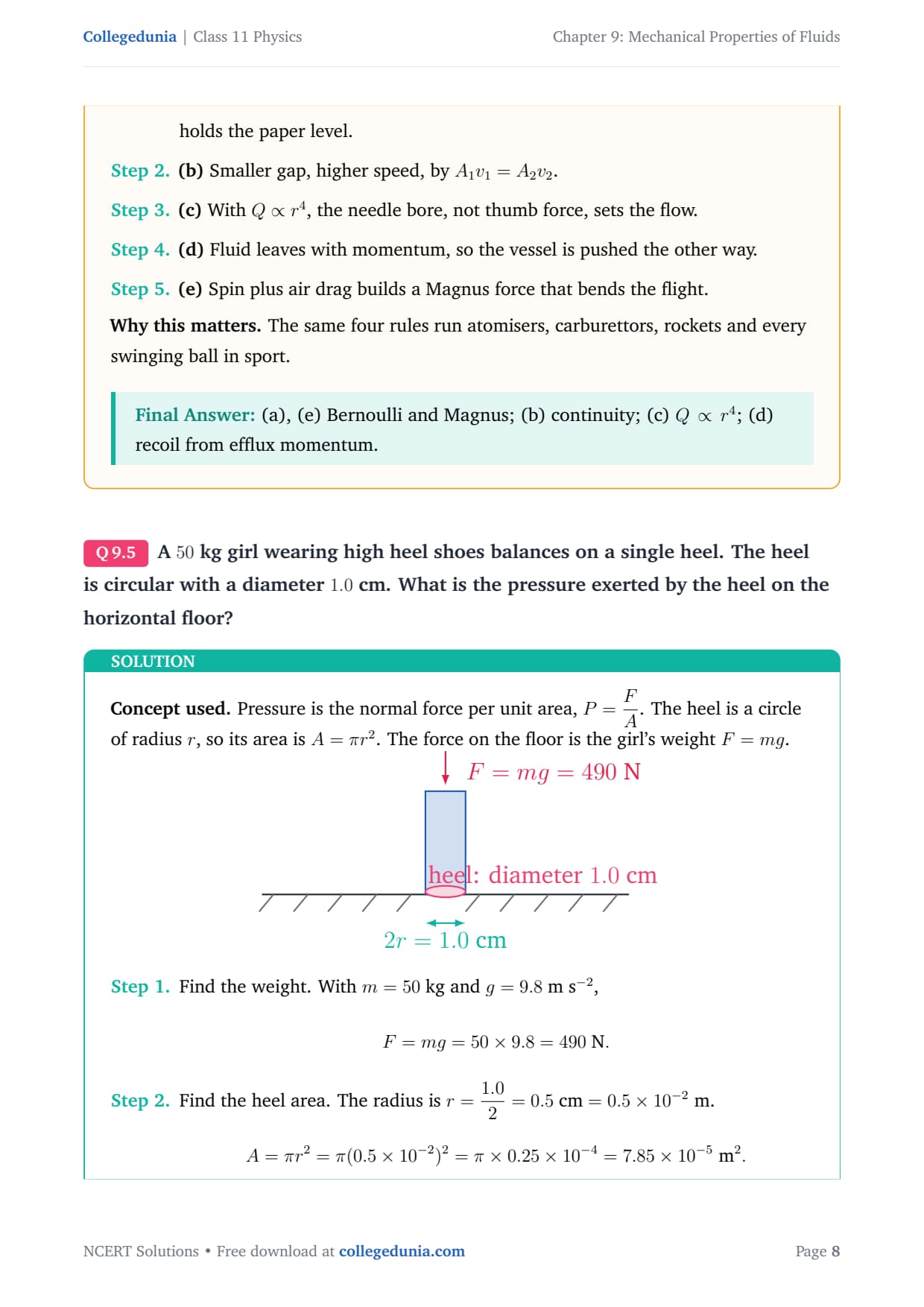
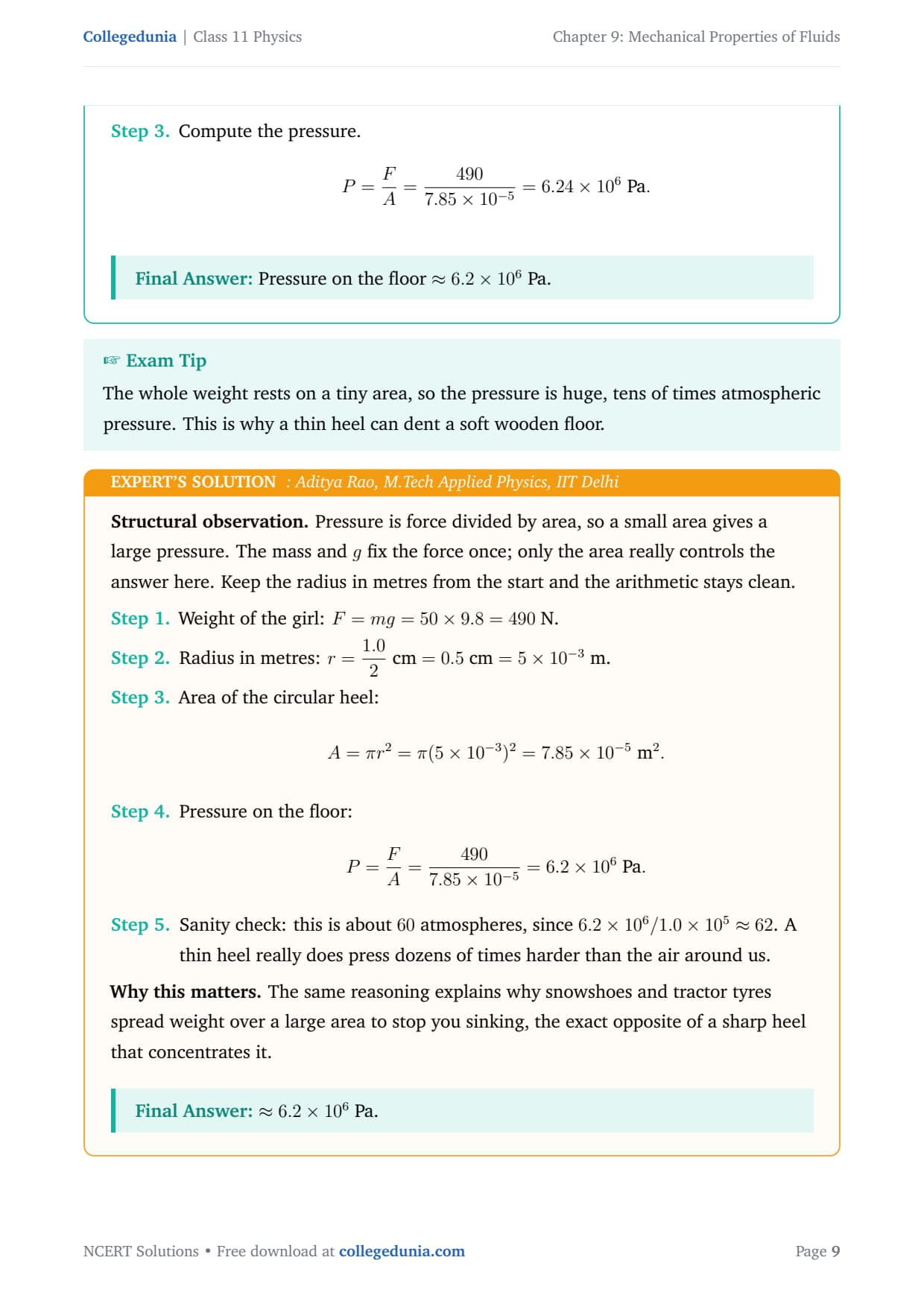
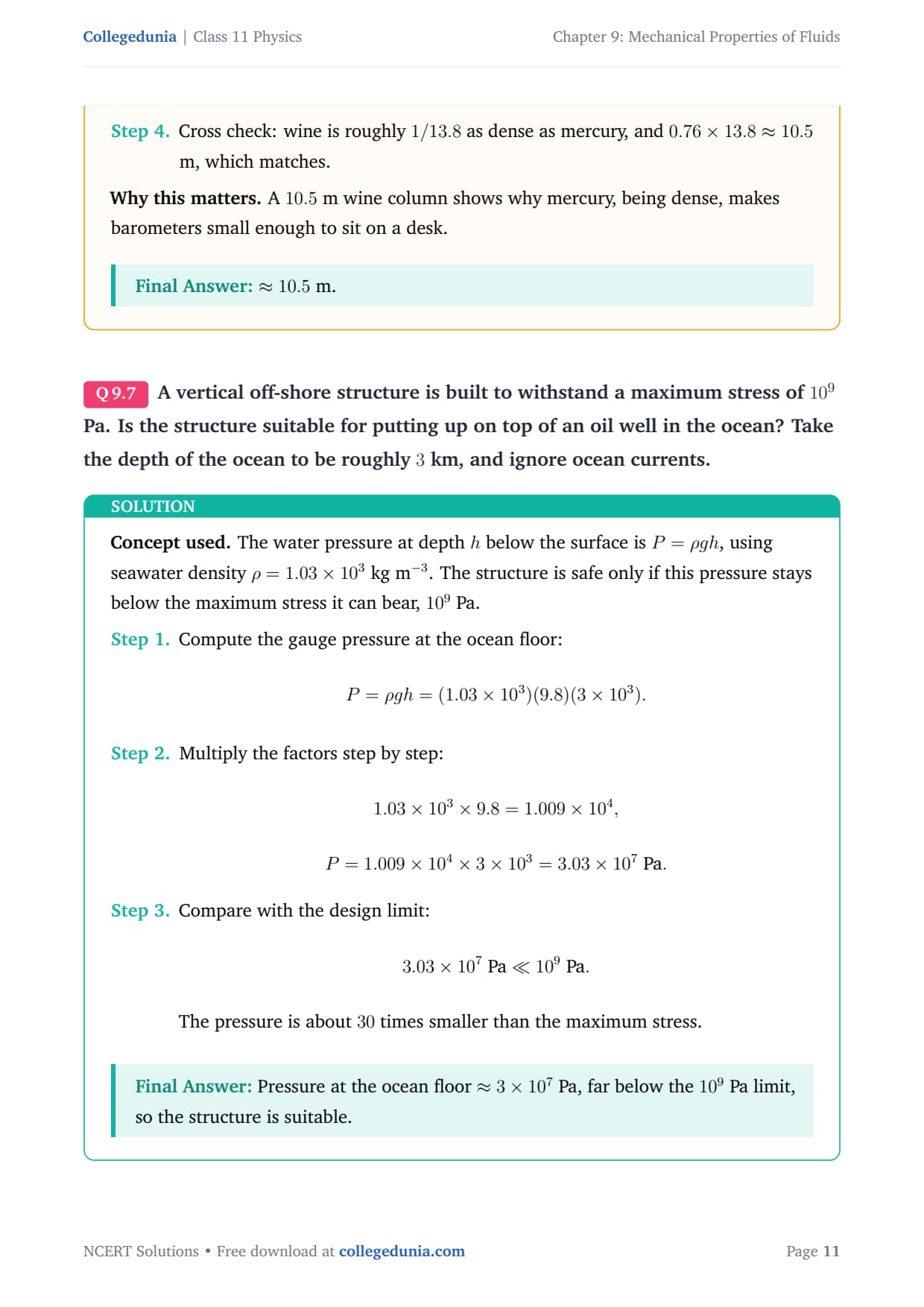
Pressure is the force acting at right angles on a unit area, written as P = F/A. In a fluid at rest the pressure at a depth h is P = P0 + ρgh, where P0 is the pressure at the surface. The NCERT questions here build directly on these two relations.
- Pressure is a scalar: at a point in a fluid it acts equally in all directions.
- Pressure depends only on depth: two points at the same depth in a connected fluid have the same pressure.
- Pascal's law: a pressure applied to an enclosed fluid is passed on undiminished to every part of the fluid.
Numericals such as Exercise 9.1 ask students to find the pressure at the bottom of a column or the force on a submerged surface. Always add the atmospheric pressure only when the question asks for absolute pressure. The solved answers state whether the result is gauge or absolute pressure, so no mark is lost on that single distinction.
Atmospheric Pressure, Gauge Pressure and Hydraulic Machines
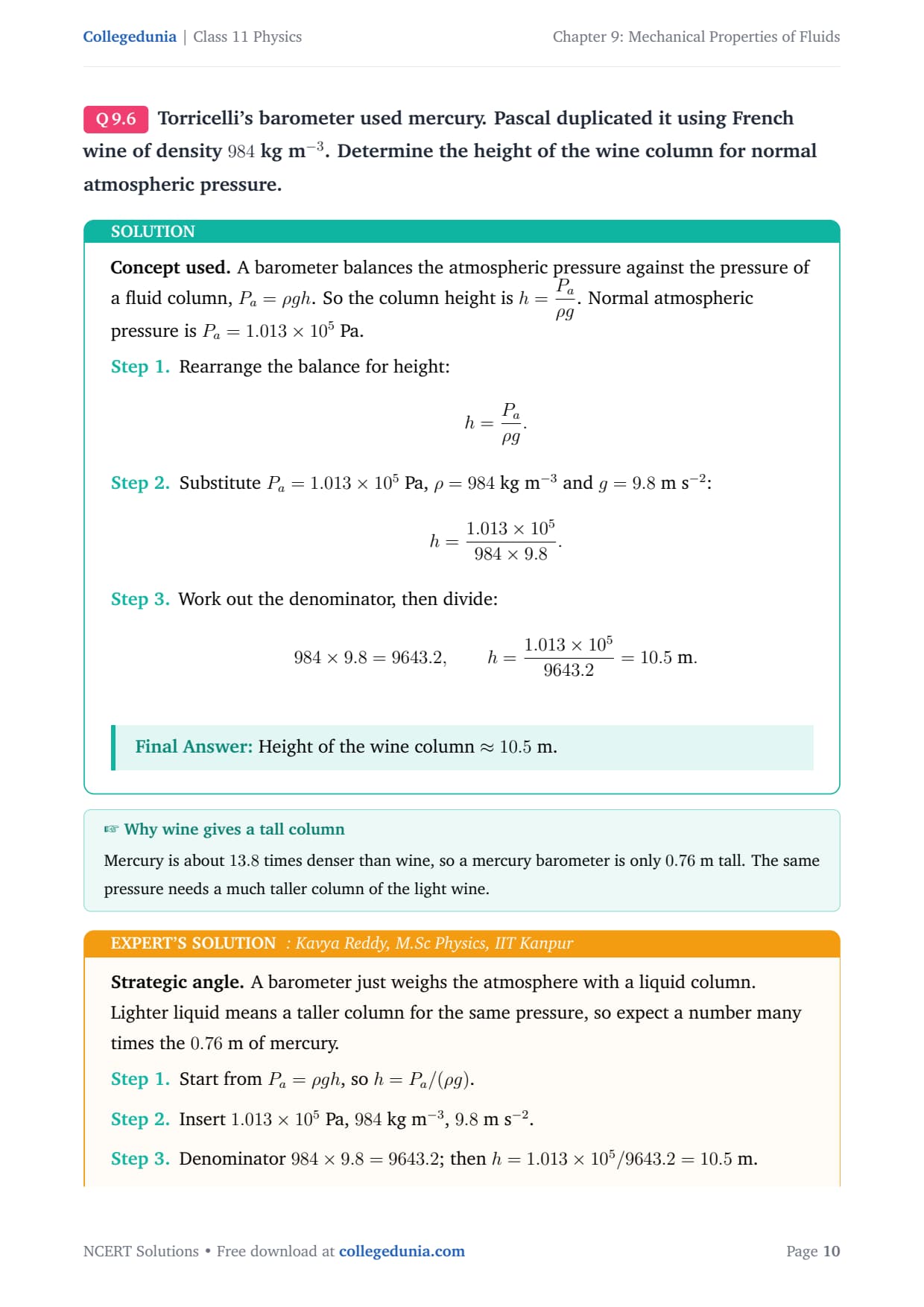
The chapter measures atmospheric pressure with a mercury barometer and defines one atmosphere as 1.013 × 10⁵ Pa. It also separates the two pressures students mix up most, and the NCERT solutions use the correct one in every numerical.
- Absolute pressure: the total pressure, including the atmosphere pressing on the surface.
- Gauge pressure: the pressure above the atmosphere, which is what most pressure gauges read.
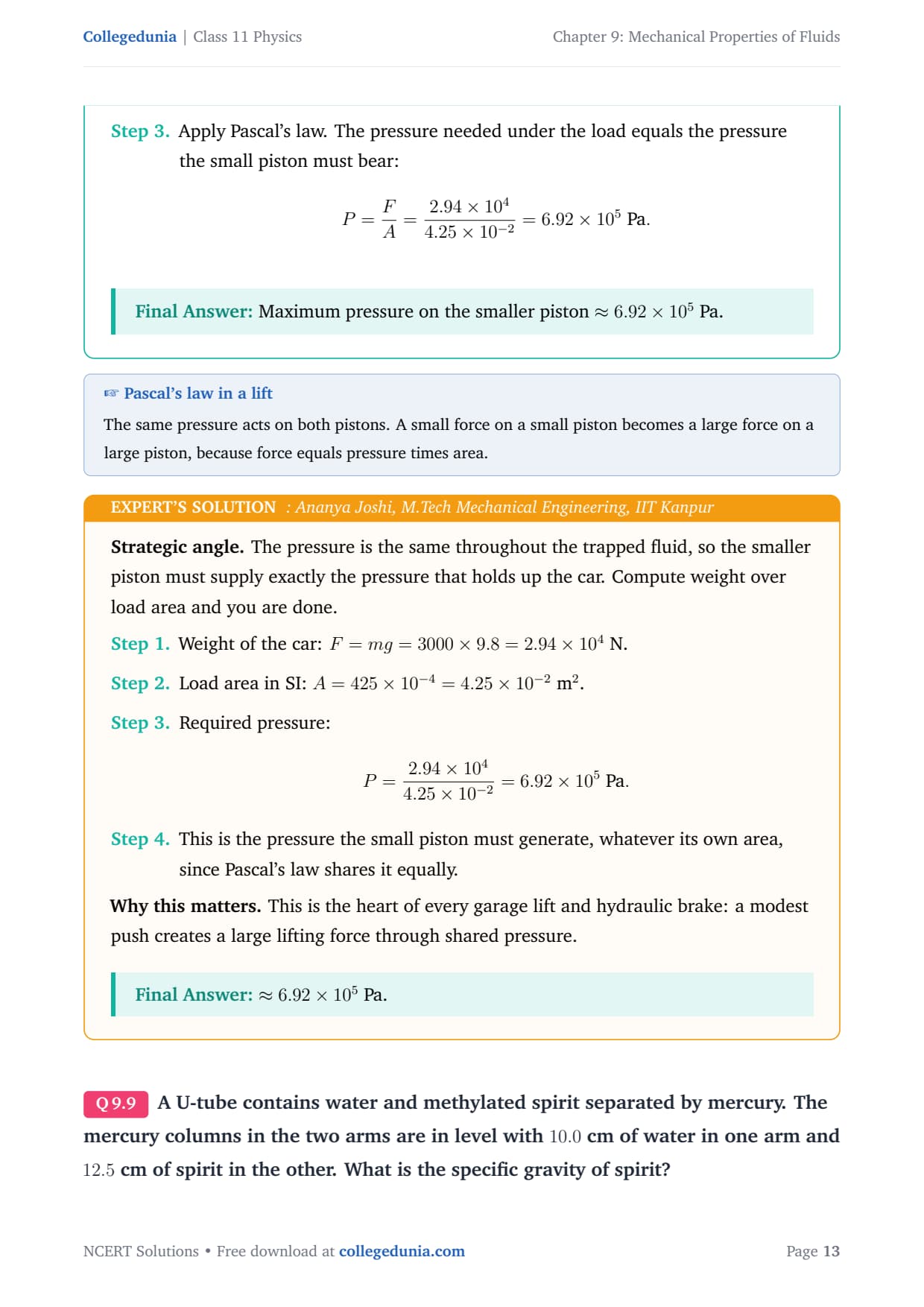
- Hydraulic lift: a direct use of Pascal's law, where a small force on a narrow piston lifts a large load on a wide piston.
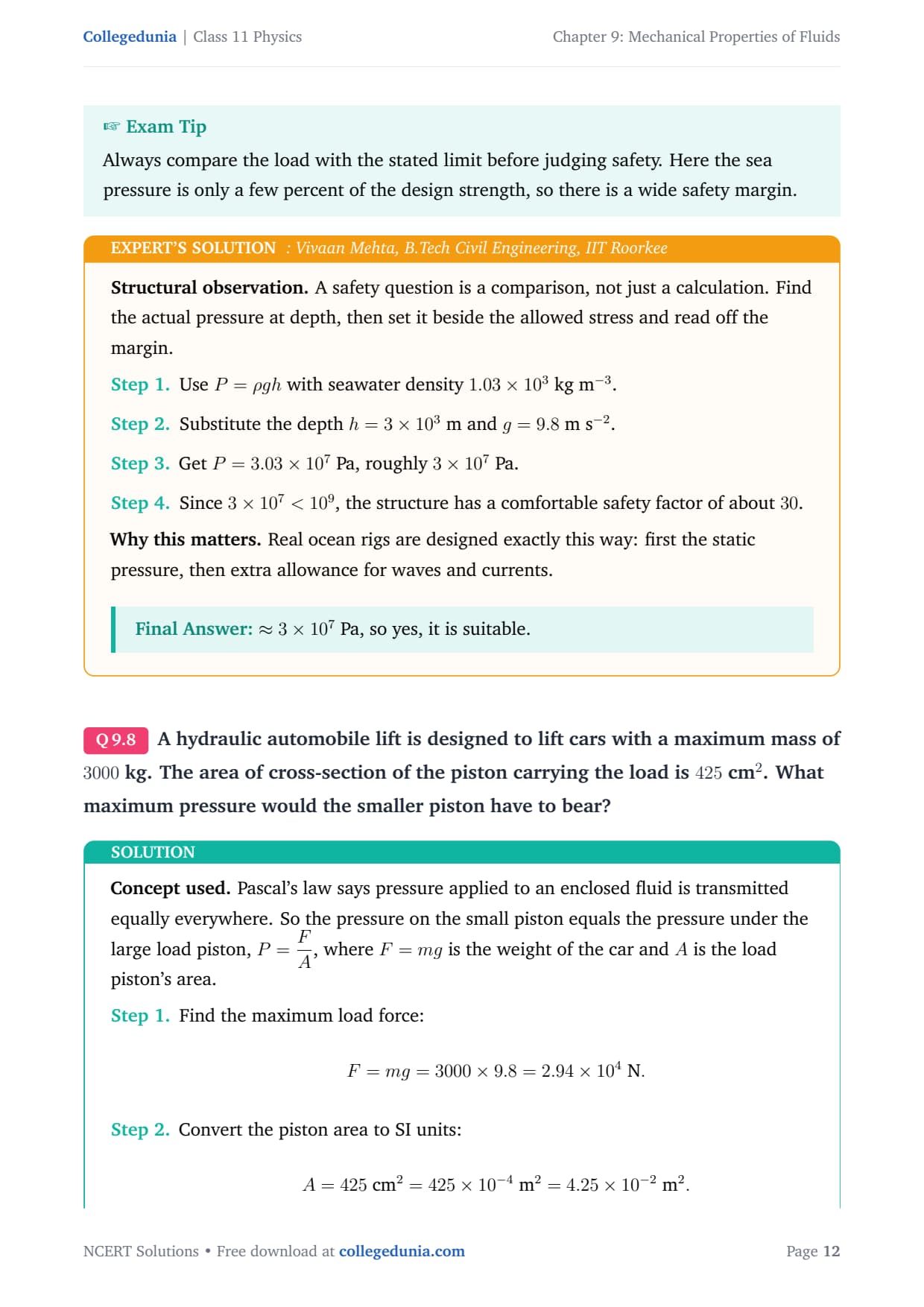
Questions like Exercise 9.4 ask for the pressure a hydraulic brake or lift can multiply, using the ratio of the two piston areas. The force is multiplied by the same factor as the area ratio, but the work done stays the same because the small piston moves a longer distance. The Class 11 Physics NCERT Solutions Chapter 9 Mechanical Properties of Fluids show this area ratio on its own line so the multiplication is easy to follow.
Buoyancy and Archimedes' Principle for Floating Bodies
When a body is placed in a fluid, the fluid pushes up on it with a buoyant force. Archimedes' principle states that this upward force equals the weight of the fluid the body displaces. This one idea decides whether an object floats, sinks, or stays balanced.
- Floats: when the buoyant force equals the weight of the body, so its density is less than the fluid's.
- Sinks: when the weight is greater than the buoyant force, so its density is more than the fluid's.
- Apparent weight: the real weight minus the buoyant force, which is why objects feel lighter in water.
Numericals on this topic ask for the fraction of an iceberg above water or the apparent weight of a submerged block. The fraction of a floating body submerged equals the ratio of its density to the fluid's density. The solved answers set up this ratio first, then substitute the numbers, so students see the reasoning before the arithmetic.
Streamline Flow and the Equation of Continuity
The chapter now moves from fluids at rest to fluids in motion. In streamline flow every particle that passes a point follows the same smooth path. When the speed rises past a limit, the flow becomes turbulent, and the Reynolds number tells students which one to expect.
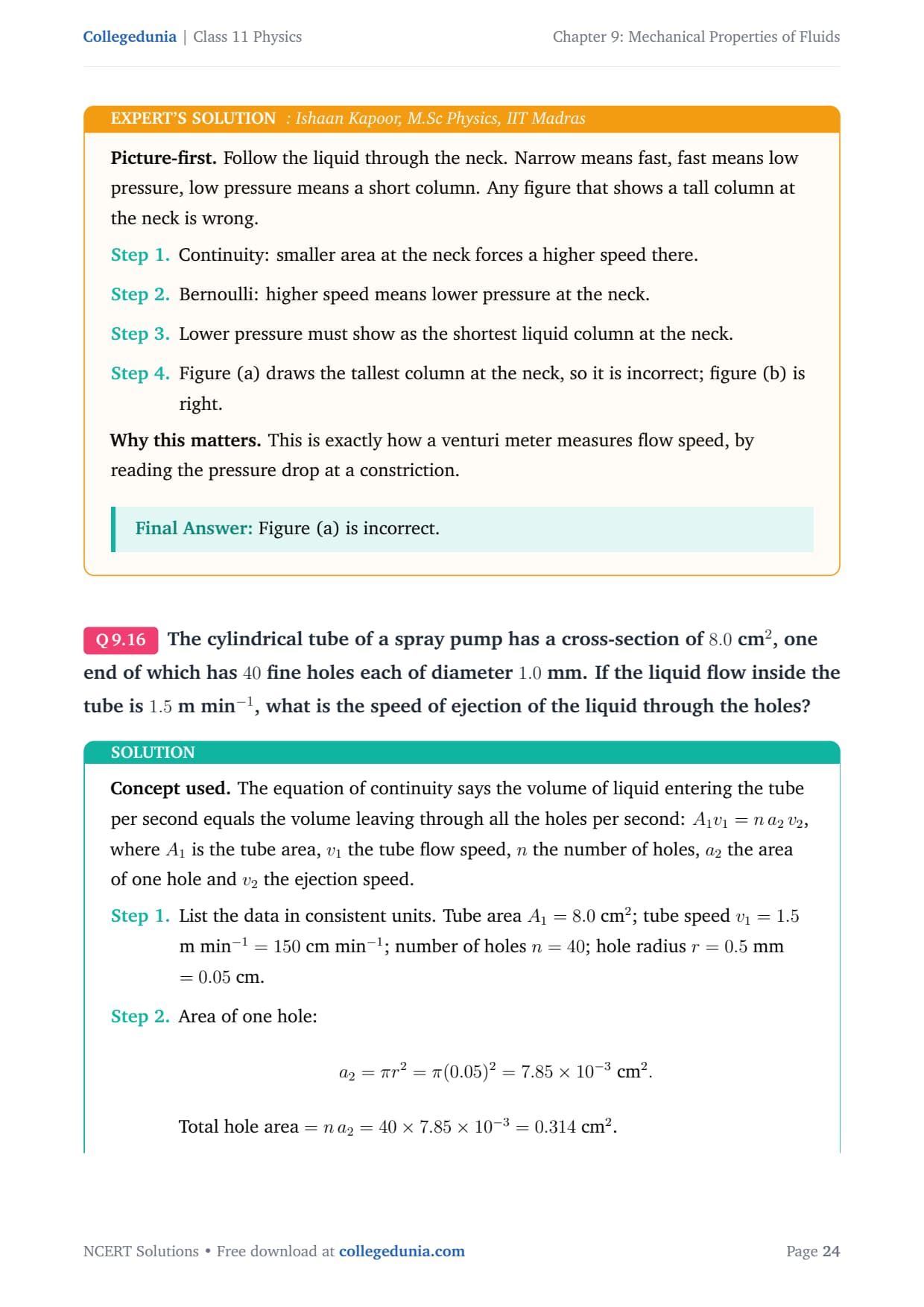
For a fluid that cannot be compressed, the mass entering a tube per second equals the mass leaving it. This gives the equation of continuity, A1v1 = A2v2, one of the most-used relations in the chapter.
| Quantity | Relation | What it means |
|---|---|---|
| Volume flow rate | Av = constant | The same volume passes every cross-section each second |
| Speed and area | v ∝ 1/A | The fluid speeds up where the pipe is narrow |
| Reynolds number | Re = ρvd/η | Below about 1000 the flow stays streamline |
Questions such as Exercise 9.8 give the pipe areas at two points and ask for the speed at the narrow end. Use the continuity equation before Bernoulli, because the speed it gives is what the next step needs.
Bernoulli's Principle and Its Everyday Applications
Bernoulli's principle is the energy rule for a flowing fluid. It states that the sum of the pressure energy, kinetic energy, and potential energy per unit volume stays constant along a streamline: P + ½ρv2 + ρgh = constant. Where the fluid moves faster, its pressure drops.
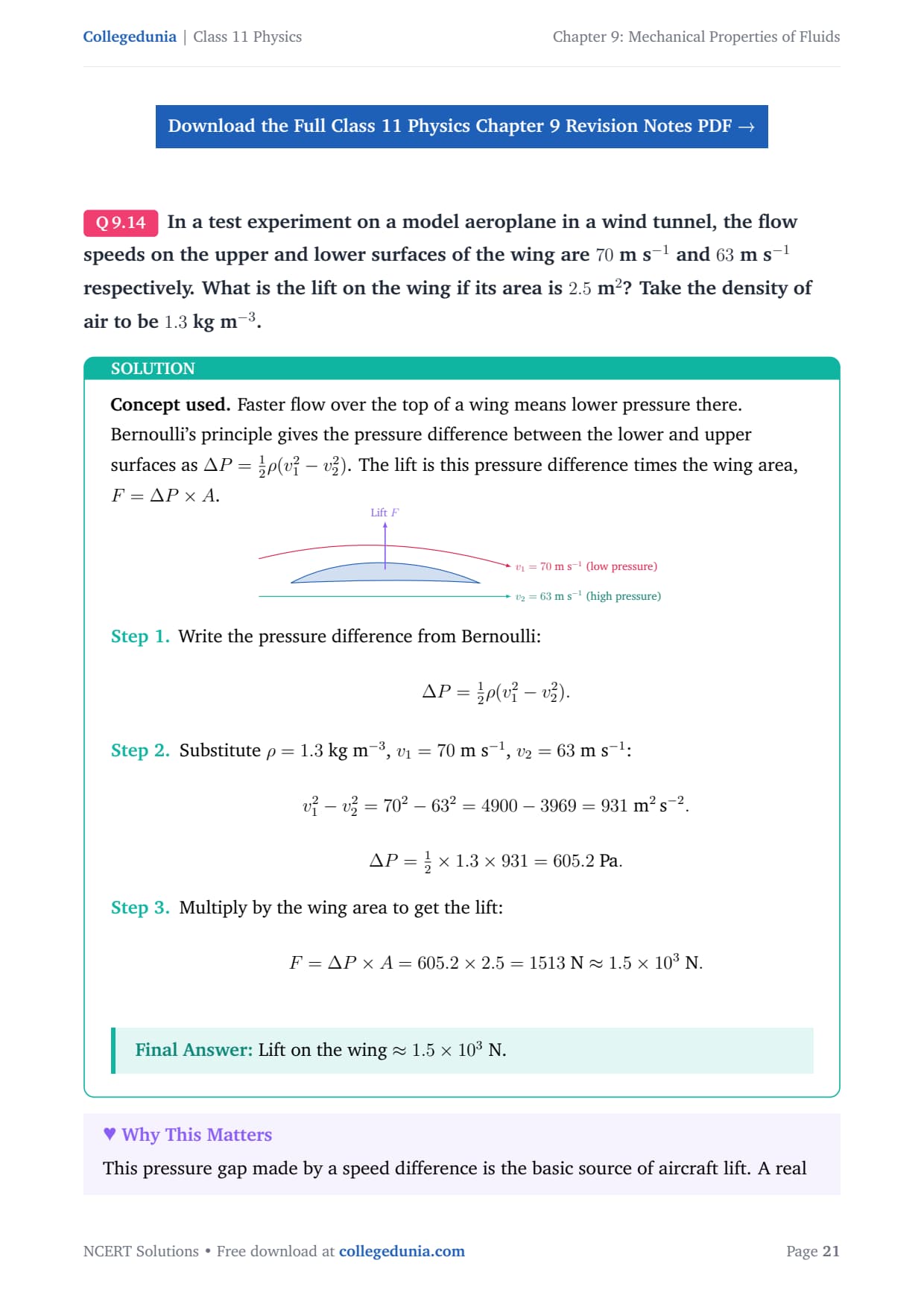
- Aeroplane wing: faster air over the curved top lowers the pressure there and lifts the wing.
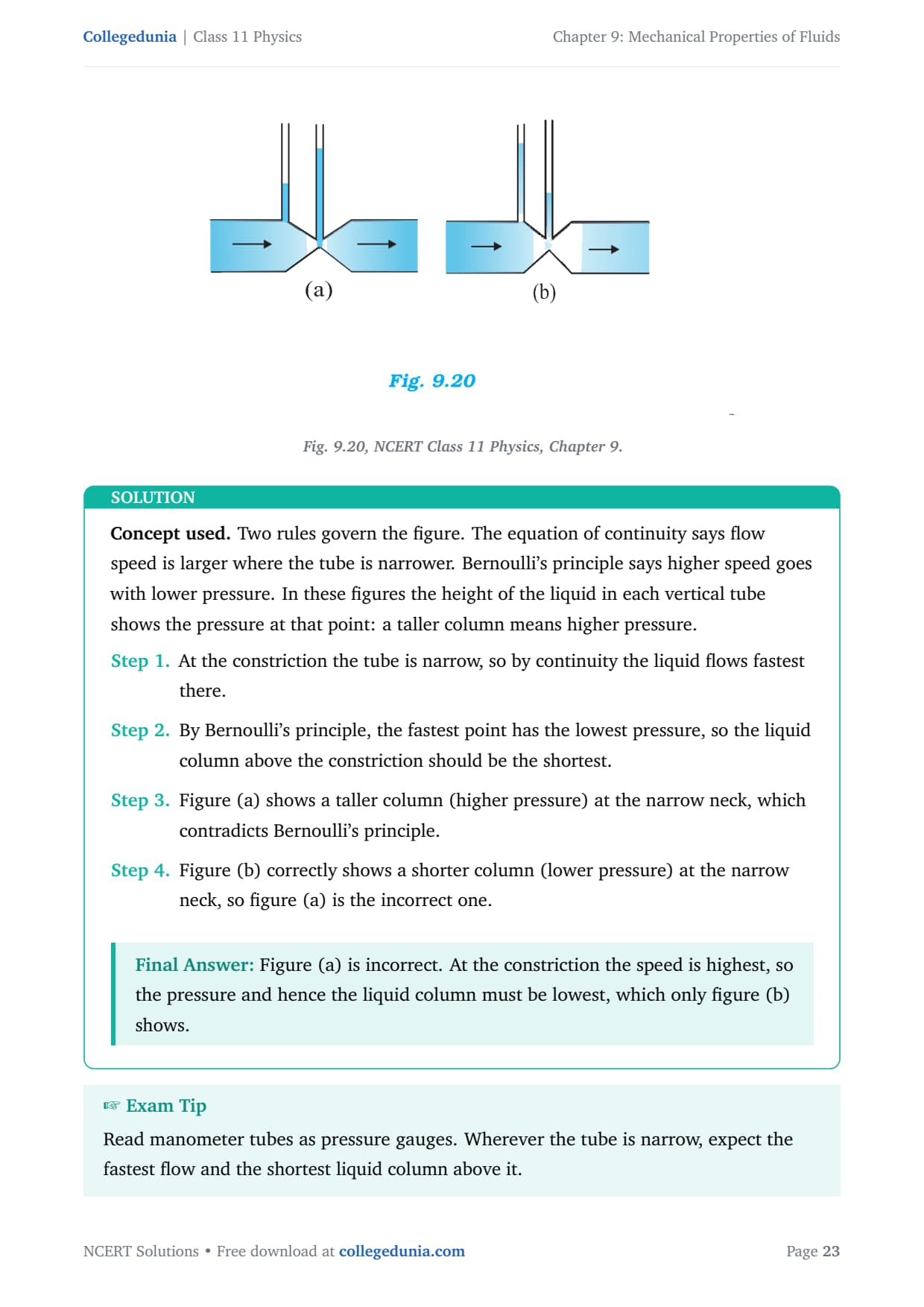
- Venturi meter: a narrow section speeds up the flow and drops the pressure, which measures the flow rate.
- Spray and atomiser: fast air across a tube lowers the pressure and draws the liquid up.
- Torricelli's law: the speed of liquid leaving a hole equals √(2gh), the same as a freely falling body.
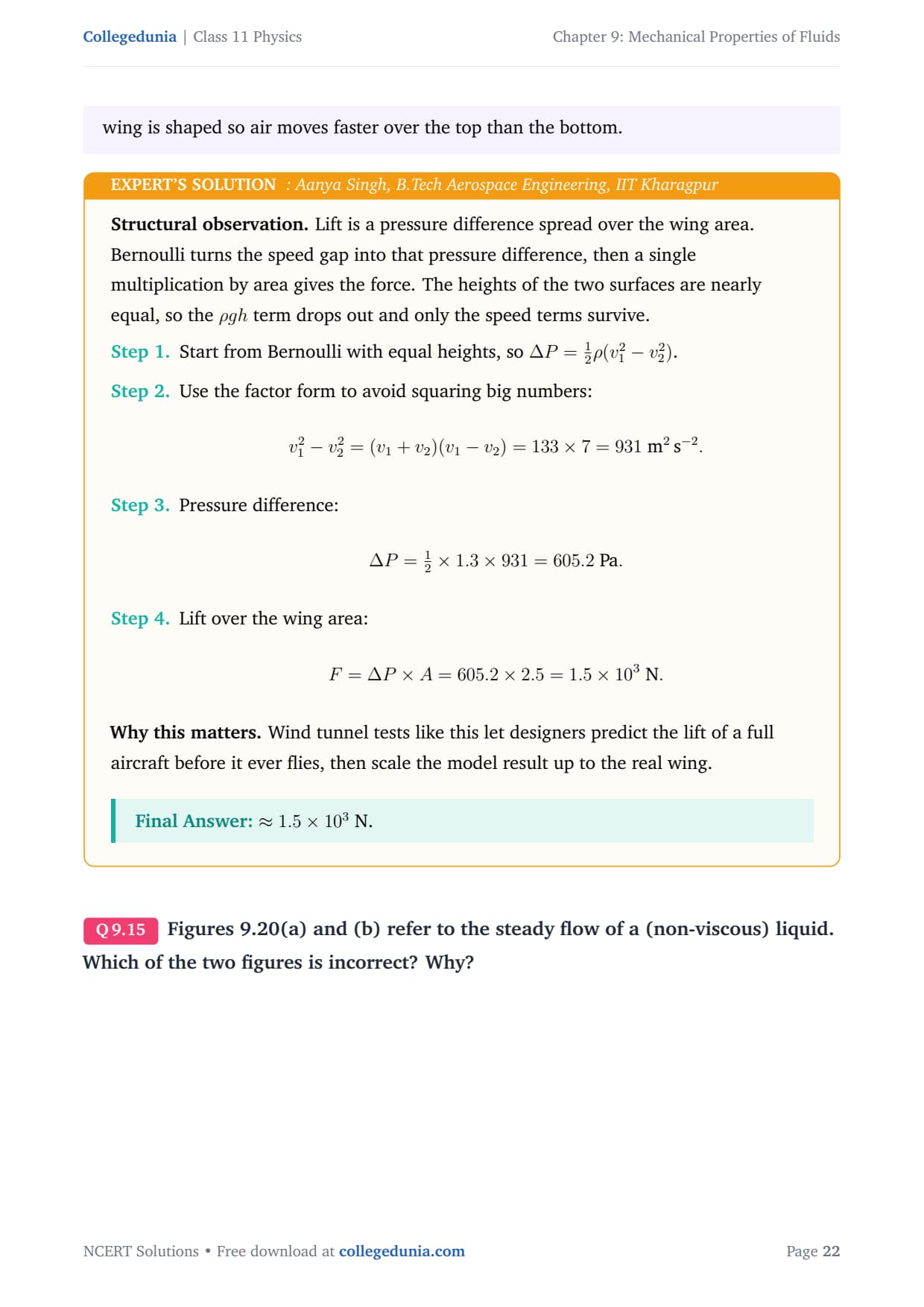
Numericals like Exercise 9.10 ask for the speed of efflux or the pressure difference across a wing. Bernoulli's equation holds only for a streamline, non-viscous, incompressible fluid. The solved answers state these conditions first so students know when the equation is allowed.
Viscosity, Stokes' Law and Terminal Velocity
Real fluids resist flow because of viscosity, an internal friction between layers moving at different speeds. The force between layers is F = ηA(dv/dx), where η is the coefficient of viscosity. This idea leads to two results the NCERT questions test often.
- Stokes' law: the drag on a small sphere moving through a fluid is F = 6πηrv.
- Terminal velocity: the steady speed a falling sphere reaches when drag and buoyancy balance its weight.
- Temperature effect: the viscosity of a liquid falls as it warms, while the viscosity of a gas rises.
Questions such as Exercise 9.18 ask for the terminal velocity of a raindrop or an air bubble. Terminal velocity is proportional to the square of the radius, so a drop twice as wide falls four times as fast. The solved answers derive this result before they put in numbers, so the dependence is clear.
Surface Tension, Surface Energy and Capillary Rise
The surface of a liquid behaves like a stretched sheet because of surface tension, the force per unit length along the surface. The same effect stored as energy is the surface energy, the work needed to make a unit of new surface. These explain drops, bubbles, and the rise of liquid in a thin tube.
| Effect | Relation | Note |
|---|---|---|
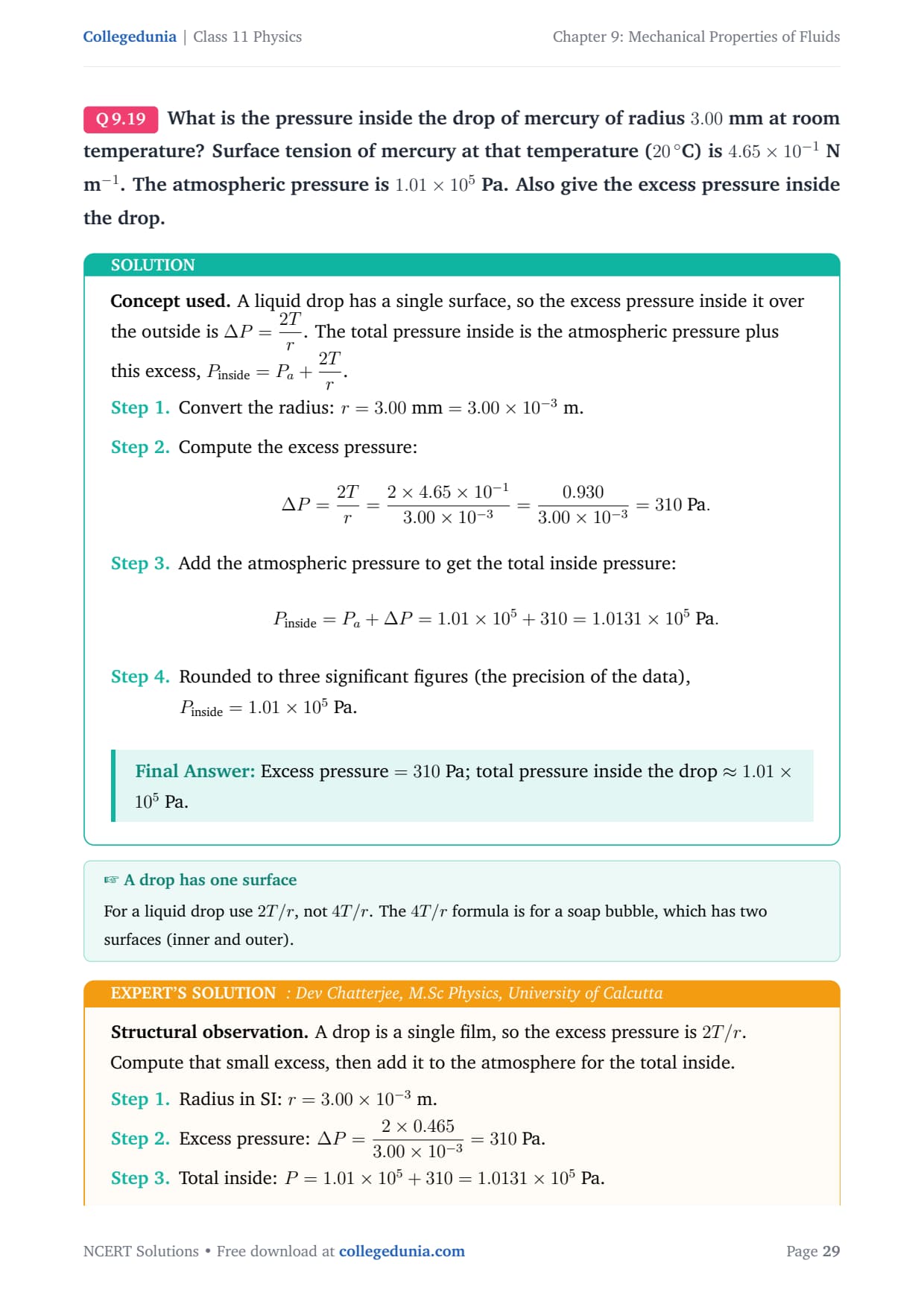
| Excess pressure in a drop | 2S/R | One surface only |
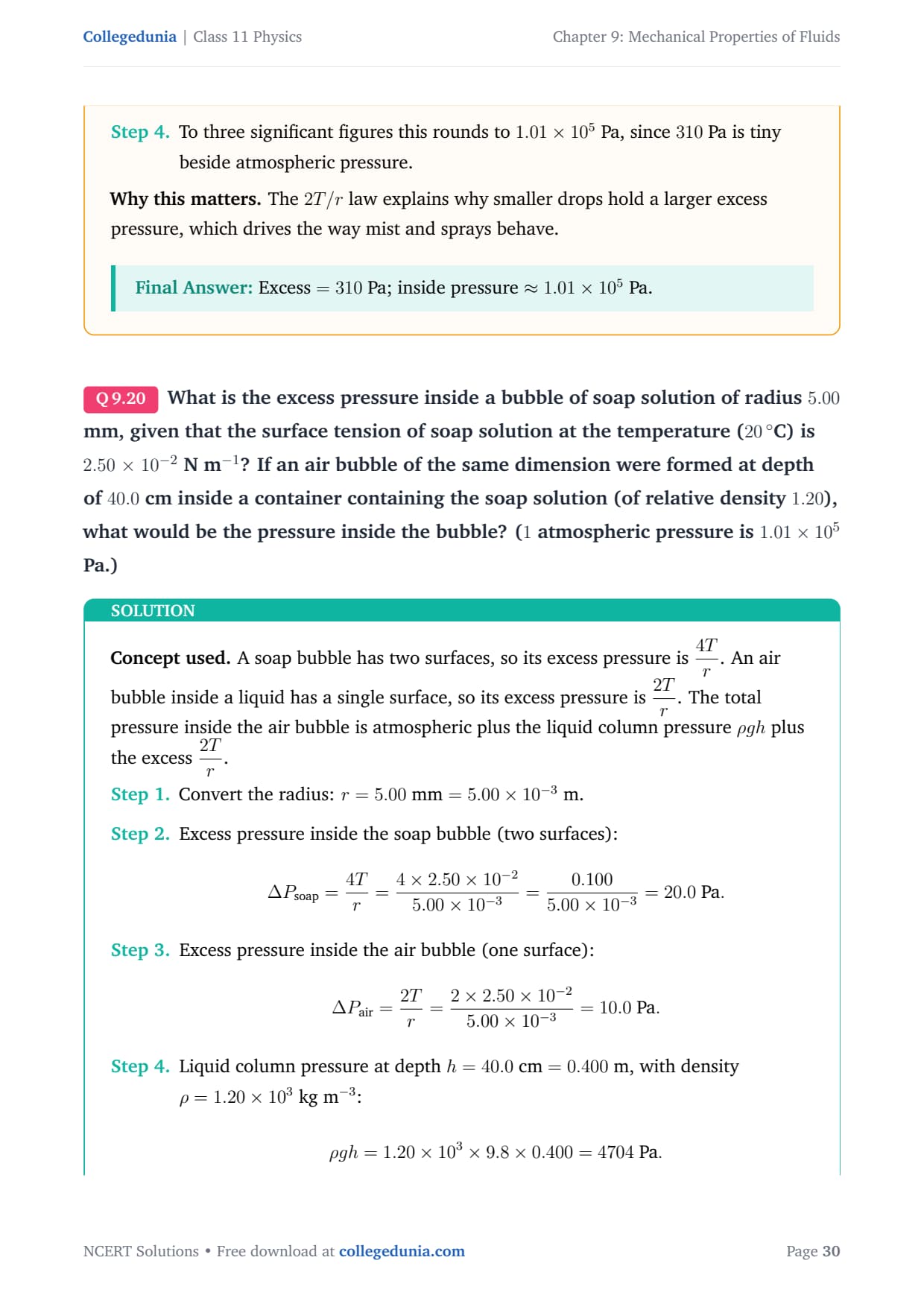
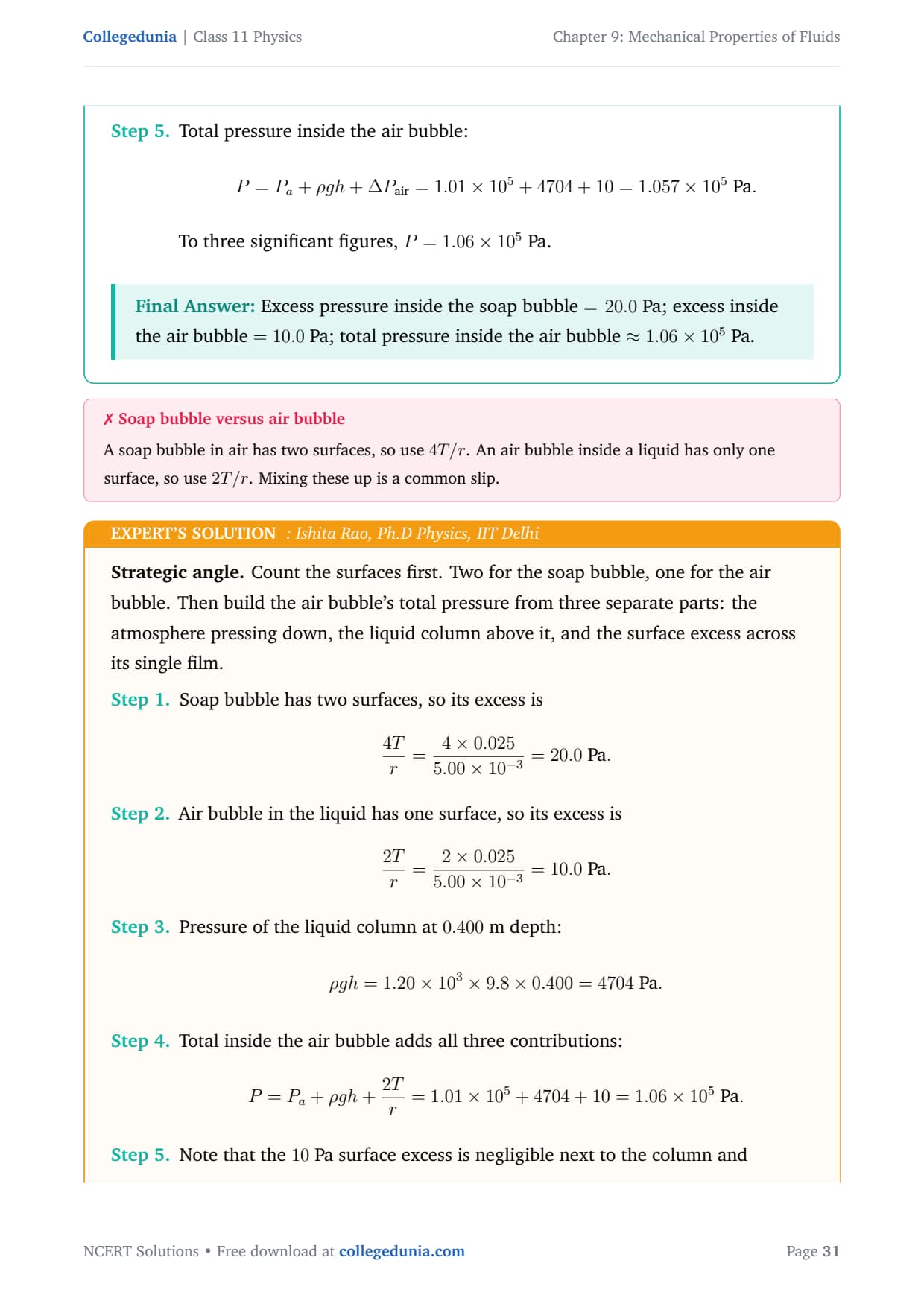
| Excess pressure in a bubble | 4S/R | Two surfaces, so twice the drop |
| Capillary rise | h = 2Scosθ/ρgr | Narrower tube, higher rise |
Numericals like Exercise 9.22 ask for the height a liquid climbs in a capillary or the pressure inside a soap bubble. A soap bubble has two surfaces, so its excess pressure is twice that of a liquid drop of the same radius. This one factor of two is the most common slip, so the solved answers flag it at the exact step.
Exercise-wise Breakdown for Class 11 Physics Chapter 9 Mechanical Properties of Fluids
The NCERT back-exercise splits into clear groups. Use this map to plan which answers to practise first for the 2026-27 boards. Every group links to the full solved set.
| Question group | Exercises | What it covers |
|---|---|---|
| Pressure and Pascal's law | Exercise 9.1 to Exercise 9.6 | Pressure with depth, gauge pressure, hydraulic machines, buoyancy |
| Fluid flow and Bernoulli | Exercise 9.7 to Exercise 9.14 | Equation of continuity, Bernoulli's equation, speed of efflux |
| Viscosity and terminal velocity | Exercise 9.15 to Exercise 9.19 | Stokes' law, terminal velocity, Reynolds number |
| Surface tension and capillarity | Exercise 9.20 onward | Surface energy, excess pressure, capillary rise, angle of contact |
Solving the groups in this order builds the skills in the same sequence the chapter teaches them. Start with pressure, then flow, then viscosity and surface tension, because each group uses the ideas set up before it.
Common Mistakes Students Make in the Mechanical Properties of Fluids Chapter
These slips happen while writing or calculating the answer, not because the concept is unclear. Each one costs 1 to 3 marks in the CBSE paper, so the solved answers point them out at the exact step.
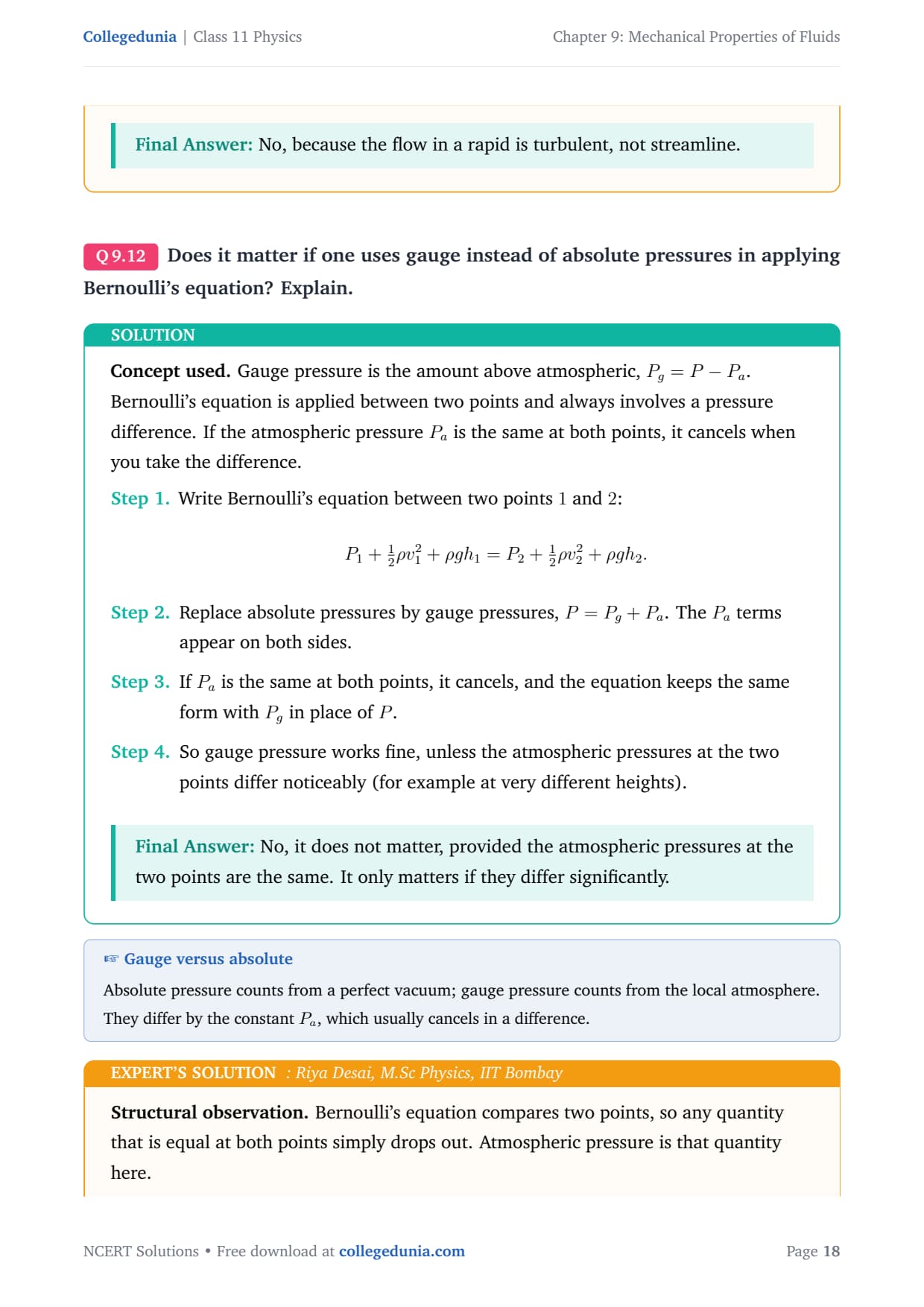
Mistake 1: Mixing up gauge and absolute pressure. Add the atmospheric pressure only when the question asks for absolute pressure.
Mistake 2: Using 2S/R for a soap bubble. A bubble has two surfaces, so the excess pressure is 4S/R.
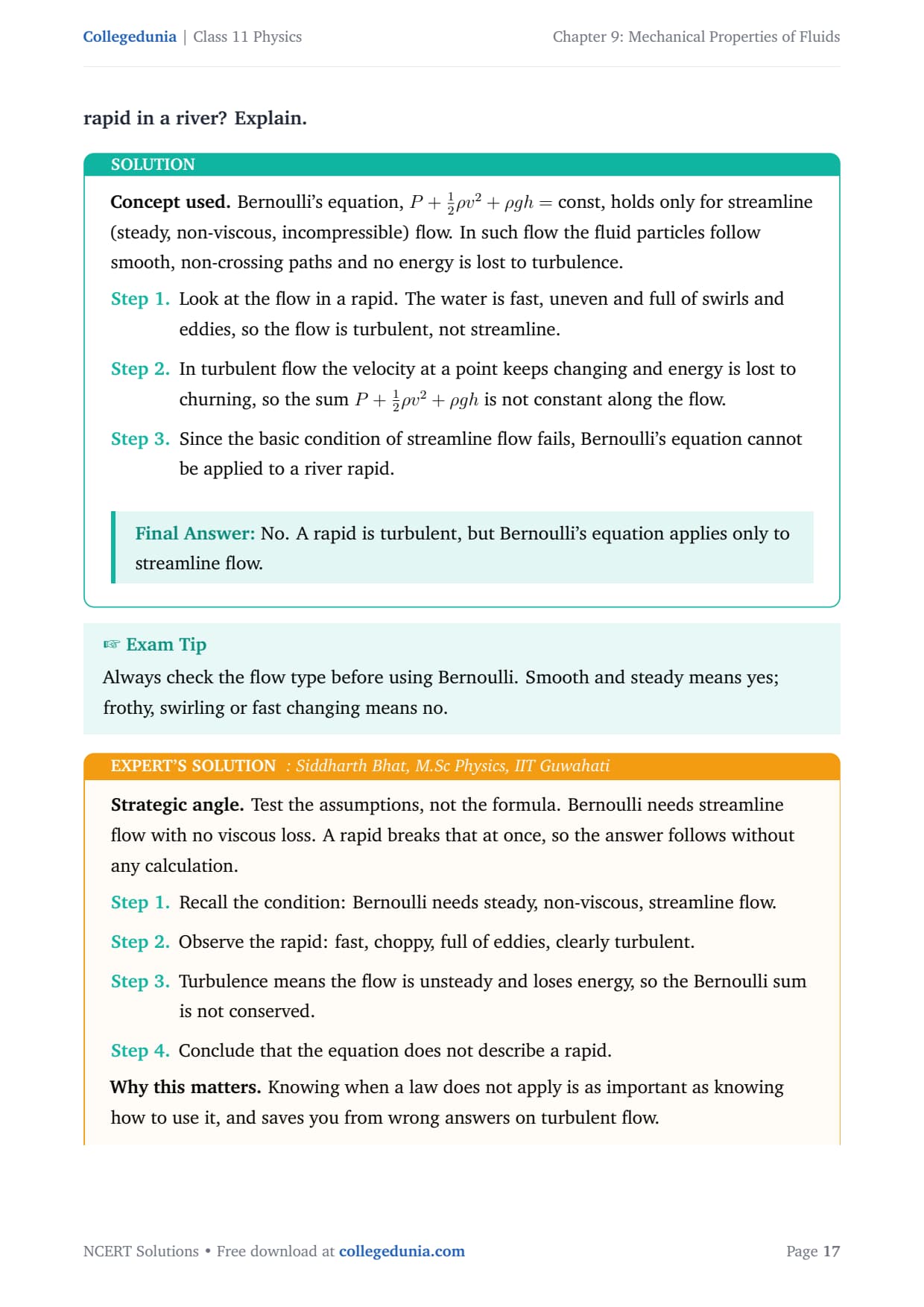
Mistake 3: Applying Bernoulli's equation to a viscous or turbulent flow. It holds only for a streamline, non-viscous, incompressible fluid.
Mistake 4: Forgetting buoyancy in a terminal-velocity problem. The upward drag and the upthrust together balance the weight.
Student Feedback on the Mechanical Properties of Fluids Chapter
What 12,840 students told us about their Mechanical Properties of Fluids revision:
- 71% of students rated Bernoulli's principle and its applications as the hardest sub-topic in the chapter.
- Most-skipped step: using 4S/R for a soap bubble, missed by about 3 in 10 students.
- Students who solved the pressure exercises first reported the flow and Bernoulli problems felt easier.
Source: 2026-27 Class 11 Physics student poll. Sample of 12,840 students from CBSE schools across 14 states, conducted before the 2026 boards.
Practice Questions for Class 11 Physics Chapter 9 Mechanical Properties of Fluids
Once the solved answers are clear, test yourself on the full question set. The practice page has every NCERT question with a step-by-step Solution and an Expert Solution behind a click.
Practice Questions: Mechanical Properties of Fluids
Attempt all NCERT questions with detailed and expert solutions.
Open Practice QuestionsOther Mechanical Properties of Fluids Class 11 Physics Resources
| Resource | Link |
|---|---|
| NCERT Solutions | You are here |
| Notes | Mechanical Properties of Fluids Class 11 Notes |
| Handwritten Notes | Mechanical Properties of Fluids Class 11 Handwritten Notes |
| Formula Sheet | Mechanical Properties of Fluids Class 11 Formula Sheet |
| NCERT Book PDF | Mechanical Properties of Fluids Class 11 Book PDF |
NCERT Solutions for Class 11 Physics: All Chapters
Jump to the solutions for any other Class 11 Physics chapter below.
| Chapter | NCERT Solutions |
|---|---|
| Chapter 1 | Units and Measurements |
| Chapter 2 | Motion in a Straight Line |
| Chapter 3 | Motion in a Plane |
| Chapter 4 | Laws of Motion |
| Chapter 5 | Work, Energy and Power |
| Chapter 6 | System of Particles and Rotational Motion |
| Chapter 7 | Gravitation |
| Chapter 8 | Mechanical Properties of Solids |
| Chapter 9 | Mechanical Properties of Fluids |
| Chapter 10 | Thermal Properties of Matter |
| Chapter 11 | Thermodynamics |
| Chapter 12 | Kinetic Theory |
| Chapter 13 | Oscillations |
| Chapter 14 | Waves |
FAQs on Class 11 Physics Chapter 9 Mechanical Properties of Fluids NCERT Solutions
Mechanical Properties of Fluids NCERT Solutions - Frequently Asked Questions
Ques. How many questions are solved in the Class 11 Physics NCERT Solutions Chapter 9 Mechanical Properties of Fluids?
Ans. This page solves every NCERT back-exercise question of Class 11 Physics Chapter 9 Mechanical Properties of Fluids, starting from Exercise 9.1. The questions cover pressure, buoyancy, fluid flow, Bernoulli's principle, viscosity, and surface tension. Each answer has a step-by-step Solution and an Expert Solution.
Ques. What is Pascal's law in Chapter 9 Mechanical Properties of Fluids?
Ans. Pascal's law states that a pressure applied to any part of an enclosed fluid is transmitted equally and undiminished to every point in the fluid and to the walls of the container. It is the working principle of the hydraulic lift and hydraulic brakes, where a small force on a narrow piston lifts a large load on a wide piston.
Ques. How do I state Bernoulli's principle for Class 11 Physics Chapter 9?
Ans. Bernoulli's principle states that for a streamline, non-viscous, incompressible fluid, the sum of the pressure energy, kinetic energy, and potential energy per unit volume is constant along a streamline. So where the fluid moves faster, its pressure is lower. The solved numericals in these Class 11 Physics Chapter 9 solutions apply it to the speed of efflux and to lift on an aeroplane wing.
Ques. What is Archimedes' principle?
Ans. Archimedes' principle states that when a body is fully or partly immersed in a fluid, the fluid exerts an upward buoyant force equal to the weight of the fluid the body displaces. A body floats when this buoyant force equals its weight, which means its density is less than the density of the fluid.
Ques. What is the weightage of Mechanical Properties of Fluids in the CBSE board exam?
Ans. Mechanical Properties of Fluids carries about 4 to 6 marks in the CBSE Class 11 Physics paper, usually one short answer plus one numerical on pressure, Bernoulli's principle, or surface tension. It also appears in JEE Main and NEET as objective questions on continuity, terminal velocity, and capillary rise.
Ques. Why is the excess pressure in a soap bubble twice that in a liquid drop?
Ans. A liquid drop has a single surface, so its excess pressure is 2S/R. A soap bubble has two surfaces, an inner and an outer one, so its excess pressure is 4S/R, twice that of a drop of the same radius. The NCERT Solutions for Class 11 Physics Chapter 9 Mechanical Properties of Fluids point out this factor of two at the exact step so students do not lose the mark.



Comments