




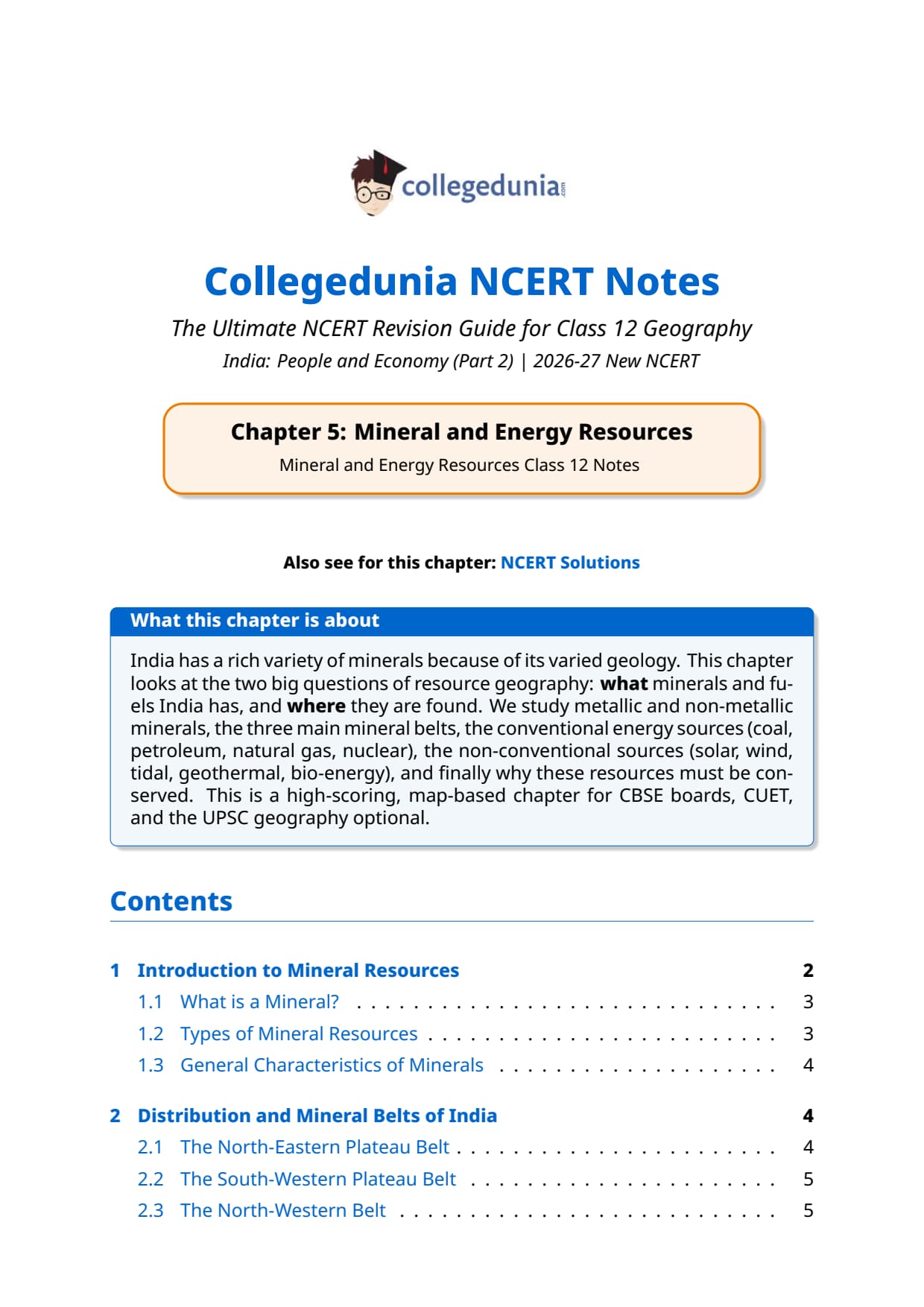
These Class 12 Geography Chapter 5 Mineral and Energy Resources notes cover every NCERT definition, mineral classification, state-wise distribution, conventional and non-conventional energy, and conservation, all aligned to the 2026-27 syllabus. Built for fast, night-before revision.
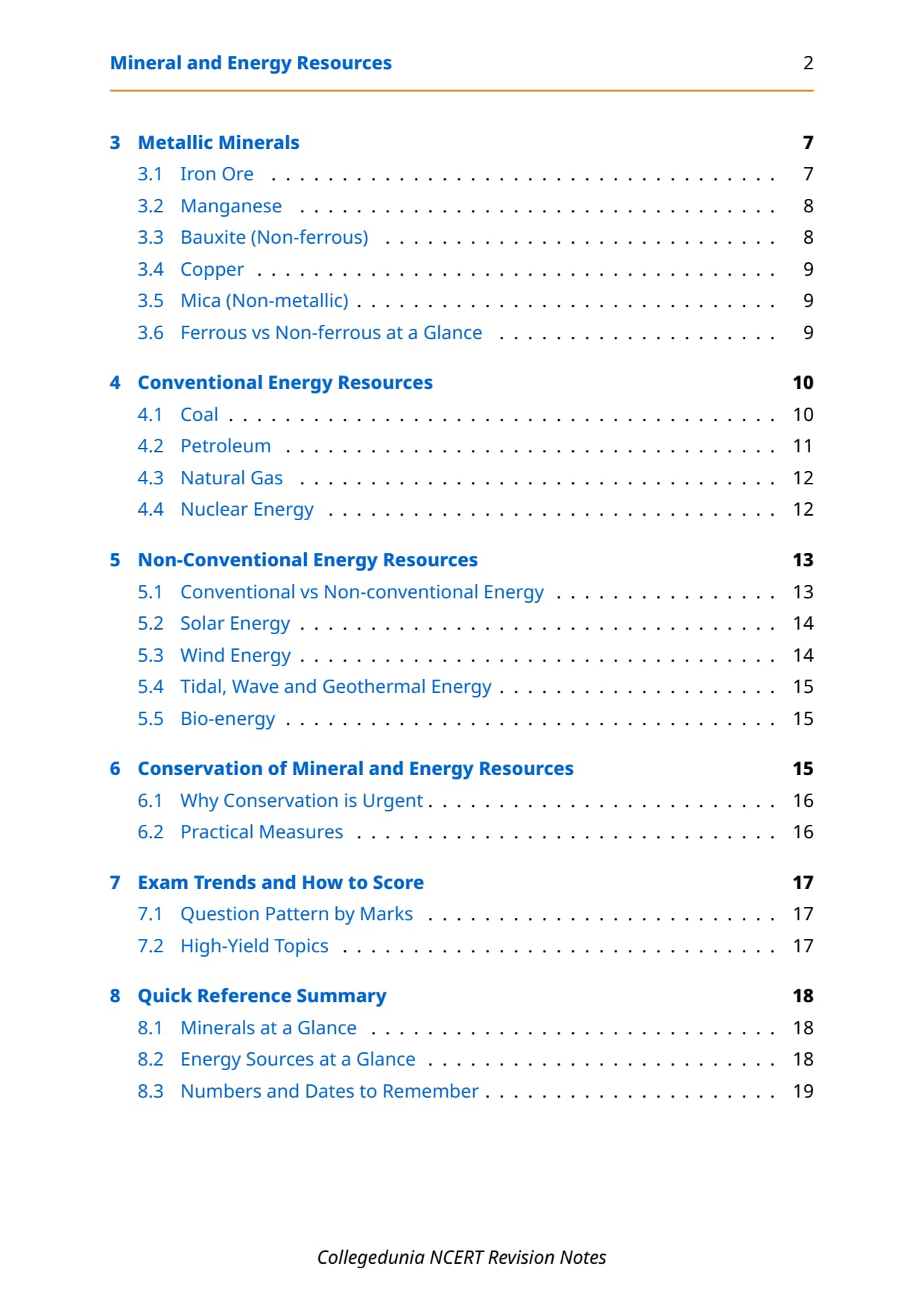
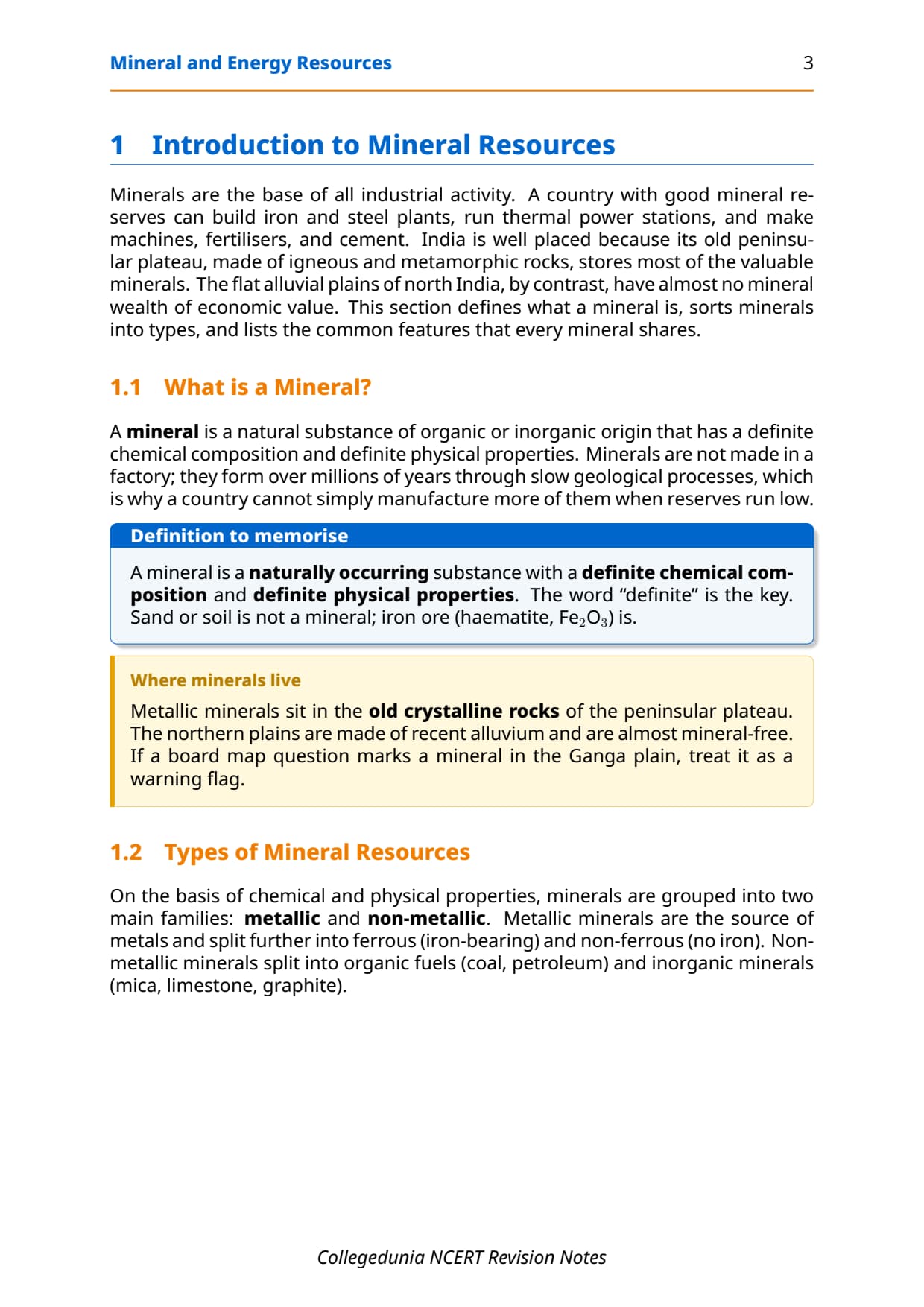
- Concept-first revision of the whole chapter: types of minerals, the four mineral belts, state-wise distribution of key minerals, and conventional plus non-conventional energy sources.
- All key definitions for mineral and energy resources class 12, the three characteristics of minerals, and the location data CBSE, CUET and UPSC examiners pick for map questions.
- Cross-links to the matching NCERT Solutions, Handwritten Notes and NCERT Book PDF for the same chapter.
Written by Collegedunia Geography experts, mapped to the 2026-27 NCERT India: People and Economy textbook and checked against the last five years of CBSE board papers.
Student Feedback on revising this chapter
71% of Class 12 Geography students found state-wise mineral distribution the most confusing part, and 3 out of 4 rated energy resources the most worth revising.
Source: 2026-27 Class 12 Geography student poll, 9,420 CBSE students.
Quick Concept Recap: Mineral and Energy Resources at a Glance
Chapter 5 covers India's mineral wealth and energy base around three ideas: what types of minerals exist, where they are found, and what energy sources India uses and must shift towards.
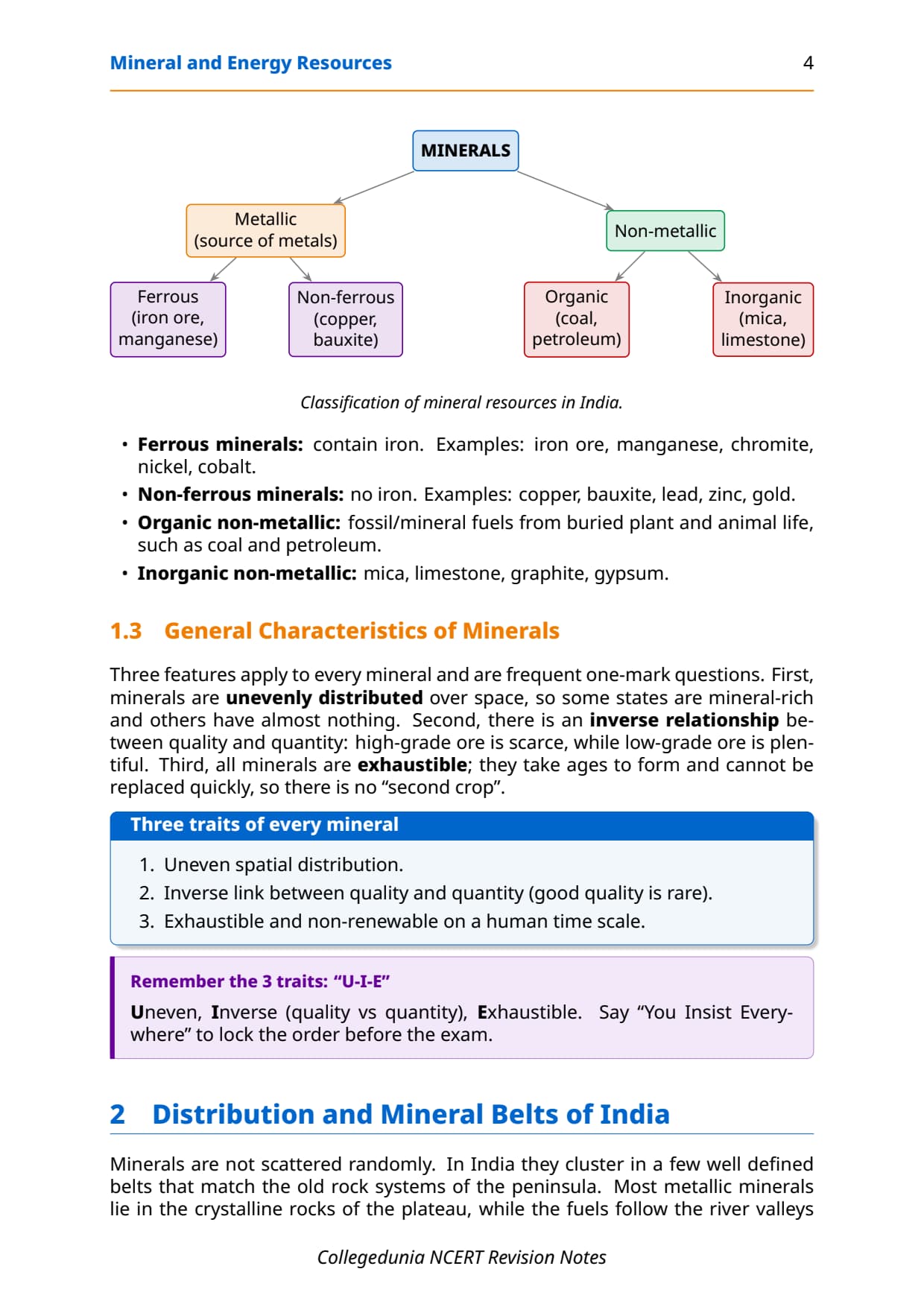
- Three types of minerals: ferrous metallic (iron ore, manganese), non-ferrous metallic (copper, bauxite) and non-metallic (coal, petroleum, mica, limestone).
- Three characteristics of minerals: unevenly distributed, an inverse link between quality and quantity, and exhaustible over time.
- Four mineral belts: North-Eastern Plateau, South-Western Plateau, North-Western region and the Himalayan belt.
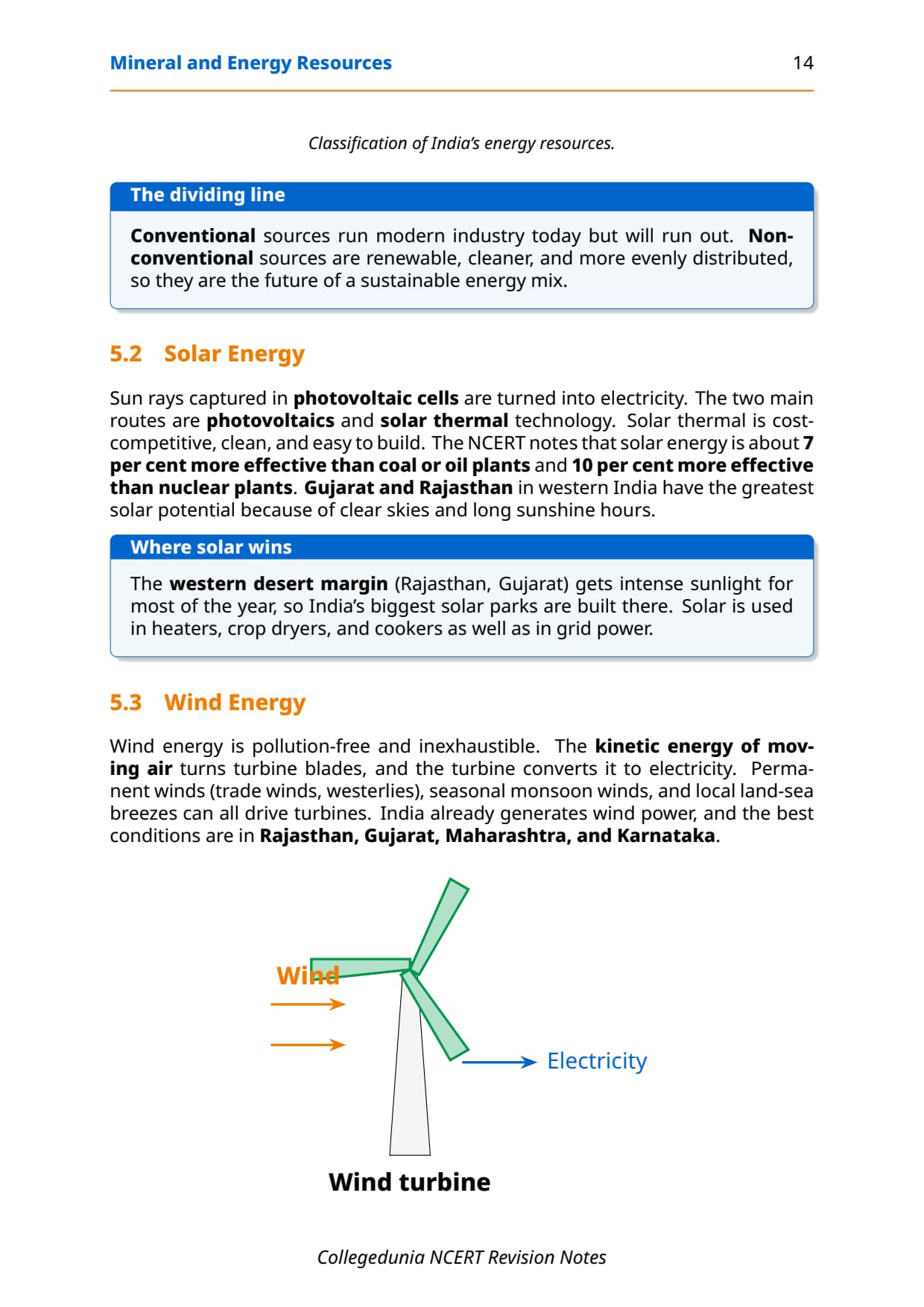
- Conventional energy: coal, petroleum, natural gas and nuclear. Non-conventional energy: solar, wind, tidal, geothermal and bio-energy, all renewable and better distributed.
Read these notes first, then use the matching NCERT Solutions for Chapter 5 for exercise drill.
Source: Humanities Wallah - Class 12th on YouTube
Key Definitions for Mineral and Energy Resources Class 12
Most objective questions start with a definition. These mineral and energy resources class 12 terms are in the one-line form CBSE markers expect.
| Term | One-line definition | NCERT pointer |
|---|---|---|
| Mineral | A natural substance of organic or inorganic origin with definite chemical and physical properties. | Introduction |
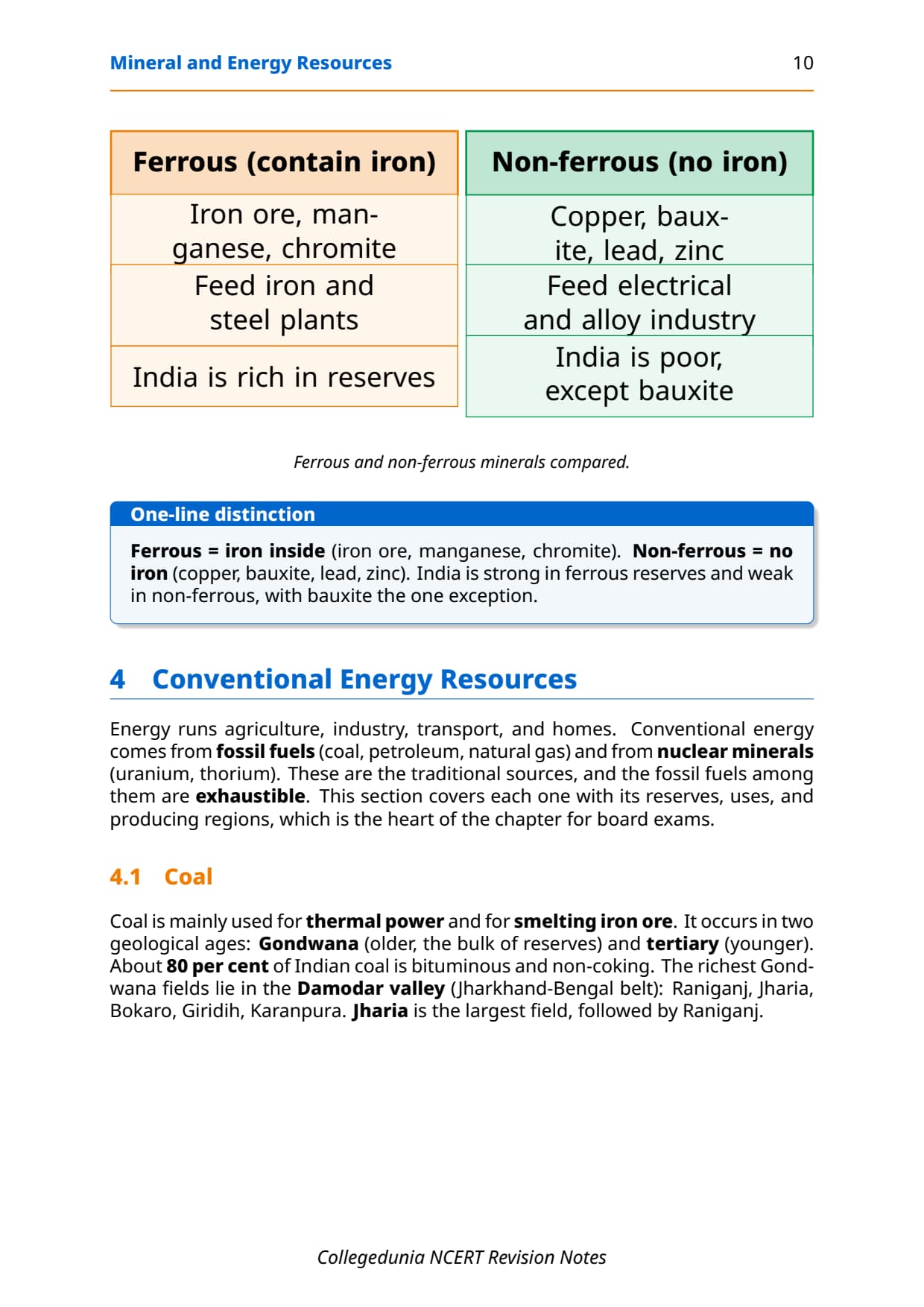
| Ferrous Minerals | Metallic minerals that contain iron, such as iron ore, manganese and chromite; provide the base for metallurgical industries. | Classification of Minerals |
| Non-Ferrous Minerals | Metallic minerals that do not contain iron, such as copper, bauxite, tin and gold; India is poorly endowed with these except bauxite. | Classification of Minerals |
| Non-Metallic Minerals | Minerals that either yield no metals (like mica, limestone, graphite) or are fossil fuels (like coal and petroleum) derived from buried plant and animal life. | Classification of Minerals |
| Fossil Fuels | Non-metallic minerals of organic origin formed from buried plant and animal matter over millions of years; include coal, petroleum and natural gas; also called mineral fuels. | Energy Resources |
| Conventional Energy Sources | Exhaustible energy resources that have been in use for a long time: coal, petroleum, natural gas and nuclear energy minerals. | Energy Resources |
| Non-Conventional Energy Sources | Renewable, environment-friendly energy sources like solar, wind, tidal, geothermal and bio-energy that can replace exhaustible fossil fuels. | Non-Conventional Energy |
| Haematite | One of the two main types of iron ore found in India; has great demand in the international market due to its superior quality. | Iron Ore section |
| Bauxite | The ore used in manufacturing aluminium; found mainly in tertiary deposits associated with laterite rocks on peninsular plateaus and coastal tracts; Odisha is the largest producer. | Non-Ferrous Minerals |
| Geothermal Energy | Energy derived from the heat released when magma comes to the surface; hot springs and geysers are tapped to generate electricity; India has a plant at Manikaran, Himachal Pradesh. | Non-Conventional Energy |
Distribution of Minerals in India (Four Mineral Belts)
Most metallic minerals occur in the peninsular plateau's old crystalline rocks. The chapter identifies four main mineral belts students must know for CBSE map questions.
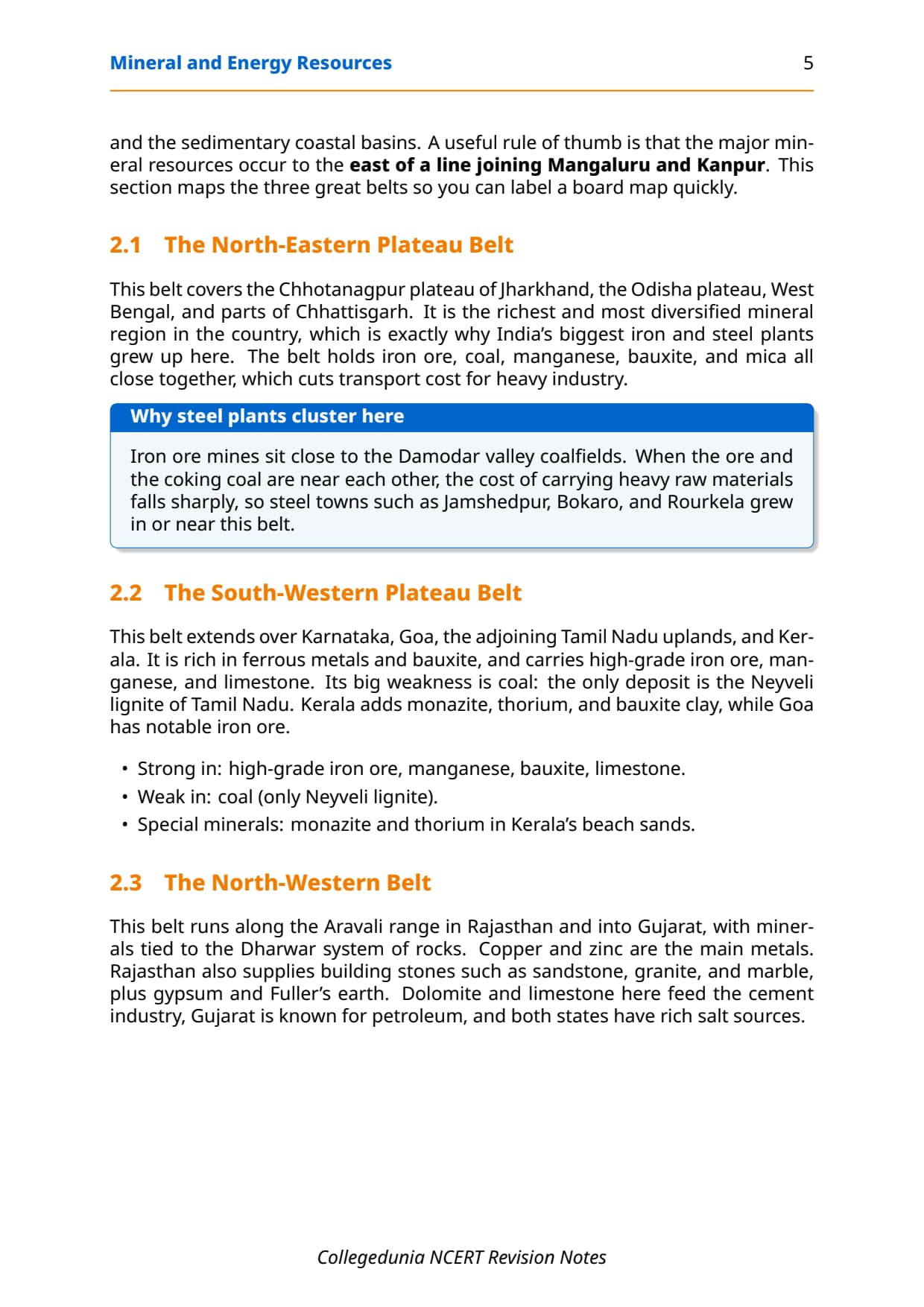
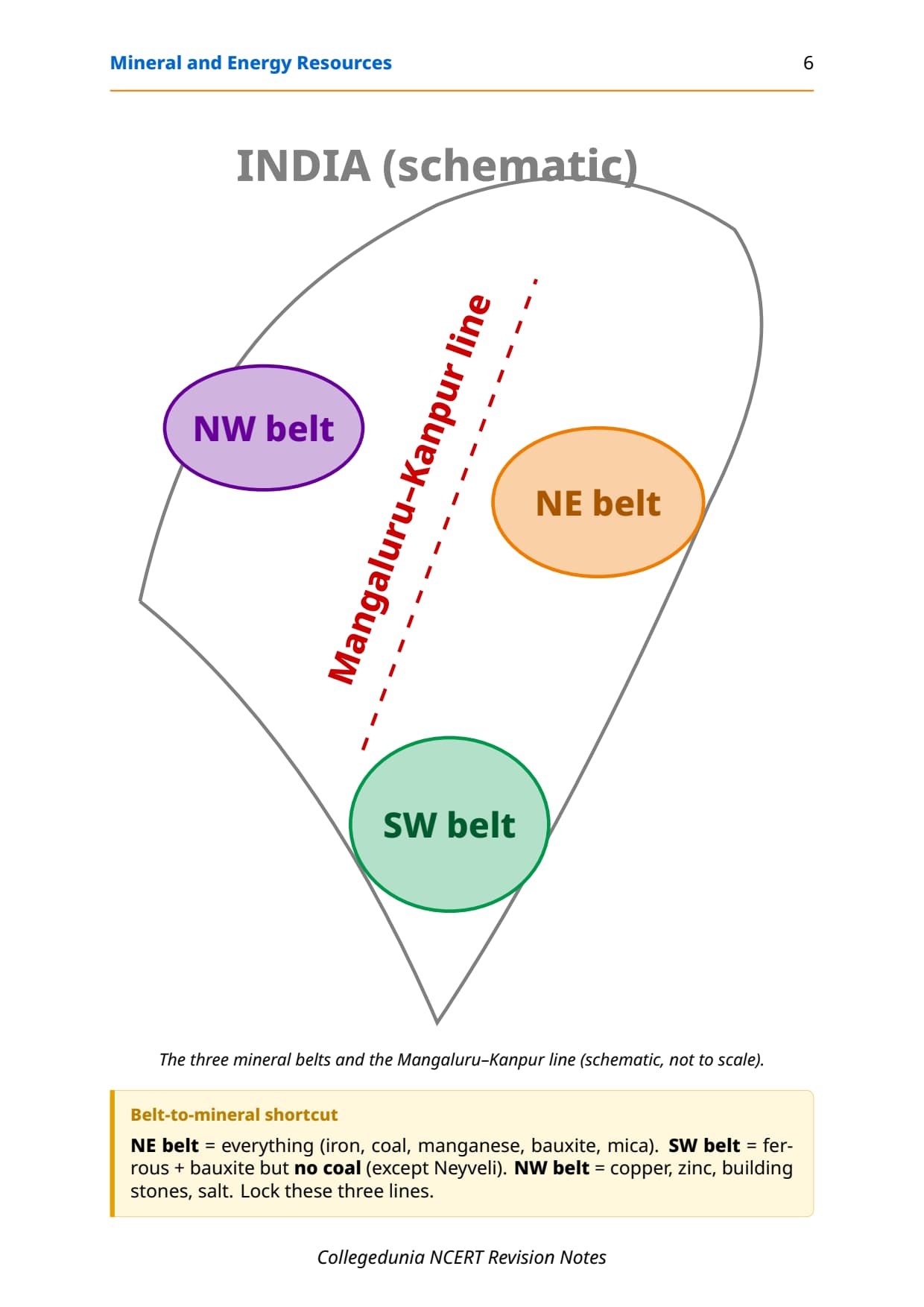
- North-Eastern Plateau: the most mineral-rich belt (Chhotanagpur, Odisha Plateau, West Bengal, Chhattisgarh). Iron ore, coal, manganese, bauxite and mica occur together, so most iron and steel plants sit here.
- South-Western Plateau: Karnataka, Goa, Tamil Nadu uplands and Kerala; rich in ferrous metals and bauxite, but coal is largely absent except Neyveli lignite. Kerala has monazite and thorium beaches.
- North-Western Region: the Aravali in Rajasthan and Gujarat; copper and zinc dominate, with gypsum, limestone and salt in Rajasthan and petroleum in Gujarat.
- Himalayan Belt: copper, lead, zinc, cobalt and tungsten, plus mineral oil in the Assam valley and offshore Mumbai High.
Quick map memory hook: Most major minerals lie east of a Mangaluru-Kanpur line, which separates mineral-rich peninsular India from the northern alluvial plains that lack useful minerals.
State-wise Distribution of Important Minerals
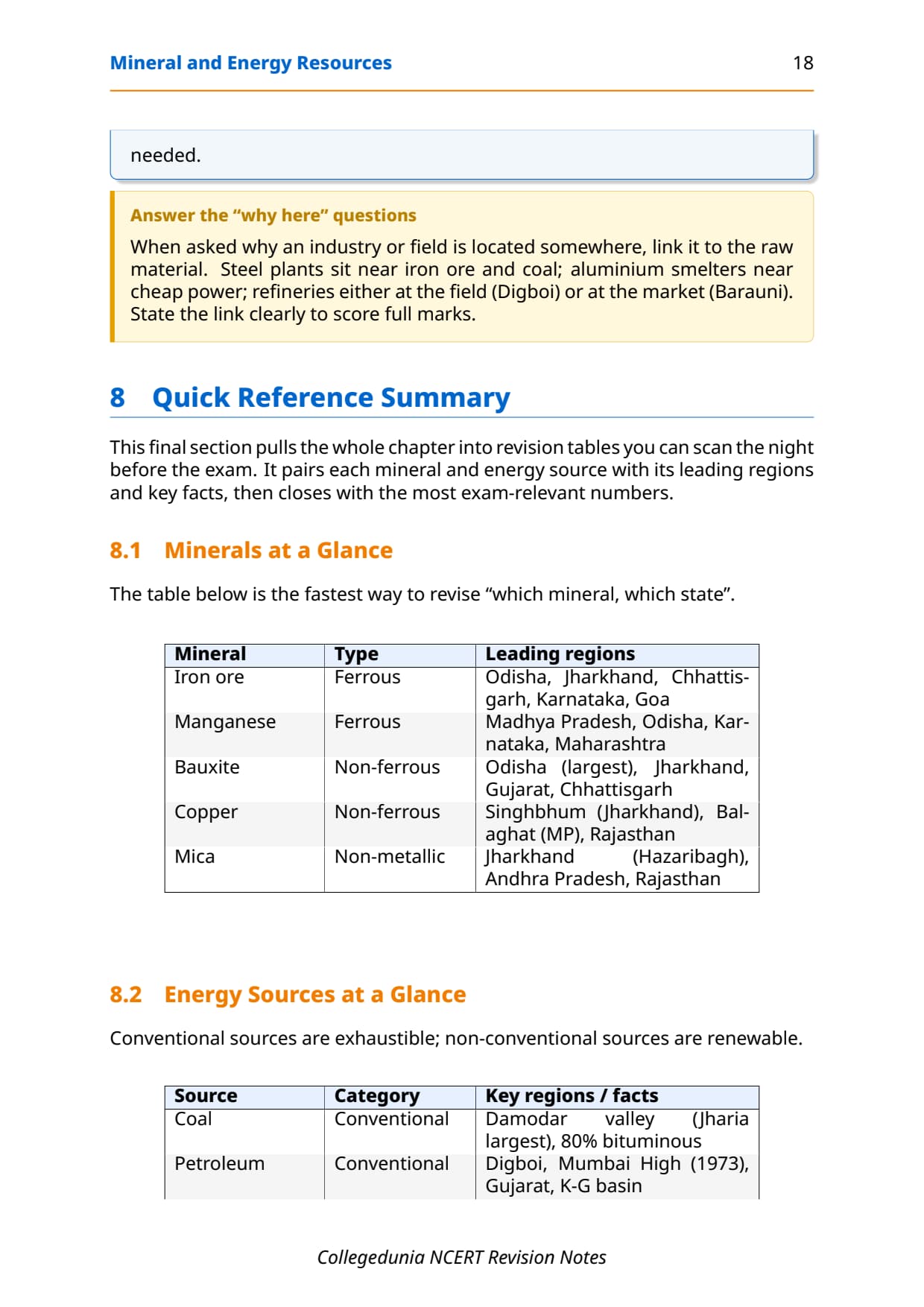
CBSE and CUET often ask students to name two states or mark one on the map. The table gives the most-tested state-mineral links.
| Mineral | Leading States | Key Mine / Area |
|---|---|---|
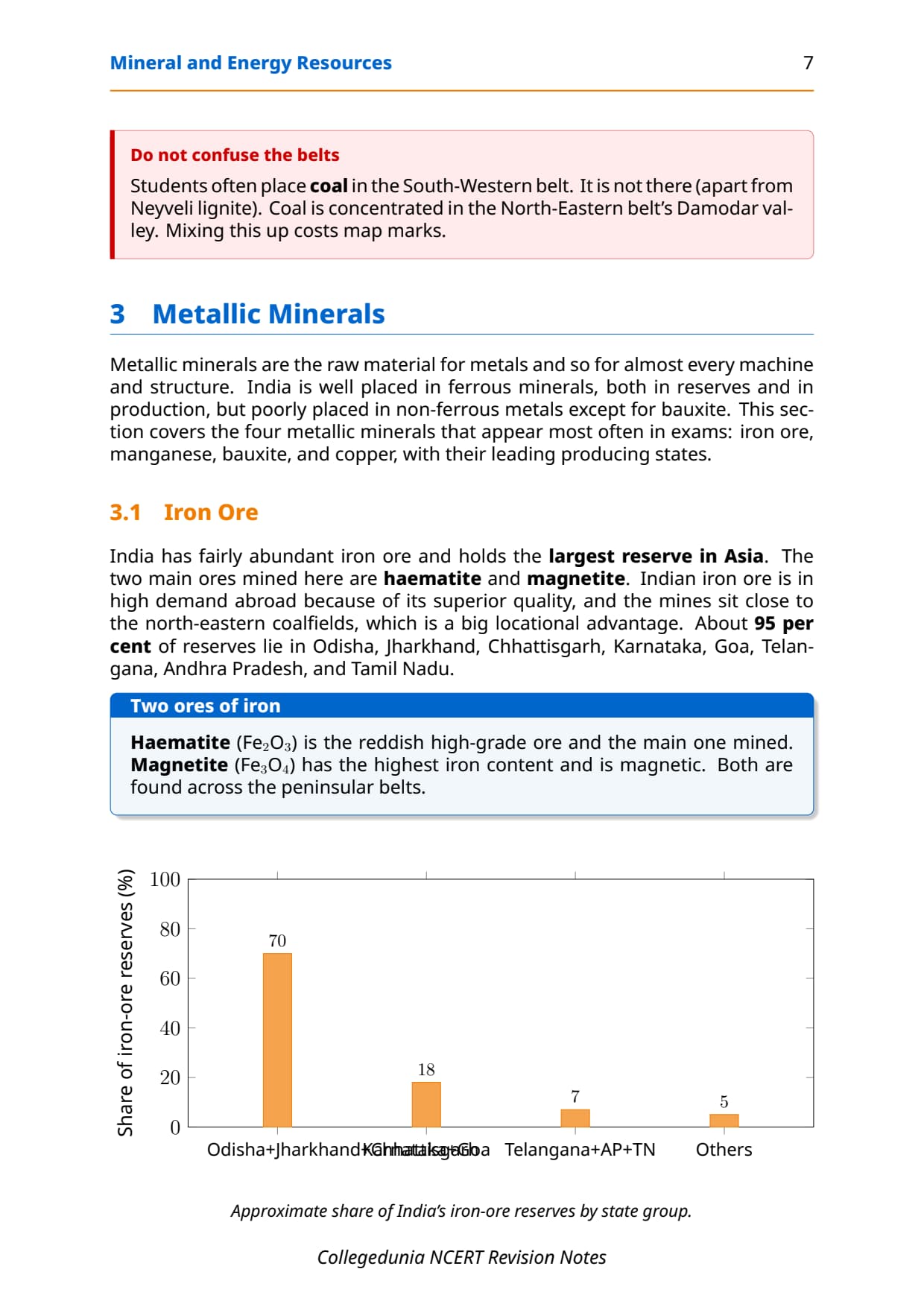
| Iron Ore | Odisha, Jharkhand, Chhattisgarh, Karnataka, Goa | Noamundi, Gua (Jharkhand); Bailadila, Dalli-Rajhara (Chhattisgarh); Kudremukh (Karnataka) |
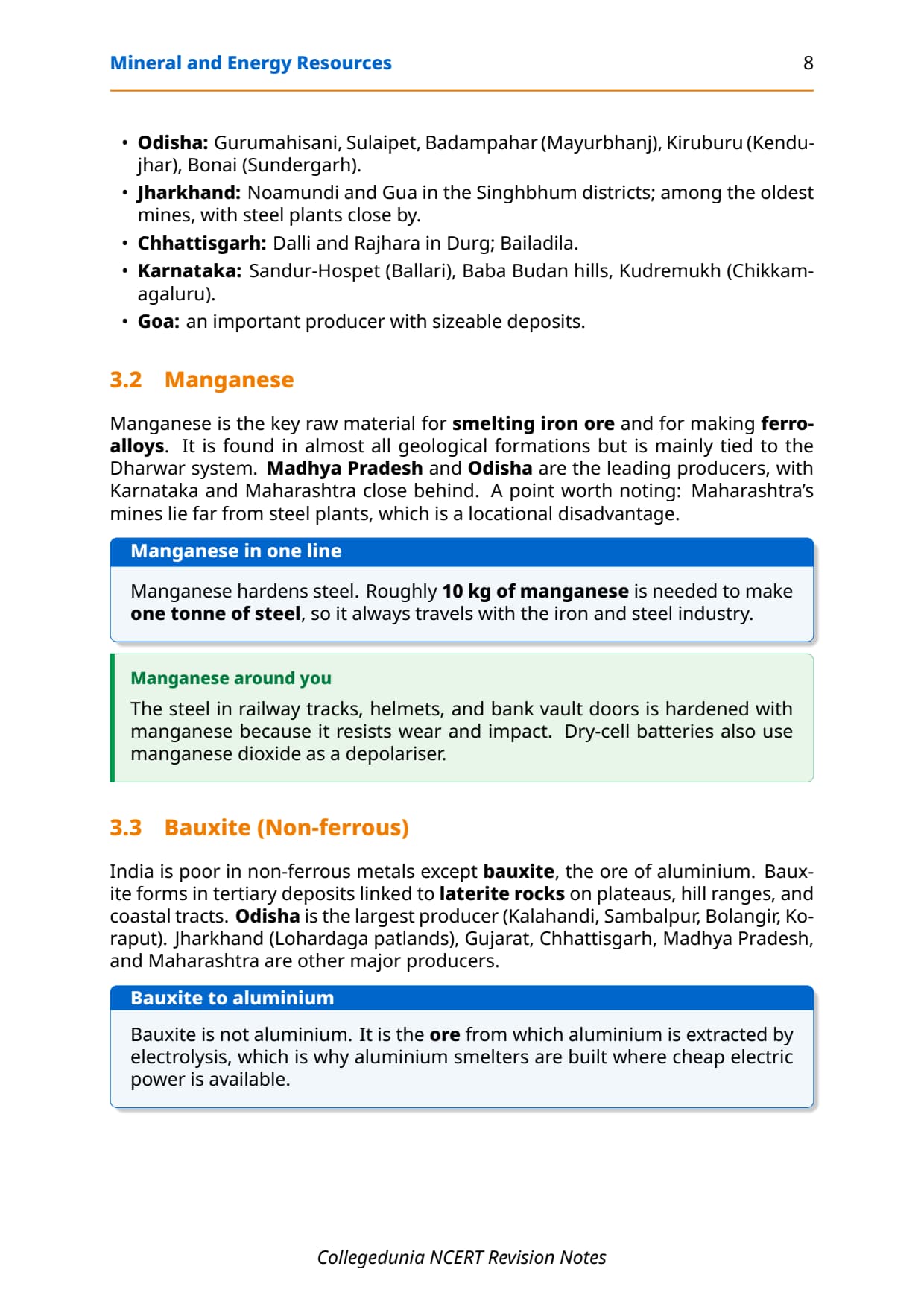
| Manganese | Madhya Pradesh, Odisha, Karnataka, Maharashtra | Balaghat-Chhindwara (MP); Bonai, Kendujhar (Odisha); Dharwar, Ballari (Karnataka) |
| Bauxite | Odisha (largest), Jharkhand, Gujarat | Kalahandi, Sambalpur (Odisha); Lohardaga (Jharkhand); Bhavnagar, Jamnagar (Gujarat) |
| Copper | Jharkhand, Madhya Pradesh, Rajasthan | Singhbhum (Jharkhand); Balaghat (MP); Jhunjhunu, Alwar (Rajasthan) |
| Mica | Jharkhand, Andhra Pradesh, Rajasthan | Lower Hazaribagh plateau (Jharkhand); Nellore (AP); Jaipur-Bhilwara belt (Rajasthan) |
| Coal | Jharkhand, West Bengal, Odisha, MP, Chhattisgarh | Jharia (largest field), Raniganj, Bokaro, Singrauli, Korba, Talcher |
| Petroleum | Assam, Gujarat, Maharashtra (offshore) | Digboi, Naharkatiya (Assam); Ankaleshwar, Kalol (Gujarat); Mumbai High |
| Uranium | Jharkhand, Rajasthan | Singhbhum Copper belt (Jharkhand); Udaipur, Alwar (Rajasthan) |
| Thorium | Kerala, Tamil Nadu | Palakkad, Kollam (Kerala) beach sands; Mahanadi river delta (Odisha) |
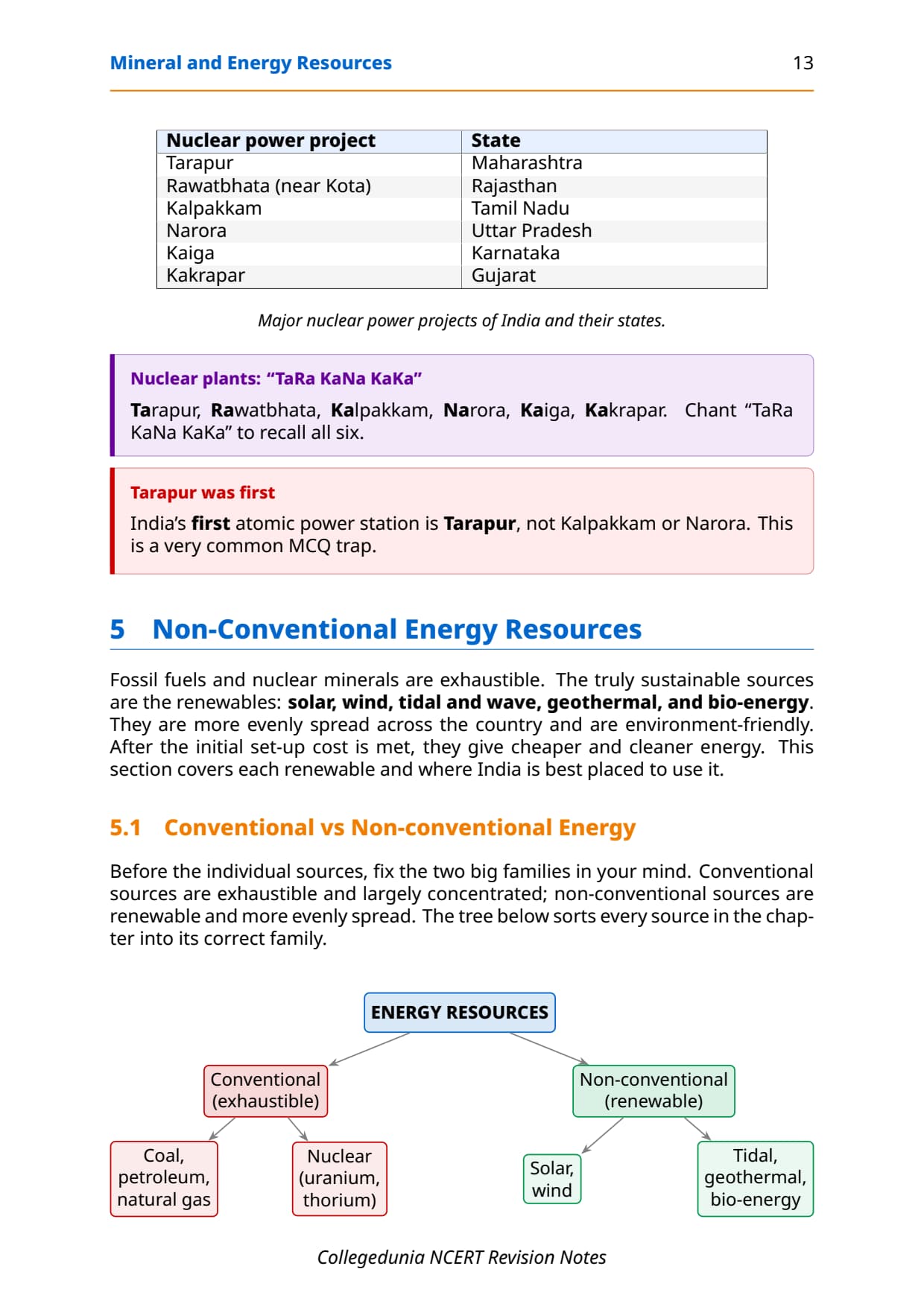
| Nuclear Power Stations | Maharashtra, Rajasthan, Tamil Nadu, UP, Karnataka, Gujarat | Tarapur, Rawatbhata, Kalpakkam, Narora, Kaiga, Kakarapara |
Tip: This table covers most map and location marks. Memorise the leading states for iron ore, manganese, mica and petroleum first, then the nuclear power stations.
Conventional Energy Resources: Coal, Petroleum and Natural Gas
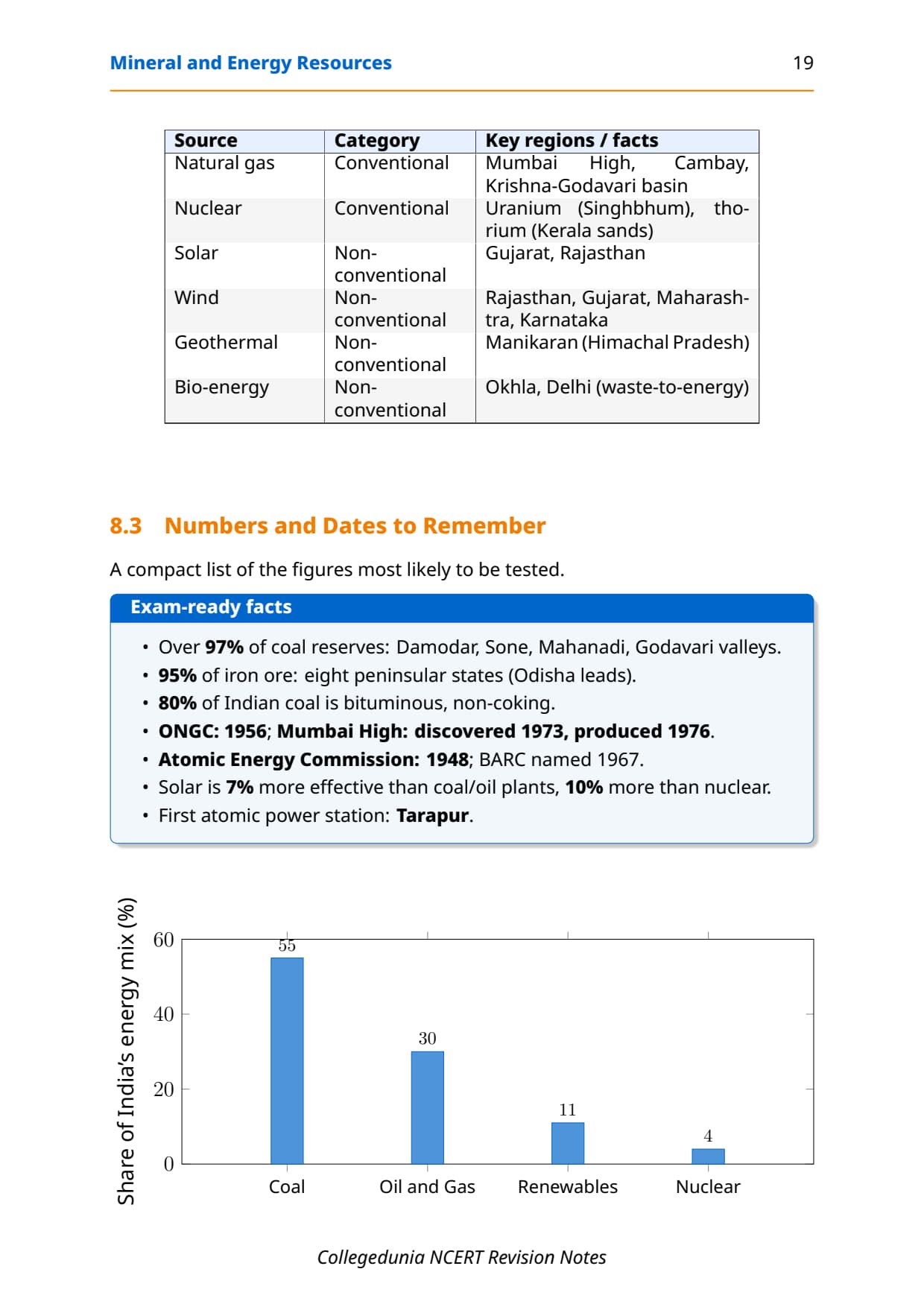
Conventional energy sources are exhaustible and power most of India's economy today. The NCERT chapter covers four: coal, petroleum, natural gas and nuclear energy minerals.
Coal
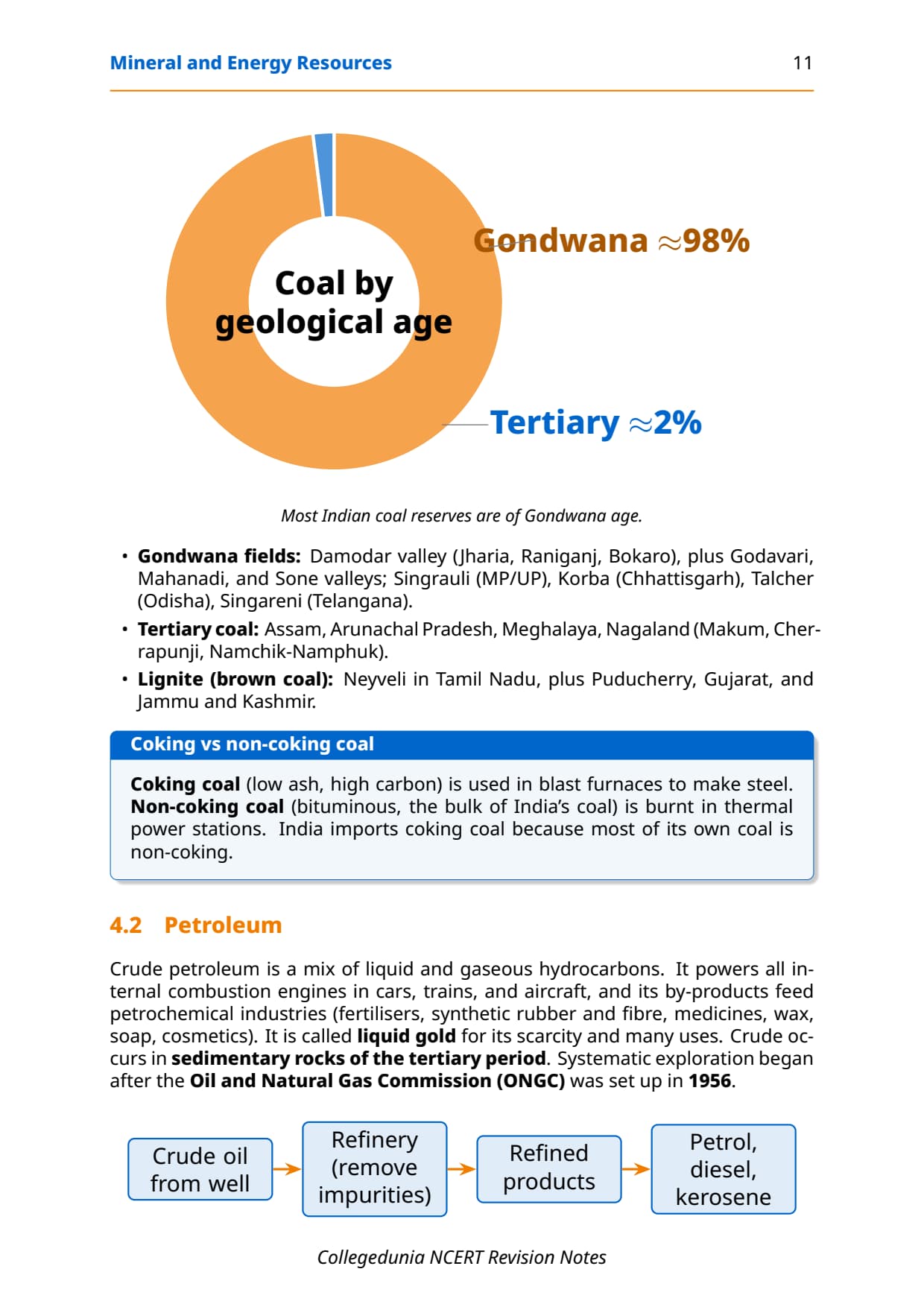
Coal is the main mineral for thermal power and iron smelting. About 80 per cent of India's coal is bituminous and non-coking. The chief coalfields lie in the Damodar Valley (Jharkhand-Bengal belt): Jharia (largest), Raniganj, Bokaro, Giridih and Karanpura, with more in the Godavari, Mahanadi and Sone valleys.
- Gondwana coal fields: the main type in peninsular river valleys; most of India's output.
- Tertiary coal: in Assam, Arunachal Pradesh, Meghalaya and Nagaland.
- Lignite (brown coal): coastal Tamil Nadu, Puducherry, Gujarat and J&K; lower energy value.
Petroleum
Petroleum is called "liquid gold" for its scarcity and wide range of uses. It occurs in tertiary sedimentary rocks. ONGC was set up in 1956 to explore and produce oil. Key producing areas:
- Assam: Digboi (India's oldest oilfield), Naharkatiya and Moran.
- Gujarat: Ankaleshwar, Kalol, Mehsana, Nawagam, Kosamba and Lunej.
- Mumbai High: 160 km offshore; in production from 1976; India's largest offshore field.
- East coast: new reserves in Krishna-Godavari and Kaveri basins.
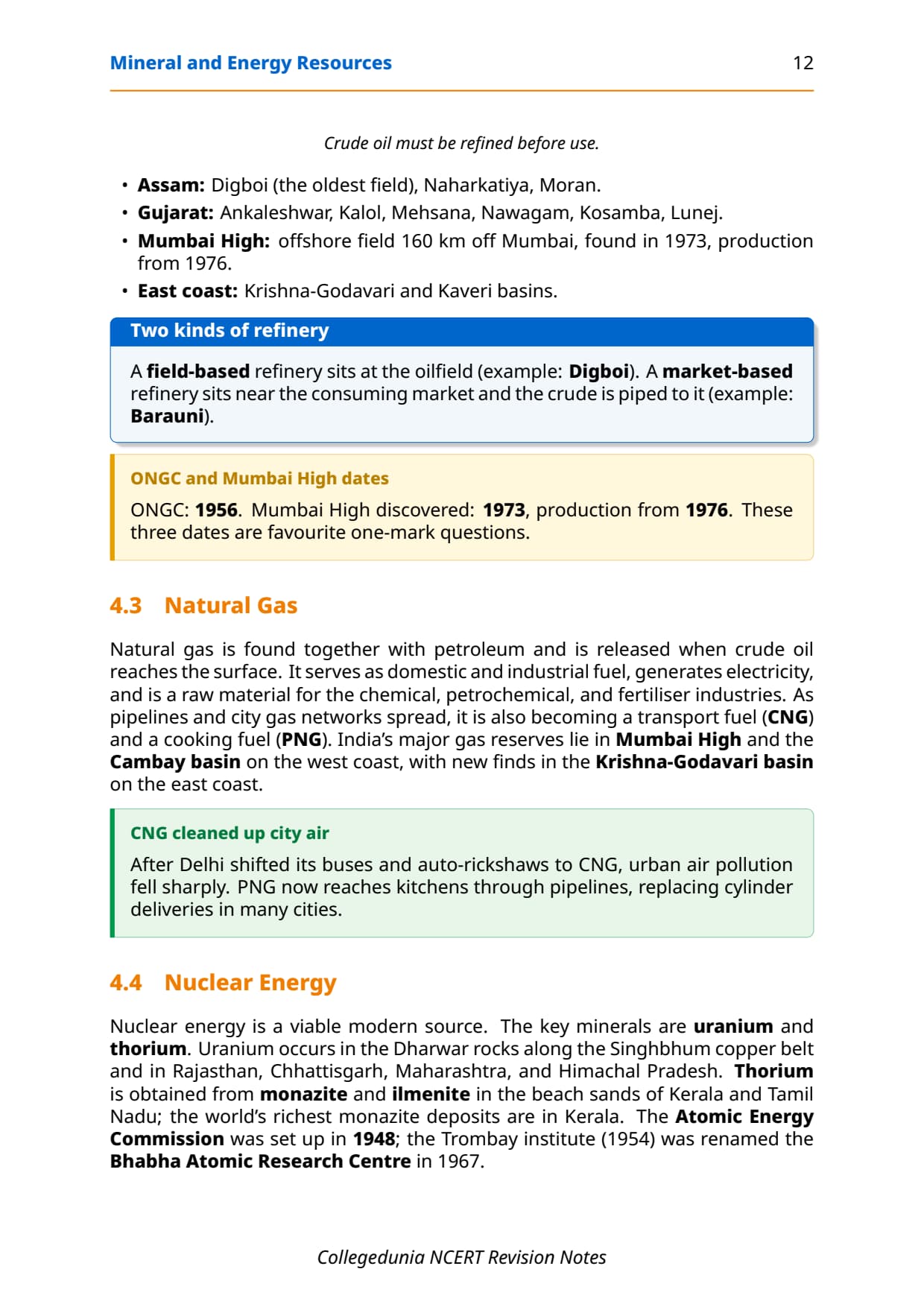
Crude oil is refined at field-based (Digboi) and market-based (Barauni) refineries. By-products feed petrochemical industries making fertilisers, synthetic rubber, fibre, medicines, lubricants and cosmetics.
Natural Gas
Natural gas serves as domestic and industrial fuel, for power generation and as a chemical and fertiliser feedstock, and increasingly as CNG and PNG. Major reserves lie in Mumbai High and west-coast fields, the Cambay basin, and the Krishna-Godavari basin on the east coast.
Nuclear and Non-Conventional Energy Sources
India is shifting to renewable, clean energy to cut its dependence on fossil fuels. The chapter covers nuclear energy plus five non-conventional sources students must know.
Nuclear Energy
Nuclear energy uses uranium and thorium. Uranium occurs along the Singhbhum Copper belt (Jharkhand) and in Udaipur and Alwar (Rajasthan); thorium comes from monazite and ilmenite in Kerala and Tamil Nadu beach sands. The Atomic Energy Commission was set up in 1948. The six nuclear power stations are Tarapur (Maharashtra), Rawatbhata (Rajasthan), Kalpakkam (Tamil Nadu), Narora (Uttar Pradesh), Kaiga (Karnataka) and Kakarapara (Gujarat).
Five Non-Conventional Energy Sources
| Source | How it works | India-specific facts |
|---|---|---|
| Solar Energy | Photovoltaic cells convert sunlight into electricity; solar thermal technology uses heat directly. | Solar energy is 7% more effective than coal/oil plants and 10% more effective than nuclear plants. Rajasthan and Gujarat have the highest potential. |
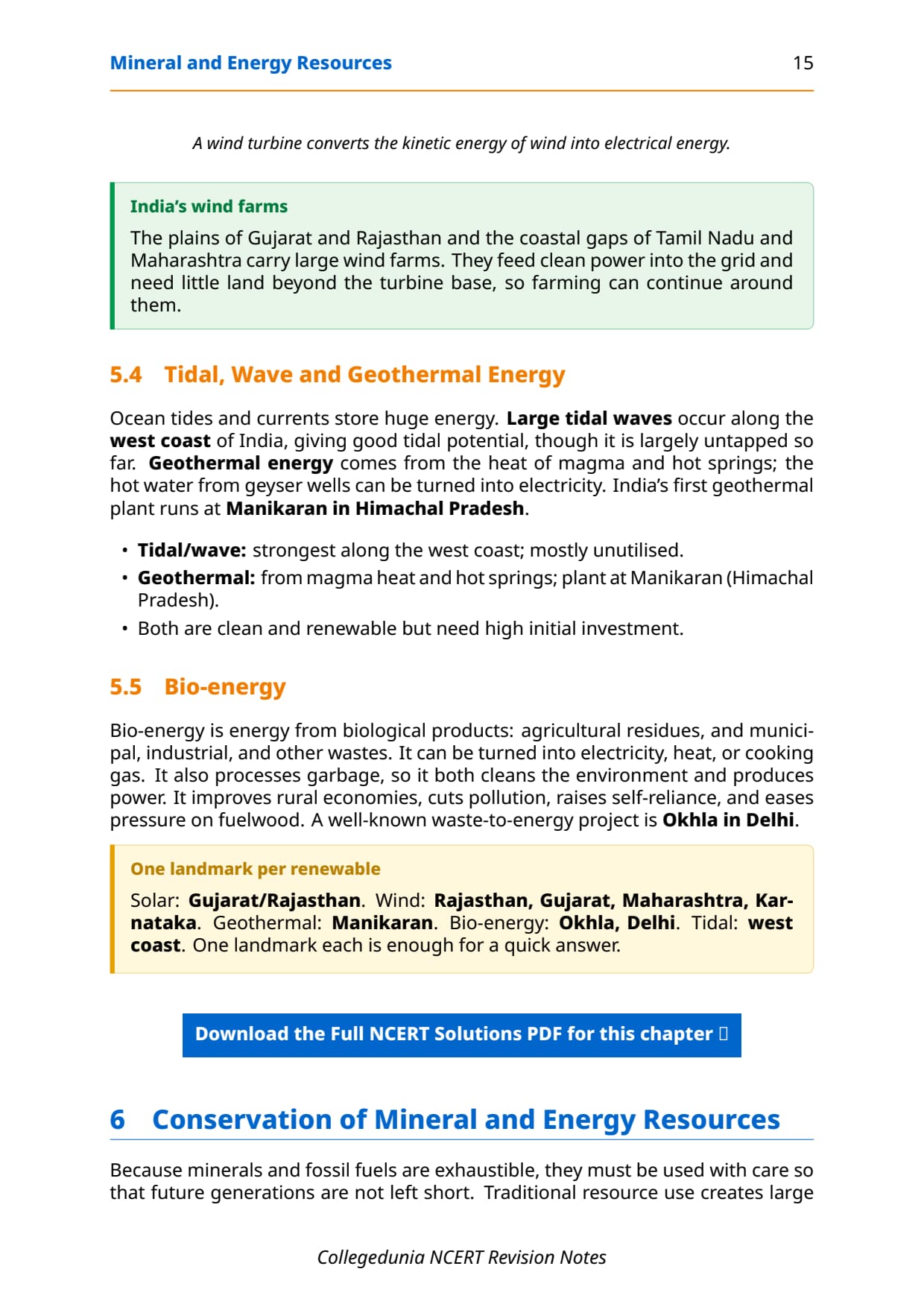
| Wind Energy | Kinetic energy of wind converted into electricity through turbines; pollution-free and inexhaustible. | Rajasthan, Gujarat, Maharashtra and Karnataka have favourable wind conditions. India already generates wind power commercially. |
| Tidal Energy | Ocean tidal waves drive turbines to generate electricity. | Large tidal waves occur along India's west coast; potential exists but has not yet been utilised commercially. |
| Geothermal Energy | Heat from magma tapped to generate electricity; hot springs and geysers also used. | India's first geothermal plant is commissioned at Manikaran in Himachal Pradesh. |
| Bio-energy | Energy derived from agricultural residues, municipal and industrial waste; converted to electricity, heat or cooking gas. | Okhla project in Delhi converts municipal waste into energy; helps reduce rural dependence on fuelwood. |
Non-conventional sources are more equitably distributed than fossil fuels, environment-friendly and cheaper once setup costs are recovered. Solar and wind appear as a 3-mark question in alternate years.
Conservation of Mineral Resources
Sustainable development means balancing growth with protecting resources for the future. The chapter lists five conservation strategies for mineral and energy resources.
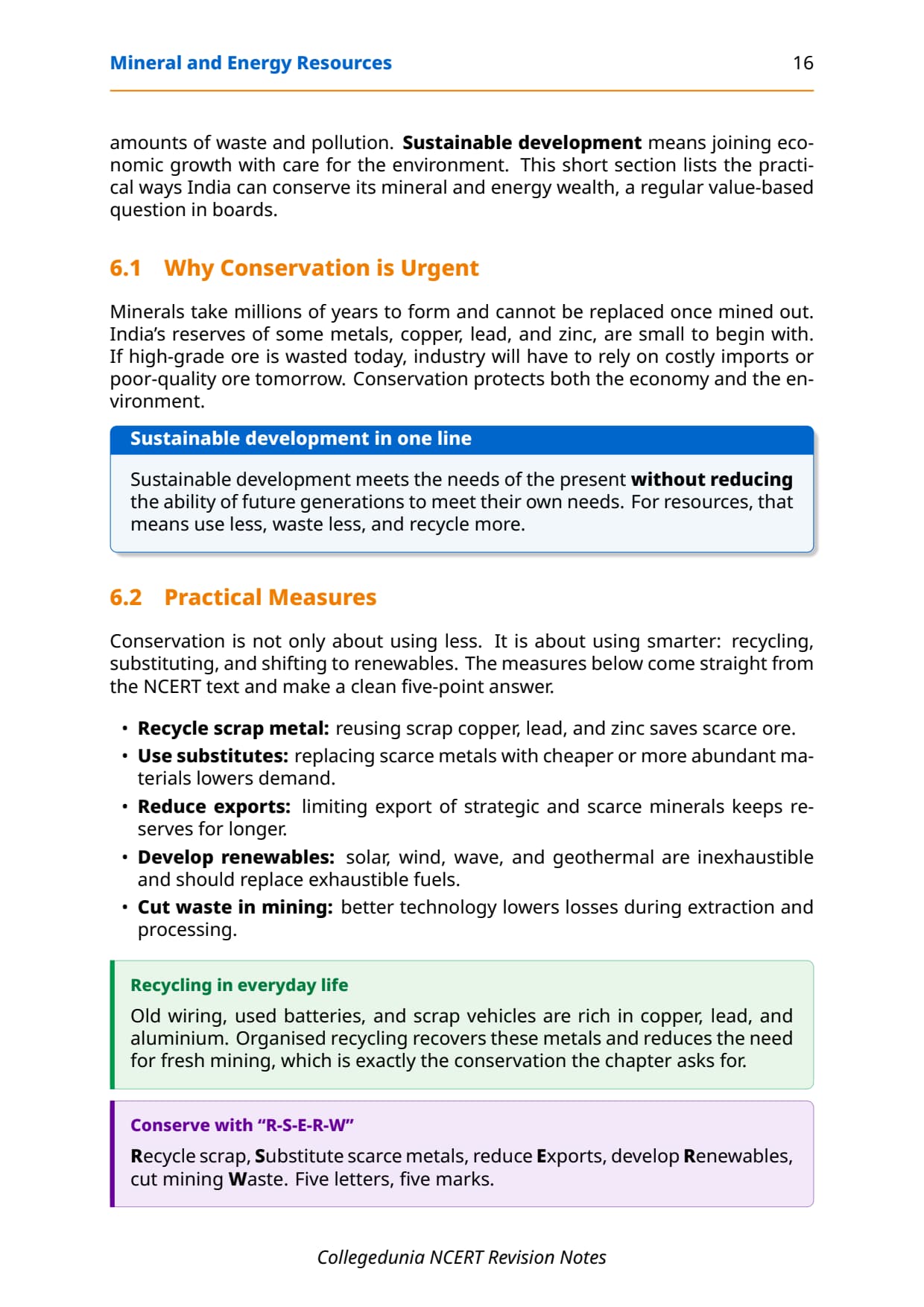
The five key conservation strategies from the NCERT chapter on mineral and energy resources class 12:
- Develop alternative energy: solar, wind, wave and geothermal are inexhaustible and should progressively replace fossil fuels.
- Recycle scrap metals: vital for copper, lead and zinc, where India's reserves are small.
- Use substitutes for scarce metals: abundant alternatives ease depletion pressure.
- Reduce export of strategic minerals: keeping reserves home extends their useful life.
- Adopt sustainable traditional methods: low-waste methods beat high-waste extraction.
This conservation theme links to the Section C long-answer questions on sustainable development, seen in about three of the last five years' papers.
Previous Year Question Trends from Mineral and Energy Resources Class 12
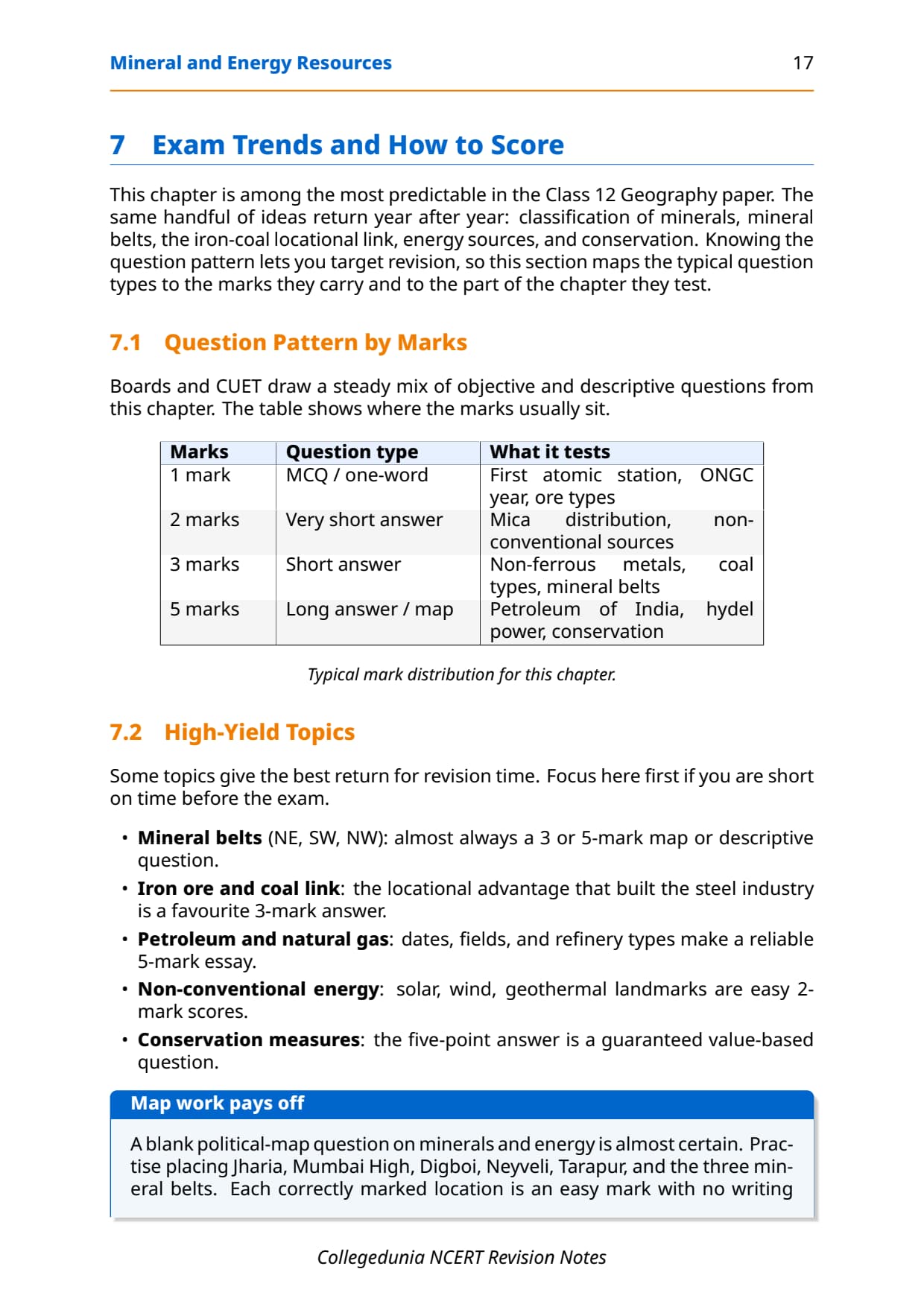
Important questions follow a stable pattern. The table maps what CBSE has asked over the last five years.
| Year | Question asked | Marks | Notes section to revise |
|---|---|---|---|
| 2025 | Name two non-conventional energy sources and explain why they are preferred over conventional sources | 5 | Nuclear and Non-Conventional Energy section |
| 2024 | Mark on map: iron ore mine in Odisha + nuclear power station in Tamil Nadu | 2 | State-wise Distribution table |
| 2023 | Describe the distribution of coal in India with reference to Gondwana and tertiary deposits | 5 | Conventional Energy Resources section |
| 2022 | Identify and explain two characteristics of minerals; name one example each of ferrous and non-ferrous mineral | 3 | Key Definitions + Quick Concept Recap |
| 2021 | Write a note on petroleum resources of India including producing states and importance | 5 | Conventional Energy Resources section |
The chapter carries an effective 8 to 10 marks per year across theory, map and long-answer questions, making it one of the highest-scoring in the paper.
Other Resources for Class 12 Geography Chapter 5 Mineral and Energy Resources
Pair these notes with the matching NCERT Solutions, handwritten notes and NCERT book chapter below.
| Resource | What it covers | Open |
|---|---|---|
| Notes | Concept-first revision notes covering mineral types, four belts, state-wise distribution, energy sources and conservation. | You are here |
| NCERT Solutions | Step-by-step answers to all exercise questions with detailed explanations for every long-answer question. | Class 12 Geography Chapter 5 NCERT Solutions |
| Handwritten Notes | A topper's genuine handwritten revision pages for last-minute board exam practice. | Class 12 Geography Chapter 5 Handwritten Notes |
| NCERT Book PDF | Official NCERT India: People and Economy Chapter 5 textbook in PDF form. | Class 12 Geography Chapter 5 NCERT Book PDF |
| Subject Hub | All chapters of Class 12 Geography with every resource in one place. | Class 12 Geography Subject Hub |
All Chapters Notes for Class 12 Geography India: People and Economy
Related Links: Use the table below for the Notes of the other Class 12 Geography (India: People and Economy) chapters.
| Chapter | Topic | Notes link |
|---|---|---|
| Chapter 1 | Population Distribution, Density, Growth and Composition | Class 12 Geography Chapter 1 IPE Notes |
| Chapter 2 | Human Settlements | Class 12 Geography Chapter 2 IPE Notes |
| Chapter 3 | Land Resources and Agriculture | Class 12 Geography Chapter 3 IPE Notes |
| Chapter 4 | Water Resources | Coming soon |
| Chapter 5 | Mineral and Energy Resources | You are here |
| Chapter 6 | Planning and Sustainable Development in Indian Context | Coming soon |
| Chapter 7 | Transport and Communication | Coming soon |
| Chapter 8 | International Trade | Coming soon |
| Chapter 9 | Geographical Perspective on Selected Issues and Problems | Coming soon |
NCERT Notes Class 12 Geography Chapter 5 Mineral and Energy Resources FAQs
Ques. What are the mineral and energy resources class 12 notes meant to be used for?
Ans. The mineral and energy resources class 12 notes are a concept-first revision file that compresses the entire NCERT Chapter 5 of Class 12 India: People and Economy into a printable study guide. They cover mineral types (ferrous, non-ferrous, non-metallic), the four mineral belts, state-wise distribution of key minerals, conventional and non-conventional energy sources, and conservation strategies. Students typically use these notes for the 30-minute first-pass revision and the 20-minute night-before pass; the worked exercise answers live in the matching NCERT Solutions PDF.
Ques. What are the four mineral belts of India as per NCERT Class 12 Geography?
Ans. The NCERT chapter identifies four main mineral belts. The North-Eastern Plateau Region (Jharkhand, Odisha, West Bengal, Chhattisgarh) is the most diversified, with iron ore, coal, manganese, bauxite and mica. The South-Western Plateau Region (Karnataka, Goa, Tamil Nadu, Kerala) is rich in ferrous metals and bauxite but lacks coal. The North-Western Region (Rajasthan, Gujarat) has copper, zinc and petroleum. The Himalayan belt has copper, lead, zinc and oil deposits in Assam. These four belts are the core map-based knowledge students must have for CBSE board exams.
Ques. Which state is the largest producer of bauxite in India?
Ans. Odisha is the largest producer of bauxite in India as per the NCERT Class 12 Geography chapter. Within Odisha, Kalahandi and Sambalpur are the leading producing districts. Bolangir and Koraput have been increasing their production. Other major producers are Jharkhand (Lohardaga), Gujarat (Bhavnagar, Jamnagar), Chhattisgarh and Madhya Pradesh. This is one of the most-tested state-mineral links in CBSE board papers for this chapter.
Ques. What is the difference between conventional and non-conventional energy sources in Class 12 Geography?
Ans. Conventional energy sources such as coal, petroleum, natural gas and nuclear energy minerals are exhaustible: once used, they cannot be quickly replenished. Non-conventional energy sources like solar, wind, tidal, geothermal and bio-energy are renewable, environment-friendly and more equitably distributed. The NCERT chapter argues that sustainable development requires shifting from conventional to non-conventional sources. This distinction is tested as a 3-mark or 5-mark question in the CBSE board paper for this chapter.
Ques. Where are the nuclear power stations located in India as per Class 12 Geography NCERT?
Ans. The NCERT chapter lists six nuclear power stations in India: Tarapur (Maharashtra), Rawatbhata near Kota (Rajasthan), Kalpakkam (Tamil Nadu), Narora (Uttar Pradesh), Kaiga (Karnataka) and Kakarapara (Gujarat). Uranium for these plants comes mainly from the Singhbhum Copper belt in Jharkhand and from Udaipur and Alwar districts in Rajasthan. Thorium, another nuclear fuel, is obtained from monazite-rich beach sands in Kerala and Tamil Nadu.
Ques. What are the three characteristics of minerals mentioned in NCERT Class 12 Geography Chapter 5?
Ans. The NCERT chapter states three main characteristics of minerals. First, minerals are unevenly distributed over space: some regions are mineral-rich and others are mineral-poor. Second, there is an inverse relationship between quality and quantity: high-quality minerals are less abundant than low-quality minerals. Third, all minerals are exhaustible over time: they take millions of years to form geologically and cannot be replenished at the time of need. These three characteristics explain why conservation of mineral resources is essential.
Ques. How are Gondwana and tertiary coal fields different in India?
Ans. Gondwana coal fields are the older and economically more important fields, accounting for most of India's coal production. They lie in the peninsular river valleys of Damodar, Sone, Godavari and Mahanadi. The major Gondwana fields are Jharia, Raniganj, Bokaro and Singrauli. Tertiary coal fields are found in north-eastern states like Assam, Arunachal Pradesh, Meghalaya and Nagaland and are less extensive. About 80 per cent of India's coal is bituminous (Gondwana type) and of non-coking grade, which means it cannot be used directly in blast furnaces without blending.
Ques. Why is petroleum called liquid gold in NCERT Class 12 Geography?
Ans. Petroleum is called liquid gold in the NCERT chapter because of its scarcity and its extremely wide range of uses. It powers all internal combustion engines in automobiles, railways and aircraft. Its by-products feed petrochemical industries producing fertilisers, synthetic rubber, fibre, medicines, vaseline, lubricants, wax, soap and cosmetics. Despite its importance, petroleum occurs only in limited sedimentary rock deposits (tertiary period) in Assam, Gujarat and the offshore Mumbai High, making it both valuable and exhaustible. This combination of high utility and scarcity earns it the name liquid gold.
Ques. Are these mineral and energy resources class 12 notes aligned to the 2026-27 CBSE syllabus?
Ans. Yes. These mineral and energy resources class 12 notes are fully aligned to the 2026-27 NCERT India: People and Economy textbook and the 2026-27 CBSE Class 12 Geography syllabus. No major changes were made to this chapter in the rationalised syllabus. All content, definitions and state-wise mineral data match the reprinted 2026-27 edition of the NCERT chapter. Students preparing for the 2026 CBSE boards, CUET Geography or UPSC Geography optional can use these notes directly without any adjustment.



Comments