




These Class 12 Geography Chapter 2 Human Settlements notes cover every NCERT definition, the four types of rural settlements, the census definition of urban areas, the evolution of Indian towns, and the functional classification of cities, all aligned to the 2026-27 syllabus.

- Concept-first revision: rural settlement types, the census urban definition, ancient/medieval/modern town classification and urbanisation trends from 1901 to 2011.
- Settlement pattern factors, the Smart Cities Mission feature, and the full functional classification of towns that CBSE, CUET and UPSC examiners repeatedly pick.
- Cross-pointers to the matching NCERT Solutions, Handwritten Notes and NCERT Book PDF.
Every line in these Human Settlements Class 12 notes is written by Collegedunia geography subject experts, mapped to the 2026-27 NCERT India: People and Economy textbook, and checked against the last five years of CBSE board papers and CUET Geography patterns.
Student Feedback
69% of Class 12 students said the four rural settlement types were the most-confused part, and 3 out of 4 rated the functional classification as most worth revising from a notes sheet. Most finished a full revision in about 30 minutes.
Source: 2026-27 Class 12 Geography student poll, 10,200 CBSE students.
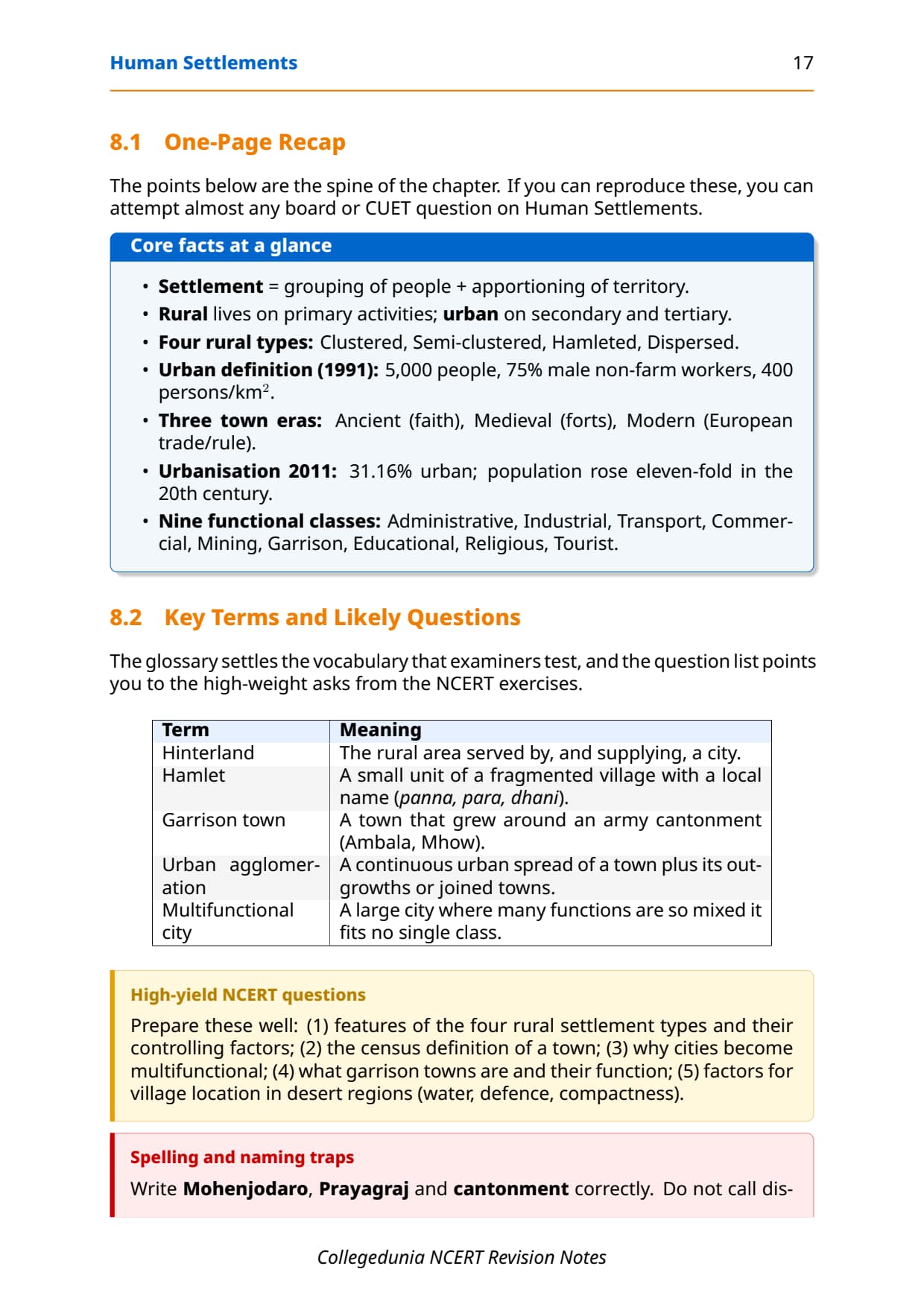
Quick Concept Recap: Human Settlements at a Glance
A human settlement is a cluster of dwellings where people live, command territory and build an economic support base, ranging from a hamlet to a metropolitan city. Every concept in this chapter flows from the rural-versus-urban divide.
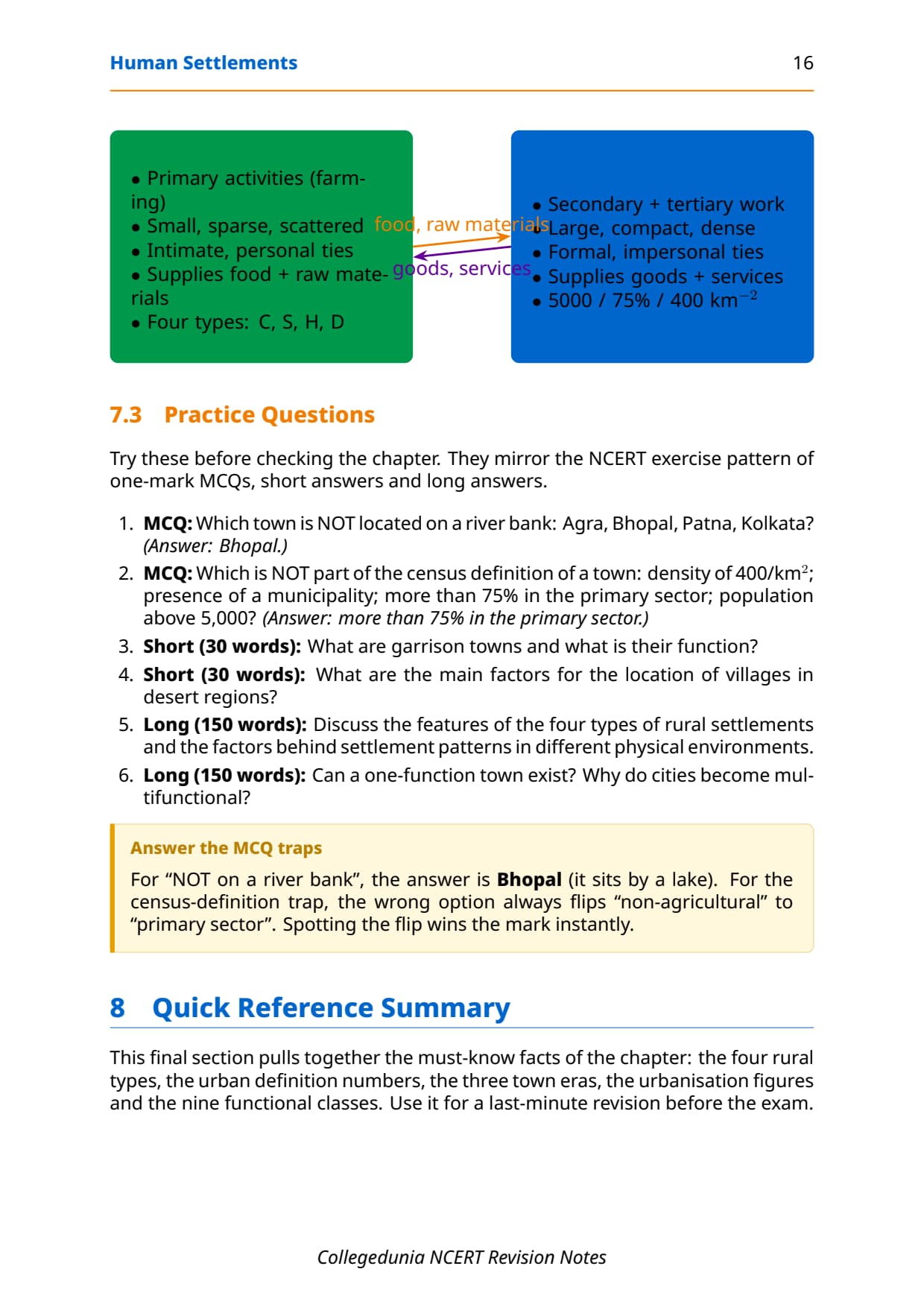
- Rural vs urban: rural runs on land-based primary activities; urban runs on secondary/tertiary activities as a node of economic growth.
- Four rural types: clustered, semi-clustered, hamleted and dispersed.
- Census urban definition: population 5,000+, 75%+ male workers non-agricultural, density 400+ per sq km, plus a municipality.
- Three town phases: ancient (Varanasi, Madurai), medieval (Delhi, Jaipur) and modern (Mumbai, Chennai, Kolkata).
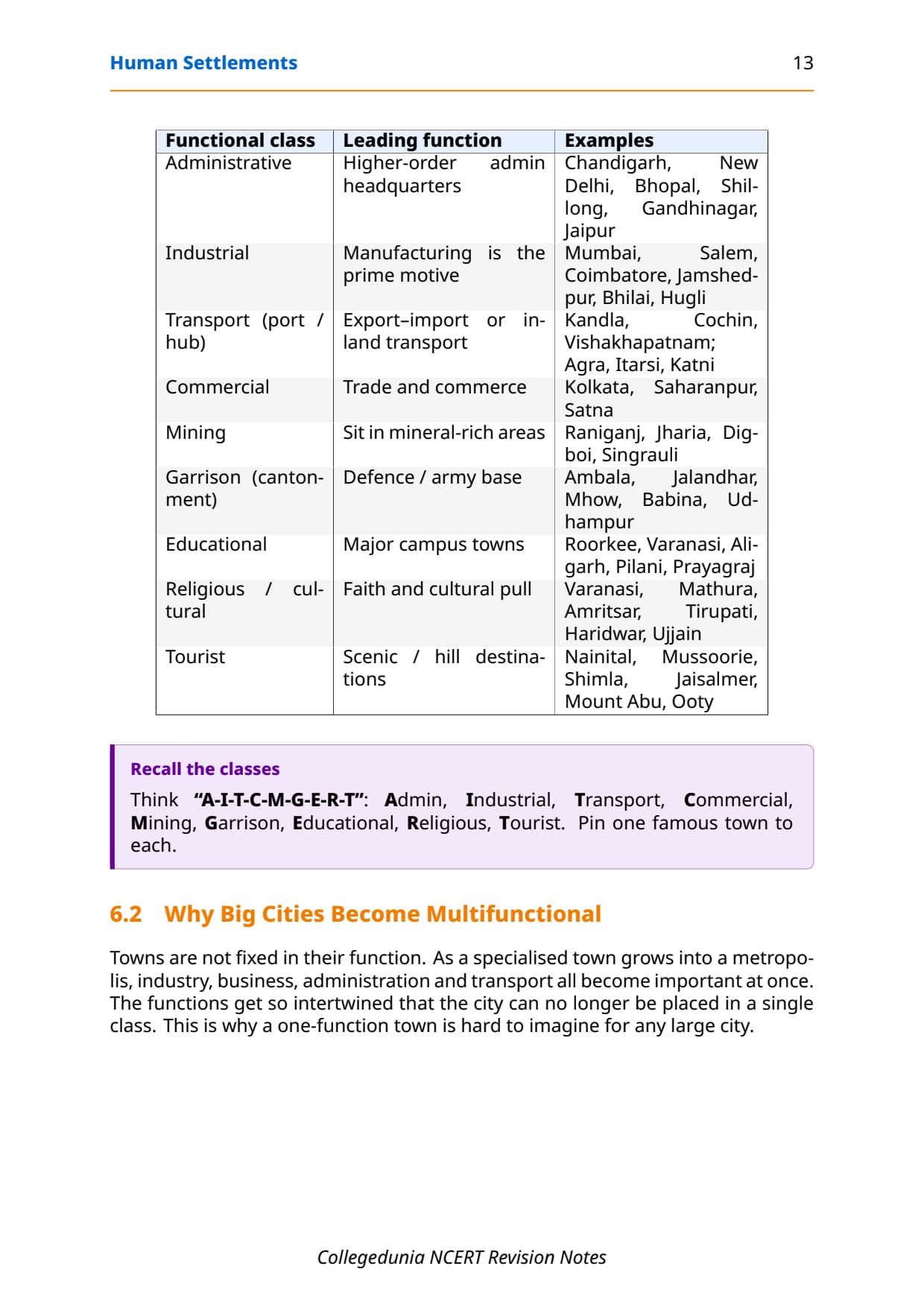
- Functional classification: administrative, industrial, transport, commercial, mining, garrison, educational, religious and tourist towns.
Read these notes first, then drop into the matching NCERT Solutions for Class 12 Geography Chapter 2 for the exercise drill.
Source: Lucky Education on YouTube
Key Definitions for Human Settlements Class 12
Every objective-type question on this chapter starts with a definition. The table below uses the exact one-line form CBSE markers expect.
| Term | One-line definition | NCERT pointer |
|---|---|---|
| Human Settlement | A cluster of dwellings of any type or size where human beings live and command some territory as their economic support base. | Chapter 2 intro |
| Rural Settlement | A small, sparsely spaced settlement deriving its economic support from land-based primary activities such as agriculture. | Types of Rural Settlement |
| Urban Settlement | A generally compact, larger settlement engaged in non-agricultural economic and administrative functions, acting as a node of economic growth. | Urban Settlements section |
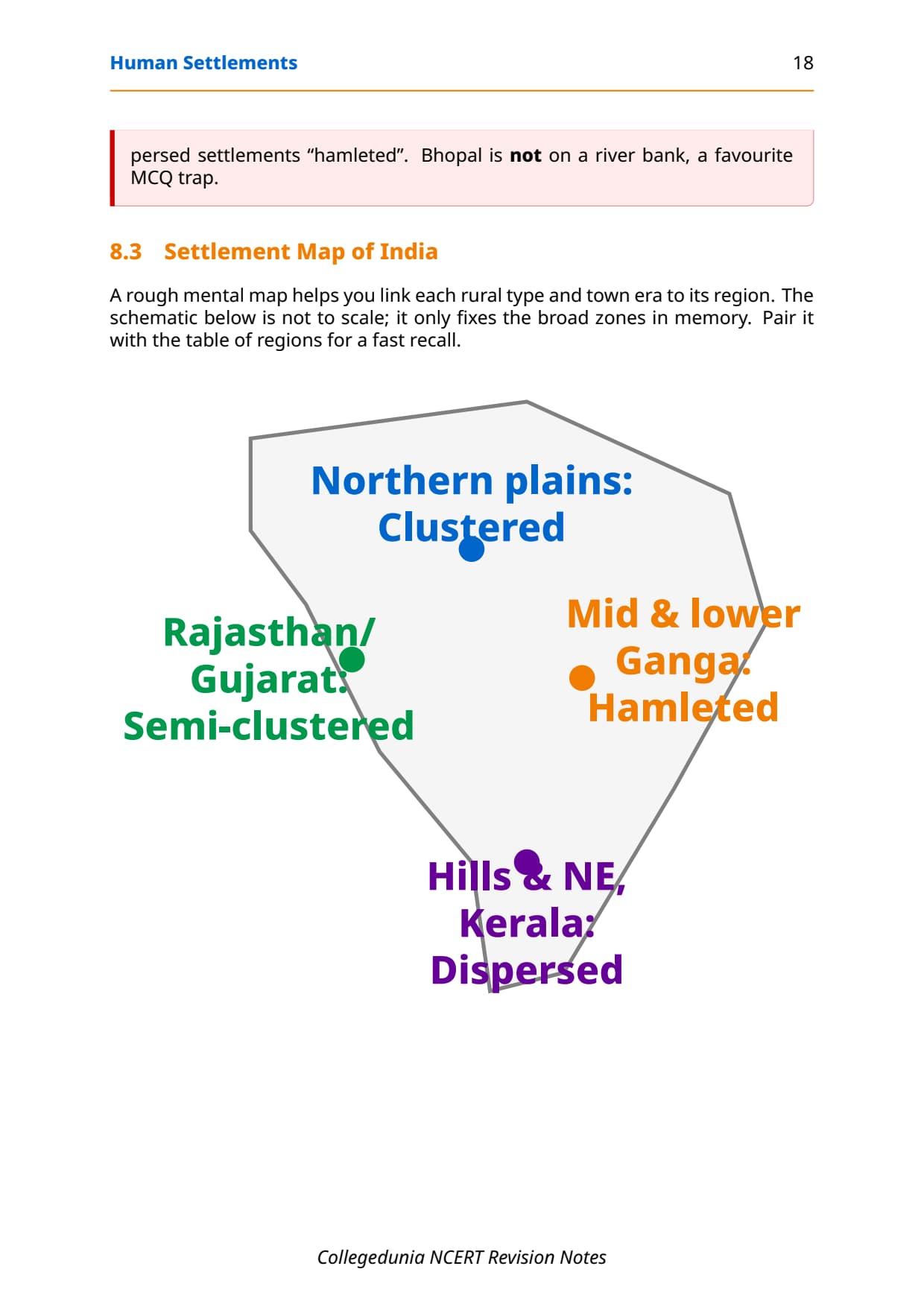
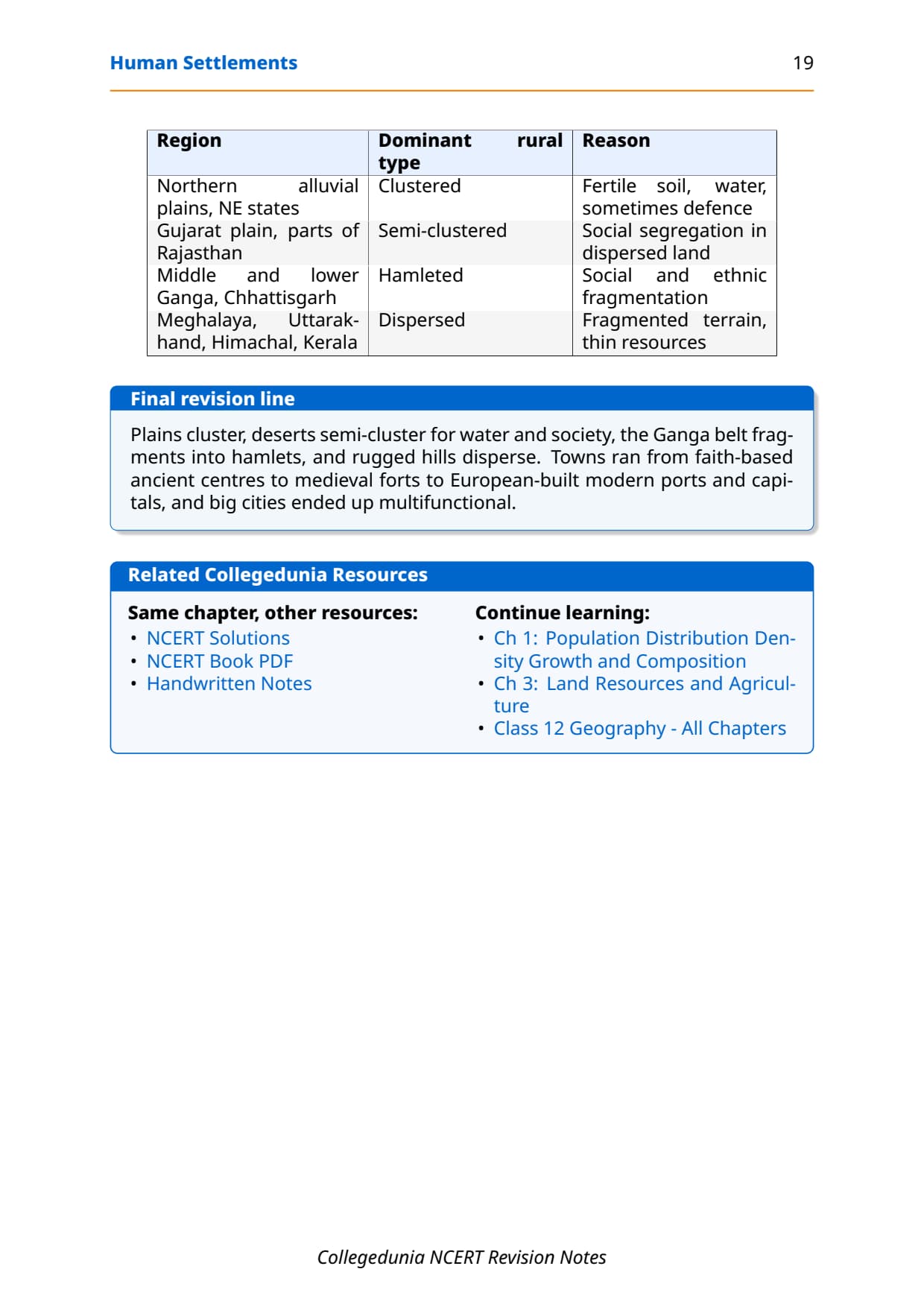
| Clustered Settlement | A compact or closely built-up area of houses with a distinct living area separated from surrounding farms and pastures; common in alluvial plains and northeastern states. | Rural Settlement types |
| Semi-Clustered Settlement | A settlement where one or more sections of the village live away from the main cluster due to social segregation; widespread in the Gujarat plain and parts of Rajasthan. | Rural Settlement types |
| Hamleted Settlement | A settlement fragmented into several physically separated units bearing a common name, locally called panna, para, palli or dhani; common in the Ganga plain and Chhattisgarh. | Rural Settlement types |
| Dispersed Settlement | Isolated huts or small hamlets in remote areas caused by extremely fragmented terrain; found in Meghalaya, Uttarakhand, Himachal Pradesh and Kerala. | Rural Settlement types |
| Census Urban Definition (1991) | All places with a municipality or corporation, minimum 5,000 population, at least 75% male workers in non-agriculture and population density of at least 400 persons per sq km. | Urban Settlements section |
| Smart Cities Mission | A government initiative to promote cities that provide core infrastructure, a clean environment and a decent quality of life using smart solutions; focuses on sustainable, inclusive, compact development. | Smart Cities box |
| Urban Agglomeration | A continuous urban spread comprising a city and its adjoining urban outgrowths, counted together as a single urban unit for census purposes. | Urbanisation Trends table |
These ten definitions cover roughly 7 of the 9 one-mark and 3-mark theory questions CBSE has asked on this topic since 2021. Write each one out on paper before moving on.
Four Types of Rural Settlements in India
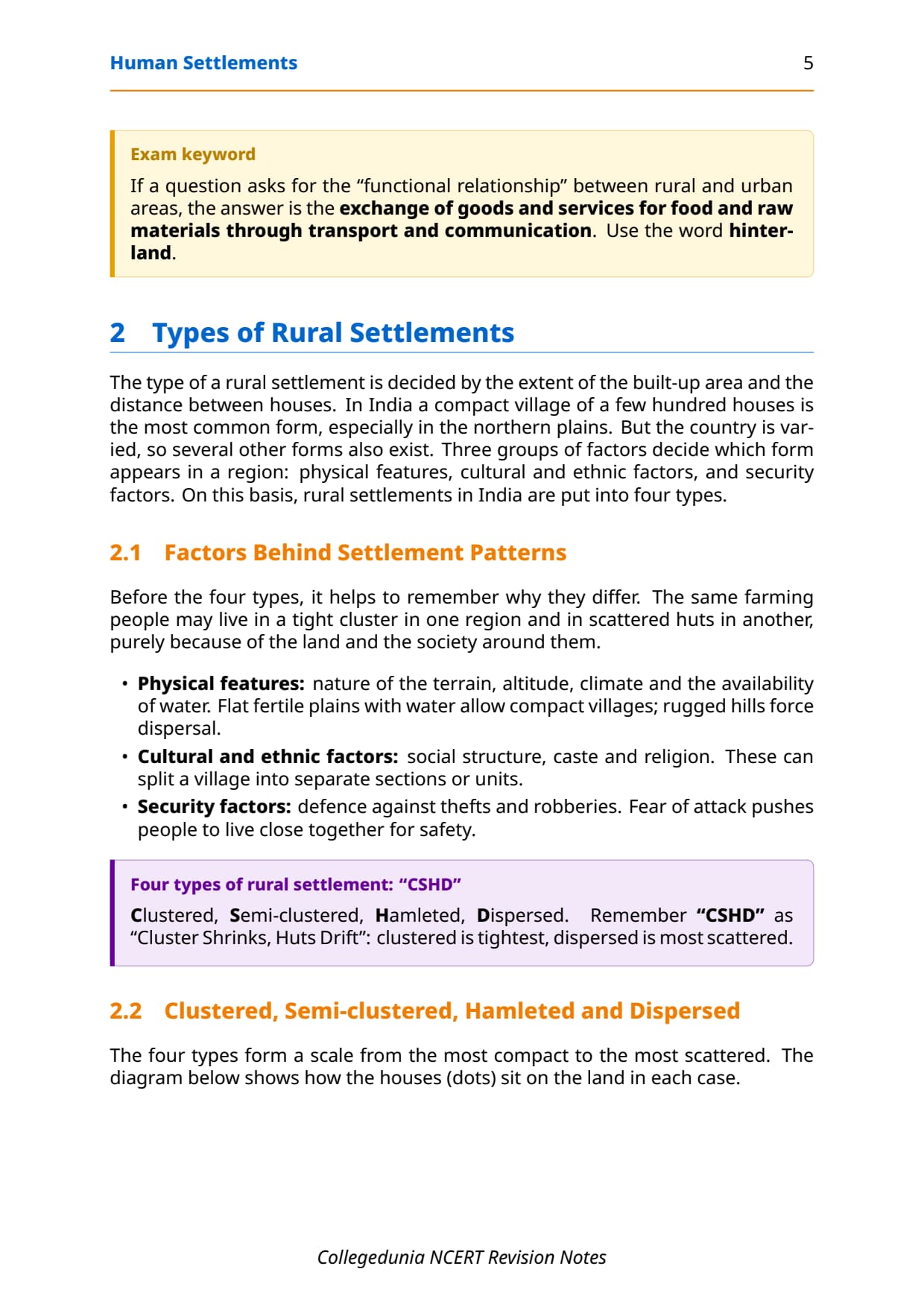
Rural settlement type depends on the built-up area's extent and spacing, shaped by terrain, water availability, social structure and security. CBSE asks students to distinguish the four types below.
Type 1: Clustered (Nucleated) Settlements
A compact village with a geometric pattern (rectangular, radial, linear), separated from surrounding farms. Common in northern alluvial plains and northeastern states. Bundelkhand and Nagaland cluster for security; Rajasthan clusters due to water scarcity.
Type 2: Semi-Clustered (Fragmented) Settlements
Forms when a dispersed settlement clusters in a restricted core, or a large village splits and one section (often lower social strata) is pushed to the fringe. Widespread in the Gujarat plain and parts of Rajasthan.
Type 3: Hamleted Settlements
Fragmented into separated units sharing a common name, locally called panna, para, palli, nagla or dhani. Driven by social and ethnic factors; common in the Ganga plain, Chhattisgarh and lower Himalayan valleys.
Type 4: Dispersed (Isolated) Settlements
Isolated huts or small hamlets in remote jungles or hill slopes, caused by fragmented terrain and a limited resource base. Found across Meghalaya, Uttarakhand, Himachal Pradesh and Kerala.
Key warning for CBSE: do not confuse hamleted with semi-clustered. Hamleted units share a common name; semi-clustered units are parts of the same village split by social hierarchy.
Urban Settlements: Census Definition and Characteristics
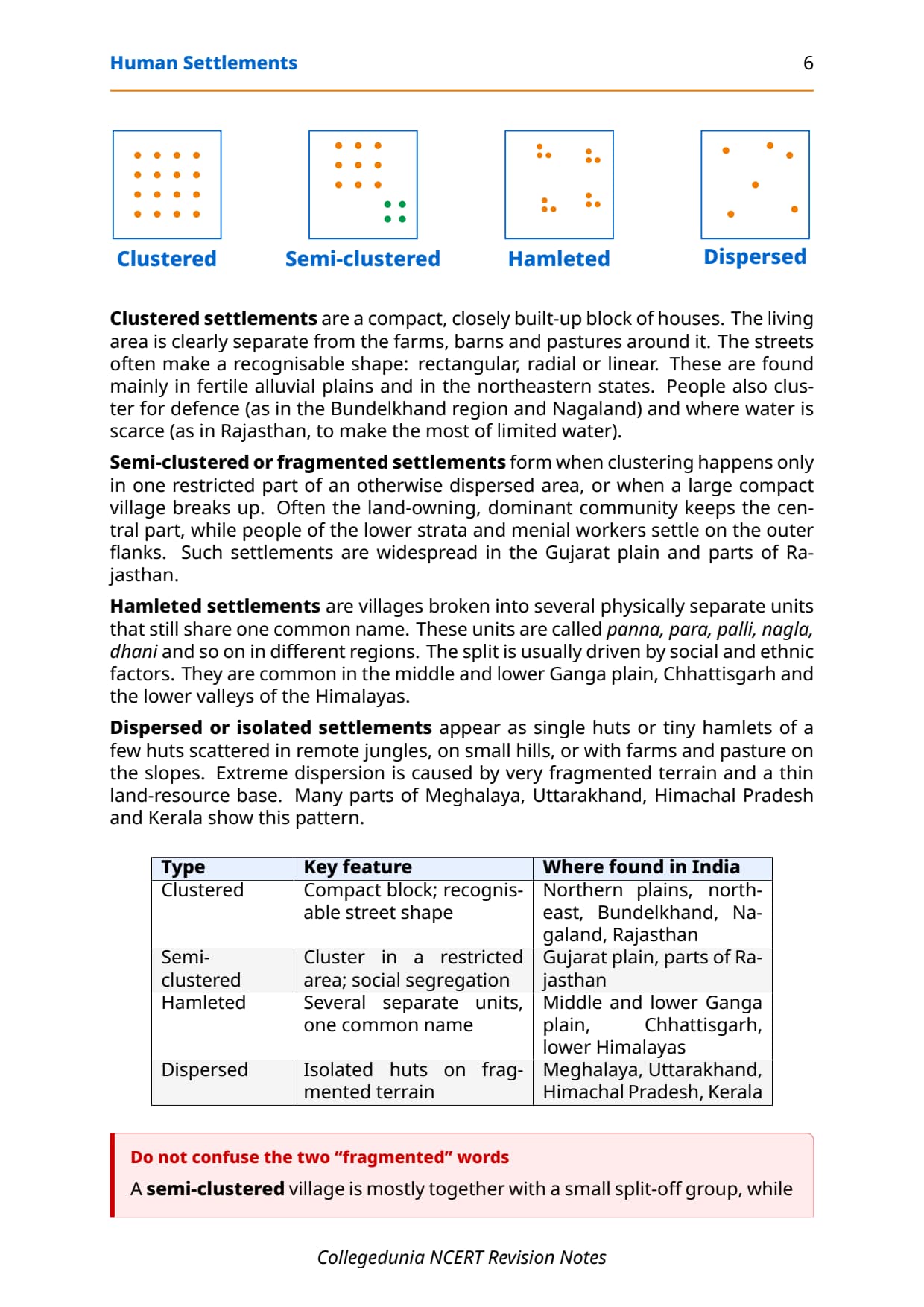
Urban settlements are compact, large, and run on non-agricultural economic and administrative functions. All conditions below must hold together, per Census of India 1991, for a place to count as urban.
| Census Criterion | Threshold | Why it matters for CBSE |
|---|---|---|
| Administrative body | Must have a municipality, corporation, cantonment board or notified town area committee | Often asked as "what is NOT part of the census urban definition" MCQ |
| Minimum population | At least 5,000 persons | Numbers-based MCQ; CBSE has set options 2,000 / 5,000 / 10,000 / 25,000 |
| Occupational structure | At least 75% of male workers engaged in non-agricultural pursuits | 3-mark question: "why is this criterion important?" |
| Population density | At least 400 persons per sq km | Sometimes paired with MCQ: which criterion is WRONG? |
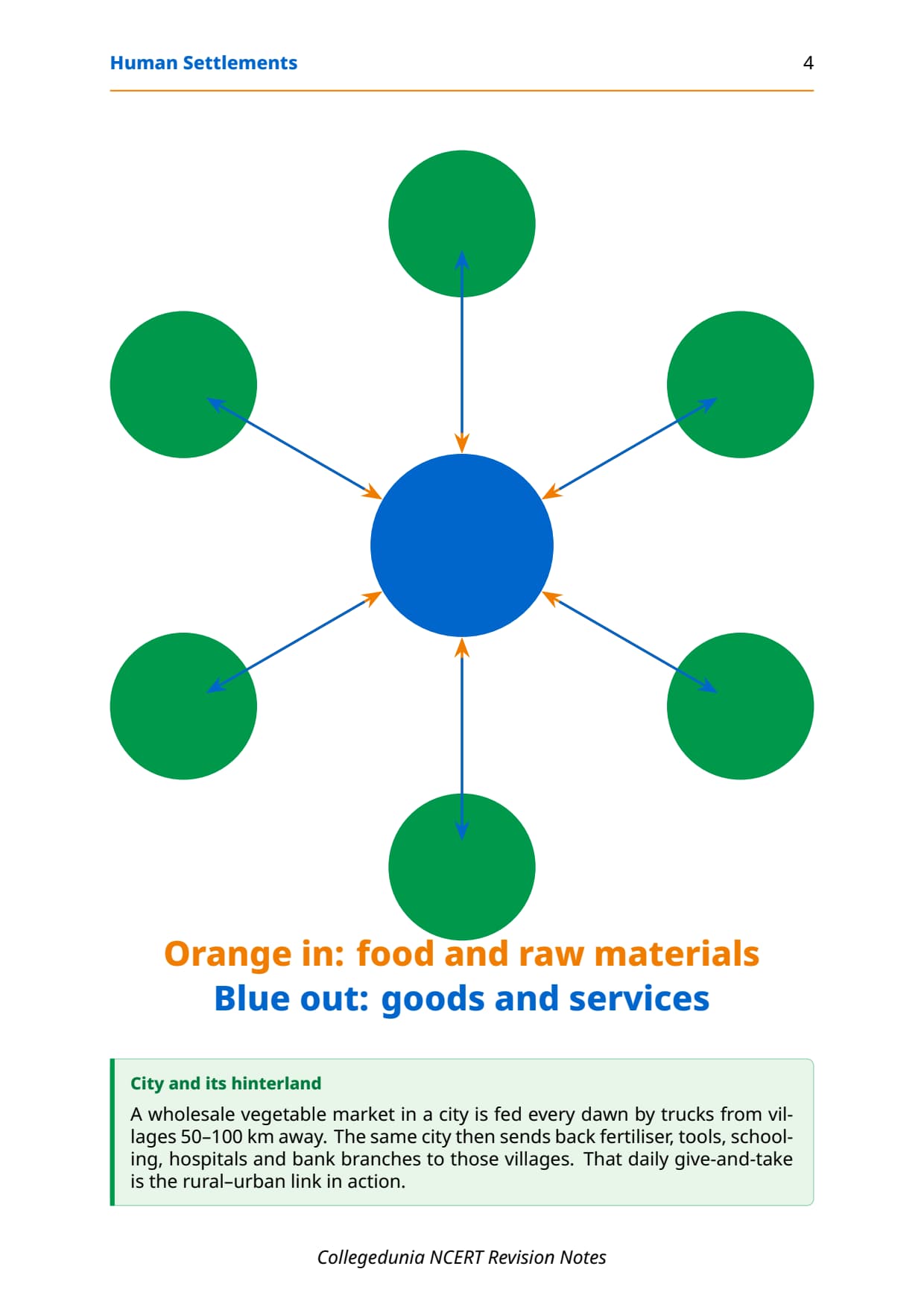
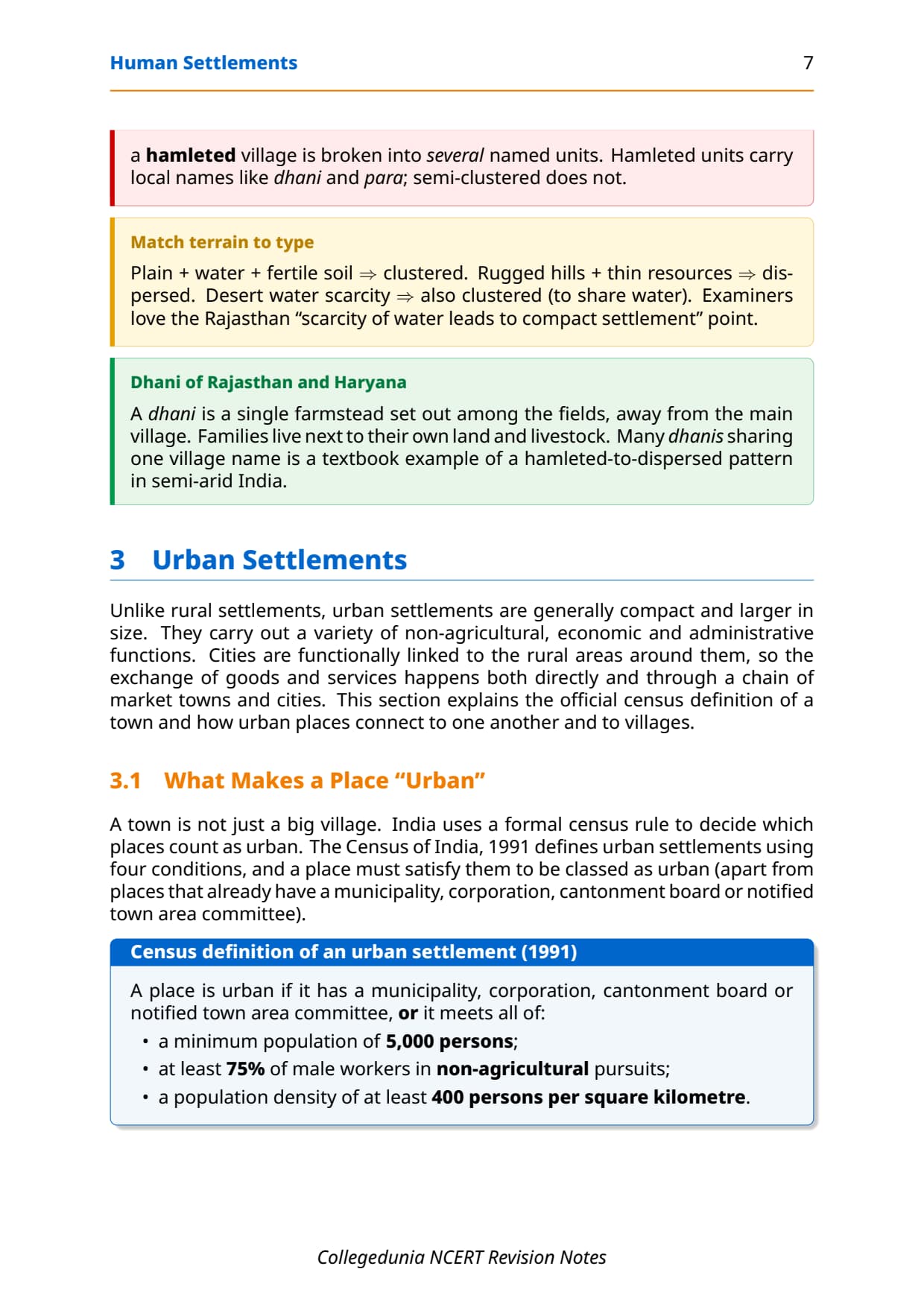
Urban settlements differ from rural ones in three ways: secondary/tertiary activities, formal social relations, and acting as nodes of growth that supply goods and services to the rural hinterland in exchange for food and raw materials.
Memory hook: Think 5-75-400: population 5,000, non-farm male workers 75%, density 400 per sq km, plus an administrative body. Miss one, and the place stays rural for census purposes.
Evolution of Towns in India: Ancient, Medieval and Modern
Towns have existed in India since Indus Valley towns like Harappa and Mohenjodaro. NCERT classifies existing towns by the period they took shape in: ancient, medieval and modern, a frequent 3-mark "distinguish between" question.
Ancient Towns
Over 2,000 years old, mostly religious and cultural centres. Varanasi is the key example, along with Prayag (Prayagraj), Pataliputra (Patna) and Madurai. They survive through different political regimes and remain major cities today.
Medieval Towns
About 100 existing towns date to the medieval period, mostly headquarters of principalities and kingdoms, often fort towns built on earlier ruins. Examples: Delhi, Hyderabad, Jaipur, Lucknow, Agra and Nagpur.
Modern Towns
The British developed a new class of towns from coastal footholds like Surat, Daman, Goa and Pondicherry, then consolidated around Mumbai, Chennai and Kolkata, later extending inland with administrative centres and hill-town resorts.
Key CBSE tip: Bhopal is modern (a princely state capital), not medieval. Do not confuse the fort-town category with all pre-British towns.
Urbanisation Trends in India (1901-2011)
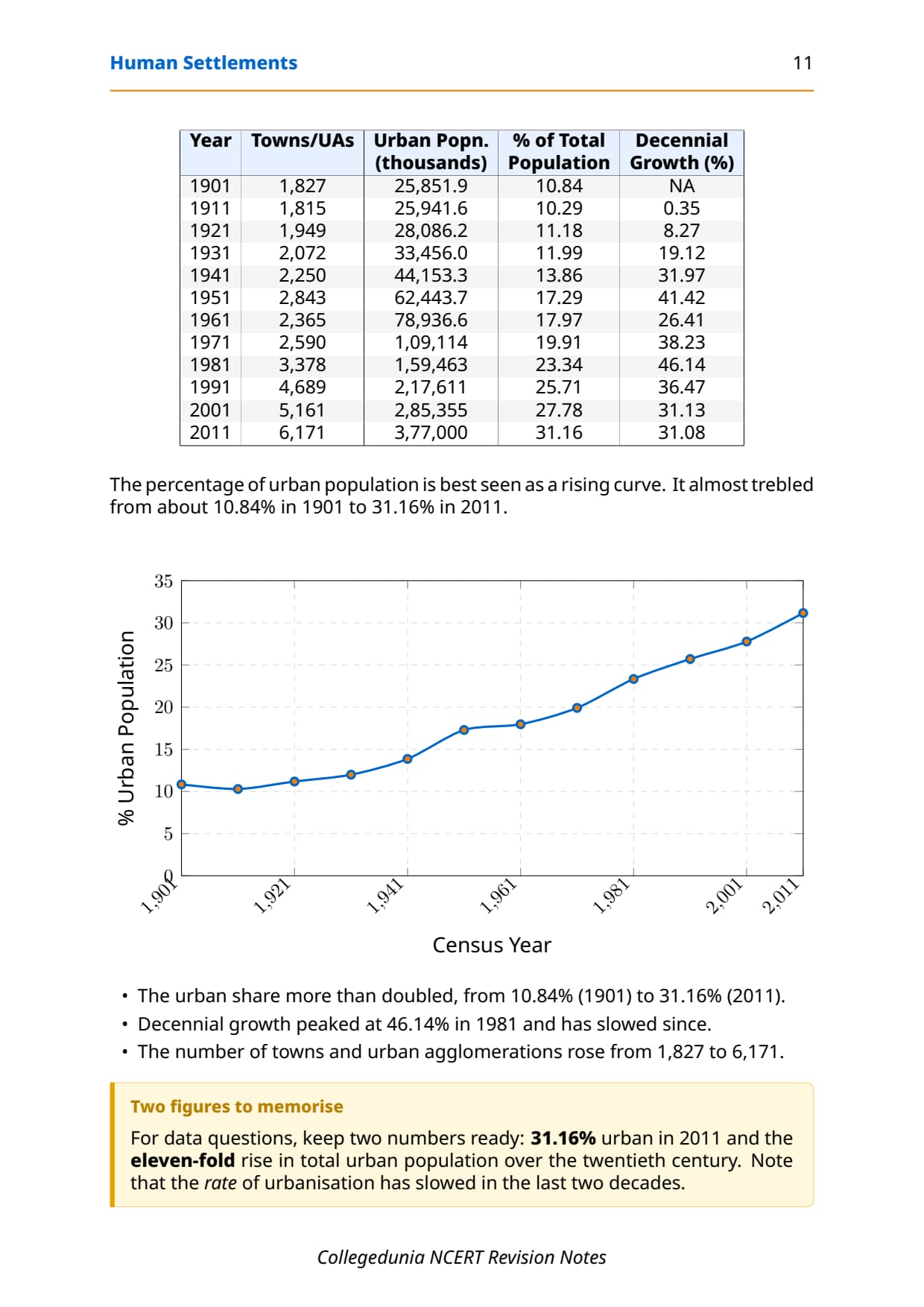
India's urbanisation data from 1901 to 2011 shows a clear upward trend with some fluctuation in growth rates. CBSE and CUET draw questions from this table (NCERT Table 2.1); remember the headline figures, not every row.
| Year | Urban Population (thousands) | % of Total Population | Key trend note |
|---|---|---|---|
| 1901 | 25,852 | 10.84% | Baseline year; about 1 in 10 Indians urban |
| 1921 | 28,086 | 11.18% | Slow growth in early decades |
| 1951 | 62,444 | 17.29% | Post-independence urbanisation picks up |
| 1971 | 1,09,114 | 19.91% | Industrial growth spurs urban migration |
| 1991 | 2,17,612 | 25.72% | Liberalisation era, service sector growth |
| 2001 | 2,85,355 | 27.78% | IT and manufacturing hubs emerge |
| 2011 | 3,77,106 | 31.16% | Urban share crosses 31%; still low vs developed countries |
India's urban population in 2011 was 31.16 per cent, quite low next to developed countries, after an eleven-fold rise over the twentieth century. Growth slowed in the last two decades of the century, driven both by enlargement of existing centres and by new towns emerging: the standard 3-mark data-interpretation answer.
Functional Classification of Towns and Cities
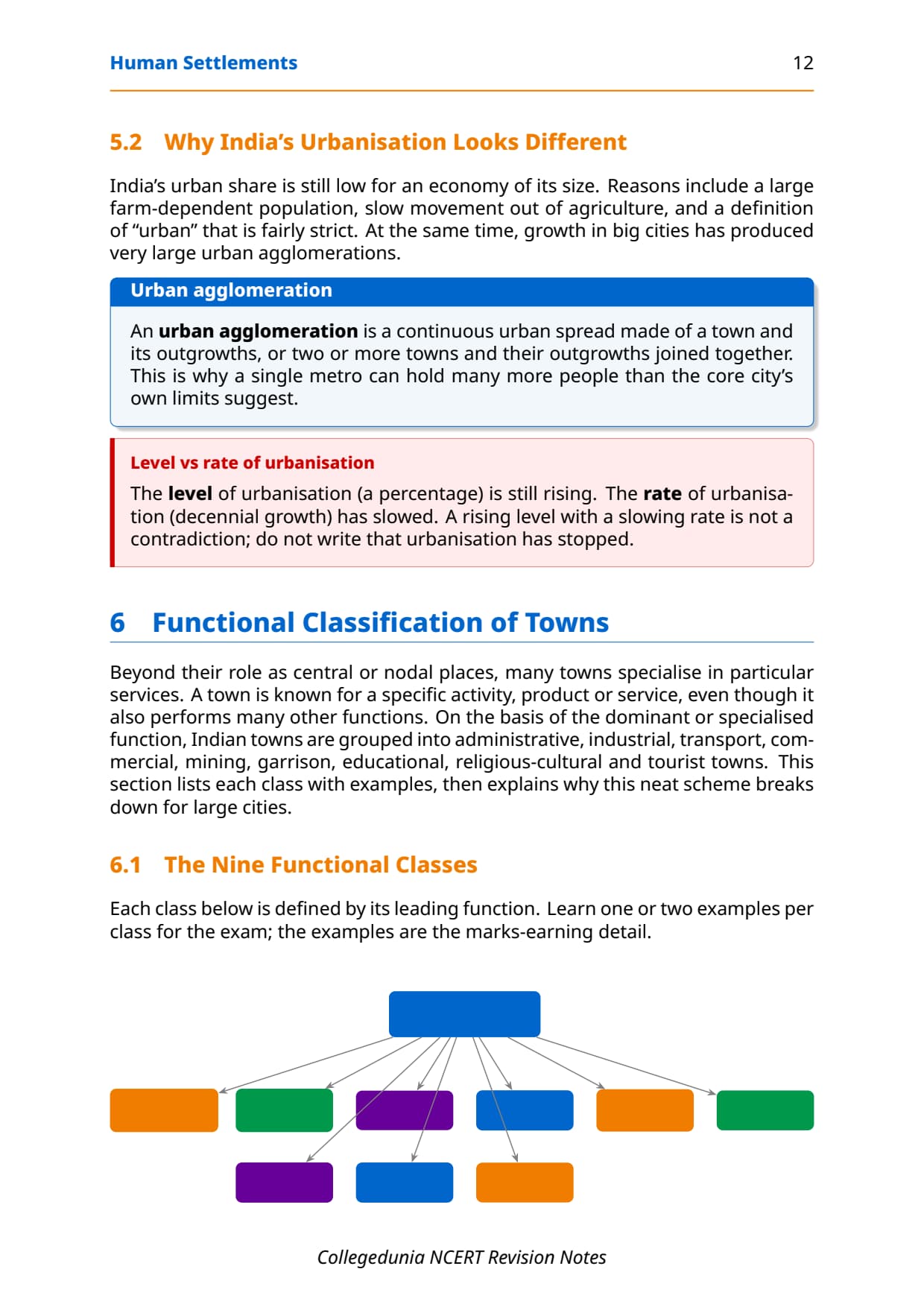
Many Indian towns perform specialised services. NCERT classifies them by dominant activity; know at least two example towns per category for the common "identify the functional class" question.
| Functional Class | Defining feature | Example towns |
|---|---|---|
| Administrative towns | Headquarters of higher-order administration | Chandigarh, New Delhi, Bhopal, Shillong, Guwahati, Gandhinagar, Jaipur, Chennai |
| Industrial towns | Industries are the prime motive force | Mumbai, Salem, Coimbatore, Jamshedpur, Hugli, Bhilai |
| Transport towns | Ports or inland transport hubs | Kandla, Cochin, Vishakhapatnam (ports); Agra, Itarsi, Katni (inland hubs) |
| Commercial towns | Specialise in trade and commerce | Kolkata, Saharanpur, Satna |
| Mining towns | Developed in mineral-rich areas | Raniganj, Jharia, Digboi, Ankaleshwar, Singrauli |
| Garrison (Cantonment) towns | Emerged as military towns | Ambala, Jalandhar, Mhow, Babina, Udhampur |
| Educational towns | Grown from centres of education into campus towns | Roorkee, Varanasi, Aligarh, Pilani, Prayagraj |
| Religious/Cultural towns | Prominent due to religious or cultural significance | Varanasi, Mathura, Amritsar, Madurai, Puri, Ajmer, Haridwar, Ujjain |
| Tourist towns | Known as tourist destinations | Nainital, Mussoorie, Shimla, Pachmarhi, Jodhpur, Jaisalmer, Ooty, Mount Abu |
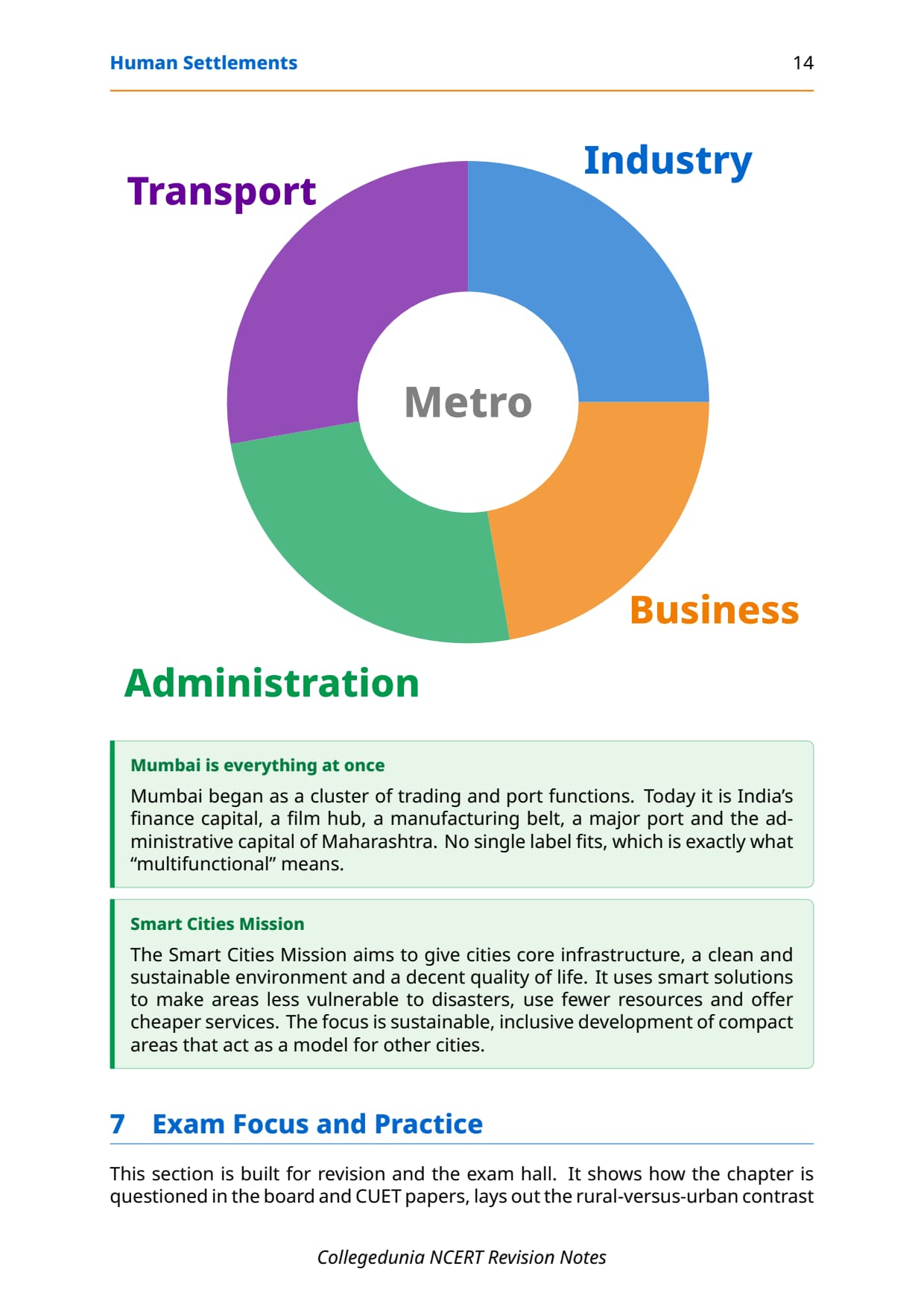
Cities are not static in function. As they grow into metropolises they become multifunctional: industry, business, administration and transport all matter at once, and simple classification breaks down.
Memory hook for Smart Cities Mission: aims for core infrastructure, a clean and sustainable environment, and a decent quality of life, through compact, replicable model development. UPSC and CUET have used this box for current-affairs-linked questions.
Previous Year Question Trends from Human Settlements
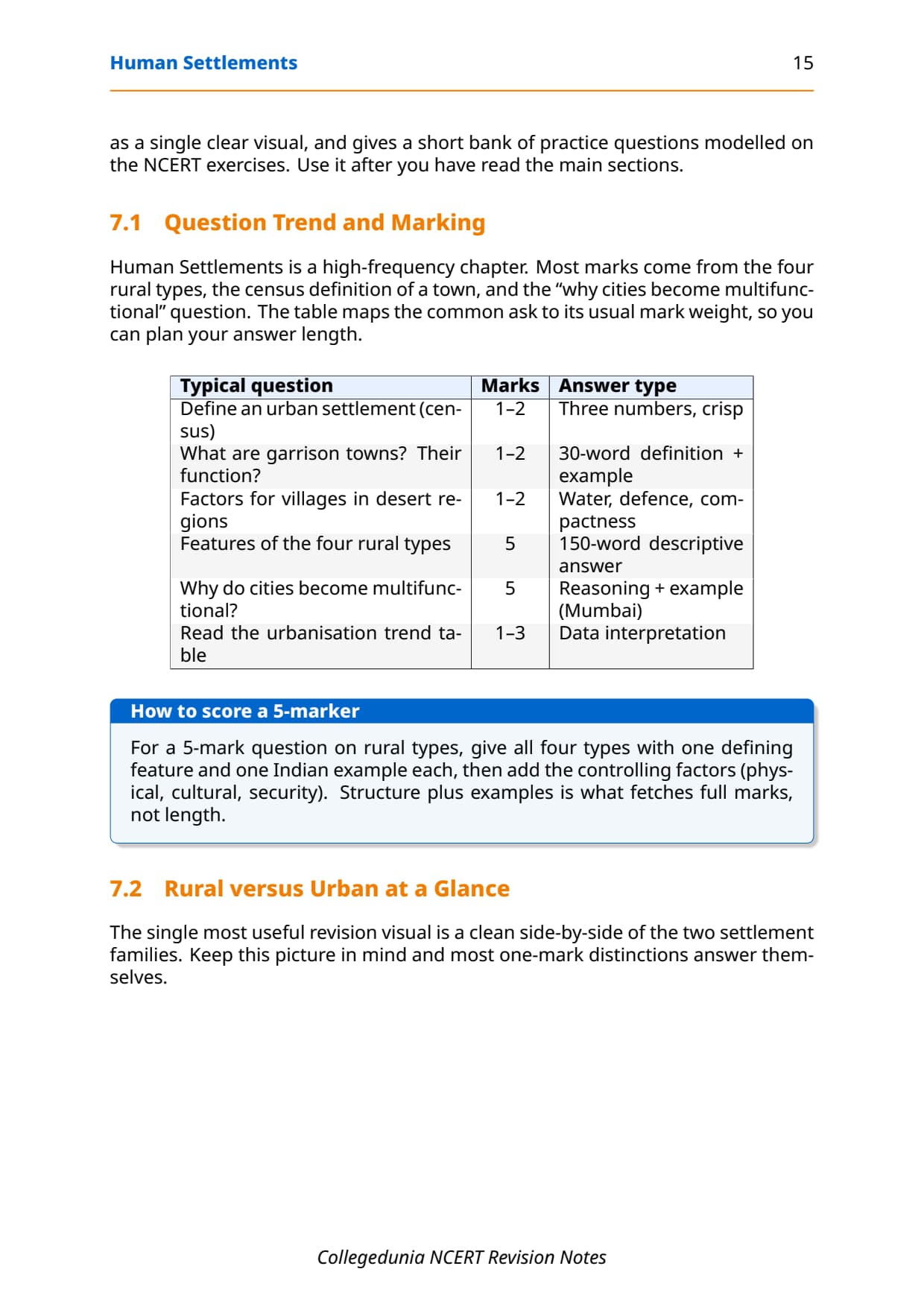
Human settlements questions follow a stable pattern in CBSE board papers. Scan this table to know where to focus final revision.
| Year | Question type asked | Marks | Notes section to revise |
|---|---|---|---|
| 2025 | Distinguish between clustered and dispersed rural settlements with examples | 3 | Four Types of Rural Settlements |
| 2024 | What is the census definition of an urban area? Give any two criteria. | 3 | Urban Settlements: Census Definition |
| 2023 | Classify Indian towns on the basis of their evolution with one example each | 5 | Evolution of Towns section |
| 2022 | MCQ: which Indian city is NOT a garrison town? (Ambala / Jalandhar / Jharia / Babina) | 1 | Functional Classification table |
| 2021 | Why do cities become multifunctional as they grow? Explain with an example. | 3 | Functional Classification closing note |
The chapter carries an effective weight of 6 to 8 marks per year. Rural settlement types and functional classification together generate about 60% of those marks.
Other Resources for Class 12 Geography Chapter 2 Human Settlements
Pair these revision notes with the matching NCERT Solutions, handwritten notes and the official NCERT book chapter.
| Resource | What it covers | Open |
|---|---|---|
| Notes | Concept-first revision notes covering settlement definitions, four rural types, census urban definition, evolution of towns and functional classification. | You are here |
| NCERT Solutions | Step-by-step answers to all exercise questions with Expert's Solution alternatives for every long-answer question. | Class 12 Geography Chapter 2 NCERT Solutions |
| Handwritten Notes | Topper's handwritten revision pages for last-minute board exam practice. | Class 12 Geography Chapter 2 Handwritten Notes |
| NCERT Book PDF | Official NCERT India: People and Economy Chapter 2 textbook in PDF form. | Class 12 Geography Chapter 2 NCERT Book PDF |
| Subject Hub | All chapters of Class 12 Geography with every resource in one place. | Class 12 Geography Subject Hub |
All Chapters Notes for Class 12 Geography (India: People and Economy)
Related Links: Navigate to the Notes for the other chapters of Class 12 Geography India: People and Economy.
| Chapter | Topic | Notes link |
|---|---|---|
| Chapter 1 | Population: Distribution, Density, Growth and Composition | Class 12 Geography Population Notes |
| Chapter 2 | Human Settlements | You are here |
| Chapter 3 | Land Resources and Agriculture | Class 12 Geography Land Resources Notes |
| Chapter 4 | Water Resources | Class 12 Geography Water Resources Notes |
| Chapter 5 | Mineral and Energy Resources | Class 12 Geography Mineral and Energy Resources Notes |
| Chapter 6 | Planning and Sustainable Development in Indian Context | Class 12 Geography Planning and Sustainable Development Notes |
| Chapter 7 | Transport and Communication | Class 12 Geography Transport and Communication Notes |
| Chapter 8 | International Trade | Class 12 Geography International Trade Notes |
| Chapter 9 | Geographical Perspective on Selected Issues and Problems | Class 12 Geography Geographical Perspective Notes |
NCERT Notes Class 12 Geography Chapter 2 Human Settlements FAQs
Ques. What are human settlements class 12 notes meant to be used for?
Ans. The human settlements class 12 notes are a concept-first revision file. They compress the entire NCERT Chapter 2 of India: People and Economy into a printable study guide, with definitions, the four rural settlement types, the census urban definition, the evolution of towns and the functional classification of cities laid out for a single sitting. Students typically use these notes for the 30-minute first-pass revision and the 15-minute night-before pass; the worked answers to exercise questions live in the matching NCERT Solutions PDF, not in this Notes file.
Ques. What are the four types of rural settlements in India class 12?
Ans. The four types of rural settlements in India, as described in NCERT Class 12 Geography Chapter 2, are: (1) Clustered or nucleated settlements, compact geometric villages found in alluvial plains and northeastern states; (2) Semi-clustered or fragmented settlements, where one section of the village lives away from the main cluster due to social segregation, found in the Gujarat plain; (3) Hamleted settlements, fragmented into separate named units called panna, para, palli or dhani, common in the Ganga plain and Chhattisgarh; and (4) Dispersed or isolated settlements, isolated huts in remote or hilly terrain, found in Meghalaya, Uttarakhand, Himachal Pradesh and Kerala.
Ques. What is the census definition of an urban area in India class 12?
Ans. According to the Census of India 1991, an urban area is defined as all places that have a municipality, corporation, cantonment board or notified town area committee, AND have a minimum population of 5,000 persons, AND at least 75% of male workers are engaged in non-agricultural pursuits, AND a population density of at least 400 persons per sq km. All four conditions must be met simultaneously. This definition is a standard 3-mark question in CBSE Class 12 Geography and a direct MCQ source in CUET.
Ques. What is the difference between ancient, medieval and modern towns in India?
Ans. Ancient towns are those with a history spanning over 2,000 years, mostly developed as religious and cultural centres. Examples include Varanasi, Prayagraj, Patna and Madurai. Medieval towns, about 100 in number, developed as headquarters of principalities and kingdoms, mostly as fort towns; examples include Delhi, Hyderabad, Jaipur, Lucknow and Agra. Modern towns were developed by the British and other Europeans, starting from coastal trading ports like Surat, Daman and Goa, and later consolidated around Mumbai, Chennai and Kolkata. This three-part classification is a frequent 5-mark answer question in CBSE Class 12 Geography.
Ques. What is the functional classification of towns in India class 12?
Ans. The NCERT chapter classifies Indian towns into nine functional classes: administrative towns (Chandigarh, New Delhi), industrial towns (Mumbai, Jamshedpur), transport towns such as ports (Kandla, Cochin) or inland hubs (Agra, Itarsi), commercial towns (Kolkata, Saharanpur), mining towns (Raniganj, Digboi), garrison cantonment towns (Ambala, Jalandhar), educational towns (Roorkee, Aligarh), religious and cultural towns (Varanasi, Mathura, Amritsar, Haridwar), and tourist towns (Nainital, Shimla, Ooty). As cities grow, they tend to become multifunctional, making single-category classification less accurate.
Ques. Why do cities become multifunctional as they grow?
Ans. Cities are not static in their function. As a specialised city grows into a metropolis, it attracts diverse economic activities. Industry, business, administration, transport, education and trade all become important simultaneously. The functions get so intertwined that the city can no longer be placed in one functional class. For example, Mumbai began as a trading port (transport/commercial town) but is now simultaneously India's financial capital, a major industrial hub and an entertainment centre. This point is a direct 3-mark answer question in CBSE Class 12 Geography.
Ques. What were the urbanisation trends in India from 1901 to 2011?
Ans. India's urban population grew from about 25.8 million (10.84% of total) in 1901 to about 377 million (31.16% of total) in 2011, an eleven-fold increase over the twentieth century. Growth was slow in the early decades, picked up significantly after independence (1951 onward), and slowed again in the last two decades of the century. Despite this growth, India's urbanisation level of 31.16% in 2011 remains quite low compared to developed countries. Both the expansion of existing urban centres and the creation of new towns contributed to this urbanisation. CBSE and CUET regularly ask data-based questions using this table.
Ques. What is the Smart Cities Mission and how is it relevant to class 12 Geography?
Ans. The Smart Cities Mission is a Government of India initiative to promote cities that provide core infrastructure, a clean and sustainable environment, and a decent quality of life to citizens. The mission focuses on compact, replicable model development: creating one well-planned city that acts as a lighthouse for others. Smart solutions are applied to infrastructure and services to make them better, less vulnerable to disasters, and more resource-efficient. The NCERT Class 12 Geography textbook includes this as a box feature in Chapter 2, and UPSC and CUET have used it as a source for current-affairs-linked geography questions.
Ques. What factors determine the type of rural settlement in an area?
Ans. Three sets of factors determine the type of rural settlement in India. Physical features include the nature of terrain, altitude, climate and availability of water; for example, water scarcity in Rajasthan encourages clustered settlements while hilly fragmented terrain in Meghalaya produces dispersed ones. Cultural and ethnic factors include social structure, caste and religion; social segregation within a village can produce semi-clustered or hamleted patterns. Security factors, including defence against theft and robbery, have historically encouraged compact clustered villages such as those in the Bundelkhand region. These three categories of factors are the standard framework for the 5-mark "factors responsible for settlement patterns" question in CBSE Class 12 Geography.
Ques. Is the Class 12 Geography syllabus for human settlements changing in 2026-27?
Ans. No significant reductions to the Human Settlements chapter have been announced for the 2026-27 NCERT syllabus cycle. The chapter structure covering rural settlement types, the census urban definition, evolution of towns and the functional classification of cities remains unchanged. These human settlements class 12 notes for the 2026-27 cycle are aligned to the unchanged textbook and the latest CBSE sample paper released for the 2026 boards.
Ques. How many marks does the Human Settlements chapter carry in CBSE Class 12 Geography?
Ans. The Human Settlements chapter from the India: People and Economy book typically contributes 5 to 8 marks per year in the CBSE Class 12 Geography board paper. These marks are usually split across 1-mark MCQ questions (often from the census urban definition or the functional classification), 3-mark short-answer questions (often on distinguishing two settlement types or listing the criteria for an urban area) and occasional 5-mark long-answer questions (evolution of towns or factors affecting rural settlement patterns). Revising the definitions table and the four rural types together covers the majority of these marks.



Comments