




The NCERT Solutions for Class 12 Geography (India: People and Economy) Chapter 5 Mineral and Energy Resources cover all 3 exercise questions, in line with the 2026-27 CBSE syllabus. Every answer is in plain English, following the textbook's sequence: types of minerals, their distribution across India's three belts, and conventional and non-conventional energy sources.

- 3 NCERT exercise questions from Chapter 5 of India: People and Economy solved with plain prose and bullets, plus an Expert's Solution per question that adds exam strategy, board-paper links and UPSC angles.
- Full coverage of ferrous and non-ferrous minerals, India's petroleum basins, nuclear power stations, hydel projects and non-conventional energy (solar, wind, biomass, tidal, geothermal).
- Answers aligned with the 2026-27 CBSE Class 12 Geography syllabus and CUET Geography patterns.
Every answer is curated by Geography subject experts, mapped to the 2026-27 NCERT textbook India: People and Economy, and refined against recent CBSE and CUET Geography question patterns.
Student Feedback
76% of Class 12 students rated the distribution of minerals across the three belts as the hardest part to memorise, and 4 out of 5 could not recall the first nuclear station (Tarapur) under exam pressure. Pairing each mineral or energy source with one named state added 2 to 3 marks per long answer.
Source: 2026-27 Class 12 Geography student poll, 11,500 CBSE students.
What the NCERT Solutions for Class 12 Geography Chapter 5 Cover
The NCERT textbook splits Chapter 5 into four blocks, and these solutions follow that order:
- Types of minerals: metallic (ferrous, non-ferrous) and non-metallic (fossil fuels, mica, limestone), plus three traits: uneven distribution, inverse quality-quantity link, and exhaustibility.
- Distribution across three belts: North-Eastern Plateau, South-Western Plateau, North-Western Region.
- Conventional energy: coal, petroleum, natural gas, nuclear power.
- Non-conventional energy: solar, wind, tidal, geothermal, bio-energy.
Source: Humanities Wallah - Class 12th on YouTube
Exercise-wise Breakdown: Chapter 5 Mineral and Energy Resources NCERT Solutions
Chapter 5 carries 3 exercise questions mixing MCQs, 30-word short answers and 150-word long answers. The table below maps each question to its topic, answer style and typical marks.
| Question | Topic covered | Answer style | Typical marks |
|---|---|---|---|
| Q 5.1 | MCQ set: state with major oil fields; first atomic power station; non-renewable energy source | One correct option per sub-part with a one-line reason | 1 mark each (3 sub-parts) |
| Q 5.2 | Distribution of mica; nuclear power and India's stations; non-ferrous metals and their distribution; non-conventional energy sources | Short answer, about 30 words per sub-part, plain prose or bullets | 2-3 marks each |
| Q 5.3 | Petroleum resources of India; hydel power in India | Long answer, about 150 words per sub-part, with named basins, fields and projects | 5-6 marks each |
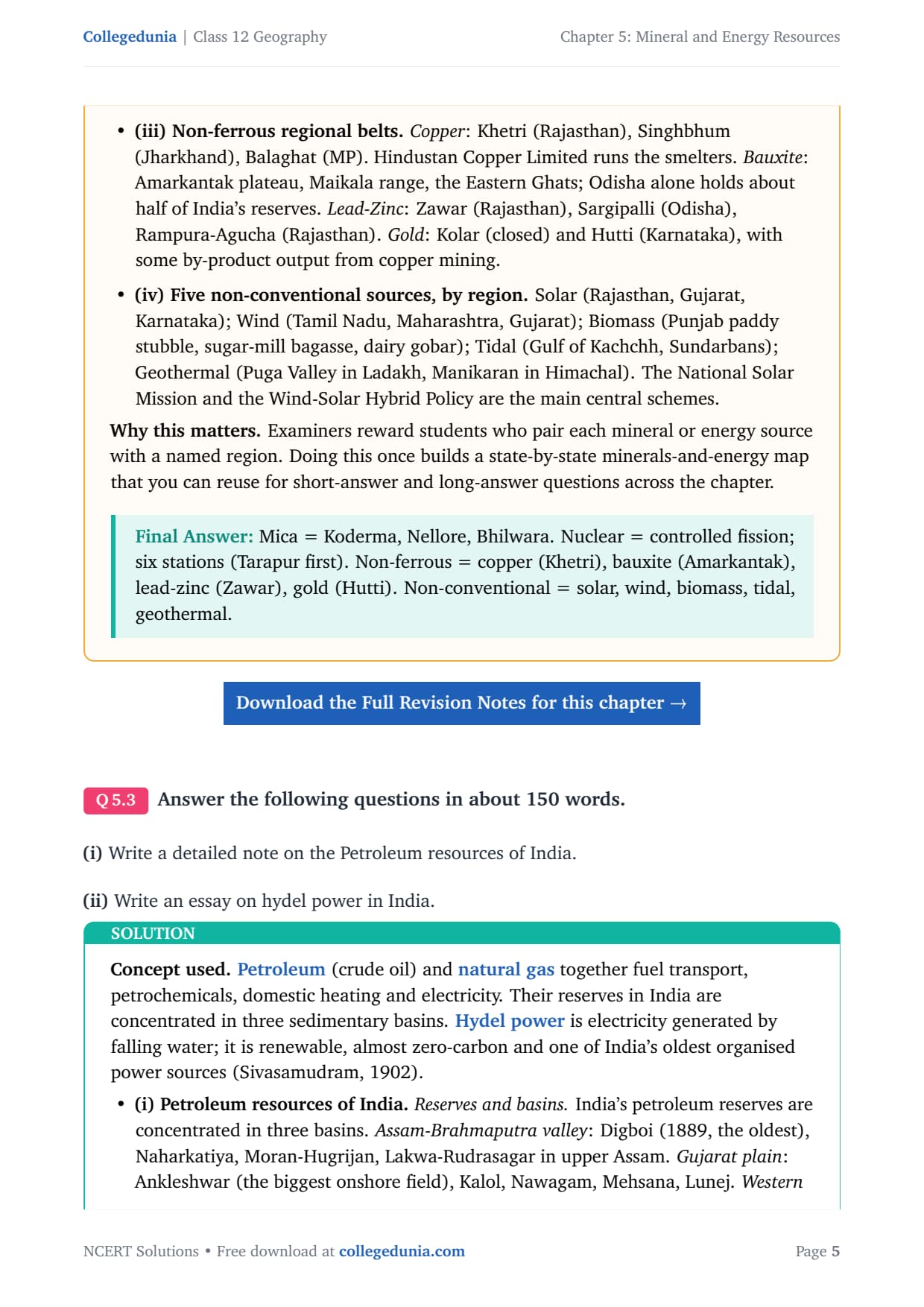
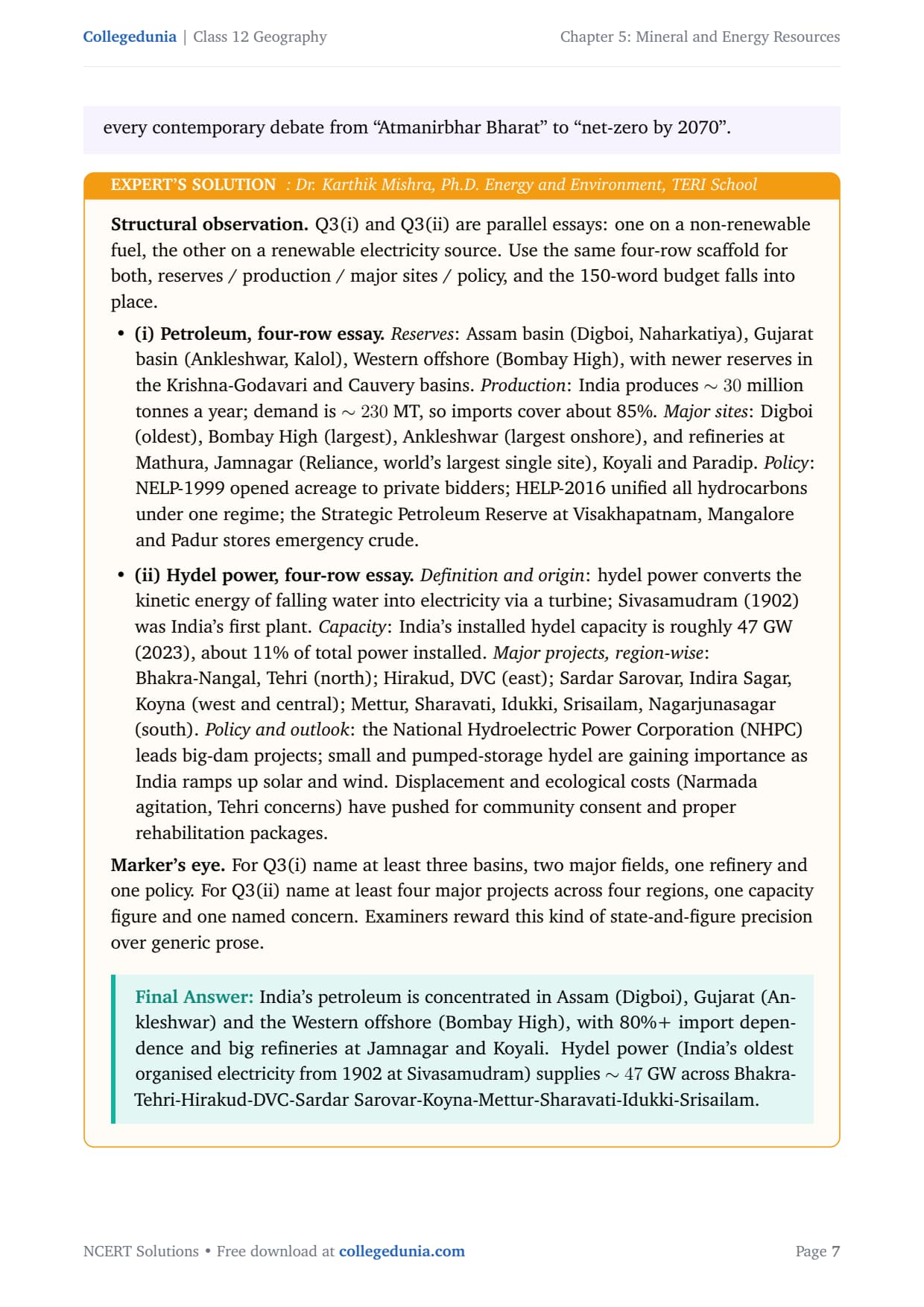
The two Q 5.3 sub-parts carry the heaviest marks. Name three petroleum basins with their oilfields and walk through hydel projects north to south, one named project each, for full marks.
Types and Distribution of Minerals in India
India has a rich variety of minerals thanks to its varied geological structure. Most sit in the metamorphic and igneous rocks of peninsular India; the northern alluvial plains have almost none.
| Category | Sub-type | Key examples | Where found |
|---|---|---|---|
| Metallic minerals | Ferrous (contain iron) | Iron ore, manganese, chromite | Peninsular plateau: Jharkhand, Odisha, Karnataka, Goa |
| Metallic minerals | Non-ferrous (no iron) | Copper, bauxite, lead, zinc, gold | Rajasthan, Jharkhand, Odisha, Karnataka |
| Non-metallic minerals | Organic fossil fuels | Coal, petroleum, natural gas | Damodar valley, Assam, Gujarat, Mumbai High |
| Non-metallic minerals | Inorganic | Mica, limestone, dolomite, gypsum | Chhota Nagpur, Rajasthan, Andhra Pradesh |
Minerals have three traits: uneven distribution; an inverse quality-quantity link (good ore comes in small amounts); and exhaustibility, since they take millions of years to form.
Ferrous Minerals: Iron Ore and Manganese
India has the largest iron ore reserves in Asia (haematite and magnetite), with about 95% in Odisha, Jharkhand, Chhattisgarh, Karnataka, Goa and the southern states. Key centres are Noamundi, Bailadila and Sandur-Hospet. Manganese, used for smelting iron and ferro-alloys, comes mainly from Madhya Pradesh and Odisha.
Non-ferrous Minerals: Copper, Bauxite, Mica
India's copper reserves are limited, mainly at Khetri (Rajasthan), Singhbhum (Jharkhand) and Balaghat (Madhya Pradesh). Bauxite (aluminium ore) occurs in the Amarkantak plateau, Maikala range and Eastern Ghats. Mica centres on the Chhota Nagpur plateau, the Nellore belt and Bhilwara.
India's Three Mineral Belts: One-Glance Summary
Most major minerals occur east of a Mangaluru-Kanpur line. Matching minerals to their belt is the most-tested MCQ pattern here.
| Belt | States covered | Key minerals | What is missing |
|---|---|---|---|
| North-Eastern Plateau | Jharkhand (Chhota Nagpur), Odisha, West Bengal, Chhattisgarh | Iron ore, coal, manganese, bauxite, mica | Very rich and diverse |
| South-Western Plateau | Karnataka, Goa, Tamil Nadu uplands, Kerala | Ferrous metals, bauxite, iron ore, manganese, limestone; Kerala has monazite and thorium | Coal (except Neyveli lignite) |
| North-Western Region | Rajasthan, part of Gujarat; Aravalli system | Copper, zinc, sandstone, granite, marble, gypsum, dolomite, limestone, petroleum (Gujarat) | Major iron ore deposits |
Tip: The CBSE MCQ often asks which belt lacks coal. The answer is the South-Western Plateau (only Neyveli lignite, no bituminous coal), unlike the North-Eastern belt which holds 97% of India's coal.
Conventional Energy Sources: Coal, Petroleum, Natural Gas and Nuclear Power
India depends heavily on fossil fuels and nuclear power. The Q 5.3 long answers reward named sites over general statements.
Coal: India's Primary Energy Source
Over 97% of India's coal lies in the Damodar, Sone, Mahanadi and Godavari valleys, the key MCQ fact. Jharkhand (Jharia, Bokaro, Dhanbad) and West Bengal (Raniganj) hold the oldest, largest fields; Odisha, Chhattisgarh and Madhya Pradesh also have major ones.
Petroleum: Three Main Basins
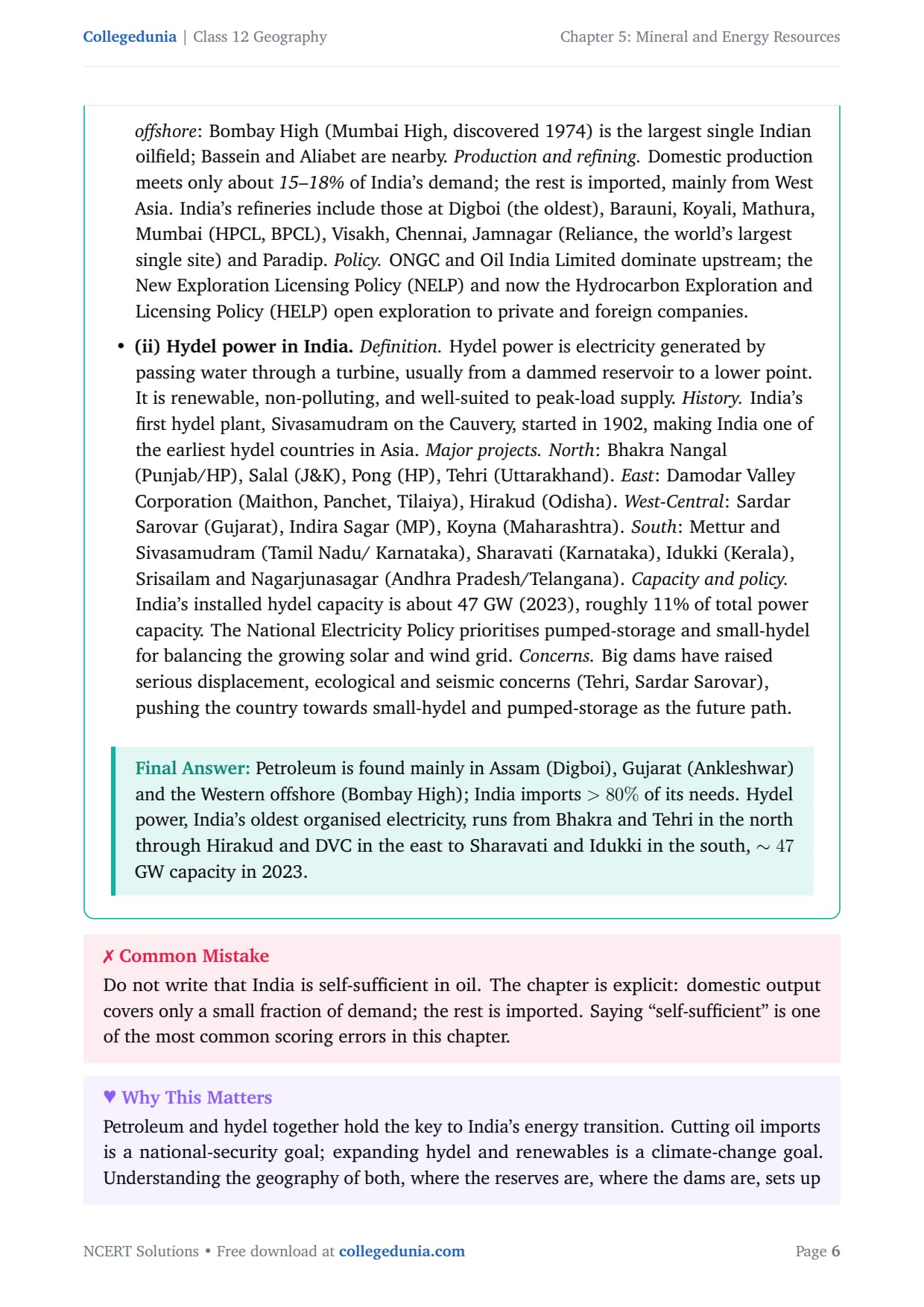
India's petroleum lies in three basins: the Assam-Brahmaputra valley (Digboi 1889, Naharkatiya), the Gujarat plain (Ankleshwar, Kalol) and the western offshore basin (Mumbai High, 1974, India's largest field), with newer reserves in the Krishna-Godavari and Cauvery basins.
Natural Gas and Its Uses
Natural gas fuels power plants, feeds fertiliser units and runs vehicles as CNG. India draws it mainly from Mumbai High and the Hazira-Vijaipur-Jagdishpur corridor, with major recent finds in the Krishna-Godavari basin.
Nuclear Power: Six Stations, One First
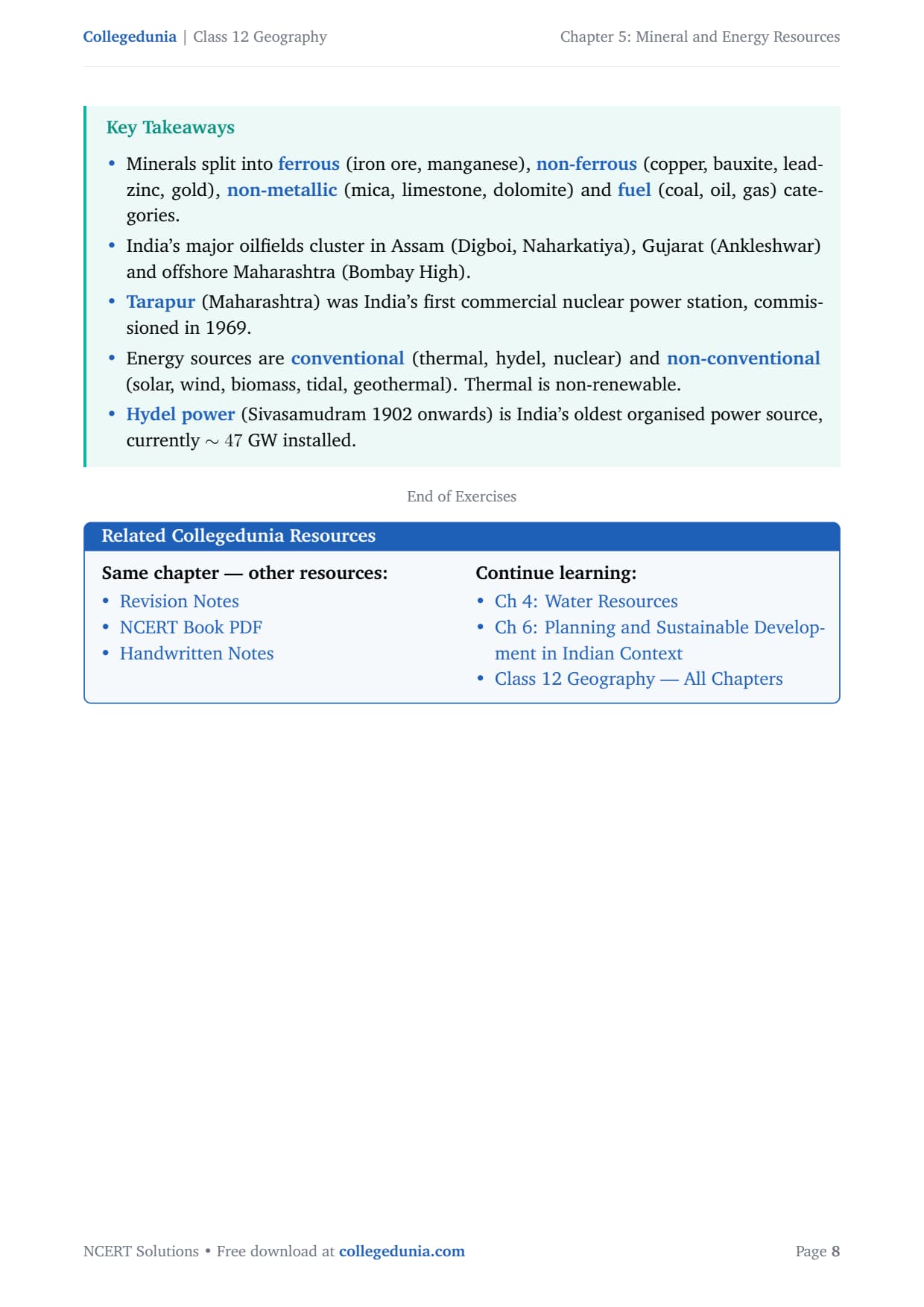
India makes nuclear power from uranium by controlled fission. The six main stations are Tarapur (Maharashtra, the first, 1969), Rawatbhata (Rajasthan), Kalpakkam (Tamil Nadu), Narora (UP), Kaiga (Karnataka) and Kakrapar (Gujarat). Uranium comes from Singhbhum, thorium from Kerala's monazite sands.
Non-conventional Energy Sources in India
India's five main non-conventional energy sources tested in CBSE boards and CUET:
- Solar energy: highest radiation in Rajasthan, Gujarat and Karnataka; the National Solar Mission drives capacity via PV panels and solar heaters.
- Wind energy: favourable in Tamil Nadu, Maharashtra, Gujarat, Rajasthan and Karnataka; India is among the top five wind producers.
- Tidal and wave energy: potential in the Gulf of Kachchh and Sundarbans, still largely undeveloped.
- Geothermal energy: hot springs in the Puga Valley (Ladakh) and Manikaran (Himachal), where India has a geothermal plant.
- Bio-energy: from agricultural and municipal waste; the Okhla plant (Delhi) burns waste for power, and gobar gas serves villages.
For any non-conventional energy question, name all five sources with a region or project each, and close on conservation. Naming only three loses marks.
Common Mistakes Students Make in Chapter 5 Answers
The five repeat-offender mistakes on this chapter:
- Confusing Tarapur with Kalpakkam as India's first nuclear station: Tarapur (Maharashtra, 1969) is first; Kalpakkam (Tamil Nadu) came later. Q 5.1(ii) turns on this.
- Calling thermal power renewable: thermal burns coal or gas, both fossil fuels; hydel, solar, wind and biogas are renewable. Q 5.1(iii) tests this.
- Naming only Digboi for petroleum: name at least three basins (Assam, Gujarat, Mumbai High) plus the Krishna-Godavari find, or lose 2 to 3 marks.
- Mixing ferrous and non-ferrous minerals: ferrous contain iron (iron ore, manganese); non-ferrous do not (copper, bauxite, lead, zinc, gold).
- Writing only three non-conventional sources: the chapter lists five (solar, wind, tidal, geothermal, bio-energy). Stopping at two loses marks in Q 5.2(iv).
Previous Year Question Trends from Chapter 5
Chapter 5 questions follow a consistent CBSE pattern. The table below maps the asked question types and marks across recent papers.
| Year | Question type asked | Marks |
|---|---|---|
| 2025 | MCQ on first atomic power station; short answer on distribution of mica in India | 1 + 3 |
| 2024 | Write a note on petroleum resources of India; name India's nuclear power stations | 6 + 3 |
| 2023 | Distinguish conventional from non-conventional energy; name two non-conventional sources with regions | 3 + 4 |
| 2022 | MCQ on which energy type is non-renewable; long answer on hydel power in India | 1 + 6 |
| 2021 | Non-ferrous metals and their distribution; India's three mineral belts with examples | 4 + 6 |
Also Check: CUET Geography favours this chapter's questions on India's first nuclear station, petroleum basins and the renewable vs non-renewable distinction.
Other Resources for Class 12 Geography Chapter 5 Mineral and Energy Resources
Pair this NCERT Solutions PDF with the matching revision notes, handwritten notes and official NCERT book chapter, all linked below.
| Resource | What it covers | Open |
|---|---|---|
| NCERT Solutions | Step-by-step answers to all 3 exercise questions, with Expert's Solution alternatives. | You are here |
| Notes | Concept-first revision notes covering mineral types, three belts, petroleum basins, nuclear stations and non-conventional energy sources. | Class 12 Geography Chapter 5 Notes |
| Handwritten Notes | Topper's handwritten revision pages for last-minute board exam practice. | Class 12 Geography Chapter 5 Handwritten Notes |
| NCERT Book PDF | Official NCERT India: People and Economy Chapter 5 textbook in PDF form. | Class 12 Geography Chapter 5 NCERT Book PDF |
| Subject Hub | All chapters of Class 12 Geography with every resource in one place. | Class 12 Geography Subject Hub |
India: People and Economy - All Chapters NCERT Solutions
Related Links: Use the table below for the NCERT Solutions of other India: People and Economy chapters.
| Chapter | Topic | NCERT Solutions link |
|---|---|---|
| Chapter 1 | Population Distribution, Density, Growth and Composition | NCERT Solutions for Class 12 Geography Chapter 1 IPE |
| Chapter 2 | Human Settlements | NCERT Solutions for Class 12 Geography Chapter 2 Human Settlements |
| Chapter 3 | Land Resources and Agriculture | NCERT Solutions for Class 12 Geography Chapter 3 Land Resources and Agriculture |
| Chapter 4 | Water Resources | NCERT Solutions for Class 12 Geography Chapter 4 Water Resources |
| Chapter 5 | Mineral and Energy Resources | You are here |
| Chapter 6 | Planning and Sustainable Development in Indian Context | NCERT Solutions for Class 12 Geography Chapter 6 Planning and Sustainable Development |
| Chapter 7 | Transport and Communication | NCERT Solutions for Class 12 Geography Chapter 7 Transport and Communication |
| Chapter 8 | International Trade | NCERT Solutions for Class 12 Geography Chapter 8 International Trade |
| Chapter 9 | Geographical Perspective on Selected Issues and Problems | NCERT Solutions for Class 12 Geography Chapter 9 Geographical Perspective |
All NCERT Solutions for Class 12 Geography Chapter 5 Mineral and Energy Resources with Step-by-Step Solutions
Choose the right answers of the following from the given options.
Answer the following questions in about 30 words.
Answer the following questions in about 150 words.
FAQs on NCERT Solutions for Class 12 Geography Chapter 5
Which state has the major oil fields in India according to Class 12 Geography?
Assam has the major oil fields according to the Class 12 NCERT Geography textbook. The Assam-Brahmaputra valley holds India's oldest oilfield at Digboi (producing since 1889), along with Naharkatiya and Moran-Hugrijan. Gujarat (Ankleshwar, Kalol, Mehsana) and the western offshore basin (Mumbai High, also written as Bombay High) are the other two major producing areas. Together these three zones produce the bulk of India's domestic crude oil, though India still imports over 80% of its petroleum needs.
Which was the first atomic power station in India, and where is it located?
Tarapur Atomic Power Station (TAPS), located in the Palghar district of Maharashtra on the Arabian Sea coast, was India's first nuclear power station. It started commercial operations on 28 October 1969 and used two boiling-water reactors of 160 MW each. India's other nuclear power stations are Rana Pratap Sagar or Rawatbhata (Rajasthan), Kalpakkam (Tamil Nadu), Narora (Uttar Pradesh), Kaiga (Karnataka) and Kakrapar (Gujarat).
What is the difference between conventional and non-conventional energy sources?
Conventional energy sources are those that have been in use for a long time and depend on finite resources. They include coal, petroleum, natural gas, and nuclear power. All these are either fossil fuels or require mined uranium, and they will eventually run out. Non-conventional energy sources, also called renewable sources, are replenished naturally on a human timescale and do not get exhausted. India's five main non-conventional sources are solar, wind, biomass, tidal and geothermal energy. Thermal power (which burns coal or gas) is non-renewable; hydel, solar and wind are renewable.
What are India's three main mineral belts?
India's three main mineral belts are: (1) The North-Eastern Plateau Region, covering Jharkhand (Chhota Nagpur plateau), Odisha, West Bengal and parts of Chhattisgarh. This is the richest and most diverse belt with iron ore, coal, manganese, bauxite and mica. (2) The South-Western Plateau Region, covering Karnataka, Goa, Tamil Nadu uplands and Kerala. This belt is rich in ferrous metals and bauxite but lacks coal except Neyveli lignite. Kerala has monazite and thorium. (3) The North-Western Region, covering Rajasthan and part of Gujarat along the Aravalli system. This belt has copper, zinc, building stones, gypsum, dolomite, limestone and petroleum in Gujarat.
What are non-conventional sources of energy and what is their importance?
Non-conventional energy sources are renewable resources that nature replenishes continuously. India's five main ones are: solar energy (PV panels and solar water heaters used in Rajasthan, Gujarat, Karnataka), wind energy (Tamil Nadu, Maharashtra and Gujarat are the leading states), biomass (gobar gas from cattle dung, agricultural residue biogas, the Okhla plant in Delhi), tidal and wave energy (Gulf of Kachchh and Sundarbans have potential) and geothermal energy (Puga Valley in Ladakh, Manikaran in Himachal Pradesh). Their importance is that they are inexhaustible, low-pollution alternatives to fossil fuels, reduce India's import dependence, support sustainable development and bring electricity to remote areas not connected to the grid.



Comments