




These Class 12 Geography Chapter 5 Mineral and Energy Resources handwritten notes are a topper's genuine handwritten revision pages, matched to the 2026-27 CBSE syllabus. The pages cover all five major topics in the chapter: mineral classification, mineral belts of India, energy resources (conventional and non-conventional), nuclear energy, and conservation of minerals. Use the PDF in the 24 hours before the board paper.
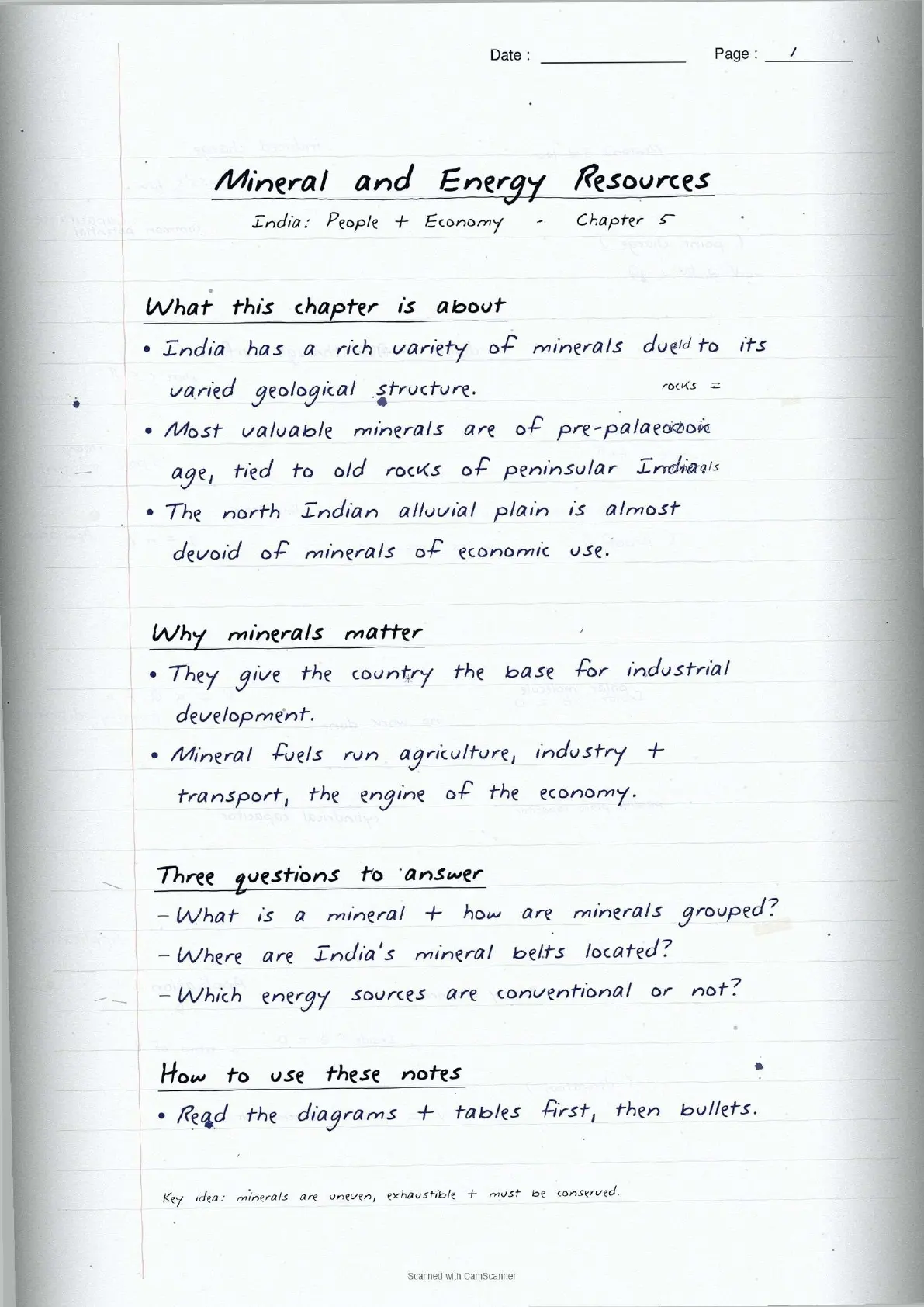
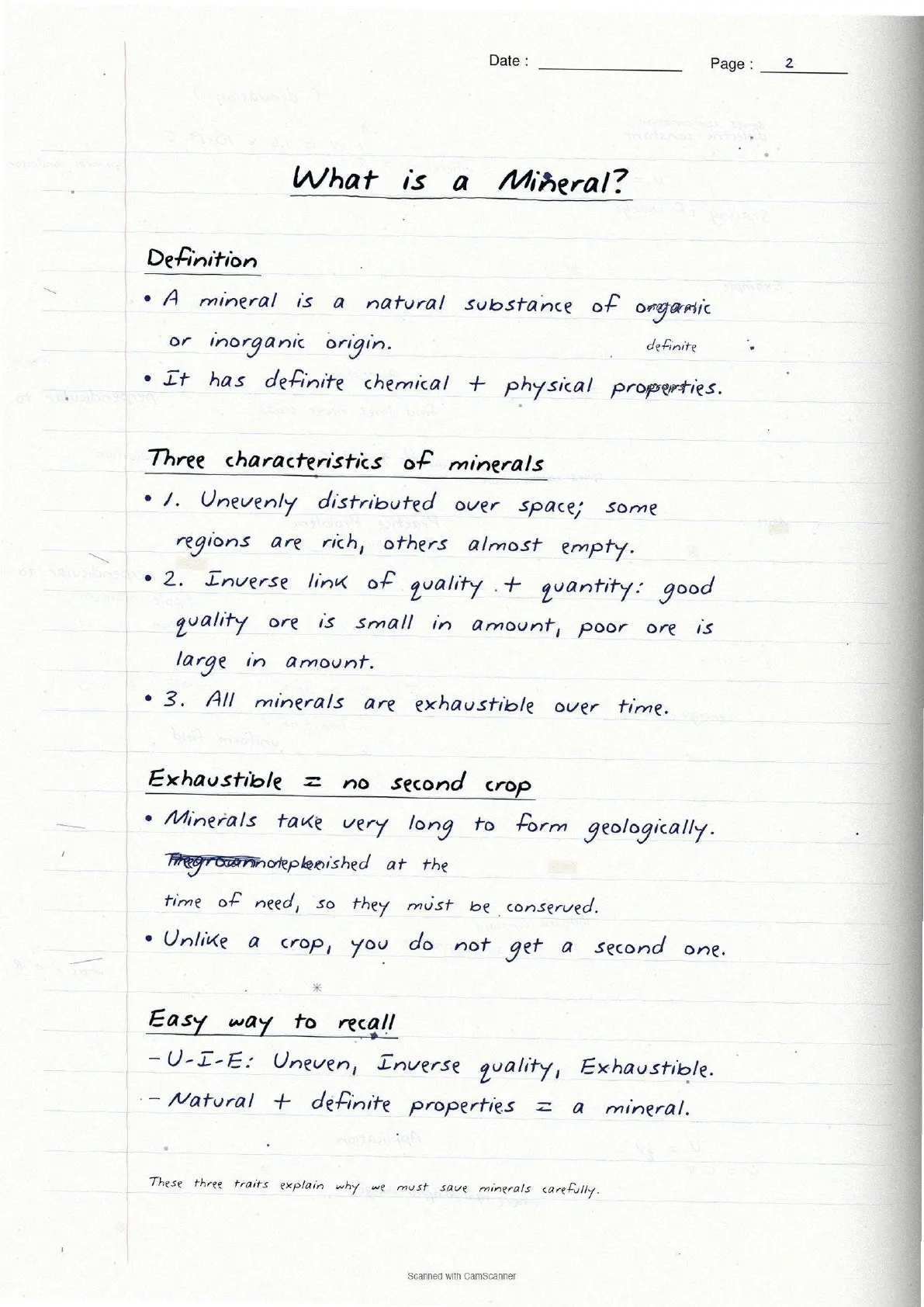
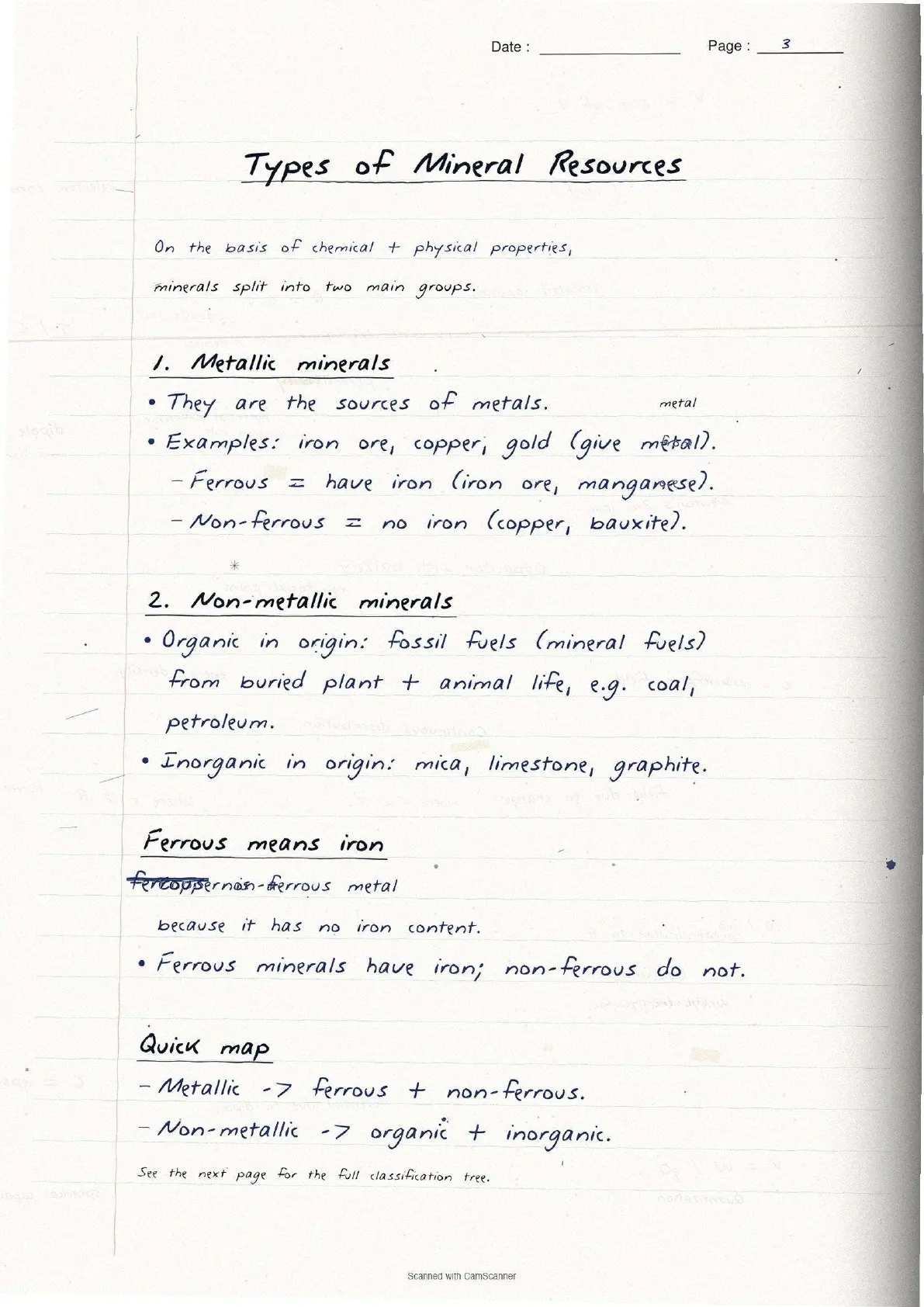
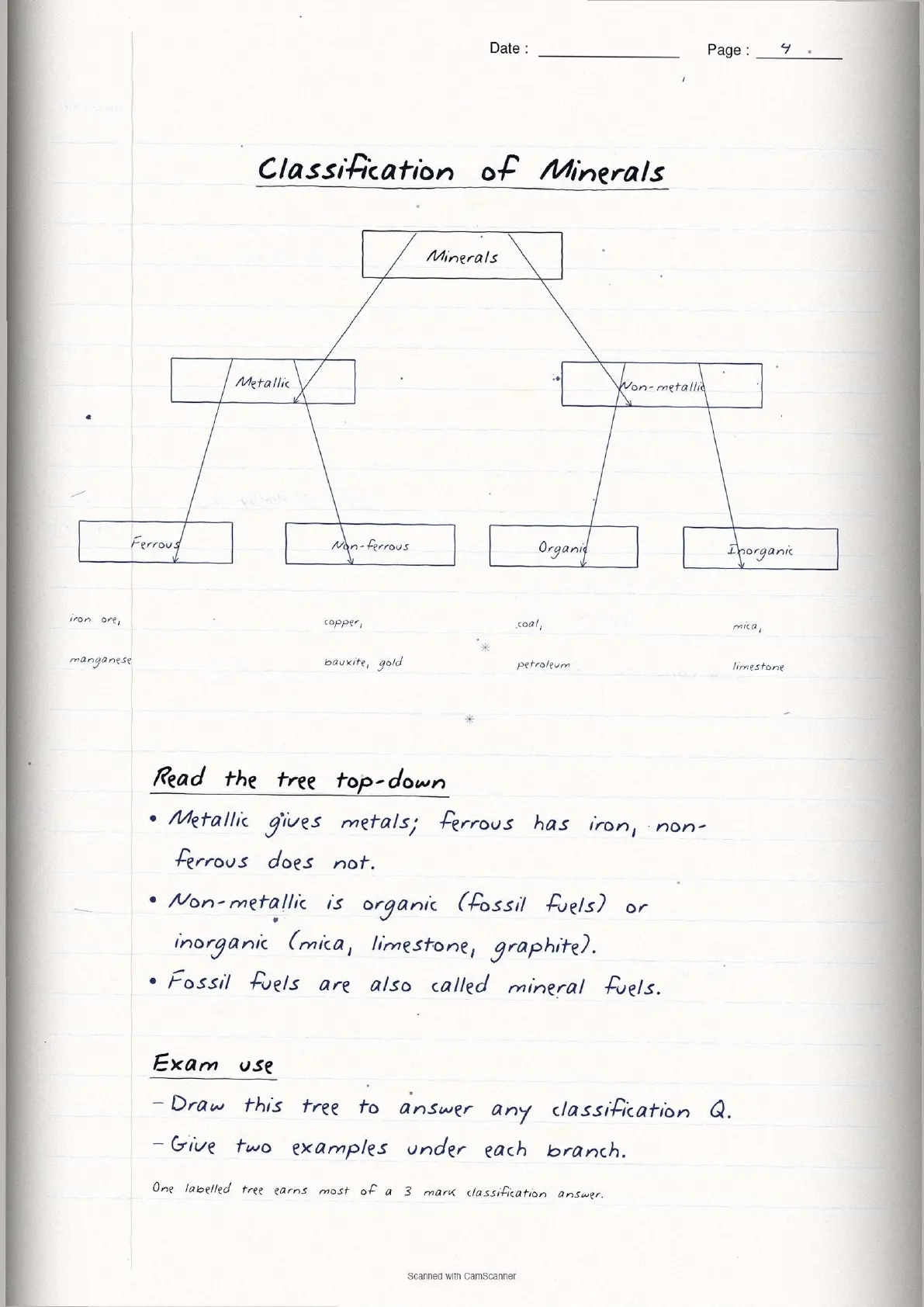
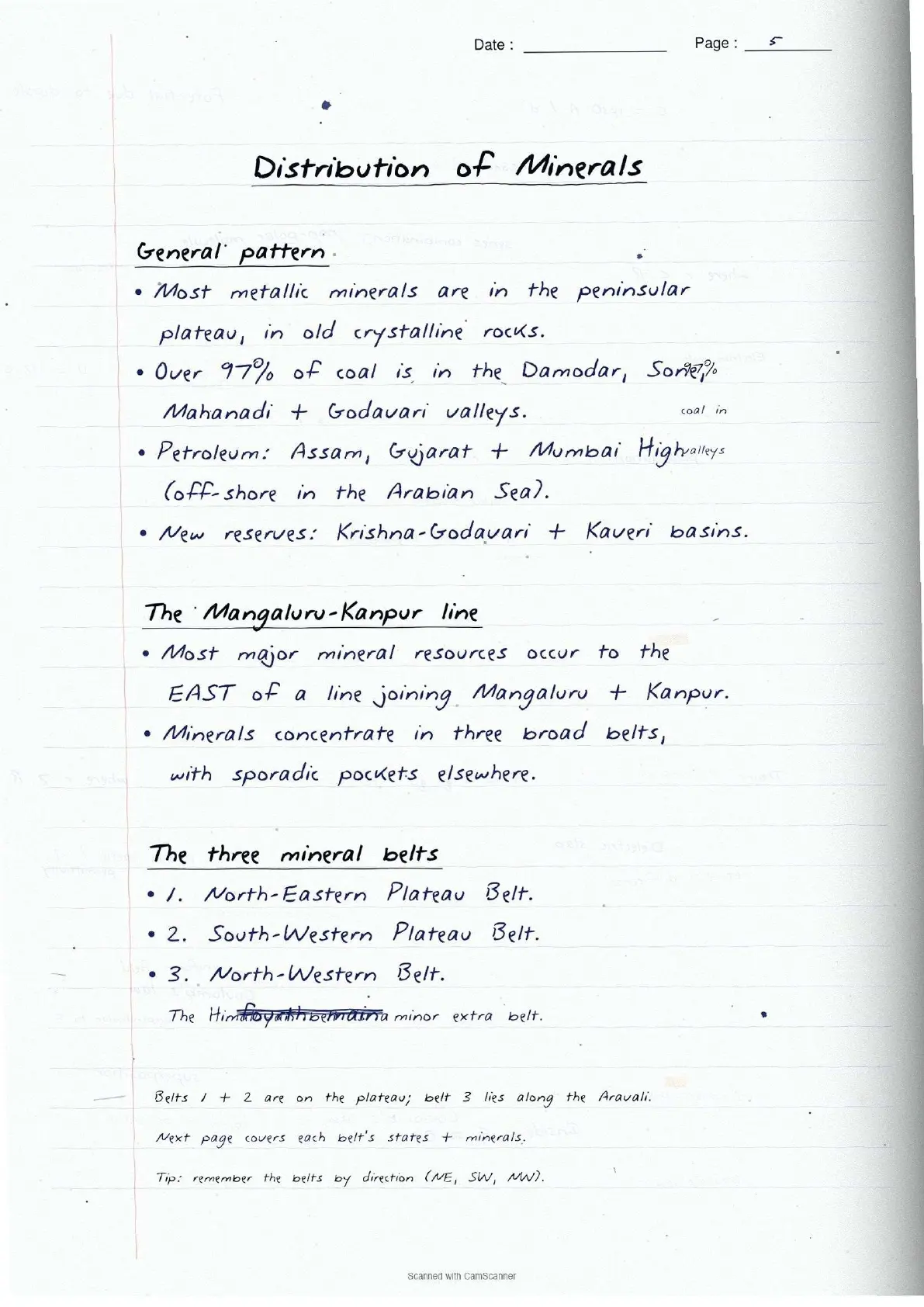
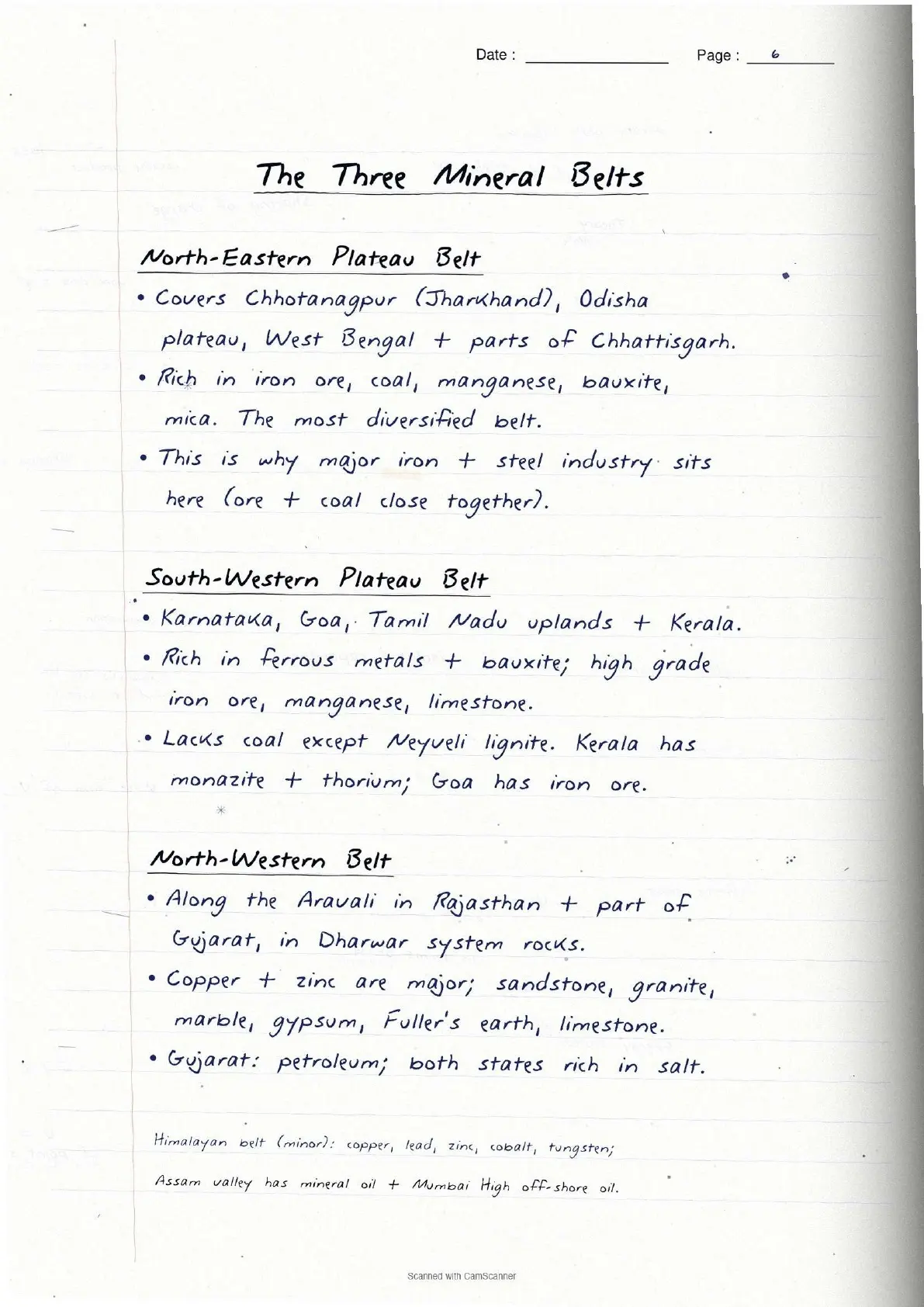
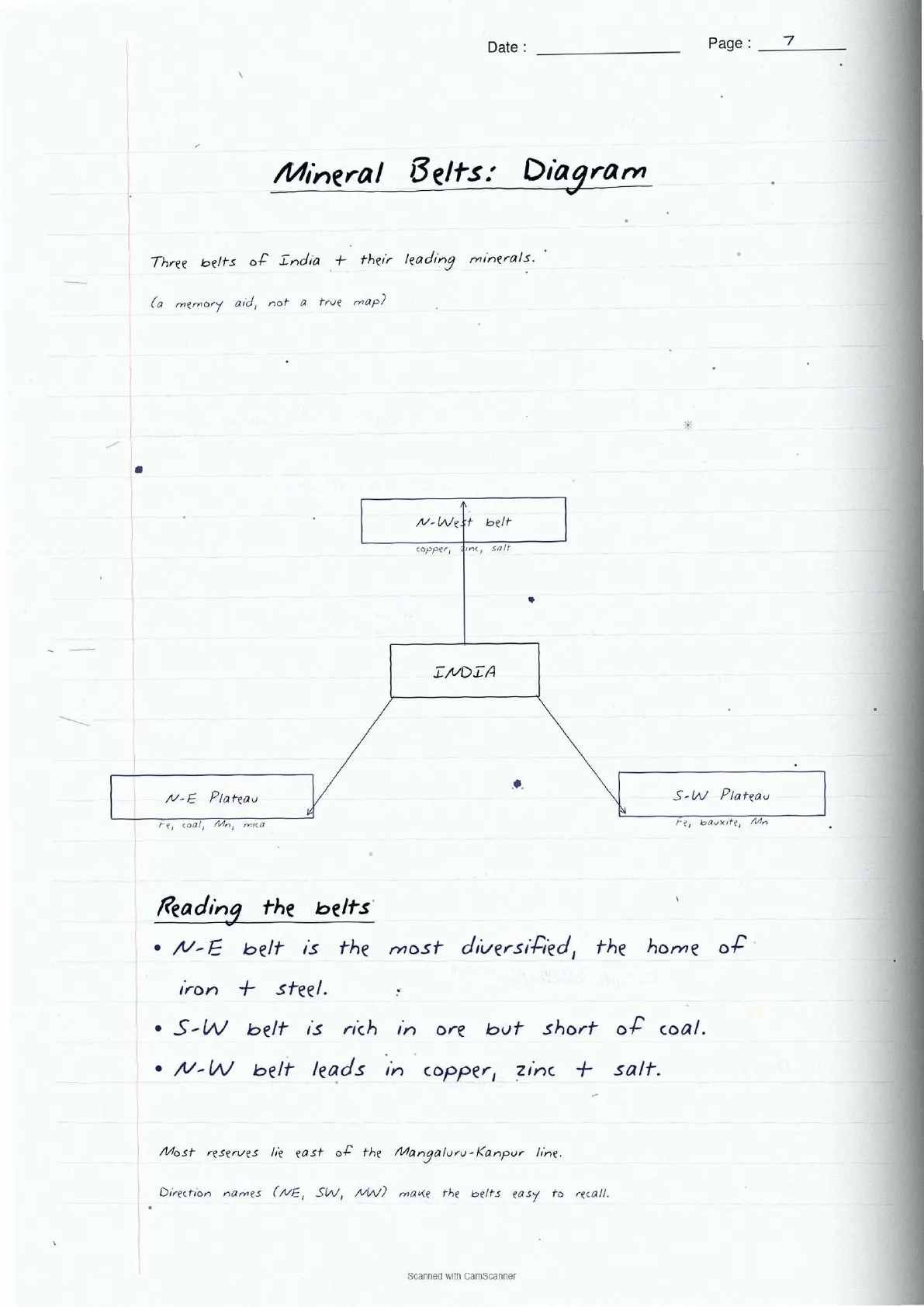
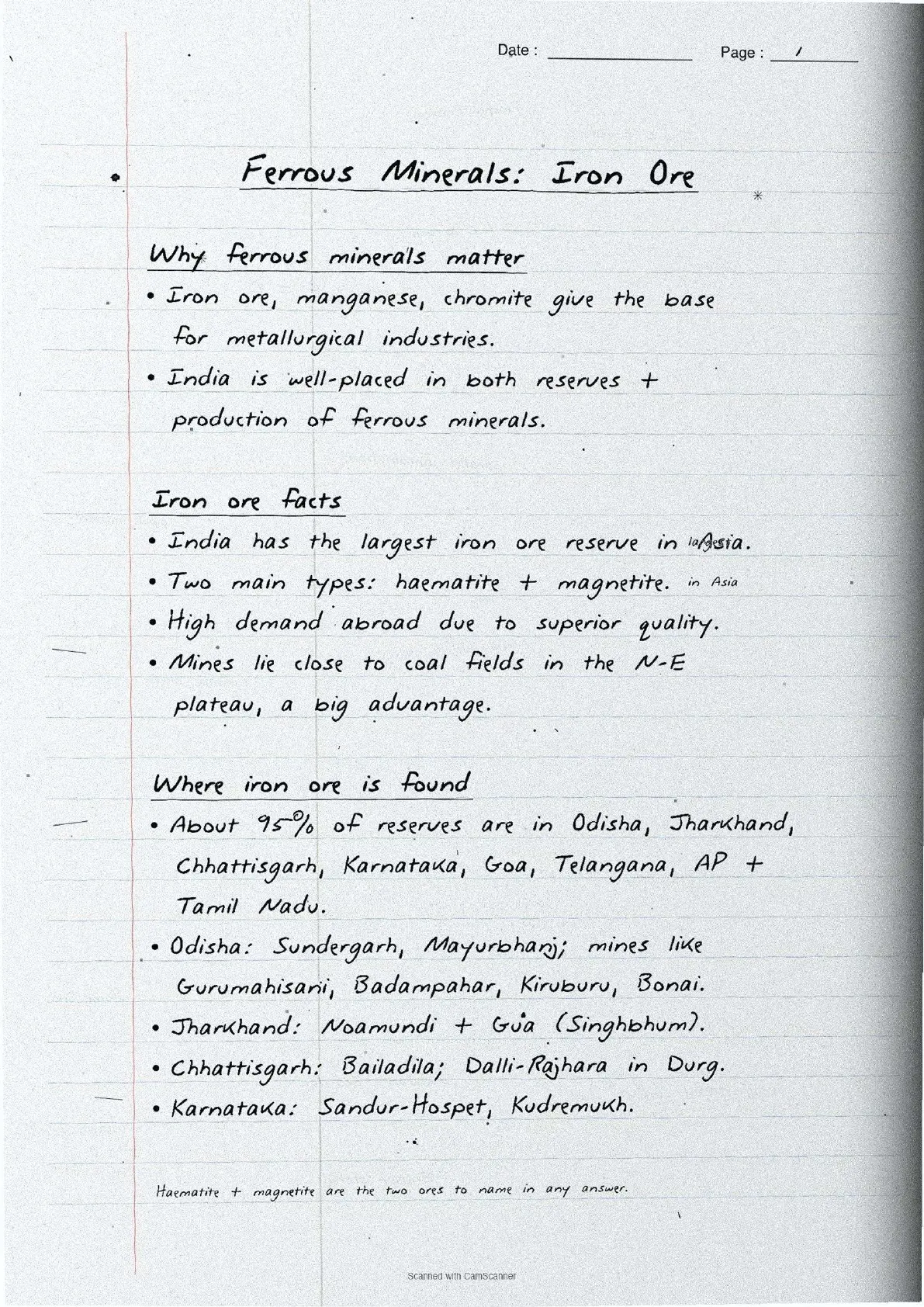
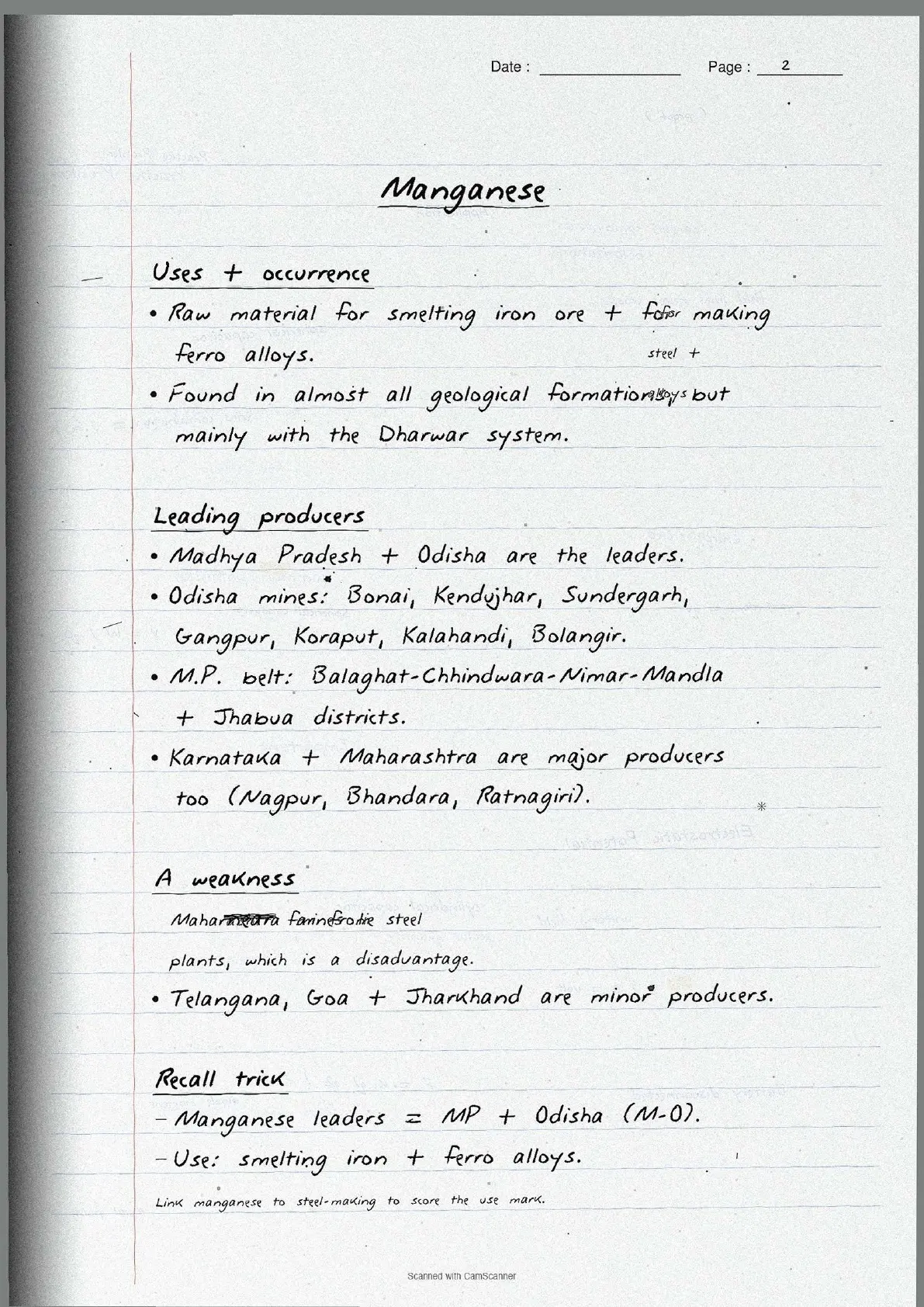
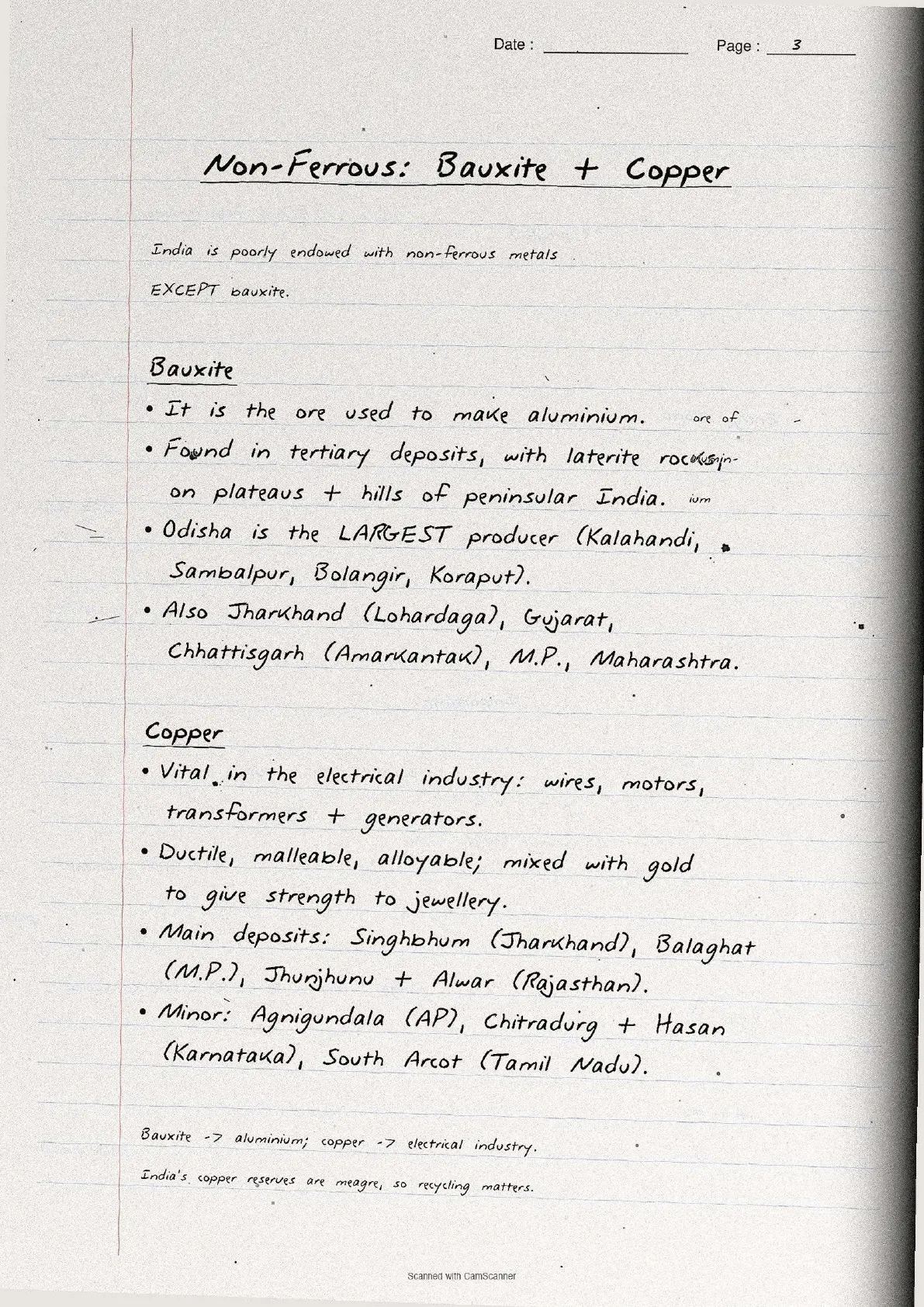
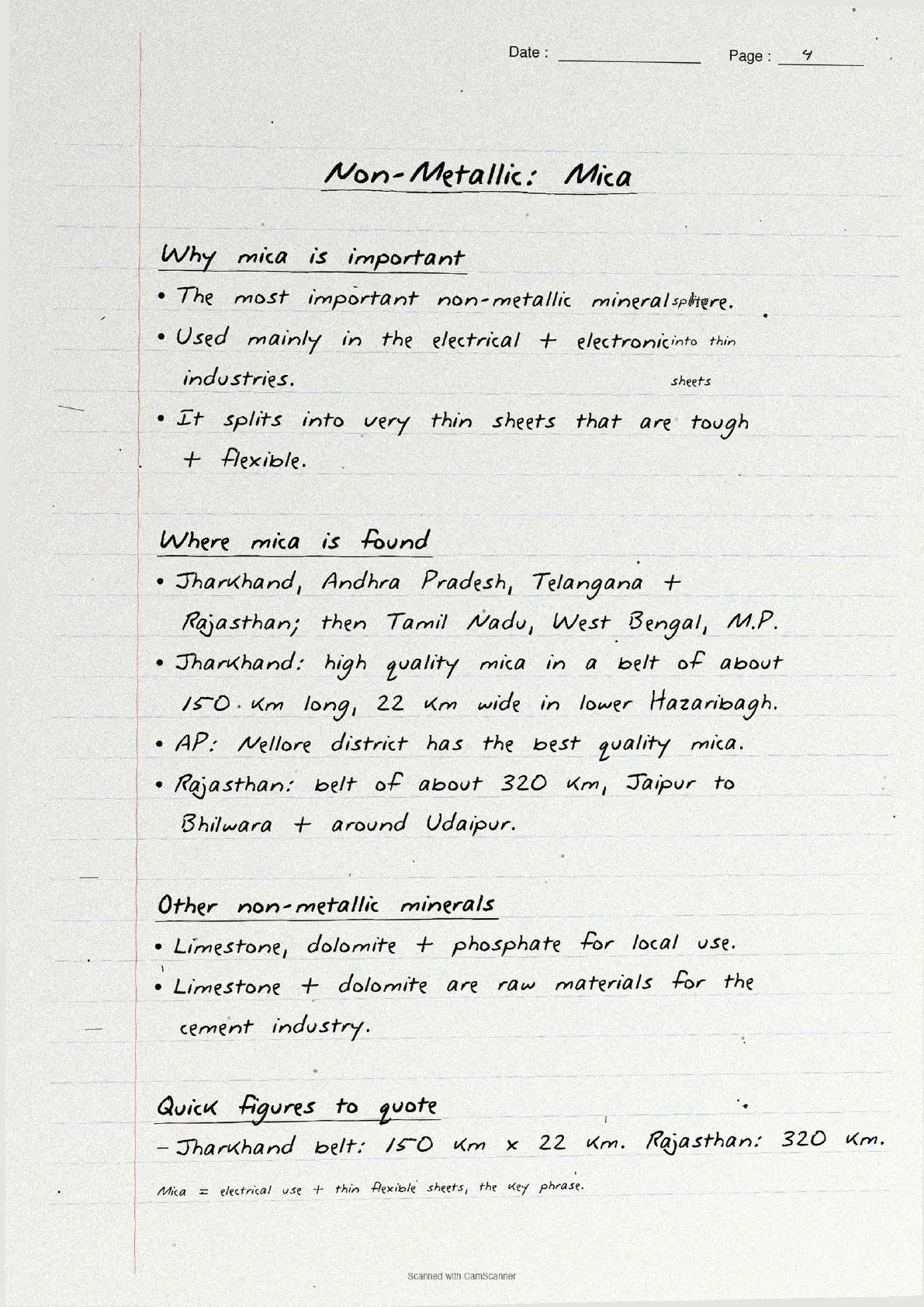
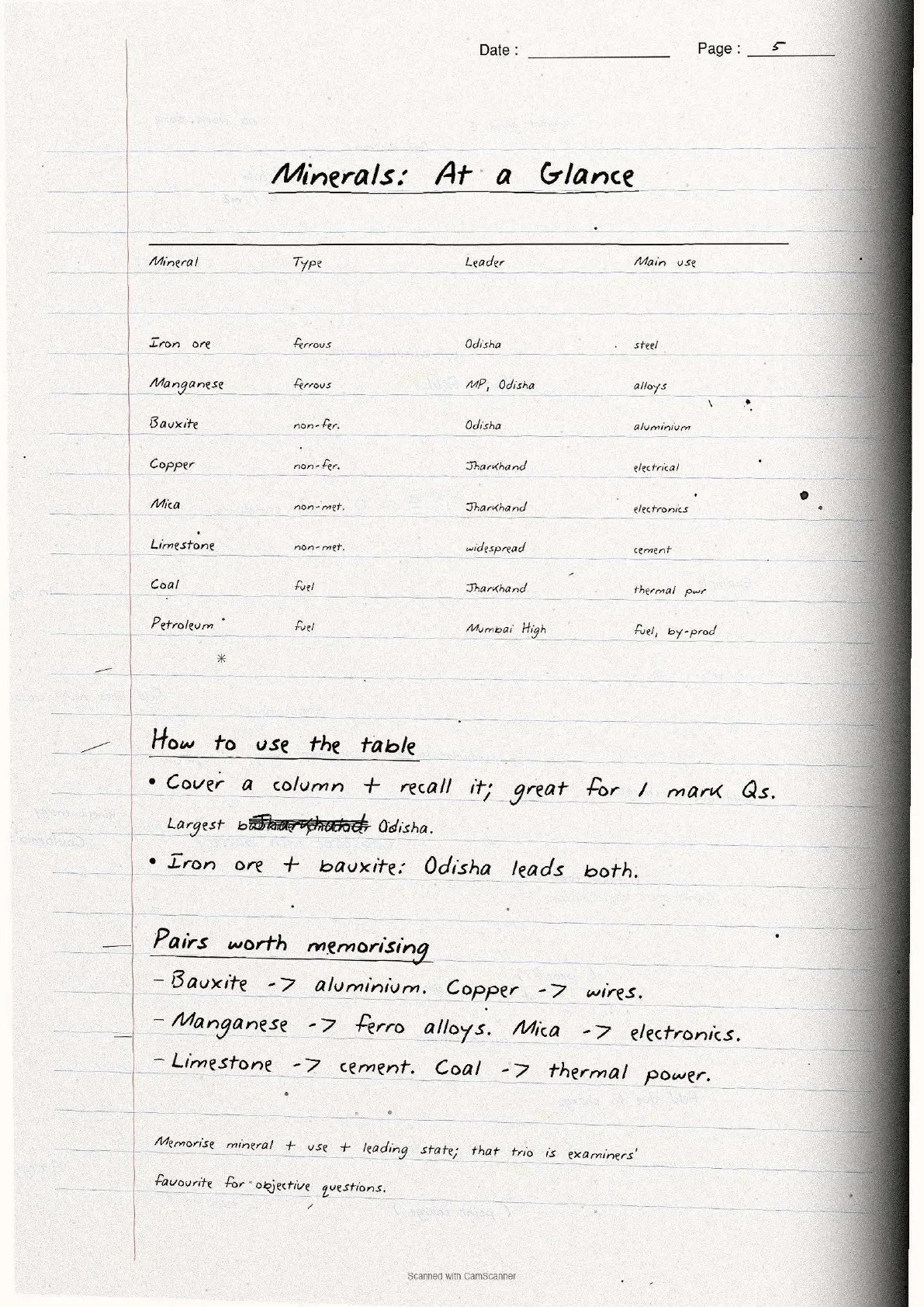
- Topper's handwritten revision notes covering all of CBSE Class 12 Geography India People and Economy Chapter 5.
- 8-10 marks weightage in the Class 12 Geography board paper, with mineral belts, energy source types and distribution data laid out clearly by hand.
- Pairs with the typed NCERT Solutions, typed Notes and the official NCERT Book PDF for the same chapter.
Each page of these mineral and energy resources class 12 handwritten notes is written by a Collegedunia subject expert, mapped to the 2026-27 NCERT India People and Economy textbook, and cross-checked against the last five years of CBSE Class 12 Geography board papers.
Student Feedback
73% of Class 12 students said handwritten notes feel faster to scan than typed PDFs in the final 48 hours before the board exam, and 4 out of 5 students said pen-on-paper concept boxes stick in memory better when revising mineral and energy resources class 12. The average student finished one full revision pass in about 24 minutes.
Source: 2026-27 Class 12 Geography handwritten-notes feedback poll, 10,240 CBSE students.
What These Handwritten Notes Include
The mineral and energy resources class 12 handwritten notes PDF is a 5 to 6 page revision file. Every page is handwritten in ballpoint pen, with classification trees for mineral types, arrow-tagged maps of the three mineral belts, and neat corrections in a second ink colour. The file is built for last-mile revision, not first-time concept building.
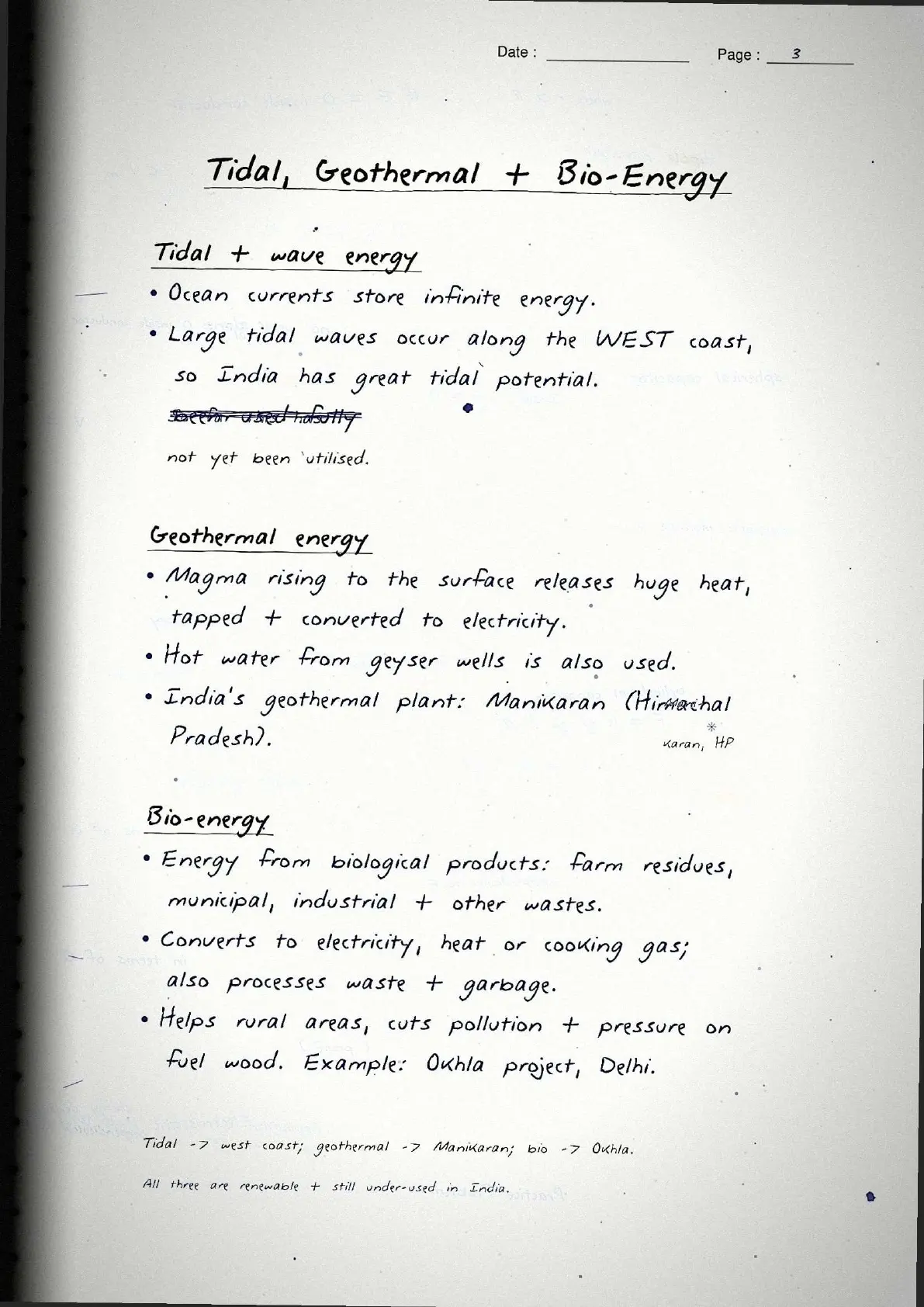
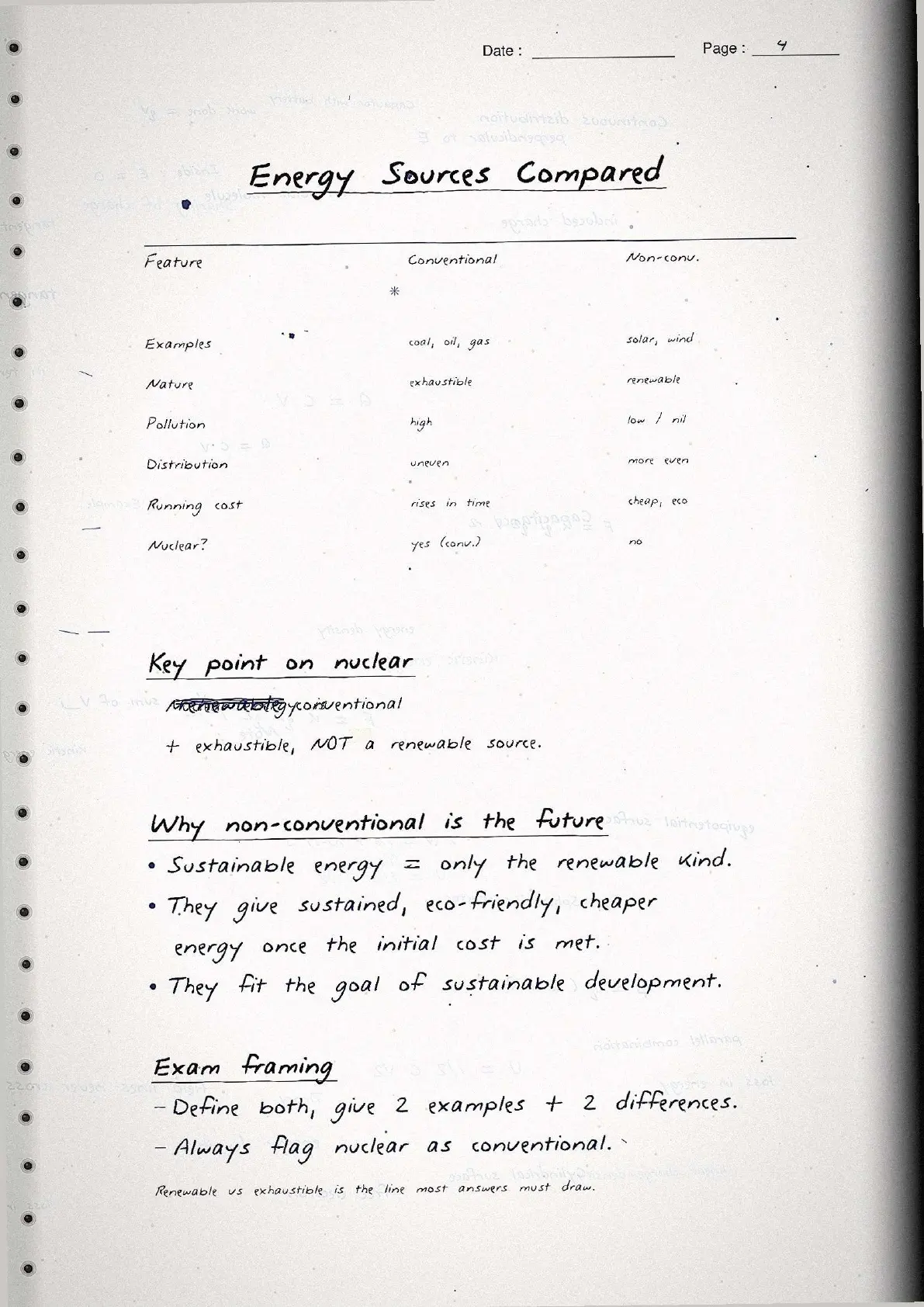
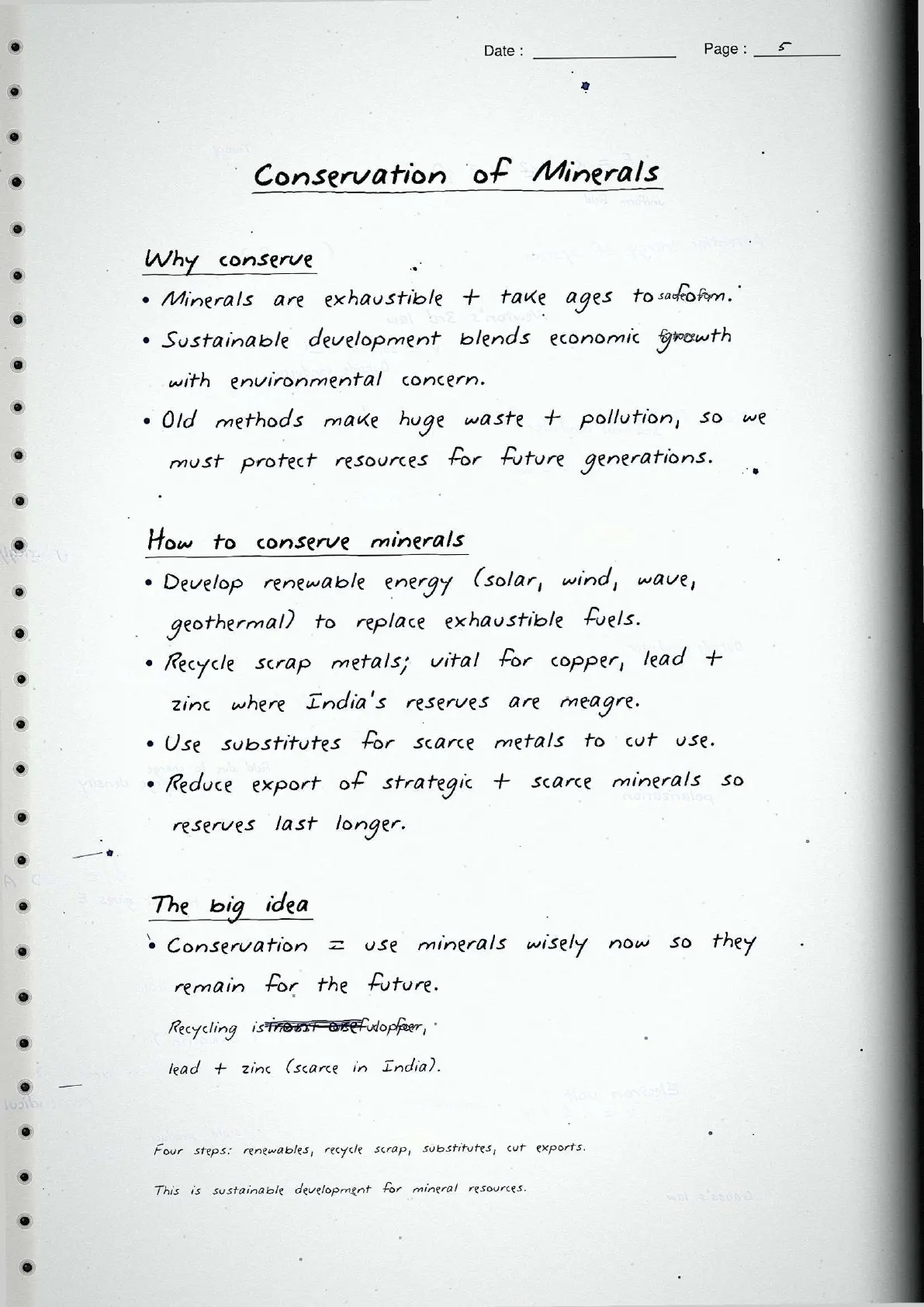
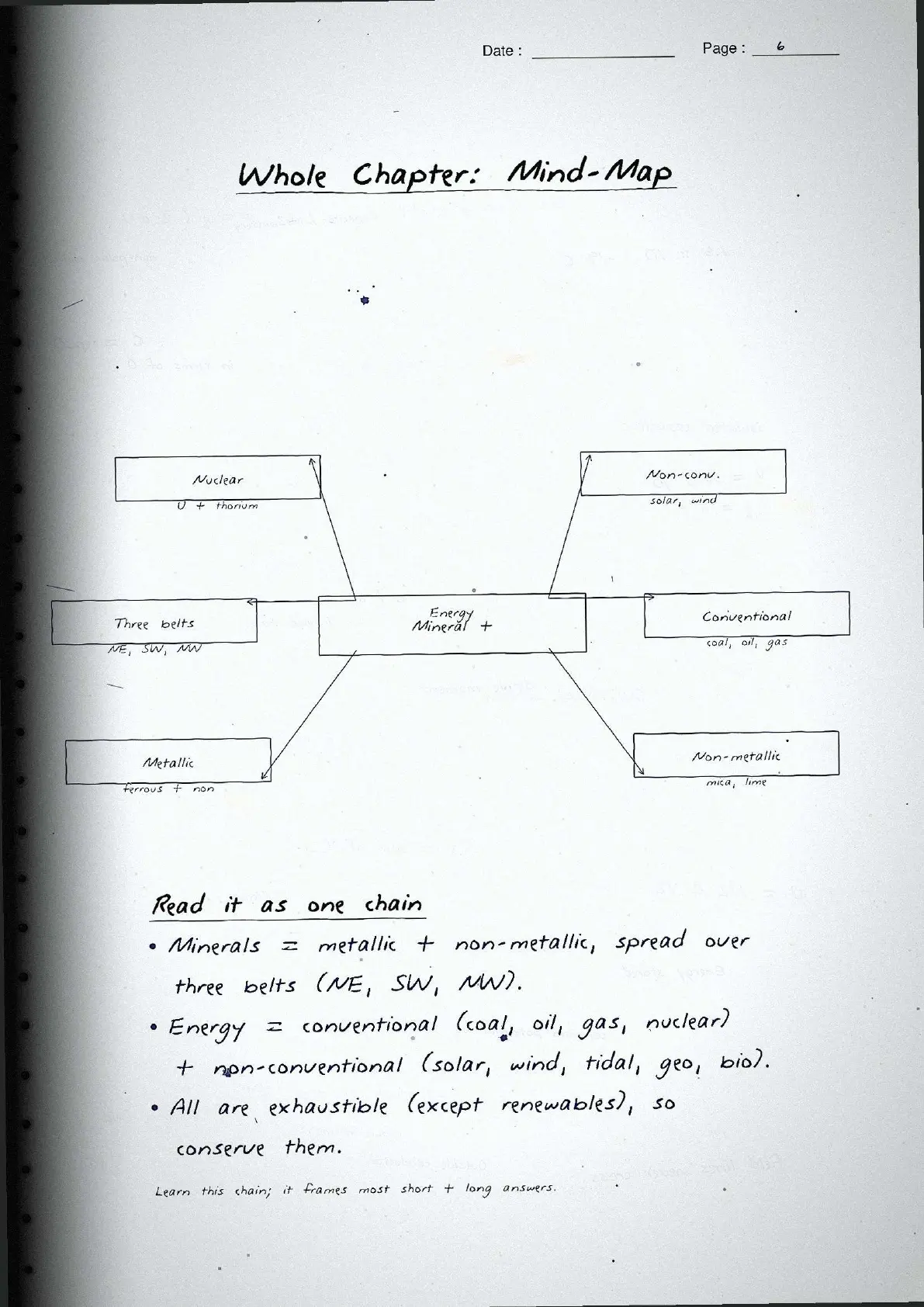
The pages capture every concept tested in CBSE Class 12 Geography Chapter 5: the two main categories of minerals (metallic and non-metallic), the three mineral belts of India, key minerals such as iron ore, manganese, copper, bauxite and mica, conventional energy sources (coal, petroleum, natural gas, hydel), nuclear energy minerals (uranium and thorium), the non-conventional energy sources (solar, wind, tidal, geothermal, bio-energy), and the conservation of mineral resources.
| Page | What the page covers | Approx revision time |
|---|---|---|
| Page 1 | Mineral definition and classification tree (metallic: ferrous/non-ferrous; non-metallic: organic/inorganic), three characteristics of minerals, three broad mineral belts of India. | 5 minutes |
| Page 2 | Iron ore (haematite and magnetite), leading producer states, manganese, copper, bauxite distribution. | 6 minutes |
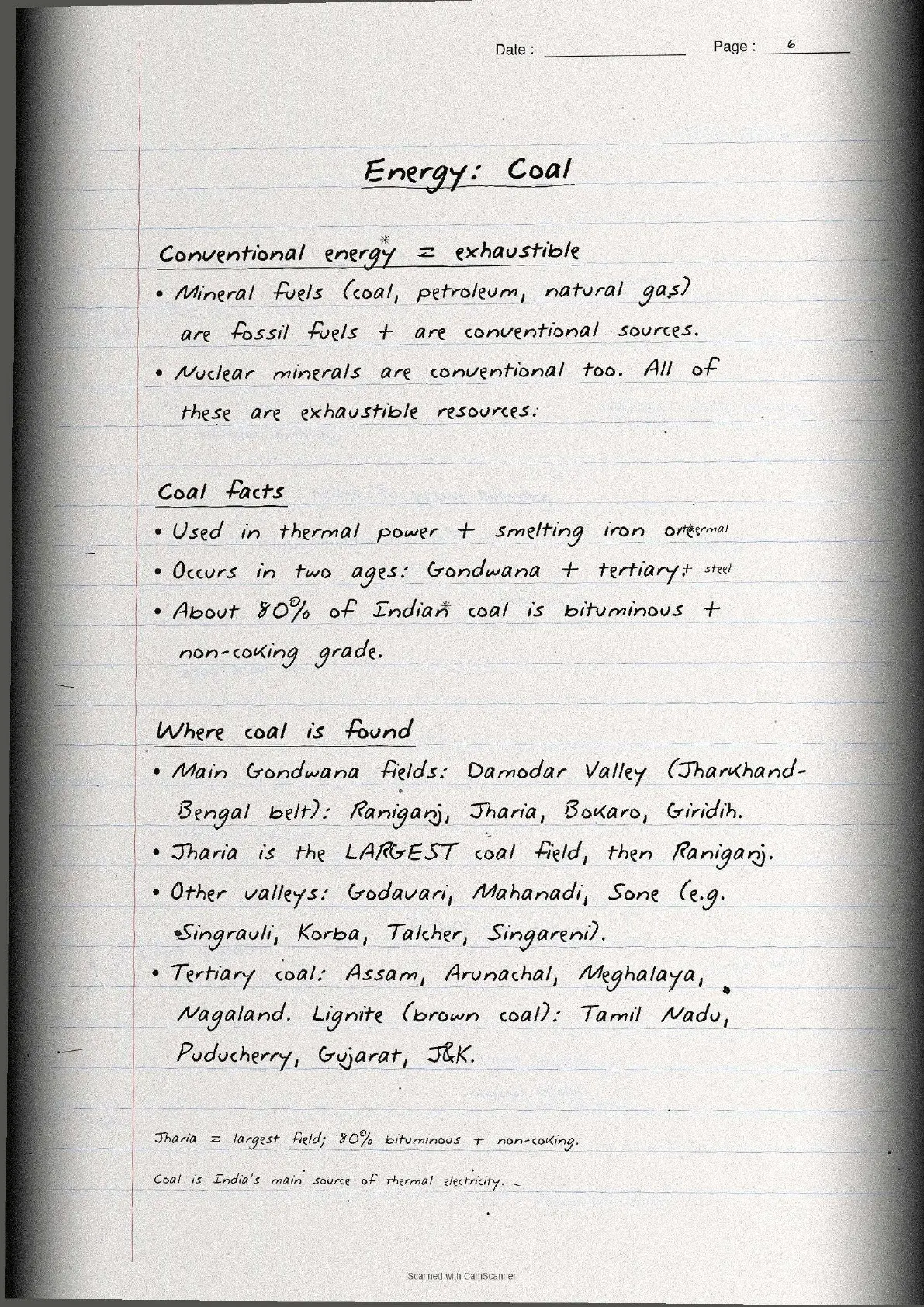
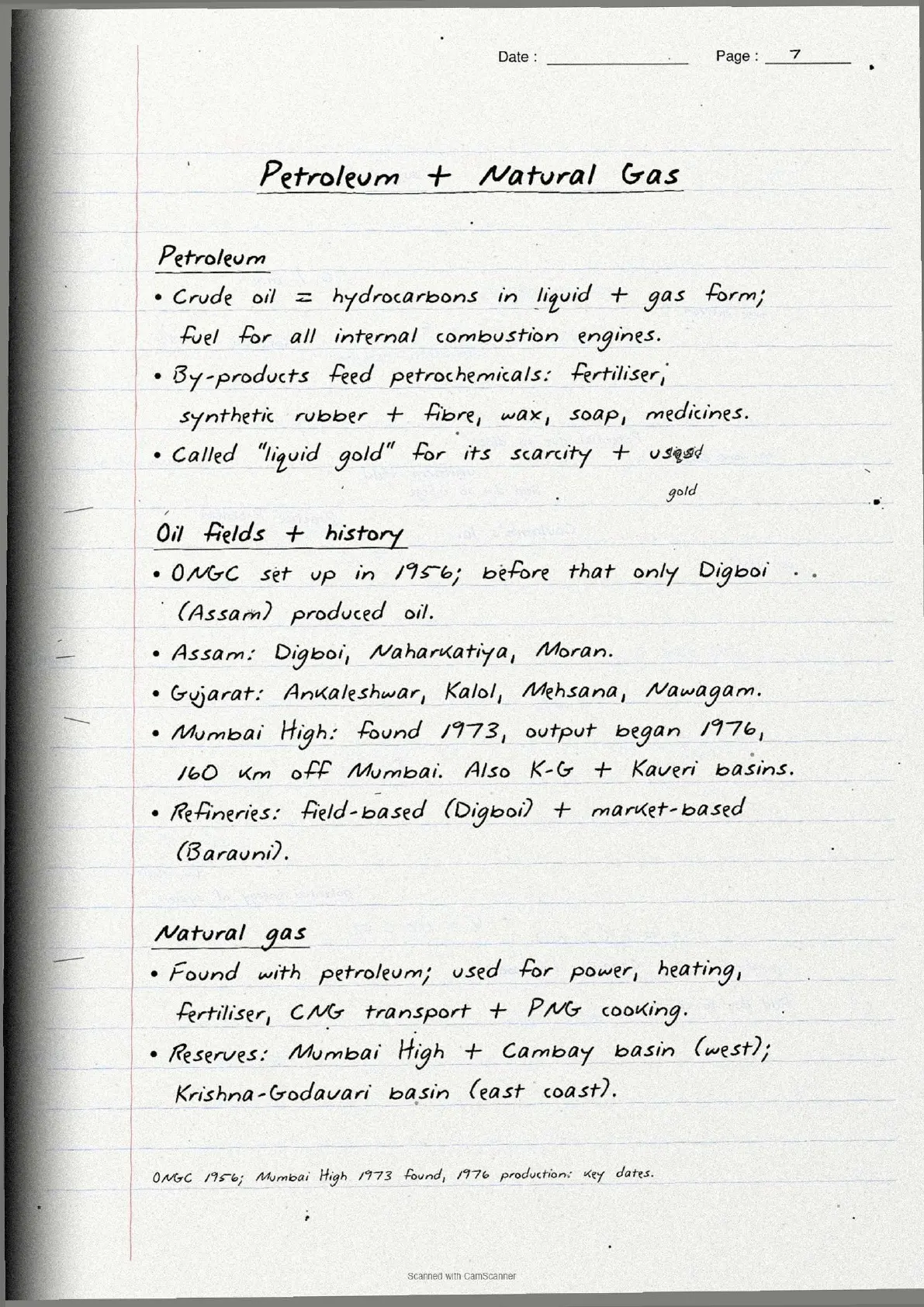
| Page 3 | Non-metallic minerals: mica, limestone; conventional energy: coal (types and fields), petroleum (fields and refineries). | 6 minutes |
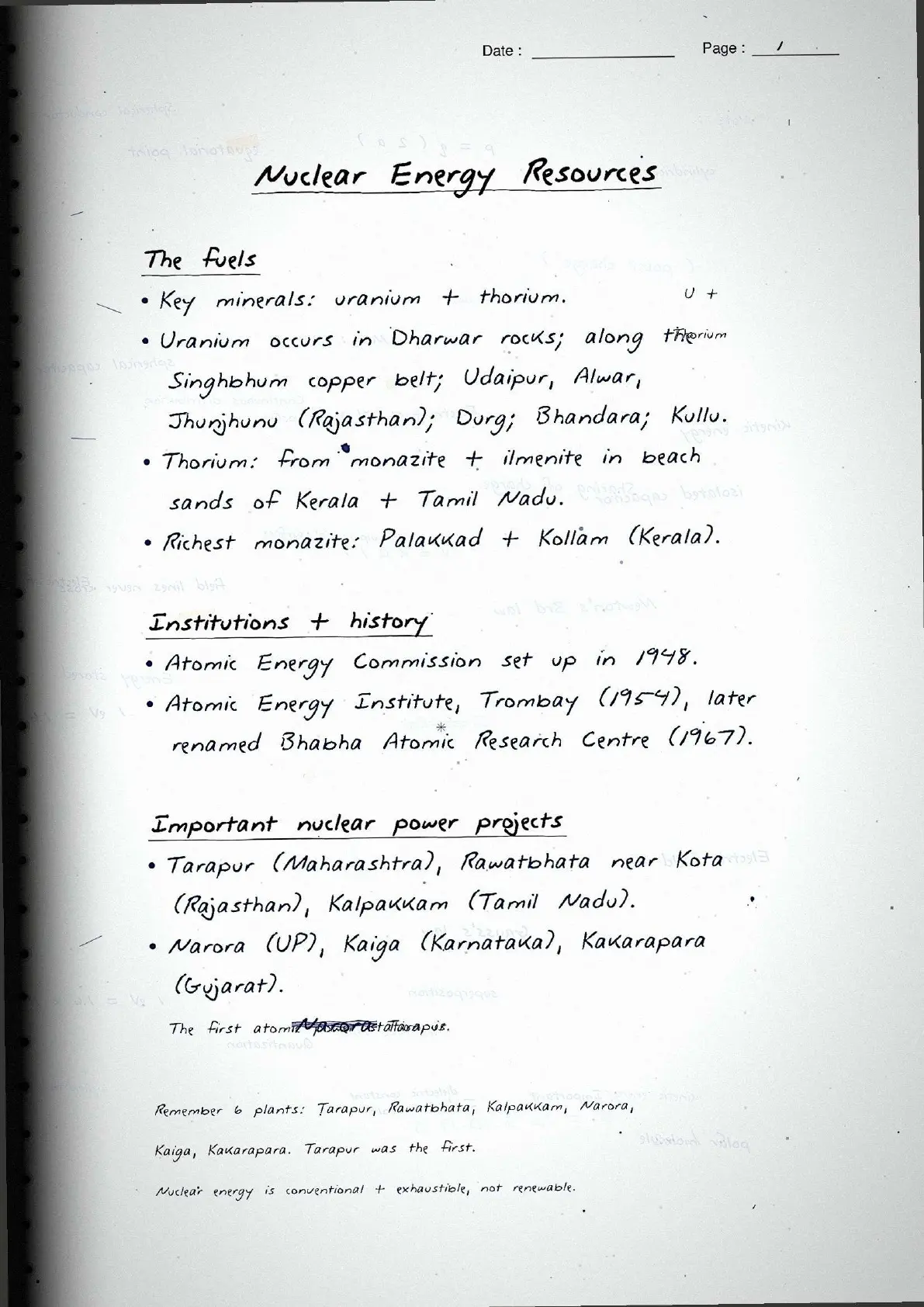
| Page 4 | Natural gas, hydel power (major projects), nuclear energy (uranium and thorium deposits, power stations). | 5 minutes |
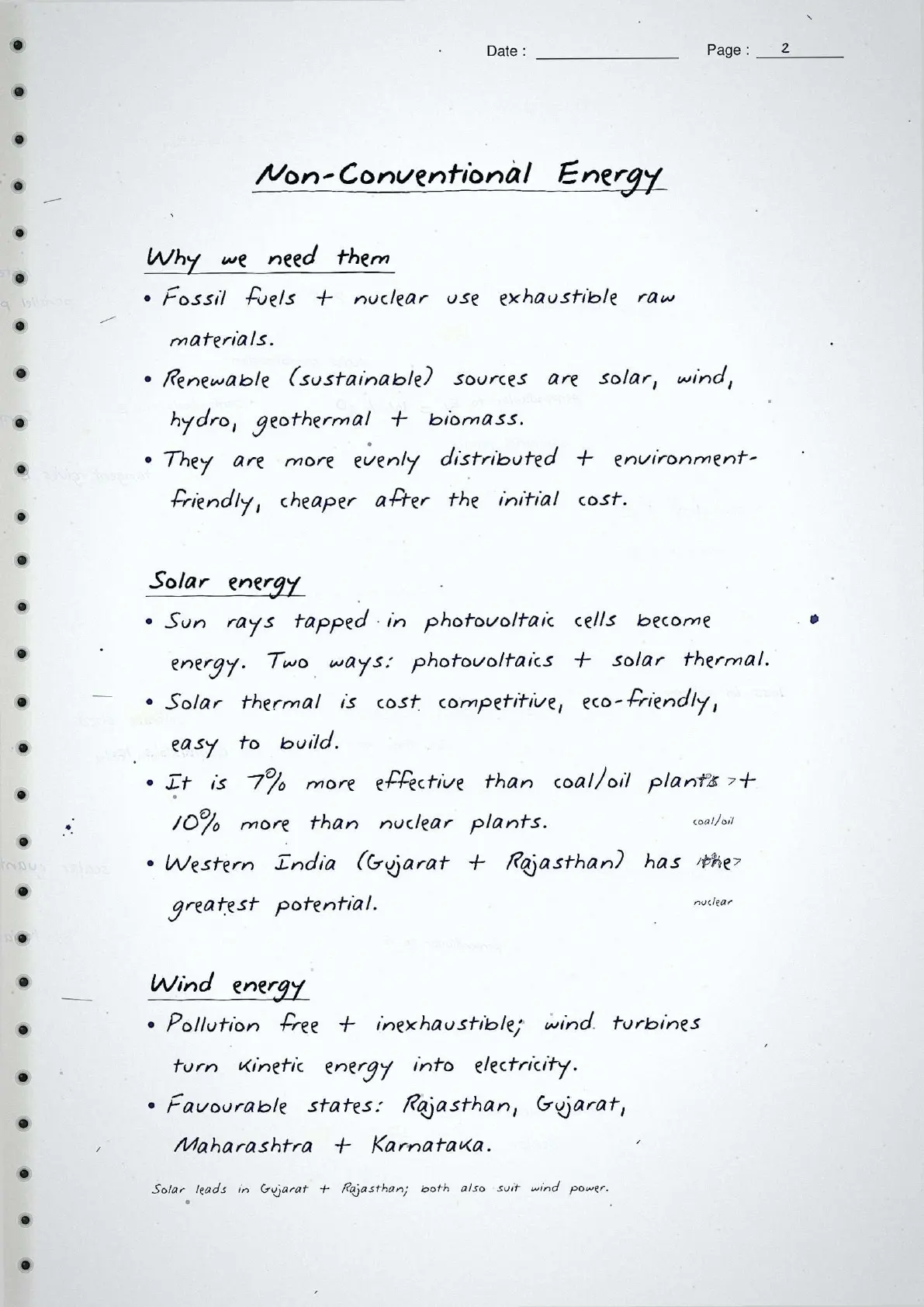
| Page 5 | Non-conventional energy: solar, wind, tidal, geothermal (Manikaran plant), bio-energy; conservation strategies. | 4 minutes |
Mineral Belts of India at a Glance
The three mineral belts are the geographic backbone of this chapter and the single most-tested spatial fact in Chapter 5. The notes draw all three belts on Page 1 with a simple pen-sketch of peninsular India, and repeat the key minerals next to each belt so students absorb location and resource together.
| Mineral Belt | States covered | Key minerals | CBSE exam relevance |
|---|---|---|---|
| North-Eastern Plateau Region | Jharkhand (Chhotanagpur), Odisha Plateau, West Bengal, parts of Chhattisgarh | Iron ore, coal, manganese, bauxite, mica | Most diverse belt; most-asked belt in 3-mark questions |
| South-Western Plateau Region | Karnataka, Goa, Tamil Nadu uplands, Kerala | Iron ore (high grade), manganese, bauxite; Neyveli lignite; Kerala monazite and thorium | Lacks coal; rich in ferrous metals; Neyveli lignite frequently asked |
| North-Western Region | Rajasthan (Aravali), Gujarat | Copper, zinc, sandstone, granite, marble, gypsum, salt; Gujarat petroleum | Building stones and petroleum most-asked from this belt |
| Himalayan Belt | Eastern and western Himalayas, Assam valley | Copper, lead, zinc, cobalt, tungsten; Assam petroleum | Secondary belt; occasionally asked in 1-mark or MCQ format |
Important: Most of the major mineral resources occur to the east of a line linking Mangaluru and Kanpur. This NCERT sentence is a direct source for a 1-mark MCQ or fill-in-the-blank, and the notes put it in a boxed callout on Page 1 with a double-underline because it gets missed by students who focus only on state lists.
Conventional Energy Resources: Coal, Petroleum, Natural Gas
Pages 3 and 4 cover conventional energy resources in sequence: coal, petroleum, natural gas and hydel power. These four together account for the largest share of exam questions from this chapter.
Coal
Coal is the most abundant fossil fuel in India. Over 97 per cent of coal reserves occur in the valleys of Damodar, Sone, Mahanadi and Godavari. NCERT categorises Indian coal into bituminous and lignite; the notes flag Neyveli lignite (Tamil Nadu) as the one exception to the "eastern India = coal" rule that CBSE markers check for.
Petroleum
Petroleum reserves lie in the sedimentary basins of Assam, Gujarat and Mumbai High (offshore Arabian Sea), with newer finds in the Krishna-Godavari and Kaveri basins. India has over 18 major refineries including Digboi (India's oldest), Koyali, Mumbai, Vishakhapatnam and Chennai. Digboi is worth memorising because it often appears as a 1-mark MCQ.
Natural Gas and Hydel Power
Natural gas reserves are concentrated in Mumbai High and allied fields on the west coast, and in the Krishna-Godavari basin on the east coast. It is used as a power fuel, a raw material for fertilisers, and as CNG for transport and PNG for cooking. Hydel power is generated at major dams like Bhakra-Nangal (Punjab-Himachal Pradesh), Hirakud (Odisha) and Nagarjunasagar (Andhra Pradesh-Telangana), listed on Page 4 with river and state alongside.
Non-Conventional Energy: Solar, Wind, Nuclear and More
Non-conventional energy forms the second half of the chapter and is increasingly tested as the government pushes for energy transition. All six sources appear on Page 5 in two-line summary boxes, and nuclear energy gets a separate Page 4 treatment because its mineral geography (uranium and thorium) links back to the mineral distribution section.
| Energy Source | Key fact | India-specific detail | CBSE test format |
|---|---|---|---|
| Nuclear | Uranium (Singhbhum, Rajasthan) and thorium (monazite from Kerala, Tamil Nadu) | Power stations: Tarapur, Rawatbhata, Kalpakkam, Narora, Kaiga, Kakarapara | 3-5 mark question; name 2-3 stations |
| Solar | Photovoltaic cells convert sunlight; solar thermal technology more cost-competitive than coal | Rajasthan and Gujarat have highest potential | 1-3 mark definition or advantage question |
| Wind | Kinetic energy of wind converted via turbines to electrical energy; pollution-free and inexhaustible | Rajasthan, Gujarat, Maharashtra, Karnataka have favourable conditions | 1-3 mark question; often MCQ on states |
| Tidal and Wave | Ocean tides and currents as energy store; large tidal waves on west coast of India | Potential exists but not yet developed commercially | 1 mark: "not yet utilised" is key phrase |
| Geothermal | Magma heat tapped and converted to electricity; hot springs and geysers used | First Indian geothermal plant at Manikaran, Himachal Pradesh | 1 mark: Manikaran is the go-to answer |
| Bio-energy | Energy from agricultural residues, municipal and industrial waste; reduces environmental pollution | Okhla (Delhi) converts municipal waste to energy | 1-2 mark definition question |
The notes connect nuclear energy back to mineral geography with a pen arrow labelled "Thorium-rich Kerala monazite = Page 2 South-Western Belt". Students who make this cross-page connection revise the chapter as one integrated unit, which is what the 5-mark essay question rewards.
Common Mistakes Highlighted in the Notes
The six repeat-offender mistakes CBSE examiners flag each year on mineral and energy resources class 12 questions, marked in a second ink colour beside the relevant topic.
- Confusing ferrous and non-ferrous minerals. Ferrous minerals contain iron (iron ore, manganese, chromite); non-ferrous do not (copper, bauxite, gold). Swapping these in a 3-mark answer loses all method marks.
- Treating organic and inorganic non-metallic minerals as the same. Organic = fossil fuels (coal, petroleum); inorganic = mica, limestone, graphite. The NCERT table makes this split explicit and CBSE MCQs test it directly.
- Forgetting the 97 per cent coal figure. Over 97 per cent of coal reserves are in the Damodar-Sone-Mahanadi-Godavari valleys. Write the four river names and the figure, not just "peninsular India".
- Placing Tarapur in Rajasthan. Tarapur is in Maharashtra; Rawatbhata near Kota is in Rajasthan. This is the most common MCQ trap in the nuclear power station question.
- Saying tidal energy is used in India. India has tidal potential on the west coast but has not developed it commercially. The NCERT phrase is "not yet utilised".
- Confusing Manikaran with any other geothermal location. Manikaran in Himachal Pradesh is the only operating geothermal plant in the NCERT textbook, and the most-missed 1-mark in this chapter.
Previous Year Question Trends
The CBSE Class 12 Geography paper has carried a stable 8 to 10 marks from Chapter 5 over the last five years, split across one or two theory questions (3 marks each) and one long-answer or map-based question (5 marks). The pages are structured around this pattern.
| Year | Question asked | Marks | Notes page to revise |
|---|---|---|---|
| 2025 | Name two nuclear power stations in India and their states + what is geothermal energy? | 2 + 3 | Page 4 + Page 5 |
| 2024 | Write a detailed note on petroleum resources of India | 5 | Page 3 |
| 2023 | Distinguish between ferrous and non-ferrous minerals with two examples each | 3 | Page 1 |
| 2022 | Name the leading iron ore producing states in India + write about non-conventional sources of energy | 3 + 5 | Page 2 + Page 5 |
| 2021 | Explain the distribution of coal in India + what are non-metallic minerals? | 5 + 3 | Page 3 + Page 1 |
Petroleum distribution and non-conventional energy together account for over half the marks the chapter carries, so revise Pages 3 and 5 together, not selectively.
Other Resources for Class 12 Geography Chapter 5 (India People and Economy)
Pair these handwritten notes with the matching NCERT Solutions, typed Notes and the official NCERT Book chapter.
| Resource | What it covers | Open |
|---|---|---|
| Handwritten Notes | Topper's handwritten revision pages for last-mile board exam prep on mineral and energy resources. | You are here |
| NCERT Solutions | Step-by-step model answers to all exercise questions including MCQs, short-answer and long-answer questions on mineral distribution, energy sources and conservation. | Class 12 Geography Chapter 5 NCERT Solutions |
| Notes | Concept-first typed revision notes with mineral classification, belt distribution, energy source analysis and conservation strategies. | Class 12 Geography Chapter 5 Notes |
| NCERT Book PDF | Official NCERT India People and Economy Chapter 5 textbook in PDF form. | Class 12 Geography Chapter 5 NCERT Book PDF |
| Subject Hub | All chapters of Class 12 Geography with every resource in one place. | Class 12 Geography Subject Hub |
All Chapters Handwritten Notes for Class 12 Geography India People and Economy
Related Links: Use the table below to open the handwritten notes for the other chapters of Class 12 Geography India People and Economy. Every chapter ships with the same handwritten structure, data boxes and margin-callout common mistakes.
| Chapter | Topic | Handwritten Notes link |
|---|---|---|
| Chapter 1 | Population: Distribution, Density, Growth and Composition | Class 12 Geography Population Chapter Handwritten Notes |
| Chapter 2 | Human Settlements | Class 12 Geography Human Settlements Handwritten Notes |
| Chapter 3 | Land Resources and Agriculture | Class 12 Geography Land Resources and Agriculture Handwritten Notes |
| Chapter 4 | Water Resources | Class 12 Geography Water Resources Handwritten Notes |
| Chapter 5 | Mineral and Energy Resources | You are here |
| Chapter 6 | Planning and Sustainable Development in Indian Context | Class 12 Geography Planning and Sustainable Development Handwritten Notes |
| Chapter 7 | Transport and Communication | Class 12 Geography Transport and Communication Handwritten Notes |
| Chapter 8 | International Trade | Class 12 Geography International Trade Handwritten Notes |
| Chapter 9 | Geographical Perspective on Selected Issues and Problems | Class 12 Geography Geographical Perspective Handwritten Notes |
Mineral and Energy Resources Class 12 Handwritten Notes FAQs
Ques. What are these mineral and energy resources class 12 handwritten notes meant to be used for?
Ans. The mineral and energy resources class 12 handwritten notes compress the full NCERT Chapter 5 of Class 12 Geography India People and Economy into 5 to 6 pages of handwritten classification trees, mineral belt summaries and energy source boxes. Students typically use the file for last-mile revision in the 24 hours before the board paper, paired with the typed Notes PDF for concept building and the NCERT Solutions PDF for full-sentence answer practice. The handwritten file is the closest thing to borrowing a topper's own revision pages for one sitting.
Ques. How are handwritten notes different from the typed mineral and energy resources class 12 notes?
Ans. The typed mineral and energy resources class 12 notes carry deeper prose around each mineral and energy source (policy context, India's global standing, environmental implications) and run 6 to 8 pages long. The handwritten notes compress that prose down to classification trees, belt tables and energy source summary boxes, sit at 5 to 6 pages, and lean on visual recall (boxed data, arrow-tagged belt sketches) rather than typed explanations. The two files are designed to be used together, not as substitutes. Read the typed Notes first to build the concept, then move to the handwritten file for the second and third revision passes.
Ques. What are the two types of minerals in Class 12 Geography Chapter 5?
Ans. The two main types of minerals in Class 12 Geography Chapter 5 are metallic minerals and non-metallic minerals. Metallic minerals are sources of metals and are further divided into ferrous (iron-bearing, such as iron ore, manganese, chromite) and non-ferrous (no iron content, such as copper, bauxite, gold). Non-metallic minerals are either organic in origin (fossil fuels like coal and petroleum, also called mineral fuels) or inorganic in origin (mica, limestone, graphite). This classification forms the branching box on Page 1 of the handwritten notes, with examples in each branch written in blue ink.
Ques. What are the three main mineral belts of India covered in these handwritten notes?
Ans. The three main mineral belts of India in NCERT Class 12 Geography Chapter 5 are: (i) the North-Eastern Plateau Region, covering Chhotanagpur in Jharkhand, Odisha Plateau, West Bengal and parts of Chhattisgarh, with iron ore, coal, manganese, bauxite and mica; (ii) the South-Western Plateau Region, extending over Karnataka, Goa, Tamil Nadu uplands and Kerala, with high-grade iron ore, manganese, bauxite and thorium (from monazite); and (iii) the North-Western Region, along Aravali in Rajasthan and Gujarat, with copper, zinc, building stones and petroleum. All three belts are drawn as labelled regions in a pen-sketch of peninsular India on Page 1.
Ques. Which state has the largest reserves of iron ore in India according to NCERT Class 12?
Ans. According to the NCERT Class 12 India People and Economy textbook, about 95 per cent of total iron ore reserves are located in Odisha, Jharkhand, Chhattisgarh, Karnataka, Goa, Telangana, Andhra Pradesh and Tamil Nadu. India has the largest reserve of iron ore in Asia. The two main types of ore are haematite and magnetite. The handwritten notes list all eight major iron ore states on Page 2 in a ranked box with Odisha and Jharkhand underlined as the two leading mining regions for CBSE quick-recall.
Ques. What are non-conventional sources of energy in Class 12 Geography?
Ans. Non-conventional sources of energy in Class 12 Geography Chapter 5 are renewable energy sources that are more equitably distributed and environment-friendly than fossil fuels. They include solar energy (photovoltaic cells and solar thermal technology), wind energy (kinetic energy converted to electricity via turbines), tidal and wave energy (ocean currents, potential exists on India's west coast but not yet commercially developed), geothermal energy (heat from earth's interior; India's plant at Manikaran in Himachal Pradesh) and bio-energy (energy from agricultural residues and municipal waste; Okhla in Delhi is the key example). All six sources appear in two-line summary boxes on Page 5.
Ques. Are these mineral and energy resources class 12 handwritten notes enough for the CBSE board exam?
Ans. The handwritten notes are sufficient for the definition-recall and data-recall component (roughly 6 to 7 marks of the 8 to 10 marks the chapter typically carries), but the full-sentence model answers for long-answer questions (5 marks on petroleum or hydel power) need the NCERT Solutions PDF. Students aiming for 90-plus in CBSE Class 12 Geography should pair the handwritten file with the matching NCERT Solutions PDF and one past-year practice session using the question trend table on this page. Both resources are linked in the cross-resource table above.
Ques. How long does it take to revise these mineral and energy resources class 12 handwritten notes?
Ans. The full handwritten notes file is designed for a 26-minute first revision pass, a 15-minute targeted pass and an 8-minute final pass right before the exam. Students who already have the chapter under their belt finish the full file in under 22 minutes. Page 1 (mineral classification and belts) and Page 5 (non-conventional energy summary) together take 9 to 10 minutes to revise and cover roughly 6 of the 8 to 10 marks the chapter typically carries in the CBSE Class 12 Geography board paper.
Ques. Can these handwritten notes be printed and pasted in a physical revision notebook?
Ans. Yes, and that is the recommended use pattern. The PDF is sized for A4 printing, with each page sitting cleanly inside a standard ruled page. Toppers in the 2026 Class 12 Geography student poll reported that printing the pages and pasting them inside their physical revision notebook added 2 marks on average on the mineral belt identification and energy source questions, because the pen-on-paper layout matches the muscle memory of writing the answer in the answer script.
Ques. Is the Class 12 Geography syllabus for mineral and energy resources changing in 2026-27?
Ans. No major changes in 2026-27. The India People and Economy textbook chapter structure is unchanged for the current cycle, and the CBSE marking scheme continues to reward definition-based answers with specific examples (state names, project names, mineral types). These mineral and energy resources class 12 handwritten notes for the 2026-27 cycle are aligned to the unchanged textbook and the latest CBSE sample paper released for the 2026 boards.
Ques. Where are the major coal fields located in India according to NCERT Class 12?
Ans. According to the NCERT Class 12 India People and Economy textbook, over 97 per cent of India's coal reserves occur in the valleys of four rivers: Damodar, Sone, Mahanadi and Godavari. These valleys cover states in the North-Eastern Plateau Region, which includes Jharkhand, West Bengal, Chhattisgarh, Odisha and Madhya Pradesh. The South-Western Plateau Region has Neyveli lignite in Tamil Nadu as its only significant coal deposit. The handwritten notes put the 97 per cent figure and the four river names in a boxed callout on Page 3, with Neyveli circled as the exception to the "eastern coalfields" rule.
Ques. What is nuclear energy and which minerals are used for it in India?
Ans. Nuclear energy is electricity generated by the fission of radioactive minerals. The two important minerals used in India for nuclear energy generation are uranium and thorium. Uranium deposits occur in the Dharwar rocks of Singhbhum copper belt in Jharkhand, and also in Udaipur, Alwar and Jhunjhunu in Rajasthan, Durg in Chhattisgarh, Bhandara in Maharashtra and Kullu in Himachal Pradesh. Thorium is mainly obtained from monazite, found in beach sands along the coasts of Kerala and Tamil Nadu; the world's richest monazite deposits occur in Palakkad and Kollam districts of Kerala. Major nuclear power stations include Tarapur (Maharashtra), Rawatbhata near Kota (Rajasthan), Kalpakkam (Tamil Nadu), Narora (Uttar Pradesh), Kaiga (Karnataka) and Kakarapara (Gujarat). All six stations are listed in a two-column table on Page 4.



Comments