




These Kings, Farmers and Towns Class 12 Notes give a quick, exam-ready summary of early states and economies for the 2026-27 CBSE syllabus. The notes pull together every key date, name and term from Theme 2 of Themes in Indian History Part I. Students can use them for a fast revision the night before a test or to fix the main ideas before they attempt the back-exercise questions.
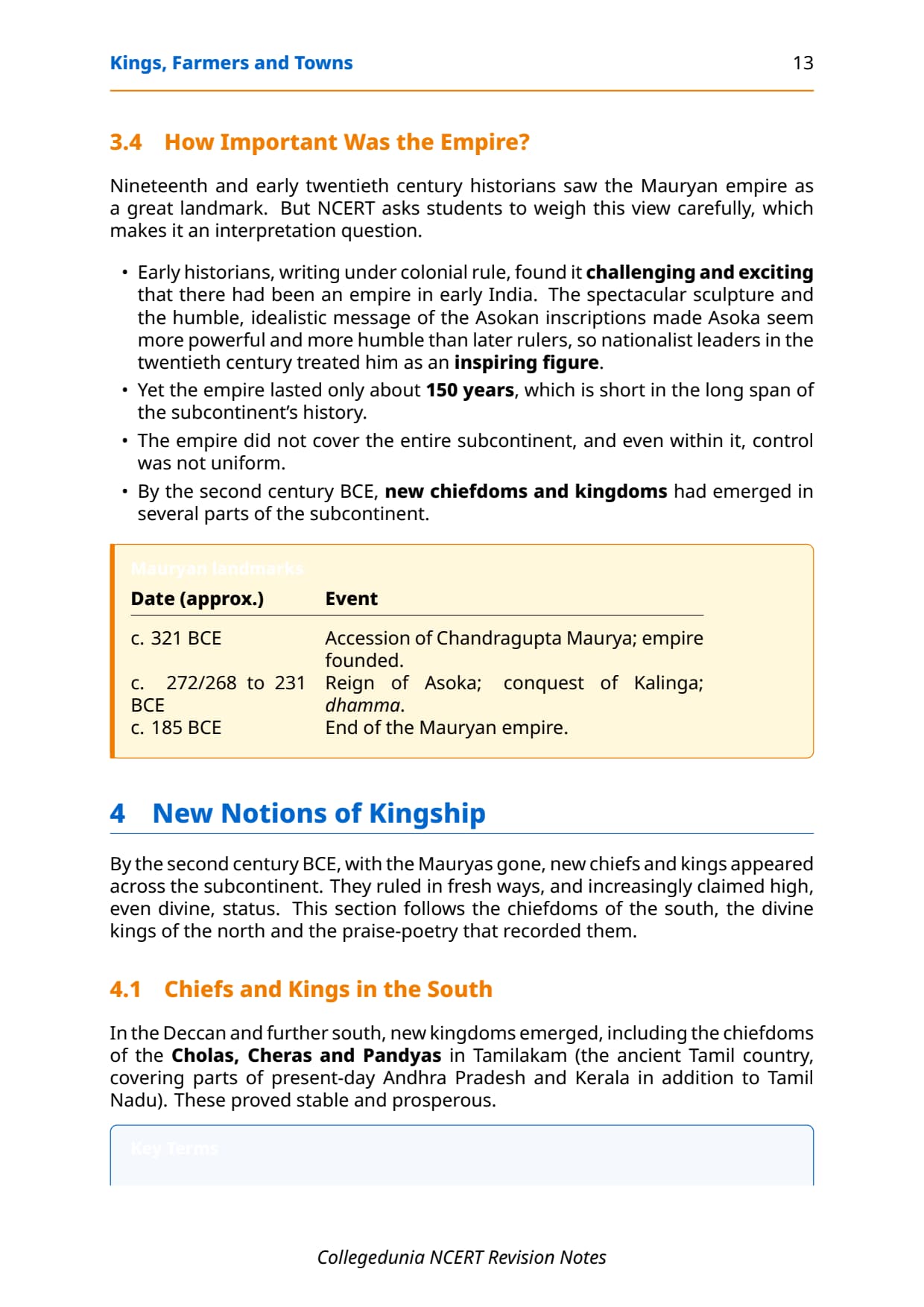
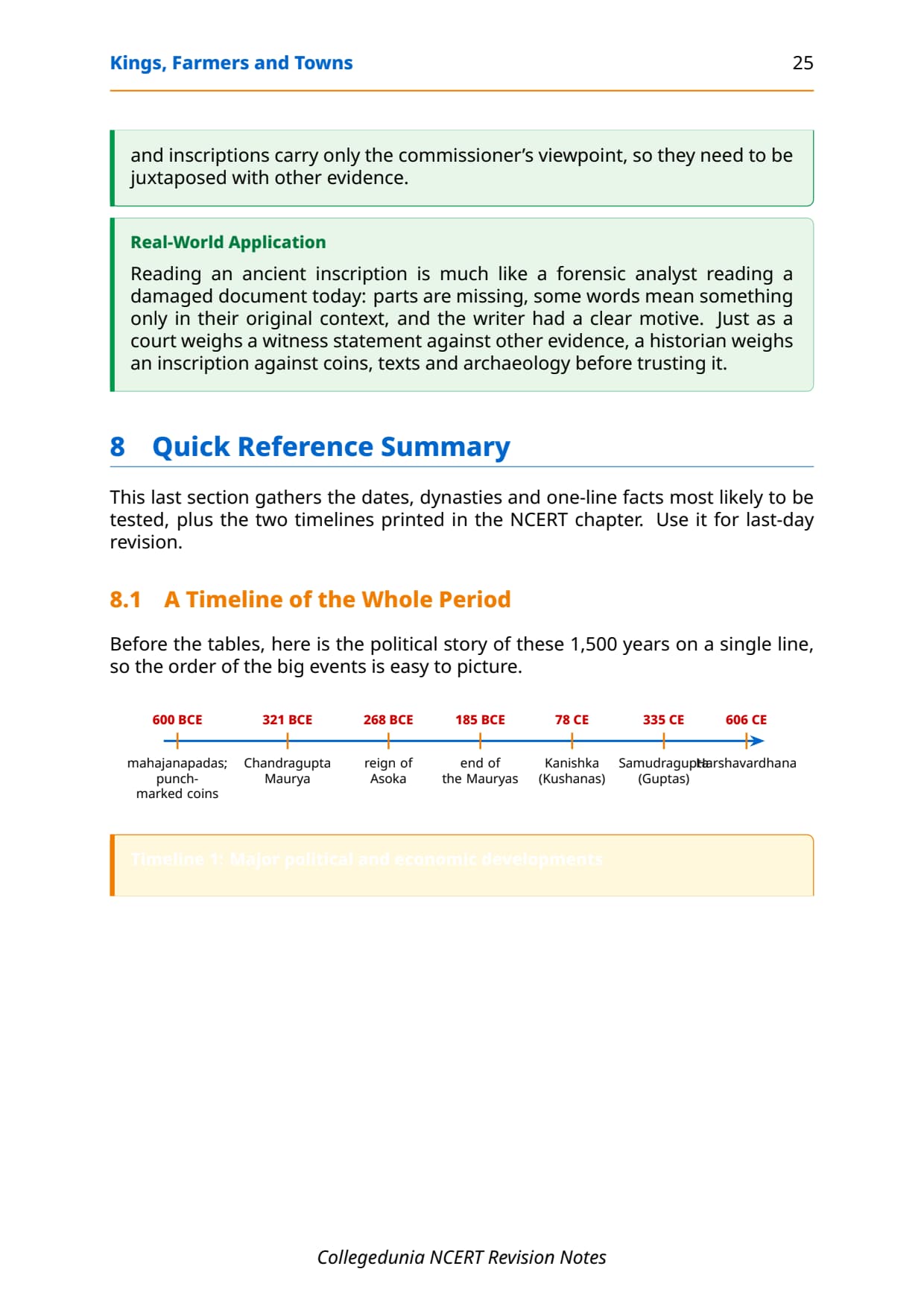
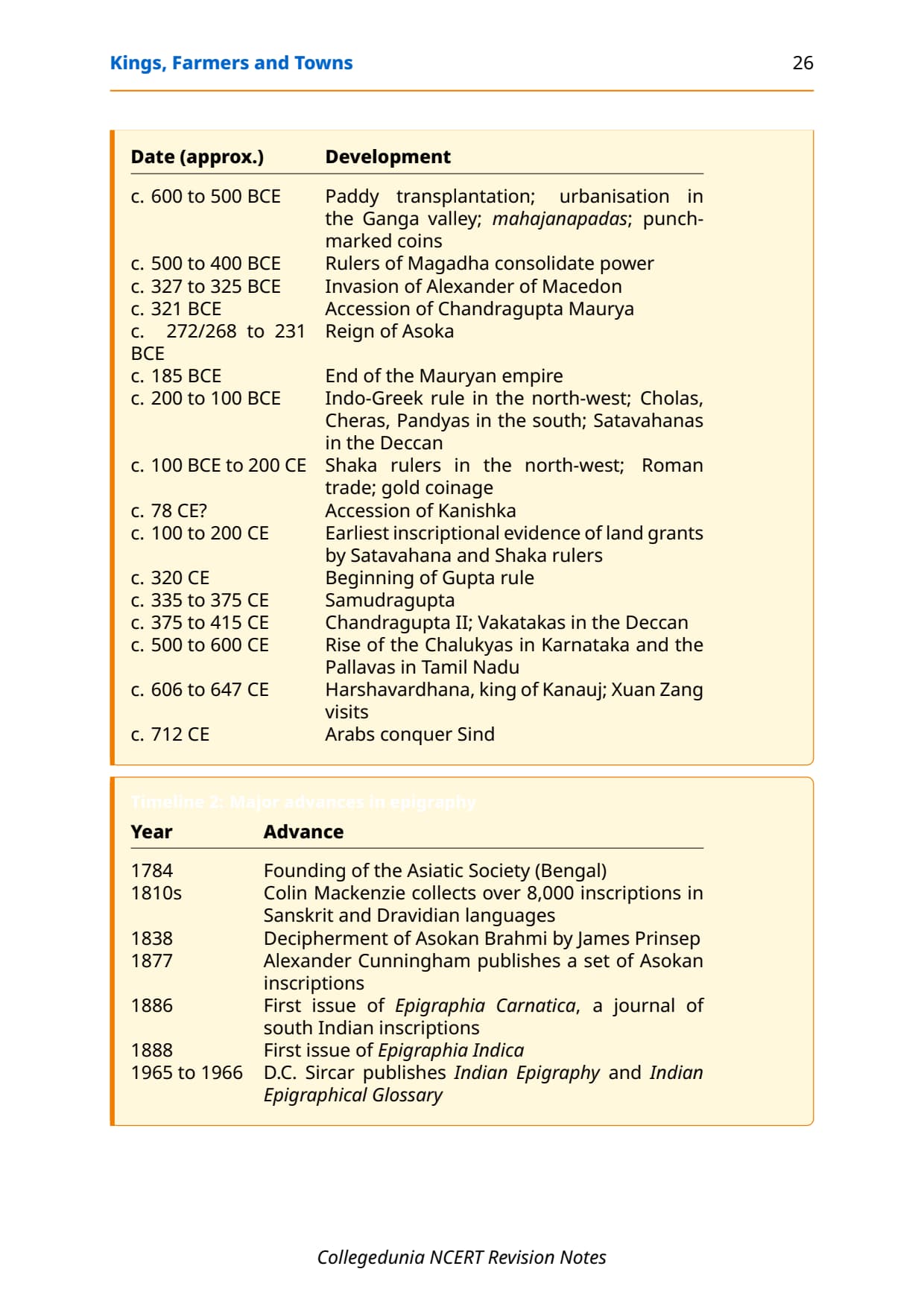
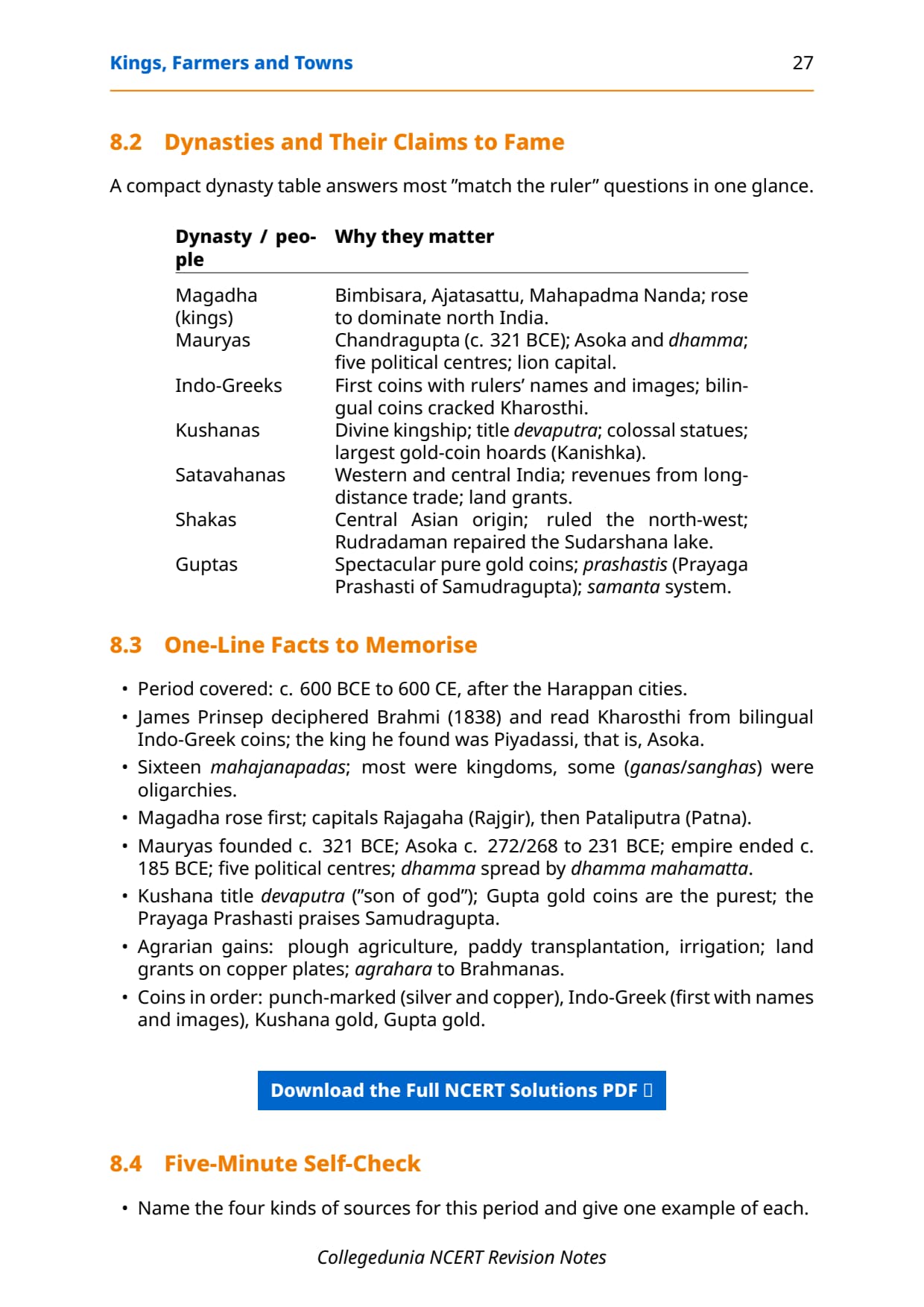
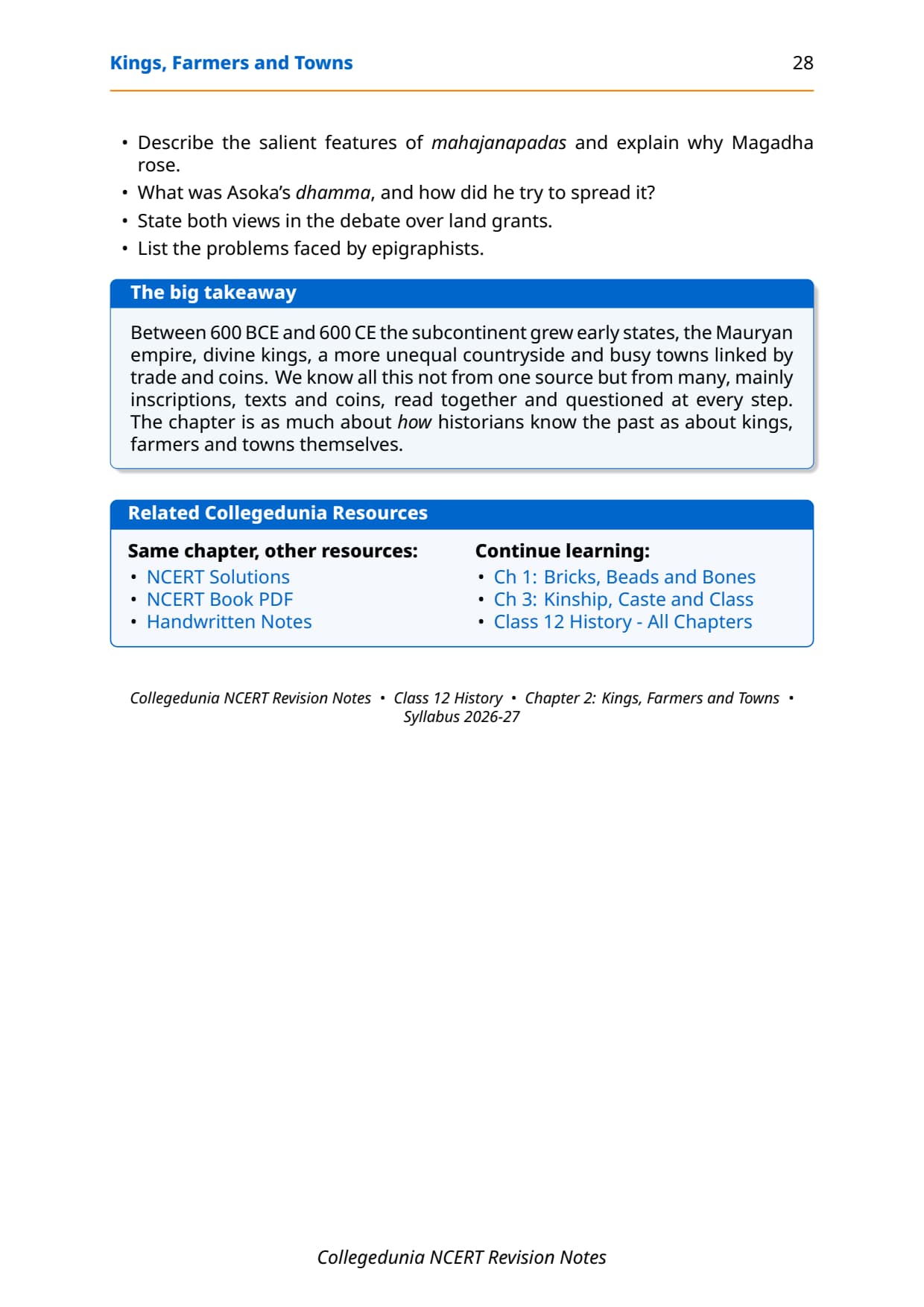
- Covers the mahajanapadas, the Mauryan Empire, farming, towns, coins and kingship in one place.
- This Class 12 History chapter usually carries 6 to 8 marks in the board paper.
- Pairs with the NCERT Solutions, Handwritten Notes and Book PDF linked lower on this page.
These Kings, Farmers and Towns Class 12 notes are written from the official NCERT Themes in Indian History Part I and checked against the last five years of CBSE board papers.
Student Feedback: In a Collegedunia poll of 9,460 Class 12 History students taken before the 2026 boards, 70% of students said short, point-wise notes on the mahajanapadas and Mauryan administration were the fastest way to revise this chapter. Most students kept the dates, capitals and key terms on a single sheet for last-minute recall.
Source: 2026-27 Class 12 History student poll. Sample of 9,460 students from CBSE schools across 12 states.
What the Kings, Farmers and Towns Notes Cover
Kings, Farmers and Towns is the second chapter of Themes in Indian History Part I. It studies early states and economies from about 600 BCE to 600 CE. Unlike the Harappan chapter, this period has written records, so historians use inscriptions, coins and texts together to reconstruct it.
The three words in the title are the easiest way to organise your revision:
- Kings stand for the mahajanapadas, the Mauryan Empire and post-Mauryan kingship.
- Farmers stand for plough farming, irrigation and growing differences in the countryside.
- Towns stand for cities, crafts, coins and long-distance trade.
So these Kings, Farmers and Towns notes are really about how states, farming and towns grew side by side. If you sort each fact under kings, farmers or towns first, and then ask which source it comes from, almost every question in chapter 2 history class 12 becomes easier to answer. Keep this three-part frame at the top of your revision sheet.
Mahajanapadas and the Rise of Magadha Notes
The notes start with the sixteen mahajanapadas, the "great realms" listed in early Buddhist and Jaina texts from the sixth century BCE. For quick revision, learn them as a short set of features plus the reasons Magadha rose to the top.
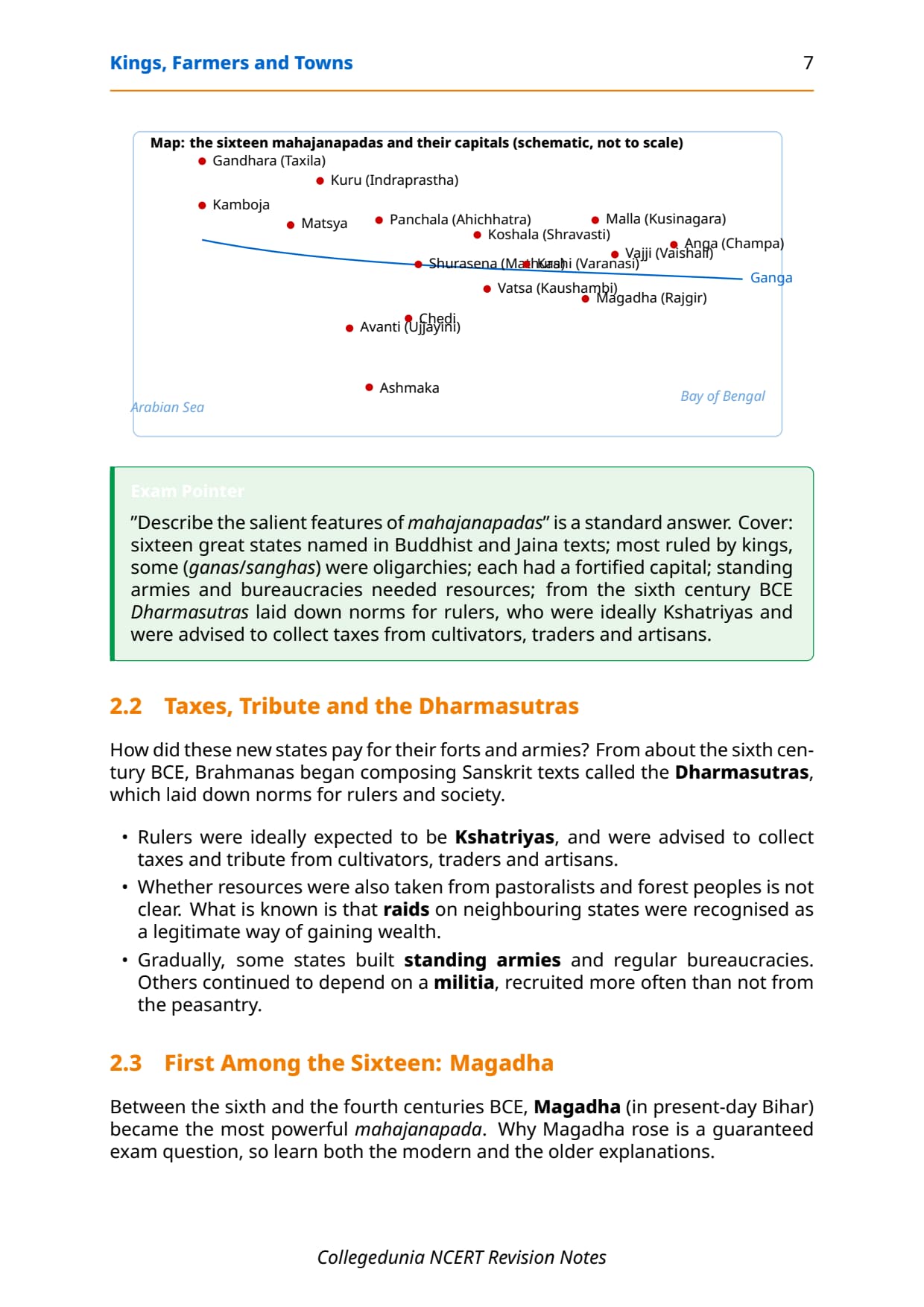
- Sixteen states: Vajji, Magadha, Koshala, Kuru, Panchala, Gandhara and Avanti recur most often.
- Two kinds of rule: most were kingdoms; some, the ganas or sanghas, were oligarchies of many rajas. The Buddha and Mahavira belonged to such ganas.
- Capitals and resources: each had a fortified capital, and rulers collected taxes and tribute under Dharmasutra norms.
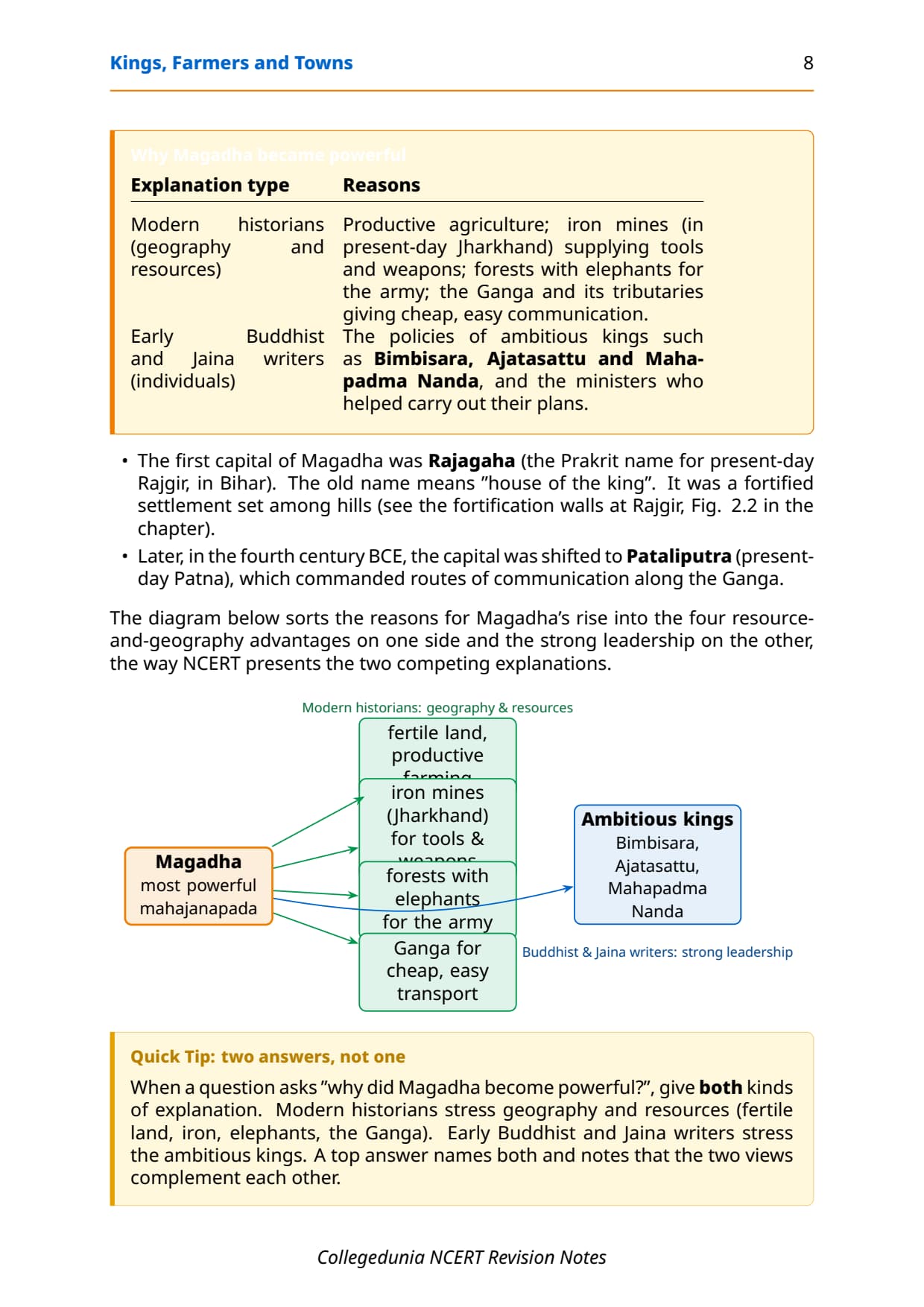
- Why Magadha rose: fertile land, iron mines, forest elephants and the Ganga for transport; capital Rajagaha, later Pataliputra.
The salient-features question is a board regular. The short answer to remember is the king-versus-gana split, then the supporting features of fortified capitals, taxes and armies. This is the single most testable idea in the topic, so keep it as a clear one-line contrast on your sheet.
Mauryan Empire and Administration Notes
The Mauryan Empire, founded by Chandragupta around 321 BCE, is the centre of the chapter. Historians reconstruct it from Megasthenes, the Arthashastra and, above all, Asoka's inscriptions. The table below sorts the administration for fast revision.
| Feature | What it shows |
|---|---|
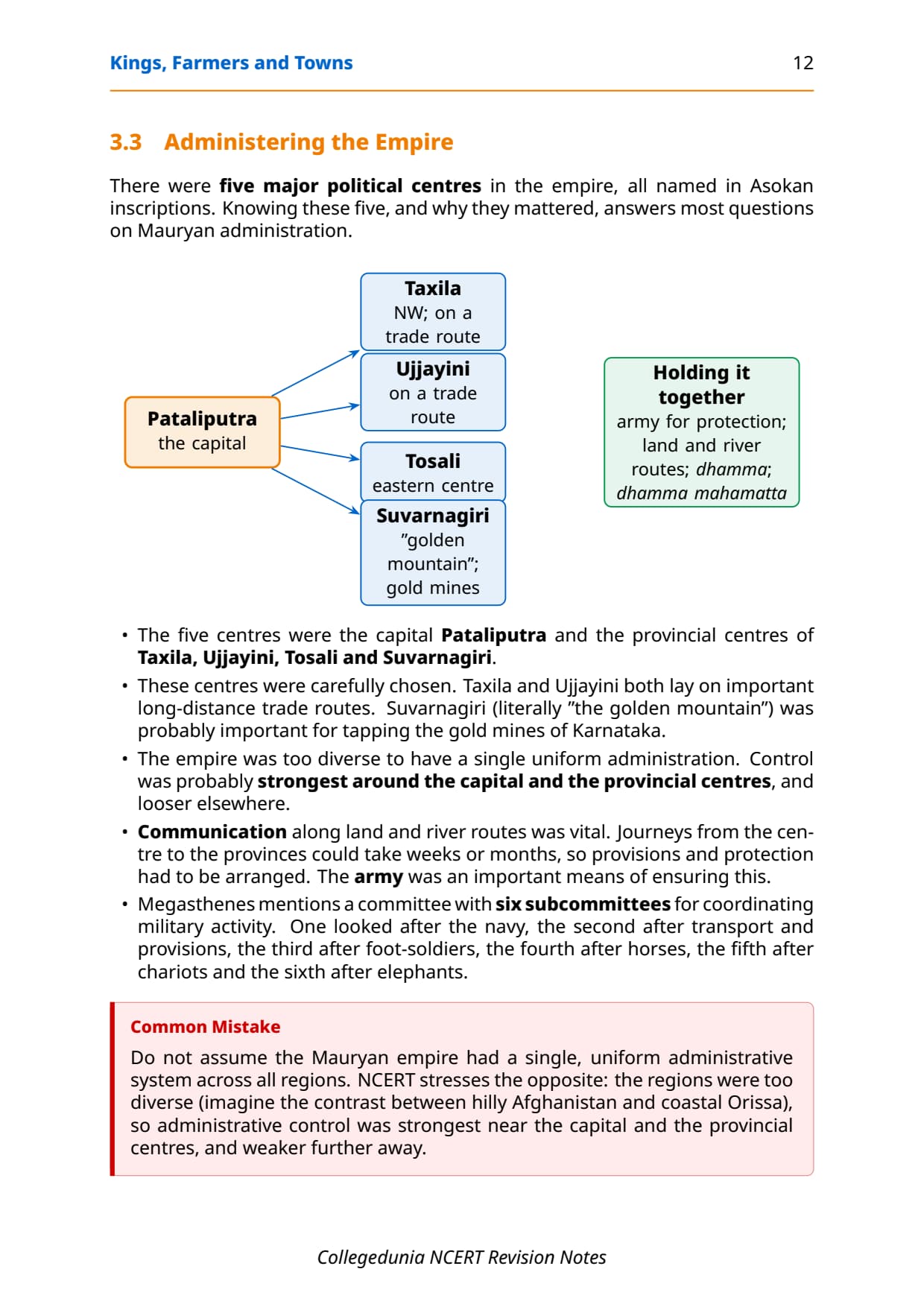
| Five centres | Capital Pataliputra plus Taxila, Ujjayini, Tosali and Suvarnagiri; all named in Asokan inscriptions. |
| Army committees | Megasthenes describes a six-sub-committee, thirty-member board for the army and provisions. |
| Land officials | Officers measured land, inspected irrigation and oversaw artisans; they collected taxes. |
| Communication | Land and river routes linked the centre to provinces. |
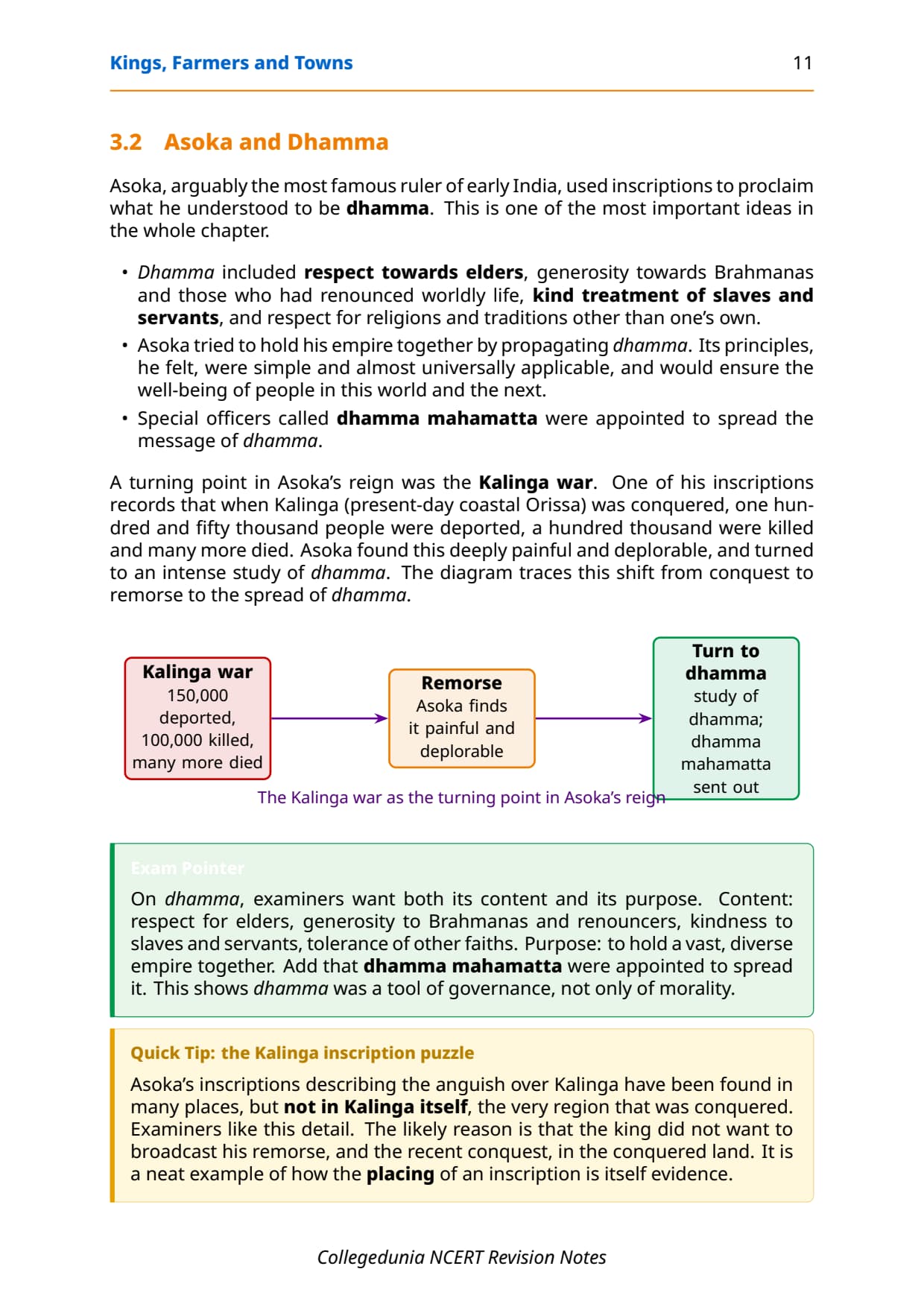
| Dhamma | Asoka spread dhamma through dhamma mahamattas to hold the empire together. |
The single most important revision point is the source-tagging. The five centres, dhamma, the dhamma mahamattas and the pativedakas appear in the Asokan inscriptions; the army committees and land officials come from Megasthenes and the Arthashastra. Keep this split as a one-line takeaway, because it is the part of Question 2.6 most students drop.
Farmers, Towns, Coins and Trade Notes
The "farmers" and "towns" threads cover the economy. Learn these as short lists for the 3-mark and "to what extent" answers. Farming changed in real but uneven ways, and towns grew with crafts, coins and trade.
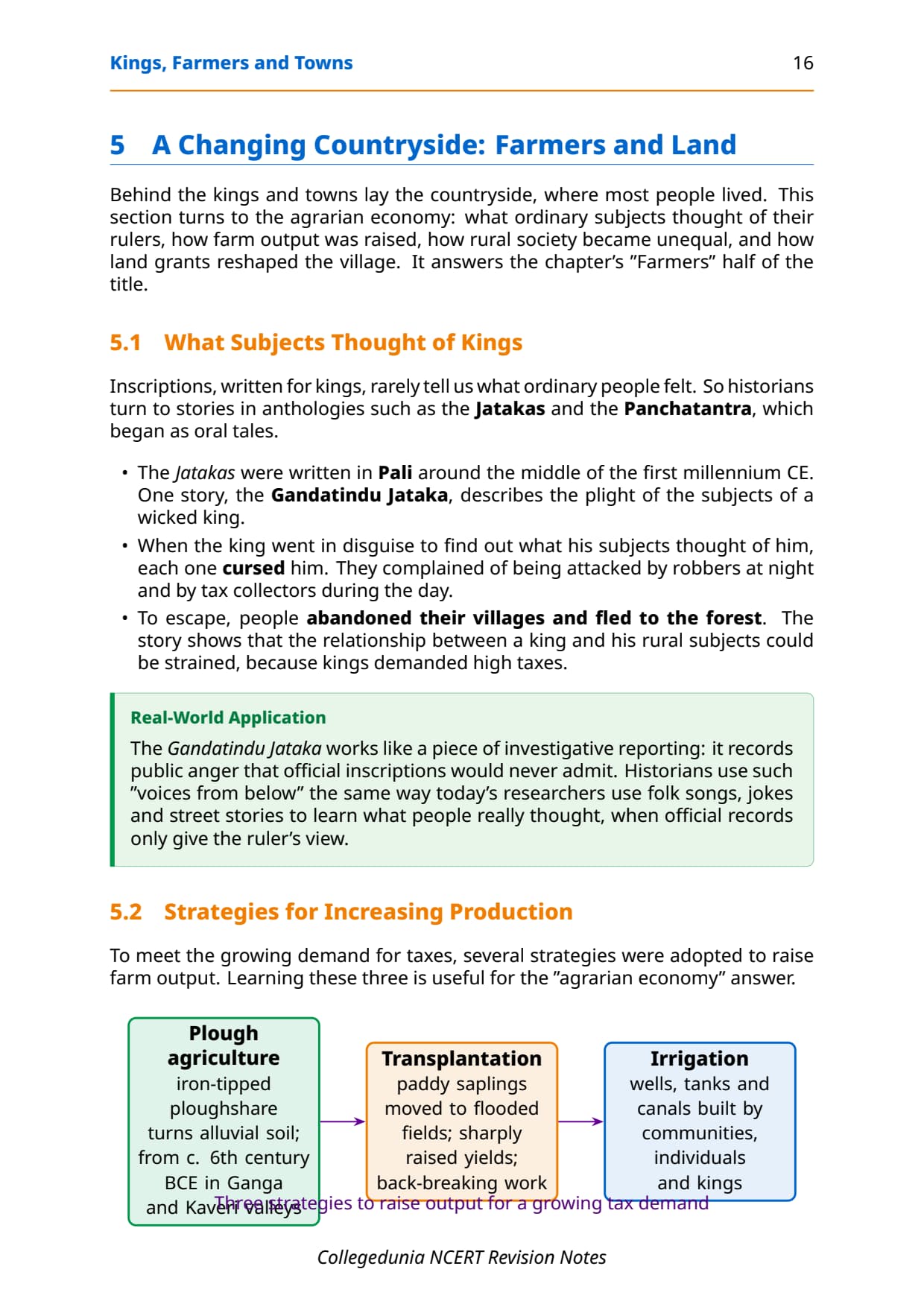
- Plough and iron share: from the sixth century BCE, plough farming with an iron share turned heavy alluvial soil in the Ganga and Kaveri valleys.
- Transplantation: replanting paddy saplings in flooded fields sharply raised rice output.
- Rural ranks: Sangam texts name vellalar (large landowners), uzhavar (ploughmen) and adimai (slaves); Pali uses gahapati.
- Towns and crafts: Early Historic cities, fine NBPW pottery, and craft guilds called shrenis.
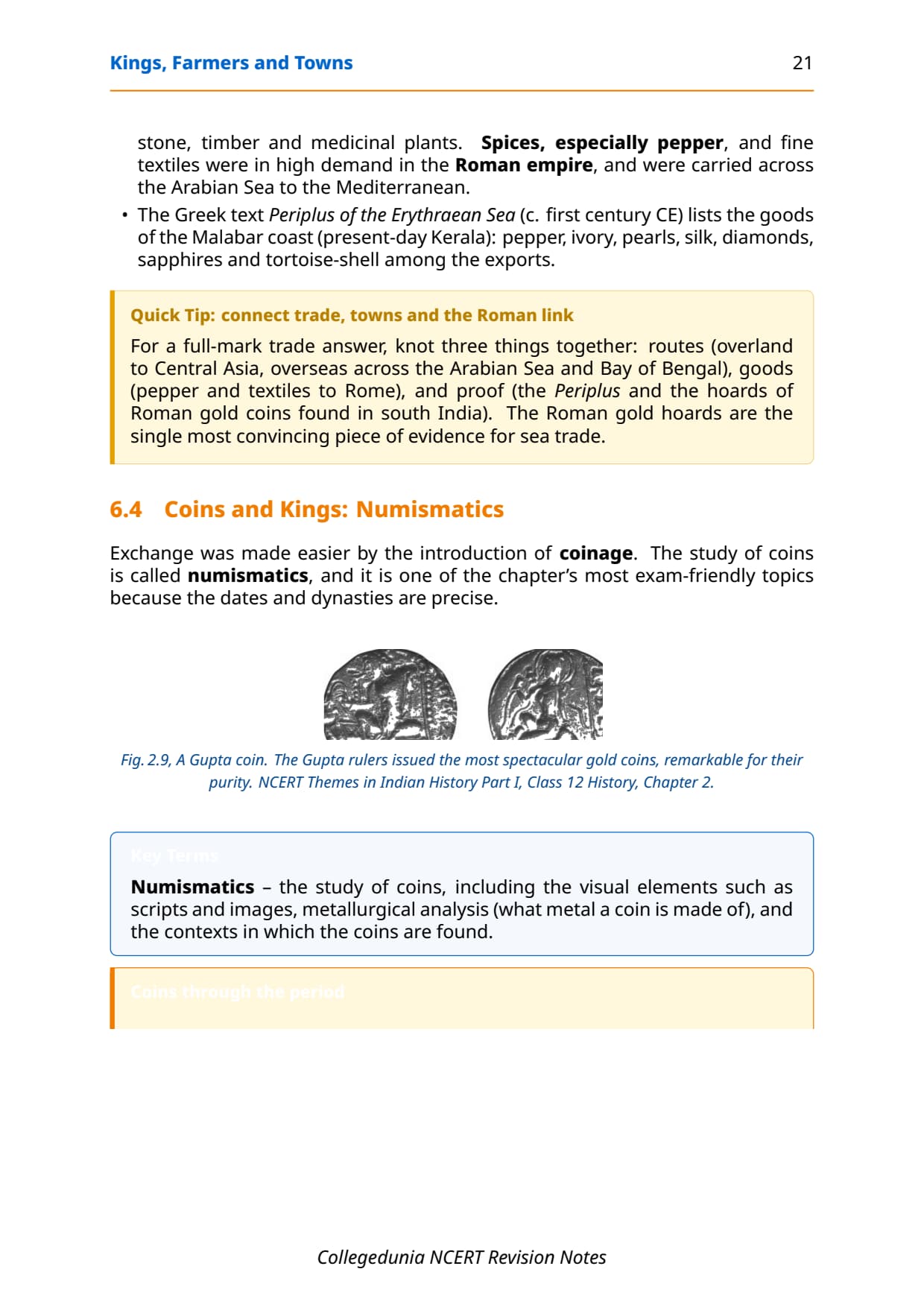
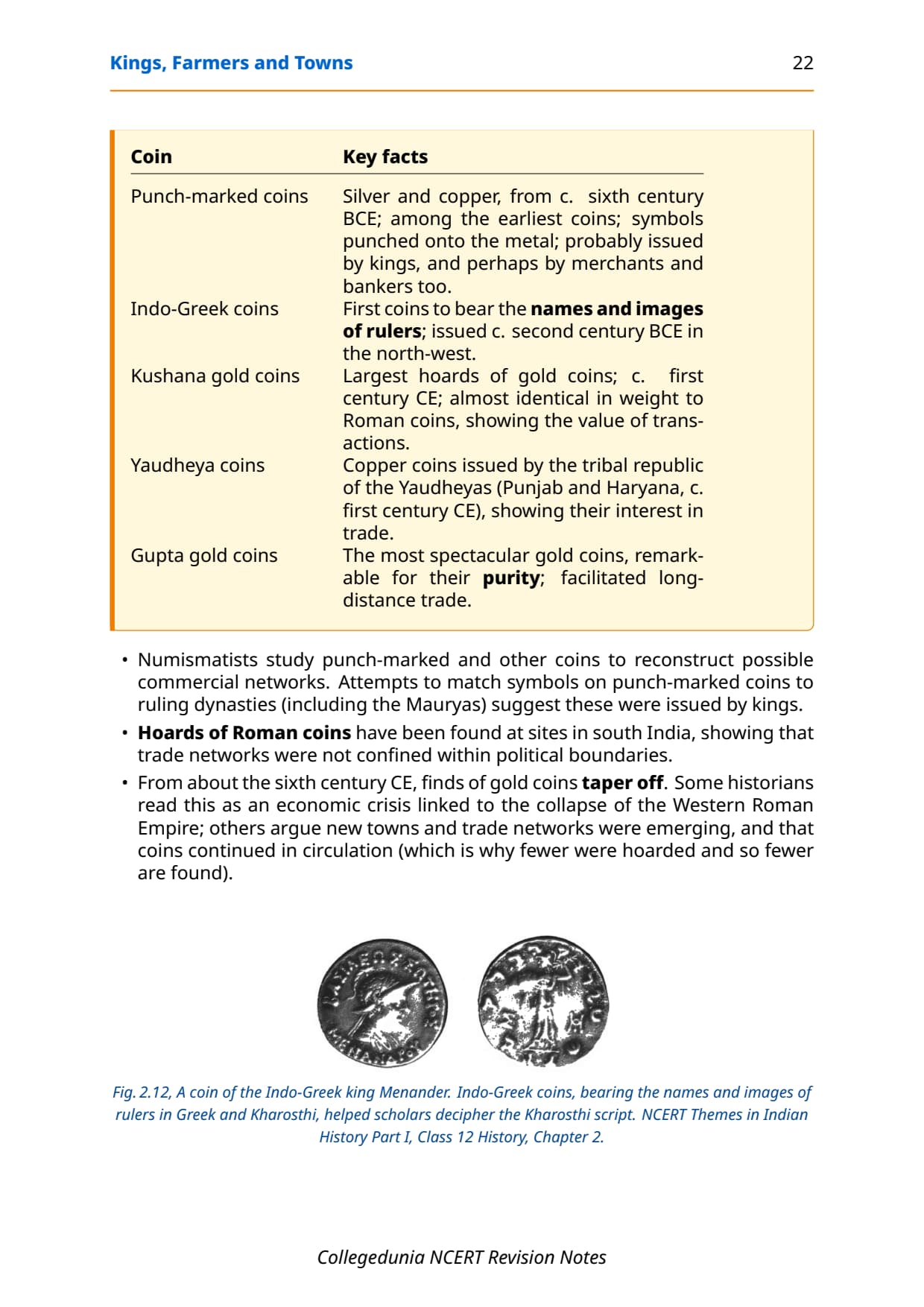
- Coins: early punch-marked silver coins; later Kushana gold and Roman coins show booming trade.
For the agriculture question, the rule is simple. Practices did change, but the change was uneven and deepened differences in rural society. For craft production, the key contrast with Harappan cities is that Early Historic sites have a readable script and written sources, and many are still inhabited. Keep both contrasts ready as one-liners.
Kingship, Inscriptions and How the Past Is Reconstructed
The post-Mauryan period brought new ideas about kingship, and the chapter also weighs the limits of inscriptions. These notes split the topic into how kings claimed power and how historians read the sources.
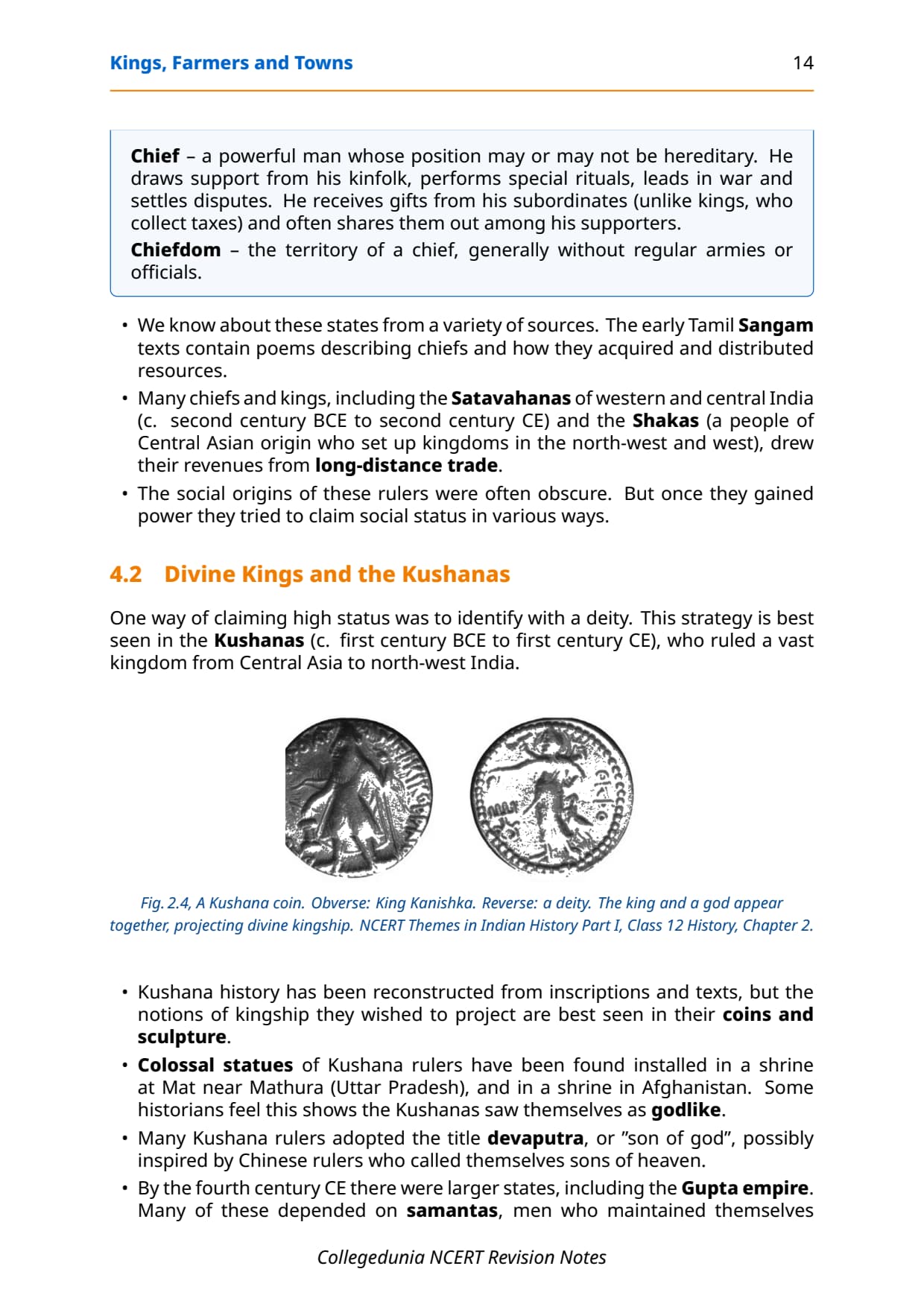
- Divine kingship: the Kushanas took the title devaputra ("son of god") and set up colossal statues.
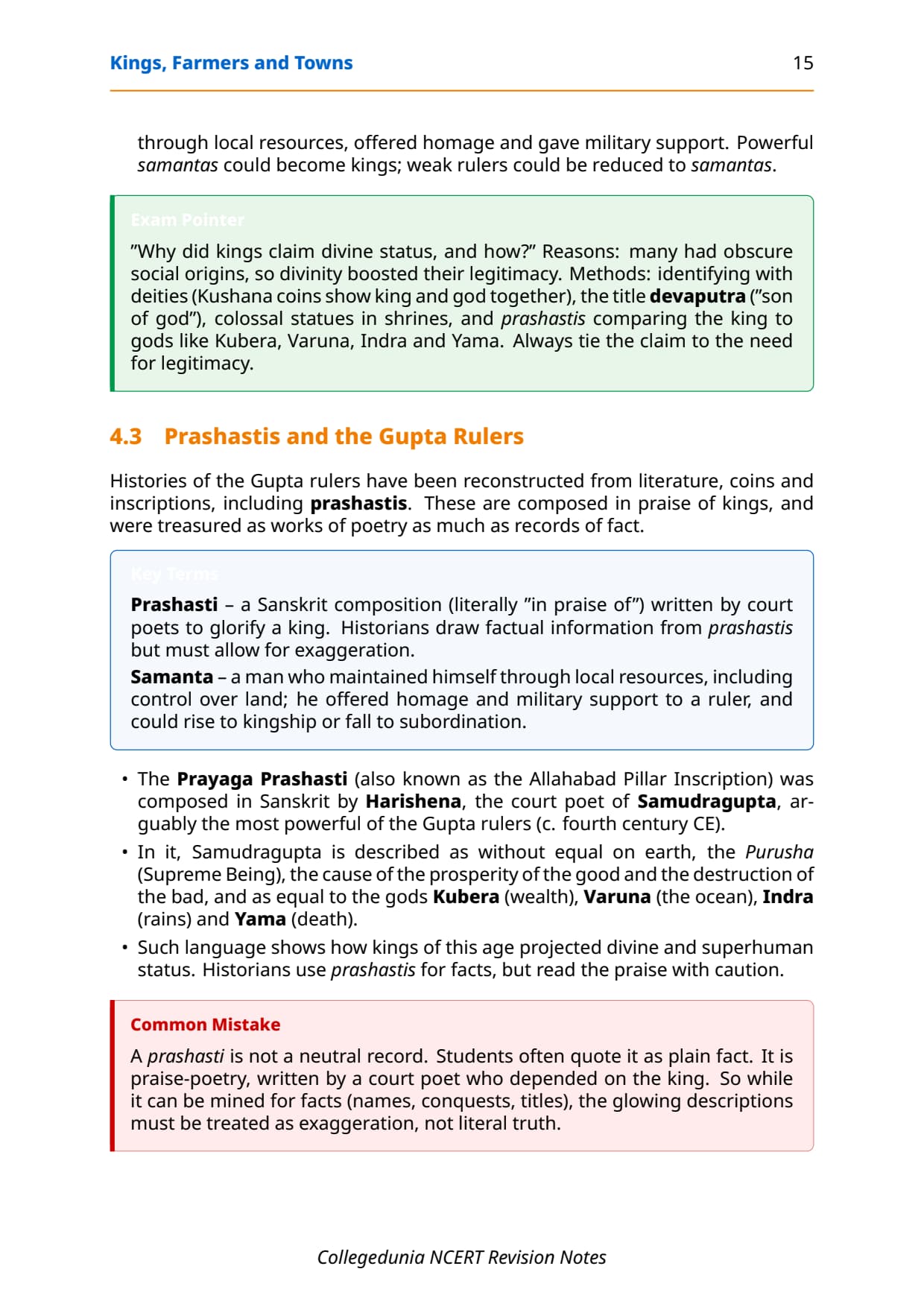
- Prashastis: Harishena's Prayaga Prashasti praised Samudragupta as superhuman and equal to the gods.
- Samanta system: later kings depended on samantas who held local resources and gave military support.
- Ordinary lives: read from Jataka and Panchatantra stories, people named in passing in inscriptions, and archaeology.
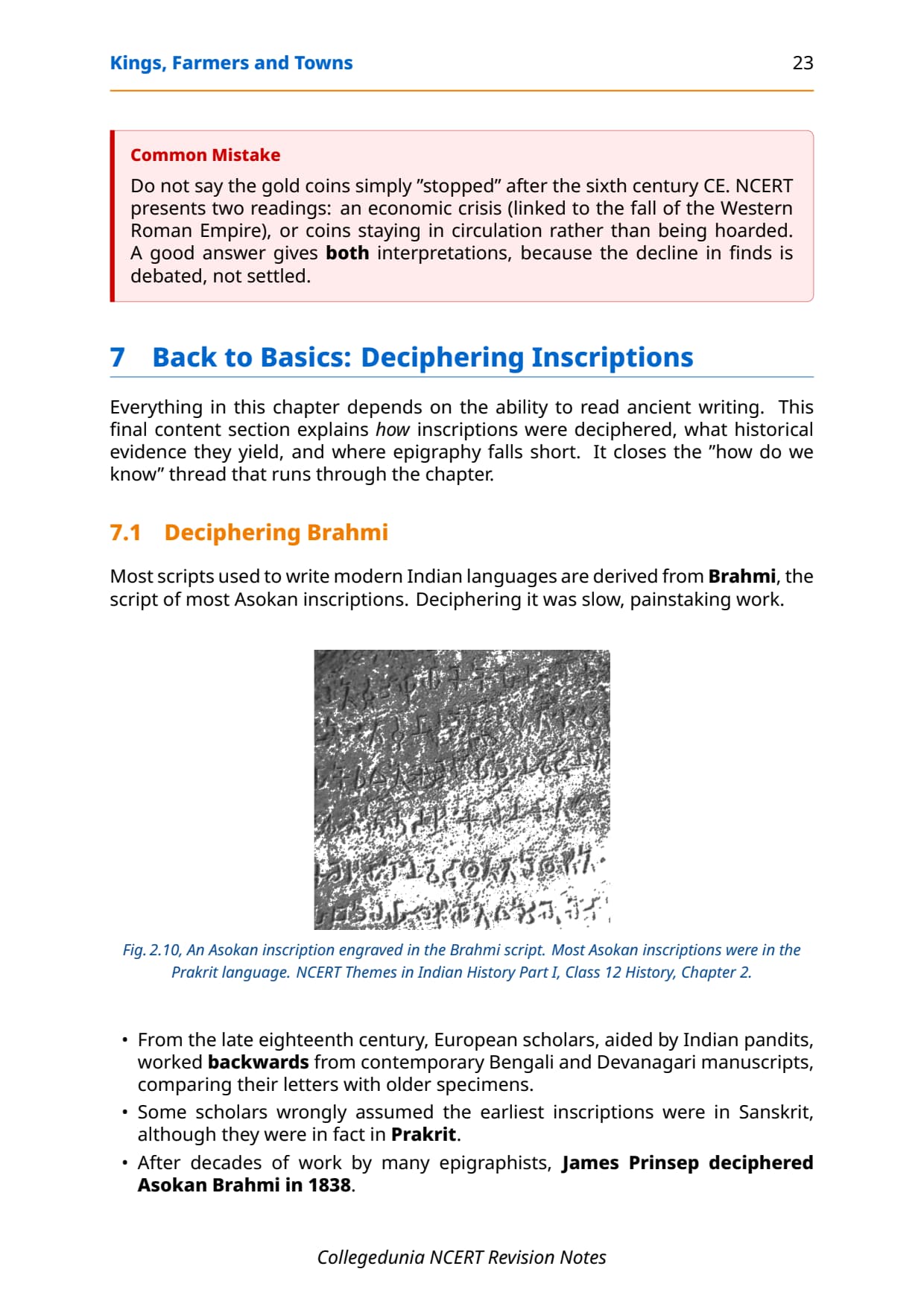
On the problems of inscriptions and D.C. Sircar's claim, the balanced line to remember is that inscriptions reflect a great deal, but not everything, and they usually favour the powerful. Historians break the silence of ordinary people by reading royal records against the grain. Keep this two-sided point ready, since the exam rewards a balanced answer.
Kings, Farmers and Towns Important Questions and Exam Pointers
CBSE sets a steady mix of source-based, short and long answers from this chapter. Knowing the pattern helps students decide how much to write and which topics to revise first. A focused list of chapter 2 history class 12 important questions saves a lot of time before the board exam.
- Source-based (often 8 marks): a passage on an Asokan edict, a prashasti or a land grant, with three sub-parts.
- Long answer (5 to 6 marks): features of Mauryan administration, or notions of kingship.
- Short answer (3 marks): salient features of mahajanapadas, craft production, or problems faced by epigraphists.
- Objective and MCQ: dates, capital names, coin types, and who issued what.
For quick recall, students often practise a short class 12 history chapter 2 mcq drill and a list of class 12 history chapter 2 important questions. The most repeated items are the Mauryan administration and the kingship debate, so keep those answer points ready in your own words. Reading these Kings, Farmers and Towns notes once, then writing the key lists from memory, is the fastest way to lock the chapter in.
Common Mistakes Students Make in This Chapter
A few errors cost marks every year. Most come from mixing up sources or from listing features without weighing them. Fixing these five points is the quickest way to lift a score on the long answers, so add them to the end of your revision sheet.
- Calling a gana or sangha a kingdom - it was an oligarchy of many rajas.
- Crediting all Mauryan features to the edicts - the army committees come from Megasthenes.
- Treating prashastis as plain fact - they are royal eulogies, written to praise the king.
- Saying farming changed completely - the change was real but uneven.
- Forgetting that inscriptions favour the powerful - this is the key limit in the Sircar answer.
Students who fix these five points usually move from average to high marks. The exam rewards careful wording, so write "may have", "largely" or "scholars suggest" when the evidence is not certain. These notes flag each soft point so you can phrase it safely in the answer sheet.
How These Notes Pair with the Solutions and Book PDF
These revision notes summarise the chapter. To prepare fully, students should use them alongside the other resources for the same chapter, all linked in the table below. Read the notes first, then test yourself with the solutions, and open the book PDF whenever you need the original text and figures.
| Resource | Best used for |
|---|---|
| Kings, Farmers and Towns NCERT Solutions | Step-by-step answers to all 12 back-exercise questions |
| Kings, Farmers and Towns Handwritten Notes | Last-minute, one-shot revision in a scanned notebook style |
| Kings, Farmers and Towns NCERT Book PDF | Reading the original NCERT chapter text and figures |
Tip: read these notes first, then attempt the solutions on your own, and only then check the model answers. That order builds memory faster than copying answers straight away.
All Class 12 History Notes by Chapter
The table links the revision notes for every chapter in Themes in Indian History so students can move across the book in one click. Chapter 2 is highlighted.
| Chapter | Notes |
|---|---|
| Chapter 1 | Bricks, Beads and Bones |
| Chapter 2 | Kings, Farmers and Towns |
| Chapter 3 | Kinship, Caste and Class |
| Chapter 4 | Thinkers, Beliefs and Buildings |
| Chapter 5 | Through the Eyes of Travellers |
| Chapter 6 | Bhakti-Sufi Traditions |
| Chapter 7 | An Imperial Capital Vijayanagara |
| Chapter 8 | Peasants, Zamindars and the State |
| Chapter 9 | Colonialism and the Countryside |
| Chapter 10 | Rebels and the Raj 1857 |
| Chapter 11 | Mahatma Gandhi and the Nationalist Movement |
| Chapter 12 | Framing the Constitution |
FAQs on Kings, Farmers and Towns Class 12 Notes
Kings, Farmers and Towns Class 12 History Notes Common Questions
Ques. Where can I download the Kings, Farmers and Towns Class 12 notes PDF?
Ans. You can download the Kings, Farmers and Towns Class 12 History notes PDF directly from this page. It is free, follows the 2026-27 NCERT, and covers the mahajanapadas, the Mauryan Empire, farming, towns, coins and kingship in a short, point-wise format.
Ques. What does the Kings, Farmers and Towns chapter cover for Class 12?
Ans. It covers early states and economies from about 600 BCE to 600 CE, including the sixteen mahajanapadas, the rise of Magadha, the Mauryan Empire and its administration, agricultural change, towns and coins, and post-Mauryan notions of kingship.
Ques. Which topics are most important in class 12 history chapter 2 for the board exam?
Ans. The features of Mauryan administration, the salient features of mahajanapadas, and the notions of kingship are the most-asked long answers. These three top every list of class 12 history chapter 2 important questions, so revise them first.
Ques. Why are inscriptions central to this chapter?
Ans. Because Asokan edicts, prashastis and land grants are the main written sources for the period. Historians read them, with coins and texts, to reconstruct states and society, while weighing their limits, since inscriptions usually favour the powerful.
Ques. How should I use these notes to revise quickly?
Ans. Read the notes once under the kings, farmers and towns frame, keep all dates, capitals and key terms on one sheet, then write the key lists from memory. Finish by attempting a short class 12 history chapter 2 mcq drill to test the small facts.



Comments