




These Colonialism and the Countryside Class 12 Notes give a quick, exam-ready summary of colonial rule in rural India for the 2026-27 CBSE syllabus. The notes pull together every key date, term and event from Theme 9 of Themes in Indian History Part III. Students can use them for a fast revision the night before a test or to fix the main ideas before they attempt the back-exercise questions.
- Covers Bengal, the Rajmahal hills and the Deccan, plus the official archives behind them, in one place.
- This Class 12 History chapter usually carries 6 to 8 marks in the board paper.
- Pairs with the NCERT Solutions, Handwritten Notes and Book PDF linked lower on this page.
These Colonialism and the Countryside Class 12 notes are written from the official NCERT Themes in Indian History Part III and checked against the last five years of CBSE board papers.
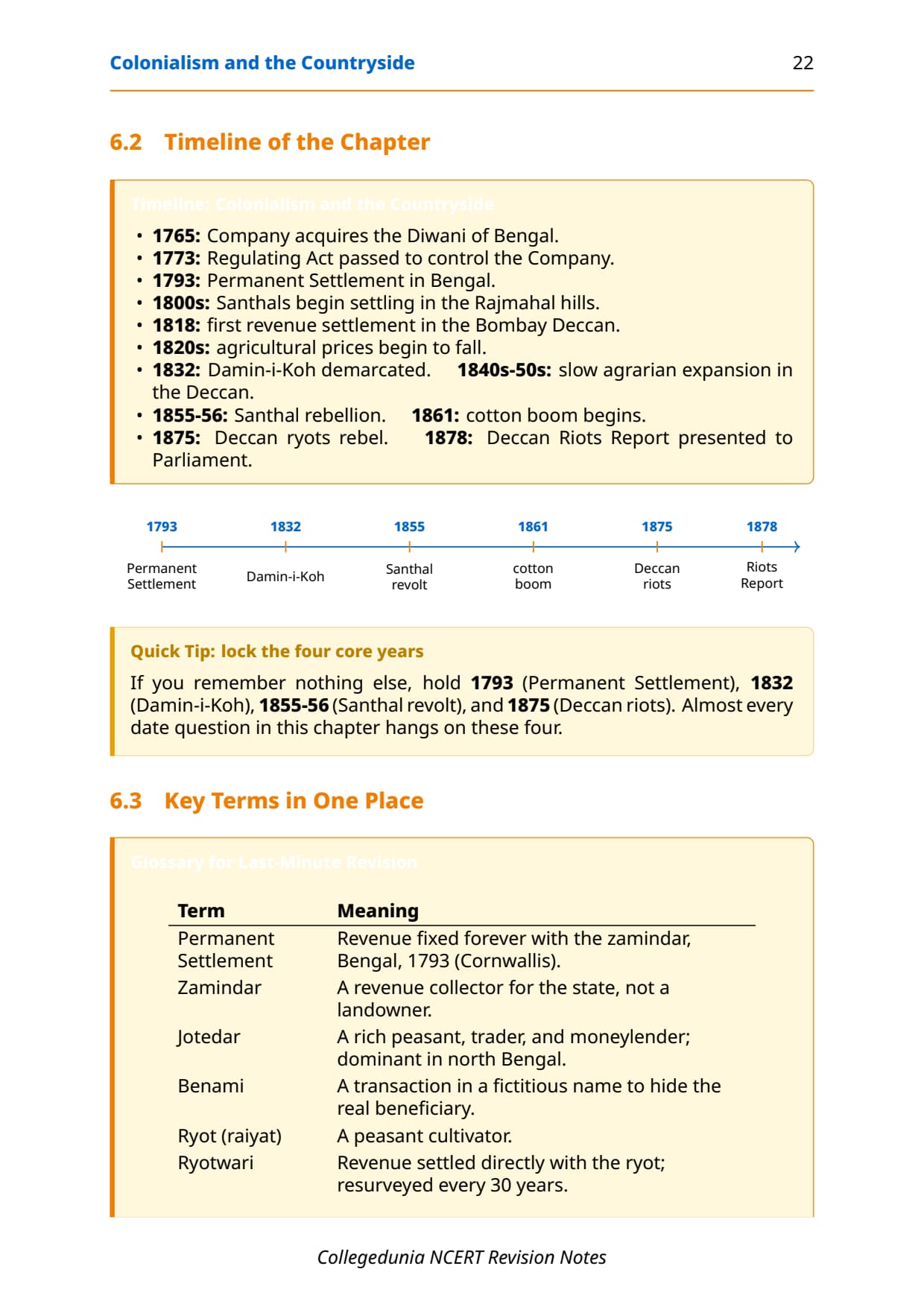
Student Feedback: In a Collegedunia poll of 9,540 Class 12 History students taken before the 2026 boards, 72% of students said short, point-wise notes that keep the three regions apart were the fastest way to revise this chapter. Most students kept the dates 1793, 1832, 1855 and 1875 on a single sheet for last-minute recall.
Source: 2026-27 Class 12 History student poll. Sample of 9,540 students from CBSE schools across 12 states.
What the Colonialism and the Countryside Notes Cover
Colonialism and the Countryside is the ninth chapter of Themes in Indian History Part III. It studies how colonial rule changed rural life, read through official archives such as revenue records, surveys and enquiry reports. The chapter moves through three regions, so these notes keep them apart for clear revision.
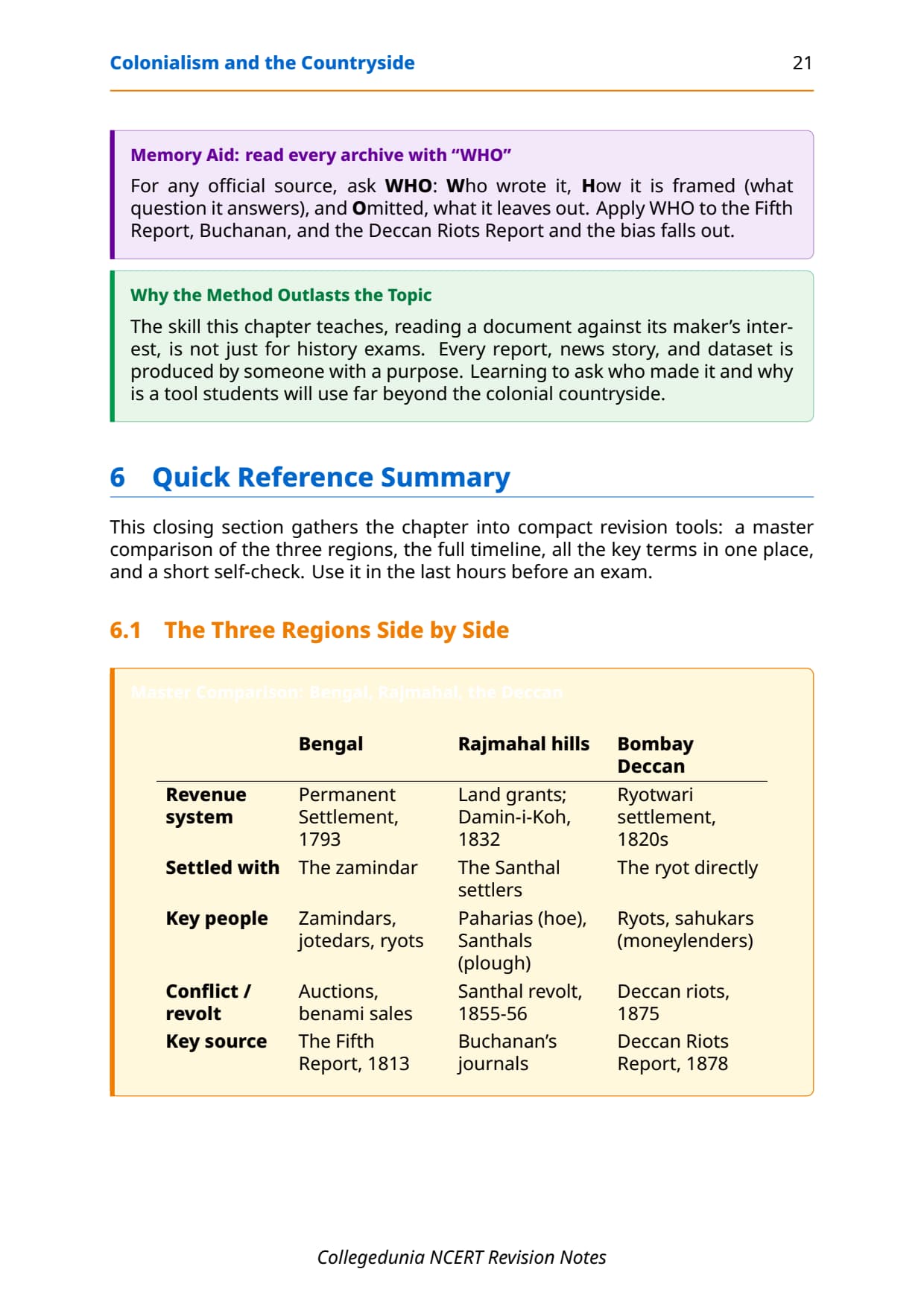
The three regions are the easiest way to organise the whole chapter:
- Bengal: the Permanent Settlement of 1793, zamindars, jotedars and ryots.
- The Rajmahal hills: the Paharias and the Santhals, and the Santhal Revolt of 1855.
- The Bombay Deccan: the ryotwari system, moneylenders and the Deccan Riots of 1875.
So these Colonialism and the Countryside notes are really about reading the state's records against the grain. If you sort each fact under Bengal, the Rajmahal hills or the Deccan first, almost every question in chapter 9 history class 12 becomes easier to answer. Keep this three-part frame at the top of your revision sheet and slot each new detail into one of the three boxes as you read.
Bengal and the Permanent Settlement Notes
The Bengal section is the first region and the source of several questions. The Permanent Settlement of 1793 fixed the revenue forever, and the table below sorts the key terms so students can copy them straight onto the answer sheet.
| Term | What it means |
|---|---|
| Permanent Settlement | Bengal, 1793, under Cornwallis; revenue fixed in perpetuity. |
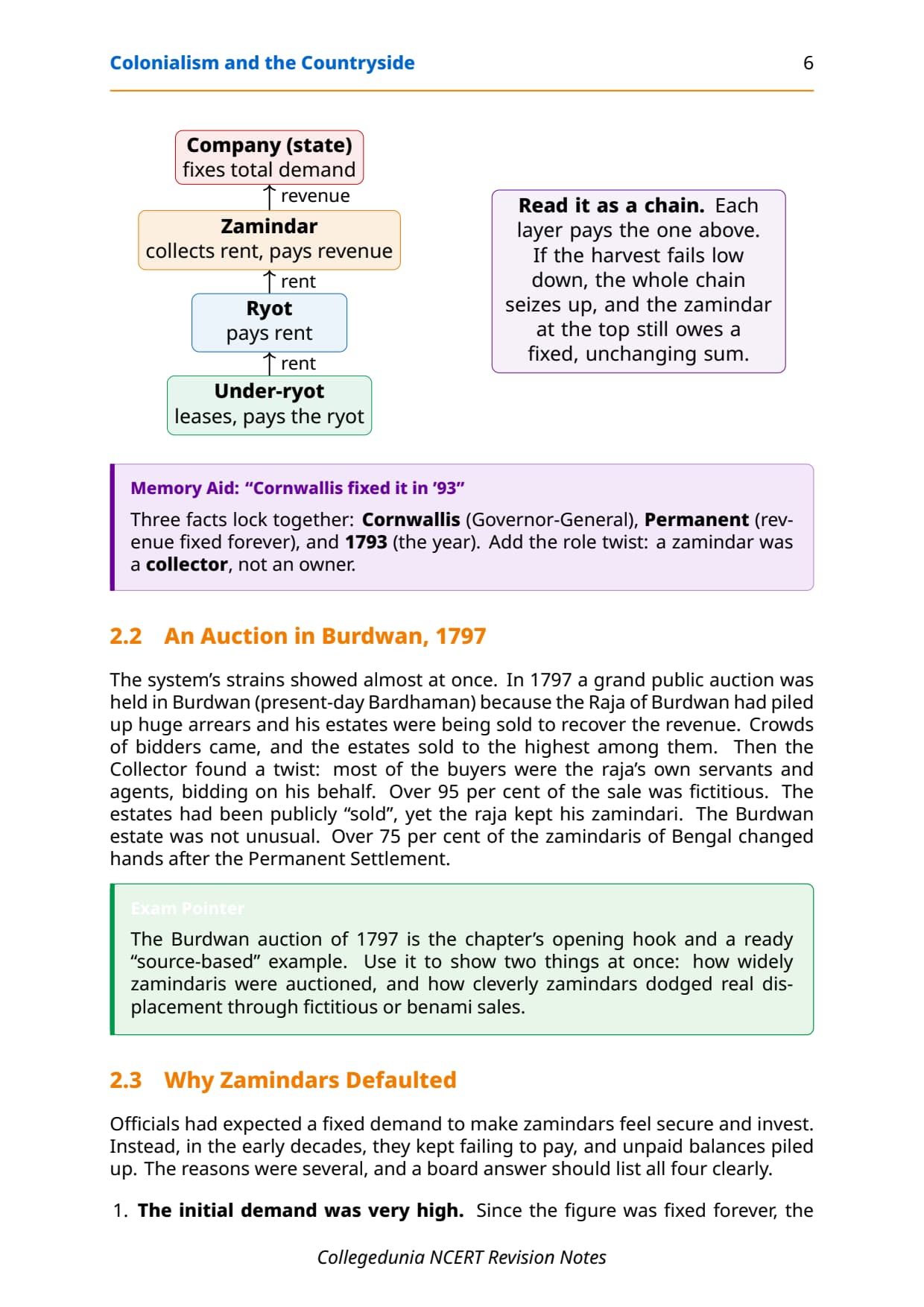
| Zamindar | A revenue collector for the Company, not a true landowner. |
| Sunset Law | Estate auctioned if revenue was not paid by sunset of the due date. |
| Benami sale | A fictitious sale that let zamindars buy back their own estates cheaply. |
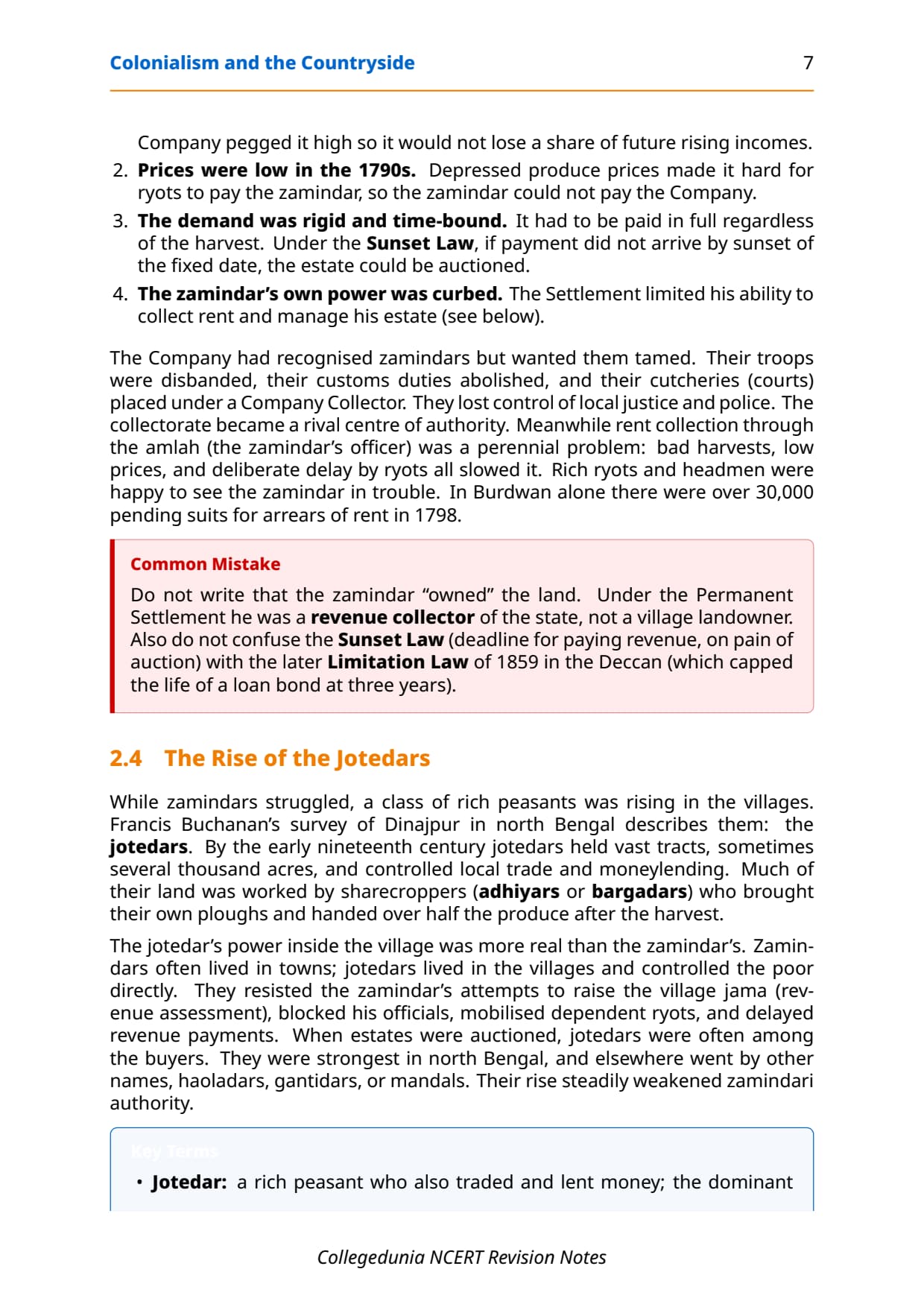
| Jotedar | A rich, village-based peasant who rose as zamindars declined. |
The single most important revision point is that the auction was often a sham. Over 95 per cent of the Burdwan sale was fictitious, so the zamindar kept control. Note too that the jotedar lived in the village while the zamindar often did not, which is what made the jotedar powerful. Keep both of these as one-line takeaways on your sheet.
Paharias, Santhals and the Santhal Revolt Notes
The Rajmahal hills section covers two very different peoples. The chapter frames the contrast as the hoe versus the plough, and the notes keep the two apart so students do not mix them up. Learn each as a short, boxed list for the comparison answer.
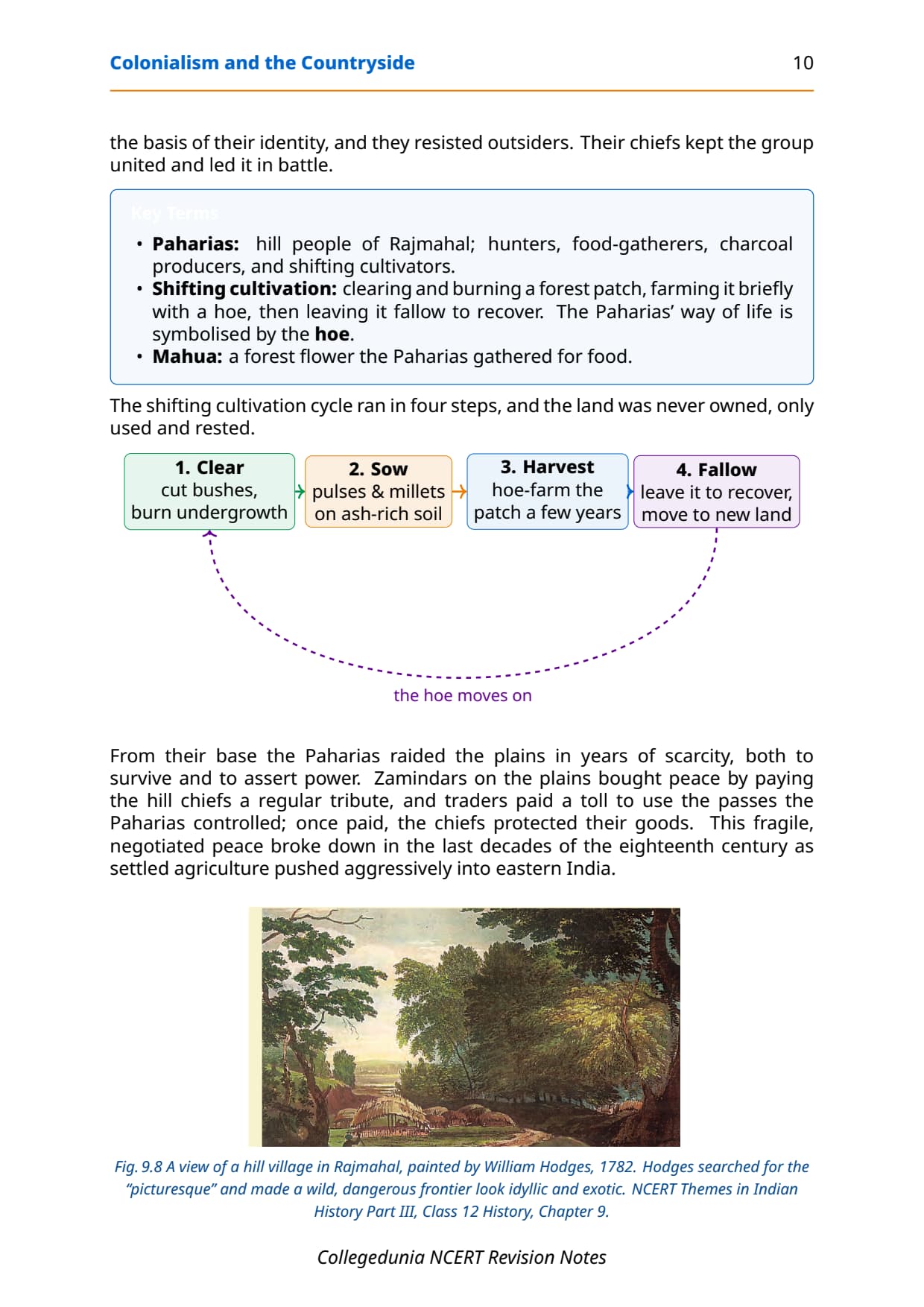
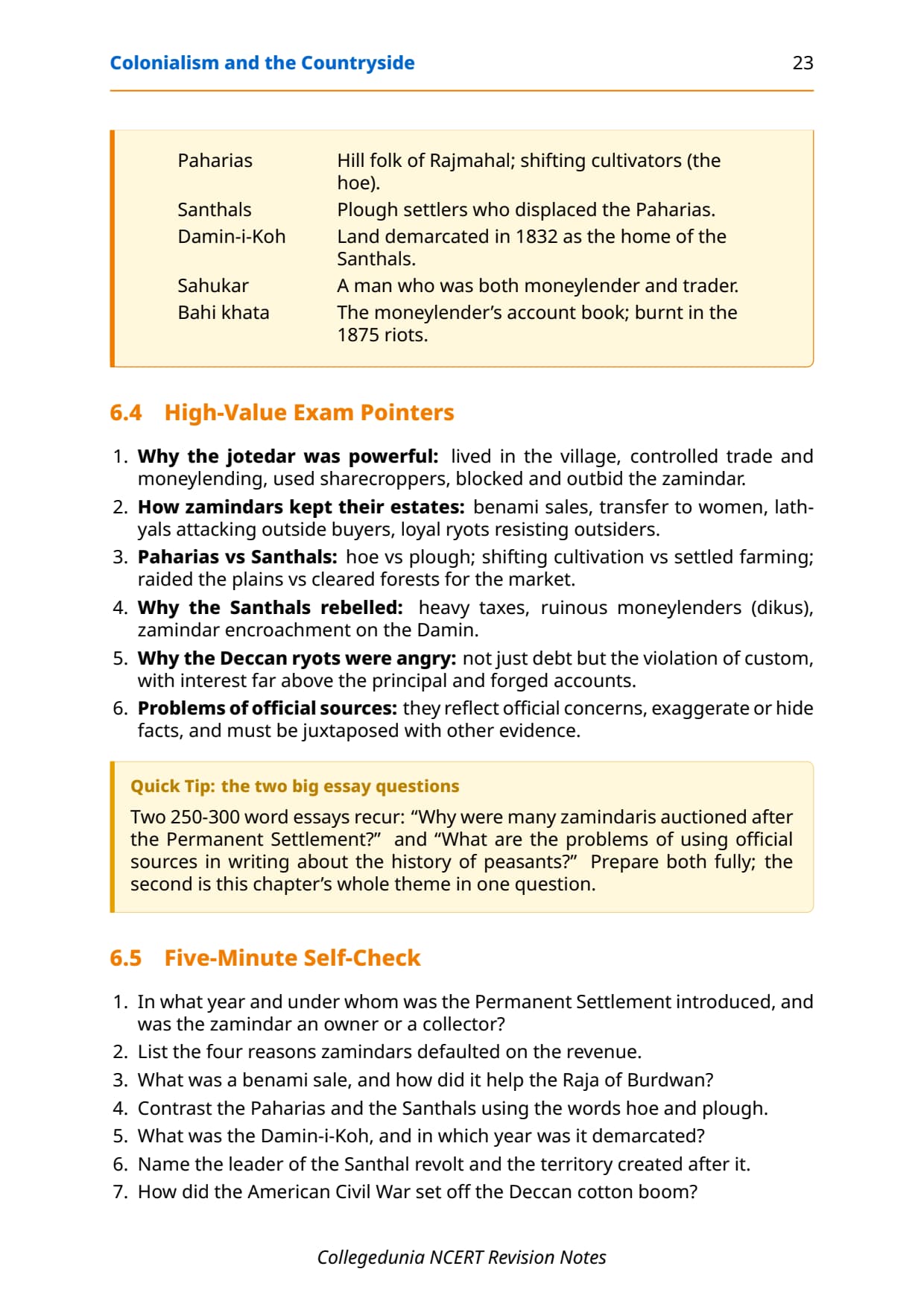
- Paharias (the hoe): mobile forest people, shifting cultivation, hunting, mahua, resin and charcoal.
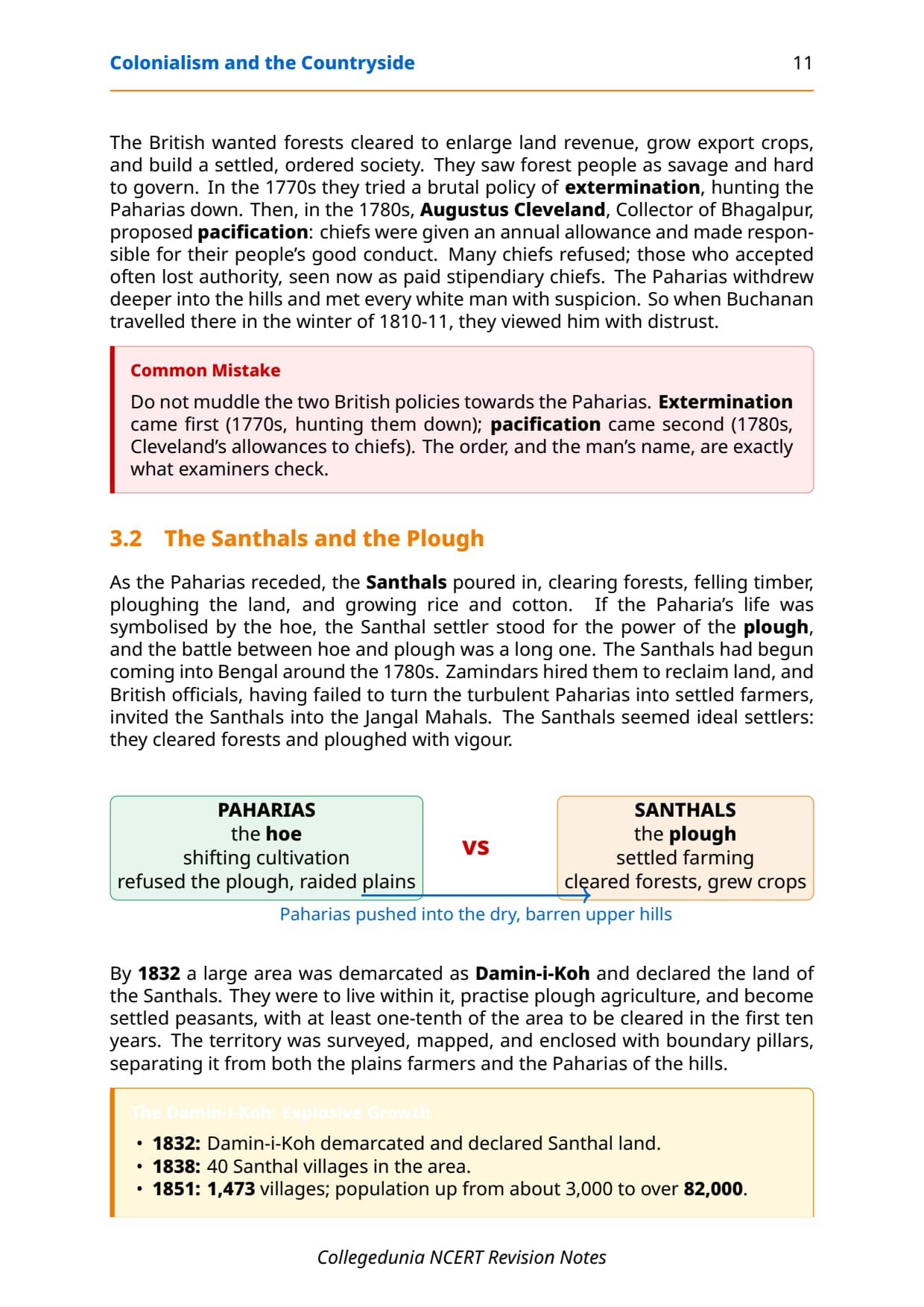
- Santhals (the plough): settled farmers, cleared the Damin-i-Koh (marked in 1832), grew rice and cotton for the market.
- Paharia response: raids and tolls, then armed resistance, then refusal of Cleveland's allowances, then withdrawal.
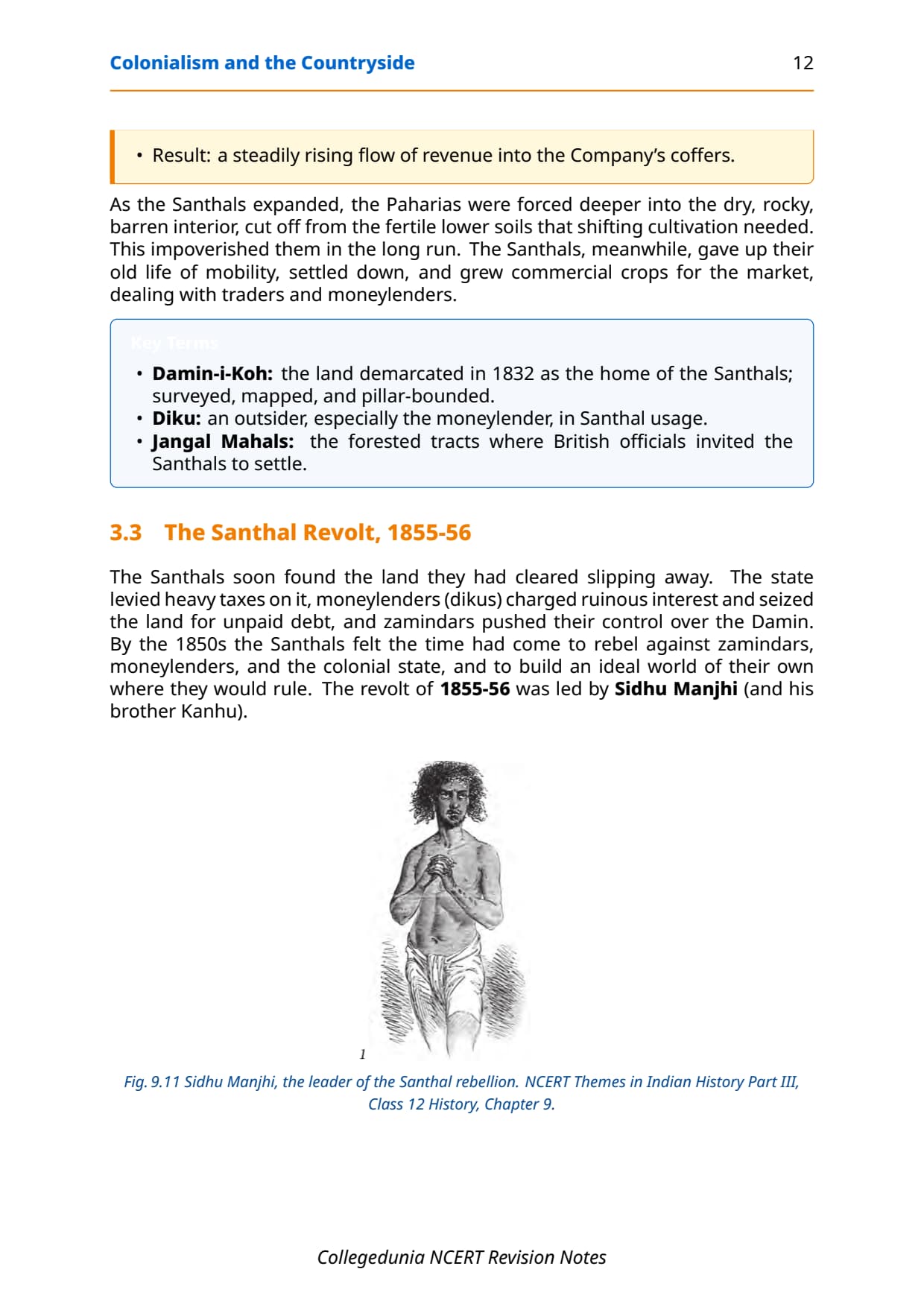
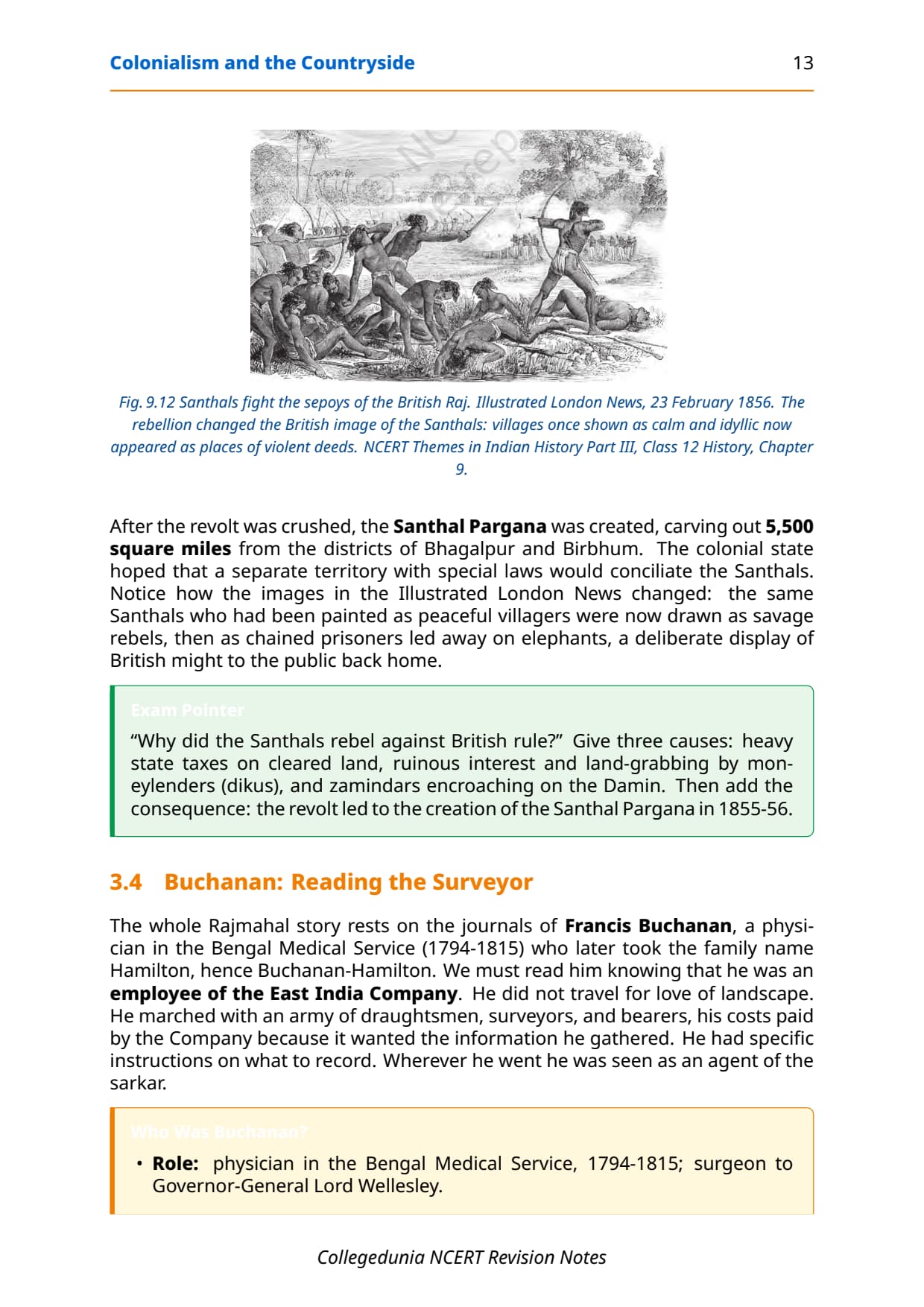
- Santhal Revolt (1855 to 1856): led by Sidhu and Kanu, against heavy taxes, dikus and zamindars; led to the Santhal Pargana.
The heart of the Santhal answer is dispossession. The Santhals cleared the forest, then watched the state, the moneylender and the zamindar take the land they had made. That sense of injustice is what turned settlers into rebels. For the comparison question, run the same tests, tools, forest use and mobility, down both columns, and the answer writes itself.
The Deccan, the Ryotwari System and the 1875 Riots Notes
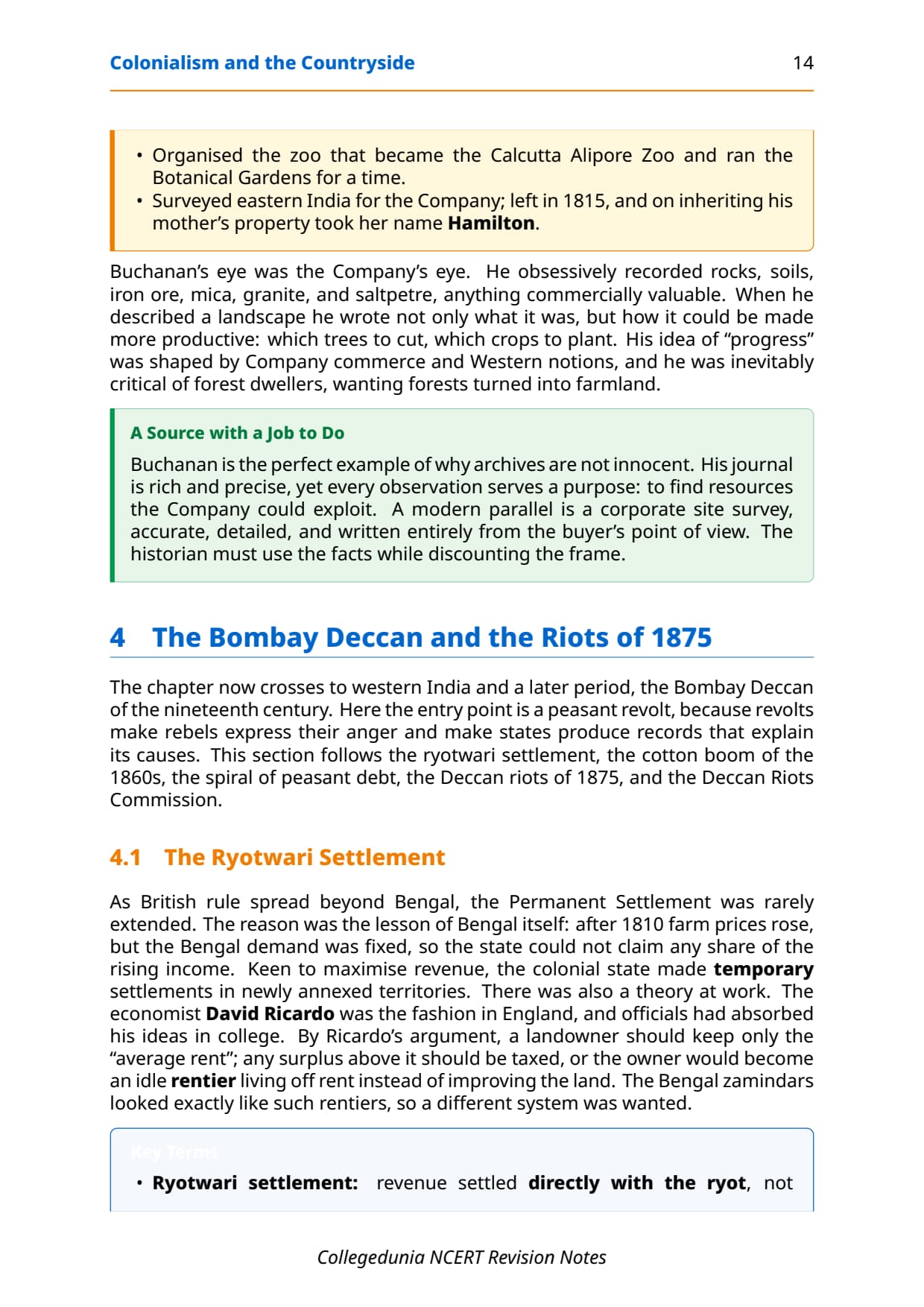
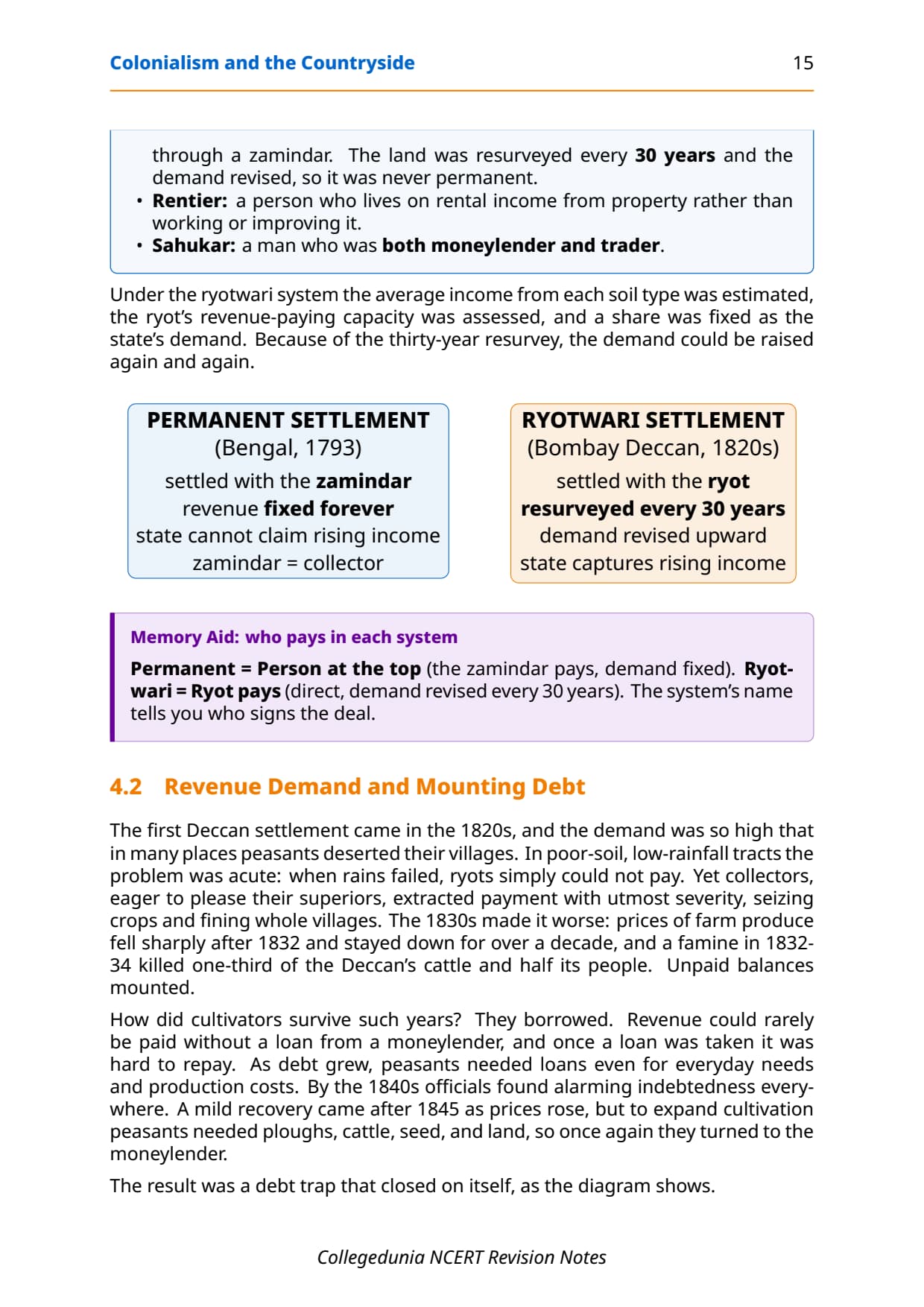
The Deccan section settles revenue directly with the ryot under the ryotwari system. High demand forced borrowing, and debt to the sahukars built the anger that exploded in 1875. The notes split this into the abuses and the cotton link.
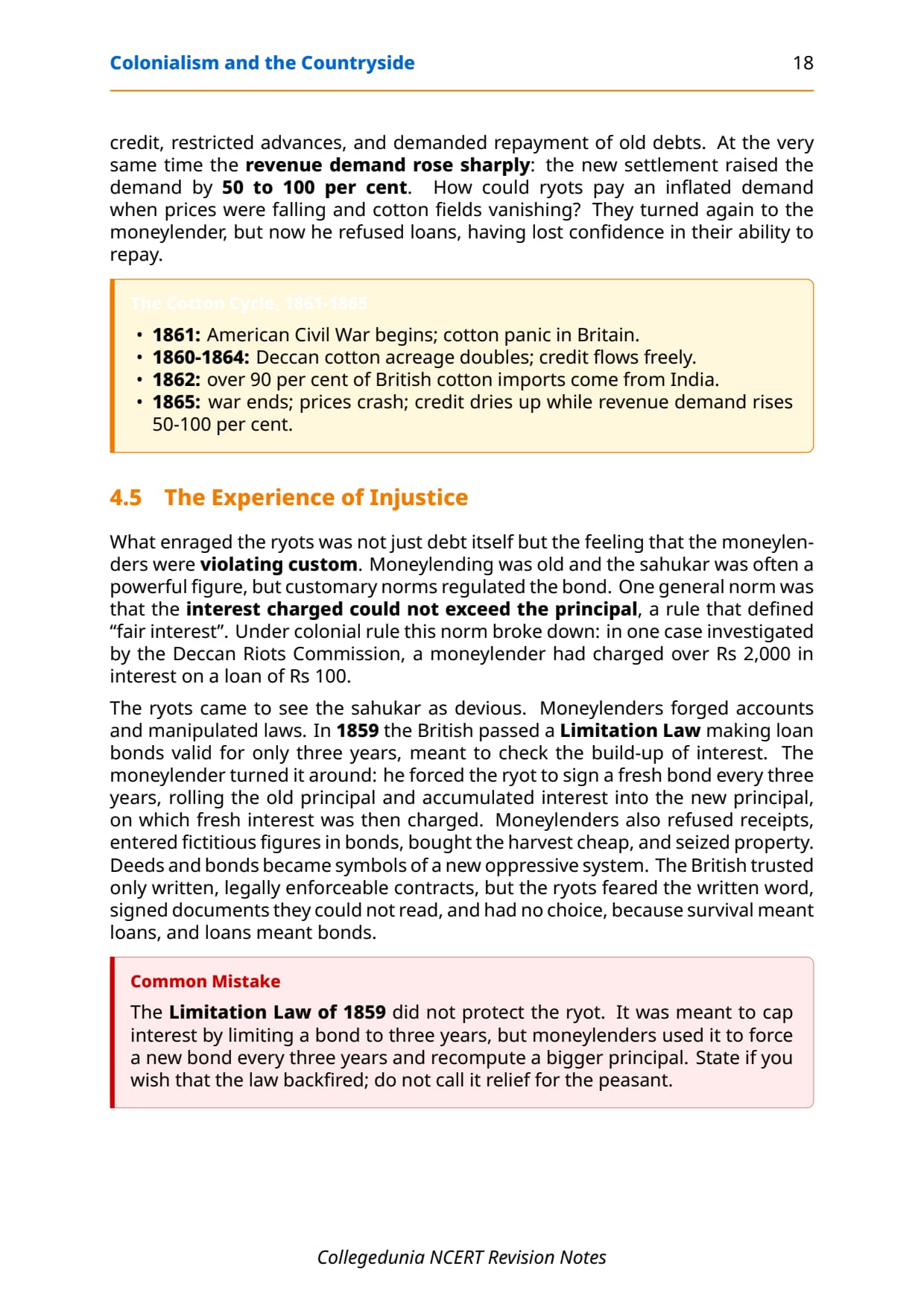
- Custom broken: interest could not exceed the principal, yet one sahukar charged Rs 2,000 on a Rs 100 loan.
- Cheating through paper: forged accounts, no receipts, and a new bond forced every three years under the 1859 Limitation Law.
- Deeds of hire: a ruined ryot had to rent back his own bullocks and carts.
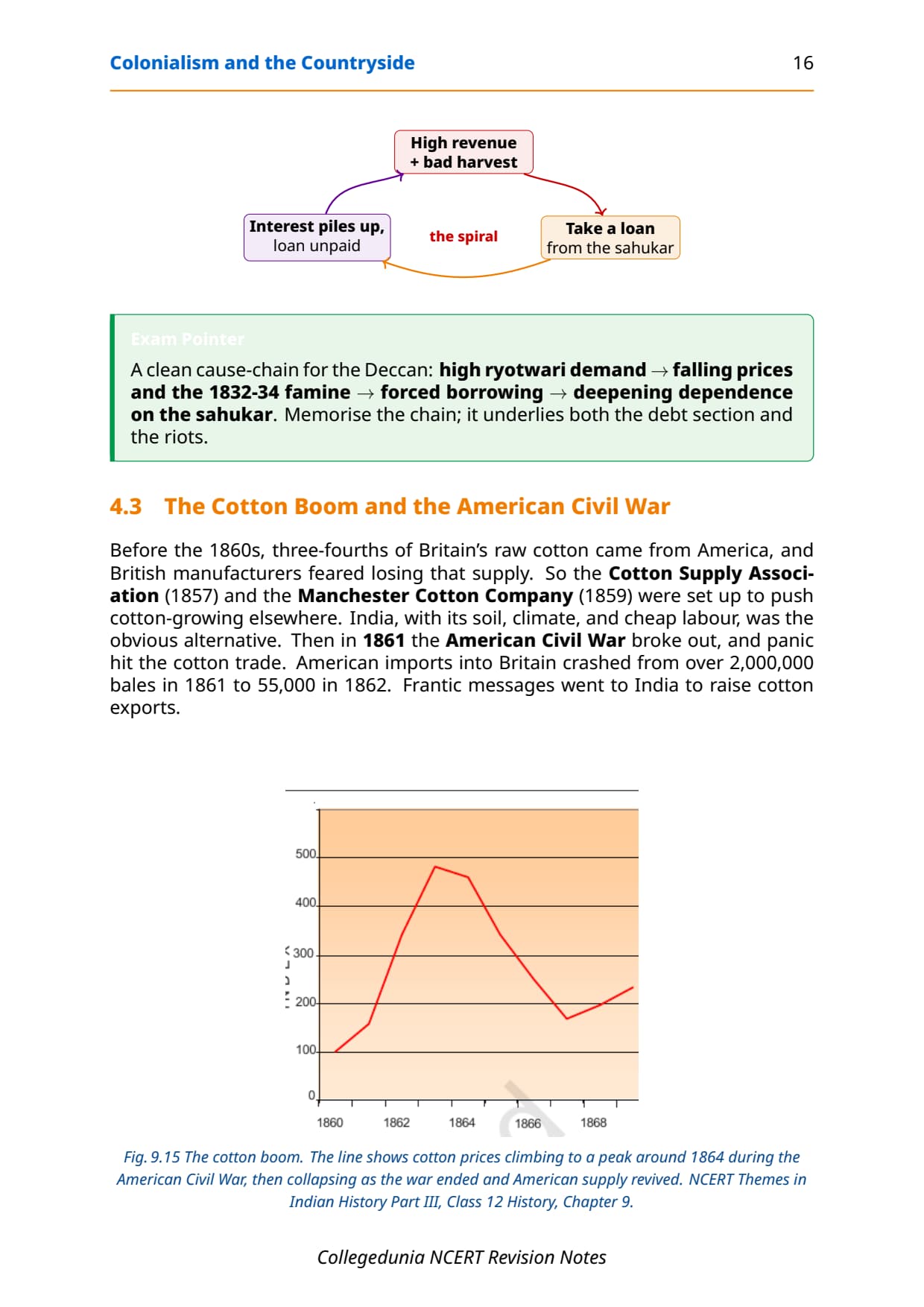
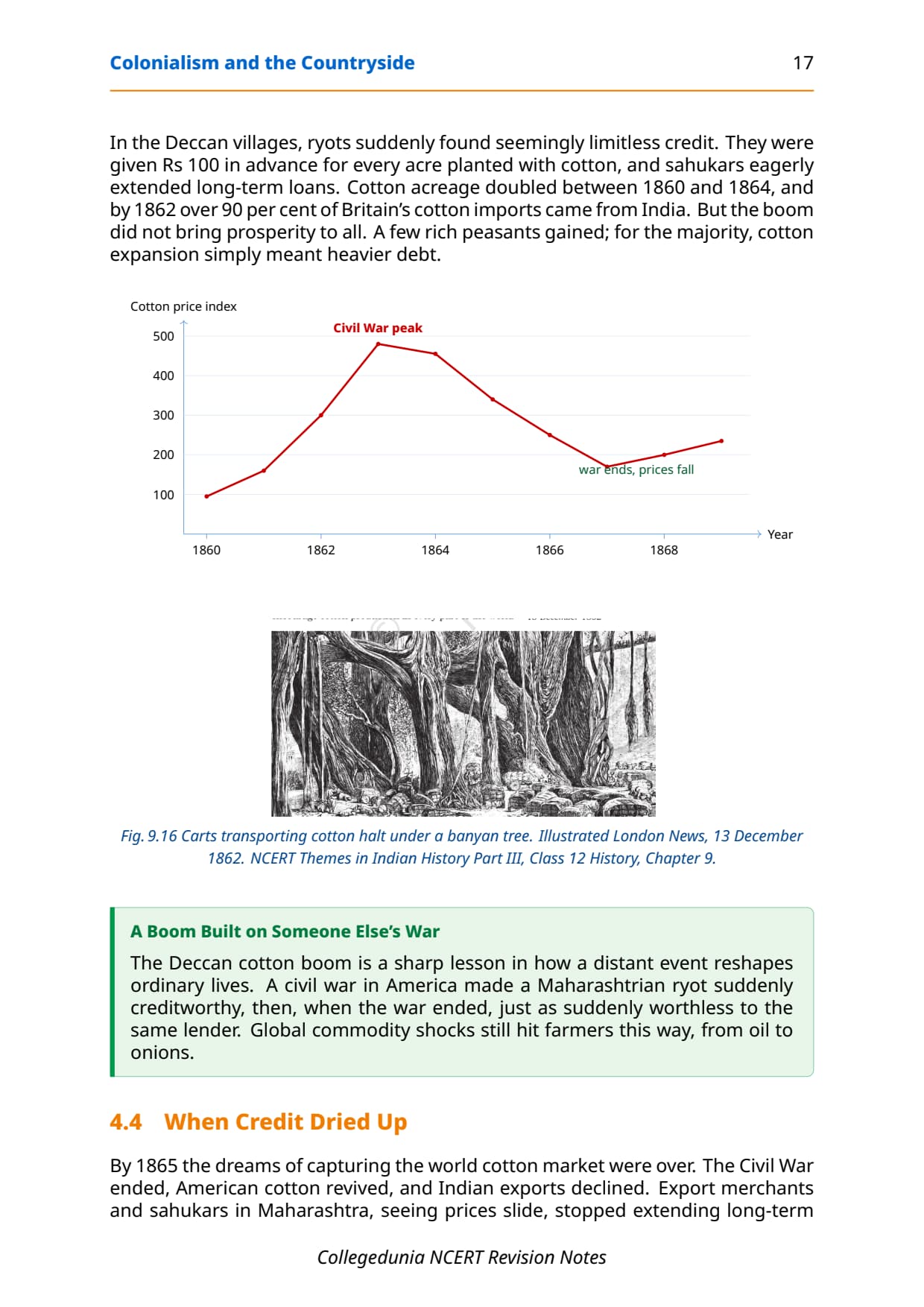
- The cotton link: the American Civil War (1861) sparked a boom, then a bust after 1865 that deepened ryot debt.
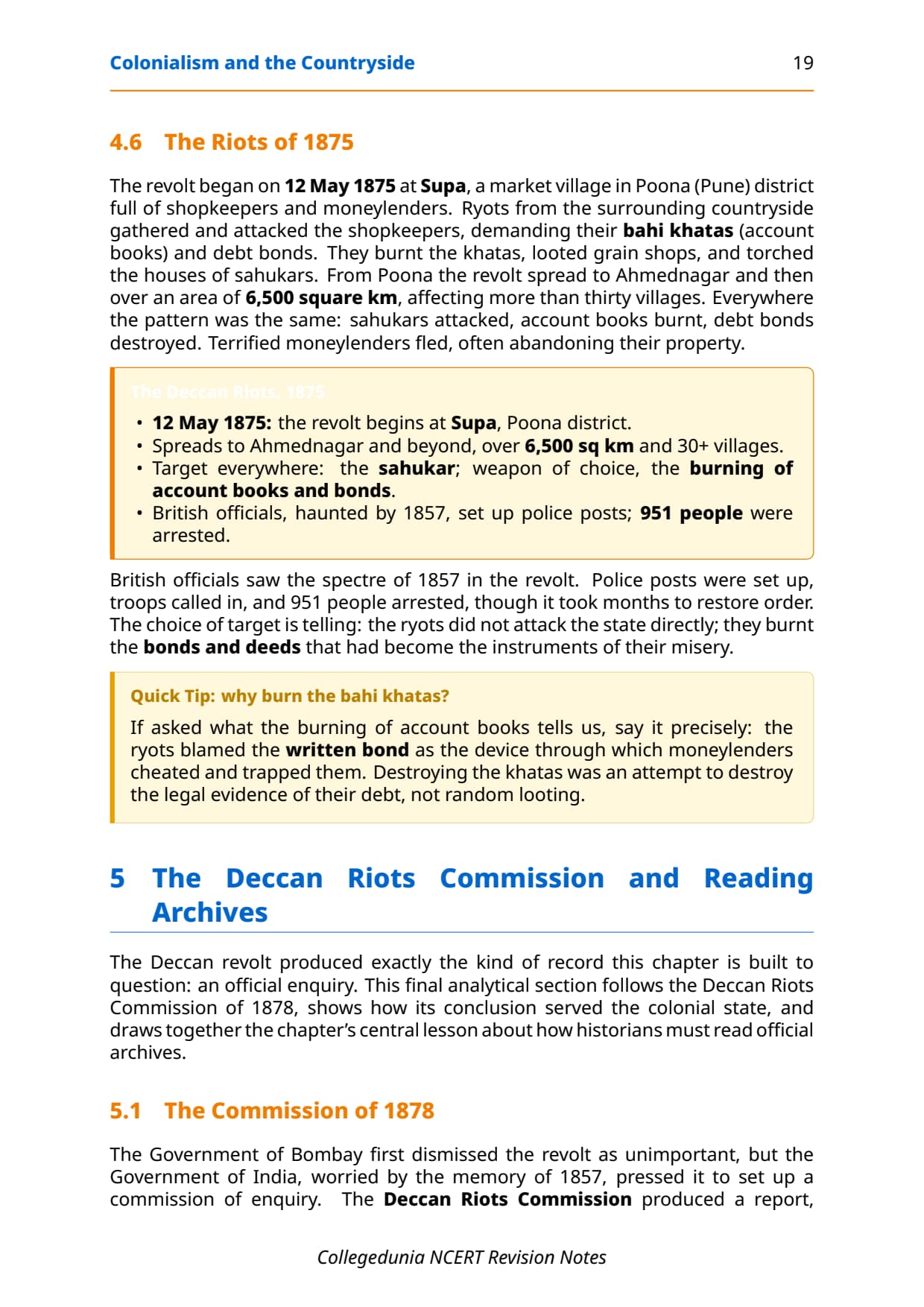
The single point to remember is that the anger was about injustice, not debt as such. That is why the rebels' first act in 1875 was to burn the account books and bonds. The Deccan Riots Commission (1878) then blamed the moneylenders, not the revenue, which is itself a lesson in official bias and a favourite short-answer link.
Reading Official Archives Notes
The chapter is titled "Exploring Official Archives", so the method matters as much as the facts. These notes keep the three main sources and their biases side by side for the "problems of official sources" answer.
| Source | Bias to remember |
|---|---|
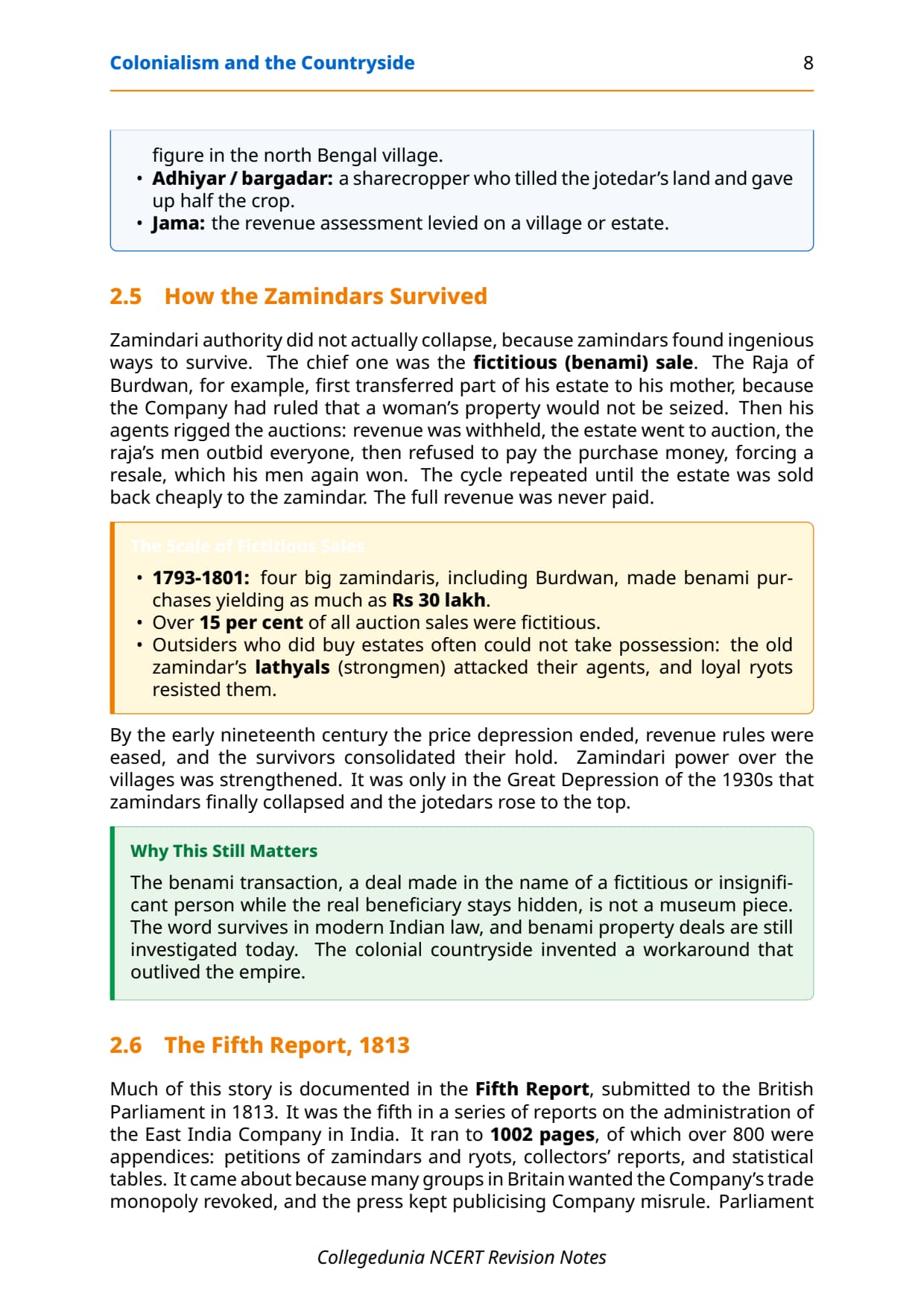
| Fifth Report (1813) | Written to attack Company rule, so it exaggerated the collapse of zamindari power. |
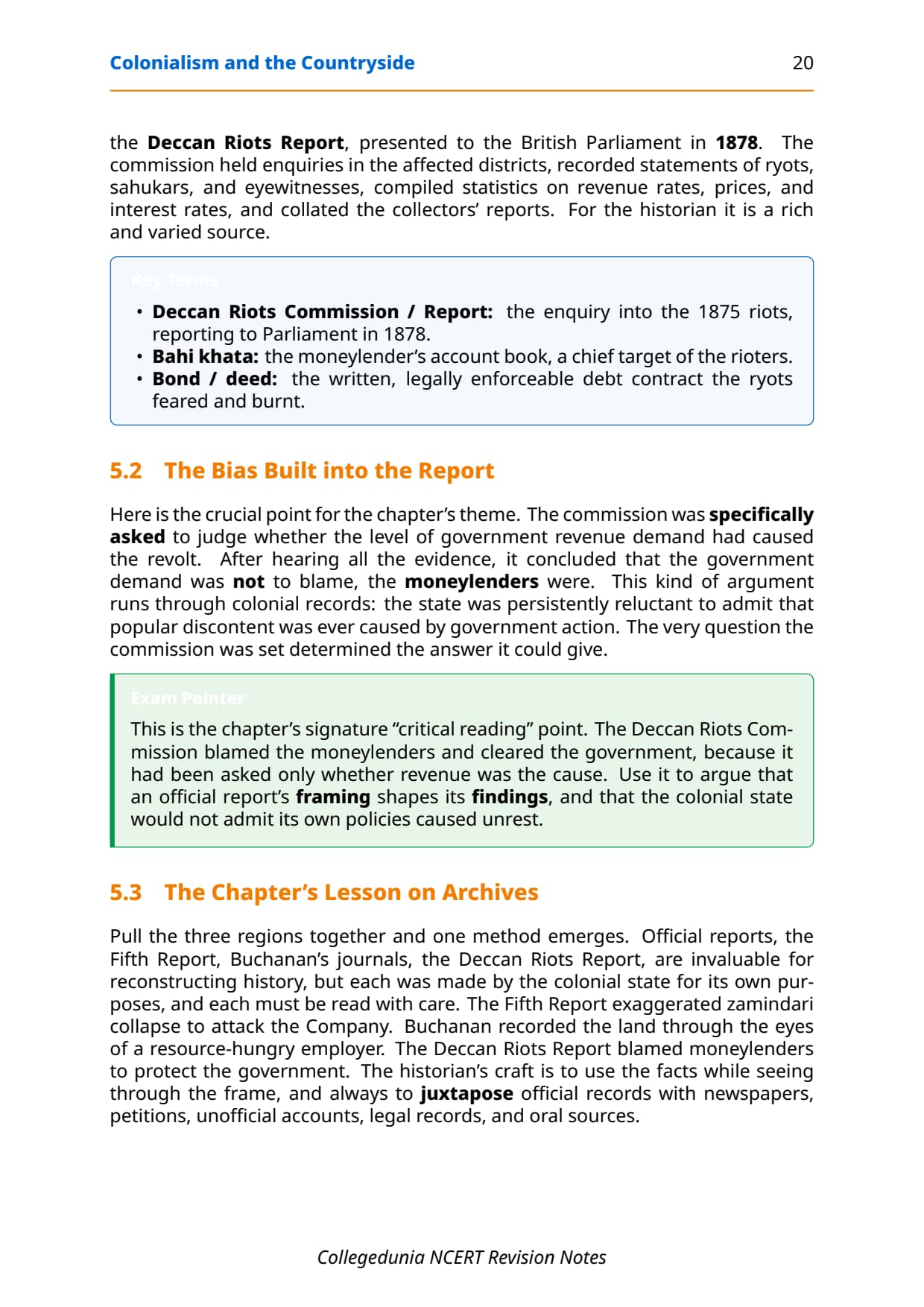
| Deccan Riots Report (1878) | Blamed the moneylenders, not the revenue, to shield the government. |
| Buchanan's surveys | A paid Company surveyor whose eye was angled towards commerce and "progress". |
The honest line for your notes is that official sources speak with the state's voice, so they reflect official concerns, not peasant ones. The remedy is not to discard them but to ask who wrote them and why, then juxtapose them with newspapers, legal records and oral sources. State that method clearly and the answer tops the band.
Colonialism and the Countryside Important Questions and Exam Pointers
CBSE sets a steady mix of source-based, short and long answers from this chapter. Knowing the pattern helps students decide how much to write and which topics to revise first. A focused list of chapter 9 history class 12 important questions saves a lot of time before the board exam.
- Source-based (often 8 marks): an extract from the Fifth Report, a Buchanan journal, or a moneylender's bond, with three sub-parts.
- Long answer (5 to 6 marks): the Santhal Revolt, the Deccan riots, or the cotton boom and bust.
- Short answer (3 marks): the jotedar, benami sales, or the Paharia response.
- Objective and MCQ: dates (1793, 1832, 1855, 1875), names (Sidhu, Kanu, Cleveland) and places.
For quick recall, students often practise a short class 12 history chapter 9 mcq drill and a list of class 12 history chapter 9 important questions. The most repeated items are the Santhal Revolt and the Deccan ryots' anger, so keep those answer points ready in your own words. Reading these Colonialism and the Countryside notes once, then writing the key lists from memory, is the fastest way to lock the chapter in.
Common Mistakes Students Make in This Chapter
A few errors cost marks every year. Most come from giving only one side of an argument or from reducing a rich answer to a single cause. Fixing these five points is the quickest way to lift a score on the long answers, so add them to the end of your revision sheet.
- Saying the auctions ended the zamindars - most survived through benami sales.
- Reducing the Deccan ryots' anger to "they were in debt" - it was about injustice.
- Describing only the cotton boom - the marks lie in the bust after 1865.
- Treating official reports as plain fact - they carry the state's bias.
- Mixing up the Paharias (hoe) and the Santhals (plough) - keep the two peoples apart.
Students who fix these five points usually move from average to high marks. The exam rewards balanced wording, so always give both sides of a debate. These notes flag each soft point so you can phrase it safely in the answer sheet.
How These Notes Pair with the Solutions and Book PDF
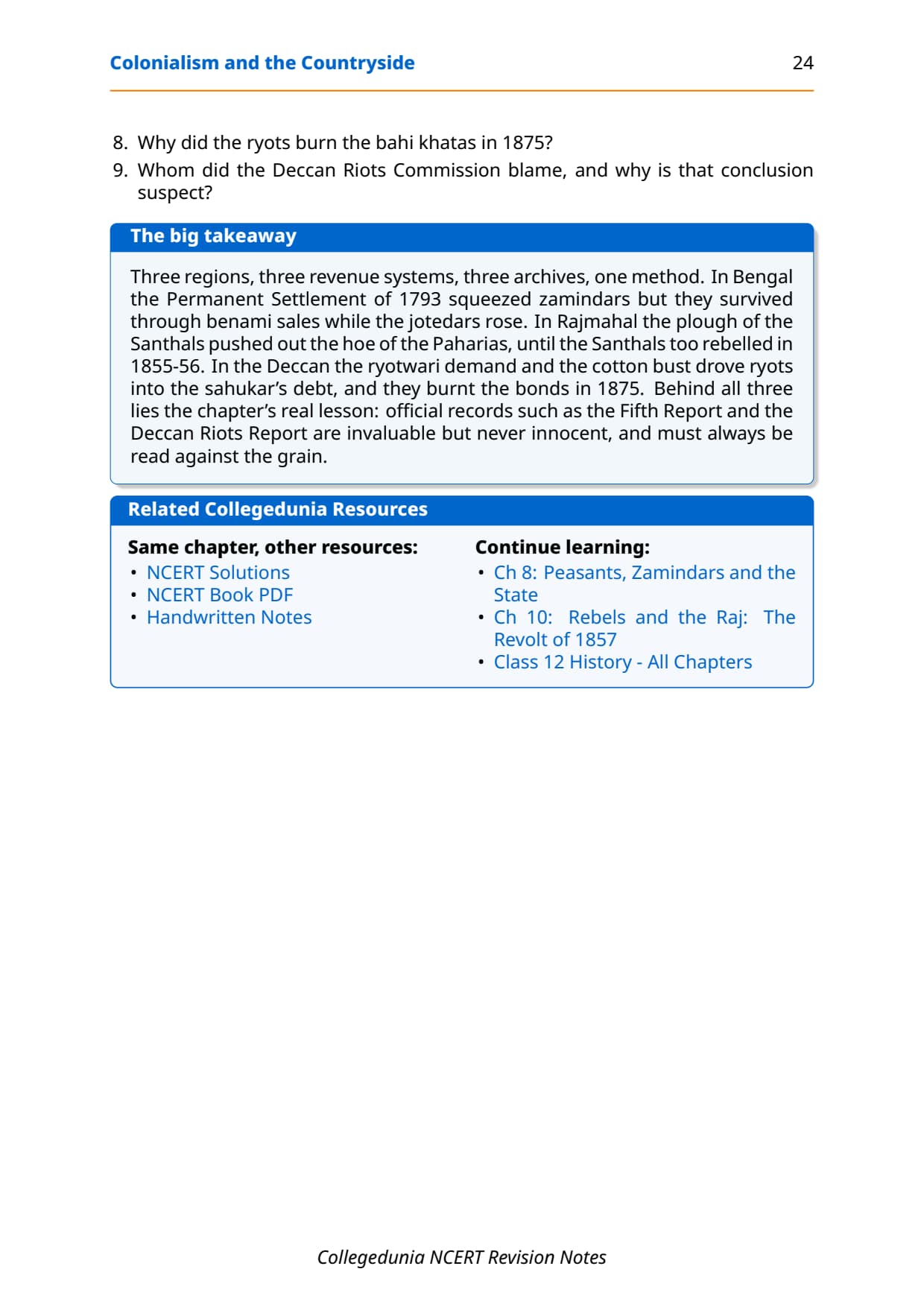
These revision notes summarise the chapter. To prepare fully, students should use them alongside the other resources for the same chapter, all linked in the table below. Read the notes first, then test yourself with the solutions, and open the book PDF whenever you need the original text and figures.
| Resource | Best used for |
|---|---|
| Colonialism and the Countryside NCERT Solutions | Step-by-step answers to all 12 back-exercise questions |
| Colonialism and the Countryside Handwritten Notes | Last-minute, one-shot revision in a scanned notebook style |
| Colonialism and the Countryside NCERT Book PDF | Reading the original NCERT chapter text and figures |
Tip: read these notes first, then attempt the solutions on your own, and only then check the model answers. That order builds memory faster than copying answers straight away.
All Class 12 History Notes by Chapter
The table links the revision notes for every chapter in Themes in Indian History so students can move across the book in one click. Chapter 9 is highlighted.
| Chapter | Notes |
|---|---|
| Chapter 1 | Bricks, Beads and Bones |
| Chapter 2 | Kings, Farmers and Towns |
| Chapter 3 | Kinship, Caste and Class |
| Chapter 4 | Thinkers, Beliefs and Buildings |
| Chapter 5 | Through the Eyes of Travellers |
| Chapter 6 | Bhakti-Sufi Traditions |
| Chapter 7 | An Imperial Capital Vijayanagara |
| Chapter 8 | Peasants, Zamindars and the State |
| Chapter 9 | Colonialism and the Countryside |
| Chapter 10 | Rebels and the Raj 1857 |
| Chapter 11 | Mahatma Gandhi and the Nationalist Movement |
| Chapter 12 | Framing the Constitution |
FAQs on Colonialism and the Countryside Class 12 Notes
Colonialism and the Countryside Class 12 History Notes Common Questions
Ques. Where can I download the Colonialism and the Countryside Class 12 notes PDF?
Ans. You can download the Colonialism and the Countryside Class 12 History notes PDF directly from this page. It is free, follows the 2026-27 NCERT, and covers Bengal, the Rajmahal hills and the Deccan in a short, point-wise format.
Ques. What does the Colonialism and the Countryside chapter cover for Class 12?
Ans. It covers colonial rule in rural India through official archives: the Permanent Settlement and zamindars in Bengal, the Paharias and Santhals in the Rajmahal hills, the ryotwari system and the Deccan riots, and the problems of using official sources.
Ques. Which topics are most important in class 12 history chapter 9 for the board exam?
Ans. The Santhal Revolt, the anger of the Deccan ryots, and the effect of the American Civil War are the most-asked long answers. These three top every list of class 12 history chapter 9 important questions, so revise them first.
Ques. Why did the Santhals rebel in 1855?
Ans. The Santhals had cleared the Damin-i-Koh, but the state taxed it heavily, moneylenders (dikus) charged ruinous interest and seized fields, and zamindars pushed into the Damin. Led by Sidhu and Kanu, they rose against all three to build a world they could rule.
Ques. How should I use these notes to revise quickly?
Ans. Read the notes once under the three-region frame, keep all dates and key terms on one sheet, then write the key lists from memory. Finish by attempting a short class 12 history chapter 9 mcq drill to test the small facts.



Comments