




These Kinship, Caste and Class Class 12 Notes give a quick, exam-ready summary of early Indian society for the 2026-27 CBSE syllabus. The notes pull together every key date, dynasty and source name from Theme 3 of Themes in Indian History Part I. Students can use them for a fast revision the night before a test or to fix the main ideas before they attempt the back-exercise questions.
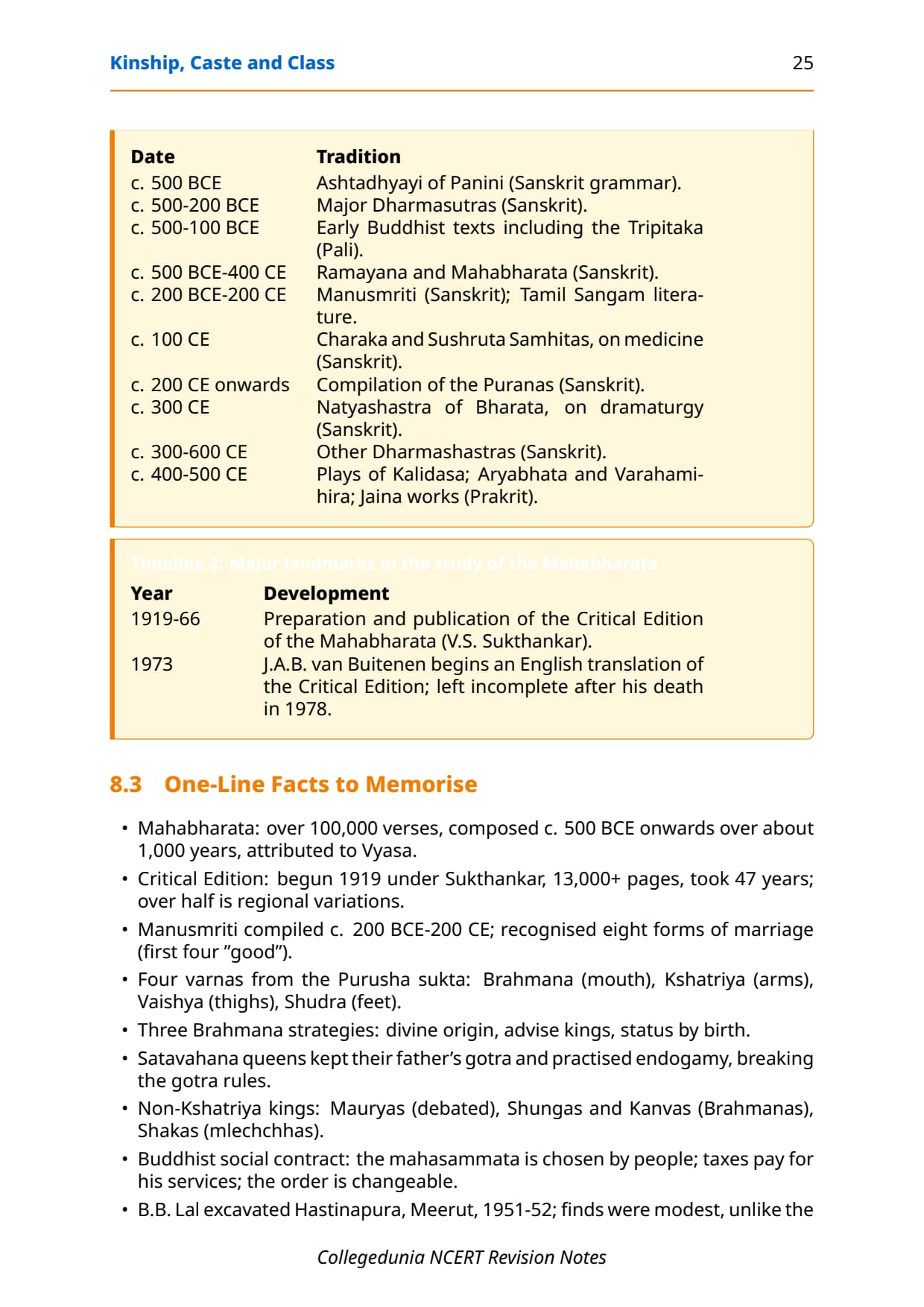
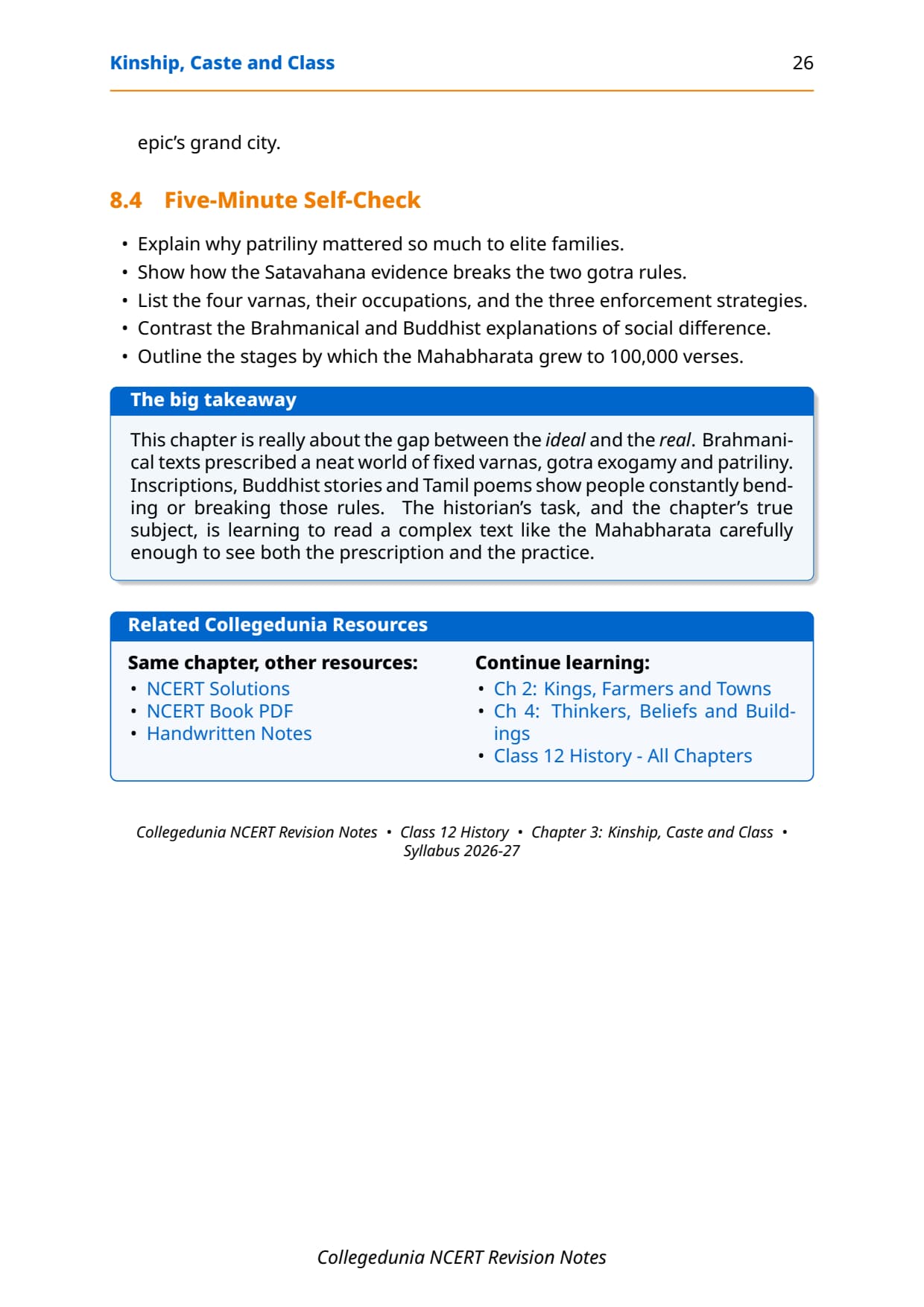
- Covers patriliny, the varna order, gender, property and the Mahabharata in one place.
- This Class 12 History chapter usually carries 6 to 8 marks in the board paper.
- Pairs with the NCERT Solutions, Handwritten Notes and Book PDF linked lower on this page.
These Kinship, Caste and Class Class 12 notes are written from the official NCERT Themes in Indian History Part I and checked against the last five years of CBSE board papers.
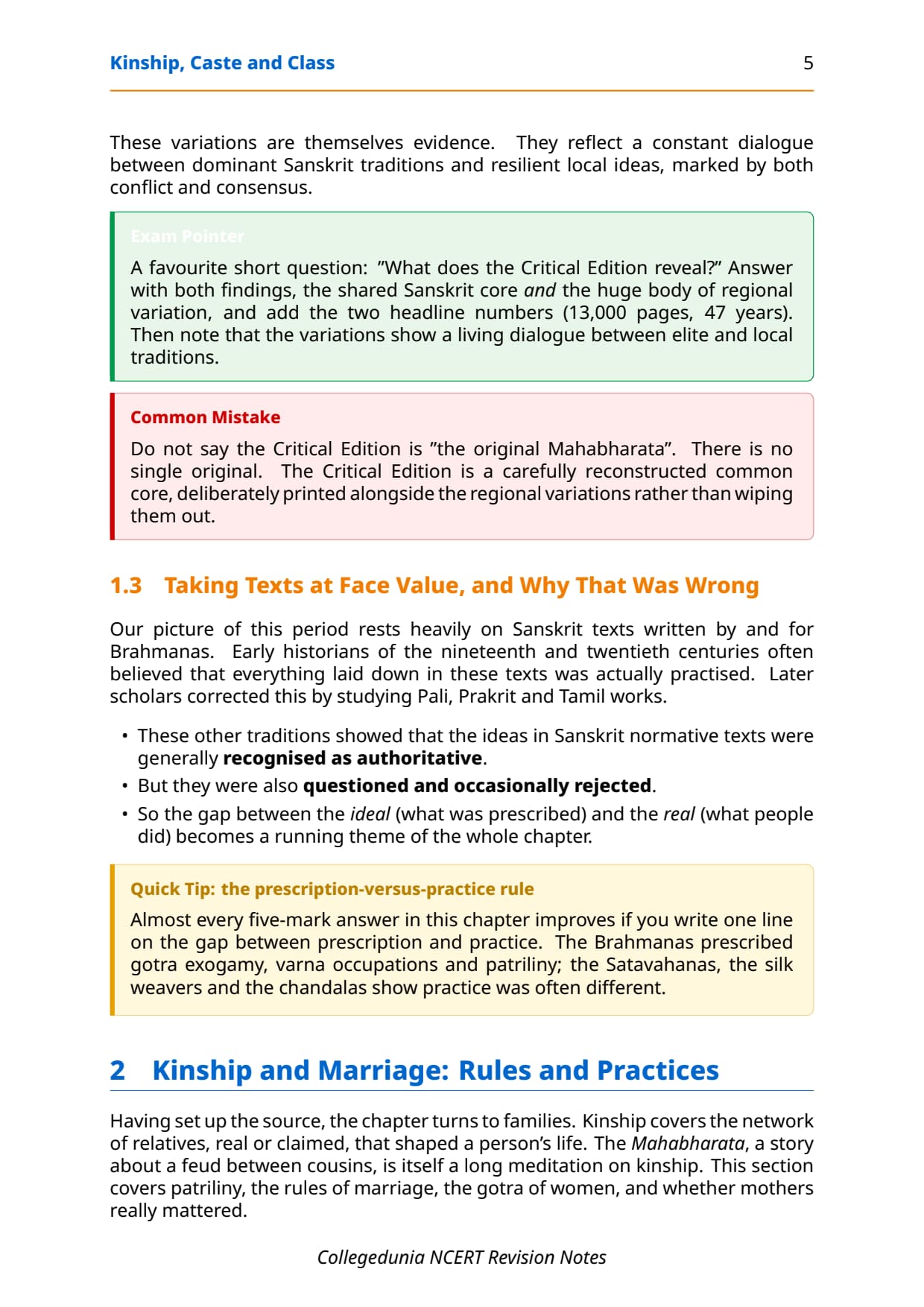
Student Feedback: In a Collegedunia poll of 9,640 Class 12 History students taken before the 2026 boards, 72% of students said short, point-wise notes on the varna order and the rule-versus-practice idea were the fastest way to revise this chapter. Most students kept the dynasties and source names on a single sheet for last-minute recall.
Source: 2026-27 Class 12 History student poll. Sample of 9,640 students from CBSE schools across 12 states.
What the Kinship, Caste and Class Notes Cover
Kinship, Caste and Class is the third chapter of Themes in Indian History Part I. It studies early Indian society from about 600 BCE to 600 CE, read mostly through the Mahabharata, the Dharmashastras and inscriptions. The chapter has one big skill: telling what people were told to do from what they actually did, so these notes keep that idea front and centre.
The three words in the title are the easiest way to organise your revision:
- Kinship stands for patriliny, the gotra and the rules of marriage.
- Caste stands for the varna and jati order, non-Kshatriya kings and untouchability.
- Class stands for gender, property and who controlled wealth.
So these Kinship, Caste and Class notes are really about reading society off one epic. If you pair each Brahmanical rule with the case that breaks it, almost every question in chapter 3 history class 12 becomes easier to answer. Keep this rule-versus-practice frame at the top of your revision sheet and slot each new detail into one of the three boxes as you read.
Patriliny, Gotra and Marriage Rules Notes
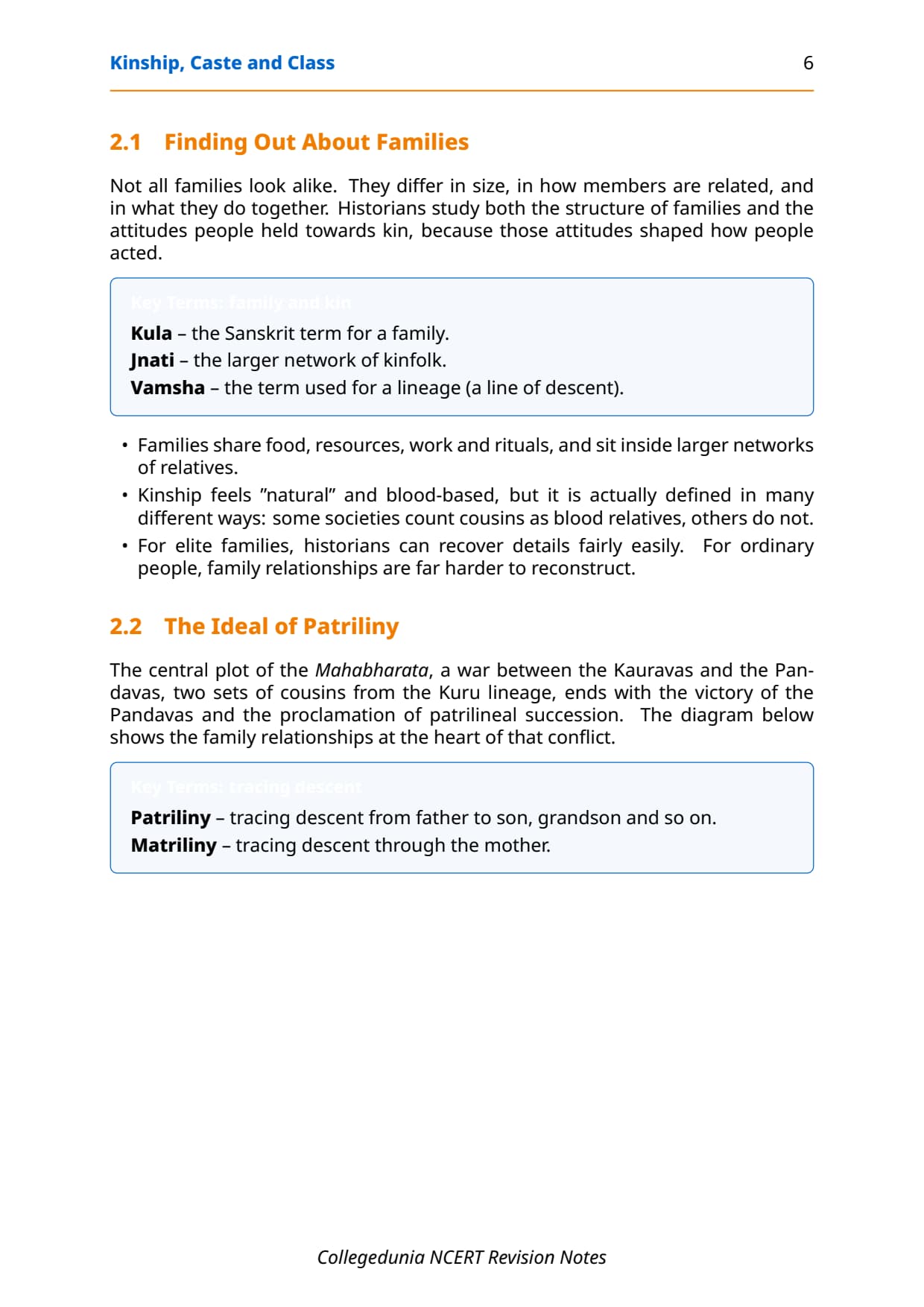
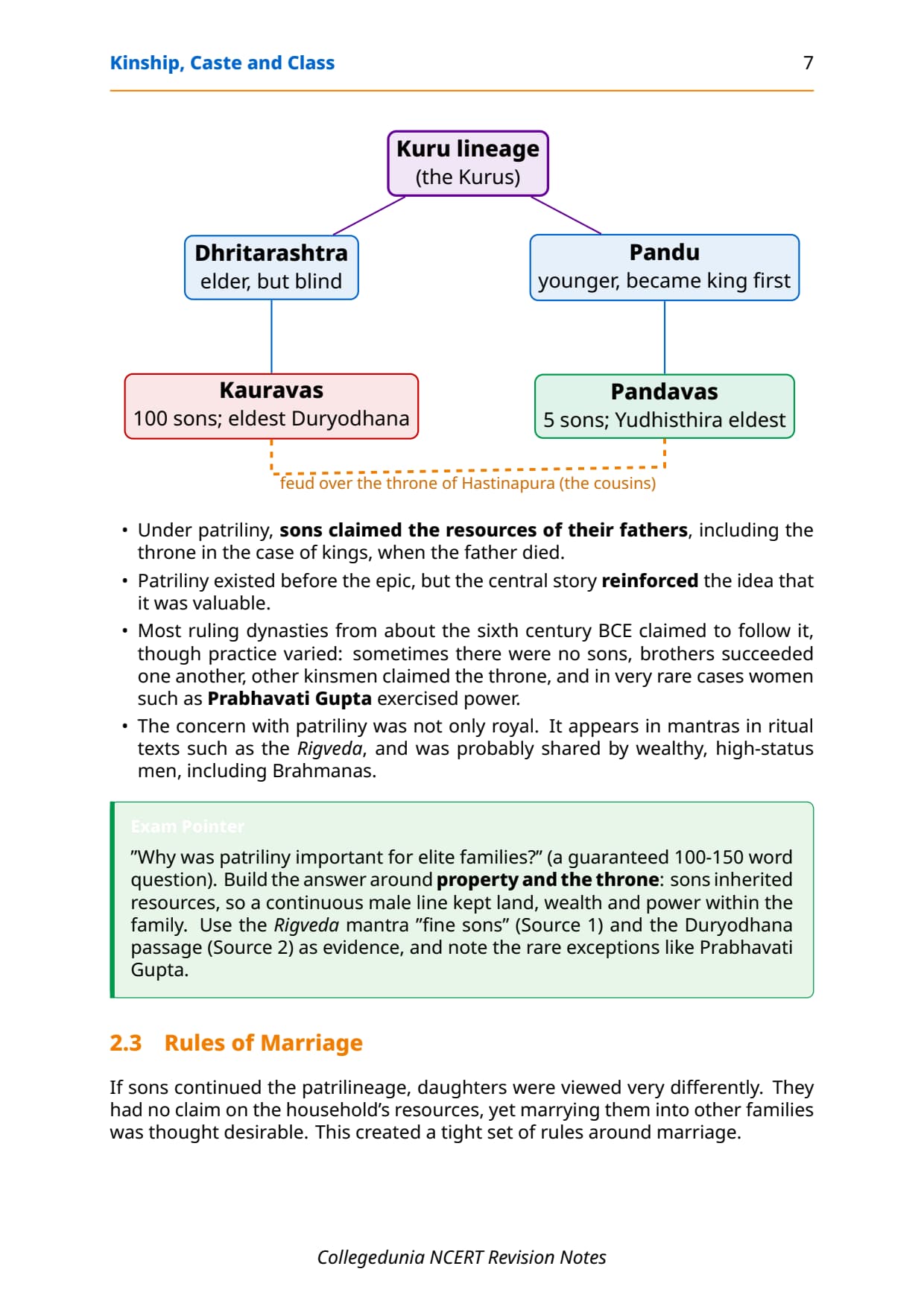
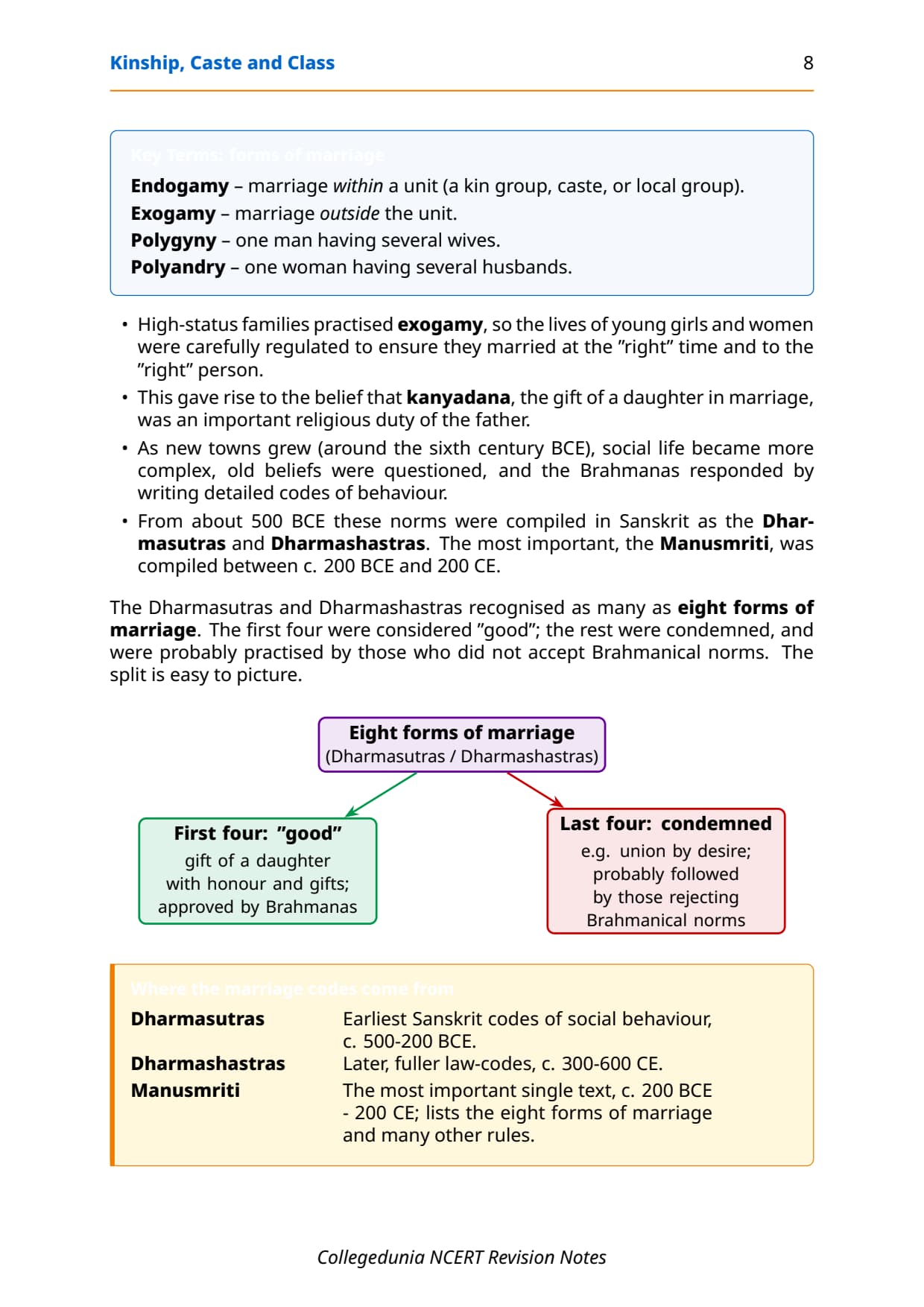
Kinship is built on patriliny, tracing descent from father to son. Under it sons inherited land, cattle, wealth and, for kings, the throne, which is why the rule mattered most to elite families. The marriage rules of gotra and exogamy sit alongside, and both are tested for how often they broke. Learn the rules as short lists for the 3-mark answers.
- Patriliny: descent runs father to son; sons inherit, daughters do not; the Mahabharata ends by proclaiming it.
- Gotra rule: a wife took her husband's gotra; same-gotra people could not marry.
- Exogamy: the Brahmanical ideal was to marry outside the kin group.
- Kanyadana: gifting a daughter in marriage was the father's religious duty.
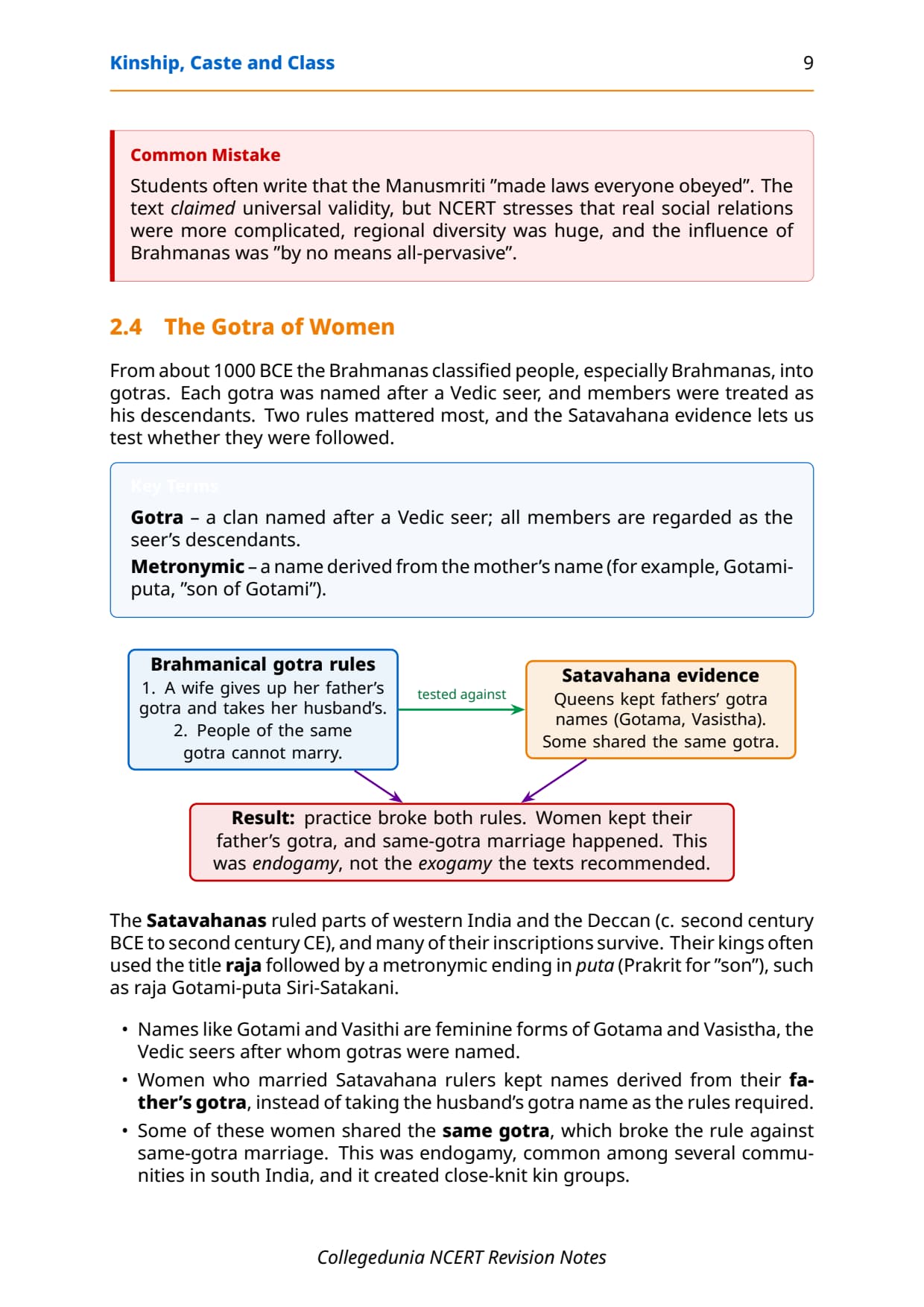
The single most important revision point is that these rules were often broken. Satavahana queens kept their fathers' gotra names, some married within the same gotra, and the dynasty practised endogamy. Keep this as a one-line takeaway, because the gotra question is really about how far Brahmanical influence reached, and the answer is not all-pervasive across a diverse subcontinent.
Varna, Jati and Non-Kshatriya Kings Notes
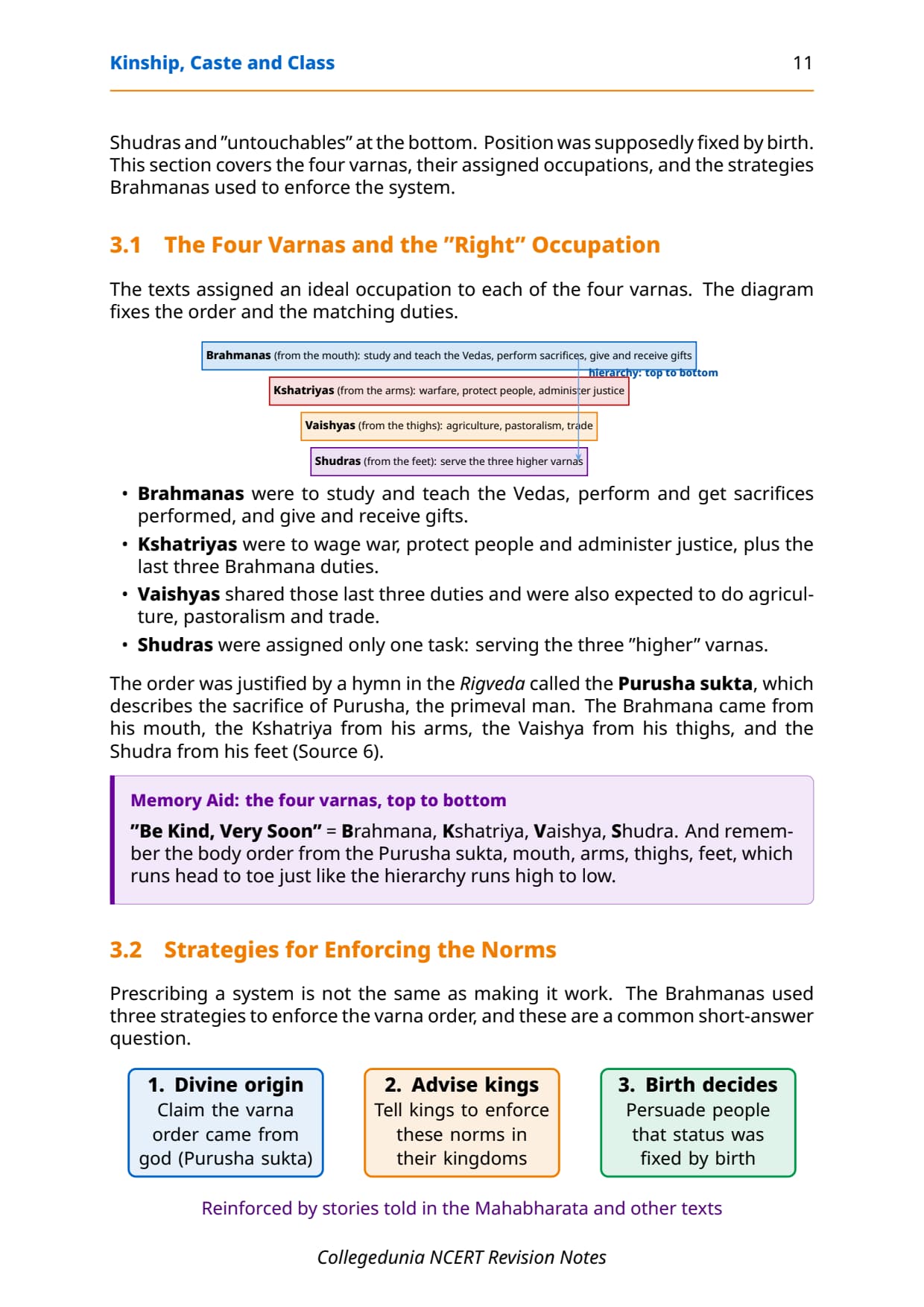
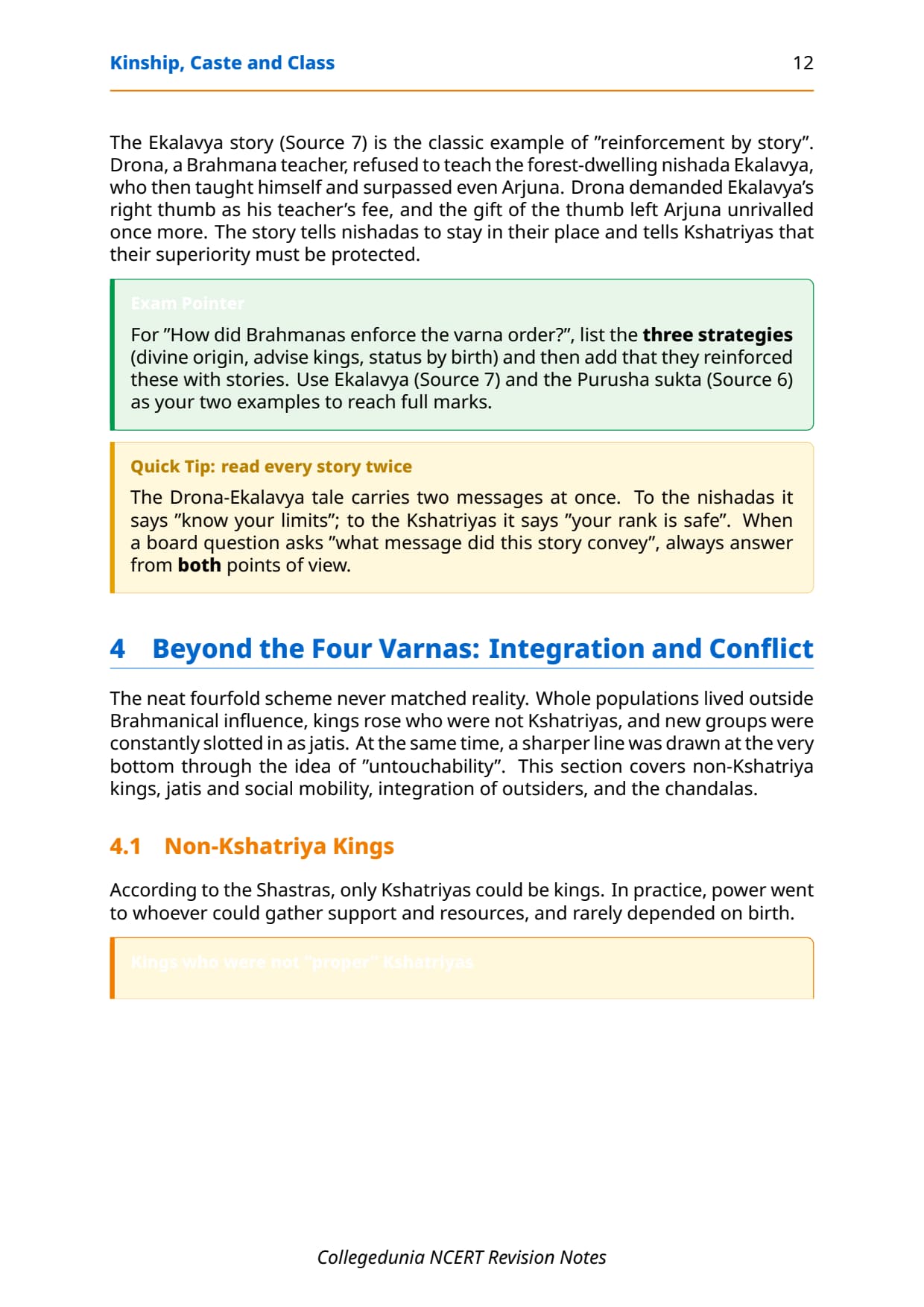
Caste in the chapter rests on varna, the four-fold order the Brahmanas said was divine, set out in the Purusha sukta. The Shastras said only Kshatriyas could be kings, but the dynasties on the ground broke that rule. The table below sorts the non-Kshatriya kings for fast revision.
| Dynasty | Origin and what it shows |
|---|---|
| Mauryas | Disputed origin; Buddhist texts call them Kshatriyas, Brahmanical texts call them "low". |
| Shungas and Kanvas | Successors of the Mauryas; they were Brahmanas. |
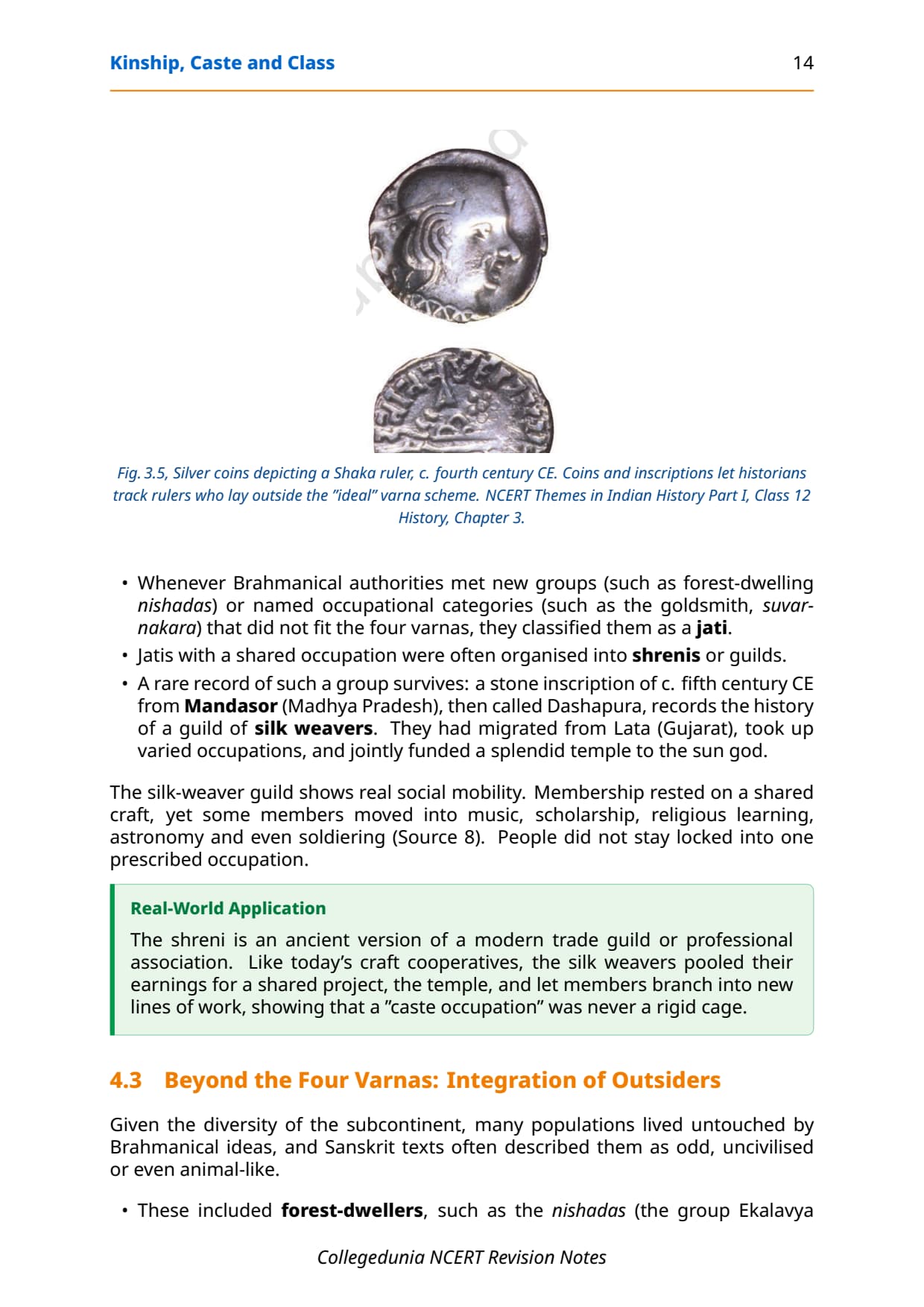
| Shakas | Central-Asian outsiders, treated as mlechchhas, yet adopted Sanskritic ways. |
| Satavahanas | King Gotami-puta claimed to be a "unique Brahmana" while upholding varna. |
The one-line takeaway is that political power went to whoever could gather support and resources, not to Kshatriya birth. Below the four varnas, the jati order grew more open-ended, while chandalas were pushed to "untouchability". Keep the divine-and-fixed varna idea (from the Purusha sukta) ready, because it pairs neatly with the Buddhist alternative below.
Gender, Property and the Buddhist Social Contract
Class and gender are where early society was most unequal. The Manusmriti and the dice game show the limits placed on women, while the Buddhist social contract offers a rival explanation of social order. Learn these as short lists, since they feed both the gender essay and the difference question.
- Sons over daughters: sons inherited under patriliny; daughters had no claim and were married out.
- Property law: the Manusmriti gave the estate to sons; women kept only stridhana, the gifts received at marriage.
- Draupadi at dice: Yudhisthira staked and lost the common wife, the sharpest image of a woman as property.
- Purusha sukta: the four varnas spring from the body of Purusha; society is divine and fixed by birth.
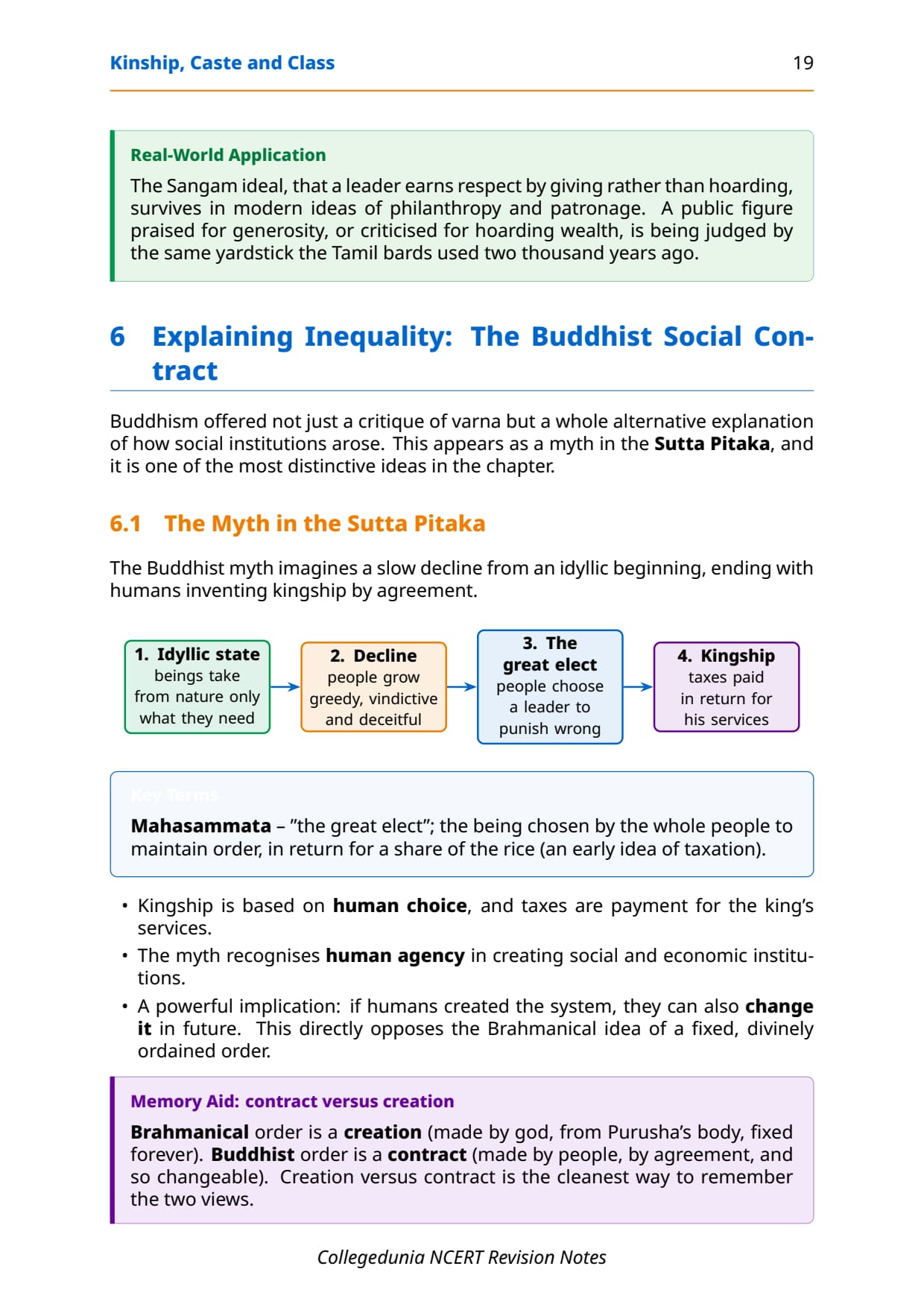
- Buddhist contract: people elected the mahasammata to keep order; society is a human choice and can change.
The honest line to remember is that the Purusha sukta makes inequality god-given, while the Buddhist contract makes it man-made and open to reform. Yet practice was sometimes softer than the texts: the Vakataka queen Prabhavati Gupta held resources, and Satavahana women kept their gotra names, so note that gender differences were real but not absolute.
The Mahabharata as a Dynamic Text
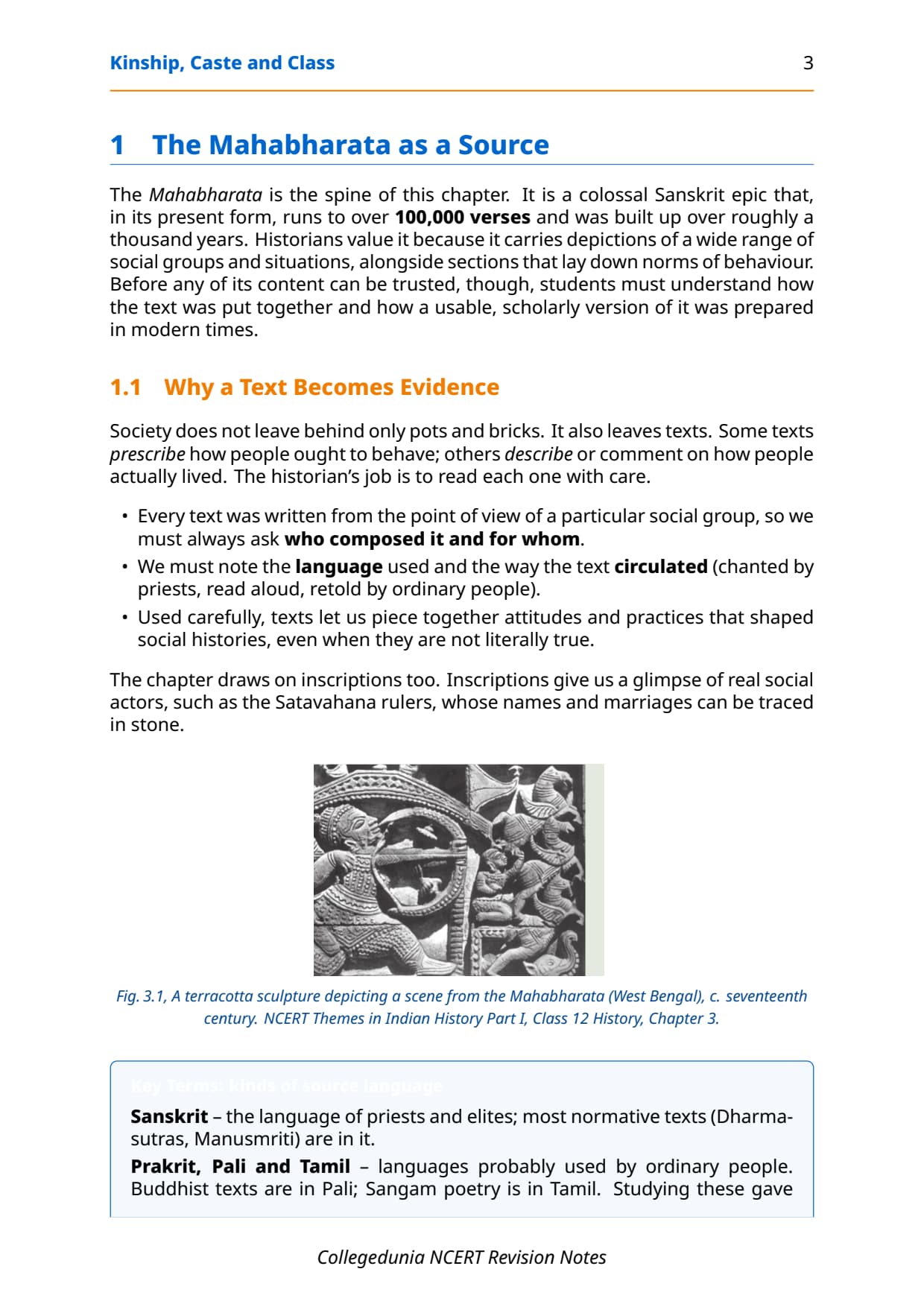
The chapter reads society off one giant epic, so the Mahabharata's own history is a key topic. It was built up in stages over about a thousand years, which is why it is so varied and why no single author could have written it. The table keeps the phases in order for fast revision.
| Phase | What happened |
|---|---|
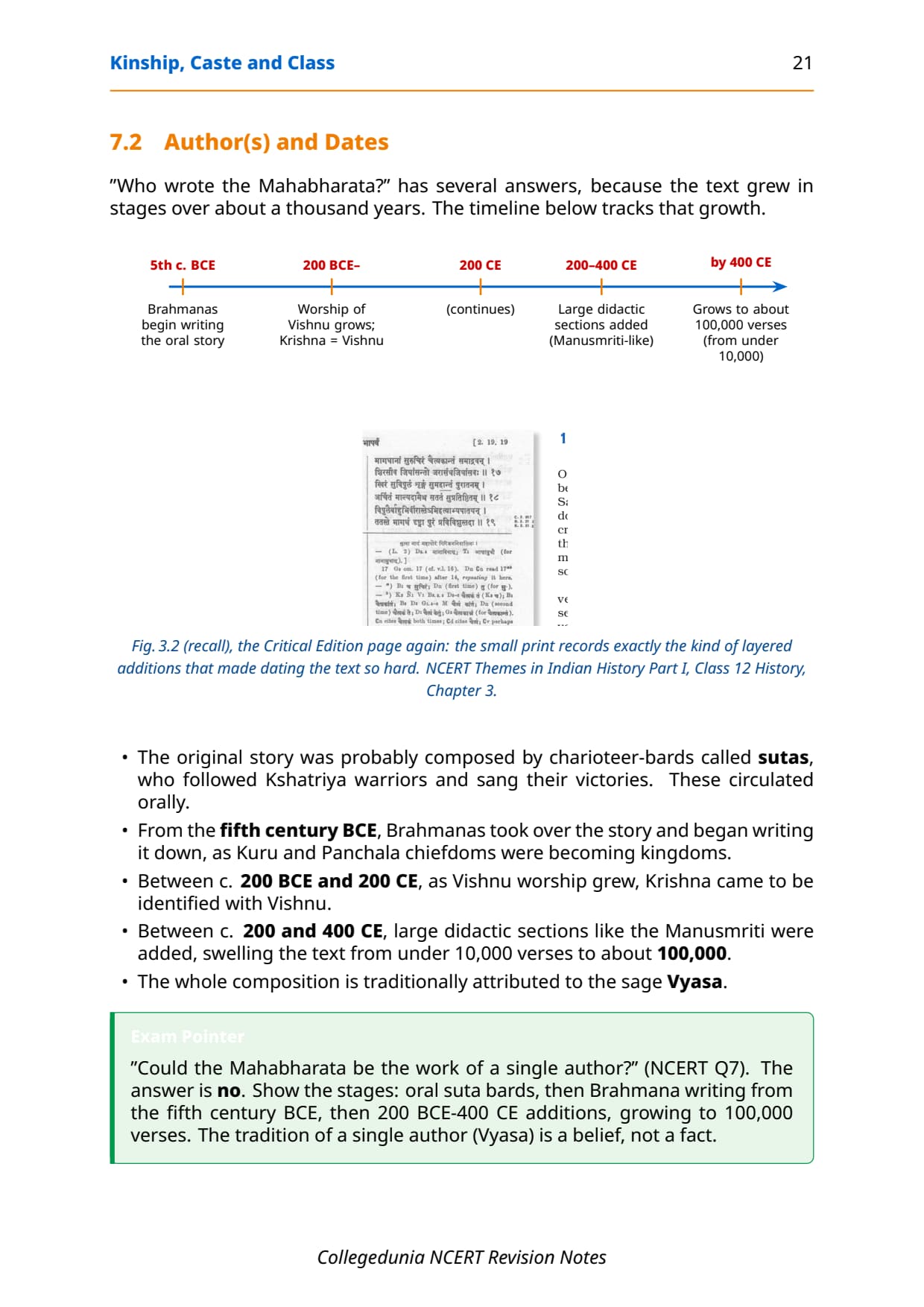
| c. 500 BCE | Charioteer-bards (sutas) sang of Kshatriya victories; the story spread orally. |
| From 5th c. BCE | Brahmanas took over the story and wrote it down. |
| 200 BCE to 200 CE | Worship of Vishnu grew; Krishna was identified with Vishnu. |
| 200 to 400 CE | Large didactic sections were added; the text reached about 100,000 verses. |
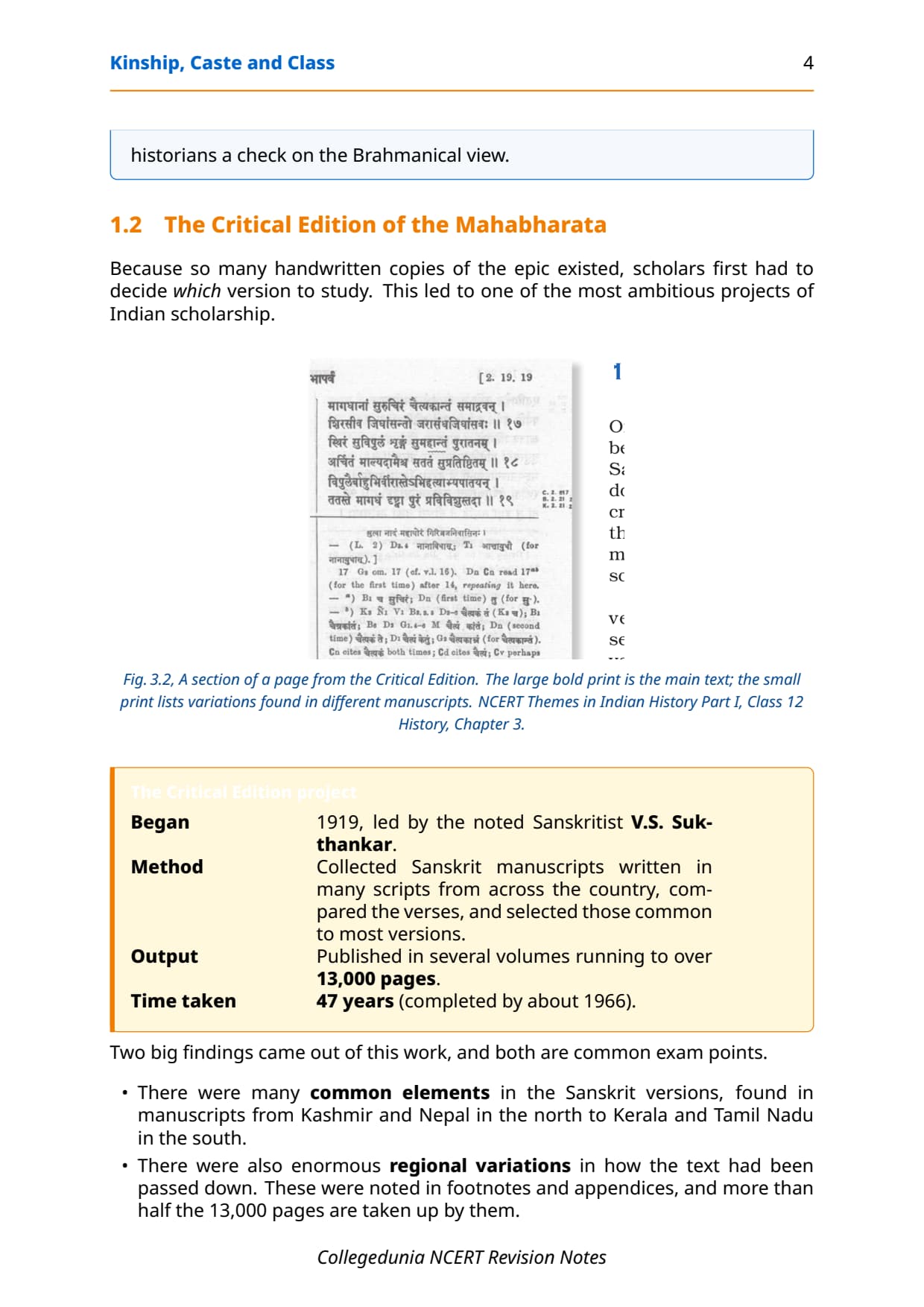
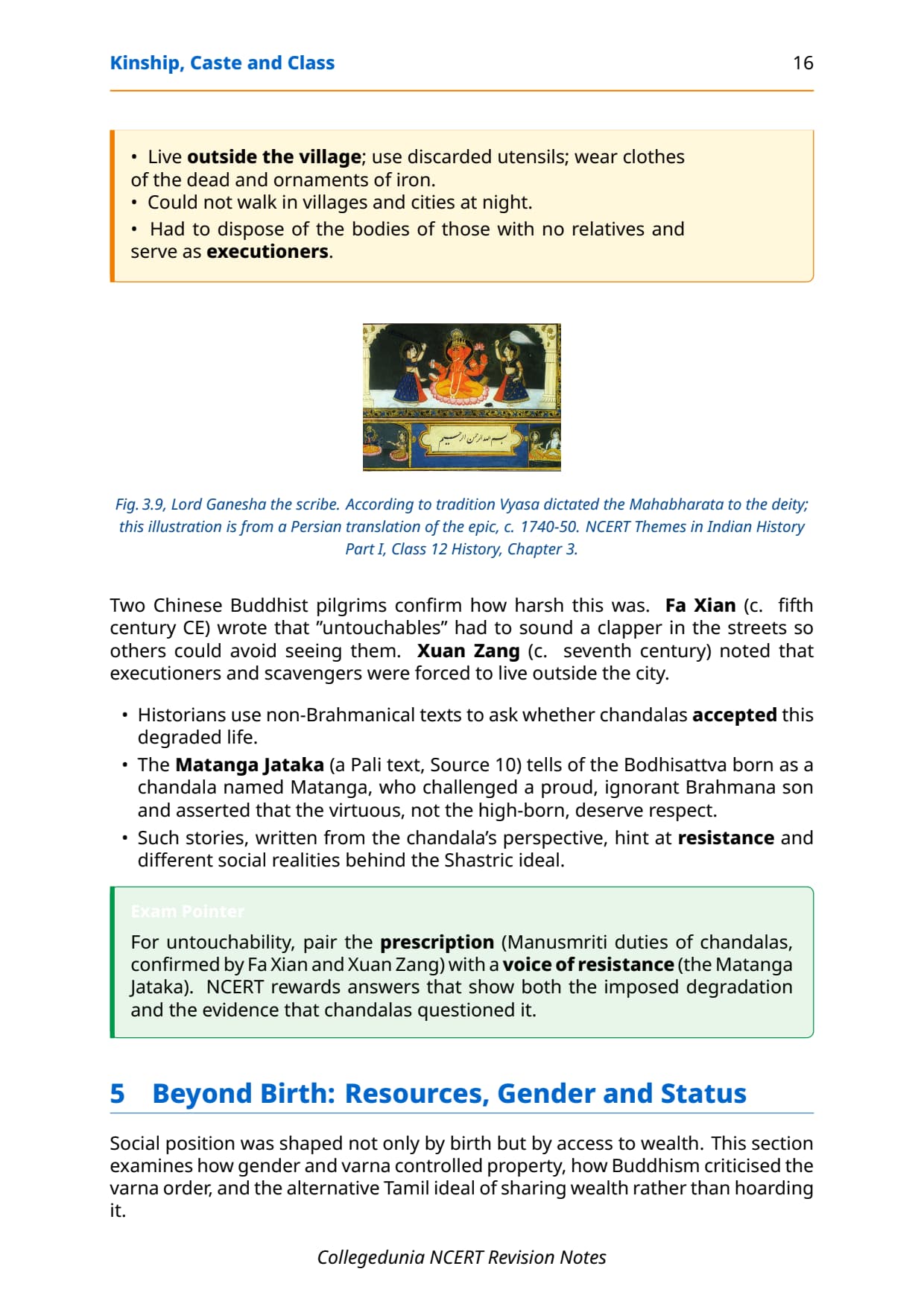
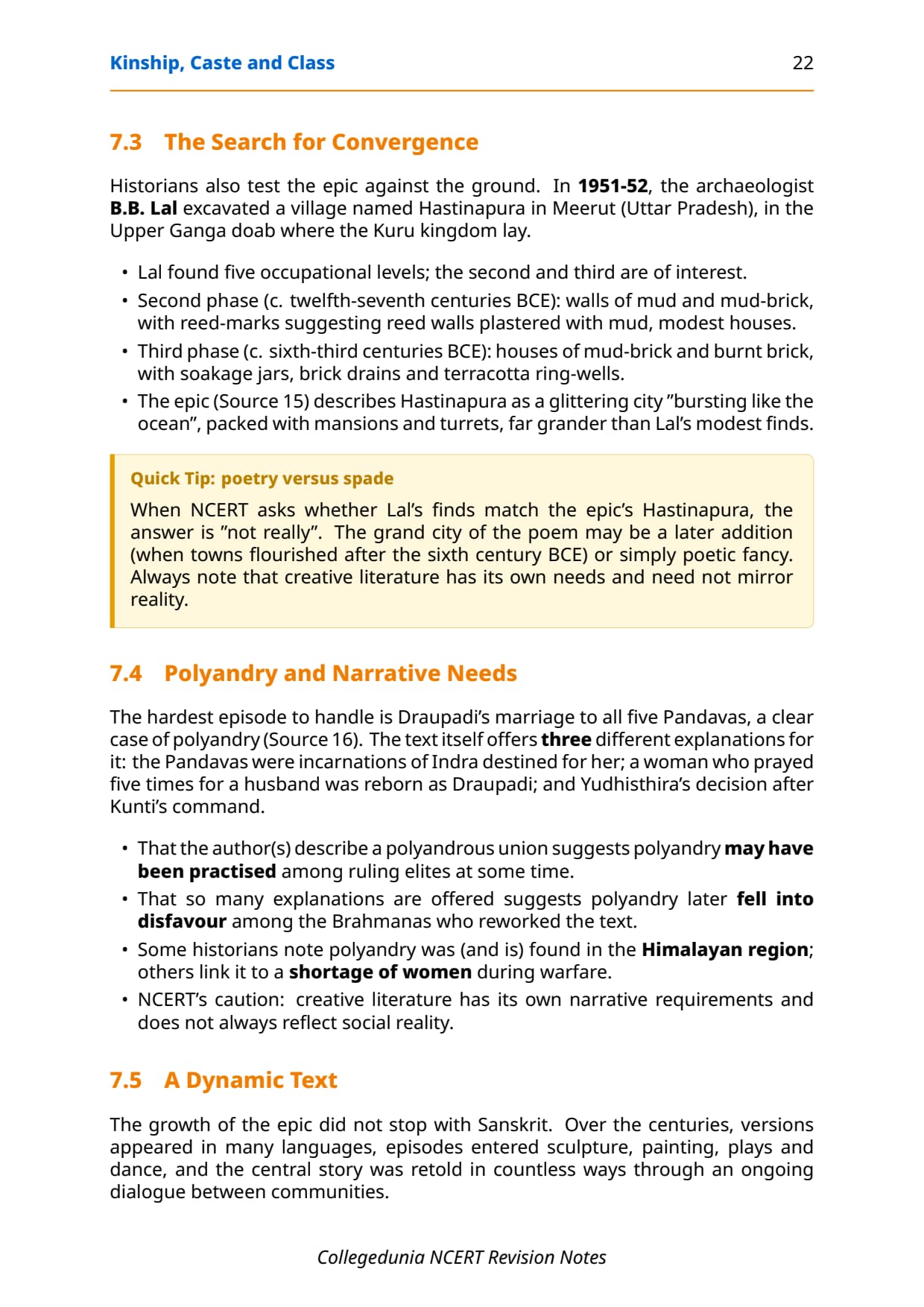
One sharp exam point for your notes: V.S. Sukthankar's Critical Edition (1919 to 1966) found that over half its 13,000-plus pages are variant readings. So many versions imply many hands. Tradition credits the sage Vyasa, but the evidence of phased growth and countless variants shows the epic was the work of many composers. Note that it is still a living, retold text, which is exactly Winternitz's point about it mirroring "the soul of the folk".
Rule Versus Practice: Key Evidence
The chapter's central method is to set the Brahmanical rule against the evidence that it was broken. These notes gather that evidence in one place, since it answers the gotra question and strengthens almost every long answer. Inscriptions matter most because they are independent of the Brahmanical texts.
- Women's gotra names: Satavahana queens kept gotra-derived names like Gotami and Vasithi, their fathers' gotras.
- Same-gotra marriage: some of these women shared a gotra yet married, breaking the rule directly.
- Endogamy: the Satavahanas married within the kin group, against the prescribed exogamy.
- Polyandry: Draupadi's marriage to the five Pandavas is far from the Brahmanical ideal.
The takeaway is simple: the prescriptions were recognised as authoritative, but were questioned and sometimes simply ignored. When real names carved in stone contradict the rule, you have hard evidence that the norm was not always obeyed, which is the exact point examiners want in Question 3.9.
Kinship, Caste and Class Important Questions and Exam Pointers
CBSE sets a steady mix of source-based, short and long answers from this chapter. Knowing the pattern helps students decide how much to write and which topics to revise first. A focused list of chapter 3 history class 12 important questions saves a lot of time before the board exam.
- Source-based (often 8 marks): a passage on the Drona-Ekalavya story, the Purusha sukta, or Draupadi at dice.
- Long answer (5 to 6 marks): the single-author debate, gender differences, or the Buddhist social contract.
- Short answer (3 marks): patriliny, the gotra rule, or non-Kshatriya kings.
- Objective and MCQ: dates, dynasty names, and who composed which source.
For quick recall, students often practise a short class 12 history chapter 3 mcq drill and a list of class 12 history chapter 3 important questions. The most repeated items are the single-author debate and the gender differences essay, so keep those answer points ready in your own words. Reading these Kinship, Caste and Class notes once, then writing the key lists from memory, is the fastest way to lock the chapter in.
Common Mistakes Students Make in This Chapter
A few errors cost marks every year. Most come from stating the Brahmanical rule as if it were always obeyed, or from giving only one side of a debate. Fixing these five points is the quickest way to lift a score on the long answers, so add them to the end of your revision sheet.
- Saying kings were always Kshatriyas - name the Mauryas, Shungas, Kanvas, Shakas and Satavahanas.
- Treating the gotra and exogamy rules as universal - the Satavahanas broke them.
- Crediting the whole Mahabharata to Vyasa as fact - that is tradition, not historical proof.
- Forgetting to name the source tradition in the Drona, Hidimba and Matanga comparison.
- Calling gender rules absolute - cases like Prabhavati Gupta show some flexibility.
Students who fix these five points usually move from average to high marks. The exam rewards careful wording, so write "the texts prescribed" and "in practice, however" to show you can separate norm from reality. These notes flag each soft point so you can phrase it safely in the answer sheet.
How These Notes Pair with the Solutions and Book PDF
These revision notes summarise the chapter. To prepare fully, students should use them alongside the other resources for the same chapter, all linked in the table below. Read the notes first, then test yourself with the solutions, and open the book PDF whenever you need the original text and figures.
| Resource | Best used for |
|---|---|
| Kinship, Caste and Class NCERT Solutions | Step-by-step answers to all 12 back-exercise questions |
| Kinship, Caste and Class Handwritten Notes | Last-minute, one-shot revision in a scanned notebook style |
| Kinship, Caste and Class NCERT Book PDF | Reading the original NCERT chapter text and figures |
Tip: read these notes first, then attempt the solutions on your own, and only then check the model answers. That order builds memory faster than copying answers straight away.
All Class 12 History Notes by Chapter
The table links the revision notes for every chapter in Themes in Indian History so students can move across the book in one click. Chapter 3 is highlighted.
| Chapter | Notes |
|---|---|
| Chapter 1 | Bricks, Beads and Bones |
| Chapter 2 | Kings, Farmers and Towns |
| Chapter 3 | Kinship, Caste and Class |
| Chapter 4 | Thinkers, Beliefs and Buildings |
| Chapter 5 | Through the Eyes of Travellers |
| Chapter 6 | Bhakti-Sufi Traditions |
| Chapter 7 | An Imperial Capital Vijayanagara |
| Chapter 8 | Peasants, Zamindars and the State |
| Chapter 9 | Colonialism and the Countryside |
| Chapter 10 | Rebels and the Raj 1857 |
| Chapter 11 | Mahatma Gandhi and the Nationalist Movement |
| Chapter 12 | Framing the Constitution |
FAQs on Kinship, Caste and Class Class 12 Notes
Kinship, Caste and Class Class 12 History Notes Common Questions
Ques. Where can I download the Kinship, Caste and Class Class 12 notes PDF?
Ans. You can download the Kinship, Caste and Class Class 12 History notes PDF directly from this page. It is free, follows the 2026-27 NCERT, and covers kinship, the varna order, gender, property and the Mahabharata in a short, point-wise format.
Ques. What does the Kinship, Caste and Class chapter cover for Class 12?
Ans. It covers early Indian society from about 600 BCE to 600 CE, read mainly through the Mahabharata, the Dharmashastras and inscriptions, including patriliny and the gotra, the varna and jati order, non-Kshatriya kings, gender and property, and how the epic was built up over a thousand years.
Ques. Which topics are most important in class 12 history chapter 3 for the board exam?
Ans. The single-author debate on the Mahabharata, the importance of gender differences, and the evidence that Brahmanical kinship rules were not always followed are the most-asked long answers. These three top every list of class 12 history chapter 3 important questions, so revise them first.
Ques. Why were kings in early India not always Kshatriyas?
Ans. Because political power went to whoever could gather support and resources, not to Kshatriya birth. The Mauryas were of disputed origin, the Shungas and Kanvas were Brahmanas, the Shakas were outsiders, and the Satavahanas claimed Brahmana status, all against the Shastric rule.
Ques. How should I use these notes to revise quickly?
Ans. Read the notes once under the kinship, caste and class frame, keep all dates, dynasties and source names on one sheet, then write the key lists from memory. Finish by attempting a short class 12 history chapter 3 mcq drill to test the small facts.



Comments