History Mentor, Sri Venkateswara College | Updated on - Jul 21, 2026
The NCERT Solutions for History Class 12 NCERT Solutions Chapter 2 Kings, Farmers and Towns cover every textbook question on early states and economies, as per the latest 2026-27 CBSE syllabus. Each answer is based on the inscriptions, coins and texts that historians use to study the period from about 600 BCE to 600 CE. These solutions help students prepare for the Class 12 History board paper and the UPSC foundation in 2026-27.
Covers all 12 exercise questions from Theme 2, with full source-based and long-answer points.
This Class 12 History chapter usually carries 6 to 8 marks per board paper.
Pairs with the Notes, Handwritten Notes and NCERT Book PDF linked lower on this page.
Every solution for class 12 history chapter 2 in this Collegedunia compilation is curated by subject experts, written from the official NCERT Themes in Indian History Part I, and checked against the last five years of CBSE board papers.
Student Feedback: In a Collegedunia poll of 10,920 Class 12 History students conducted before the 2026 boards, 72% of students rated the Mauryan administration and "problems faced by epigraphists" questions as the hardest part of Kings, Farmers and Towns. Most students said tagging each feature to its source, inscription, coin or text, made the answers click.
Source: 2026-27 Class 12 History student poll. Sample of 10,920 students from CBSE schools across 14 states.
What the Kings, Farmers and Towns Class 12 Chapter Is About
Kings, Farmers and Towns is the second chapter of Themes in Indian History Part I. It studies early states and economies across roughly a thousand years, from about 600 BCE to 600 CE. The chapter opens after the Harappan cities have faded and traces how new states, farming and towns grew across the subcontinent. Unlike Chapter 1, this period does have written records, so the evidence is richer.
The title names the three big threads the chapter follows:
Kings point to the mahajanapadas, the Mauryan Empire and post-Mauryan notions of kingship.
Farmers point to the spread of plough farming, irrigation and growing differences in the countryside.
Towns point to the rise of cities, craft production, coins and long-distance trade.
Holding these three threads in mind helps a student connect almost any question in chapter 2 history class 12 to one of them. A second key idea runs through the whole chapter: historians read inscriptions, coins and texts together to reconstruct this past. This is why history 12 class chapter 2 revision works best when you sort every fact under kings, farmers or towns, and then ask which source it comes from.
The Sixteen Mahajanapadas and the Rise of Magadha
The chapter begins with the sixteen mahajanapadas, the "great realms" that early Buddhist and Jaina texts list from the sixth century BCE. These are the first clear states after the Vedic period, and several exercise questions test their features.
The points students should remember about the mahajanapadas are:
Sixteen states: the lists vary, but Vajji, Magadha, Koshala, Kuru, Panchala, Gandhara and Avanti recur, so they were the most important.
Two kinds of rule: most were ruled by kings, but some, the ganas or sanghas, were oligarchies where power was shared by many rajas. The Buddha and Mahavira belonged to such ganas.
Fortified capitals: each mahajanapada had a capital, often fortified, which needed steady resources.
Norms for rulers: the Dharmasutras said rulers should ideally be Kshatriyas and could collect taxes and tribute from cultivators, traders and artisans.
Among these states, Magadha became the most powerful between the sixth and fourth centuries BCE. Its rise rested on fertile land, iron mines that gave tools and weapons, elephants from the forests, and the river Ganga for cheap transport. Early capital Rajagaha later shifted to Pataliputra, a hub of routes. For the salient-features question, students should name the sixteen, stress the king-versus-gana split, and then add capitals, taxes and armies.
The Mauryan Empire and Its Administration
The Mauryan Empire, founded by Chandragupta around 321 BCE, is the centrepiece of the chapter and the focus of one long question. Historians reconstruct it from Megasthenes, the Arthashastra, later literature and, above all, Asoka's inscriptions. The administration must be described in detail.
Feature
What it shows
Five centres
Capital Pataliputra plus Taxila, Ujjayini, Tosali and Suvarnagiri; all named in Asokan inscriptions.
Not uniform
The empire was too diverse to be ruled the same way everywhere; control was tightest near the hubs.
Army committees
Megasthenes describes a six-sub-committee, thirty-member board for the army, navy and provisions.
Land officials
Officers measured land, inspected irrigation and oversaw artisans and miners; they collected taxes.
Dhamma
Asoka spread dhamma and appointed dhamma mahamattas to carry its message across the empire.
The second half of the question asks which features appear in the Asokan inscriptions. The five centres, dhamma, the dhamma mahamattas and the pativedakas (reporters) are inscription-attested; the army committees and land officials come mainly from Megasthenes and the Arthashastra. Tagging each feature to its source is exactly what earns the marks in Question 2.6, and it is the step our survey found students drop most often.
Farmers, Land and Agricultural Change
The "farmers" thread asks how far farming changed between 600 BCE and 600 CE. The chapter shows real but uneven change, and one exercise question tests exactly this. Students should list the new practices and then qualify how far they spread.
Plough and iron share: from about the sixth century BCE, plough farming with an iron-tipped share turned the heavy alluvial soil of the Ganga and Kaveri valleys.
Transplantation of paddy: growing saplings and replanting them in flooded fields sharply raised rice output, though it meant hard labour.
Irrigation: wells, tanks and, less often, canals raised production; both communities and individuals built them.
Growing differences: the gains were uneven, so gaps widened between large landholders (gahapati), small peasants and landless labourers.
The honest answer to "to what extent" is that practices did change, but the change was uneven and deepened differences in rural society. Early Tamil Sangam texts even name the ranks: vellalar (large landowners), uzhavar (ploughmen) and adimai (slaves). Strong answers in Question 2.9 weigh the change instead of just listing the new tools.
Towns, Coins, Craft Production and Trade
The "towns" thread covers the new cities, their crafts and the coins and trade that linked them. Several short and long answers come from here, including the craft-production comparison with Harappan cities.
Early Historic cities: many grew on trade routes or near rivers; most are still inhabited, so digging is hard.
Craft evidence: fine pottery like Northern Black Polished Ware, plus ornaments, tools and figurines in many materials.
Guilds: craftspeople and merchants organised into guilds, or shrenis, named in votive inscriptions.
Coins: punch-marked silver coins appeared early; later Kushana gold and Roman coins show booming trade.
The craft-production question also asks how this differs from Harappan evidence. For Early Historic cities we have written sources and a readable script, while the Harappan script is undeciphered, and many Early Historic sites are still lived in, unlike the abandoned Harappan towns. Naming these two structural differences is what lifts the answer in Question 2.1 from a plain list into a real comparison.
Notions of Kingship and the Problems of Inscriptions
The post-Mauryan period brought new ideas about kingship, and the chapter also reflects carefully on the limits of its main source, inscriptions. Both feed long answers, and the kingship question is a board favourite.
The main ways kings claimed authority, and the main problems of inscriptions, are:
Divine kingship: the Kushanas set up colossal statues and took the title devaputra, "son of god".
Coins, sculpture and prashastis: Harishena's Prayaga Prashasti praised Samudragupta as superhuman and equal to the gods.
Samanta system: later kings depended on samantas who held local resources and offered military support.
Problems for epigraphists: faint or broken letters, uncertain meaning, low survival, and the bias that records favour the powerful.
On D.C. Sircar's claim that "there is no aspect of life that is not reflected in inscriptions", the balanced answer is that inscriptions reflect a great deal, but not everything, since ordinary people and routine life are often left out. The honest, two-sided reply is what scores best. This is the careful reading the 72% of students in our survey said helped them most.
How Historians Reconstruct Ordinary Lives
Because inscriptions usually speak for kings and donors, historians reconstruct the lives of ordinary people indirectly. This method sits behind one full exercise question and several source-based extracts. The reading runs across stories, inscriptions and digging.
Source
What it reveals
Jatakas and Panchatantra
Popular stories that show the strained tie between kings and the rural poor, like the Gandatindu Jataka.
Inscriptions read closely
Land-grant and votive records name peasants, washerfolk, weavers and scribes in passing.
Buddhist and Sangam texts
They grade rural society: gahapati, vellalar, uzhavar and adimai.
Archaeology
Tools, pottery and the spread of plough farming fill in the material side of daily life.
The key method point is to read royal records "against the grain", picking out the ordinary people who appear only at the edges. Saying this shows the examiner you grasp the method, not just the facts. Question 2.3 rewards a problem-and-solution shape: state that the poor left few records, then show how each source breaks that silence.
Kings, Farmers and Towns Class 12 Exercise-wise Coverage
The chapter exercise has 12 questions. The table maps each one to its topic so students can plan revision and find the right NCERT answer fast. The full step-by-step solution for each sits in the question set lower on this page.
Question
Topic it tests
Q 2.1
Evidence of craft production in Early Historic cities, and how it differs from Harappan cities
Q 2.2
Salient features of the mahajanapadas
Q 2.3
How historians reconstruct the lives of ordinary people
Q 2.4
Source comparison: gifts to the Pandyan chief versus the village of Danguna
Q 2.5
Problems faced by epigraphists
Q 2.6
Main features of Mauryan administration and the Asokan inscriptions
Q 2.7
Discussing D.C. Sircar's claim about inscriptions
Q 2.8
Notions of kingship in the post-Mauryan period
Q 2.9
How far agricultural practices were transformed
Q 2.10 to 2.12
Map work and project-style activities
Questions 2.5, 2.6 and 2.8 are the most-asked long answers, so students preparing chapter 2 history class 12 revision should learn those three first. The map and project tasks (2.10 to 2.12) are also useful for the history project file class 12 chapter 2 that many schools assign.
Students who want the offline copy can save the class 12 history chapter 2 pdf from the download card above and tick off each question as they finish it.
Kings, Farmers and Towns Important Questions and Previous Year Trends
CBSE sets a steady mix of source-based, short and long answers from this chapter. Knowing the pattern helps students decide how much to write. The chapter is a regular source of one 5-mark or 8-mark source-based question, which is why a focused list of chapter 2 history class 12 important questions saves a lot of revision time.
Source-based (often 8 marks): a passage on an Asokan edict, a prashasti or a land grant, with three sub-parts.
Long answer (5 to 6 marks): features of Mauryan administration, or notions of kingship.
Short answer (3 marks): mahajanapadas, craft production, or problems faced by epigraphists.
Objective and MCQ: dates, capital names, coin types, and who issued what.
For quick recall before the exam, students often practise the class 12 history chapter 2 mcq set and a list of class 12 history chapter 2 important questions. The most repeated history class 12 chapter 2 question answer items are the Mauryan administration and the kingship debate, so keep those answer points ready in your own words.
It also helps to attempt a short history class 12 chapter 2 mcq drill and the class 12 history chapter 2 extra questions and answers after you finish the main exercise. These extra sets test the small facts, such as exact dates and capital names, that examiners use for one-mark objective questions.
Working through the ncert solution class 12 history chapter 2 set twice, once open-book and once from memory, fixes those facts well before the board exam.
Common Mistakes Students Make in the Kings, Farmers and Towns Chapter
A few errors cost marks every year in this chapter. Most come from mixing up sources or from listing features without weighing them. Avoiding them is the fastest way to lift a score.
Calling a gana or sangha a kingdom - it was an oligarchy ruled by many rajas.
Crediting all Mauryan features to the inscriptions - the army committees come from Megasthenes, not the edicts.
Treating prashastis as plain fact - they are royal eulogies, written to praise the king.
Saying farming changed completely - the change was real but uneven across regions.
Forgetting that inscriptions favour the powerful - this is the key limit in the Sircar answer.
Students who fix these five points usually move from average to high marks on the long answers. The exam rewards careful wording, so write "may have", "largely" or "scholars suggest" when the evidence is not certain.
Kings, Farmers and Towns PDF Download Formats and Languages
The solutions are free to download in more than one format, so students can pick what suits their device and revision style. The download card at the top of the page carries each option for this chapter.
Normal and HD PDF: the history class 12 chapter 2 pdf is offered in a normal size for quick downloads and an HD version for clear printing.
English medium: all 12 answers are written in simple English for the CBSE board paper.
Question-only set: a print-and-practise sheet of class 12 history chapter 2 extra questions for self-testing.
Whole-book pack: the chapter 2 history class 12 ncert solutions sit in one set that runs through every theme, so you can revise across the book in one place.
Many students search for class 12 chapter 2 history answers on their phone the night before a test, so a saved PDF means you can revise even without internet. Keep both the question set and the solved version handy for a full self-check.
How the Kings, Farmers and Towns Solutions Pair with Notes and the Book PDF
These NCERT Solutions answer the back-exercise questions. To revise the full chapter, students should use them alongside the other resources for the same chapter, all linked in the table below.
Reading the original NCERT chapter text and figures
Tip: read the Notes first, then attempt these solutions on your own, and only then check the model answers here. That order builds memory faster than copying answers straight away.
All NCERT Solutions for Class 12 History Chapter 2 Kings, Farmers and Towns
The table links the NCERT Solutions for every chapter in Themes in Indian History so students can move across the book in one click. Chapter 2 is highlighted.
All NCERT Solutions for Kings, Farmers and Towns with Step-by-Step Solutions
Below are all 12 NCERT exercise questions for this chapter, exactly as they appear in the textbook. Tap Check Solution for the model answer or Expert Solution for the topper-style approach.
Q 2.1
Discuss the evidence of craft production in Early Historic
cities. In what ways is this different from the evidence from Harappan
cities?
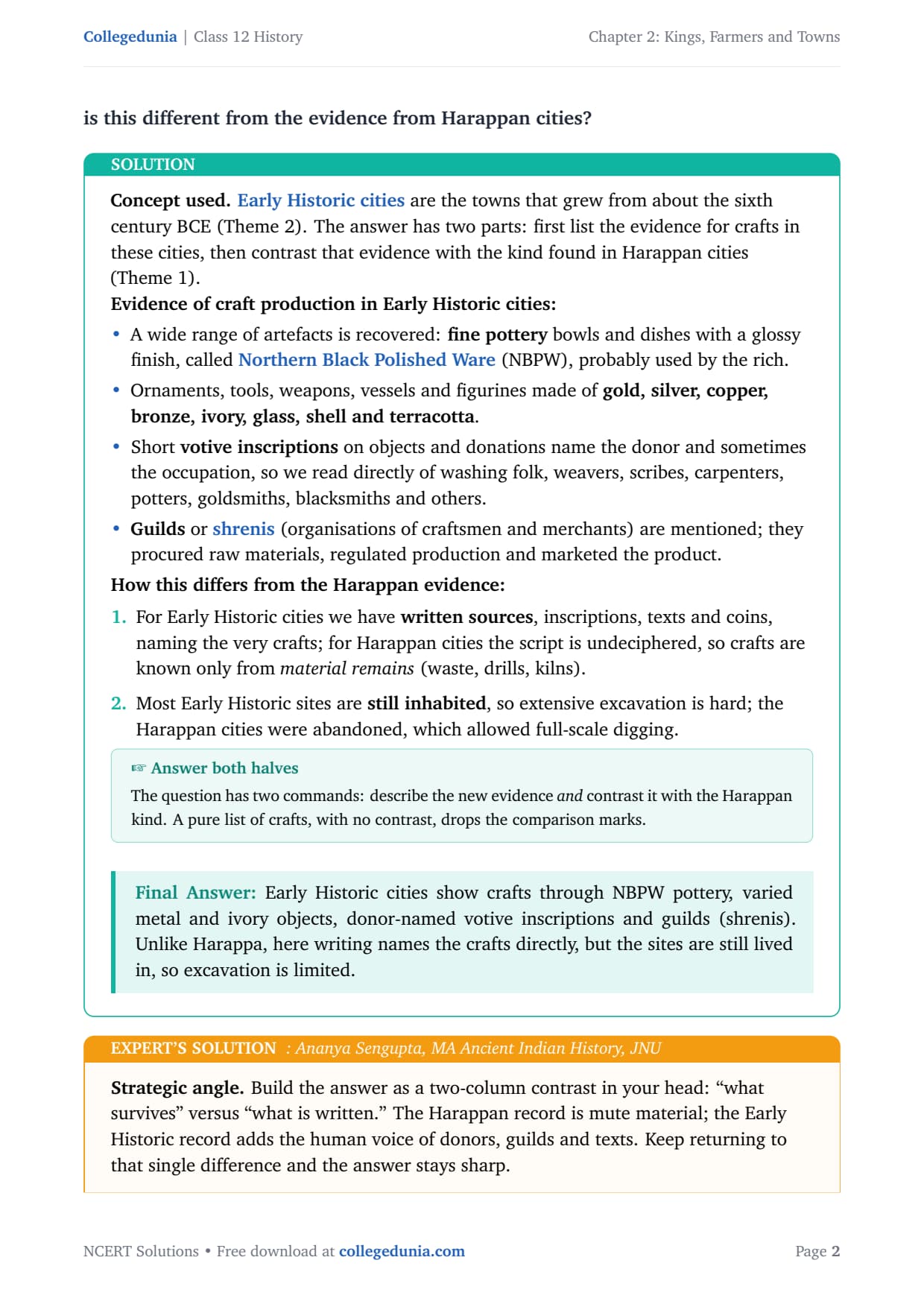
Concept used.Early Historic cities are the towns that
grew from about the sixth century BCE (Theme 2). The answer has two parts:
first list the evidence for crafts in these cities, then contrast that
evidence with the kind found in Harappan cities (Theme 1).
Evidence of craft production in Early Historic cities:
A wide range of artefacts is recovered: fine pottery
bowls and dishes with a glossy finish, called Northern
Black Polished Ware (NBPW), probably used by the rich.
Ornaments, tools, weapons, vessels and figurines made of
gold, silver, copper, bronze, ivory, glass, shell and
terracotta.
Short votive inscriptions on objects and donations name
the donor and sometimes the occupation, so we read directly of
washing folk, weavers, scribes, carpenters, potters, goldsmiths,
blacksmiths and others.
Guilds or shrenis (organisations of craftsmen
and merchants) are mentioned; they procured raw materials,
regulated production and marketed the product.
How this differs from the Harappan evidence:
For Early Historic cities we have written sources,
inscriptions, texts and coins, naming the very crafts; for
Harappan cities the script is undeciphered, so crafts are known
only from material remains (waste, drills, kilns).
Most Early Historic sites are still inhabited, so
extensive excavation is hard; the Harappan cities were abandoned,
which allowed full-scale digging.
Answer both halves
The question has two commands: describe the new evidence and
contrast it with the Harappan kind. A pure list of crafts, with no
contrast, drops the comparison marks.
Early Historic cities show crafts through NBPW pottery, varied
metal and ivory objects, donor-named votive inscriptions and guilds
(shrenis). Unlike Harappa, here writing names the crafts directly, but the
sites are still lived in, so excavation is limited.
AS
Ananya Sengupta
MA Ancient Indian History, JNU
Verified Expert
Strategic angle. Build the answer as a two-column contrast in your
head: ``what survives'' versus ``what is written.'' The Harappan record is
mute material; the Early Historic record adds the human voice of donors,
guilds and texts. Keep returning to that single difference and the answer
stays sharp.
Open with the material finds shared by both periods: pottery,
metal, ivory, glass. This earns the description mark before you
even reach the contrast.
Spotlight what is new: NBPW as a luxury ware, votive
inscriptions that actually name a potter or goldsmith, and the
shreni as an organised craft body. These are absent at Harappa.
Close on the two structural differences: undeciphered script versus
readable inscriptions, and abandoned Harappan sites versus
still-occupied Early Historic ones that block full excavation.
Why this matters. The deeper point is about sources, not
crafts. A top answer shows you grasp that the Early Historic period is the
first time crafts speak for themselves through writing, while the Harappan
crafts must be inferred in silence. That awareness of how evidence itself
changes is exactly the historical skill the question rewards, and it lifts
your script above a plain list of objects.
Both periods leave craft objects in metal, clay and ivory, but
Early Historic cities add written proof: NBPW, donor-named votive
inscriptions and guilds. The contrast is method, readable writing and
living sites here, undeciphered script and abandoned sites at Harappa.
Q 2.2
Describe the salient features of mahajanapadas.
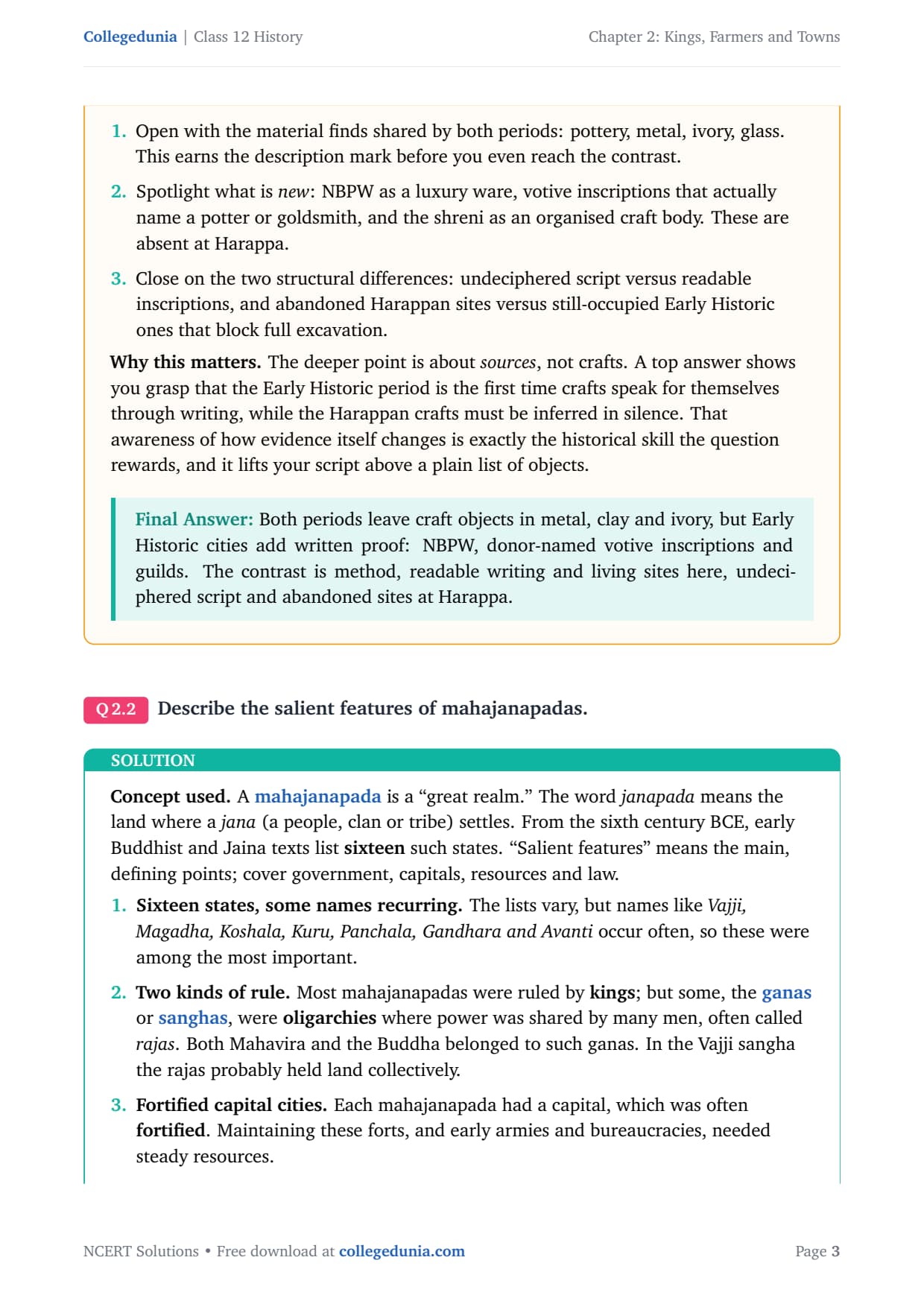
Concept used. A mahajanapada is a ``great realm.'' The
word janapada means the land where a jana (a people, clan or
tribe) settles. From the sixth century BCE, early Buddhist and Jaina texts
list sixteen such states. ``Salient features'' means the main,
defining points; cover government, capitals, resources and law.
Sixteen states, some names recurring. The lists vary, but
names like Vajji, Magadha, Koshala, Kuru, Panchala, Gandhara
and Avanti occur often, so these were among the most important.
Two kinds of rule. Most mahajanapadas were ruled by
kings; but some, the ganas or sanghas,
were oligarchies where power was shared by many men, often
called rajas. Both Mahavira and the Buddha belonged to such
ganas. In the Vajji sangha the rajas probably held land
collectively.
Fortified capital cities. Each mahajanapada had a capital,
which was often fortified. Maintaining these forts, and
early armies and bureaucracies, needed steady resources.
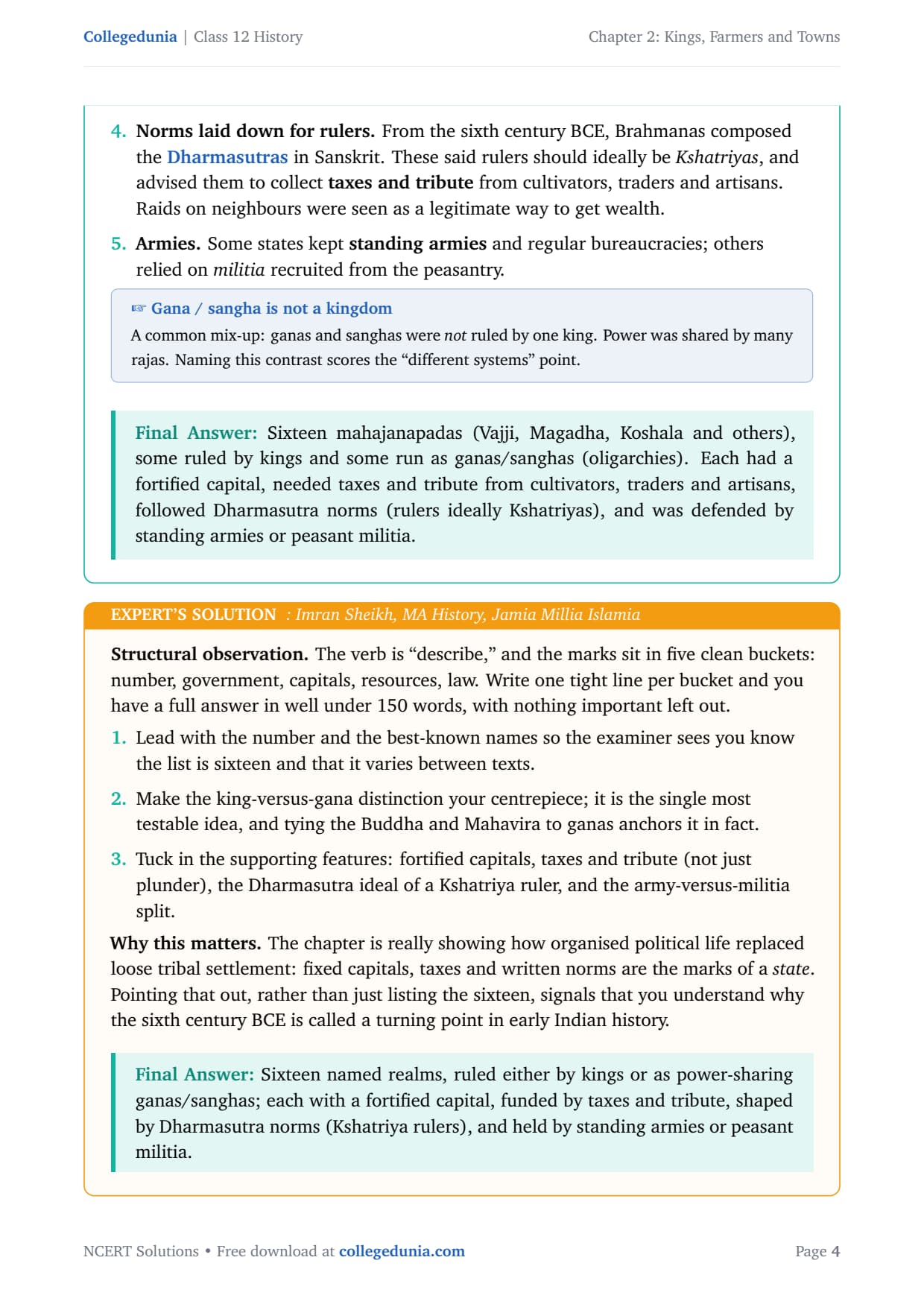
Norms laid down for rulers. From the sixth century BCE,
Brahmanas composed the Dharmasutras in Sanskrit. These
said rulers should ideally be Kshatriyas, and advised them
to collect taxes and tribute from cultivators, traders and
artisans. Raids on neighbours were seen as a legitimate way to get
wealth.
Armies. Some states kept standing armies and
regular bureaucracies; others relied on militia recruited
from the peasantry.
Gana / sangha is not a kingdom
A common mix-up: ganas and sanghas were not ruled by one king.
Power was shared by many rajas. Naming this contrast scores the
``different systems'' point.
Sixteen mahajanapadas (Vajji, Magadha, Koshala and others), some
ruled by kings and some run as ganas/sanghas (oligarchies). Each had a
fortified capital, needed taxes and tribute from cultivators, traders and
artisans, followed Dharmasutra norms (rulers ideally Kshatriyas), and was
defended by standing armies or peasant militia.
IS
Imran Sheikh
MA History, Jamia Millia Islamia
Verified Expert
Structural observation. The verb is ``describe,'' and the marks
sit in five clean buckets: number, government, capitals, resources, law.
Write one tight line per bucket and you have a full answer in well under
150 words, with nothing important left out.
Lead with the number and the best-known names so the examiner sees
you know the list is sixteen and that it varies between texts.
Make the king-versus-gana distinction your centrepiece; it is the
single most testable idea, and tying the Buddha and Mahavira to
ganas anchors it in fact.
Tuck in the supporting features: fortified capitals, taxes and
tribute (not just plunder), the Dharmasutra ideal of a Kshatriya
ruler, and the army-versus-militia split.
Why this matters. The chapter is really showing how organised
political life replaced loose tribal settlement: fixed capitals, taxes and
written norms are the marks of a state. Pointing that out, rather
than just listing the sixteen, signals that you understand why the sixth
century BCE is called a turning point in early Indian history.
Sixteen named realms, ruled either by kings or as power-sharing
ganas/sanghas; each with a fortified capital, funded by taxes and tribute,
shaped by Dharmasutra norms (Kshatriya rulers), and held by standing armies
or peasant militia.
Q 2.3
How do historians reconstruct the lives of ordinary people?
Concept used.Ordinary people, peasants, herders,
labourers, women, rarely left their own records. Inscriptions usually speak
for kings and donors. So historians reconstruct ordinary lives
indirectly, by reading several kinds of source against each other.
Stories and anthologies. Collections such as the
Jatakas (written in Pali, c. mid first millennium CE) and
the Panchatantra began as popular oral tales. The
Gandatindu Jataka, for example, describes the plight of a
wicked king's subjects, elderly people, cultivators, herders and
village boys, attacked by robbers at night and tax collectors by
day, who flee to the forest. Such stories reveal the strained tie
between kings and the rural poor.
Inscriptions, read for the people in them. Land-grant and
votive inscriptions, though commissioned by the powerful, still
name peasants (gramakutumbinas), Brahmanas, washing folk,
weavers, scribes and others, giving glimpses of who lived and
worked in villages and towns.
Texts on rural society. Buddhist texts mention landless
labourers, small peasants and large landholders; the Pali term
gahapati marks the second and third. Early Tamil Sangam
texts name vellalar (large landowners), uzhavar
(ploughmen) and adimai (slaves).
Archaeology. Tools, pottery and the spread of plough
agriculture and irrigation fill in the material side of daily life.
Read sources against the grain
Because the powerful wrote the records, historians must read them
``against the grain'', picking out the ordinary people who appear only at
the edges. Saying this shows you grasp the method, not just the facts.
Historians reconstruct ordinary lives indirectly: from Jataka and
Panchatantra stories, from peasants and workers named in inscriptions, from
Buddhist and Sangam texts on rural ranks (gahapati, vellalar, uzhavar,
adimai), and from archaeology, all read together because ordinary people
left few records of their own.
LM
Lakshmi Menon
MPhil Archaeology, University of Calcutta
Verified Expert
Strategic angle. Frame the whole answer around one problem: the
poor are nearly silent in the record. Then present each source as a
different way to break that silence. That problem-and-solution shape reads
far better than a flat list of sources.
State the difficulty first: ordinary people left almost no records,
and inscriptions favour kings and donors. This sets up everything
that follows.
Bring in the story sources, the Jatakas and Panchatantra, as
windows into village feeling (the Gandatindu Jataka is your sharp
example), then the texts that grade rural society.
Add the indirect readings: people who slip into the margins of
royal inscriptions, plus the archaeology of tools and farming that
no text bothers to mention.
Why this matters. The chapter ends by noting that recent decades
have shifted attention to marginalised groups. Connecting your
method to that wider change, from a history of kings to a history of
everyone, shows you understand not just how ordinary lives are
reconstructed but why historians now bother to try.
By breaking the silence of the poor: Jataka and Panchatantra
tales, the ordinary folk named in passing in inscriptions, Buddhist and
Sangam texts on rural ranks, and the archaeology of tools and agriculture,
all juxtaposed because such people kept few records.
Q 2.4
Compare and contrast the list of things given to the Pandyan
chief (Source 3) with those produced in the village of Danguna
(Source 8). Do you notice any similarities or differences?
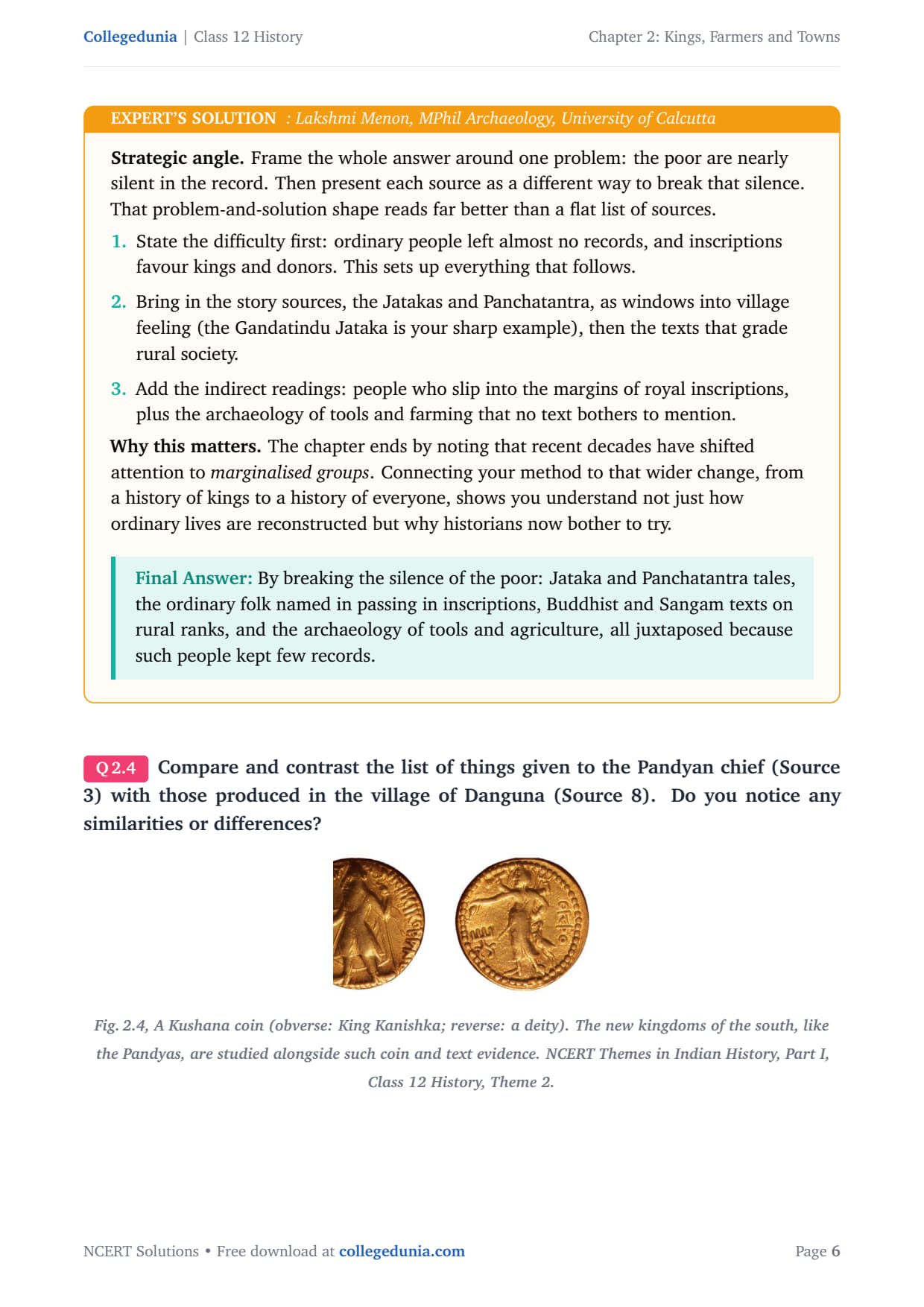
Fig. 2.4, A Kushana coin (obverse: King
Kanishka; reverse: a deity). The new kingdoms of the south, like the
Pandyas, are studied alongside such coin and text evidence. NCERT Themes in
Indian History, Part I, Class 12 History, Theme 2.
Concept used. This is a source-comparison question. You
read two short excerpts, Source 3 (the Silappadikaram, gifts
to the Pandyan chief Senguttuvan) and Source 8 (Prabhavati
Gupta's inscription on the village of Danguna), and set their lists of
things side by side to find what is alike and what differs.
What each source lists:
Source 3 (gifts to the Pandyan chief): mostly
forest produce, ivory, fragrant and sandalwood, deer-hair
fans, honey, red ochre, antimony, turmeric, cardamom, pepper,
coconuts, mangoes, fruits, sugarcane, flowers, areca nut, bananas,
and many wild animals, baby tigers, lions, elephants,
monkeys, bear, deer, peacocks, speaking parrots.
Source 8 (village of Danguna): mainly agricultural
and settled-village produce owed as dues, grass, animal hides,
charcoal, fermenting liquors, salt, mines, khadira trees, flowers
and milk, along with major and minor taxes.
Similarities:
Both are lists of goods owed or given to a person in
authority, a chief in one case, the donee (the teacher
Chanalasvamin) in the other.
Both include some forest and natural products (flowers
appear in both; Danguna's grass, charcoal and hides come from
forest and pasture).
Differences:
Source of the goods. Source 3 is overwhelmingly
wild, forest and hunted produce; Source 8 is mostly the
produce and dues of a settled agricultural village.
Nature of the transfer. Source 3 lists gifts
brought to a chief (chiefs receive gifts); Source 8 lists
taxes, dues and exemptions in a formal land grant
(kings/donees collect dues).
Use the gift-versus-tax contrast
The sharpest mark here is the chief-receives-gifts versus
king-collects-taxes distinction the chapter draws. Name it explicitly to
lift the comparison.
Source 3 is largely forest produce and wild animals given as
gifts to a chief; Source 8 is mostly village and agricultural dues
(grass, hides, salt, milk, taxes) tied to a land grant. Similarity:
both transfer goods to an authority and include some natural produce.
Difference: gift versus tax, and forest versus farmed produce.
MK
Meera Krishnan
MA History, University of Hyderabad
Verified Expert
Strategic angle. Do not just list the two sources separately; the
marks are in the compare-and-contrast. Use a clear two-axis frame:
(a) where the goods come from, forest versus farmed, and (b) how they move,
gift versus tax. Every item then drops neatly onto one axis.
Summarise each list in one phrase, ``forest and wild produce'' for
Source 3, ``village dues and farm produce'' for Source 8, so the
contrast is visible before you give examples.
Pull the similarities first: both are goods flowing to someone in
power, and both touch on nature (flowers, forest items). Honest
comparison needs the overlaps, not only the differences.
Drive home the two differences with the chapter's own categories:
chiefs receive gifts and redistribute them, kings and donees
collect taxes and dues. That single line is worth more than
re-listing every item.
Why this matters. The comparison quietly teaches the difference
between a chiefdom and a state. The Pandyan list is the
economy of a gift-giving forest chiefdom; the Danguna list is the economy
of a tax-collecting agrarian state. Spotting that the two lists embody two
kinds of polity is the insight that turns a tidy comparison into a
top-band answer.
Both lists move goods to an authority and include natural
produce, but Source 3 is wild, forest, gift-economy items for a chief,
while Source 8 is settled-village dues and taxes in a land grant, gift
versus tax, forest versus farm.
Q 2.5
List some of the problems faced by epigraphists.
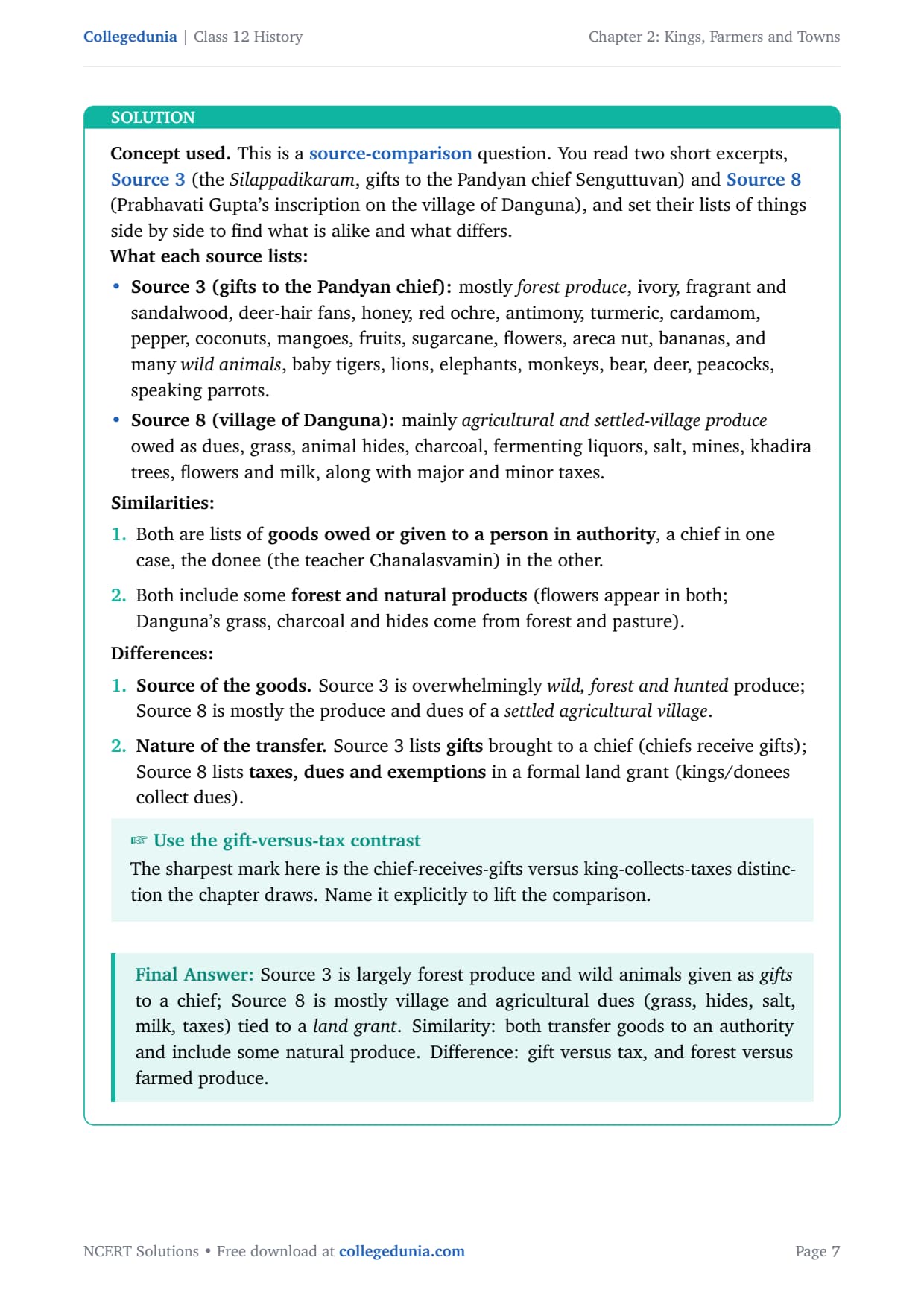
Fig. 2.1, An inscription at Sanchi (Madhya
Pradesh), c. second century BCE. Reading faint, damaged engravings like
this is the epigraphist's daily challenge. NCERT Themes in Indian History,
Part I, Class 12 History, Theme 2.
Concept used.Epigraphy is the study of inscriptions,
and an epigraphist is the scholar who reads them. The chapter's
section on the Limitations of Inscriptional Evidence lists the
problems; group them into technical, interpretive and ``what is missing''
problems.
Technical problems of reading. Letters are sometimes
very faintly engraved, so reconstructions stay uncertain.
Inscriptions may be damaged, with letters
missing.
Problems of meaning. It is not always easy to be sure of
the exact meaning of the words, some of which were
specific to a particular place or time. Scholars constantly
debate alternative readings.
Survival and coverage. Of several thousand inscriptions
found, not all have been deciphered, published or
translated. Many more must once have existed but did not survive
the ravages of time, so what we have is only a fraction of
what was inscribed.
What was never recorded. Not everything significant was
put into inscriptions. Routine matters, ordinary
agriculture and the everyday joys and sorrows of ordinary people,
find no mention; inscriptions focus on grand, unique events.
Bias of viewpoint. An inscription almost always projects
the perspective of the person who commissioned it, so it
must be set beside other sources for a fairer picture.
Sort the problems into types
Do not give a random pile of problems. Group them, technical, meaning,
survival, omission, bias, so the examiner sees a structured answer.
Problems epigraphists face: faint, damaged or missing letters;
uncertain word meanings tied to place and time; many inscriptions still
undeciphered or lost, leaving only a fraction; routine daily life left
unrecorded; and the in-built bias of the commissioner's viewpoint.
SQ
Sara Qureshi
MA Archaeology, Aligarh Muslim University
Verified Expert
Strategic angle. Split the problems into two families and name
them: problems of reading the stone (technical) and problems of
trusting the content (interpretive and what is left out). That
two-family structure reads as expert and is easy to mark.
Reading problems first: faint, broken or missing letters, and words
whose meaning shifts with place and time. These are the hands-on
difficulties at the rock face.
Trust problems next: only a fraction of inscriptions survive and are
published; routine life goes unrecorded; and every inscription
carries the slant of whoever paid for it.
Close with the cure the chapter offers: juxtapose inscriptions with
other kinds of evidence, because epigraphy alone cannot give a full
picture.
Why this matters. This question is really testing whether you can
be a critical reader of sources. D.C. Sircar said inscriptions reflect
every aspect of Indian life, yet this section is the careful counterweight:
even rich sources have limits. Holding both ideas together, inscriptions
are invaluable and incomplete, is the mark of a mature historian and
exactly what earns the top band.
Two families of problems: reading the stone (faint, damaged,
missing letters; uncertain, time-bound meanings) and trusting it (only a
fraction survives, routine life is omitted, the commissioner's bias
dominates), which is why inscriptions must be read alongside other
sources.
Q 2.6
Discuss the main features of Mauryan administration. Which of
these elements are evident in the Asokan inscriptions that you have
studied?
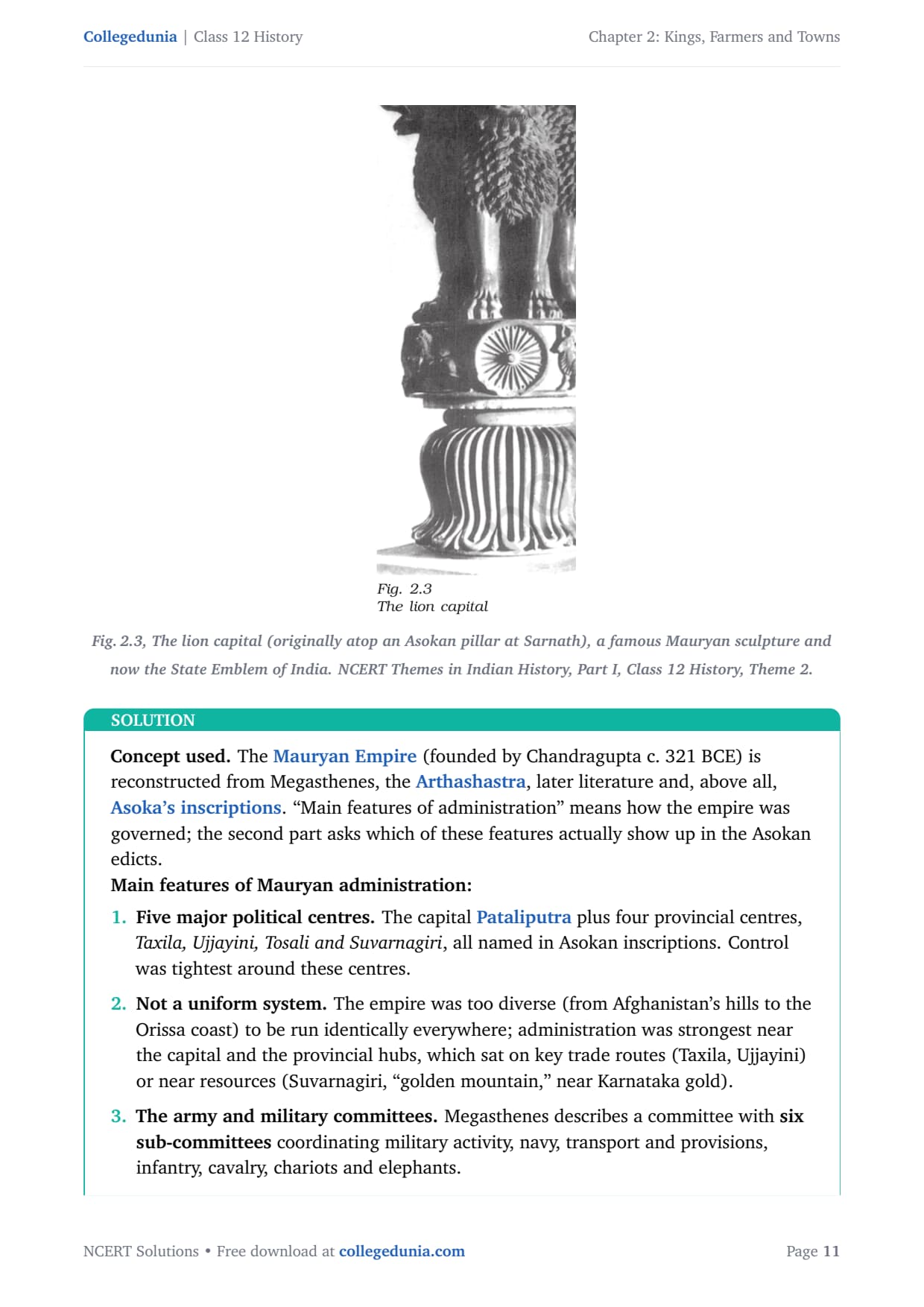
Fig. 2.3, The lion capital (originally atop an
Asokan pillar at Sarnath), a famous Mauryan sculpture and now the State
Emblem of India. NCERT Themes in Indian History, Part I, Class 12 History,
Theme 2.
Concept used. The Mauryan Empire (founded by
Chandragupta c. 321 BCE) is reconstructed from Megasthenes, the
Arthashastra, later literature and, above all, Asoka's
inscriptions. ``Main features of administration'' means how the empire was
governed; the second part asks which of these features actually show up in
the Asokan edicts.
Main features of Mauryan administration:
Five major political centres. The capital
Pataliputra plus four provincial centres, Taxila,
Ujjayini, Tosali and Suvarnagiri, all named in Asokan
inscriptions. Control was tightest around these centres.
Not a uniform system. The empire was too diverse (from
Afghanistan's hills to the Orissa coast) to be run identically
everywhere; administration was strongest near the capital and the
provincial hubs, which sat on key trade routes (Taxila, Ujjayini)
or near resources (Suvarnagiri, ``golden mountain,'' near Karnataka
gold).
The army and military committees. Megasthenes describes a
committee with six sub-committees coordinating military
activity, navy, transport and provisions, infantry, cavalry,
chariots and elephants.
Officials supervising land and labour. Megasthenes says
officers measured land, inspected irrigation sluices, and oversaw
woodcutters, carpenters, blacksmiths and miners; they collected
taxes and could reward or punish.
Communication. Land and riverine routes linked centre to
provinces; journeys took weeks or months, needing provisions and
protection.
Dhamma and its officers. Asoka tried to hold the empire
together by propagating dhamma, and appointed
dhamma mahamattas to spread its message.
Which elements appear in the Asokan inscriptions?
The five political centres are all named in the
inscriptions.
Dhamma and the dhamma mahamattas are proclaimed
in the edicts themselves.
Asoka's concern to govern actively appears in Source 10, where he
says pativedakas (reporters) should bring him news of the
people's affairs at all times.
Match the feature to its source
The second half is what most students drop. For each feature, ask: do we
know it from Megasthenes, the Arthashastra, or the inscriptions? Only the
last counts for ``evident in the Asokan inscriptions.''
Mauryan administration: a capital and four provincial centres
(all named by Asoka), a non-uniform system strongest near these hubs, a
six-fold military committee and officials over land, labour and taxes, road
and river communication, and dhamma spread by dhamma mahamattas. Of these,
the five centres, dhamma, the dhamma mahamattas and the pativedakas appear
in the Asokan inscriptions; the army committees and land officials come
mainly from Megasthenes and the Arthashastra.
VD
Vikram Desai
MA Ancient History, Banaras Hindu University
Verified Expert
Strategic angle. This is a two-part essay, so split it visibly.
First march through administration under clear sub-heads, then add a short
``what the edicts confirm'' section. Tagging each feature with its source as
you go makes the second part almost write itself.
Open with the founding facts (Chandragupta c. 321 BCE, Asoka the
most famous ruler) and the five centres, since the centres are both
the backbone of the system and inscription-attested, so they bridge
both halves of the question.
Walk the administrative machinery in order: the six military
sub-committees (Megasthenes), the land-and-labour officials
(Megasthenes and the Arthashastra), and communication along land
and river routes. Keep noting which source each comes from.
Give dhamma its own beat as Asoka's distinctive integrative tool,
with the dhamma mahamattas, and bring in Source 10's pativedakas to
show the emperor wanted constant reports. These are the clearest
inscription-based elements.
Why this matters. A sharp answer also weighs how powerful
the empire really was: it lasted only about 150 years and never covered the
whole subcontinent, and control was uneven. Saying that the administration
was real but limited, and carefully separating Megasthenes and the
Arthashastra from the edicts, shows the source-critical thinking that the
``which elements are evident in the inscriptions'' clause is designed to
test. That separation is what pushes the essay into the top band.
Cover the five named centres, the uneven non-uniform system, the
six military sub-committees, land-and-labour officials, communication
routes, and dhamma with its mahamattas. Then state which are
inscription-attested (the centres, dhamma, dhamma mahamattas, pativedakas)
versus those known from Megasthenes and the Arthashastra.
Q 2.7
This is a statement made by one of the best-known epigraphists of
the twentieth century, D.C. Sircar: ``There is no aspect of life, culture
and activities of the Indians that is not reflected in inscriptions.''
Discuss.
Concept used. This is an argument essay built on a
quotation. You must discuss Sircar's claim: show how richly
inscriptions reflect Indian life (supporting the statement), then weigh the
limitations (qualifying it). A balanced ``largely true, but with limits''
answer scores best.
In support of Sircar: how much inscriptions reveal:
Political life. Inscriptions record dynasties, titles and
events, Asoka's edicts on dhamma and administration, the
Prayaga Prashasti praising Samudragupta, and Rudradaman's
record on the Sudarshana lake.
Economic life. They mention land grants, taxes and
exemptions (the Danguna grant), irrigation works (the Sudarshana
lake repaired by Rudradaman), trade, guilds and coins.
Social life. Votive inscriptions name occupations, washing
folk, weavers, goldsmiths, scribes, and record donations by women
(Nagapiya, a goldsmith's wife) and by ordinary people.
Religious life. Gifts to Buddhist, Jaina and Brahmanical
institutions, and grants to Brahmanas (agraharas), show belief and
patronage.
Qualifying Sircar: the limits:
Inscriptions focus on grand, unique events; routine
agriculture and the everyday joys and sorrows of ordinary people
find little or no mention.
They carry the bias of the person who commissioned them,
usually the powerful, so many voices are missing.
Many inscriptions are faint, damaged, lost or
undeciphered, so only a fraction of the record survives.
Discuss means weigh both sides
``Discuss'' is not ``prove.'' Give strong evidence for Sircar, then
the chapter's own limits, and end with a measured verdict. A one-sided
answer caps your marks.
Sircar's claim is largely justified: inscriptions reflect
political, economic, social and religious life, from Asoka's dhamma and the
Prayaga Prashasti to land grants, guilds and donations by women and
workers. But it overstates the case: inscriptions favour grand events and
the powerful, omit routine daily life, and survive only in part, so they
must be read with other sources.
AR
Arjun Reddy
MA History, University of Delhi
Verified Expert
Strategic angle. Treat the quotation as a thesis to be tested.
Spend the first two-thirds piling up concrete inscriptional examples across
the four domains of life, then turn and qualify it using the chapter's
``Limitations'' section. The pivot from ``yes, look how much'' to ``but
not everything'' is the spine of a discuss-essay.
Marshal named examples, not vague claims: the Prayaga Prashasti,
the Danguna grant, the Sudarshana lake, Nagapiya's donation. Named
evidence is what proves the ``every aspect'' boast.
Sort them under political, economic, social and religious so the
breadth itself argues for Sircar; breadth is precisely his point.
Then qualify cleanly: routine life and ordinary feeling go
unrecorded, the commissioner's bias dominates, and much is lost or
unread. Three limits are enough.
Why this matters. The examiner wants to see that you can use a
historian's own claim as a lens and still think independently. Affirming
Sircar's breadth while flagging that inscriptions are partial and biased
shows you understand sources are powerful but never complete. That
double-edged judgement, generous yet critical, is the hallmark of a
top-band discuss answer, and it mirrors the chapter's own honest verdict
that epigraphy alone cannot give a full history.
Argue that Sircar is broadly right, inscriptions touch political,
economic, social and religious life, with named proofs, then qualify it:
they privilege grand events and elite voices, skip routine daily life, and
survive only partly, so they need other sources to complete the picture.
Q 2.8
Discuss the notions of kingship that developed in the
post-Mauryan period.
Concept used.Notions of kingship are the ideas a ruler
projected about his own authority. In the post-Mauryan period
(after c. 185 BCE), new chiefdoms and kingdoms arose, and rulers of often
obscure origins found fresh ways to claim high status. Discuss the
main strategies, with examples.
Claiming divine status. The clearest strategy was to
identify with deities. The Kushanas (c. first century BCE
to first century CE), ruling from Central Asia to northwest India,
installed colossal statues of their rulers in shrines (at
Mat near Mathura, and in Afghanistan), suggesting they thought
themselves godlike. Many Kushana kings took the title
devaputra, ``son of god,'' possibly inspired by Chinese
rulers who called themselves sons of heaven.
Projecting power through coins and sculpture. The Kushanas'
notions of kingship are best seen in their coins and
sculpture, which show the ruler in a commanding, divine manner.
Prashastis (eulogies) by court poets. Gupta rulers were
praised in prashastis. In the Prayaga Prashasti,
composed by Harishena for Samudragupta, the king
is called superhuman, ``without an antagonist on earth,'' equal to
the gods Kubera, Varuna, Indra and Yama, and even Purusha,
the Supreme Being.
Kingship resting on samantas. Larger states from the
fourth century (including the Guptas) depended on samantas
who held local resources, offered homage and gave military support.
Powerful samantas could become kings; weak kings could be reduced
to subordination, so kingship was bound up with these relations.
Kings as ``supermen'' from weakness. Some historians argue
kings projected themselves as superhuman because they were
losing control over their samantas, presenting at least a
façade of power.
Anchor each idea to an example
Do not write abstractly about ``divine kingship.'' Tie each notion to a
ruler: devaputra to the Kushanas, the Prayaga Prashasti to Samudragupta.
Named cases earn the marks.
In the post-Mauryan period kings claimed authority by identifying
with gods (Kushanas, title devaputra, colossal statues), by projecting
power through coins and sculpture, and through prashastis like Harishena's
Prayaga Prashasti that made Samudragupta godlike. Kingship also rested on
samantas, and some rulers posed as supermen precisely because their real
control was weakening.
RI
Rohan Iyer
MA Archaeology, Deccan College Pune
Verified Expert
Strategic angle. Organise by strategy of legitimation,
divine identification, visual media (coins/sculpture), poetic eulogy, and
the samanta system, and give each its named example. Listing strategies, not
dynasties, keeps the essay analytical rather than a king-by-king narrative.
Lead with divine kingship, the boldest claim: the Kushana
devaputra title and the shrine statues at Mat and in Afghanistan
are the textbook's strongest case.
Move to the media of projection, coins and sculpture for the
Kushanas, prashastis for the Guptas, with Harishena's praise of
Samudragupta as Purusha and equal of the gods as your centrepiece
quotation.
Close on the political reality beneath the rhetoric: kingship
depended on samantas, and the very grandeur of royal claims may
signal weakening control, the ``façade of power'' reading.
Why this matters. The clever move is to see that these lofty claims
were tools, not facts: rulers of obscure origin used divinity, art
and poetry to manufacture legitimacy. Noting the historians' debate, that
the superman image may reflect insecurity rather than strength, shows you
can read royal propaganda critically instead of taking it at face value.
That critical distance is exactly what turns a descriptive essay into a
top-band ``discuss.''
Post-Mauryan kingship was built through legitimation strategies:
divine identification (Kushana devaputra, colossal statues), projection via
coins, sculpture and prashastis (Harishena on Samudragupta), and dependence
on samantas, with grand superhuman claims possibly masking weakening real
control.
Q 2.9
To what extent were agricultural practices transformed in the
period under consideration?
Concept used. ``To what extent'' asks you to weigh how far
farming really changed between c. 600 BCE and 600 CE. List the new
practices that increased production, then qualify them: the changes were
real but uneven, and they widened differences in rural society.
The transformations (how practices changed):
Plough agriculture and the iron ploughshare. From about
the sixth century BCE, plough farming spread in fertile alluvial
valleys like the Ganga and Kaveri. The
iron-tipped ploughshare turned the heavy alluvial soil in
high-rainfall areas, raising productivity.
Transplantation of paddy. In parts of the Ganga valley,
rice output rose sharply through transplantation (growing
saplings, then replanting them in flooded fields), though this
meant back-breaking labour.
Irrigation. Production was also raised by wells,
tanks and (less often) canals. Both communities and individuals
(often powerful men and kings) built irrigation works and recorded
them in inscriptions (for example, the Sudarshana lake).
The limits (how far the change reached):
The iron plough was not used everywhere. In semi-arid
Punjab and Rajasthan it was not adopted until the twentieth
century; in hilly north-eastern and central tracts people kept to
hoe agriculture, better suited to that land.
Benefits were very uneven. Growing differentiation appeared
among farmers, landless labourers, small peasants (often
gahapatis) and large landholders, with village headmen and
big landowners gaining power. Early Tamil texts likewise name
vellalar, uzhavar and adimai.
Land grants reshaped the countryside. From the early
centuries CE, land grants (often to Brahmanas and
religious institutions) created new rural elites and changed
relations between cultivators and the state.
``To what extent'' needs a verdict
End with a clear judgement: practices changed significantly but
unevenly, helping some and bypassing others. That balanced verdict is
the whole point of an ``extent'' question.
Agriculture changed substantially: the iron ploughshare, paddy
transplantation and irrigation by wells, tanks and canals raised
production. But the change was uneven, the plough skipped semi-arid and
hilly zones, benefits were unequal, and land grants created new rural
elites, so the transformation was real but far from universal.
DN
Devika Nair
MSc Archaeological Science, IIT Gandhinagar
Verified Expert
Structural observation. The phrase ``to what extent'' is doing all
the work. Build two visible halves, the changes and their limits, then
finish with a one-line verdict. A pure list of new techniques, with no
weighing, misreads the question.
Set out the three productivity boosters cleanly: iron ploughshare,
paddy transplantation, irrigation. Tie each to where it worked, the
Ganga and Kaveri valleys, high-rainfall zones.
Immediately qualify with geography: the plough was useless or
unadopted in semi-arid Punjab and Rajasthan and the hilly
north-east, where hoe farming continued. This is the heart of ``to
what extent.''
Add the social dimension: uneven benefits sharpened the gap between
labourers, small peasants (gahapatis) and big landholders, and land
grants minted new rural elites.
Why this matters. The strongest answer reads agriculture not just
as technology but as a social story: the same iron plough that
enriched a Ganga-valley landholder never reached a Rajasthan cultivator,
and land grants quietly redrew who controlled the soil. Showing that the
transformation deepened inequality, rather than spreading evenly, is the
analytical move that earns the top band on an ``extent'' essay.
Considerable but uneven transformation: iron ploughshare, paddy
transplantation and irrigation raised output in fertile, high-rainfall
valleys, but bypassed semi-arid and hilly regions, while unequal benefits
and land grants created new rural elites, so change was significant yet far
from universal.
Q 2.10
Compare Maps 1 and 2, and list the mahajanapadas that might have
been included in the Mauryan Empire. Are any Asokan inscriptions found in
these areas?
Concept used. This is a map-comparison task.
Map 1 shows the early states (mahajanapadas) and their capitals;
Map 2 shows the distribution of Asokan inscriptions. You overlay
the two: which mahajanapada areas fall inside the Mauryan reach, and
whether Asokan inscriptions are found there.
Mahajanapadas likely within the Mauryan Empire. The
Mauryan Empire grew from Magadha and extended very widely
(Chandragupta reached Afghanistan and Baluchistan; Asoka conquered
Kalinga). So mahajanapadas such as Magadha, Koshala, Kashi,
Vajji, Anga, Malla, Vatsa, Chedi, Kuru, Panchala, Matsya,
Shurasena, Avanti, Gandhara and Kamboja would mostly have lain
within or under Mauryan control.
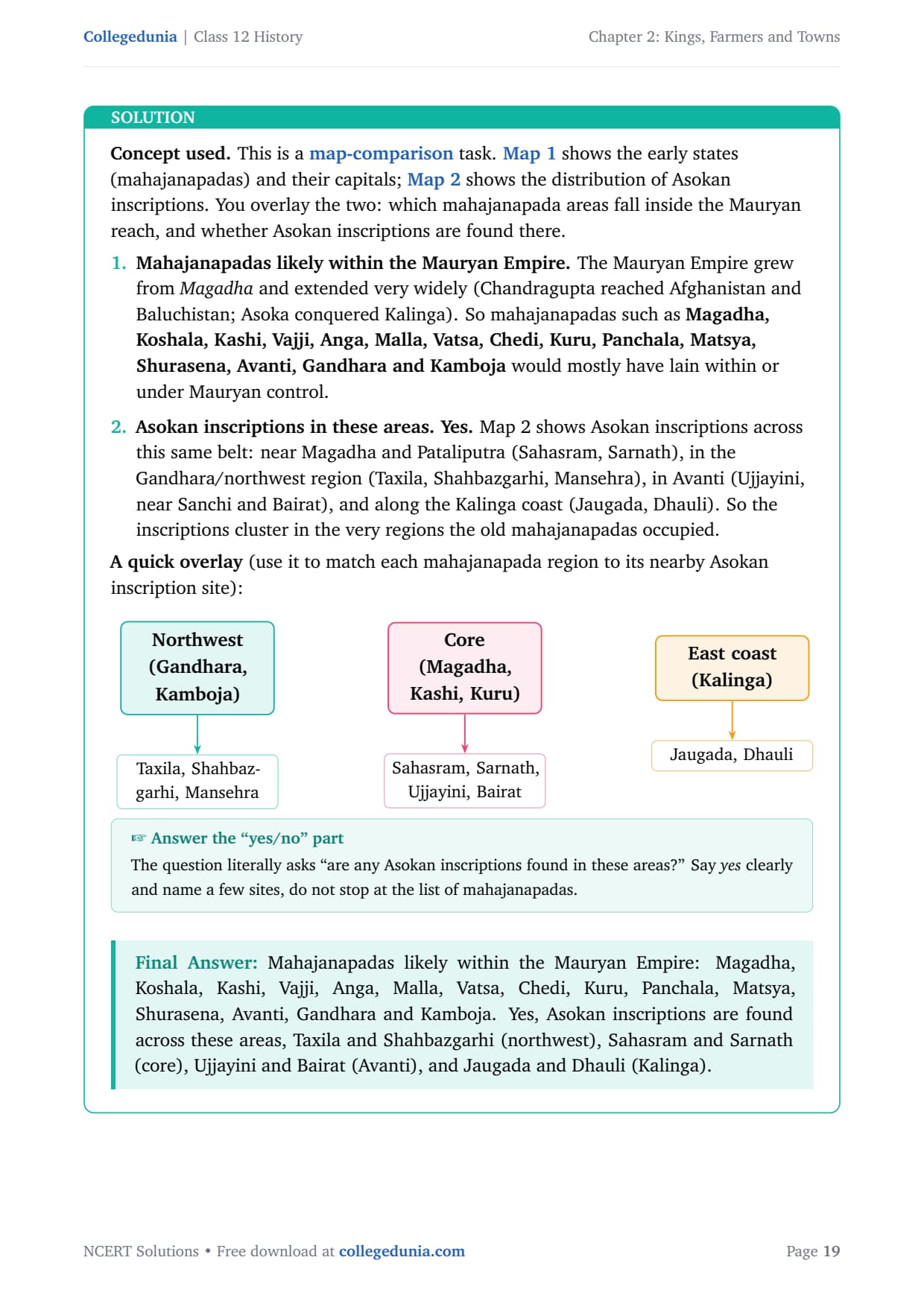
Asokan inscriptions in these areas.Yes. Map 2
shows Asokan inscriptions across this same belt: near Magadha and
Pataliputra (Sahasram, Sarnath), in the Gandhara/northwest region
(Taxila, Shahbazgarhi, Mansehra), in Avanti (Ujjayini, near Sanchi
and Bairat), and along the Kalinga coast (Jaugada, Dhauli). So the
inscriptions cluster in the very regions the old mahajanapadas
occupied.
A quick overlay (use it to match each mahajanapada region to its
nearby Asokan inscription site):
!
[See diagram in the PDF version]
Answer the ``yes/no'' part
The question literally asks ``are any Asokan inscriptions found in these
areas?'' Say yes clearly and name a few sites, do not stop at the
list of mahajanapadas.
Mahajanapadas likely within the Mauryan Empire: Magadha, Koshala,
Kashi, Vajji, Anga, Malla, Vatsa, Chedi, Kuru, Panchala, Matsya, Shurasena,
Avanti, Gandhara and Kamboja. Yes, Asokan inscriptions are found across
these areas, Taxila and Shahbazgarhi (northwest), Sahasram and Sarnath
(core), Ujjayini and Bairat (Avanti), and Jaugada and Dhauli (Kalinga).
PB
Pooja Bhatt
MA Historical Geography, Aligarh Muslim University
Verified Expert
Structural observation. Map comparison is marked on accurate
overlay, not prose. Work in two layers: first read off the mahajanapadas
from Map 1, then lay Map 2's inscription dots on top and see how far they
coincide. The coincidence is the answer.
From Map 1, list the mahajanapadas spanning the northwest to the
east; the Mauryan Empire grew out of Magadha and reached almost all
of them.
From Map 2, place the major rock edicts, minor rock edicts and
pillar inscriptions; note how they ring the same regions, the
northwest, the Gangetic core and the Kalinga coast.
State the match plainly: the inscription sites fall inside
the old mahajanapada belt, so the answer to ``are any found there''
is a confident yes, backed by named sites.
Why this matters. The overlay teaches a real historical point: the
spread of Asokan inscriptions roughly maps the reach of Mauryan power, so
the edicts double as evidence of the empire's extent. But note the careful
limit, inscriptions sit mainly near centres and routes, and the empire was
not uniform, so absence of an edict does not prove absence of control.
Reading both the match and its limits is what lifts a map answer from
mechanical to analytical.
Map 1's mahajanapadas (Magadha, Koshala, Kashi, Kuru, Panchala,
Avanti, Gandhara and more) largely lie within the Mauryan reach, and Map 2
shows Asokan inscriptions across the same belt, Taxila and Shahbazgarhi,
Sarnath and Sahasram, Ujjayini and Bairat, Jaugada and Dhauli, so the
answer is yes.
Q 2.11
Collect newspapers for one month. Cut and paste all the
statements made by government officials about public works. Note what the
reports say about the resources required for such projects, how the
resources are mobilised and the objective of the project. Who issues these
statements, and how and why are they communicated? Compare and contrast
these with the evidence from inscriptions discussed in this chapter.
Concept used. This is a project (sources comparison).
There is no single correct answer; you are marked on how carefully you
collect modern statements about public works and compare them
with ancient inscriptions about similar works (like the
Sudarshana lake repaired by Rudradaman). The guide below shows how to
gather and compare.
Collect for a month. Cut out every newspaper statement by
government officials about public works, roads, dams, canals,
bridges, irrigation, schools. Paste each with its date and source.
Note four things per report. (a) the resources
required (money, labour, materials), (b) how they are
mobilised (budget, contractors, taxes), (c) the
objective, and (d) who issues the statement and
how/why it is communicated (press, to inform or take
credit).
Compare with inscriptions. Set these beside the chapter's
inscriptions. Similarities: both record public works and
often the ruler's or government's role and credit. Differences:
inscriptions are permanent records on stone or copper, usually
glorifying one ruler, and reach few people; newspapers are
printed daily, reach a mass public, and can be questioned by an
independent press.
Build a comparison table
Use a two-column table, ``today's newspaper'' versus ``ancient
inscription'', for each feature (resources, mobilisation, purpose, who
speaks). A table makes the compare-and-contrast easy to mark.
Collect a month of newspaper statements on public works; for each
note the resources, how they are mobilised, the objective, and who
communicates them and why. Then compare with the chapter's inscriptions:
both record public works and the ruler's role, but inscriptions are
permanent, ruler-glorifying and reach few, while newspapers are daily,
public and open to scrutiny.
NV
Nikhil Verma
MA Museology, MS University of Baroda
Verified Expert
Strategic angle. Treat a modern newspaper as a future
historian's ``inscription'' and read it the same critical way: who speaks,
what is claimed, what is left out. That mindset turns a scrapbook exercise
into a real source comparison.
Organise the cuttings by project type (roads, water, buildings) and
log the four required details for each in a prepared table.
For the comparison, focus on function and bias: both
media announce works and credit those in power, but one is carved
for permanence and prestige, the other printed for a mass, sceptical
public.
Conclude on communication: an inscription's ``public'' was tiny
and mostly illiterate (as the chapter notes for Asoka's edicts),
while a newspaper assumes wide literacy and public debate.
Why this matters. The project drives home the chapter's core lesson
about reading sources critically: every record, ancient or modern, carries
the slant of whoever made it. Seeing a government press note as a
present-day prashasti makes the idea of source-bias concrete and memorable.
Gather and tabulate a month of official public-works statements
(resources, mobilisation, objective, communicator), then compare them with
the chapter's inscriptions as sources, both announce works and credit the
powerful, but differ sharply in permanence, reach and openness to
scrutiny.
Q 2.12
Collect five different kinds of currency notes and coins in
circulation today. For each one of these, describe what you see on the
obverse and the reverse (the front and the back). Prepare a report on the
common features as well as the differences in terms of pictures, scripts
and languages, size, shape and any other element that you find significant.
Compare these with the coins shown in this chapter.
Concept used. This is a project (numismatics).
Numismatics is the study of coins, their images, scripts, metal
and find-context. There is no single right answer; you observe five modern
notes and coins and compare them with the chapter's ancient coins (the
punch-marked, Kushana, Yaudheya and Gupta coins).
Collect five. Choose a spread of present-day coins and
notes of different denominations, materials and sizes.
Describe each, obverse and reverse. For every piece note
what is on the front and back: portraits or emblems,
figures, scripts and languages, numerals, the issuing authority,
plus size, shape and metal or paper.
Report common features and differences. Common: all carry
the issuer's name or emblem, a value, and scripts. Differences:
denomination, material, size, languages used and the images chosen.
Compare with the chapter's coins. Similarities: ancient
coins too bore symbols, scripts and the issuer's identity
(punch-marked symbols; the Indo-Greeks were the first to put kings'
names and images on coins; Kushana gold matched Roman
weights). Differences: ancient coins were hand-struck in
gold, silver and copper with one or few languages, while modern
money is machine-made, multilingual, and includes paper notes.
Coins are political messages
Then as now, what a coin shows, a king, a deity, an emblem, is a deliberate
message about authority. Noticing this link between the ancient and modern
coin is the heart of the project.
Collect five modern coins and notes, describe the obverse and
reverse of each (images, scripts, languages, size, material, issuer), and
report common features (issuer, value, scripts) and differences
(denomination, material, language). Compare with the chapter's ancient
coins: both use symbols, scripts and issuer identity to project authority,
but ancient coins were hand-struck metal while modern money is machine-made
and includes paper notes.
TJ
Tara Joshi
MA Art History, Visva-Bharati University
Verified Expert
Picture-first. Lay each modern coin or note beside a chapter coin
and read them like a numismatist: metal, image, script, issuer. The
side-by-side layout does most of the comparison for you and keeps the
report tidy.
Build a uniform record card for all five, obverse, reverse, script,
language, size, material, so the descriptions are consistent and
easy to mark.
For the comparison, pick the chapter's clearest parallels: the
Indo-Greeks first naming and depicting kings on coins (like a modern
portrait note), and the Kushana gold matched to Roman weights (an
early ``international'' standard).
Draw out the continuity and change: coins have always carried an
issuer's identity and a message of authority, but the technology
(hand-struck to machine-minted) and the spread of languages have
moved on.
Why this matters. The project teaches that a coin is a tiny
historical source: numismatists reconstruct trade networks and dynasties
from exactly the features you are recording. Reading today's money the same
way makes the chapter's method, and the idea of continuity and change,
concrete.
Describe five modern coins/notes (obverse, reverse, scripts,
languages, size, material, issuer) on uniform cards, then compare with the
chapter's coins: both broadcast issuer identity and authority through
symbols and scripts, but ancient coins were hand-struck metal and modern
money is machine-made, multilingual and partly paper.
FAQs on Kings, Farmers and Towns Class 12 NCERT Solutions
Kings, Farmers and Towns Class 12 History Common Questions
Ques. Where can I get the class 12 history chapter 2 ncert solutions PDF?
Ans. You can download the Kings, Farmers and Towns Class 12 History NCERT Solutions PDF directly from this page. It is free, follows the 2026-27 NCERT, and answers all 12 exercise questions step by step.
Ques. How many questions are there in class 12 history chapter 2 questions and answers?
Ans. The chapter has 12 exercise questions. Nine are written answers, and the last three (2.10 to 2.12) are map work and project activities used in the history project file class 12 chapter 2.
Ques. Which are the most important questions in history class 12 chapter 2 question answer practice?
Ans. The features of Mauryan administration (Q 2.6), the problems faced by epigraphists (Q 2.5), and the notions of kingship (Q 2.8) are the most-asked long answers. These three top every list of class 12 history chapter 2 important questions.
Ques. What does Kings, Farmers and Towns cover for Class 12?
Ans. It covers early states and economies from about 600 BCE to 600 CE, including the sixteen mahajanapadas, the rise of Magadha, the Mauryan Empire and its administration, coins and trade, agricultural change, and post-Mauryan notions of kingship.
Ques. Why are inscriptions so important in this chapter?
Ans. Because Asokan edicts, prashastis and land grants are the main written sources for the period. Historians read them, along with coins and texts, to reconstruct states and society, while also weighing their limits, since inscriptions usually favour the powerful.
Ques. Is class 12 history chapter 2 hard to score in the board exam?
Ans. No. It is a good scoring chapter if you tag each fact to its source and weigh debates instead of just listing features. Practise the source-based extracts and a few class 12 history chapter 2 mcq sets, and keep the Mauryan administration and kingship answers ready in your own words.








Comments