Political Science Mentor, Jesus and Mary College | Updated 3+ months ago
The NCERT Solutions for Political Science Class 12 Chapter 3 Contemporary South Asia answer every textbook question on India and its seven neighbours, set to the latest 2026-27 CBSE syllabus. Each answer explains the region's mixed record of democracy, the India-Pakistan and India-neighbour disputes, and the role of SAARC and outside powers. These solutions help students prepare for the Class 12 Political Science board paper and the UPSC foundation in 2026-27.
Covers all 10 exercise questions from Contemporary World Politics Chapter 3, with full point-wise answers.
This Class 12 Political Science chapter usually carries 5 to 6 marks per board paper.
Pairs with the Notes, Handwritten Notes and NCERT Book PDF linked lower on this page.
Every solution for Class 12 Political Science Chapter 3 in this Collegedunia compilation is written by subject experts from the official NCERT Contemporary World Politics textbook, and checked against the last five years of CBSE board papers.
Student Feedback: In a Collegedunia poll of 9,040 Class 12 Political Science students taken before the 2026 boards, 68% of students rated the India-Pakistan relations question as the hardest part of Contemporary South Asia. Most students said a clear list of the wars and the peace talks made the long answer easy to recall.
Source: 2026-27 Class 12 Political Science student poll. Sample of 9,040 students from CBSE schools across 13 states.
What the Contemporary South Asia Class 12 Chapter Is About
Contemporary South Asia is the third chapter of Contemporary World Politics. It shifts the focus from global power shifts to our own neighbourhood. South Asia here means the seven countries of Bangladesh, Bhutan, India, the Maldives, Nepal, Pakistan and Sri Lanka. The chapter looks at how democracy has fared in the region and how these countries get along with each other.
The chapter answers three big questions that students must keep in mind:
How healthy is democracy here? The record is mixed, from army rule in Pakistan to a new republic in Nepal.
What divides the region? Disputes over borders, rivers, ethnicity and India's size.
How do these states cooperate? Slowly, through bodies like SAARC and the SAFTA free-trade pact.
So the chapter is really about India and its neighbours, the conflicts between them, and their search for peace. A student who keeps these three threads in mind can connect almost any question in Contemporary South Asia class 12 back to one of them. This is why revision works best when you sort each fact under "democracy", "conflict" or "cooperation" first.
What South Asia Means in This Chapter
Before any conflict or treaty, students must be clear on which countries the chapter calls South Asia. The first exercise question asks you to identify each country from a clue, so knowing one signature fact per nation is the base of the whole chapter.
The seven countries: Bangladesh, Bhutan, India, the Maldives, Nepal, Pakistan and Sri Lanka.
India's place: centrally located, it shares a border with most of the others.
Landlocked states: Nepal and Bhutan have no sea coast.
Shared aim: all the countries want stable democracy, though not all have it.
The chapter is firm that this is a diverse region with mountains, rivers and a shared history, but also deep differences. China and Afghanistan are sometimes included in the wider idea of South Asia, but the seven named states are the core. Fixing these names early makes the identification question (Q1) quick marks.
The Mixed Record of Democracy in the Region
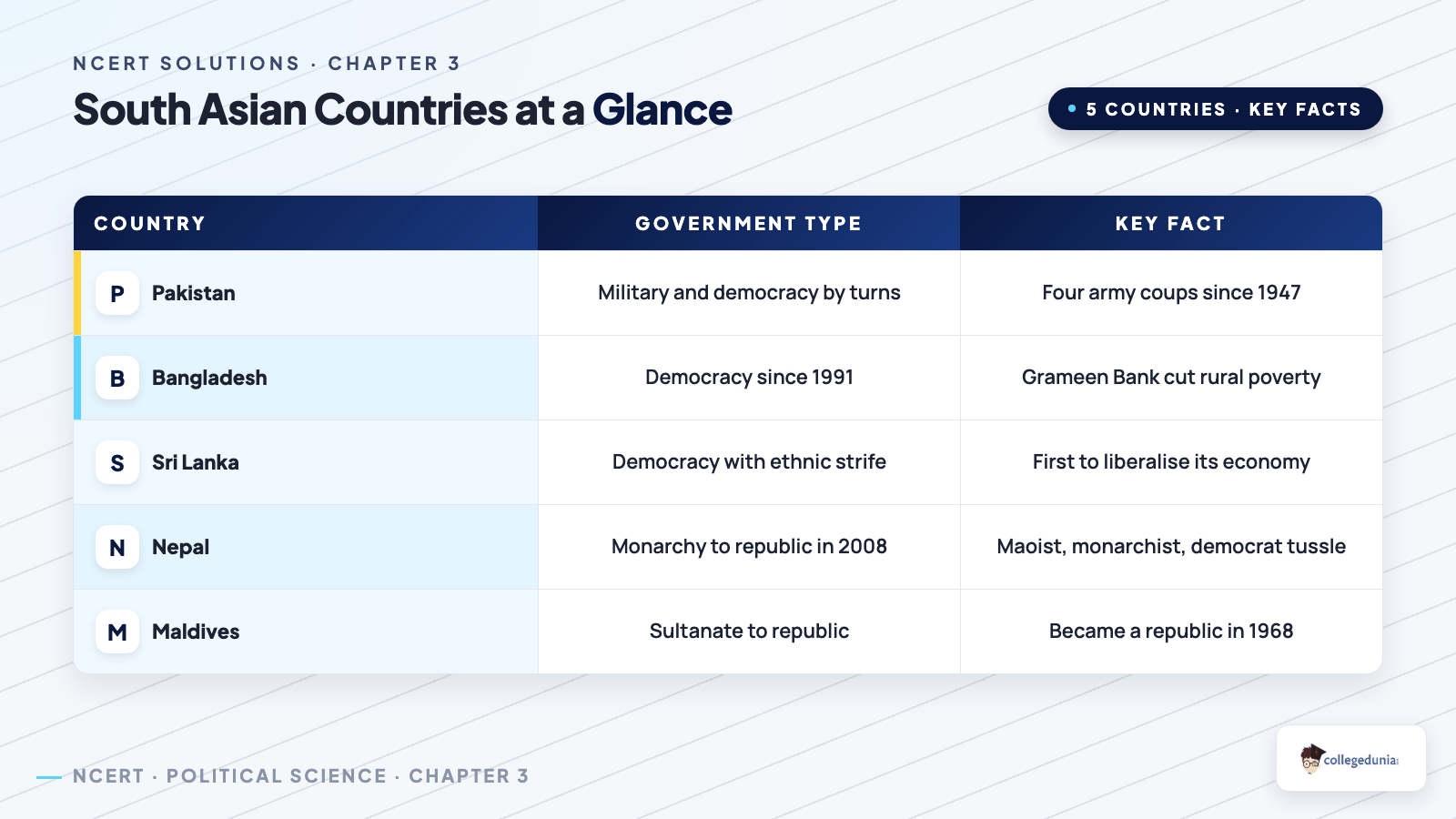
South Asia's record on democracy is uneven, and this is a long-answer favourite. The table below sorts how each country has fared so students can compare them fast in the exam.
Country
Democratic experience to recall
Pakistan
Army rule by turns; four coups by Ayub, Yahya, Zia and Musharraf.
Bangladesh
Won freedom in 1971; democracy has held since 1991.
Nepal
Hindu monarchy to a republic in 2008 after a Maoist movement.
Sri Lanka
A working democracy, but scarred by a long ethnic conflict.
India
Democratic since 1947, the region's most stable system.
A key insight for the exam is that South Asia has a mixed record, not a uniform one. Pakistan swung between army and civilian rule, Nepal and Bhutan were monarchies, while India stayed democratic throughout. This is why the MCQ in Q2 marks the line "all the countries in South Asia are democratic" as wrong.
India and Pakistan: Conflicts and Peace Efforts
The India-Pakistan story is the heart of this chapter and the most-asked long answer. Students should learn the wars and the peace moves as two clear lists, not as a single tangled story. The points below keep them separate.
The core dispute: Kashmir, claimed by both countries since 1947.
The wars: 1947-48, 1965, the 1971 war over Bangladesh, and the 1999 Kargil conflict.
Other frictions: the arms race, the Siachen glacier, and cross-border terrorism.
The peace moves: the 1972 Simla Agreement, the 1999 Lahore bus visit, and trade and travel talks.
The honest exam point is that the two countries have signed agreements but trust is still low. Confidence-building steps like trade links, the Lahore Declaration and people-to-people contact have helped, yet wars, terror attacks and the Kashmir deadlock keep relations fragile. Marks come from giving both the disputes and the agreements before you judge whether the two are on the way to friendship (Q5).
India and Its Other Neighbours
India also has a long history with Bangladesh, Nepal, Sri Lanka and the smaller states. These ties mix cooperation with friction, so the answer needs both sides. The table keeps the cooperation and the disagreements next to each other.
Neighbour
Cooperation and friction to recall
Bangladesh
Work together on trade, disaster relief and the Farakka river-water treaty; differ over illegal migration and border issues.
Nepal
Open border and trade ties; friction over water and at times over Chinese influence.
Sri Lanka
A free-trade pact and close trade; the Tamil ethnic conflict once strained ties.
One sharp point for these questions: India's neighbours often feel its size lets it dominate the region. The chapter notes this "big brother" worry, but it also shows India helping smaller states with trade, aid and disaster relief. So a balanced answer to Q9 says the impression is partly fair but not the full picture.
SAARC, SAFTA and the Role of Outside Powers
The last theme is cooperation. Students must know how SAARC works and why outside powers matter, as both appear in short and long answers. The points below sum up the key facts.
SAARC: the South Asian Association for Regional Cooperation, formed in 1985.
SAFTA: the free-trade pact signed in 2004, in effect from 2006.
Its limits: India-Pakistan tension and the fear of Indian dominance slow real cooperation.
Outside powers: China and the United States both shape the region's politics.
The judgement most answers should reach is that SAARC has helped, but politics holds it back. It has set up free trade in principle, yet rivalry between members keeps trade and travel low. For the outside-powers question (Q8), one clear example, such as China's close ties with Pakistan or the US role as a moderator, is enough to score full marks.
The Contemporary South Asia Class 12 Exercise-wise Coverage
The chapter exercise has 10 questions. The table maps each one to its topic so students can plan revision and find the right NCERT answer fast. The full point-wise solution for each sits in the question set lower on this page.
Question
Topic it tests
Q 1
Identify the country from a clue (8 sub-parts)
Q 2
Wrong statement about South Asia (MCQ)
Q 3
Commonalities and differences between Bangladesh and Pakistan
Q 4
Three challenges to democracy in Nepal
Q 5
The ethnic conflict in Sri Lanka and its resolution
Q 6
Recent India-Pakistan agreements and the friendship question
Q 7
Cooperation and disagreement between India and Bangladesh
Q 8
How external powers influence the region (with an example)
Q 9
Role and limitations of SAARC
Q 10
Whether India dominates and interferes with its neighbours
Questions 5, 6 and 9 are the most-asked long answers, so students preparing Contemporary South Asia class 12 important questions should learn those three first. The identify-the-country and MCQ items (Q1 and Q2) are quick marks, so revise the seven-country facts well to secure them.
Students who want the offline copy can save the class 12 political science chapter 3 pdf from the download card above and tick off each question as they finish it.
Contemporary South Asia Important Questions and Previous Year Trends
CBSE sets a steady mix of MCQ, short and long answers from this chapter. Knowing the pattern helps students decide how much to write. The chapter is a regular source of one 4-mark or 6-mark question, which is why a focused list of Contemporary South Asia important questions saves a lot of revision time.
Long answer (5 to 6 marks): India-Pakistan relations, or the role and limits of SAARC.
Short answer (4 marks): the ethnic conflict in Sri Lanka, or challenges to democracy in Nepal.
Source-based: a passage on India and its neighbours or on outside powers, with sub-parts.
Objective and MCQ: the seven countries, SAARC and SAFTA dates, and the Farakka Treaty.
For quick recall before the exam, students often practise the class 12 political science chapter 3 mcq set and a list of Contemporary South Asia class 12 important questions. The most repeated items are the India-Pakistan wars and the SAARC facts, so keep those answer points ready in your own words.
Working through the ncert solutions class 12 political science chapter 3 set twice, once open-book and once from memory, fixes the dates and country facts well before the board exam.
Common Mistakes Students Make in This Chapter
A few errors cost marks every year in this chapter. Most come from mixing up the countries or giving only one side of the India-neighbour debate. Avoiding them is the fastest way to lift a score.
Saying "all South Asian countries are democratic" - they are not; the record is mixed.
Naming India as the first to liberalise - it was Sri Lanka, a common examiner trap.
Confusing the landlocked states - both Nepal and Bhutan have no sea coast.
Forgetting SAARC began in 1985 and SAFTA was signed in 2004.
Writing that India only fights its neighbours - it also gives trade, aid and disaster relief.
Students who fix these five points usually move from average to high marks on the long answers. The exam rewards a balanced view, so always give both the conflict and the cooperation before you judge any relationship.
Contemporary South Asia PDF Download Formats and Languages
The solutions are free to download in more than one format, so students can pick what suits their device and revision style. The download card at the top of the page carries each option for this chapter.
Normal and HD PDF: the class 12 political science chapter 3 pdf comes in a normal size for quick downloads and an HD version for clear printing.
English medium: all 10 answers are written in simple English for the CBSE board paper.
Question-only set: a print-and-practise sheet of Contemporary South Asia extra questions for self-testing.
Whole-book pack: the solutions sit in one set that runs through every Contemporary World Politics chapter, so you can revise from Chapter 1 onwards in one place.
Many students search for class 12 political science chapter 3 answers on their phone the night before a test, so a saved PDF means you can revise even without internet. Keep both the question set and the solved version handy for a full self-check.
How the Contemporary South Asia Solutions Pair with Notes and the Book PDF
These NCERT Solutions answer the back-exercise questions. To revise the full chapter, students should use them alongside the other resources for the same chapter, all linked in the table below.
Tip: read the Notes first, then attempt these solutions on your own, and only then check the model answers here. That order builds memory faster than copying answers straight away.
All NCERT Solutions for Class 12 Political Science
The table links the NCERT Solutions for every chapter in both Class 12 Political Science books, so students can move across the course in one click. Contemporary South Asia is highlighted.
All NCERT Solutions for Contemporary South Asia with Step-by-Step Solutions
Below are all 10 NCERT exercise questions for this chapter, exactly as they appear in the textbook. Tap Check Solution for the model answer or Expert Solution for the topper-style approach.
Q 3.1
Identify the country: [3pt]
a. The struggle among pro-monarchy, pro-democracy groups and extremists created an atmosphere of political instability:
b. A landlocked country with multi-party competition:
c. The first country to liberalise its economy in the South Asian region:
d. In the conflict between the military and pro-democracy groups, the military has prevailed over democracy:
e. Centrally located and shares borders with most of the South Asian countries:
f. Earlier the island had the Sultan as the head of state. Now, it is a republic:
g. Small savings and credit cooperatives in the rural areas have helped in reducing poverty:
h. A landlocked country with a monarchy:
Concept used. Each clue points to one distinctive feature of a
South Asian country, its form of government, its geography, or a famous
policy. South Asia here means the seven countries named in the chapter:
Bangladesh, Bhutan, India, the Maldives, Nepal, Pakistan and Sri Lanka.
Match the clue to the country whose political history or location fits it.
Nepal. The chapter describes a long triangular tussle
in Nepal among the monarchist forces (pro-monarchy), the
democrats (pro-democracy) and the Maoists (the extremists),
which kept the country politically unstable.
Bhutan. Bhutan is landlocked (no sea coast) and, after
2008, became a multi-party democracy under the leadership of its
king. Note that Nepal is also landlocked, but the clue
multi-party competition fits Bhutan's described change.
Sri Lanka. The chapter clearly states Sri Lanka was
the first country in the region to liberalise the
economy.
Pakistan. Pakistan saw repeated military coups, by
Ayub Khan, Yahya Khan, Zia-ul-Haq and Pervez Musharraf, where
the army prevailed over elected, pro-democracy governments.
India. India is located centrally in the region and is
the only country that shares a border with most of the others.
Maldives. The Maldives was a Sultanate till 1968, when
it became a republic with a presidential form of government.
Bangladesh. The Grameen Bank model of small savings and
credit cooperatives in rural areas helped reduce poverty in
Bangladesh.
Nepal. A landlocked country that was a Hindu kingdom
and then a constitutional monarchy for many years, before the
monarchy was abolished in 2008.
(a) Nepal (b) Bhutan (c) Sri Lanka
(d) Pakistan (e) India (f) Maldives (g) Bangladesh
(h) Nepal.
AI
Ananya Iyer
M.A. Political Science, Jawaharlal Nehru University
Verified Expert
Quick reading. A one-mark identification question rewards
students who can attach one signature fact to each country. Build a
small mental table before you write, geography down one side, type of
government down the other, then drop each clue into the right box.
Government clues. Military over democracy is Pakistan's
story (four generals). Sultanate-to-republic is the Maldives.
Pro-monarchy plus pro-democracy plus extremists is Nepal's
triangular conflict.
Geography clues. Centrally located, borders most others,
only India fits, because of its size and central position the
chapter says it is the only country that borders the rest.
Landlocked plus multi-party is Bhutan; landlocked plus monarchy
is Nepal.
Economy and welfare clues. First to liberalise is Sri
Lanka (a fact the chapter states directly and a favourite
examiner trap, since many wrongly answer India because of 1991).
Small savings and credit cooperatives cutting poverty is the
Grameen Bank of Bangladesh.
Why this matters. The same seven countries reappear through the
whole chapter, so locking down these signature facts early makes every
later answer, on conflict, cooperation and SAARC, faster to write.
(a) Nepal, (b) Bhutan, (c) Sri Lanka, (d) Pakistan, (e) India,
(f) Maldives, (g) Bangladesh, (h) Nepal.
Q 3.2
Which among the following statements about South Asia is wrong? [3pt]
a) All the countries in South Asia are democratic.
b) Bangladesh and India have signed an agreement on river-water sharing.
c) SAFTA was signed at the 12th SAARC Summit in Islamabad.
d) The US and China play an influential role in South Asian politics.
Concept used. A wrong statement is the one that does not
match the facts given in the chapter. Test each option against what the
chapter actually says about the region's politics, treaties and outside
powers, then pick the one that fails.
Option (a) is wrong. The chapter records a mixed
record of democracy. Pakistan has had long spells of military
rule, and Bhutan and Nepal were monarchies for much of this
period. So it is false that all South Asian countries are
democratic.
Option (b) is correct. India and Bangladesh signed the
Farakka Treaty in 1996 for sharing the Ganga waters, a
river-water agreement.
Option (c) is correct. The South Asian Free Trade
Agreement (SAFTA) was signed at the 12th SAARC Summit held in
Islamabad in 2004.
Option (d) is correct. China and the United States
remain key players in South Asian politics, the US as a
moderator in India–Pakistan relations and China through its
partnership with Pakistan.
The wrong statement is (a) ``All the countries in
South Asia are democratic.''
RM
Rohan Mehta
M.A. International Relations, South Asian University
Verified Expert
Strategic angle. Three of the four options are textbook facts
you can verify in seconds; the odd one out uses the word all,
which is almost always a red flag in a politics MCQ. Scan for the
sweeping word first.
Treat (b), (c) and (d) as fact checks: Farakka Treaty 1996 (b),
SAFTA at the 12th SAARC Summit, Islamabad, 2004 (c), US and
China as key players (d). All three hold up.
Option (a) claims every country is democratic. The
chapter spends whole sections on military rule in Pakistan and
monarchy in Nepal and Bhutan, so the universal claim collapses.
By elimination and by the failed universal claim, (a) is the
wrong statement.
Why this matters. The chapter's real message is that democracy
in South Asia has a mixed record but a shared popular support;
remembering that nuance is what lets you reject the all-or-nothing
option instantly.
Option (a) is the wrong statement.
Q 3.3
What are some of the commonalities and differences between Bangladesh and Pakistan in their democratic experiences?
Concept used. The answer compares the post-independence
political journeys of Bangladesh and Pakistan, two countries that were
one state until 1971. Commonalities are shared features of their
experience; differences are where their paths diverged,
especially in the post-Cold War period.
Commonalities:
Both countries were part of a single Pakistan from 1947 to 1971,
and both have experienced both civilian democratic
governments and military rulers.
Both have seen the army intervene in politics, with elected
governments overthrown by military coups, and in both there has
been a strong popular movement and aspiration for democracy.
In both, democracy has had to struggle against powerful groups,
the military, and has faced instability and the assassination of
leaders (Sheikh Mujib and Ziaur Rahman in Bangladesh; the
removal of Bhutto and Sharif in Pakistan).
Differences:
In the post-Cold War period Bangladesh has remained a
democracy: since the fall of General Ershad and the 1991
elections, representative democracy based on multi-party
elections has worked there.
Pakistan began the post-Cold War period with elected
governments under Benazir Bhutto and Nawaz Sharif but suffered a
military coup in 1999 under General Musharraf; it returned
to civilian rule only in 2008.
In Pakistan the social dominance of the military, the clergy and
the landowning aristocracy, and the conflict with India, have
repeatedly toppled elected governments; Bangladesh, after 1991,
moved towards a more stable, settled democratic order.
Commonality: both share a divided record of civilian rule and
military coups and a strong democratic aspiration. Difference:
Bangladesh has stayed a democracy through the post-Cold War years,
while Pakistan slid back into military rule in 1999 and returned to
democracy only in 2008.
SQ
Sana Qureshi
Ph.D. South Asian Studies, University of Delhi
Verified Expert
Structural observation. Answer this in two clean halves,
commonalities then differences, and anchor each point to a
named ruler or year. Examiners reward a comparison that is balanced, not
a one-sided history of either country.
Shared ground. Same parent state until 1971; both
oscillated between elected governments and generals; both carry
a deep popular demand for democracy that keeps resurfacing
despite coups.
The decisive divergence. Trace the timelines side by
side. Bangladesh: military rule of Ziaur Rahman and Ershad,
then mass protest, Ershad steps down 1990, elections 1991,
stable democracy since. Pakistan: democratic 1988–1999, then
Musharraf's coup, army rule, civilian return only in 2008.
The explanation. Name why they diverged, in
Pakistan the army, clergy and landowning elite, plus the
conflict with India, keep pulling power away from elected
leaders; Bangladesh's society did not let the army settle back
in after 1991.
Why this matters. The point of the comparison is not to list
coups but to show that institutions and the balance of social power, not
geography or religion, decide whether democracy survives.
Both share a mixed civilian-military record and a strong
democratic aspiration; they differ in that Bangladesh consolidated
democracy after 1991 while Pakistan relapsed into military rule until
2008.
Q 3.4
List three challenges to democracy in Nepal.
Concept used. A challenge to democracy is any force or
problem that blocks or threatens free, representative government. Nepal's
transition from monarchy to a democratic republic faced several such
obstacles, drawn directly from the chapter.
The monarchy and the army. For years the king, with the
help of the army, kept full control and restricted the spread of
democracy. In 2002 the king even abolished parliament and
dismissed the government, ending the limited democracy that
existed.
The Maoist armed insurgency. The Maoists believed in
armed insurrection against the monarch and the ruling elite.
This led to a violent, at times triangular, conflict among the
monarchist forces, the democrats and the Maoists, which
destabilised the country.
Disagreement over the new constitution and the path
ahead. After 2006 the parties disagreed on key questions, the
role of a nominal monarchy, and the radical social and economic
programmes the Maoists demanded, while mutual suspicion (and
suspicion of India's role) made consensus hard.
Three challenges: (1) the king and army restricting democracy,
even abolishing parliament in 2002; (2) the violent Maoist armed
insurgency; (3) deep disagreement among the parties over the new
constitution and the shape of the future state.
BT
Bikash Thapa
M.A. Political Science, Tribhuvan University
Verified Expert
Strategic angle. Sort Nepal's troubles into three buckets,
an over-mighty crown, an armed rebellion, and a fractured
politics, and you have a complete, well-balanced answer that maps
exactly onto the chapter's narrative.
The crown. The king repeatedly clawed back power; the
2002 dissolution of parliament is the sharpest example of the
monarchy itself blocking democracy.
The gun. The Maoist insurgency turned political
competition into a civil war, the single biggest threat to a
peaceful democratic order through the 1990s and early 2000s.
The table. Even after the 2006 victory, the parties in
the Seven Party Alliance and the Maoists could not easily agree
on the constitution, monarchy's future or social restructuring,
slowing the transition that finally produced the 2015
constitution.
Why this matters. These three challenges explain why Nepal's
move to democracy took so long and why the chapter calls the transition
``almost complete'' rather than finished.
(1) The monarchy and army restricting democracy; (2) the
Maoist armed insurgency; (3) disputes among the parties over the new
constitution and the future state.
Q 3.5
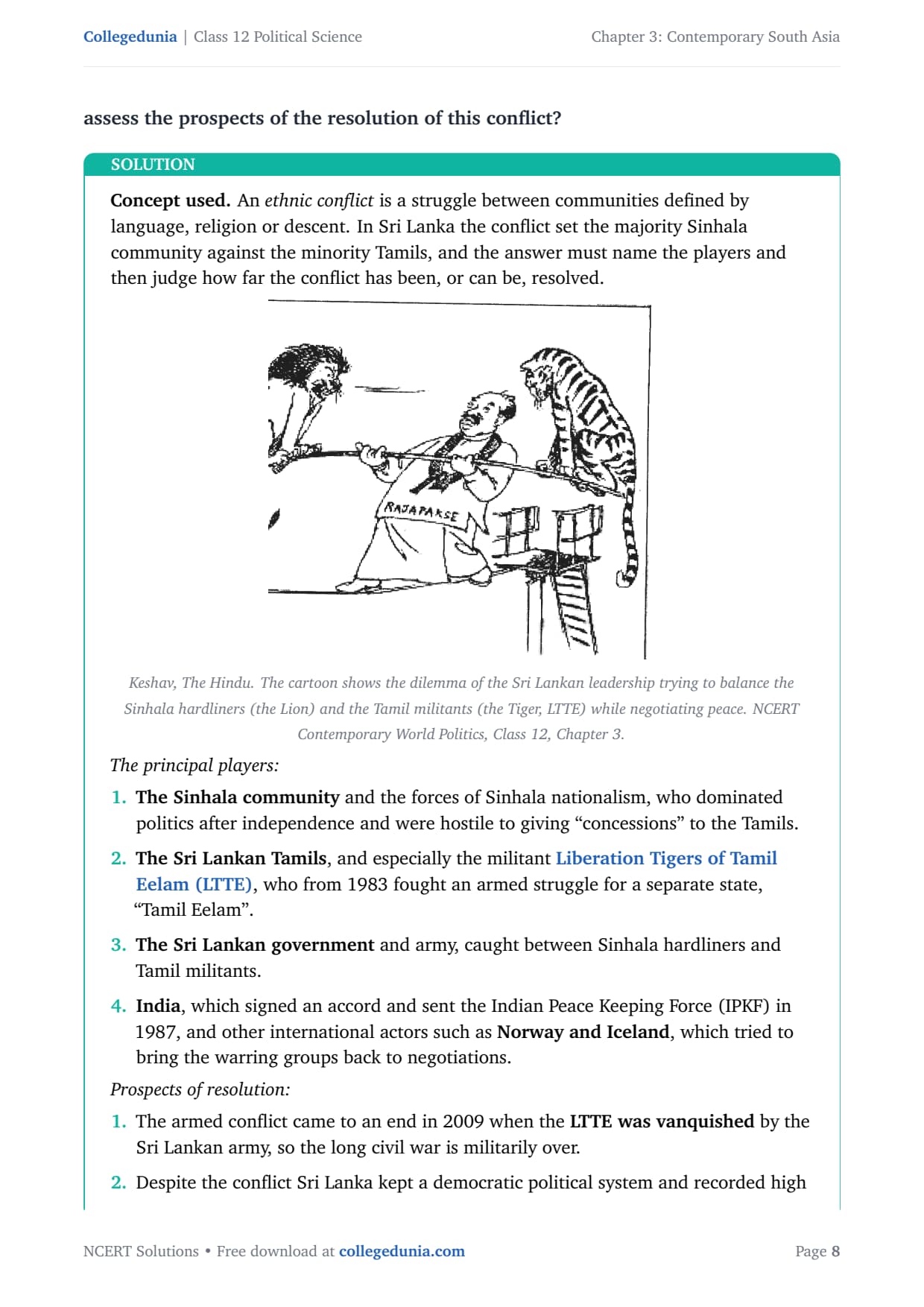
Name the principal players in the ethnic conflict in Sri Lanka. How do you assess the prospects of the resolution of this conflict?
Concept used. An ethnic conflict is a struggle between
communities defined by language, religion or descent. In Sri Lanka the
conflict set the majority Sinhala community against the minority Tamils,
and the answer must name the players and then judge how far the conflict
has been, or can be, resolved.
The principal players:
The Sinhala community and the forces of Sinhala
nationalism, who dominated politics after independence and were
hostile to giving ``concessions'' to the Tamils.
The Sri Lankan Tamils, and especially the militant
Liberation Tigers of Tamil Eelam (LTTE), who from 1983
fought an armed struggle for a separate state, ``Tamil Eelam''.
The Sri Lankan government and army, caught between
Sinhala hardliners and Tamil militants.
India, which signed an accord and sent the Indian Peace
Keeping Force (IPKF) in 1987, and other international actors such
as Norway and Iceland, which tried to bring the warring
groups back to negotiations.
Prospects of resolution:
The armed conflict came to an end in 2009 when the LTTE
was vanquished by the Sri Lankan army, so the long civil war is
militarily over.
Despite the conflict Sri Lanka kept a democratic political
system and recorded high economic growth and human development,
a base on which a lasting settlement could be built.
The deeper challenge remains political, addressing Tamil
grievances and devolving power so that the underlying ethnic
causes do not reignite; a purely military end does not by itself
guarantee a just, durable peace.
Principal players: the Sinhala nationalists, the Sri Lankan
Tamils and the LTTE, the Sri Lankan government, and outside actors
(India's IPKF, Norway and Iceland). Prospects: the armed conflict ended
with the LTTE's defeat in 2009, but a lasting resolution still depends on
politically accommodating Tamil concerns within a democratic Sri Lanka.
PR
Priya Raman
M.Phil. Conflict Studies, Madras Institute of Development Studies
Verified Expert
Picture-first. The cartoon is your whole answer in one frame: a
leader stretched between a Lion (Sinhala hardliners) and a Tiger (the
LTTE). Name the players, then judge resolution honestly, militarily
settled, politically unfinished.
Name the sides cleanly. The two communities are the
majority Sinhala nationalists and the minority Sri Lankan
Tamils, with the LTTE as the Tamils' militant arm; the Sri
Lankan government and army sit in the middle, and India (the
IPKF, 1987) plus the Scandinavian mediators (Norway and Iceland)
are the outside players. Naming all four sets, not just two,
is what separates a full answer from a thin one.
Mark the turning points. Track the timeline: militant
Tamil nationalism grew from the neglect of Tamil concerns; the
LTTE's armed struggle began in 1983; India's IPKF intervened in
1987 and withdrew in 1989 without success; and the war finally
ended with the decisive defeat of the LTTE in 2009.
Assess, do not just narrate. Argue clearly that
defeating the LTTE ended the fighting but not the ethnic
question. Sri Lanka kept its democracy and recorded high growth
and human development right through the civil war, which gives a
platform for peace, yet lasting resolution still needs the
political devolution of power and fair treatment of the Tamil
minority. So prospects depend on politics, not on arms.
Why this matters. A top answer distinguishes ending a war
from resolving a conflict: Sri Lanka achieved the first in 2009
but the second remains a work in progress. The cartoon's leader, pulled
between Lion and Tiger, captures exactly why a one-sided military victory
does not by itself settle a deep ethnic divide.
Players: Sinhala nationalists, the Tamils and the LTTE, the Sri
Lankan state, plus India and Norway/Iceland as mediators. Resolution:
the war ended in 2009 with the LTTE's defeat, but durable peace still
needs a political accommodation of Tamil concerns within a democratic
Sri Lanka.
Q 3.6
Mention some of the recent agreements between India and Pakistan. Can we be sure that the two countries are well on their way to a friendly relationship?
Concept used. The answer lists the confidence-building
measures and agreements that India and Pakistan have used to manage
tension and build peace, and then weighs whether these add up to a
guaranteed friendship. ``Agreements'' here include treaties, peace
declarations and people-to-people steps.
Some recent agreements and steps:
The two countries agreed to confidence-building
measures to reduce the risk of war, including the agreement not
to attack each other's nuclear installations and facilities.
Leaders met at summits, the Lahore bus journey and
Peace Declaration of 1999, and the Agra Summit of 2001, to
understand each other better and seek solutions.
A number of bus routes were opened between the two
countries, trade between them increased, and
visas were granted more easily, alongside the long
surviving Indus Waters Treaty (1960) on river waters.
Can we be sure of friendship?
No, we cannot be sure. Both governments continue to be
suspicious of each other: India blames Pakistan for
aiding Kashmiri militants and terrorist strikes, and Pakistan
blames India for trouble in Sindh and Balochistan.
Core disputes remain unsettled, Kashmir, the Siachen
glacier, Sir Creek, and the chapter notes that ``in recent
times, the situation has changed'', meaning relations remain
fragile and can reverse.
Recent steps include nuclear non-attack and other
confidence-building agreements, the Lahore and Agra summits, new bus
routes, more trade and easier visas. But we cannot be sure of a friendly
relationship: deep mutual suspicion and unresolved disputes like Kashmir
keep the peace fragile.
IK
Imran Khanna
M.A. Diplomacy & Disarmament, Jamia Millia Islamia
Verified Expert
Strategic angle. Split the answer into measures taken and
a sober verdict. The chapter is deliberately hopeful but
cautious, so your assessment should be ``progress, yes; guaranteed
friendship, no.''
List the toolkit of peace. Nuclear non-attack agreement
and other confidence-building measures, summit diplomacy
(Lahore 1999, Agra 2001), reopened bus routes, growing trade,
easier visas, and the durable Indus Waters Treaty.
Give the verdict. Argue that these are
tension-management steps, not a settlement. Mutual
suspicion over cross-border militancy and the unresolved Kashmir,
Siachen and Sir Creek disputes mean the relationship can swing
back, as the chapter's line ``the situation has changed''
signals.
Conclude with balance. The trajectory is positive in
parts but reversible, so certainty of friendship would overstate
the evidence.
Why this matters. Examiners want a reasoned ``no'', backed by
the unresolved disputes, not blind optimism; that judgement is what
turns a list into an answer.
Agreements: nuclear non-attack and other confidence-building
measures, Lahore and Agra summits, bus routes, more trade and easier
visas. Verdict: friendship is not assured, suspicion and the Kashmir
dispute keep the peace fragile.
Q 3.7
Mention two areas each of cooperation and disagreement between India and Bangladesh.
Concept used. The India–Bangladesh relationship mixes
cooperation (areas where the two states work together) with
disagreement (areas of dispute). The answer must give two clear
examples of each, taken from the chapter.
Areas of cooperation:
Economic and trade relations, which have improved
considerably; Bangladesh is part of India's Look East (Act East
since 2014) policy linking India to Southeast Asia via Myanmar.
Disaster management and the environment, where the two
states have cooperated regularly, along with the 2015 exchange
of enclaves that settled part of the boundary.
Areas of disagreement:
Sharing of river waters, the Ganga and the Brahmaputra,
with Bangladesh feeling India behaves like a regional bully over
water.
Illegal immigration and security, India is unhappy over
illegal immigration from Bangladesh and its alleged support for
anti-Indian groups, and over Bangladesh's refusal to let Indian
troops or natural gas pass through its territory.
Cooperation: (1) growing economic and trade ties (Look East /
Act East); (2) disaster management and environmental cooperation, plus
the 2015 exchange of enclaves. Disagreement: (1) sharing of the Ganga and
Brahmaputra river waters; (2) illegal immigration and security, including
transit and natural-gas issues.
TR
Tania Roy
M.A. Political Science, University of Dhaka
Verified Expert
Structural observation. The cleanest way to score full marks is
a four-point answer in two columns: cooperation and disagreement, two
named issues in each. Concrete nouns, rivers, enclaves, immigration,
trade, beat generalities.
Cooperation column. Trade and the Look East / Act East
link is one; disaster-management and environmental cooperation
(with the 2015 enclave exchange) is the second.
Disagreement column. River-water sharing of the Ganga and
Brahmaputra is one; illegal immigration plus security and
transit refusals is the second.
Frame the balance. Note that despite the disputes the
chapter stresses the relationship has improved, so the
net direction is towards more cooperation.
Why this matters. India–Bangladesh ties show how neighbours can
deepen trade and disaster cooperation even while real disputes over water
and migration persist; both sides of the ledger belong in a good answer.
Cooperation: trade/Look East and disaster-management (plus the
2015 enclave exchange). Disagreement: Ganga–Brahmaputra water sharing
and illegal immigration/security and transit issues.
Q 3.8
How are the external powers influencing bilateral relations in South Asia? Take any one example to illustrate your point.
Concept used.External powers are big states from outside
the region, mainly China and the United States, whose interests shape how
South Asian neighbours deal with one another. ``Bilateral relations''
means ties between two countries; the answer shows how an outside power
tilts those ties, then gives one example.
No region exists in a vacuum. The chapter says South
Asia is influenced by outside powers no matter how much it tries
to insulate itself, and that China and the United
States remain key players in South Asian politics.
The United States has good relations with both India
and Pakistan after the Cold War and increasingly works as a
moderator in India–Pakistan relations. Economic reforms
and liberal policies, large South Asian diasporas in the US and
the region's huge markets all deepen American involvement.
China influences relations too: Sino-Indian ties have
improved, but China's strategic partnership with Pakistan
remains a major irritant for India, shaping how India and
Pakistan deal with each other.
One example: In India–Pakistan relations the United
States acts as a moderator. As the cartoon shows, with the US ``umpiring''
between the two, an outside power has come to influence how this most
important bilateral relationship in the region is managed.
External powers, mainly the US and China, strongly shape South
Asia's bilateral relations. Example: the US increasingly acts as a
moderator in India–Pakistan relations (the cartoon shows it as the
umpire), while China's partnership with Pakistan colours India's ties
with both.
DF
Daniel Fernandes
M.A. International Politics, Jadavpur University
Verified Expert
Picture-first. Open with the umpire cartoon: the US sits above
the net deciding India–Pakistan calls. That single image lets you state
the mechanism, an outside power as referee, before you give the example.
State the principle. No region is sealed off from the
world. The chapter says South Asia is influenced by outside
powers and events however much it tries to insulate itself, and
names China and the United States as the two external powers
that matter most.
Show the mechanism. Explain how they tilt
bilateral ties. The US, on good terms with both India and
Pakistan after the Cold War, has slid into the role of
moderator; deeper economic reforms, the large South Asian
diaspora in the US and the region's big markets all increase
American involvement. China works the other way: improving
Sino-Indian ties are offset by China's strategic partnership
with Pakistan, which stays a major irritant for India and so
shapes India–Pakistan calculations.
Land the example. Pick India–Pakistan, the region's most
important pair. The cartoon's US umpire, calling whose court the
ball is in, is the cleanest single illustration of an outside
power refereeing a bilateral relationship.
Why this matters. A strong answer notes both the influence
and its limit: the chapter insists that whether South Asia stays
conflict-prone or becomes a cooperative bloc depends more on the
region's own people and governments than on any outside power. So
external powers shape, but do not control, South Asia, and saying so
shows you have read the chapter's conclusion, not just its middle.
The US and China shape South Asia's bilateral ties; for
example, the US acts as a moderator in India–Pakistan relations (the
umpire in the cartoon), while China's partnership with Pakistan
influences India's stance, though the region's own governments matter
most.
Q 3.9
Write a short note on the role and the limitations of SAARC as a forum for facilitating economic cooperation among the South Asian countries.
Concept used.SAARC (the South Asian Association for
Regional Cooperation) is the region's main body for building cooperation
through multilateral means, working with all member states
together. A ``short note'' should state its role, its main achievement
(SAFTA), and its limitations.
Role of SAARC:
SAARC, begun in 1985, is a major regional initiative by
the South Asian states to build cooperation and friendly
relations through multilateral means.
Its most important economic step is the South Asian
Free Trade Agreement (SAFTA), signed in 2004 and in force from
1 January 2006, which promised a free-trade zone and aims to
lower trade tariffs so the whole region can trade more
freely.
The hope behind SAFTA is that a region which trades more freely
will also cooperate better on political issues.
Limitations of SAARC:
Because of persisting political differences (above all
between India and Pakistan), SAARC ``has not had much success''.
Smaller countries fear SAFTA is a way for India to
``invade'' their markets and influence their societies and
politics through commercial presence.
Some in India feel SAFTA is not worth the trouble, since
India already has bilateral free-trade agreements with Bhutan,
Nepal and Sri Lanka.
Role: SAARC (since 1985) builds multilateral cooperation, and
through SAFTA (2004, effective 2006) aims to lower tariffs and create a
free-trade zone. Limitations: persisting political differences,
especially India–Pakistan, smaller states' fear of Indian dominance, and
Indian doubts about SAFTA have kept SAARC from achieving much.
MN
Meera Nambiar
M.A. Political Science, University of Hyderabad
Verified Expert
Structural observation. The empty-chairs cartoon is the
limitations half drawn for you. Build the note as role then limitations,
with SAFTA as the bridge, what SAARC is trying to do, and why it
keeps falling short.
Role. State plainly what SAARC is and what it tries to
do. Begun in 1985, it is the major multilateral initiative
through which the South Asian states try to build cooperation
and friendly relations together. Its flagship economic move is
SAFTA, signed in 2004 and in force from 1 January 2006, which
lowers trade tariffs to create a region-wide free-trade zone,
on the logic that a region trading freely will cooperate better
politically too.
Limitations. Give three concrete reasons it underachieves.
Persisting political differences, above all between India and
Pakistan, stall progress so the chapter says SAARC has ``not had
much success''; smaller states fear SAFTA lets India ``invade''
their markets and influence their politics; and India itself is
lukewarm because it already has bilateral free-trade agreements
with Bhutan, Nepal and Sri Lanka.
The cartoon's point. Use the empty member chairs as your
closing image: unless the states actually turn up and cooperate,
the forum's promise stays on paper, which is precisely why the
record is judged limited.
Why this matters. SAARC shows that economic logic alone does not
build a regional bloc; without political trust, even a signed free-trade
agreement struggles to deliver. That is exactly why the chapter rates
SAARC's record as limited despite a sound design, the lesson examiners
want you to draw.
Role: a multilateral cooperation forum (since 1985) whose main
economic instrument is SAFTA (signed 2004, effective 2006) to cut
tariffs towards a free-trade zone. Limitations: India–Pakistan and
other political differences, smaller states' fear of Indian dominance,
and India's own doubts have limited its success.
Q 3.10
India's neighbours often think that the Indian government tries to dominate and interfere in the domestic affairs of the smaller countries of the region. Is this a correct impression?
Concept used. The question asks for a balanced judgement,
not a yes or no. We weigh the reasons neighbours feel dominated against
the facts of India's actual conduct and the structural reason (its size
and central location) behind the impression.
Why the impression exists:
Given India's size and power, and because it is located
centrally and borders all the others, the smaller countries are
bound to be suspicious and fear India wants to be a
regionally dominant power.
There are real grievances: Nepal resents alleged
interference and designs on its rivers and access to the sea;
Bangladesh complains India behaves like a ``regional
bully'' over river waters; Sri Lanka disliked the IPKF's
1987 intervention as interference in its internal affairs.
Why the impression is not fully correct:
India often feels exploited by its neighbours in turn,
and after 1987 it shifted to a policy of disengagement
from Sri Lanka's internal troubles, the opposite of constant
interference.
India has helped its neighbours: post-tsunami
reconstruction and a free-trade agreement with Sri Lanka, big
hydroelectric projects and development aid in Bhutan,
and a quick military response in 1988 to save the Maldives
from a coup attempt.
Many disputes flow simply from geography, India is the
only country bordering all the others, so it is naturally
involved in most regional issues, which is not the same as
deliberate domination.
The impression is only partly correct. India's size, central
location and past interventions explain why smaller neighbours feel
dominated, but India has also disengaged (Sri Lanka), given large aid and
help (Bhutan, the Maldives, post-tsunami Sri Lanka) and itself feels
exploited. So the impression is understandable but exaggerated.
VS
Vikram Singh
M.A. Political Science, Banaras Hindu University
Verified Expert
Strategic angle. Treat this as a two-sided debate ending in a
verdict. First grant the neighbours' case, then rebut it with India's
record of help and restraint, then conclude ``partly correct, but
exaggerated''.
Concede the perception. India's sheer size and central
position, plus episodes like the IPKF in Sri Lanka and water
disputes with Nepal and Bangladesh, make the fear of dominance
understandable.
Rebut with evidence. India disengaged from Sri Lanka's
internal troubles after 1987, runs big aid and hydro projects in
Bhutan, rescued the Maldives in 1988 and rebuilt post-tsunami
Sri Lanka, hardly the behaviour of a relentless interferer.
Add the structural point. Because India borders everyone,
it is involved in most disputes by geography, not always by
design, and it often feels exploited by its neighbours too.
Why this matters. The chapter's own ``Indian Hegemony?'' margin
question invites exactly this nuance; the strongest answer neither
defends India blindly nor accepts the bully charge, but judges the
impression understandable yet exaggerated.
Partly correct: the perception is rooted in India's size,
central location and past interventions, but India's aid, restraint and
disengagement show the charge of constant domination is exaggerated.
FAQs on Contemporary South Asia Class 12 NCERT Solutions
Contemporary South Asia Class 12 Political Science Common Questions
Ques. Where can I get the class 12 political science chapter 3 NCERT Solutions PDF?
Ans. You can download the Contemporary South Asia Class 12 Political Science NCERT Solutions PDF directly from this page. It is free, follows the 2026-27 NCERT, and answers all 10 exercise questions step by step.
Ques. How many questions are there in Contemporary South Asia class 12 questions and answers?
Ans. The chapter has 10 exercise questions. They start with an identify-the-country item and an MCQ, then move to short and long answers on democracy in the region, India-Pakistan relations, India and Bangladesh, outside powers and SAARC.
Ques. Which seven countries make up South Asia in this chapter?
Ans. South Asia in this chapter means Bangladesh, Bhutan, India, the Maldives, Nepal, Pakistan and Sri Lanka. India sits centrally and shares a border with most of them, while Nepal and Bhutan are landlocked.
Ques. What is SAARC and when was it formed?
Ans. SAARC is the South Asian Association for Regional Cooperation, formed in 1985 to promote cooperation in the region. Its free-trade pact, SAFTA, was signed in 2004 and took effect in 2006, though India-Pakistan tension still limits how much real trade happens.
Ques. Why is the India-Pakistan relationship so important in this chapter?
Ans. Because it shapes the whole region's politics. The two countries have fought wars over Kashmir in 1947, 1965, 1971 and Kargil in 1999, and signed peace deals like the Simla Agreement and the Lahore Declaration, yet trust stays low. It is the most-asked long answer in the chapter.
Ques. Is class 12 political science chapter 3 easy to score in the board exam?
Ans. Yes. It is a scoring chapter if you keep the seven countries and their facts straight and give a balanced view on India and its neighbours. Practise the identify-the-country item and the SAARC facts, and keep the India-Pakistan points ready for the long answer.








Comments