Political Science Strategist, 6 Yrs | Updated 3+ months ago
The NCERT Solutions for Political Science Class 12 Chapter 4 India's External Relations answer every textbook question on India's foreign policy, set to the latest 2026-27 CBSE syllabus. Each answer explains why Nehru chose non-alignment, how India dealt with China and Pakistan, and what India's nuclear policy was. These solutions help students prepare for the Class 12 Political Science board paper and the UPSC foundation in 2026-27.
Covers all 10 exercise questions from Politics in India Since Independence Chapter 4, with full point-wise answers.
This Class 12 Political Science chapter usually carries 5 to 6 marks per board paper.
Pairs with the Notes, Handwritten Notes and NCERT Book PDF linked lower on this page.
Every solution for Class 12 Political Science Chapter 4 in this Collegedunia compilation is written by subject experts from the official NCERT Politics in India Since Independence textbook, and checked against the last five years of CBSE board papers.
Student Feedback: In a Collegedunia poll of 8,930 Class 12 Political Science students taken before the 2026 boards, 69% of students rated the three-wars "failure or not" question as the hardest part of India's External Relations. Most students said a clear list of who attacked first made the answer easy to argue.
Source: 2026-27 Class 12 Political Science student poll. Sample of 8,930 students from CBSE schools across 13 states.
What the India's External Relations Class 12 Chapter Is About
India's External Relations is the fourth chapter of Politics in India Since Independence. It tells the story of how a newly free India dealt with the world outside its borders. The chapter opens in the tense Cold War after the Second World War, when the globe split into two camps, and explains why Nehru chose non-alignment instead of joining either side.
The chapter answers three big questions that students must keep in mind:
What were India's foreign-policy goals? Sovereignty, territorial integrity and rapid economic development.
How did India deal with its neighbours? Friendship and then conflict with China, and three wars with Pakistan.
What was India's nuclear stand? A peaceful programme, a refusal to sign the NPT, and the 1974 test.
So the chapter is really about how a poor, newly free country found its own voice in world politics. A student who keeps these three threads in mind can connect almost any question in India's External Relations class 12 back to one of them. Sorting each fact under "goals", "neighbours" or "nuclear" first makes revision far faster.
Non-Alignment and Nehru's Three Objectives
After 1947 the world was splitting into a US-led bloc and a Soviet-led bloc. Nehru, who was both Prime Minister and Foreign Minister from 1946 to 1964, refused to join either. This choice, called non-alignment, is the heart of the chapter, so students should learn its aim and its gains clearly.
Preserve sovereignty: keep the freedom to decide India's own external policy.
Protect territorial integrity: guard the borders of the new nation.
Promote economic development: use foreign ties to help a poor country grow fast.
The gain: by staying unaligned, India could take aid from both blocs and judge each issue on its merits.
A key insight for the exam is that non-alignment was not neutrality or running away from world affairs. It was the freedom to choose. India led the world's protest when Britain attacked Egypt over the Suez Canal in 1956, yet did not simply parrot the Soviet line over Hungary the same year. Nehru saw the conduct of foreign relations as the very test of independence, because once those relations pass into someone else's hands, "to that extent you are not independent".
Afro-Asian Unity, Bandung and the NAM
India did not just stay out of the blocs; it tried to build a third path with other newly free nations. This is the topic that explains the Non-Aligned Movement (NAM), a regular short-answer source. The table below sorts the main milestones for fast revision.
Milestone
What it meant
Panchsheel (1954)
Five Principles of Peaceful Coexistence, announced by Nehru and Zhou Enlai on 29 April.
Bandung Conference (1955)
Deepened Afro-Asian contacts; the seed of the Non-Aligned Movement.
NAM founded (1961)
First summit at Belgrade; Nehru was a co-founder alongside Nasser, Tito, Sukarno and Nkrumah.
Goal of NAM
A group of nations that would not tie themselves to either superpower.
One sharp point for the matching question: Panchsheel is the five principles, while Bandung is the meeting that fed into NAM. Students often swap these two, so keep them clearly apart. The chapter shows Afro-Asian unity as Nehru's way of giving small, poor nations a louder voice in a world run by two giants.
India and China: Panchsheel to the 1962 War
India's relationship with China is a long-answer favourite because it swung from friendship to war in just a few years. Students should learn it as a clear sequence, not a story. The friendship of the early 1950s turned into the most painful conflict of Nehru's career.
The friendly start: free India began relations with China "on a very friendly note", sealed by Panchsheel in 1954.
The Tibet issue: the Dalai Lama crossed into India and was granted asylum in 1959, which angered China.
The border dispute: China occupied Aksai-chin and claimed large areas of Indian territory.
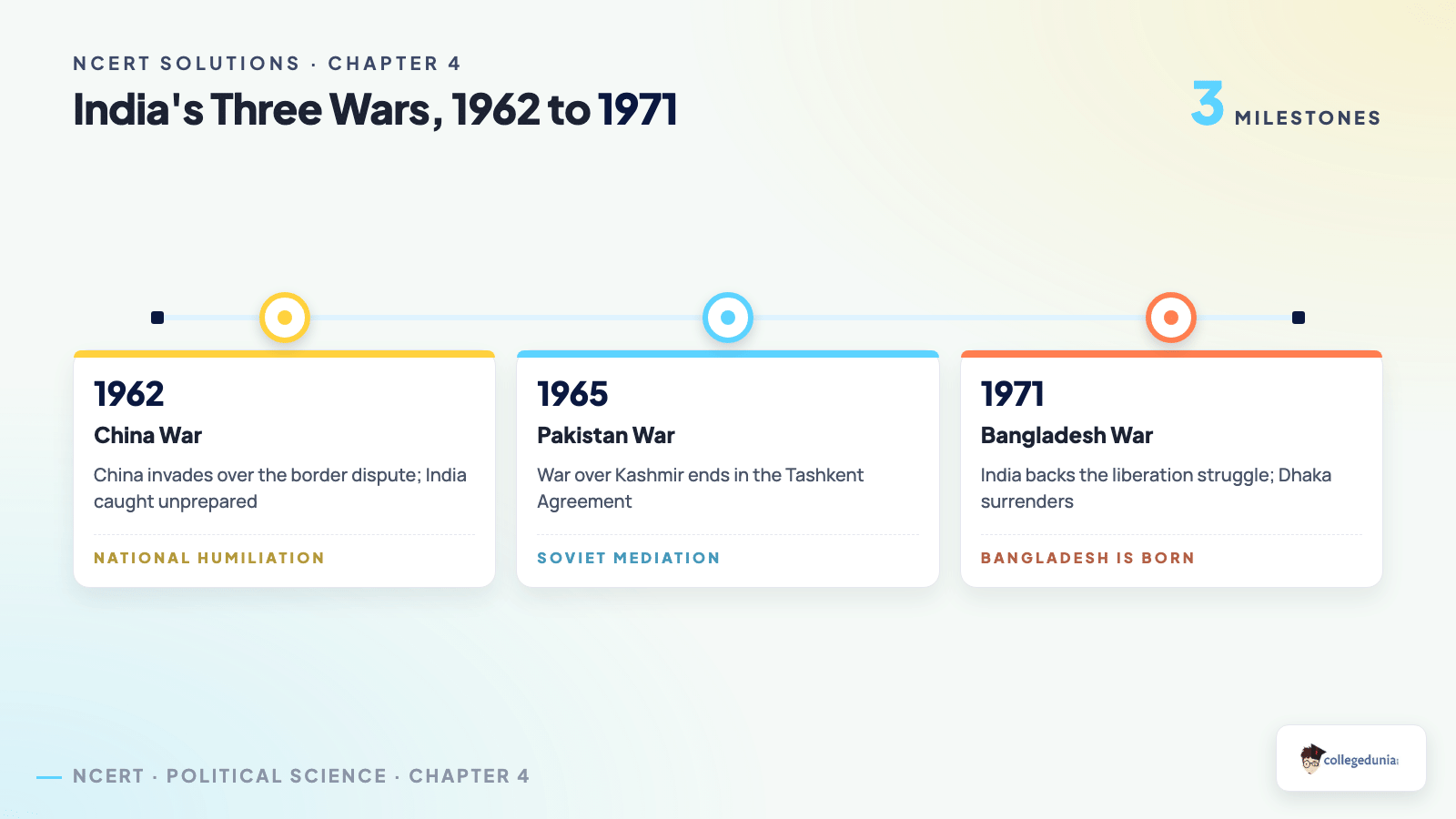
The 1962 war: in October 1962, while the world watched the Cuban Missile Crisis, China launched a massive invasion.
The honest exam point is that the 1962 defeat dented India's image and forced real change at home. Army commanders resigned, Defence Minister V. Krishna Menon had to leave the cabinet, the first no-confidence motion was moved against Nehru, and India began a defence build-up. This is the cleanest example of the chapter's idea that foreign policy is a two-way interaction between domestic compulsions and the international climate.
Wars with Pakistan and the Birth of Bangladesh
India fought Pakistan in 1965 and again in 1971, and the second war created a new country. This topic links foreign policy to India's role as a regional power, so it is a regular long answer. The table keeps the two wars side by side.
War
Key facts to recall
1965 war
Fought over the Rann of Kutch and Kashmir; ended with the Tashkent Agreement, brokered by the Soviet Union.
1971 war
Followed Pakistan's crackdown in East Pakistan and 80 lakh refugees; about 90,000 troops surrendered at Dhaka.
Birth of Bangladesh
The 1971 war created the free nation of Bangladesh; India declared a unilateral ceasefire.
1971 Soviet treaty
India signed the Treaty of Peace and Friendship with the USSR to balance the US-China-Pakistan axis.
One sharp point for the regional-power question: the 1971 war showed India shaping the politics of its own neighbourhood. India absorbed 80 lakh refugees, backed the Bangladesh struggle, defeated Pakistan and balanced the superpowers through the Soviet treaty. Most Indians read the victory as "a clear sign of India's growing military prowess", which is the heart of the regional-power answer.
India's Nuclear Policy and Foreign-Policy Consensus
The chapter closes with India's nuclear stand and the broad agreement among parties on foreign policy. Both are short-note favourites, so students should learn the few key facts well. The points below cover what every answer must contain.
Peaceful purpose: India's nuclear programme began in the late 1940s under Homi J. Bhabha for peaceful energy.
Against the NPT: India refused to sign the 1968 Nuclear Non-proliferation Treaty, calling it discriminatory.
The 1974 test: India conducted its first nuclear explosion in May 1974, describing it as a "peaceful explosion".
Consensus: Indian parties broadly agree on national integration, borders and national interest, so foreign policy stayed largely out of party conflict.
A key insight is that India saw the NPT as unfair because it let the five nuclear powers keep their weapons while denying them to others. The cross-party consensus point explains why India's foreign policy changed slowly and rarely split the parties, even through the three wars of 1962 to 1971 and across changes of government.
India's External Relations Class 12 Exercise-wise Coverage
The chapter exercise has 10 questions. The table maps each one to its topic so students can plan revision and find the right NCERT answer fast. The full point-wise solution for each sits in the question set lower on this page.
Question
Topic it tests
Q 1
True or false on non-alignment, neighbours, the Cold War and the 1971 treaty
Q 2
Match the following (foreign-policy goal, Panchsheel, Bandung, Dalai Lama)
Q 3
Why Nehru saw foreign relations as a test of independence
Q 4
Foreign policy as a two-way interaction, with a 1960s example
Q 5
Two aspects of foreign policy to retain and two to change
Q 6
Short notes on India's nuclear policy and on foreign-policy consensus
Q 7
Were the three wars (1962 to 1971) a failure of foreign policy?
Q 8
Does foreign policy show a desire to be a regional power (1971 war)?
Q 9
How political leadership shapes foreign policy, with Indian examples
Q 10
Passage-based on non-alignment and the Indo-Soviet treaty
Questions 7, 8 and 9 are the most-asked long answers, so students preparing India's External Relations class 12 important questions should learn those three first. The true-false and matching items (Q1 and Q2) are quick marks, so revise the non-alignment and Panchsheel facts well to secure them.
Students who want the offline copy can save the class 12 political science chapter 4 pdf from the download card above and tick off each question as they finish it.
India's External Relations Important Questions and Previous Year Trends
CBSE sets a steady mix of MCQ, short and long answers from this chapter. Knowing the pattern helps students decide how much to write. The chapter is a regular source of one 4-mark or 6-mark question, which is why a focused list of India's External Relations important questions saves a lot of revision time.
Long answer (5 to 6 marks): were the three wars a failure, or how leadership shaped foreign policy.
Short answer (4 marks): Nehru's three objectives, the 1971 war, or India's nuclear policy.
Source-based: a passage on non-alignment or the Indo-Soviet treaty, with sub-parts.
Objective and matching: Panchsheel, Bandung, NAM, the Dalai Lama and key dates.
For quick recall before the exam, students often practise the class 12 political science chapter 4 mcq set and a list of India's External Relations class 12 important questions. The most repeated items are the meaning of non-alignment and the 1971 war, so keep those answer points ready in your own words.
Working through the ncert solutions class 12 political science chapter 4 set twice, once open-book and once from memory, fixes the dates and names well before the board exam.
Common Mistakes Students Make in This Chapter
A few errors cost marks every year in this chapter. Most come from mixing up the 1971 treaty partner or giving only one side of the three-wars debate. Avoiding them is the fastest way to lift a score.
Saying the 1971 Treaty of Peace and Friendship was with the USA - it was with the USSR.
Swapping Panchsheel (five principles) with the Bandung Conference (the meeting that fed NAM).
Calling non-alignment "neutrality" - it was the freedom to choose, not staying out of world affairs.
Writing that India started the three wars - India fought only when attacked.
Forgetting that the 1974 test was called a "peaceful explosion" and that India refused the NPT.
Students who fix these five points usually move from average to high marks on the long answers. The exam rewards a balanced view, so always give both sides before you judge whether the wars were a failure.
India's External Relations PDF Download Formats and Languages
The solutions are free to download in more than one format, so students can pick what suits their device and revision style. The download card at the top of the page carries each option for this chapter.
Normal and HD PDF: the class 12 political science chapter 4 pdf comes in a normal size for quick downloads and an HD version for clear printing.
English medium: all 10 answers are written in simple English for the CBSE board paper.
Question-only set: a print-and-practise sheet of India's External Relations extra questions for self-testing.
Whole-book pack: the solutions sit in one set that runs through every Politics in India Since Independence chapter, so you can revise in one place.
Many students search for class 12 political science chapter 4 answers on their phone the night before a test, so a saved PDF means you can revise even without internet. Keep both the question set and the solved version handy for a full self-check.
How the India's External Relations Solutions Pair with Notes and the Book PDF
These NCERT Solutions answer the back-exercise questions. To revise the full chapter, students should use them alongside the other resources for the same chapter, all linked in the table below.
Reading the original NCERT chapter text and figures
Tip: read the Notes first, then attempt these solutions on your own, and only then check the model answers here. That order builds memory faster than copying answers straight away.
All NCERT Solutions for Class 12 Political Science
The table links the NCERT Solutions for every chapter in both Class 12 Political Science books, so students can move across the course in one click. India's External Relations is highlighted.
All NCERT Solutions for India's External Relations with Step-by-Step Solutions
Below are all 10 NCERT exercise questions for this chapter, exactly as they appear in the textbook. Tap Check Solution for the model answer or Expert Solution for the topper-style approach.
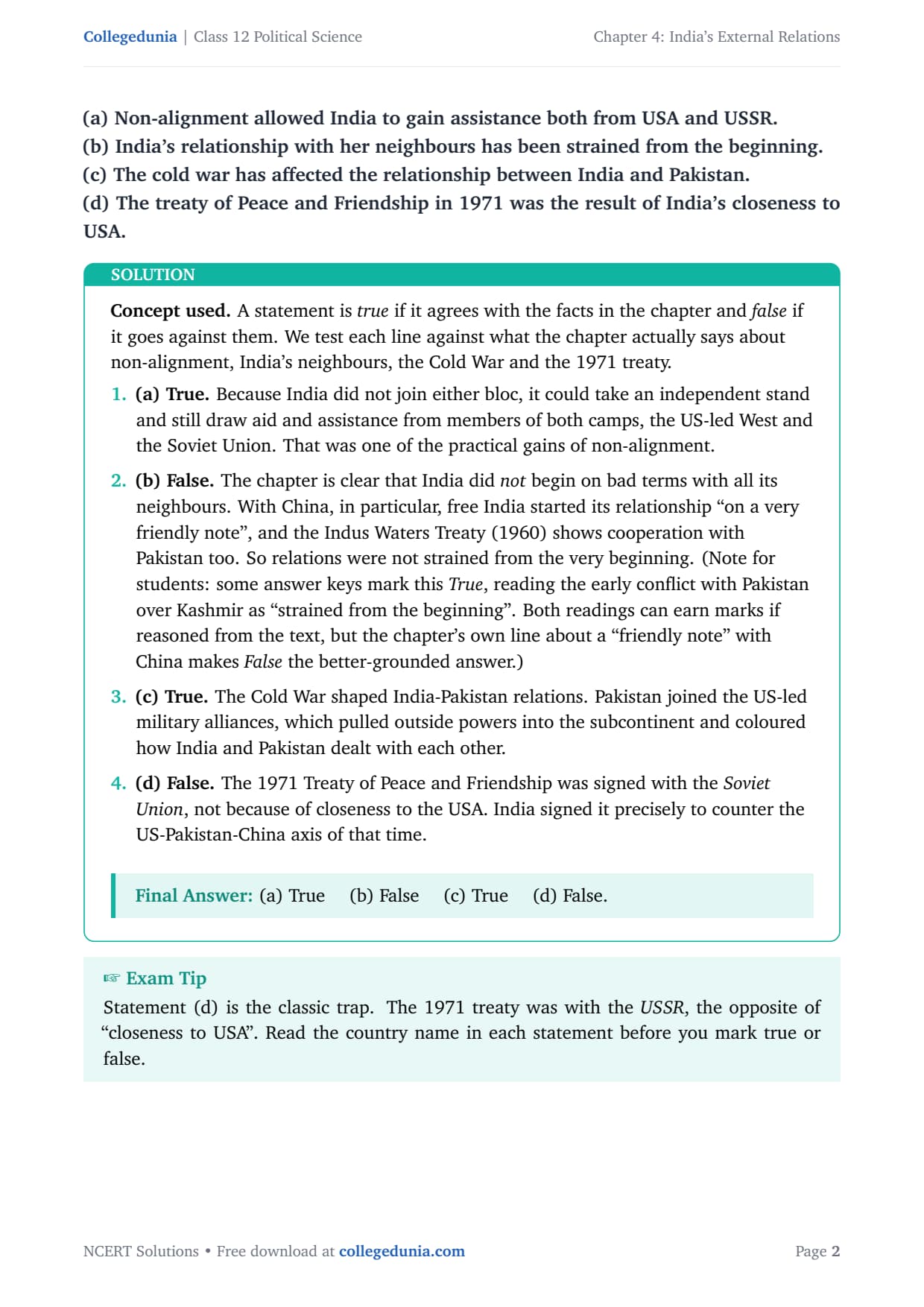
Q 4.1
Write `true' or `false' against each of these statements. [3pt]
(a) Non-alignment allowed India to gain assistance both from USA and USSR.
(b) India's relationship with her neighbours has been strained from the beginning.
(c) The cold war has affected the relationship between India and Pakistan.
(d) The treaty of Peace and Friendship in 1971 was the result of India's closeness to USA.
Concept used. A statement is true if it agrees with the facts
in the chapter and false if it goes against them. We test each line
against what the chapter actually says about non-alignment, India's
neighbours, the Cold War and the 1971 treaty.
(a) True. Because India did not join either bloc, it could
take an independent stand and still draw aid and assistance from
members of both camps, the US-led West and the Soviet Union. That was
one of the practical gains of non-alignment.
(b) False. The chapter is clear that India did not
begin on bad terms with all its neighbours. With China, in
particular, free India started its relationship ``on a very friendly
note'', and the Indus Waters Treaty (1960) shows cooperation with
Pakistan too. So relations were not strained from the very beginning.
(Note for students: some answer keys mark this True, reading
the early conflict with Pakistan over Kashmir as ``strained from the
beginning''. Both readings can earn marks if reasoned from the text,
but the chapter's own line about a ``friendly note'' with China makes
False the better-grounded answer.)
(c) True. The Cold War shaped India-Pakistan relations.
Pakistan joined the US-led military alliances, which pulled outside
powers into the subcontinent and coloured how India and Pakistan
dealt with each other.
(d) False. The 1971 Treaty of Peace and Friendship was
signed with the Soviet Union, not because of closeness to the
USA. India signed it precisely to counter the US-Pakistan-China axis
of that time.
(a) True (b) False (c) True (d) False.
AI
Ananya Iyer
M.A. Political Science, Jawaharlal Nehru University
Verified Expert
Quick reading. In a true/false set, decide first which actor each
line names, then match it to the chapter's facts. Two of these lines hinge on
a single word: which superpower, and which decade.
Lines about non-alignment and the Cold War. (a) is true
because the chapter says India took aid from both blocs while staying
unaligned; (c) is true because Pakistan's choice to join US alliances
dragged Cold War rivalry into India-Pakistan ties.
Lines about neighbours and the 1971 treaty. (b) is false
because India started friendly with China and cooperated with
Pakistan on the Indus waters, so relations were not strained from the
start. (d) is false because the 1971 treaty was with the Soviet
Union, signed to balance the US-Pakistan-China grouping.
Sanity check. Two true, two false, and the two false lines
both turn on a misnamed partner (``from the beginning'', ``USA''),
which is exactly how NCERT writes its distractors.
Why this matters. Non-alignment was not neutrality; it was the
freedom to deal with both sides. That single idea decides three of these four
statements, so locking it down here speeds up the rest of the chapter.
(a) True, (b) False, (c) True, (d) False.
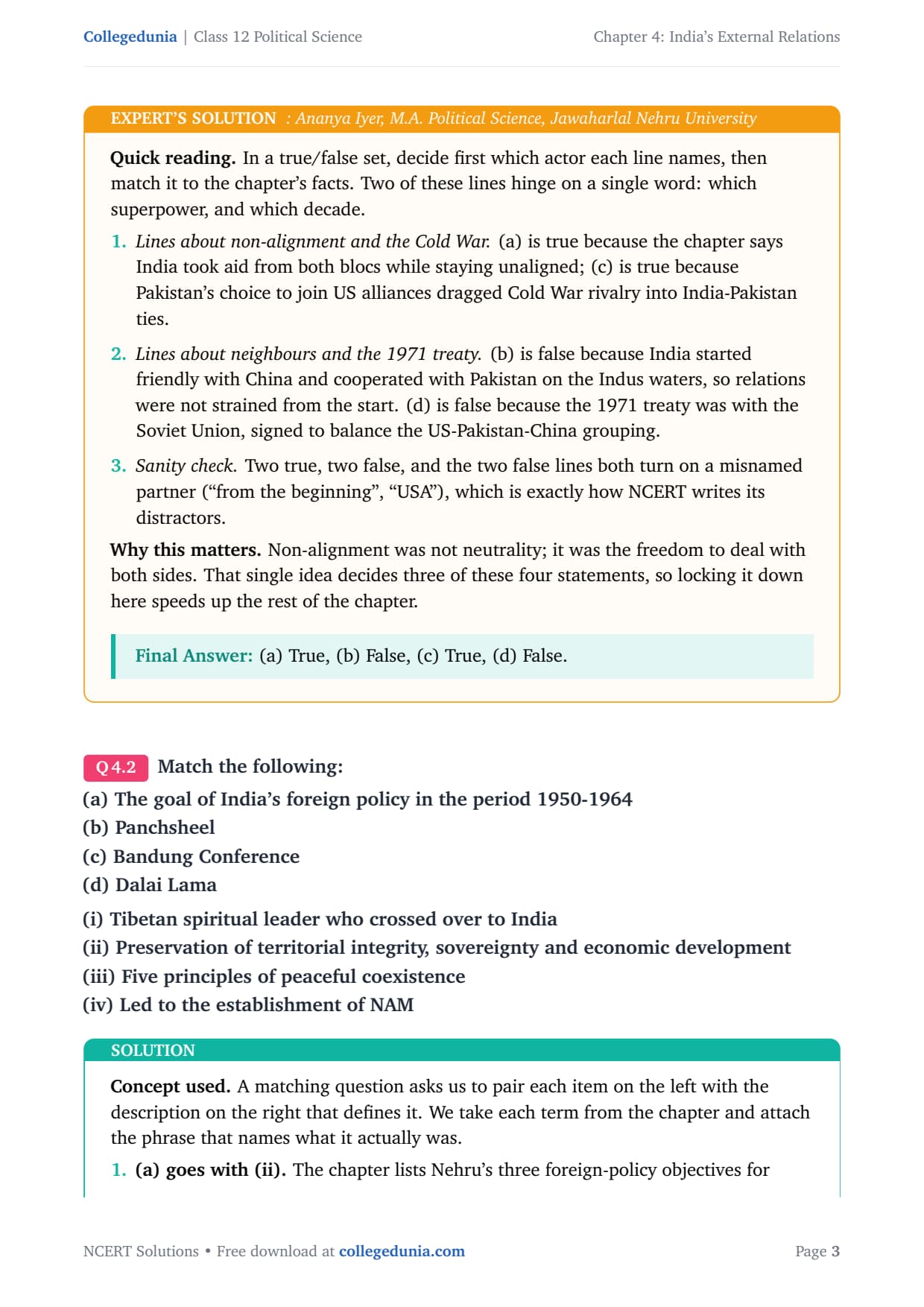
Q 4.2
Match the following: [3pt]
(a) The goal of India's foreign policy in the period 1950-1964
(b) Panchsheel
(c) Bandung Conference
(d) Dalai Lama [4pt]
(i) Tibetan spiritual leader who crossed over to India
(ii) Preservation of territorial integrity, sovereignty and economic development
(iii) Five principles of peaceful coexistence
(iv) Led to the establishment of NAM
Concept used. A matching question asks us to pair each item on the
left with the description on the right that defines it. We take each term from
the chapter and attach the phrase that names what it actually was.
(a) goes with (ii). The chapter lists Nehru's three foreign-policy
objectives for 1950-1964 as preserving sovereignty, protecting
territorial integrity, and promoting rapid economic development.
(b) goes with (iii).Panchsheel is the name given
to the Five Principles of Peaceful Coexistence, jointly announced by
Nehru and Zhou Enlai on 29 April 1954.
(c) goes with (iv). The Bandung Conference of 1955
deepened Afro-Asian contacts and later led to the establishment of the
Non-Aligned Movement (NAM).
(d) goes with (i). The Dalai Lama is the Tibetan
spiritual leader who crossed over into India and was granted asylum in
1959.
(a)–(ii), (b)–(iii), (c)–(iv), (d)–(i).
AV
Arjun Verma
M.A. International Relations, University of Delhi
Verified Expert
Structural observation. Three of these four pairs are near-automatic
once you read the right-hand clues, because each clue is a definition. Anchor
the two strongest pairs first, then the rest fall into place.
Lock the definitions. ``Five principles of peaceful
coexistence'' can only be Panchsheel (b-iii), and ``Tibetan spiritual
leader who crossed over to India'' can only be the Dalai Lama (d-i).
These two are unmistakable.
Place the remaining two. That leaves the foreign-policy goal
(a) for the description listing sovereignty, territorial integrity and
economic development (ii), and the Bandung Conference (c) for ``led to
the establishment of NAM'' (iv).
Confirm by elimination. Each left item now has exactly one
right item, with none repeated, which is the test of a correct match.
Why this matters. Matching questions reward students who treat the
right-hand column as a set of definitions. Identify the unique definitions
first and the ambiguous-looking pairs stop being ambiguous.
(a)–(ii), (b)–(iii), (c)–(iv), (d)–(i).
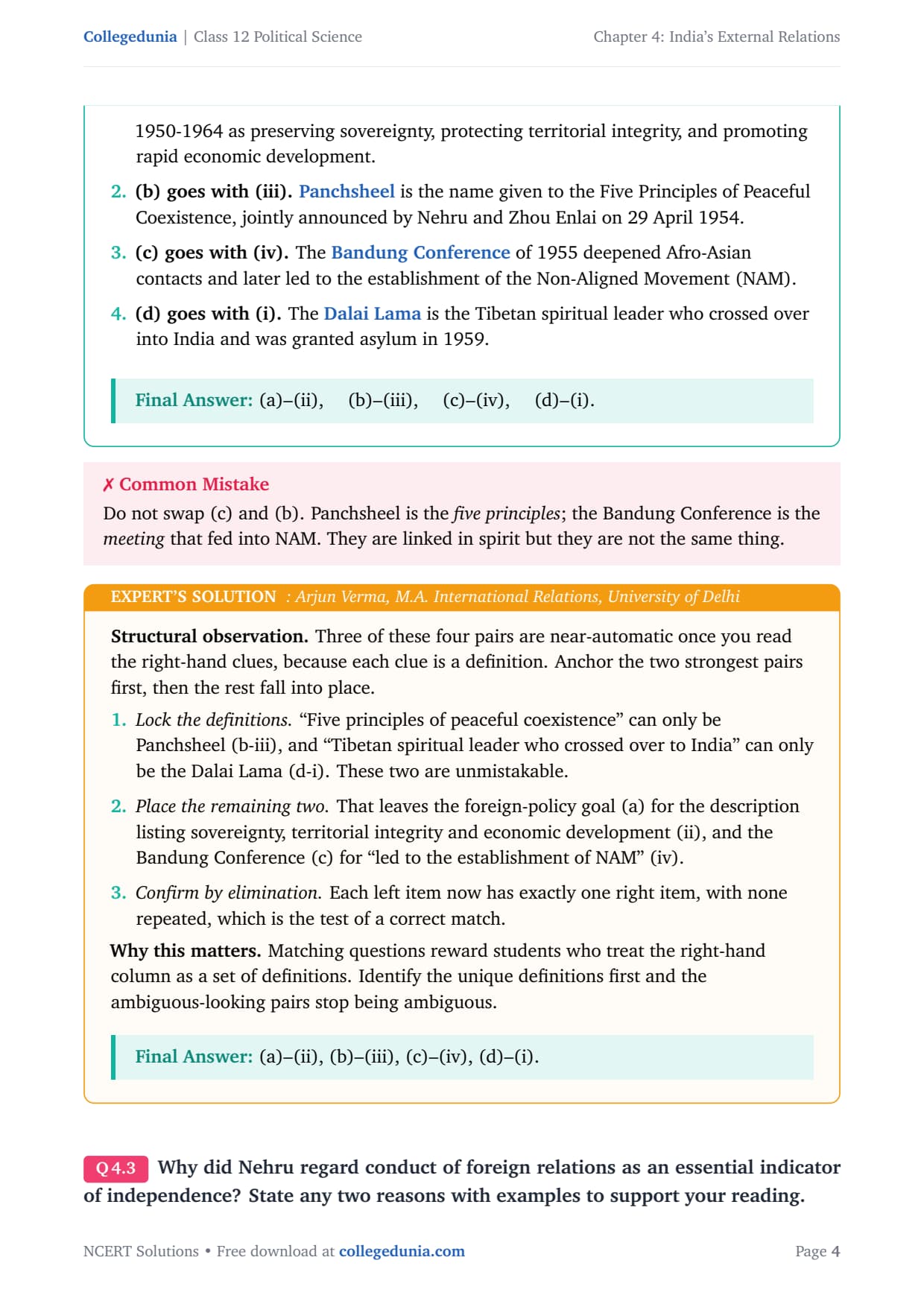
Q 4.3
Why did Nehru regard conduct of foreign relations as an essential
indicator of independence? State any two reasons with examples to support
your reading.
Concept used. For Nehru, real independence meant the freedom to
decide one's own external relations, not just self-rule at home. The chapter
quotes him saying independence consists basically of foreign relations, that
this is the very test of independence, and that once foreign relations pass
into someone else's hands, ``to that extent you are not independent''. We give
two reasons, each with an example from the chapter.
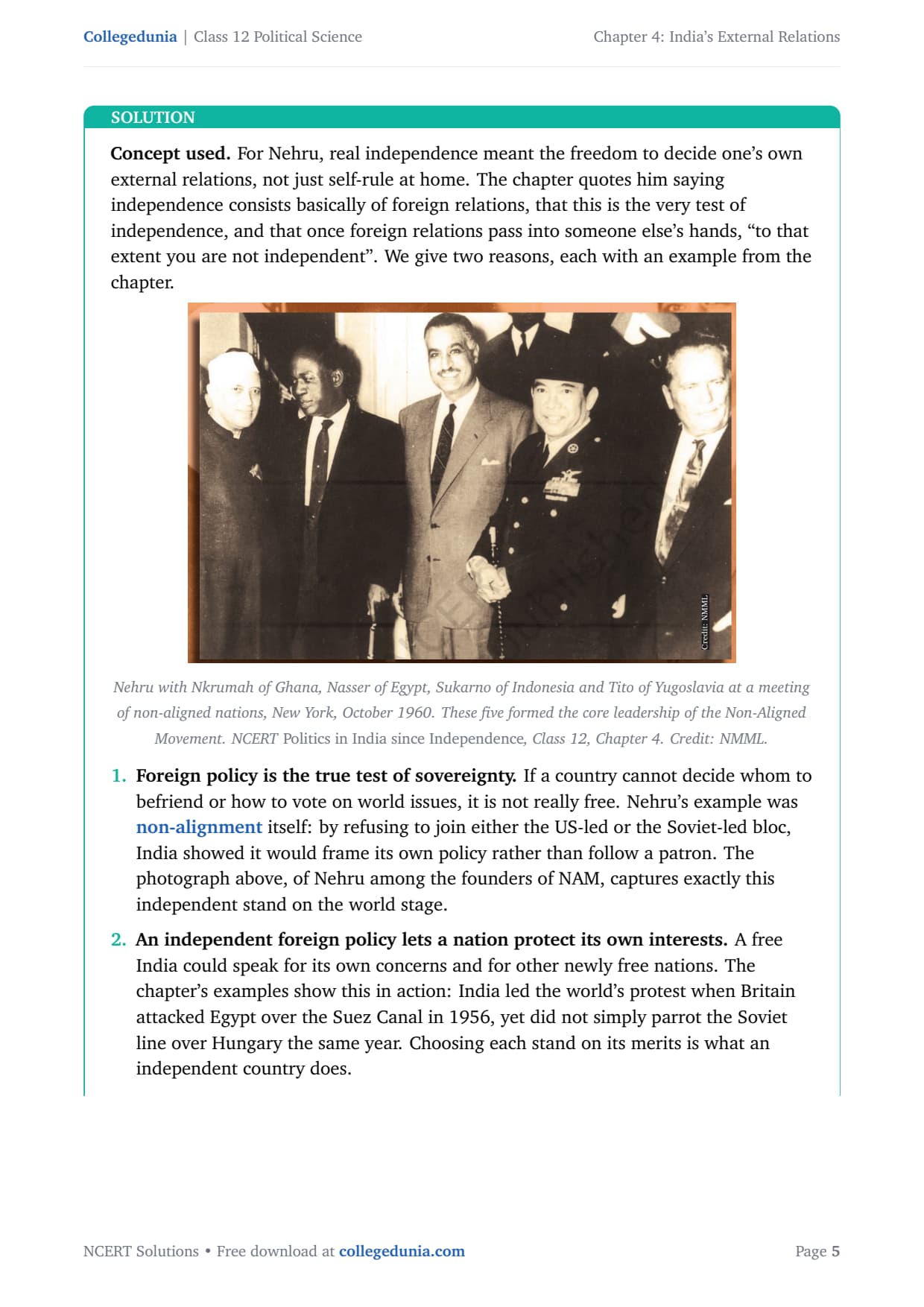
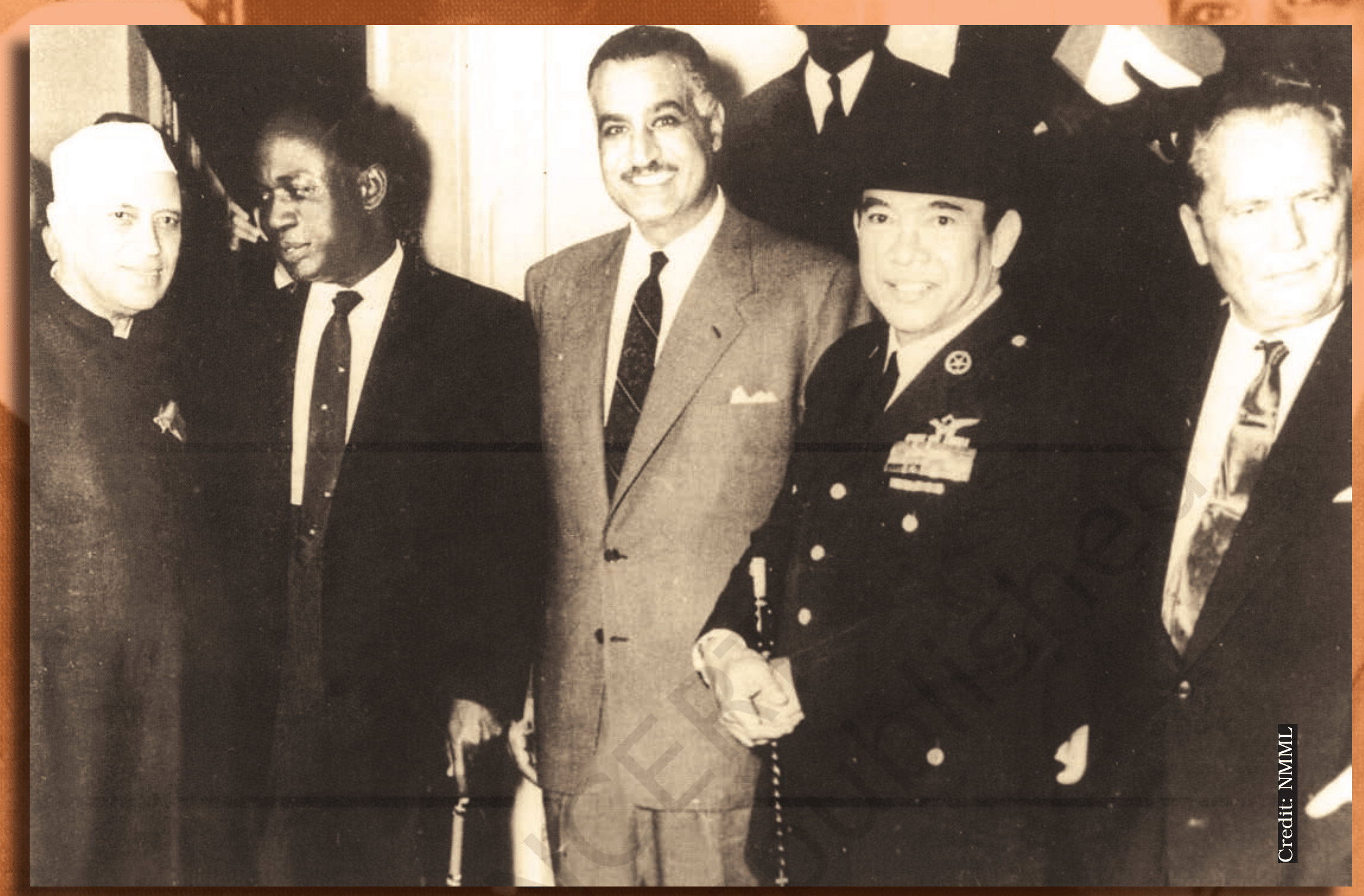
Nehru with Nkrumah of Ghana, Nasser of Egypt,
Sukarno of Indonesia and Tito of Yugoslavia at a meeting of non-aligned
nations, New York, October 1960. These five formed the core leadership of the
Non-Aligned Movement. NCERT Politics in India since Independence,
Class 12, Chapter 4. Credit: NMML.
Foreign policy is the true test of sovereignty. If a country
cannot decide whom to befriend or how to vote on world issues, it is
not really free. Nehru's example was non-alignment itself:
by refusing to join either the US-led or the Soviet-led bloc, India
showed it would frame its own policy rather than follow a patron. The
photograph above, of Nehru among the founders of NAM, captures exactly
this independent stand on the world stage.
An independent foreign policy lets a nation protect its own
interests. A free India could speak for its own concerns and for
other newly free nations. The chapter's examples show this in action:
India led the world's protest when Britain attacked Egypt over the
Suez Canal in 1956, yet did not simply parrot the Soviet line over
Hungary the same year. Choosing each stand on its merits is what an
independent country does.
Nehru saw the conduct of foreign relations as the real test of
independence because (1) deciding one's own external policy is the proof of
sovereignty, shown by non-alignment, and (2) only an independent foreign
policy lets a nation protect its own interests, shown by India judging the
Suez and Hungary crises of 1956 on their own merits.
PS
Pranav Sharma
M.A. Political Science, Banaras Hindu University
Verified Expert
Picture-first. The photo of Nehru standing shoulder to shoulder with
Nkrumah, Nasser, Sukarno and Tito is the answer in one frame: a free India
choosing its own friends, not a bloc's. Use it to set up the two reasons.
Reason one, with its quote. Independence is meaningless if
someone else runs your foreign affairs. Cite Nehru's own words from
the chapter, ``once foreign relations go out of your hands into the
charge of somebody else, to that extent you are not independent'', and
give non-alignment as the example of India keeping those relations in
its own hands.
Reason two, with its example. A self-decided foreign policy
lets a nation defend its interests and speak for others. The 1956
contrast is the cleanest evidence: India condemned the Anglo-French
attack on Egypt over Suez but declined to join the chorus over Soviet
action in Hungary, judging each case for itself.
Tie it back. Both reasons say the same thing from two angles,
the freedom to choose (sovereignty) and the freedom to act
(interest), which is why Nehru treated foreign relations as the
essential marker of being free.
Why this matters. Examiners want the link spelled out, not assumed:
self-rule at home plus self-decided relations abroad together make a country
independent. Naming the Suez/Hungary example proves you read the chapter, not
just the slogan.
Two reasons: (1) the power to decide one's own external policy is
the proof of sovereignty (non-alignment); (2) an independent foreign policy
lets a nation protect its interests and speak for others (India's contrasting
stands on Suez and Hungary in 1956).
Q 4.4
``The conduct of foreign affairs is an outcome of a two-way
interaction between domestic compulsions and prevailing international
climate''. Take one example from India's external relations in the 1960s to
substantiate your answer.
Concept used. The statement says foreign policy is shaped by
two forces at once: domestic compulsions (what is happening
and needed inside the country) and the international climate (the
world situation outside). A good answer takes one 1960s example and shows both
forces pulling on India's decision. The chapter's clearest 1960s case is the
1962 war with China.
The international climate of the early 1960s. A boundary
dispute with China hardened, the Chinese occupied Aksai-chin, and in
October 1962, while the world was watching the Cuban Missile Crisis,
China launched a massive invasion. The superpowers' Cold War rivalry
was the backdrop, the USSR stayed neutral, while India had to turn to
the Americans and the British for military help.
The domestic compulsions it created. The defeat dented
India's image, induced ``a sense of national humiliation'' and forced
real changes at home: top army commanders resigned, Defence Minister
V. Krishna Menon had to leave the cabinet, a no-confidence motion was
moved against Nehru for the first time, and India launched a military
modernisation drive (new Departments of Defence Production and
Supplies, a bigger defence budget).
The two-way interaction. The international event (China's
invasion) reshaped domestic politics and policy, while domestic
weakness (lack of military preparedness) had shaped the run-up to it.
Each side fed the other, which is exactly what the statement claims.
Foreign affairs flow from both domestic and international forces. The
1962 China war shows it: the international climate (a border dispute and
China's invasion during the Cold War) forced domestic changes (Menon's exit, a
no-confidence motion, a defence build-up), while India's own unpreparedness at
home had shaped the situation, a clear two-way interaction.
AR
Aditi Rao
M.A. Diplomacy and Disarmament, Jamia Millia Islamia
Verified Expert
Strategic angle. Pick one event and split it into two columns, what
the world outside did, and what India had to do at home, then show the arrow
running both ways. The 1962 China war is the tidiest 1960s case.
Outside in. Name the international trigger: the China border
dispute, the Aksai-chin occupation, and the October 1962 invasion
launched under cover of the Cuban Missile Crisis, with the USSR
neutral and the West providing emergency arms.
Inside out. List the domestic consequences and causes: the
national humiliation, Krishna Menon's resignation, the first
no-confidence motion against Nehru, and the military modernisation
drive, set against India's prior lack of preparedness.
Close the loop. State plainly that the world event reshaped
domestic politics while domestic weakness had shaped the lead-up, so
cause and effect ran in both directions, which is the whole point of
the quoted statement.
Why this matters. The strongest answers do not just narrate the war;
they prove the two-way claim by pointing to a domestic effect (a minister
falls) and a domestic cause (weak defences) of the same international event.
Take the 1962 China war: the international climate (border dispute,
invasion, neutral USSR) forced domestic change (Menon out, no-confidence
motion, defence build-up), while India's own unpreparedness shaped the
conflict, demonstrating the two-way interaction the statement describes.
Q 4.5
Identify any two aspects of India's foreign policy that you would
like to retain and two that you would like to change, if you were to become a
decision maker. Give reasons to support your position.
Concept used. This is an opinion question, but the opinion must be
backed by the chapter's facts. We name two strengths of India's foreign policy
worth keeping and two features worth changing, giving a reason for each. There
is no single ``correct'' list, only a well-argued one.
Two aspects to retain:
Non-alignment as independent judgement. Keeping the freedom
to judge each issue on its merits, rather than following any bloc,
served India well: it let India draw aid from both camps and take
principled stands (leading the Suez protest in 1956). This freedom of
choice is worth retaining.
Commitment to peace and Panchsheel. India's stress on peace,
peaceful coexistence and contributing troops to UN peacekeeping gave
it moral standing in the world. A foreign policy anchored in peace and
cooperation is worth keeping.
Two aspects to change:
Naive trust without military preparedness. Nehru's
``exceedingly unlikely'' assessment of a Chinese attack, and the lack
of military readiness in 1962, proved costly. A decision maker should
change this by matching friendly diplomacy with adequate defence
preparedness.
Over-dependence that limited options. Tilting heavily towards
one partner at a time (the pro-Soviet tilt, later a pro-US tilt) can
narrow India's room for manoeuvre. Genuine non-alignment, balanced
ties with all major powers, would be a healthier setting.
Retain: (1) independent judgement through non-alignment and (2) the
commitment to peace and Panchsheel. Change: (1) the trusting-but-unprepared
posture that cost India in 1962, by building real defence preparedness, and
(2) heavy tilts towards a single power, by keeping balanced ties with all.
KM
Karan Mehta
M.A. Political Science, University of Hyderabad
Verified Expert
Strategic angle. Build a four-box answer: two ``keep'' boxes and two
``change'' boxes, each with one sentence of reason rooted in the chapter.
Balance the praise with honest criticism, which is what a decision maker would
do.
Keep the strengths. Independent judgement (non-alignment, which
won aid from both blocs and let India lead on Suez) and the peace-first
approach (Panchsheel, UN peacekeeping) gave India influence beyond its
material power.
Fix the weaknesses. The trust-without-defence posture exposed by
the 1962 China war, and the swing towards one big partner at a time,
both reduced India's security and freedom of action.
Justify as a decision maker. Argue that you would retain what
gave India autonomy and standing, and reform what made it vulnerable,
so the policy keeps its idealism but adds realism.
Why this matters. The best answers show judgement, not just
preference: they keep non-alignment and peace for the autonomy they bought,
but add preparedness and balance to plug the gaps 1962 exposed.
Retain non-alignment (independent judgement) and the peace/Panchsheel
commitment; change the unprepared trust that hurt India in 1962 (add defence
readiness) and the single-power tilts (keep balanced ties with all major
powers).
Q 4.6
Write short notes on the following. [3pt]
(a) India's Nuclear policy
(b) Consensus in foreign policy matters
Concept used. A short note states the main facts about a topic
clearly and briefly. Here we summarise India's nuclear policy and the broad
agreement among Indian parties on foreign-policy questions, both taken
directly from the chapter.
(a) India's Nuclear policy:
Peaceful purpose from the start. India's nuclear programme
began in the late 1940s under Homi J. Bhabha, with the aim
of generating atomic energy for peaceful purposes. Nehru was against
nuclear weapons and pleaded with the superpowers for comprehensive
disarmament.
The 1974 test and the NPT stance. India conducted its
first nuclear explosion in May 1974, which it described as a
``peaceful explosion''. India had earlier refused to sign the
Nuclear Non-proliferation Treaty (NPT) of 1968, considering
it discriminatory because it let the five nuclear-weapon powers keep
their arms while denying them to others.
(b) Consensus in foreign policy matters:
Broad agreement across parties. Although parties differ on
minor points, Indian politics shows a broad consensus on national
integration, the protection of international boundaries, and questions
of national interest.
A limited role in party politics. Because of this agreement,
foreign policy has played only a limited role in party politics. Even
through the three wars of 1962-1971, and even when different parties
came to power, the basic foreign-policy direction stayed broadly the
same.
(a) India's nuclear policy aimed at peaceful atomic energy (Bhabha,
late 1940s), opposed weapons and disarmament was sought by Nehru, refused the
discriminatory NPT (1968), and conducted a ``peaceful'' nuclear test in May
1974. (b) Indian parties broadly agree on national integration, borders and
national interest, so foreign policy has stayed largely outside party
conflict, even across the wars of 1962-1971.
SB
Siddharth Banerjee
Ph.D. International Politics, Jadavpur University
Verified Expert
Structural observation. Two short notes mean two tight paragraphs.
For each, lead with the single defining fact, then add one supporting detail.
Do not pad; examiners mark short notes on precision.
Nuclear policy in two beats. Beat one: India's programme was
for peaceful energy (Bhabha, late 1940s) and Nehru opposed weapons,
seeking global disarmament. Beat two: India called the 1968 NPT
discriminatory and refused to sign it, then conducted a ``peaceful''
nuclear test in May 1974.
Consensus in two beats. Beat one: across parties there is broad
agreement on national integration, boundaries and national interest.
Beat two: because of that agreement, foreign policy stayed largely out
of party conflict, even through the 1962-1971 wars and changes of
government.
Link the two notes. Both show a striking continuity in Indian
foreign policy, principled on nuclear weapons, consensual across
parties, which is the chapter's closing theme.
Why this matters. The 1974 ``peaceful explosion'' and the
NPT-as-discriminatory line are the most-asked nuclear facts, while the
consensus point explains why Indian foreign policy changed slowly and rarely
split the parties.
(a) Peaceful-energy programme under Bhabha, Nehru against weapons,
refusal of the discriminatory 1968 NPT, and the 1974 ``peaceful'' nuclear
test. (b) A cross-party consensus on integration, borders and national
interest kept foreign policy largely outside party politics, even across the
1962-1971 wars.
Q 4.7
India's foreign policy was built around the principles of peace and
cooperation. But India fought three wars in a space of ten years between 1962
and 1971. Would you say that this was a failure of the foreign policy? Or
would you say that this was a result of international situation? Give reasons
to support your answer.
Concept used. The question asks for a judgement: were the three
wars proof that India's peaceful foreign policy had failed, or were they forced
on India by the international situation? A balanced answer weighs both sides and
takes a clear position. The three wars are with China (1962) and Pakistan
(1965, 1971).
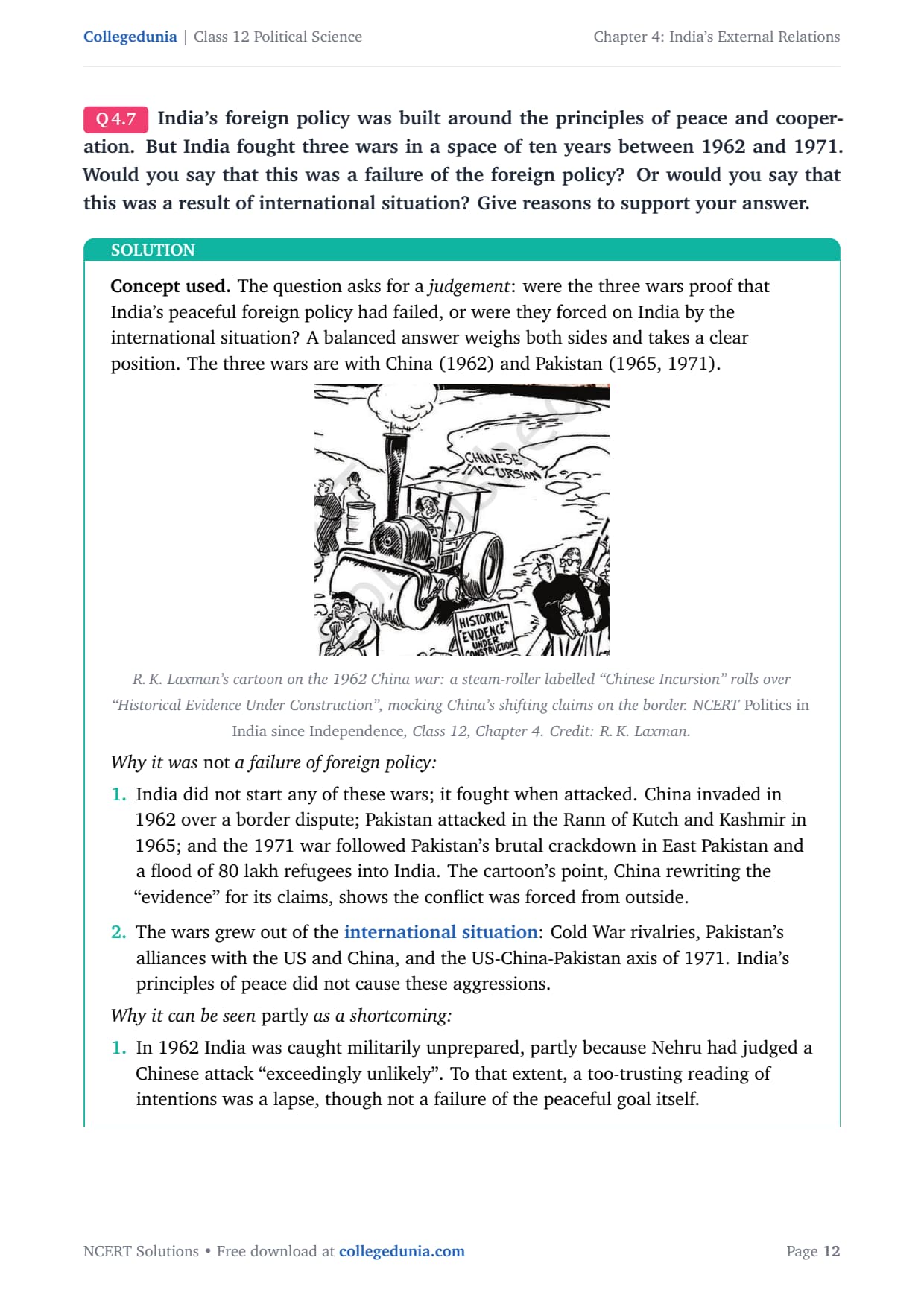
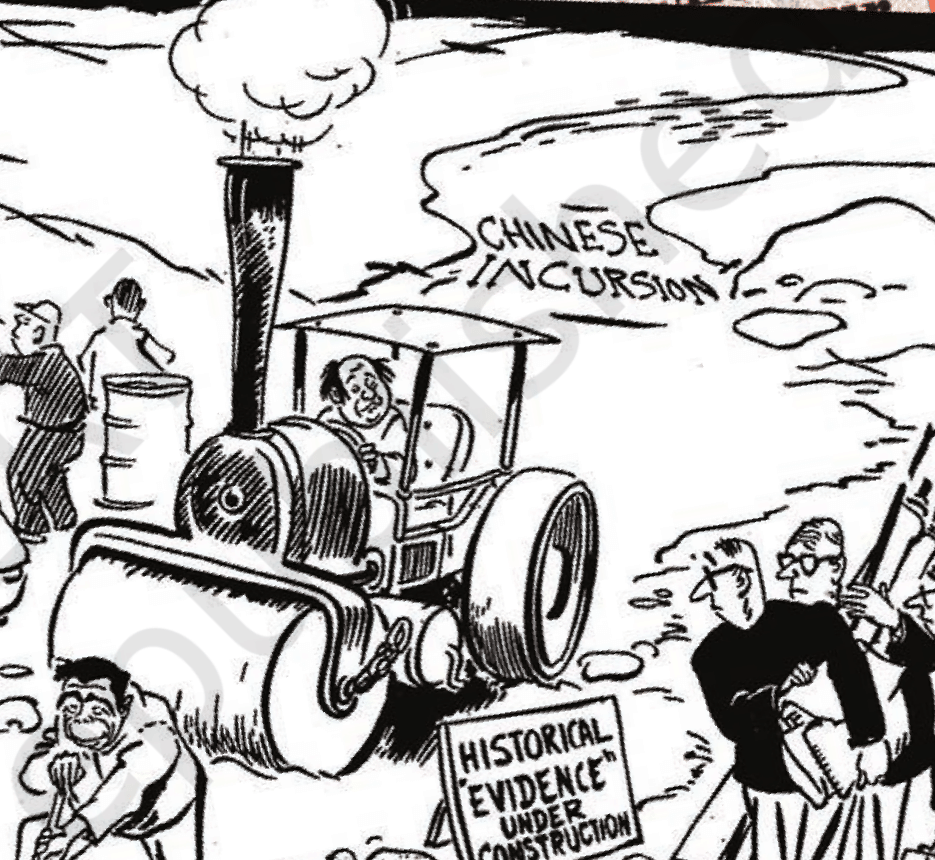
R. K. Laxman's cartoon on the 1962 China
war: a steam-roller labelled ``Chinese Incursion'' rolls over ``Historical
Evidence Under Construction'', mocking China's shifting claims on the border.
NCERT Politics in India since Independence, Class 12, Chapter 4.
Credit: R. K. Laxman.
Why it was not a failure of foreign policy:
India did not start any of these wars; it fought when attacked.
China invaded in 1962 over a border dispute; Pakistan attacked in the
Rann of Kutch and Kashmir in 1965; and the 1971 war followed
Pakistan's brutal crackdown in East Pakistan and a flood of 80 lakh
refugees into India. The cartoon's point, China rewriting the
``evidence'' for its claims, shows the conflict was forced from
outside.
The wars grew out of the international situation: Cold War
rivalries, Pakistan's alliances with the US and China, and the
US-China-Pakistan axis of 1971. India's principles of peace did not
cause these aggressions.
Why it can be seen partly as a shortcoming:
In 1962 India was caught militarily unprepared, partly because Nehru
had judged a Chinese attack ``exceedingly unlikely''. To that extent,
a too-trusting reading of intentions was a lapse, though not a failure
of the peaceful goal itself.
On balance, the three wars were mainly the result of the
international situation, not a failure of India's peaceful foreign policy.
India did not initiate them: it responded to a Chinese invasion (1962) and to
Pakistani aggression (1965, 1971). The one fair criticism is the lack of
military preparedness in 1962, a lapse in judgement rather than a failure of
the principles of peace and cooperation.
RD
Rohit Desai
M.A. Political Science, Jawaharlal Nehru University
Verified Expert
Picture-first. Open with the Laxman cartoon: a ``Chinese Incursion''
roller flattening ``evidence''. It tells the examiner in one image that the
1962 war was forced by China's shifting claims, not by any Indian aggression,
which frames your whole verdict.
State the verdict early. The wars were chiefly a result of the
international situation, not a failure of the peaceful policy. Say so
first, then prove it.
Marshal the evidence. India never struck first: China invaded
in 1962; Pakistan attacked in 1965; the 1971 war followed Pakistan's
terror in East Pakistan and the refugee crisis. Cold War alliances and
the 1971 US-China-Pakistan axis set the stage. None of this flowed
from India's idealism.
Concede the one real fault. Be honest that 1962 exposed poor
military preparedness and an over-trusting reading of China, a lapse in
execution, not in the peaceful aim. End by reaffirming that fighting in
self-defence does not mean the foreign policy failed.
Why this matters. A top answer separates the intention of the
policy (peace and cooperation, intact) from its circumstances (forced
wars). Conceding the 1962 preparedness gap, while rejecting ``failure'', is
the balanced judgement examiners look for.
The three wars were largely the outcome of the international
situation, Chinese and Pakistani aggression within a Cold War setting, not a
failure of India's peaceful foreign policy; the only valid criticism is the
1962 military unpreparedness, a lapse in judgement rather than in principle.
Q 4.8
Does India's foreign policy reflect her desire to be an important
regional power? Argue your case with the Bangladesh war of 1971 as an example.
Concept used. A regional power is a country strong enough to
shape events in its own part of the world. The question asks whether India's
foreign policy shows such an ambition, and tells us to argue it through the
Bangladesh war of 1971. We use the war's facts to make the case.
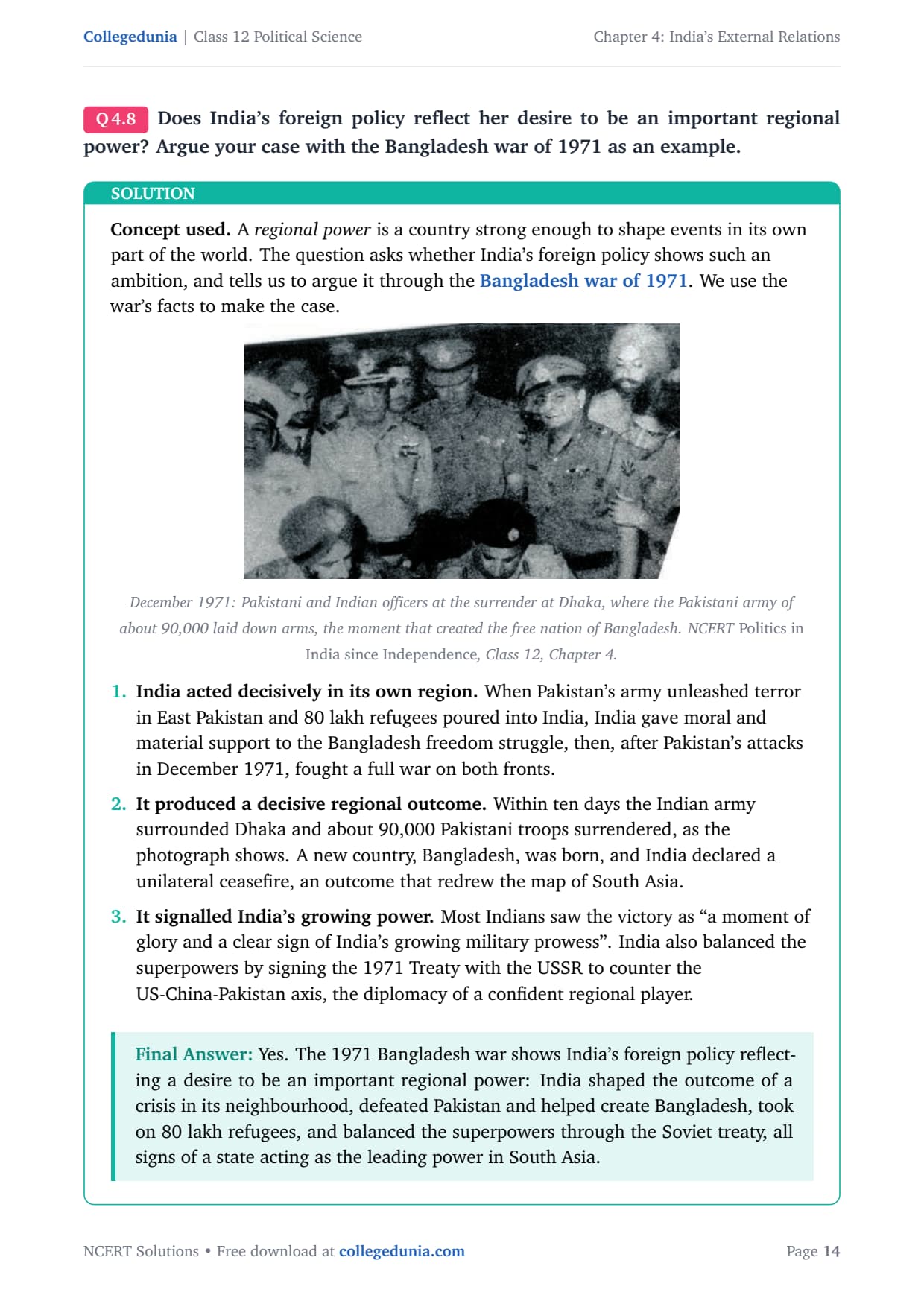
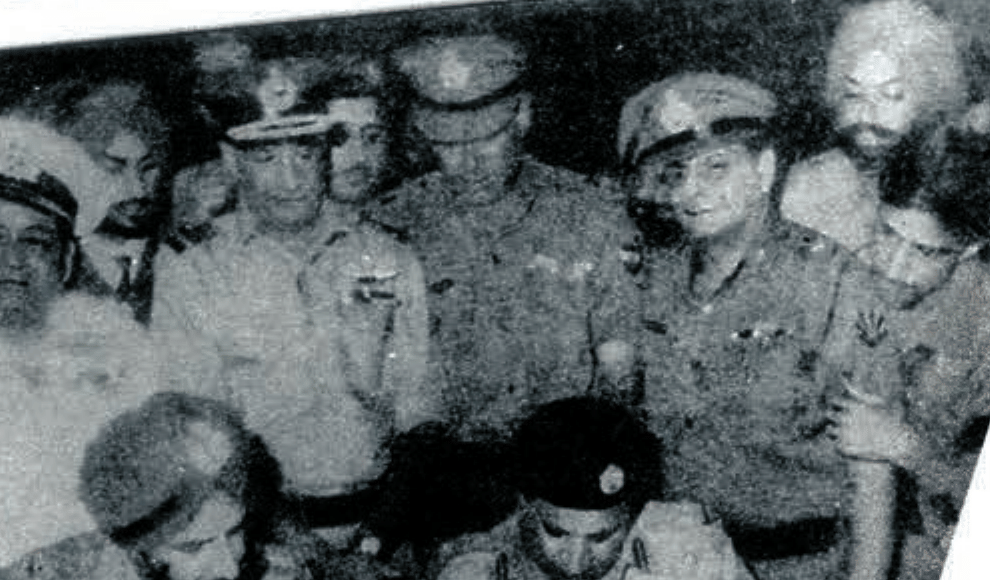
December 1971: Pakistani and Indian
officers at the surrender at Dhaka, where the Pakistani army of about 90,000
laid down arms, the moment that created the free nation of Bangladesh. NCERT
Politics in India since Independence, Class 12, Chapter 4.
India acted decisively in its own region. When Pakistan's
army unleashed terror in East Pakistan and 80 lakh refugees poured
into India, India gave moral and material support to the Bangladesh
freedom struggle, then, after Pakistan's attacks in December 1971,
fought a full war on both fronts.
It produced a decisive regional outcome. Within ten days the
Indian army surrounded Dhaka and about 90,000 Pakistani troops
surrendered, as the photograph shows. A new country, Bangladesh, was
born, and India declared a unilateral ceasefire, an outcome that
redrew the map of South Asia.
It signalled India's growing power. Most Indians saw the
victory as ``a moment of glory and a clear sign of India's growing
military prowess''. India also balanced the superpowers by signing the
1971 Treaty with the USSR to counter the US-China-Pakistan axis, the
diplomacy of a confident regional player.
Yes. The 1971 Bangladesh war shows India's foreign policy reflecting
a desire to be an important regional power: India shaped the outcome of a
crisis in its neighbourhood, defeated Pakistan and helped create Bangladesh,
took on 80 lakh refugees, and balanced the superpowers through the Soviet
treaty, all signs of a state acting as the leading power in South Asia.
TC
Tara Chatterjee
M.A. International Relations, South Asian University
Verified Expert
Picture-first. The surrender photograph is your thesis: 90,000
Pakistani soldiers laying down arms at Dhaka is what regional power looks like.
Lead with it, then build the argument in three moves, act, outcome, signal.
Act in the region. India did not stand aside from a
neighbouring crisis. It absorbed 80 lakh refugees, backed the
Bangladesh liberation struggle, and responded to Pakistan's December
attacks with a full two-front war.
Deliver the outcome. The decisive result, Dhaka surrounded in
ten days, about 90,000 troops surrendered, Bangladesh free, India's
unilateral ceasefire, shows a power able to reshape South Asia, not
merely defend itself.
Read the signal. Pair the battlefield result with the
diplomacy: the 1971 Indo-Soviet treaty neutralised the
US-China-Pakistan axis, and Indians read the victory as proof of
growing military prowess. That is a state behaving as the region's
leading power.
Why this matters. The 1971 war is the textbook case of foreign policy
serving regional-power ambition: India shaped its neighbourhood's politics,
balanced the great powers, and emerged stronger, exactly what an important
regional power does.
Yes, India's foreign policy reflects a desire to be an important
regional power, and the 1971 Bangladesh war proves it: India intervened
decisively in its neighbourhood, defeated Pakistan, helped create Bangladesh,
and balanced the superpowers via the Soviet treaty.
Q 4.9
How does political leadership of a nation affect its foreign policy?
Explain this with the help of examples from India's foreign policy.
Concept used.Political leadership means the leaders who set
and run a country's policy. Their ideas, values and judgement strongly shape
foreign policy. The chapter shows this above all through Nehru, but also
through later leaders. We explain the influence and give examples.
Nehru set the entire direction. As both Prime Minister and
Foreign Minister from 1946 to 1964, Nehru exercised ``profound
influence'' over India's foreign policy. He chose non-alignment,
defined the three objectives (sovereignty, territorial integrity,
economic development), championed Afro-Asian unity and co-founded the
NAM. The whole direction bore his personal stamp.
A leader's judgement has costs as well. Nehru's belief that a
Chinese attack was ``exceedingly unlikely'' shaped India's relaxed
border posture before 1962, and his stature suffered after the defeat.
This shows leadership affecting outcomes for worse as well as better.
Later leaders shifted the policy. Lal Bahadur Shastri's
decisions guided the 1965 war; Indira Gandhi's leadership shaped the
decisive 1971 war and the Soviet treaty; and the Janata government of
1977 announced ``genuine non-alignment'', correcting the pro-Soviet
tilt. Each change in leadership nudged the policy.
Political leadership strongly shapes foreign policy through the
leaders' ideas and judgement. In India, Nehru's vision built non-alignment,
the three objectives, Afro-Asian unity and the NAM, while his misjudgement of
China contributed to the 1962 setback; later, Shastri (1965), Indira Gandhi
(1971 war and the Soviet treaty) and the Janata government (``genuine
non-alignment'', 1977) each redirected policy, showing leadership's clear
influence.
VK
Vivaan Kapoor
M.A. Political Science, University of Delhi
Verified Expert
Strategic angle. Prove the claim by contrast: show one leader building
the policy (Nehru), the cost of his judgement (1962), and then successors
changing course (Shastri, Indira, Janata). Continuity plus change together
prove leadership matters.
Building leader. Nehru, as PM and Foreign Minister for nearly
two decades, authored non-alignment, the three objectives, Afro-Asian
unity and the NAM. No other figure shaped the foundation as much.
Costly judgement. His ``exceedingly unlikely'' reading of
China left the border lightly guarded and his reputation bruised after
1962, evidence that a leader's misjudgement can hurt the nation.
Changing leaders, changing policy. Shastri steered 1965, Indira
Gandhi drove the 1971 war and the Soviet treaty, and the 1977 Janata
government promised ``genuine non-alignment'' to undo the pro-Soviet
tilt. Each handover moved the needle.
Why this matters. Foreign policy is not made by impersonal forces
alone; the values and choices of leaders steer it. India's case, one architect
and several course-correctors, is the clearest classroom example.
Leadership shapes foreign policy through leaders' ideas and
judgement: Nehru built India's foreign-policy base (non-alignment, three
objectives, NAM) but misjudged China in 1962, while Shastri (1965), Indira Gandhi (1971)
and the 1977 Janata government each redirected the policy, proving leadership's
decisive role.
Q 4.10
Read this passage and answer the questions below: [3pt]
``Broadly, non-alignment means not tying yourself off with military
blocs It means trying to view things, as far as possible, not from the
military point of view, though that has to come in sometimes, but
independently, and trying to maintain friendly relations with all
countries.'' Jawaharlal Nehru [4pt]
(a) Why does Nehru want to keep off military blocs?
(b) Do you think that the Indo-Soviet friendship treaty violated the principle
of non-alignment? Give reasons for your answer.
(c) If there were no military blocs, do you think non-alignment would have been
unnecessary?
Concept used. A passage-based question must be answered from the
passage and the chapter together. The passage defines non-alignment
as staying out of military blocs, judging issues independently and staying
friendly with all. We answer each sub-question using that definition plus the
chapter's facts.
(a) Why keep off military blocs? Nehru wanted India to view
world issues independently, on their merits, and to stay
friendly with all countries. Joining a bloc would force India to take
sides automatically, surrender its freedom of judgement, and become
entangled in the Cold War rivalry between the US-led and Soviet-led
camps. Staying out kept India's foreign policy in its own hands.
(b) Did the Indo-Soviet treaty violate non-alignment? No, not
really. The 1971 Treaty of Peace and Friendship was a response to a
specific threat, the US-China-Pakistan axis forming around the
Bangladesh crisis, and it assured India of Soviet support if attacked.
It was a friendship treaty, not membership of a military bloc, and
India did not give up its independent judgement. (Some critics did
argue it tilted India towards the Soviet side, so a reasoned ``it
strained, but did not break, non-alignment'' is also acceptable.)
(c) Would non-alignment be unnecessary without blocs? No.
Non-alignment was more than just staying out of the two blocs. As the
passage says, it also meant judging issues independently and keeping
friendly relations with all countries. Those positive aims would
remain valuable even if the military blocs did not exist, so
non-alignment would still have a purpose.
(a) To keep its freedom of judgement, stay friendly with all and
avoid being dragged into Cold War rivalries. (b) No, the Indo-Soviet treaty
was a friendship and security treaty against a specific threat, not bloc
membership, so it did not break non-alignment (though critics felt it tilted
India). (c) No, because non-alignment also meant independent judgement and
friendship with all, aims that would stay useful even without military blocs.
NJ
Neha Joshi
M.A. Political Science, Banaras Hindu University
Verified Expert
Strategic angle. Treat the passage as your dictionary: it defines
non-alignment as no blocs, independent judgement, friendship with all. Answer
each sub-part by checking it against that three-part definition.
(a) Read straight from the passage. Blocs force automatic
side-taking and entanglement in Cold War rivalry. Nehru wanted to
judge each issue independently and stay friendly with everyone, which
bloc membership would have made impossible.
(b) Apply the definition. The Indo-Soviet treaty was a
friendship-and-security pact prompted by the US-China-Pakistan axis of
1971, not entry into a military alliance, and India kept its
independent voice. So it did not violate non-alignment, even if
critics saw a tilt.
(c) Stress the positive content. Non-alignment was not merely
``no blocs''. Its independent-judgement and friendly-to-all elements
give it value even in a world without blocs, so it would not become
unnecessary.
Why this matters. The passage's own wording is the key: because
non-alignment had positive aims (independent judgement, friendship with all),
it was never just a Cold War tactic, which answers both (b) and (c) cleanly.
(a) To preserve independent judgement, friendship with all, and
freedom from Cold War entanglement. (b) No, a friendship/security treaty
against a specific threat is not bloc membership and India kept its
independence. (c) No, non-alignment's positive aims of independent judgement
and universal friendship would remain useful even without military blocs.
FAQs on India's External Relations Class 12 NCERT Solutions
India's External Relations Class 12 Political Science Common Questions
Ques. Where can I get the class 12 political science chapter 4 NCERT Solutions PDF?
Ans. You can download the India's External Relations Class 12 Political Science NCERT Solutions PDF directly from this page. It is free, follows the 2026-27 NCERT, and answers all 10 exercise questions step by step.
Ques. How many questions are there in India's External Relations class 12 questions and answers?
Ans. The chapter has 10 exercise questions. The first two are true-false and matching items, while Questions 3 to 10 are short notes, long answers and a passage-based question on non-alignment and the Indo-Soviet treaty.
Ques. What is non-alignment in India's External Relations?
Ans. Non-alignment meant staying out of both Cold War military blocs while judging each world issue on its merits and keeping friendly ties with all countries. It was not neutrality, but the freedom to choose, and it let India draw aid from both the US-led and Soviet-led camps.
Ques. Were the three wars of 1962 to 1971 a failure of India's foreign policy?
Ans. On balance, no. India did not start any war: China invaded in 1962, and Pakistan attacked in 1965 and 1971. The wars were mainly a result of the international situation. The one fair criticism is the lack of military preparedness in 1962, a lapse in judgement rather than a failure of the peaceful policy.
Ques. Who was the 1971 Treaty of Peace and Friendship signed with?
Ans. It was signed with the Soviet Union (USSR), not the USA. India signed it to balance the US-China-Pakistan axis around the Bangladesh crisis. It was a friendship and security treaty, not membership of a military bloc, so it did not break non-alignment.
Ques. Is class 12 political science chapter 4 easy to score in the board exam?
Ans. Yes. It is a scoring chapter if you keep the dates straight and give a balanced view on the three wars. Practise the matching and true-false items, learn Nehru's three objectives, and keep the 1971 war and the nuclear policy points ready for the long answers.








Comments