The NCERT Solutions for Political Science Class 12 Chapter 5 Challenges to and Restoration of the Congress System answer every textbook question on the decade after Nehru, set to the latest 2026-27 CBSE syllabus. Each answer explains the 1967 election, the 1969 Congress split and Indira Gandhi's 1971 "Garibi Hatao" win. These solutions help students prepare for the Class 12 Political Science board paper and the UPSC foundation in 2026-27.
Covers all 10 exercise questions from Politics in India Since Independence Chapter 5, with full point-wise answers.
This Class 12 Political Science chapter usually carries 5 to 6 marks per board paper.
Pairs with the Notes, Handwritten Notes and NCERT Book PDF linked lower on this page.
Every solution for Class 12 Political Science Chapter 5 in this Collegedunia compilation is written by subject experts from the official NCERT Politics in India Since Independence textbook, and checked against the last five years of CBSE board papers.
Student Feedback: In a Collegedunia poll of 8,460 Class 12 Political Science students taken before the 2026 boards, 71% of students rated the 1969 Congress split question as the hardest part of this chapter. Most students said a clear "Congress (O) versus Congress (R)" split made the answer easy to recall.
Source: 2026-27 Class 12 Political Science student poll. Sample of 8,460 students from CBSE schools across 13 states.
What the Challenges to and Restoration of the Congress System Chapter Is About
Challenges to and Restoration of the Congress System is the fifth chapter of Politics in India Since Independence. It traces Indian politics through the decade after Nehru, from his death in 1964 to Indira Gandhi's sweeping win in 1971. The chapter is about how the Congress system was first challenged and then re-built around one popular leader.
The chapter answers three big questions that students must keep in mind:
How was succession managed? The deaths of Nehru and Shastri brought Indira Gandhi to power.
How was the Congress challenged? The 1967 election, non-Congressism and the 1969 split shook it.
How was it restored? The 1971 "Garibi Hatao" landslide rebuilt Congress dominance.
So the chapter is really about challenge and recovery. A student who keeps these three threads in mind can connect almost any question in Challenges to and Restoration of the Congress System class 12 back to one of them. Revision works best when you sort each fact under "succession", "challenge" or "restoration" first.
Political Succession After Nehru
Nehru's death in 1964 raised a real fear: would Indian democracy survive without its founding Prime Minister? The chapter answers that the succession was managed smoothly, twice over. To understand the rest of the chapter, students must first know this peaceful transfer of power.
Lal Bahadur Shastri: became PM in 1964 and gave the slogan "Jai Jawan, Jai Kisan" in 1965.
Indira Gandhi: became PM in 1966 after Shastri's sudden death at Tashkent.
The Syndicate: a group of senior leaders, led by K. Kamaraj, backed both choices.
The result: both transfers were peaceful, but Indira Gandhi was still seen as a "novice".
The exam point here is that the Congress managed succession without a crisis, but the Syndicate expected to control the new leader. The senior leaders thought Indira Gandhi would follow their advice. That assumption sets up the power struggle that splits the party in 1969, so keep the Syndicate's role clear from the start.
The Fourth General Election of 1967
The 1967 election is the hinge of the whole chapter. It was fought amid drought, food shortage and an economic crisis, and its result is a long-answer favourite. The table below sorts the key facts for fast revision.
Result
What it meant
Congress kept the Centre
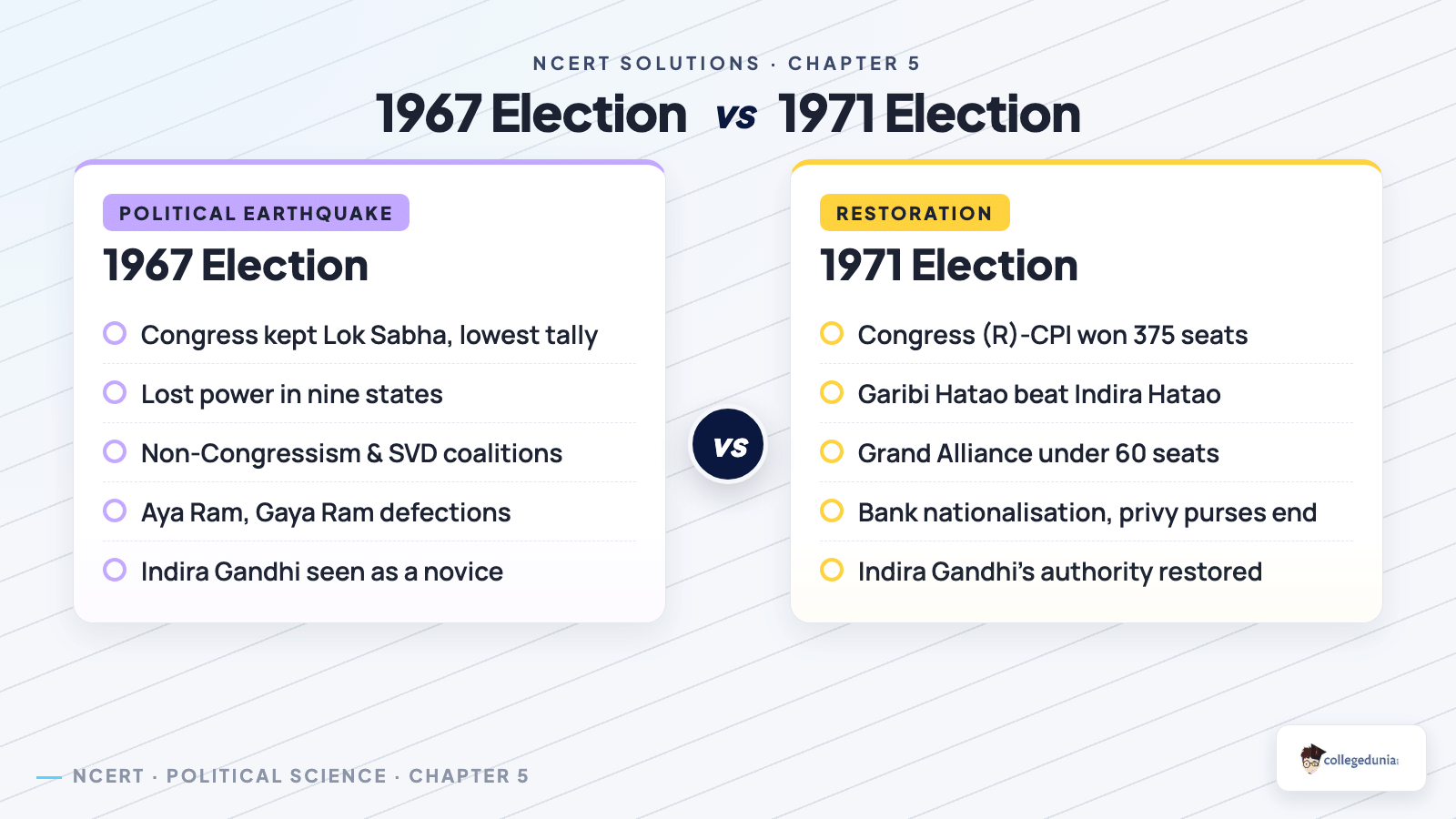
It won the Lok Sabha, but with its lowest tally of seats and votes since 1952.
Lost power in nine states
Out of power in Punjab, Haryana, UP, MP, Bihar, West Bengal, Orissa, Madras and Kerala.
The DMK swept Madras
The DMK won Madras outright on the back of the anti-Hindi agitation.
Ministers defeated
Half the ministers in Indira Gandhi's cabinet lost their own seats.
"Political earthquake"
Observers called the result a political earthquake for the Congress.
A key insight for the exam is that 1967 was a split verdict: a win at the Centre, a rout in the states. This gap, between a Congress that still ruled Delhi but could now be beaten in the states, is what makes the later split and restoration so dramatic. Fix "Centre safe, states lost" in memory and half the chapter unlocks.
Non-Congressism, Defection and the Syndicate
After 1967 three forces reshaped Indian politics, and the exam tests all three by name. Students should learn each as a short definition rather than a story, because matching questions use them directly.
Non-Congressism: coined by Ram Manohar Lohia, rival parties uniting only to defeat the Congress.
Samyukta Vidhayak Dal (SVD): the non-Congress coalition governments that formed in many states.
Defection: an elected member leaving the party whose ticket got them elected, summed up as "Aya Ram, Gaya Ram".
The Syndicate: the group of powerful Congress organisation bosses, led by K. Kamaraj.
The honest exam point is that the Syndicate was a faction inside the Congress, while non-Congressism was a strategy of the parties outside and against it. Do not swap the two. One pulled the party from within, the other pushed against it from outside. Keep "Aya Ram, Gaya Ram" tied to defection so the match question is quick marks.
The Congress Split of 1969
The formal split of the Congress in 1969 is the most-asked long answer in the chapter. It grew out of the power struggle between Indira Gandhi and the Syndicate, but the trigger was one specific event. Learn the sequence as a clear list, not a story.
The trigger: the 1969 Presidential election, after President Zakir Hussain died.
The contest: the Syndicate's official candidate N. Sanjeeva Reddy versus the independent V. V. Giri.
Whip vs conscience vote: the party whip ordered a vote for Reddy; Indira Gandhi called for a "conscience vote".
The split: Giri won, the Congress President expelled Indira Gandhi, and the party split into Congress (O) and Congress (R).
The judgement most answers should reach is that the split was a contest over who would control the party, not just a quarrel. The Syndicate's Old Congress (Congress O) faced Indira Gandhi's New Congress (Congress R), framed as conservatives versus socialists. Marks come from naming the Presidential election as the trigger, then the whip-versus-conscience-vote clash.
The 1971 Election and Restoration of Congress
The 1971 election is where the Congress system is restored, and it links the chapter to Indira Gandhi's rise. This topic is a regular short and long answer. The table keeps the two rival slogans and the result side by side.
Side
Key facts to recall
Indira Gandhi (Congress R)
"Garibi Hatao"; allied with the CPI; won 375 seats and a clear mandate.
The Grand Alliance
Non-communist, non-Congress parties; only plank was "Indira Hatao"; under 60 seats.
The aftermath
The 1971 war with Pakistan and the birth of Bangladesh sealed her stature.
One sharp point for the restoration question: a positive slogan beat a negative one. Indira Gandhi's "Garibi Hatao" (Remove Poverty) won where the Grand Alliance's "Indira Hatao" (Remove Indira) failed, because unity against someone is not the same as unity for something. But this restoration rebuilt the Congress around a single leader, a key idea for the essay-type questions.
Challenges to and Restoration of the Congress System Exercise-wise Coverage
The chapter exercise has 10 questions. The table maps each one to its topic so students can plan revision and find the right NCERT answer fast. The full point-wise solution for each sits in the question set lower on this page.
Question
Topic it tests
Q 1
Correct statement about the 1967 election result (MCQ)
Q 2
Match the following (Syndicate, Defection, Slogan, Anti-Congressism)
Q 3
Who raised the slogans "Jai Jawan Jai Kisan", "Indira Hatao", "Garibi Hatao"
Q 4
Correct statement about the Grand Alliance of 1971 (MCQ)
Q 5
How a party should resolve its internal differences (open-ended)
Q 6
Which factors were reasons for the Congress defeat in 1967
Q 7
Factors behind the popularity of Indira Gandhi's government
Q 8
Meaning and role of the Syndicate in the Congress
Q 9
The major issue that led to the 1969 Congress split
Q 10
Passage (Sudipta Kaviraj) on Nehru versus Indira Gandhi's Congress
Questions 7, 8 and 9 are the most-asked long answers, so students preparing Challenges to and Restoration of the Congress System class 12 important questions should learn those three first. The MCQs and match items (Q1 to Q4) are quick marks, so revise the 1967 result and the key terms well to secure them.
Students who want the offline copy can save the class 12 political science chapter 5 pdf from the download card above and tick off each question as they finish it.
Challenges to and Restoration of the Congress System Important Questions and Previous Year Trends
CBSE sets a steady mix of MCQ, short and long answers from this chapter. Knowing the pattern helps students decide how much to write. The chapter is a regular source of one 4-mark or 6-mark question, which is why a focused list of Challenges to and Restoration of the Congress System important questions saves a lot of revision time.
Long answer (5 to 6 marks): the 1969 split, or the factors behind Indira Gandhi's popularity.
Short answer (4 marks): the meaning and role of the Syndicate, or the reasons for the 1967 defeat.
Source-based: the Sudipta Kaviraj passage on the "death" of the Congress organisation, with sub-parts.
Objective and MCQ: the 1967 result, the Grand Alliance, "Garibi Hatao" and the key terms.
For quick recall before the exam, students often practise the class 12 political science chapter 5 mcq set and a list of Challenges to and Restoration of the Congress System class 12 important questions. The most repeated items are the 1969 split and the restoration of 1971, so keep those answer points ready in your own words.
Working through the ncert solutions class 12 political science chapter 5 set twice, once open-book and once from memory, fixes the dates and names well before the board exam.
Common Mistakes Students Make in This Chapter
A few errors cost marks every year in this chapter. Most come from mixing up the dates of 1967 and 1969 or swapping the two Congress factions. Avoiding them is the fastest way to lift a score.
Calling the 1969 split a cause of the 1967 defeat - the split came after, in 1969.
Swapping Congress (O) and Congress (R) - the Syndicate was Congress (O), Indira Gandhi led Congress (R).
Confusing the Syndicate (inside the party) with non-Congressism (the parties outside).
Treating "Indira Hatao" as Indira Gandhi's slogan - it was the opposition's plank against her.
Saying the Grand Alliance had a clear programme - its only common plank was "Indira Hatao".
Students who fix these five points usually move from average to high marks on the long answers. The exam rewards a clear timeline, so always check the order of 1964, 1967, 1969 and 1971 before you call something a "cause".
Challenges to and Restoration of the Congress System PDF Download Formats and Languages
The solutions are free to download in more than one format, so students can pick what suits their device and revision style. The download card at the top of the page carries each option for this chapter.
Normal and HD PDF: the class 12 political science chapter 5 pdf comes in a normal size for quick downloads and an HD version for clear printing.
English medium: all 10 answers are written in simple English for the CBSE board paper.
Question-only set: a print-and-practise sheet of the chapter's extra questions for self-testing.
Whole-book pack: the solutions sit in one set that runs through every Politics in India Since Independence chapter, so you can revise in one place.
Many students search for class 12 political science chapter 5 answers on their phone the night before a test, so a saved PDF means you can revise even without internet. Keep both the question set and the solved version handy for a full self-check.
How the Congress System Solutions Pair with Notes and the Book PDF
These NCERT Solutions answer the back-exercise questions. To revise the full chapter, students should use them alongside the other resources for the same chapter, all linked in the table below.
Reading the original NCERT chapter text and figures
Tip: read the Notes first, then attempt these solutions on your own, and only then check the model answers here. That order builds memory faster than copying answers straight away.
All NCERT Solutions for Class 12 Political Science
The table links the NCERT Solutions for every chapter in both Class 12 Political Science books, so students can move across the course in one click. Challenges to and Restoration of the Congress System is highlighted.
All NCERT Solutions for Challenges to and Restoration of the Congress System with Step-by-Step Solutions
Below are all 10 NCERT exercise questions for this chapter, exactly as they appear in the textbook. Tap Check Solution for the model answer or Expert Solution for the topper-style approach.
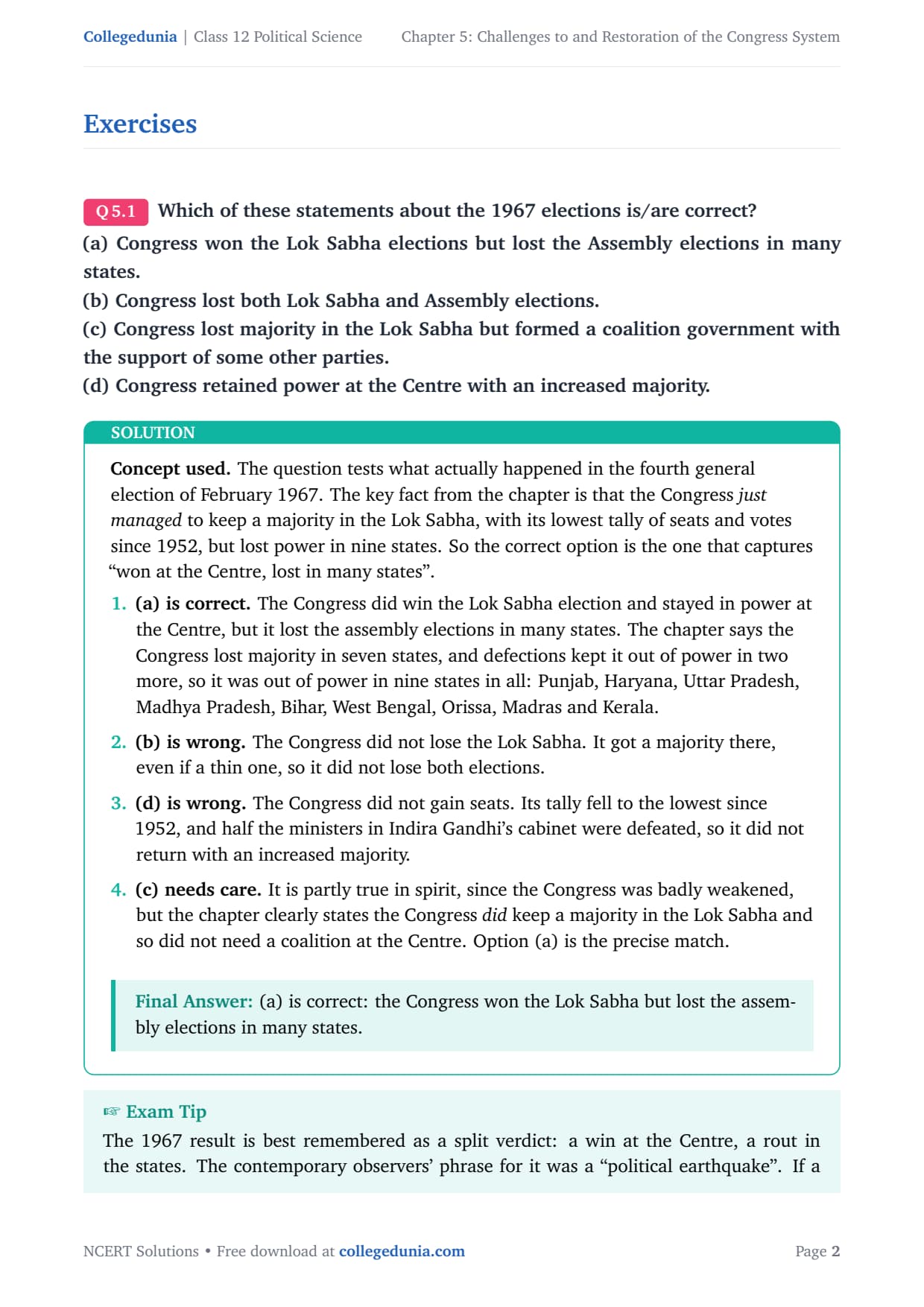
Q 5.1
Which of these statements about the 1967 elections is/are correct? [3pt]
(a) Congress won the Lok Sabha elections but lost the Assembly elections in many states.
(b) Congress lost both Lok Sabha and Assembly elections.
(c) Congress lost majority in the Lok Sabha but formed a coalition government with the support of some other parties.
(d) Congress retained power at the Centre with an increased majority.
Concept used. The question tests what actually happened in the fourth
general election of February 1967. The key fact from the chapter is that the
Congress just managed to keep a majority in the Lok Sabha, with its
lowest tally of seats and votes since 1952, but lost power in nine states. So
the correct option is the one that captures ``won at the Centre, lost in many
states''.
(a) is correct. The Congress did win the Lok Sabha election and
stayed in power at the Centre, but it lost the assembly elections in many
states. The chapter says the Congress lost majority in seven states, and
defections kept it out of power in two more, so it was out of power in
nine states in all: Punjab, Haryana, Uttar Pradesh, Madhya Pradesh,
Bihar, West Bengal, Orissa, Madras and Kerala.
(b) is wrong. The Congress did not lose the Lok Sabha. It got a
majority there, even if a thin one, so it did not lose both elections.
(d) is wrong. The Congress did not gain seats. Its tally fell to
the lowest since 1952, and half the ministers in Indira Gandhi's cabinet
were defeated, so it did not return with an increased majority.
(c) needs care. It is partly true in spirit, since the Congress
was badly weakened, but the chapter clearly states the Congress
did keep a majority in the Lok Sabha and so did not need a
coalition at the Centre. Option (a) is the precise match.
(a) is correct: the Congress won the Lok Sabha but lost the assembly
elections in many states.
AR
Aditya Raghavan
M.A. Political Science, Jawaharlal Nehru University
Verified Expert
Quick reading. Treat the four options as four claims and check each
against one anchor fact: ``Congress kept the Lok Sabha, lost nine states''.
Whichever option matches that sentence is correct; the rest contradict it.
Centre. The Congress retained the Lok Sabha, so any option that
says it lost the Lok Sabha (b) or gained seats (d) is out at once.
States. The chapter's headline is the state-level collapse: out
of power in nine states, with the DMK winning Madras outright. So the
right option must mention losing the assemblies.
Match. Only (a) says ``won Lok Sabha, lost assemblies in many
states''. That is the textbook sentence almost word for word, so (a) is
the answer.
Why this matters. 1967 is the hinge of the whole chapter. It is the
moment the Congress is shown to be beatable in the states while still ruling at
the Centre, and that gap is what makes the later split and restoration so
dramatic. Fixing ``Centre safe, states lost'' in memory unlocks half the
chapter.
(a).
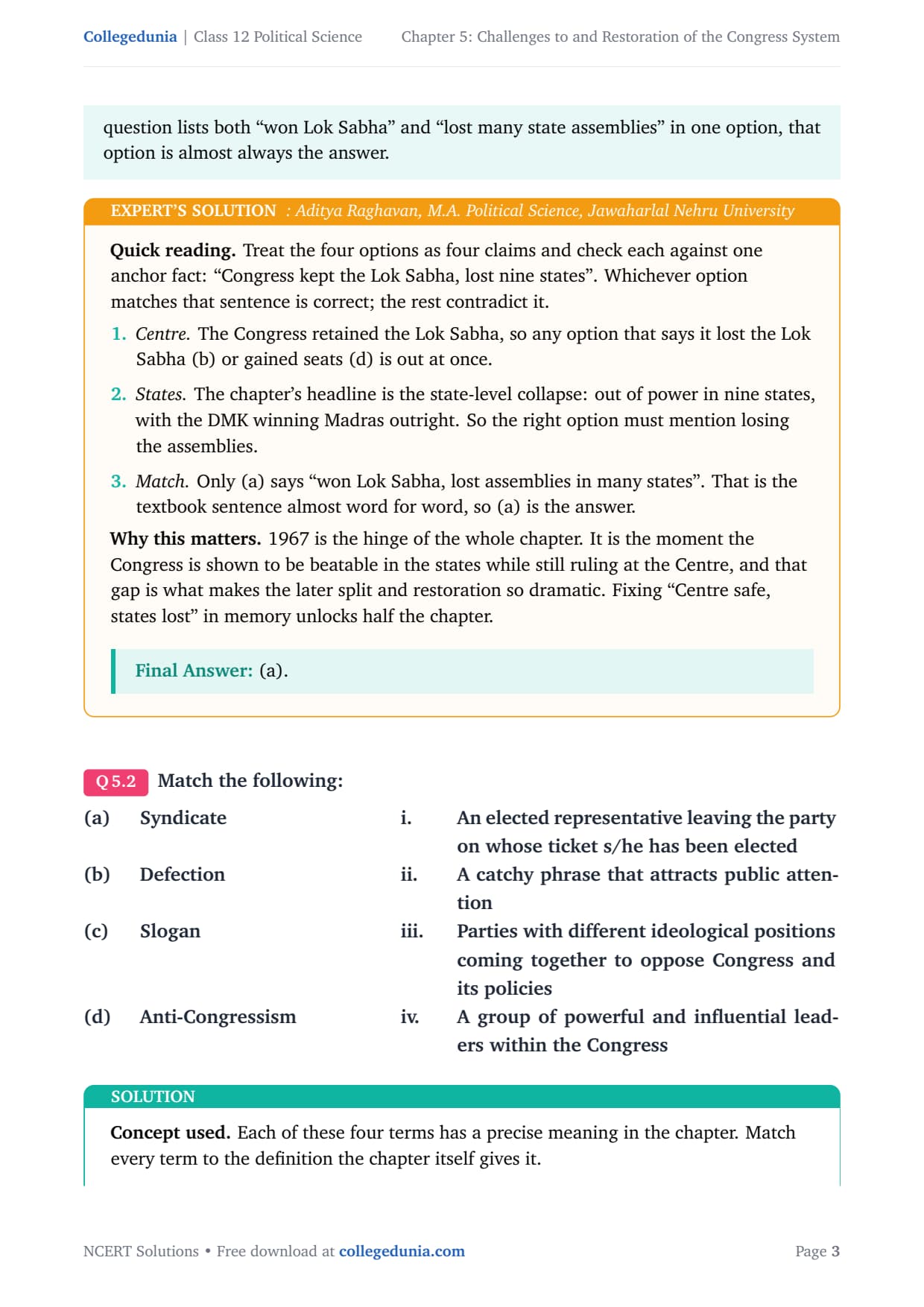
Q 5.2
Match the following: [4pt]
tabular@p0.05p0.32p0.05p0.50@
(a) & Syndicate & i. & An elected representative leaving the party on whose ticket s/he has been elected [4pt]
(b) & Defection & ii. & A catchy phrase that attracts public attention [4pt]
(c) & Slogan & iii. & Parties with different ideological positions coming together to oppose Congress and its policies [4pt]
(d) & Anti-Congressism & iv. & A group of powerful and influential leaders within the Congress
tabular
Concept used. Each of these four terms has a precise meaning in the
chapter. Match every term to the definition the chapter itself gives it.
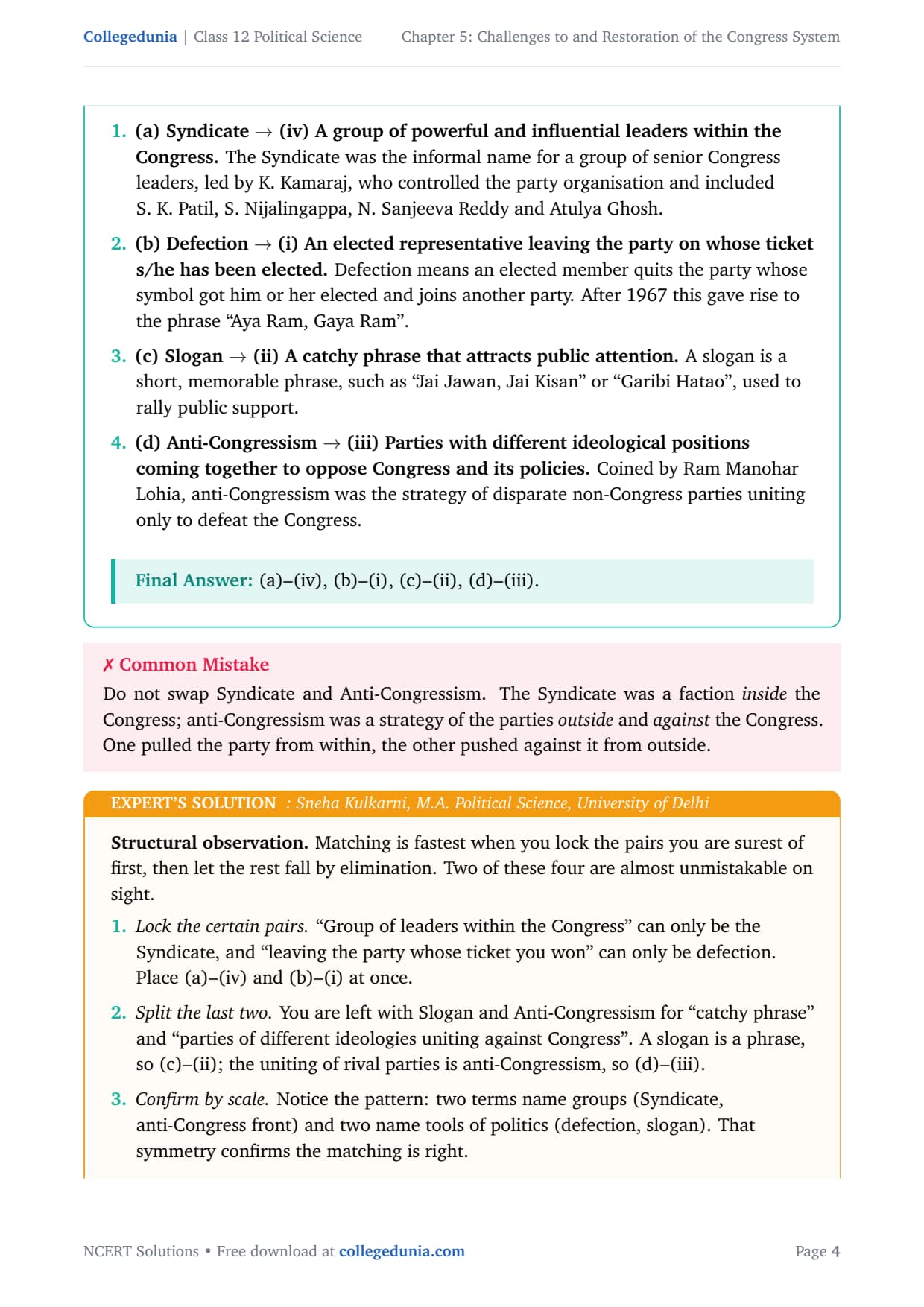
(a) Syndicate → (iv) A group of powerful and
influential leaders within the Congress. The Syndicate was the informal
name for a group of senior Congress leaders, led by K. Kamaraj, who
controlled the party organisation and included S. K. Patil,
S. Nijalingappa, N. Sanjeeva Reddy and Atulya Ghosh.
(b) Defection → (i) An elected representative leaving
the party on whose ticket s/he has been elected. Defection means an
elected member quits the party whose symbol got him or her elected and
joins another party. After 1967 this gave rise to the phrase ``Aya Ram,
Gaya Ram''.
(c) Slogan → (ii) A catchy phrase that attracts
public attention. A slogan is a short, memorable phrase, such as ``Jai
Jawan, Jai Kisan'' or ``Garibi Hatao'', used to rally public support.
(d) Anti-Congressism → (iii) Parties with different
ideological positions coming together to oppose Congress and its
policies. Coined by Ram Manohar Lohia, anti-Congressism was the strategy
of disparate non-Congress parties uniting only to defeat the Congress.
(a)–(iv), (b)–(i), (c)–(ii), (d)–(iii).
SK
Sneha Kulkarni
M.A. Political Science, University of Delhi
Verified Expert
Structural observation. Matching is fastest when you lock the pairs you
are surest of first, then let the rest fall by elimination. Two of these four
are almost unmistakable on sight.
Lock the certain pairs. ``Group of leaders within the Congress''
can only be the Syndicate, and ``leaving the party whose ticket you
won'' can only be defection. Place (a)–(iv) and (b)–(i) at once.
Split the last two. You are left with Slogan and
Anti-Congressism for ``catchy phrase'' and ``parties of different
ideologies uniting against Congress''. A slogan is a phrase, so
(c)–(ii); the uniting of rival parties is anti-Congressism, so
(d)–(iii).
Confirm by scale. Notice the pattern: two terms name groups
(Syndicate, anti-Congress front) and two name tools of politics
(defection, slogan). That symmetry confirms the matching is right.
Why this matters. These four words are the working vocabulary of the
chapter. Once Syndicate, defection, slogan and anti-Congressism are fixed in
memory, the story of the split and the 1971 election reads almost on its own.
(a)–(iv), (b)–(i), (c)–(ii), (d)–(iii).
Q 5.3
Whom would you identify with the following slogans/phrases? [3pt]
(a) Jai Jawan, Jai Kisan
(b) Indira Hatao!
(c) Garibi Hatao!
Concept used. Each slogan belongs to a particular leader or political
camp in this chapter. Match the phrase to the person or group that raised it.
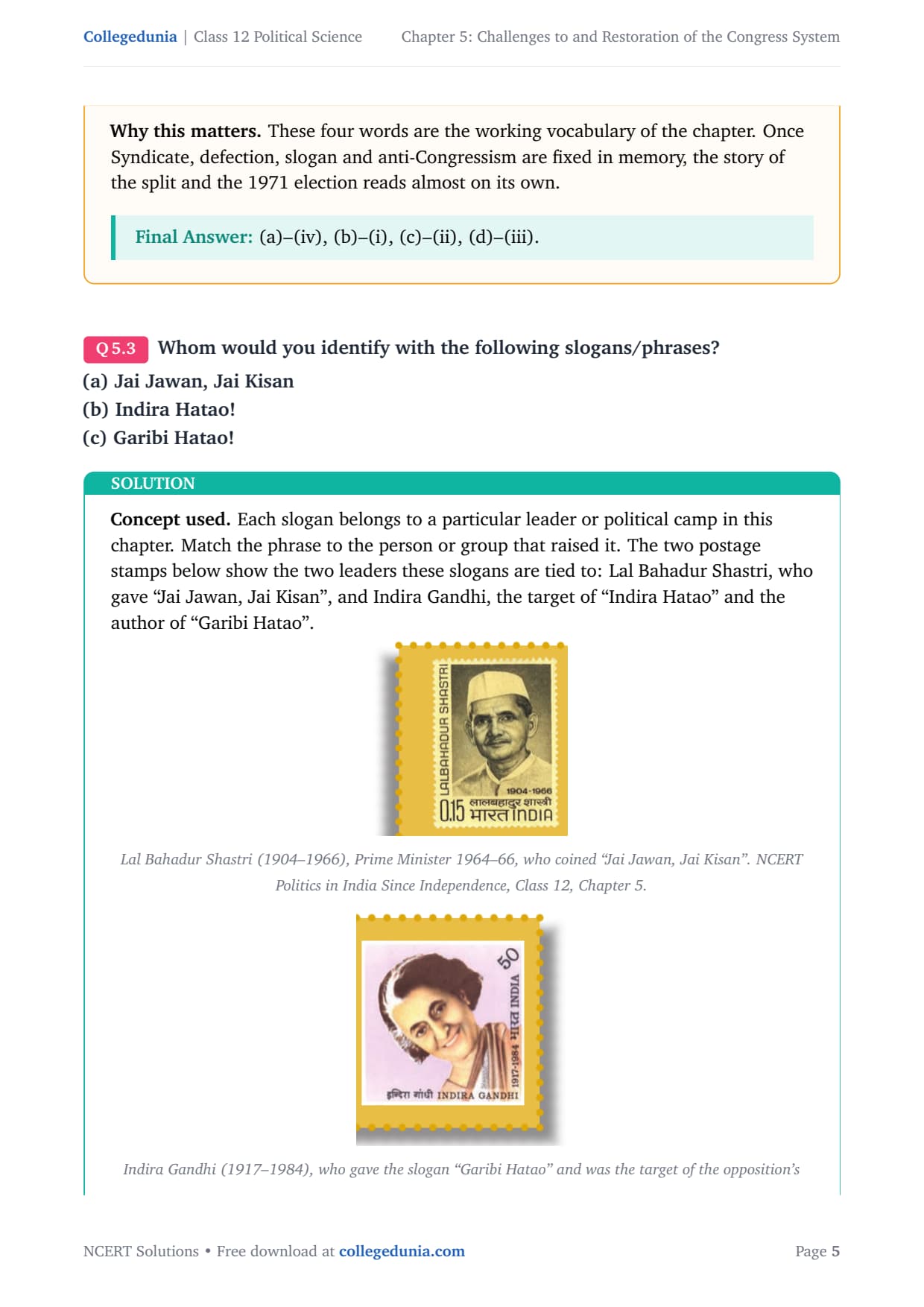
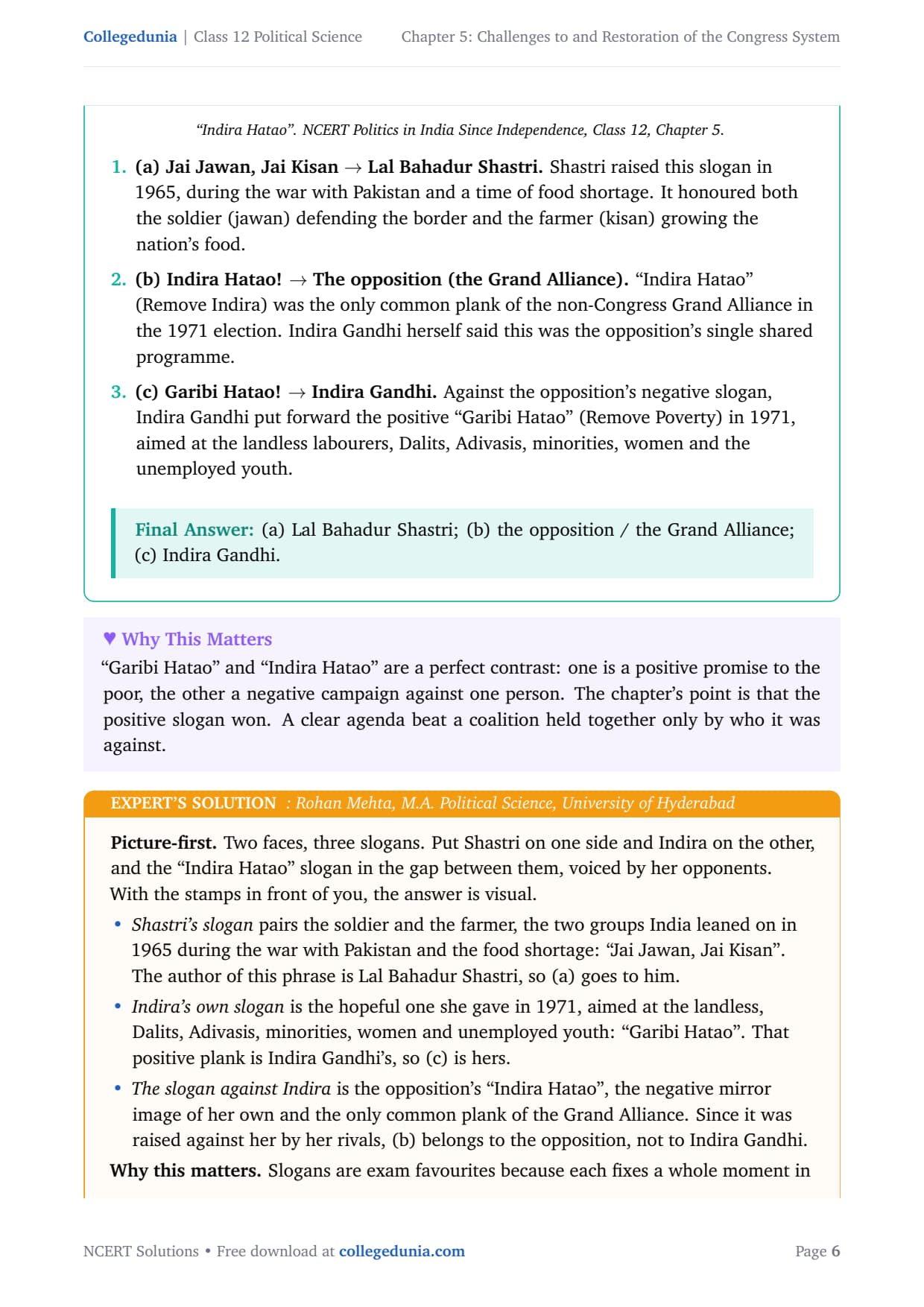
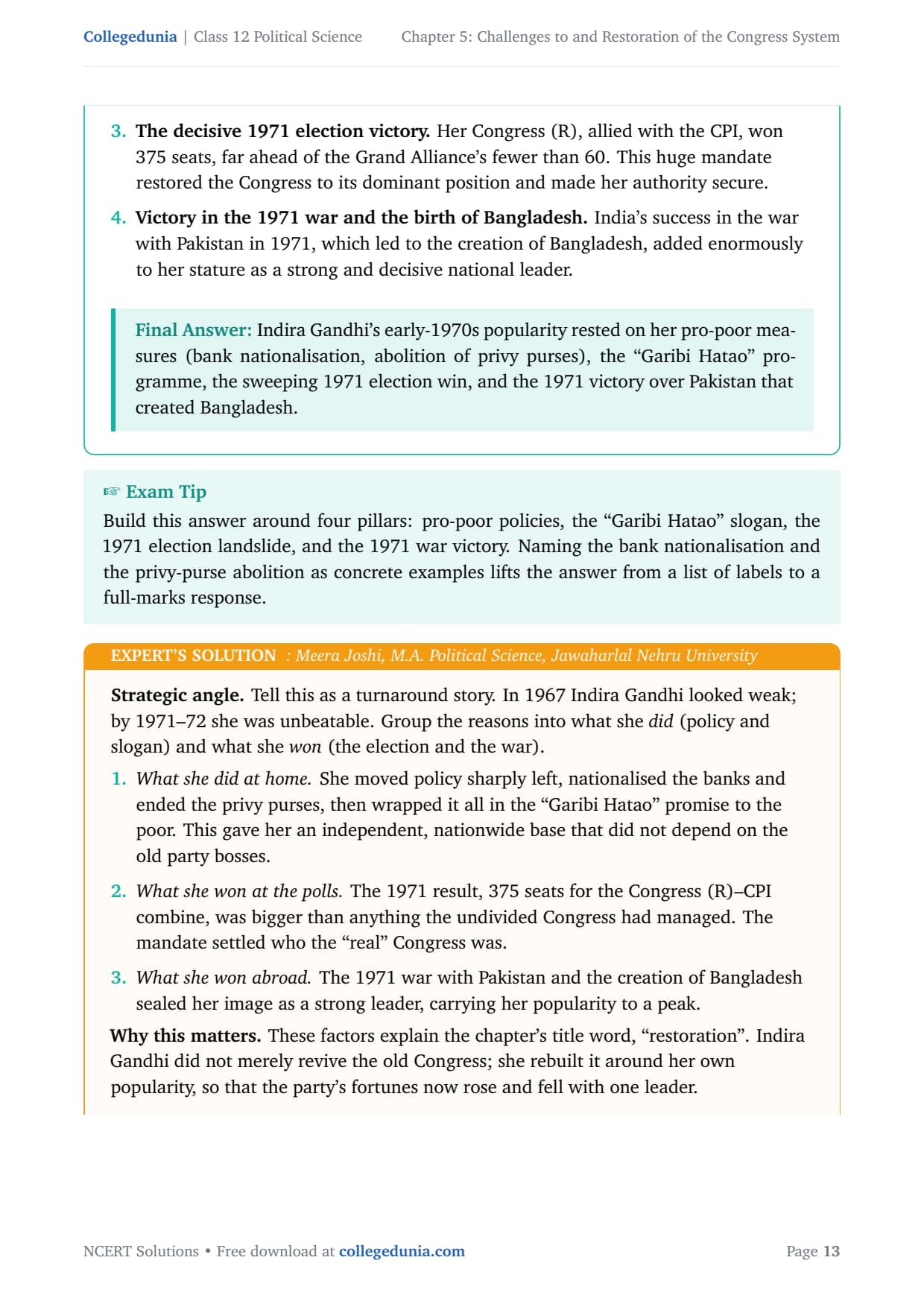
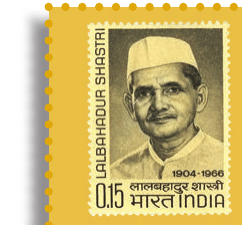
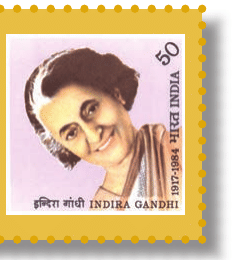
The two postage stamps below show the two leaders these slogans are tied to:
Lal Bahadur Shastri, who gave ``Jai Jawan, Jai Kisan'', and Indira Gandhi, the
target of ``Indira Hatao'' and the author of ``Garibi Hatao''.
Lal Bahadur Shastri (1904–1966), Prime
Minister 1964–66, who coined ``Jai Jawan, Jai Kisan''. NCERT Politics in India
Since Independence, Class 12, Chapter 5.Indira Gandhi (1917–1984), who gave the
slogan ``Garibi Hatao'' and was the target of the opposition's ``Indira
Hatao''. NCERT Politics in India Since Independence, Class 12, Chapter 5.
(a) Jai Jawan, Jai Kisan → Lal Bahadur Shastri.
Shastri raised this slogan in 1965, during the war with Pakistan and a
time of food shortage. It honoured both the soldier (jawan) defending
the border and the farmer (kisan) growing the nation's food.
(b) Indira Hatao! → The opposition (the Grand
Alliance). ``Indira Hatao'' (Remove Indira) was the only common plank
of the non-Congress Grand Alliance in the 1971 election. Indira Gandhi
herself said this was the opposition's single shared programme.
(c) Garibi Hatao! → Indira Gandhi. Against the
opposition's negative slogan, Indira Gandhi put forward the positive
``Garibi Hatao'' (Remove Poverty) in 1971, aimed at the landless
labourers, Dalits, Adivasis, minorities, women and the unemployed youth.
(a) Lal Bahadur Shastri; (b) the opposition / the Grand Alliance;
(c) Indira Gandhi.
RM
Rohan Mehta
M.A. Political Science, University of Hyderabad
Verified Expert
Picture-first. Two faces, three slogans. Put Shastri on one side and
Indira on the other, and the ``Indira Hatao'' slogan in the gap between them,
voiced by her opponents. With the stamps in front of you, the answer is
visual.
[leftmargin=14pt]
Shastri's slogan pairs the soldier and the farmer, the two groups
India leaned on in 1965 during the war with Pakistan and the food
shortage: ``Jai Jawan, Jai Kisan''. The author of this phrase is Lal
Bahadur Shastri, so (a) goes to him.
Indira's own slogan is the hopeful one she gave in 1971, aimed at
the landless, Dalits, Adivasis, minorities, women and unemployed youth:
``Garibi Hatao''. That positive plank is Indira Gandhi's, so (c) is
hers.
The slogan against Indira is the opposition's ``Indira Hatao'',
the negative mirror image of her own and the only common plank of the
Grand Alliance. Since it was raised against her by her rivals, (b)
belongs to the opposition, not to Indira Gandhi.
Why this matters. Slogans are exam favourites because each fixes a
whole moment in one phrase. ``Jai Jawan Jai Kisan'' is 1965 and Shastri;
``Garibi Hatao'' is 1971 and Indira Gandhi's restoration; ``Indira Hatao'' is
the opposition that lost. The trap is part (b): the phrase contains Indira's
name, but it was aimed at her by her opponents, so it is the
opposition's slogan, not hers. Reading who raised a slogan, not just
whose name it carries, is what keeps the three turning points apart.
(a) Lal Bahadur Shastri; (b) the opposition (Grand Alliance);
(c) Indira Gandhi.
Q 5.4
Which of the following statement about the Grand Alliance of 1971 is correct? [3pt]
The Grand Alliance
(a) was formed by non-Communist, non-Congress parties.
(b) had a clear political and ideological programme.
(c) was formed by all non-Congress parties.
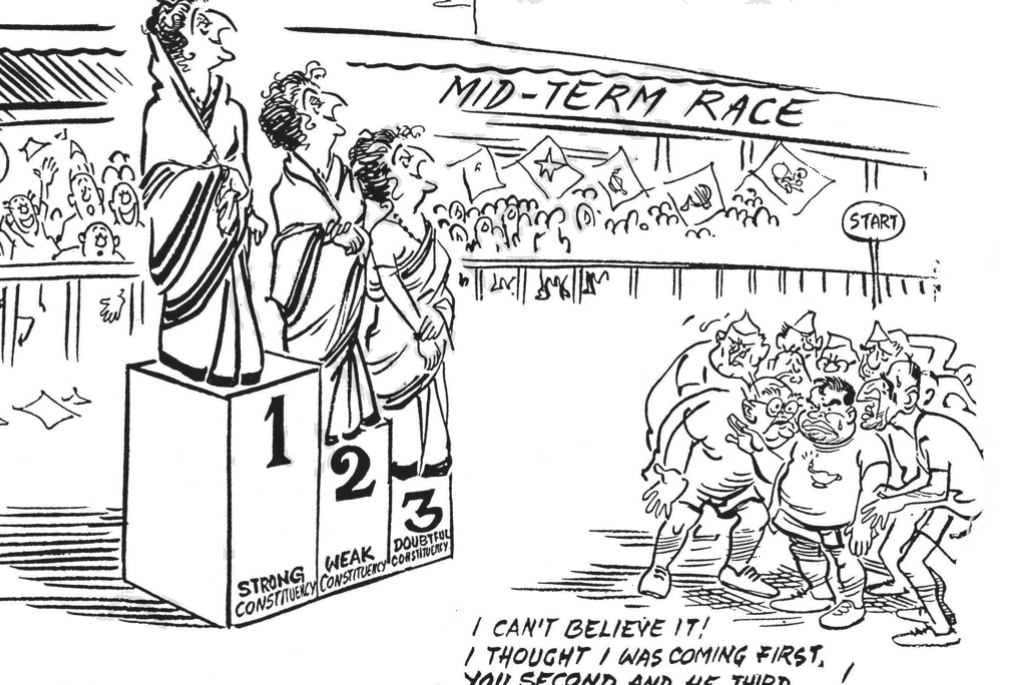
Concept used. The Grand Alliance was the opposition front in the 1971
Lok Sabha election. Test each statement against what the chapter says about who
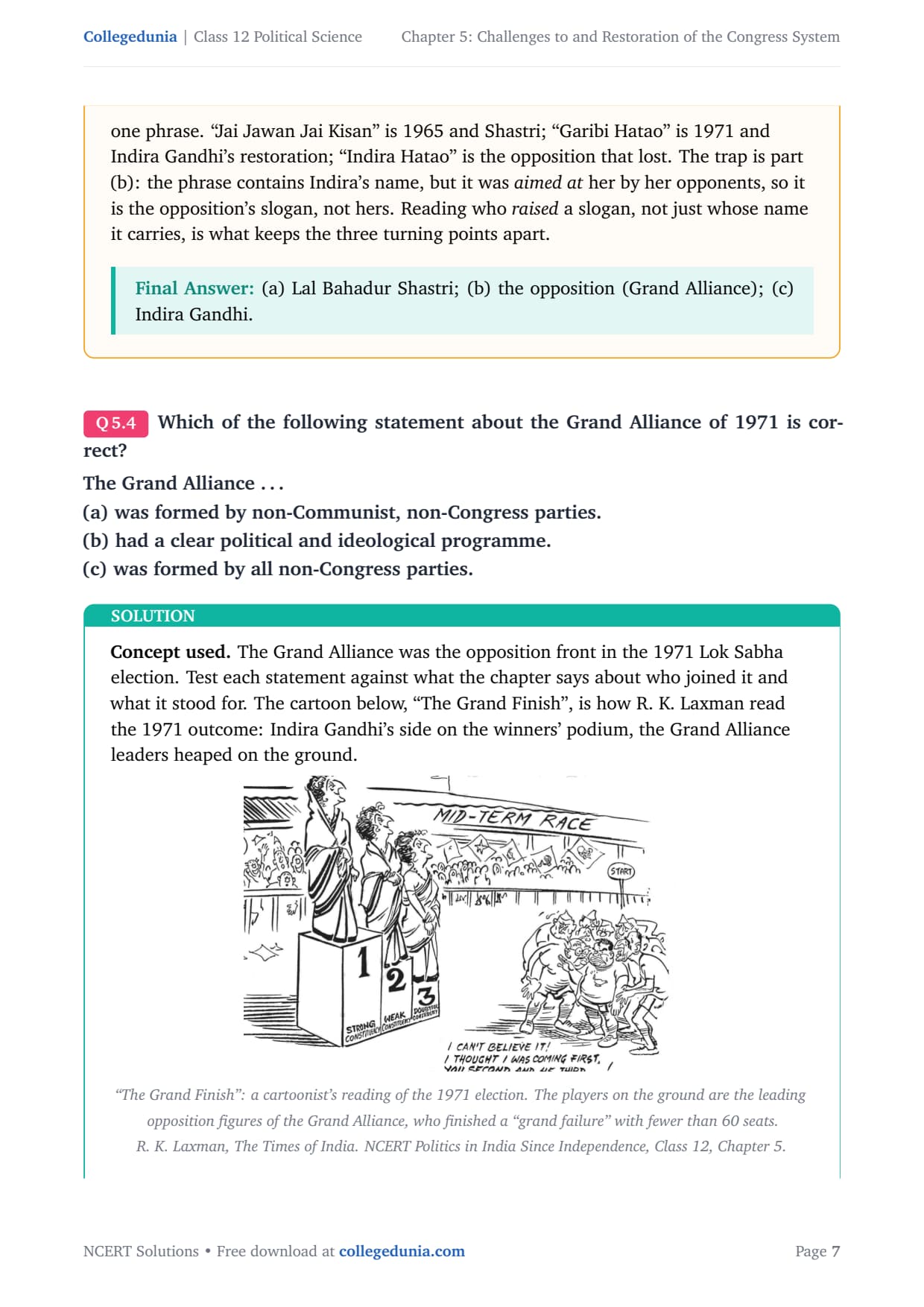
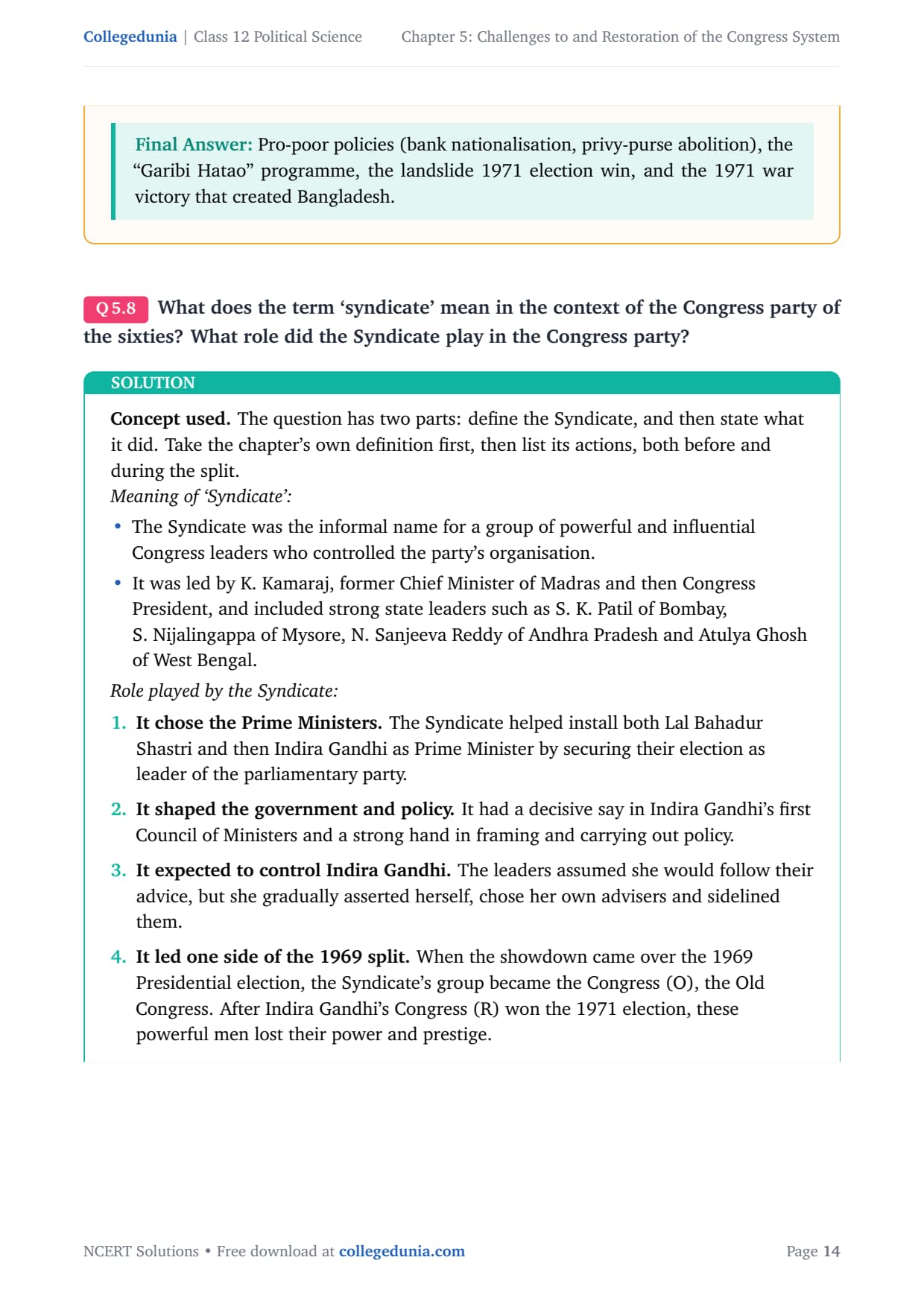
joined it and what it stood for. The cartoon below, ``The Grand Finish'', is how
R. K. Laxman read the 1971 outcome: Indira Gandhi's side on the winners' podium,
the Grand Alliance leaders heaped on the ground.
``The Grand Finish'': a cartoonist's
reading of the 1971 election. The players on the ground are the leading
opposition figures of the Grand Alliance, who finished a ``grand failure'' with
fewer than 60 seats. R. K. Laxman, The Times of India. NCERT Politics in India
Since Independence, Class 12, Chapter 5.
(a) is correct. The chapter states that all the major
non-communist, non-Congress opposition parties formed the Grand Alliance:
the SSP, PSP, Bharatiya Jana Sangh, Swatantra Party and Bharatiya Kranti
Dal. So it was an alliance of non-Communist, non-Congress parties.
(b) is wrong. The Grand Alliance did not have a clear
political and ideological programme. Indira Gandhi pointed out that its
only common plank was ``Indira Hatao''. The chapter calls it a ``grand
failure'' precisely because it lacked a coherent agenda.
(c) is wrong. It was not formed by all non-Congress
parties. The Communist Party of India was not in it; in fact the CPI was
allied with Indira Gandhi's Congress (R), so not every non-Congress
party was in the alliance.
(a) is correct: the Grand Alliance was formed by non-Communist,
non-Congress parties.
KB
Karan Bose
M.A. Political Science, Jamia Millia Islamia
Verified Expert
Strategic angle. Test the three statements against two facts: who was
in the alliance, and what it stood for. The alliance was the
non-communist, non-Congress parties, and it had no shared programme beyond
removing Indira. Those two facts decide all three options.
Membership. Non-communist and non-Congress parties joined, but
the CPI stayed out and backed Indira Gandhi. So (a) is right and (c),
which says ``all'' non-Congress parties, is wrong.
Programme. The alliance's only glue was ``Indira Hatao''. A
negative slogan is not a clear ideological programme, so (b) is wrong.
Confirm with the cartoon. ``The Grand Finish'' shows the
alliance collapsing in a heap: an apt picture of a front with no
positive idea, beaten by Indira Gandhi's ``Garibi Hatao''.
Why this matters. The Grand Alliance is the chapter's lesson that
unity against someone is not the same as unity for something. With under 60
seats against Indira Gandhi's 375, the front shows why a shared enemy alone
cannot win an election.
(a).
Q 5.5
How should a political party resolve its internal differences? Here are some suggestions. Think of each and list out their advantages and shortcomings. [3pt]
(a) Follow the footsteps of the party president
(b) Listen to the majority group
(c) Secret ballot voting on every issue
(d) Consult the senior and experienced leaders of the party
Concept used. This is an open, thinking question on inner-party
democracy. There is no single ``correct'' option; the task is to weigh each
method for its advantages and shortcomings. A useful test for each method is
whether it keeps the party both united and democratic, the very
balance that the 1969 Congress split shows is hard to hold.
(a) Follow the footsteps of the party president:
[leftmargin=14pt]
Advantage: It gives quick, clear decisions and keeps the party
disciplined and united behind one line.
Shortcoming: It can turn into one-person rule, ignore other
views, and weaken inner-party democracy, much as the chapter shows the
new Congress came to rely entirely on a single supreme leader.
(b) Listen to the majority group:
[leftmargin=14pt]
Advantage: It is democratic and gives the decision the backing
of most members, so it usually carries wide support.
Shortcoming: The minority view may be ignored every time,
which can leave a permanent minority frustrated and tempt it to break
away.
(c) Secret ballot voting on every issue:
[leftmargin=14pt]
Advantage: It lets members vote their honest opinion without
fear of pressure from leaders, as Indira Gandhi's call for a
``conscience vote'' tried to do in 1969.
Shortcoming: Voting on every issue is slow and
impractical, and constant secret ballots can breed distrust and hide
who is responsible for a decision.
(d) Consult the senior and experienced leaders of the party:
[leftmargin=14pt]
Advantage: It brings the wisdom and experience of senior
leaders to bear, and respects the party's collective memory.
Shortcoming: It can let a small group of veterans, like the
Syndicate, dominate the party and block younger members and new ideas.
Each method has a real benefit and a real cost; the best practice is
to blend them, using discussion, majority decision and consultation together,
so the party stays both united and internally democratic.
AP
Ananya Pillai
M.A. Political Science, Banaras Hindu University
Verified Expert
Strategic angle. For a ``list advantages and shortcomings'' question,
give each option exactly one good point and one bad point, and tie at least one
of them to the chapter. A short, balanced table of pros and cons scores better
than a long opinion.
Group the four methods. Two are top-down (follow the president,
consult the seniors) and two are member-driven (majority group, secret
ballot). Top-down methods give unity but risk dominance; member-driven
methods give democracy but can be slow or divisive.
Anchor each in the chapter. Link ``follow the president'' to the
leader-centred new Congress, ``consult seniors'' to the Syndicate,
``secret ballot'' to the 1969 conscience vote, and ``majority group'' to
ordinary party voting. The chapter gives a real example for almost each.
State your view briefly. The healthiest party uses a mix: open
discussion first, a majority decision where needed, and the senior
leaders' counsel, so that no single method, and no single person, runs
the party.
Why this matters. Inner-party democracy decides whether a party
splits or survives. The Congress of 1969 is the warning: when none of these
methods is allowed to work fairly, the only outcome left is a split.
All four methods have advantages and shortcomings; a healthy party
combines discussion, majority decisions and consultation so it stays both
united and democratic.
Q 5.6
State which of these were reasons for the defeat of the Congress in 1967. Give reasons for your answer. [3pt]
(a) The absence of a charismatic leader in the Congress party
(b) Split within the Congress party
(c) Increased mobilisation of regional, ethnic and communal groups
(d) Increasing unity among non-Congress parties
(e) Internal differences within the Congress party
Concept used. The setback of 1967 had several causes, but not every
option listed here is one of them. Check each against the chapter's timeline:
the split came after 1967, so it cannot be a cause of the 1967 result.
(a) Yes, a reason. The Congress fought the 1967 election for
the first time without Nehru, and the new Prime Minister Indira Gandhi
was still seen as a political novice. The absence of a tall, charismatic
leader weakened the party at the polls.
(b) No, not a reason. The formal split in the Congress happened
only in 1969, two years after the 1967 election. An event that
had not yet occurred cannot have caused the 1967 defeat, so this is not
a reason.
(c) Yes, a reason. This period saw greater mobilisation of
regional, ethnic and communal groups. The DMK's anti-Hindi agitation
carried it to power in Madras, and other regional forces grew, eating
into Congress support.
(d) Yes, a reason. Non-Congress parties grew more united. Under
Lohia's idea of non-Congressism, rival parties stopped splitting the
anti-Congress vote and instead formed fronts and seat adjustments, which
hurt the Congress badly.
(e) Yes, a reason. Internal differences and factionalism within
the Congress were real even before the split, and they weakened the
party's campaign and unity in 1967.
Reasons for the 1967 defeat: (a), (c), (d) and (e). Statement (b) is
not a reason, because the Congress split happened in 1969, after the
1967 election.
VS
Vikram Saini
M.A. Political Science, University of Calcutta
Verified Expert
Strategic angle. Sort the five options by time. Anything that happened
in or before 1967 can be a cause; anything that happened after 1967 cannot. One
option fails that single test.
Run the date test. Four causes belong to 1967 or earlier: no
Nehru (a), regional mobilisation (c), opposition unity (d) and Congress
factionalism (e). The split (b) belongs to 1969, so it is ruled out at
once.
Give a reason for each ``yes''. No charismatic leader after
Nehru; the DMK and other regional forces rising; non-Congressism uniting
the rivals; and factions weakening the party from inside. Each is a
named fact from the chapter.
Justify the ``no''. The split came two years later, so it could
not have caused a defeat that had already happened. Stating this date
gap is what earns the mark on (b).
Why this matters. Examiners use 1967 versus 1969 to test whether you
know the sequence. The 1967 setback weakened the Congress; the 1969 split then
reshaped it. Mixing the two is the commonest error, so getting the order right
shows real command of the chapter.
(a), (c), (d), (e) are reasons; (b) is not, since the split came in
1969, after the 1967 election.
Q 5.7
What were the factors which led to the popularity of Indira Gandhi's Government in the early 1970s?
Concept used. By the early 1970s Indira Gandhi had turned from a leader
seen as a ``novice'' into one with ``unprecedented political authority''. The
factors behind this rise are spread across the chapter's account of the split,
the pro-poor programme, the 1971 election and the 1971 war. Gather them under
clear heads.
A pro-poor, left-leaning image. After the split she gave
government policy a clear left orientation. She nationalised fourteen
major private banks and abolished the privy purses of the former
princes. These bold, popular steps won her support among ordinary
people.
The ``Garibi Hatao'' slogan and programme. In the 1971 election
she offered a positive agenda, ``Garibi Hatao'' (Remove Poverty), with
promises of land ceilings, removal of income disparities and help for
the poor. This built a new support base among landless labourers, Dalits,
Adivasis, minorities, women and unemployed youth.
The decisive 1971 election victory. Her Congress (R), allied
with the CPI, won 375 seats, far ahead of the Grand Alliance's fewer
than 60. This huge mandate restored the Congress to its dominant position
and made her authority secure.
Victory in the 1971 war and the birth of Bangladesh. India's
success in the war with Pakistan in 1971, which led to the creation of
Bangladesh, added enormously to her stature as a strong and decisive
national leader.
Indira Gandhi's early-1970s popularity rested on her pro-poor measures
(bank nationalisation, abolition of privy purses), the ``Garibi Hatao''
programme, the sweeping 1971 election win, and the 1971 victory over Pakistan
that created Bangladesh.
MJ
Meera Joshi
M.A. Political Science, Jawaharlal Nehru University
Verified Expert
Strategic angle. Tell this as a turnaround story. In 1967 Indira
Gandhi looked weak; by 1971–72 she was unbeatable. Group the reasons into what
she did (policy and slogan) and what she won (the election and the
war).
What she did at home. She moved policy sharply left, nationalised
the banks and ended the privy purses, then wrapped it all in the
``Garibi Hatao'' promise to the poor. This gave her an independent,
nationwide base that did not depend on the old party bosses.
What she won at the polls. The 1971 result, 375 seats for the
Congress (R)–CPI combine, was bigger than anything the undivided
Congress had managed. The mandate settled who the ``real'' Congress was.
What she won abroad. The 1971 war with Pakistan and the creation
of Bangladesh sealed her image as a strong leader, carrying her
popularity to a peak.
Why this matters. These factors explain the chapter's title word,
``restoration''. Indira Gandhi did not merely revive the old Congress; she
rebuilt it around her own popularity, so that the party's fortunes now rose and
fell with one leader.
Pro-poor policies (bank nationalisation, privy-purse abolition), the
``Garibi Hatao'' programme, the landslide 1971 election win, and the 1971 war
victory that created Bangladesh.
Q 5.8
What does the term `syndicate' mean in the context of the Congress party of the sixties? What role did the Syndicate play in the Congress party?
Concept used. The question has two parts: define the Syndicate, and
then state what it did. Take the chapter's own definition first, then list its
actions, both before and during the split.
Meaning of `Syndicate':
[leftmargin=14pt]
The Syndicate was the informal name for a group of powerful and
influential Congress leaders who controlled the party's organisation.
It was led by K. Kamaraj, former Chief Minister of Madras and then
Congress President, and included strong state leaders such as
S. K. Patil of Bombay, S. Nijalingappa of Mysore, N. Sanjeeva Reddy of
Andhra Pradesh and Atulya Ghosh of West Bengal.
Role played by the Syndicate:
It chose the Prime Ministers. The Syndicate helped install both
Lal Bahadur Shastri and then Indira Gandhi as Prime Minister by securing
their election as leader of the parliamentary party.
It shaped the government and policy. It had a decisive say in
Indira Gandhi's first Council of Ministers and a strong hand in framing
and carrying out policy.
It expected to control Indira Gandhi. The leaders assumed she
would follow their advice, but she gradually asserted herself, chose her
own advisers and sidelined them.
It led one side of the 1969 split. When the showdown came over
the 1969 Presidential election, the Syndicate's group became the
Congress (O), the Old Congress. After Indira Gandhi's Congress (R) won
the 1971 election, these powerful men lost their power and prestige.
The Syndicate was a group of powerful senior Congress leaders, led by
K. Kamaraj, who controlled the party organisation. It helped pick the Prime
Ministers, shaped the ministry and policy, and finally became the Congress (O)
on the losing side of the 1969 split.
AN
Arjun Nair
M.A. Political Science, University of Madras
Verified Expert
Structural observation. Answer the two halves cleanly: a one-line
definition with the leaders' names, then the role in three or four numbered
points. Naming Kamaraj and the chief lieutenants is what marks out a strong
answer.
Define first. The Syndicate is the informal club of senior
Congress organisation men, led by Kamaraj, with Patil, Nijalingappa,
Reddy and Ghosh. That single sentence answers part one.
Then trace the role as a rise and fall. They made Prime Ministers
(Shastri, then Indira Gandhi), ran the ministry and policy, expected
obedience, and finally lost the 1969 power struggle as the Congress (O).
End on the outcome. After 1971 these once all-powerful men were
left without power or prestige, which shows how completely Indira Gandhi
broke their hold.
Why this matters. The Syndicate is the face of the ``old'' Congress.
Understanding it explains why the 1969 split was not just a quarrel but a
contest over who would control the party: the organisation bosses or the
popular leader.
A group of powerful senior Congress organisation leaders led by
K. Kamaraj, who picked the Prime Ministers and controlled the ministry and
policy, and who became the losing Congress (O) in the 1969 split.
Q 5.9
Discuss the major issue which led to the formal split of the Congress Party in 1969.
Concept used. The 1969 split grew out of the power struggle between
Indira Gandhi and the Syndicate, but the formal break was triggered by
one specific event: the 1969 Presidential election. Trace the issue from the
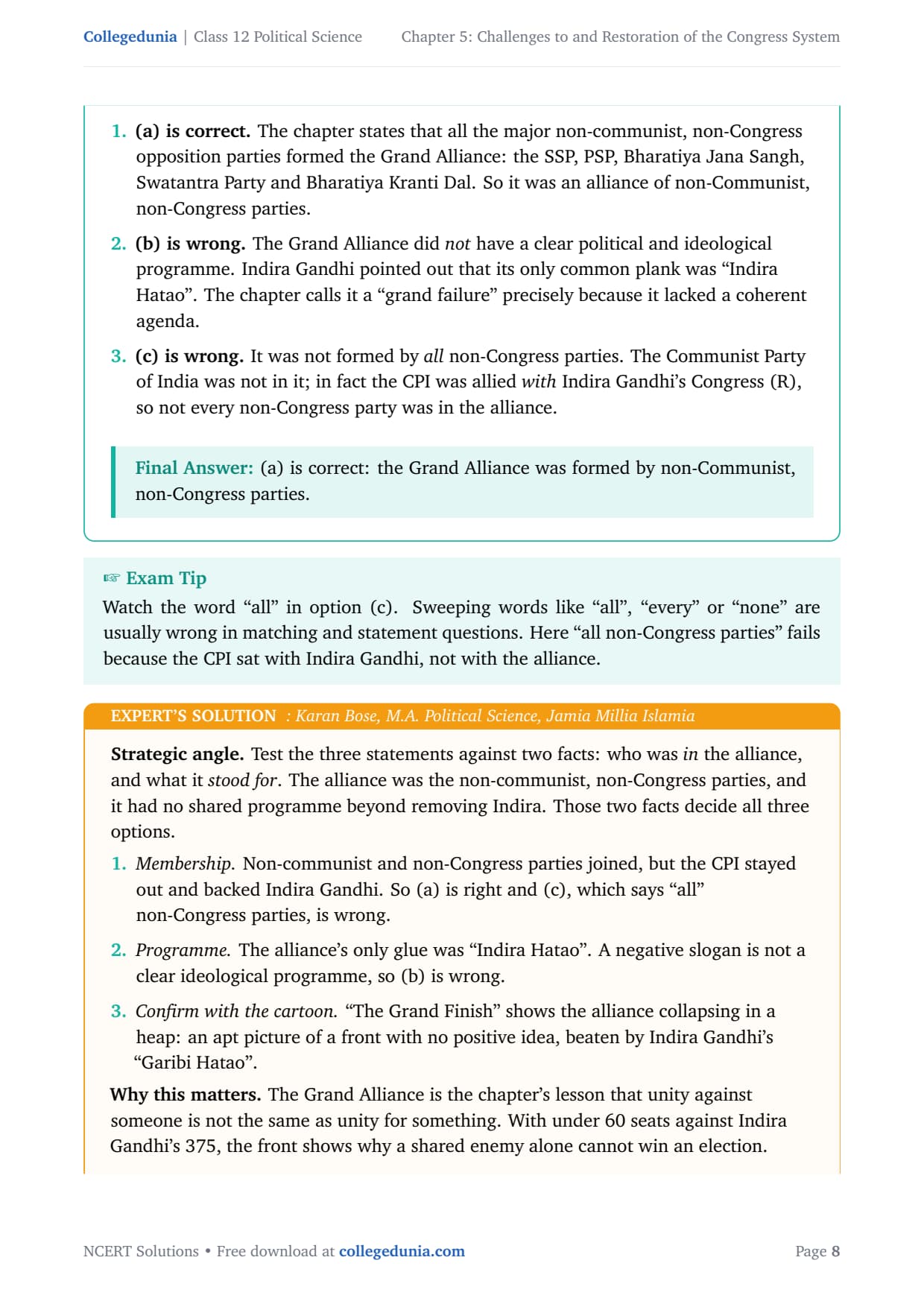
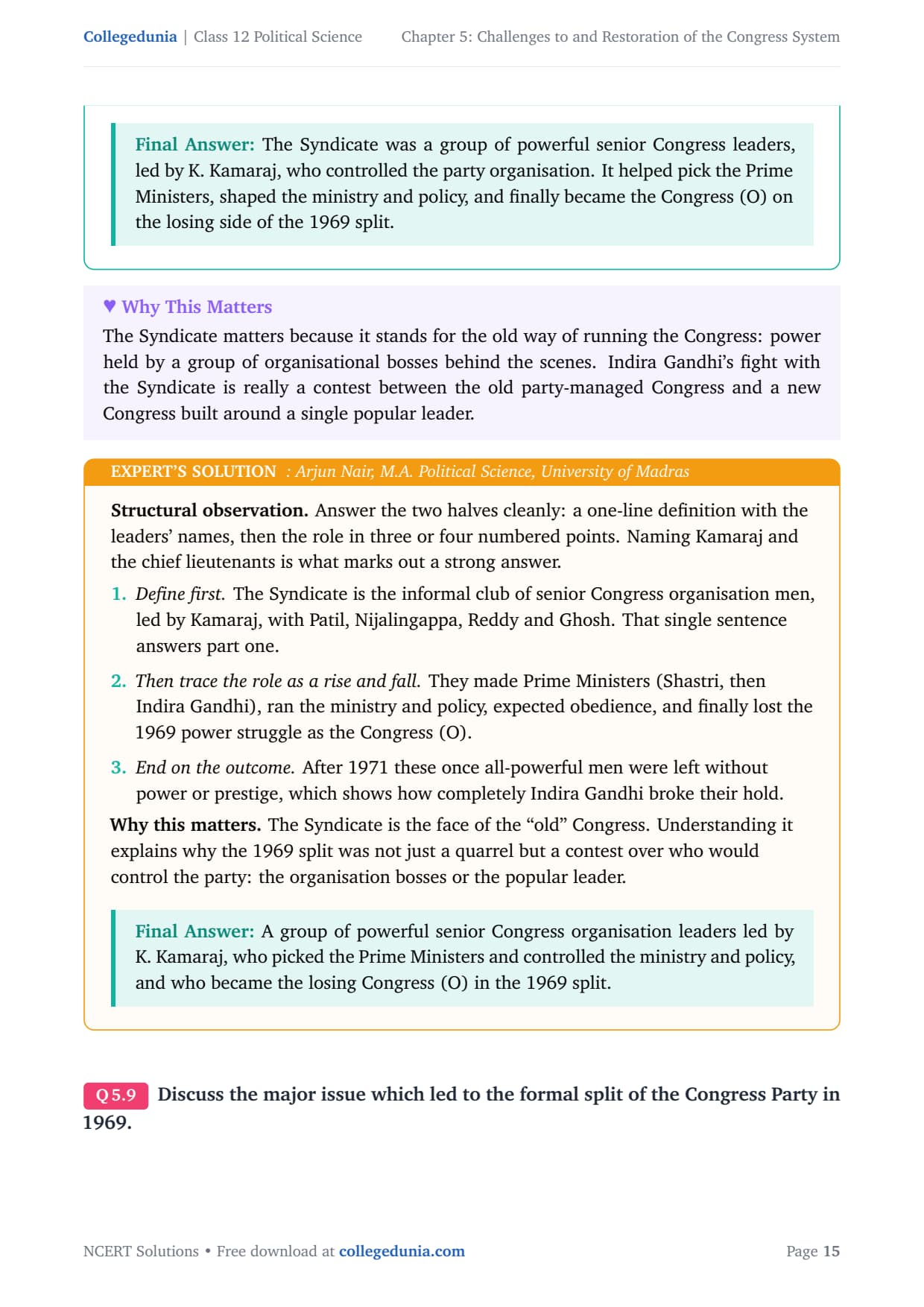
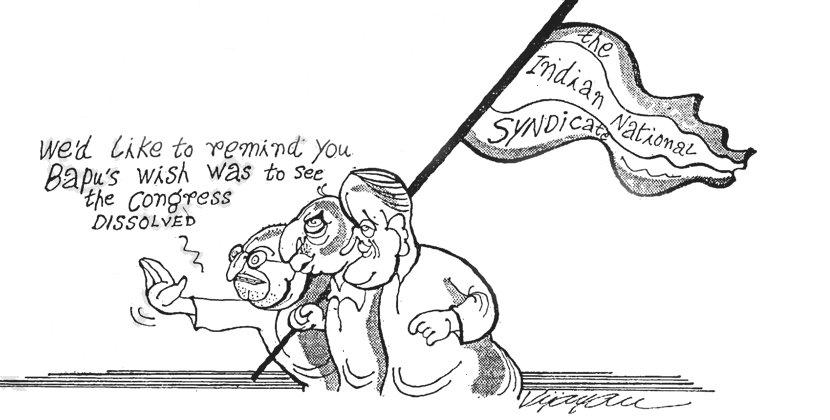
rivalry, through the Presidential contest, to the formal split. The cartoon
below captures the leadership rivalry inside the Congress in 1969.
A cartoonist's impression of the
leadership rivalry in the Congress in 1969: a Syndicate figure carries the ``The
Indian National Syndicate'' flag and reminds Indira Gandhi that ``Bapu's wish
was to see the Congress dissolved''. Vijayan, Shankar's Weekly. NCERT Politics
in India Since Independence, Class 12, Chapter 5.
The underlying rivalry. Indira Gandhi was trying to free
herself from the Syndicate, while the Syndicate wanted to keep control.
She had begun to assert her own authority and to give policy a left
orientation.
The 1969 Presidential election, the trigger. When President
Zakir Hussain died, the Syndicate nominated Indira Gandhi's opponent,
N. Sanjeeva Reddy, as the official Congress candidate. Indira Gandhi hit
back by quietly backing the independent candidate, V. V. Giri.
Whip versus conscience vote. Congress President S. Nijalingappa
issued a ``whip'' ordering all Congress MPs and MLAs to vote for Reddy.
Indira Gandhi openly called instead for a ``conscience vote'', leaving
members free to vote as they wished, a direct defiance of the official
party line.
The result and the formal split. V. V. Giri, the independent,
won, and the official Congress candidate Reddy lost. This defeat
formalised the break. The Congress President expelled Indira Gandhi from
the party; she claimed her group was the real Congress. By November 1969
the Syndicate's side was the Congress (O), Old Congress, and her side the
Congress (R), New Congress.
The major issue was the 1969 Presidential election. The Syndicate's
official candidate N. Sanjeeva Reddy faced V. V. Giri, whom Indira Gandhi
backed. Her call for a ``conscience vote'' against the party whip, and Giri's
victory, formalised the split into Congress (O) and Congress (R).
IB
Ishita Banerjee
M.A. Political Science, University of Hyderabad
Verified Expert
Picture-first. The cartoon says it in one frame: the Syndicate, holding
its own ``Indian National Syndicate'' flag, lecturing Indira Gandhi. That is the
rivalry. The Presidential election is simply where it finally exploded into a
formal split.
Set the scene. Indira Gandhi wants independence from the
Syndicate; the Syndicate wants obedience. She has already begun choosing
her own advisers and pushing a left-leaning programme, so both sides are
now looking for a showdown rather than a compromise.
Name the trigger. The death of President Zakir Hussain leaves the
post vacant, and that vacancy becomes the battlefield. The Syndicate gets
N. Sanjeeva Reddy made the official Congress candidate; Indira Gandhi
quietly backs the independent V. V. Giri and then openly calls for a
``conscience vote'', telling Congress members to vote as they wish in
defiance of the official party whip.
State the outcome. Giri wins, the official candidate Reddy loses,
and that defeat formalises the break. Indira Gandhi is expelled by the
Congress President, she claims her side is the real Congress, and by
November 1969 the party has split into the Syndicate's Old Congress
(Congress O) and her New Congress (Congress R). She frames the divide as
socialists versus conservatives, the pro-poor versus the pro-rich.
Why this matters. The split is the turning point of the chapter. It
ends the old, faction-balancing Congress, where rivals stayed inside one tent,
and sets up the new, leader-centred Congress that Indira Gandhi would restore to
dominance in the 1971 election. Knowing that the trigger was a Presidential vote,
not a policy debate, is what separates a precise answer from a vague one.
The 1969 Presidential election: the Syndicate's candidate Reddy versus
V. V. Giri, backed by Indira Gandhi. Her ``conscience vote'' against the party
whip, and Giri's win, formalised the split into Congress (O) and Congress (R).
Q 5.10
Read the passage and answer the questions below: [3pt]
`` Indira Gandhi changed the Congress into highly centralised and
undemocratic party organisation, from the earlier federal, democratic and
ideological formation that Nehru had led But this could not have
happened had not Indira Gandhi changed the entire nature of politics. This new,
populist politics turned political ideology into a mere electoral
discourse, use of various slogans not meant to be translated into government
policies During its great electoral victories in early 1970s, amidst the
celebration, the Congress party as a political organisation died''
(Sudipta Kaviraj) [4pt]
(a) What according to the author is the difference between the strategies of Nehru and Indira Gandhi?
(b) Why does the author say that the Congress party `died' in the seventies?
(c) In what way, did the change in the Congress party affect other political parties also?
Concept used. Sudipta Kaviraj's passage contrasts Nehru's Congress with
Indira Gandhi's. The key idea is that Indira Gandhi rebuilt the party around a
single popular leader and around slogans, so the old, federal, faction-rich
organisation effectively ``died''. Answer each part by reading the author's
argument and linking it to the chapter's account of the restoration.
(a) The difference between Nehru's and Indira Gandhi's strategies:
[leftmargin=14pt]
Under Nehru, the Congress was a federal, democratic and
ideological formation: power was shared, many factions and ideologies
lived inside it, and ideology was meant to be carried into policy.
Under Indira Gandhi, it became highly centralised and
undemocratic, run from the top and relying on the popularity of one
leader. Politics became populist, and ideology shrank into election-time
slogans.
(b) Why the author says the Congress `died' in the seventies:
[leftmargin=14pt]
As an organisation, the old Congress lost its life. It no longer
had the many factions that once absorbed different opinions and
interests, and its inner democracy was gone.
It now depended entirely on the popularity of the supreme leader, with a
weak organisational structure. So even as it won great electoral
victories, the Congress as a political organisation had died: only
its name and election-winning power survived.
(c) How the change affected other political parties:
[leftmargin=14pt]
Other parties were drawn into the same leader-centred, populist style of
politics, competing through slogans and personalities rather than
organisation.
The new Congress, resting on one leader, no longer absorbed many groups
and opinions, so the space for many of those interests shifted outside
the Congress, shaping how the opposition organised itself.
In short, Indira Gandhi's reinvention of the Congress reset the rules of
the game, and the other parties had to respond to this new, populist,
leader-driven politics.
(a) Nehru ran a federal, democratic, ideological Congress; Indira
Gandhi made it centralised, undemocratic and built on one leader's popularity
and slogans. (b) Because the old organisation, with its factions and inner
democracy, ceased to exist even as the party kept winning elections. (c) Other
parties were pulled into the same populist, slogan- and leader-centred politics,
and had to adjust to the new Congress.
DM
Devika Menon
M.A. Political Science, University of Delhi
Verified Expert
Structural observation. A passage question rewards three short, direct
answers, each quoting the author's key word: ``centralised'', ``died'',
``populist''. Handle (a), (b) and (c) as three separate mini-answers.
Part (a) is a contrast. Set Nehru's Congress against Indira
Gandhi's, trait for trait. Nehru's was federal (power shared with the
states and units), democratic (decisions taken inside the party) and
ideological (ideas meant to become policy). Indira Gandhi's was
centralised (run from the top), undemocratic and built on one leader's
popularity, with ideology shrunk into election-time slogans.
Part (b) is about organisation. Stress the single word ``died''
and qualify it carefully: the party did not stop winning, it stopped
being a living organisation. Its many factions, which once
absorbed different opinions and interests, were gone, and its inner
democracy with them. So even amid the great victories of the early 1970s,
the Congress as an organisation had died.
Part (c) is about spillover. Show that the change did not stay
inside the Congress. Other parties were drawn into the same populist,
slogan-and-leader style of politics, and because the new Congress no
longer absorbed every group, much of that competition moved outside it,
reshaping the whole party system.
Why this matters. The examiner is checking whether you see the chapter's
final twist. Indira Gandhi won by re-inventing the Congress, not by restoring the
old one, and Kaviraj's words ``the Congress party as a political organisation
died'' are the sharpest way to say it. A top answer keeps the paradox in view:
the party was never more successful at the polls and never weaker as an
organisation than at this very moment.
(a) Nehru: federal, democratic, ideological; Indira Gandhi:
centralised, undemocratic, leader- and slogan-driven. (b) The old organisation,
with its factions and inner democracy, died even as the party won elections.
(c) Other parties were pulled into the same populist, leader-centred politics.
FAQs on Challenges to and Restoration of the Congress System Class 12 NCERT Solutions
Challenges to and Restoration of the Congress System Class 12 Political Science Common Questions
Ques. Where can I get the class 12 political science chapter 5 NCERT Solutions PDF?
Ans. You can download the Challenges to and Restoration of the Congress System Class 12 Political Science NCERT Solutions PDF directly from this page. It is free, follows the 2026-27 NCERT, and answers all 10 exercise questions step by step.
Ques. How many questions are there in Challenges to and Restoration of the Congress System class 12 questions and answers?
Ans. The chapter has 10 exercise questions. The first four are MCQ, match and identify-the-slogan items, while Questions 5 to 10 are short, long and passage-based answers, including the 1969 split and the Sudipta Kaviraj source question.
Ques. What was the major issue behind the 1969 Congress split?
Ans. The trigger was the 1969 Presidential election. The Syndicate's official candidate N. Sanjeeva Reddy faced the independent V. V. Giri, whom Indira Gandhi quietly backed. Her call for a "conscience vote" against the party whip, and Giri's win, formalised the split into Congress (O) and Congress (R).
Ques. Why did the Congress lose power in many states in 1967?
Ans. The 1967 setback came from the absence of a tall leader after Nehru, drought and economic crisis, rising regional and communal mobilisation like the DMK in Madras, the growing unity of non-Congress parties under non-Congressism, and factionalism inside the Congress. The Congress kept the Lok Sabha but lost power in nine states.
Ques. What does "restoration" mean in this chapter?
Ans. Restoration means the Congress regained its dominant position after the 1971 election, when Indira Gandhi's "Garibi Hatao" won 375 seats against the Grand Alliance's "Indira Hatao". But the restored Congress was rebuilt around a single popular leader, not the old federal, faction-rich party.
Ques. Is class 12 political science chapter 5 easy to score in the board exam?
Ans. Yes. It is a high-scoring chapter if you keep the dates of 1964, 1967, 1969 and 1971 straight and never swap Congress (O) and Congress (R). Practise the MCQs and the 1969 split answer, and keep the "Garibi Hatao" point ready for the restoration question.








Comments