




The Class 9 Social Science Notes Chapter 9 The Price Puzzle What Drives the Market give you a quick, clear revision of how prices are set in a market. In one place you learn demand, supply, their two laws, market equilibrium, and why the government steps in when markets turn unfair.
Prepared by Collegedunia subject experts from the new Understanding Society textbook for the 2026-27 syllabus.
- Full concept revision: demand, supply, their laws, market equilibrium, and the role of government in one set of notes.
- Exam ready: clear demand and supply curves, key terms, and a quick comparison table for fast recall.
- Why it matters: Chapter 9 builds the base for economics in higher classes and for CBSE Class 9 exams.
Student Feedback
In a Collegedunia study of 1,080 Class 9 students, 74% said the demand versus supply comparison table helped them most before a test. About 4 out of 5 found the market equilibrium diagram the clearest part, and many said linking price swings to onion and hotel examples made the chapter easy to recall.
What You Revise in Class 9 Social Science Chapter 9 The Price Puzzle What Drives the Market
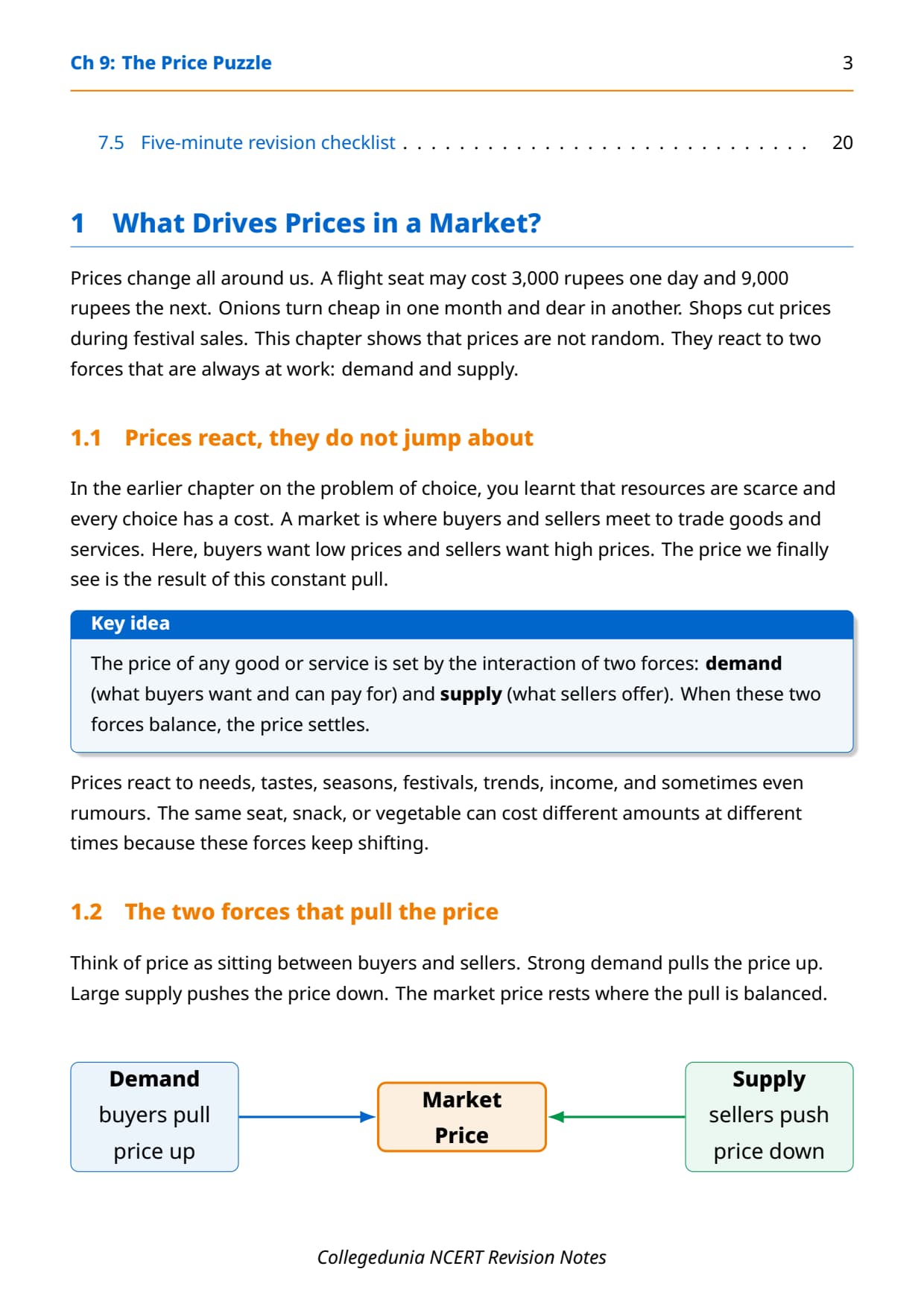
Prices change all around us. A flight seat may cost 3,000 rupees one day and 9,000 rupees the next. Onions turn cheap in one month and dear in another. This chapter shows that prices are not random. They react to two forces that are always at work: demand and supply.
The Class 9 Social Science Notes Chapter 9 The Price Puzzle What Drives the Market cover every idea in the same order as the Understanding Society book, so your revision follows the flow of the chapter. In minutes, you can recall these core points:
- Demand: what buyers want and can pay for, and the Law of Demand.
- Supply: what sellers offer, and the Law of Supply.
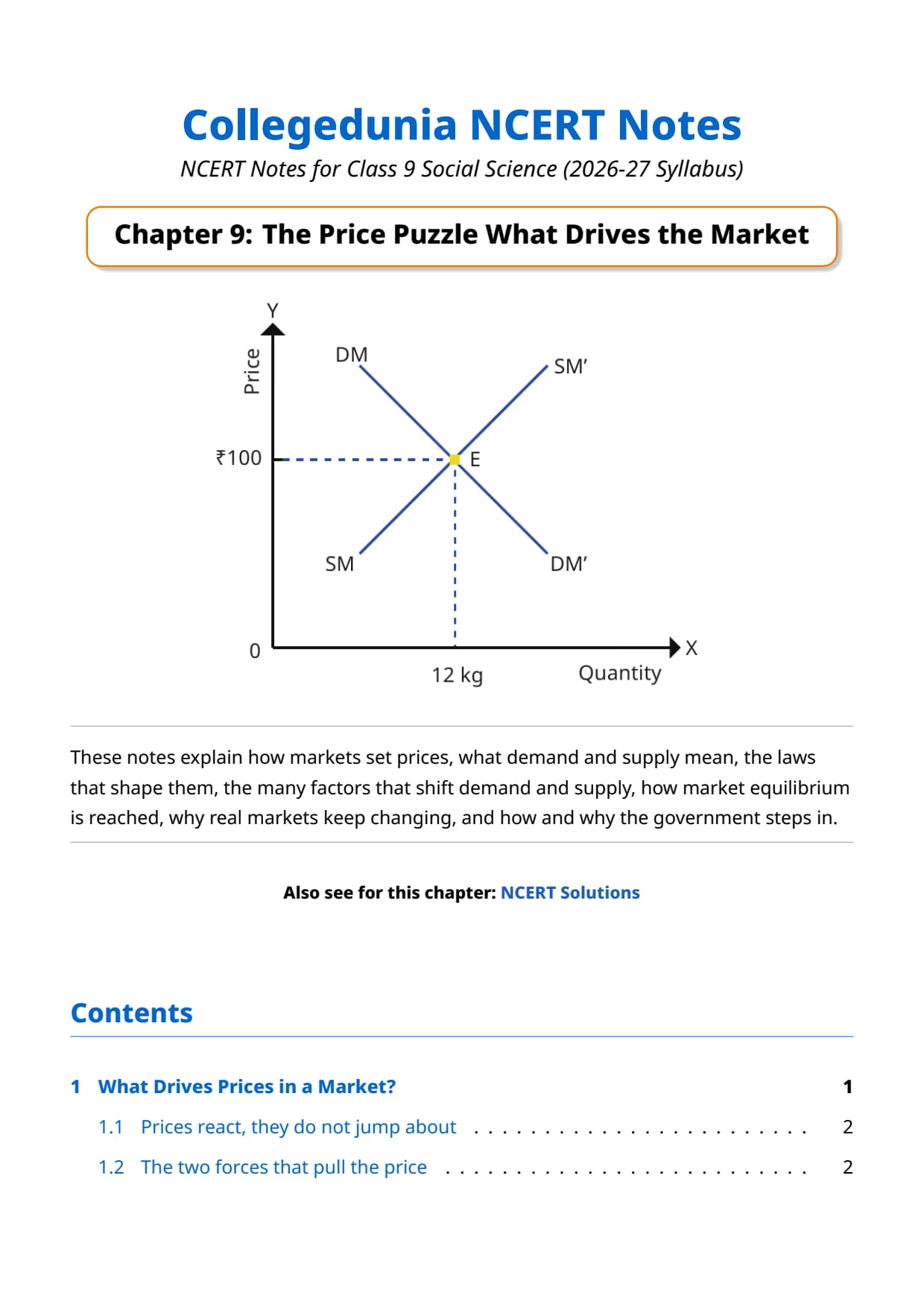
- Market equilibrium: the price where demand meets supply.
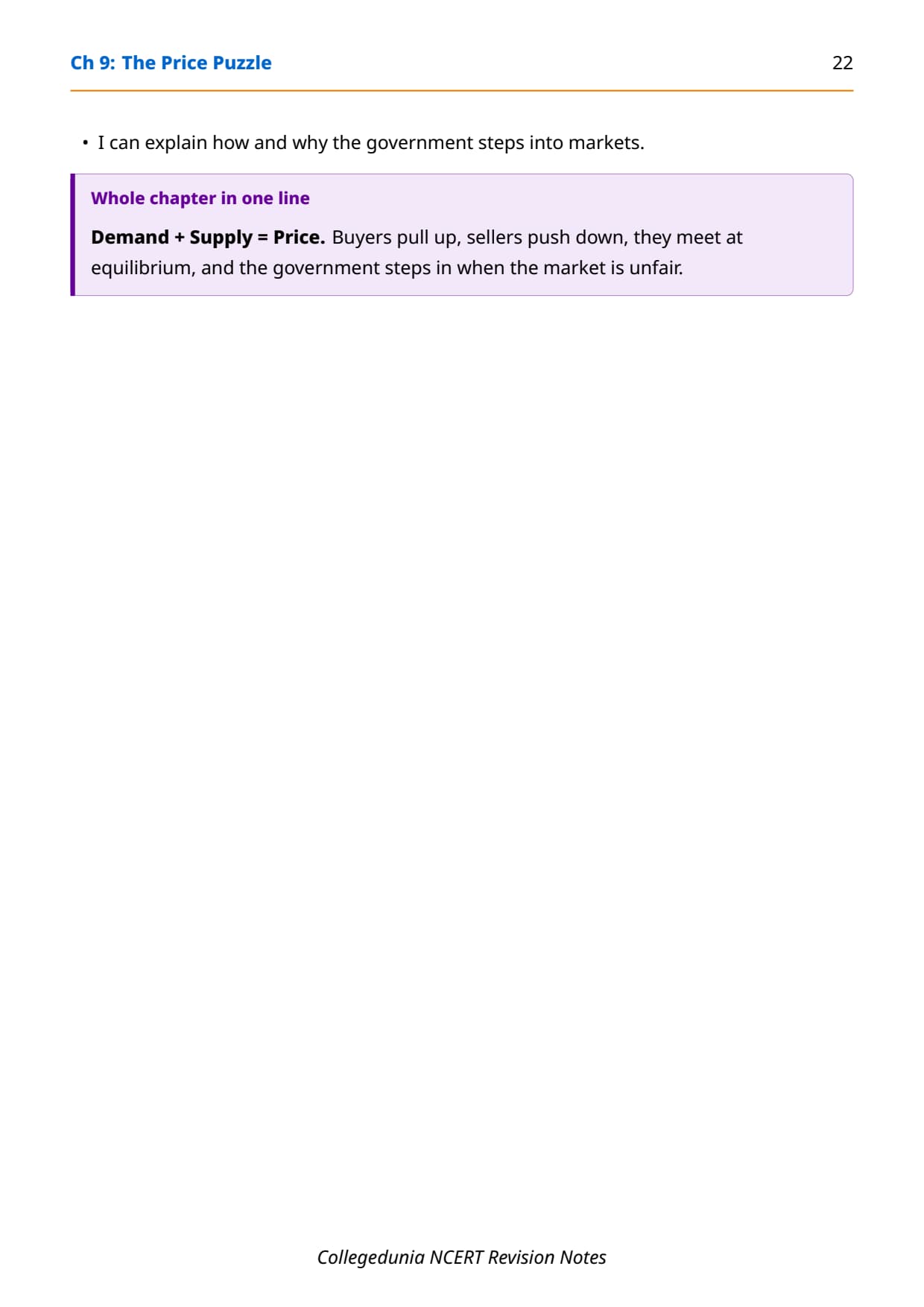
- Government: why and how it steps in when the market is unfair.
Demand and the Law of Demand in Class 9 Social Science Chapter 9
Demand is the buyer's side of the market. It tells us how much of a product people are willing and able to buy at a given price. Wanting a costly phone is only a desire. It becomes demand only when you can also pay for it, so demand needs purchasing power.
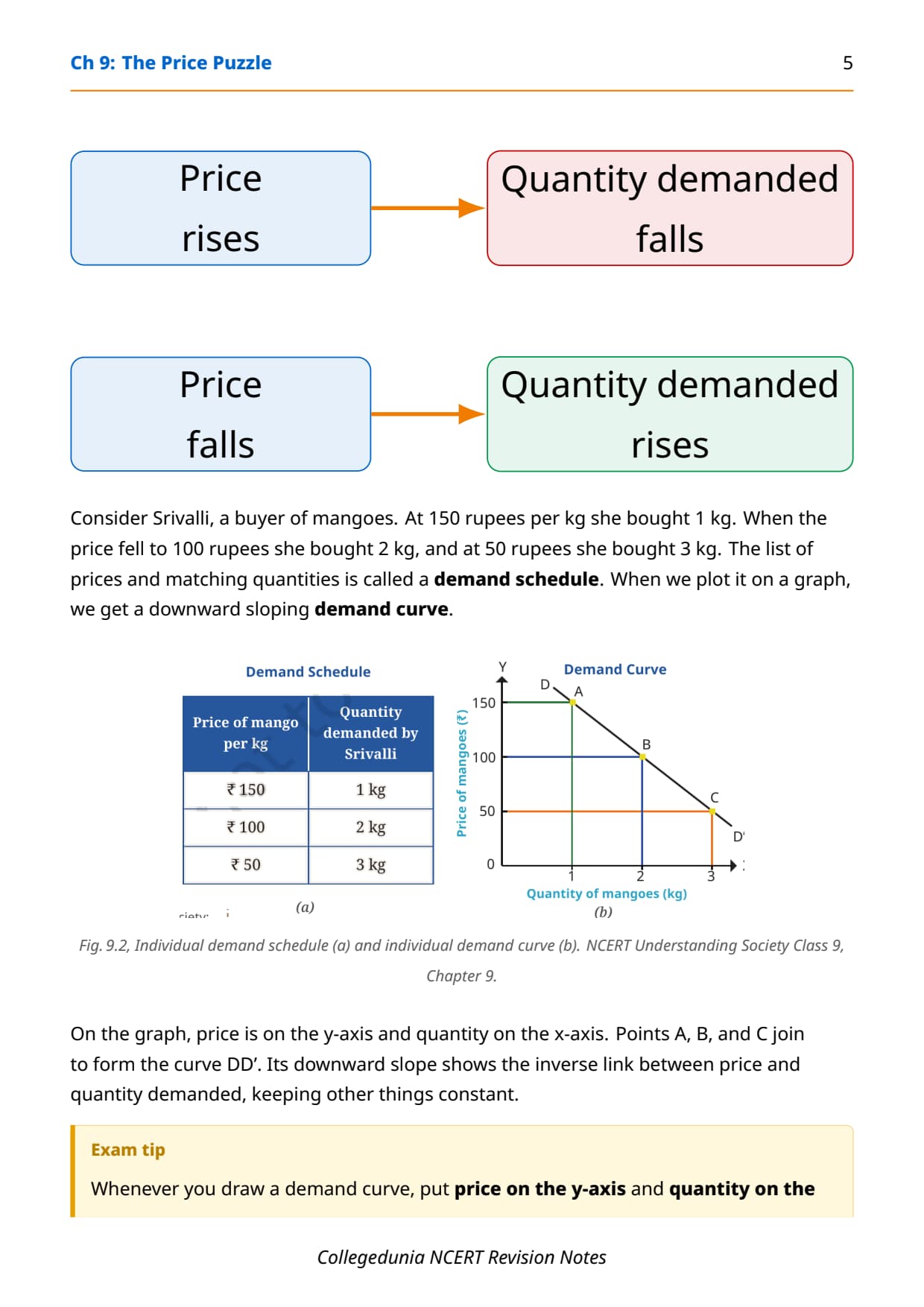
The Law of Demand says that when the price of a product rises, the quantity demanded falls. When the price falls, the quantity demanded rises. This is an inverse link.
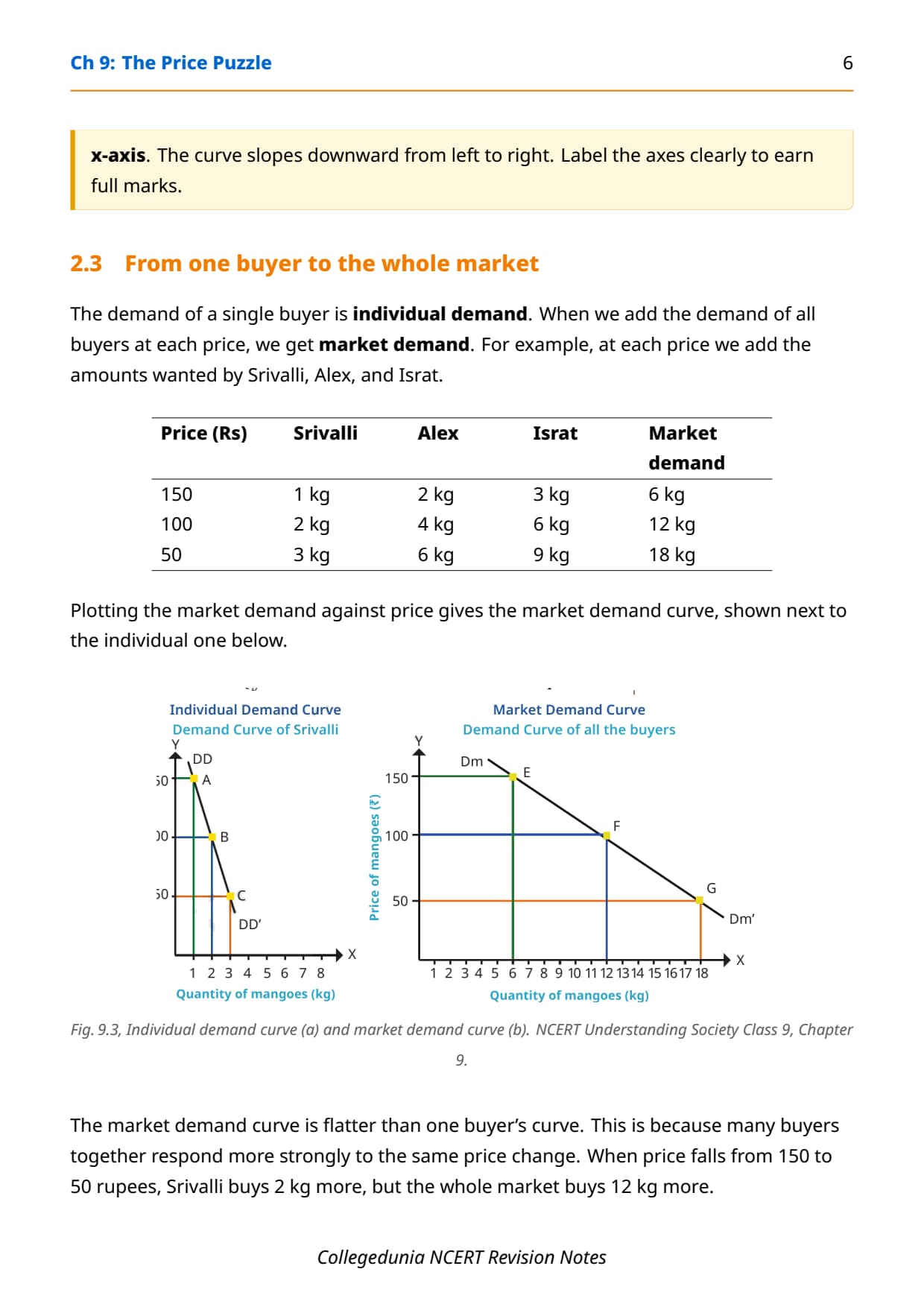
- Demand schedule: a list of prices and the matching quantities buyers want.
- Demand curve: the graph of that schedule, which slopes downward from left to right.
- Individual to market: add the demand of all buyers at each price to get market demand.
Other Factors That Shift Demand: Class 9 Social Science Chapter 9 Notes
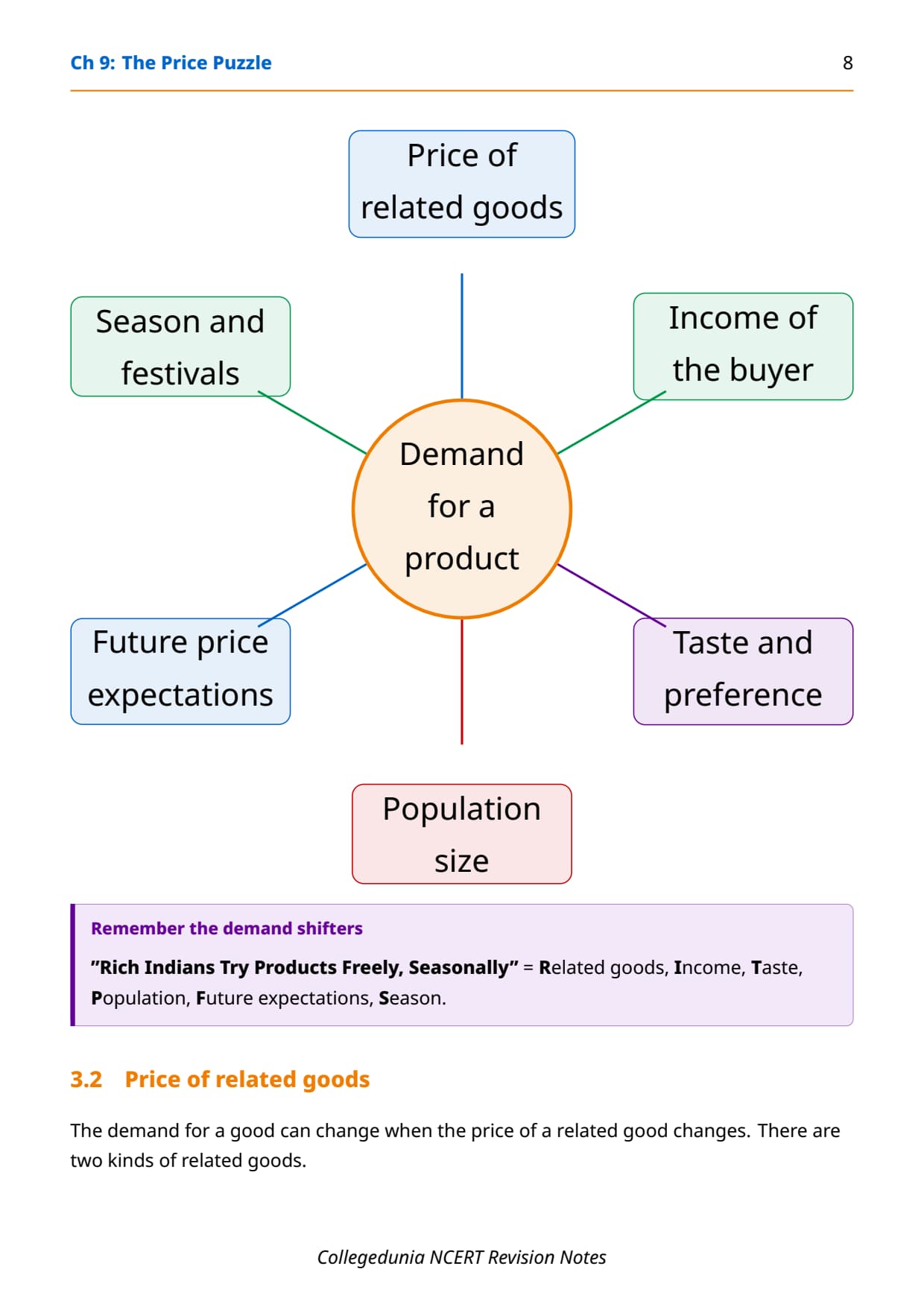
Price is not the only thing that decides demand. Many other factors change how much people buy, even when the price stays the same. These are the determinants of demand, and they often appear in exam questions.
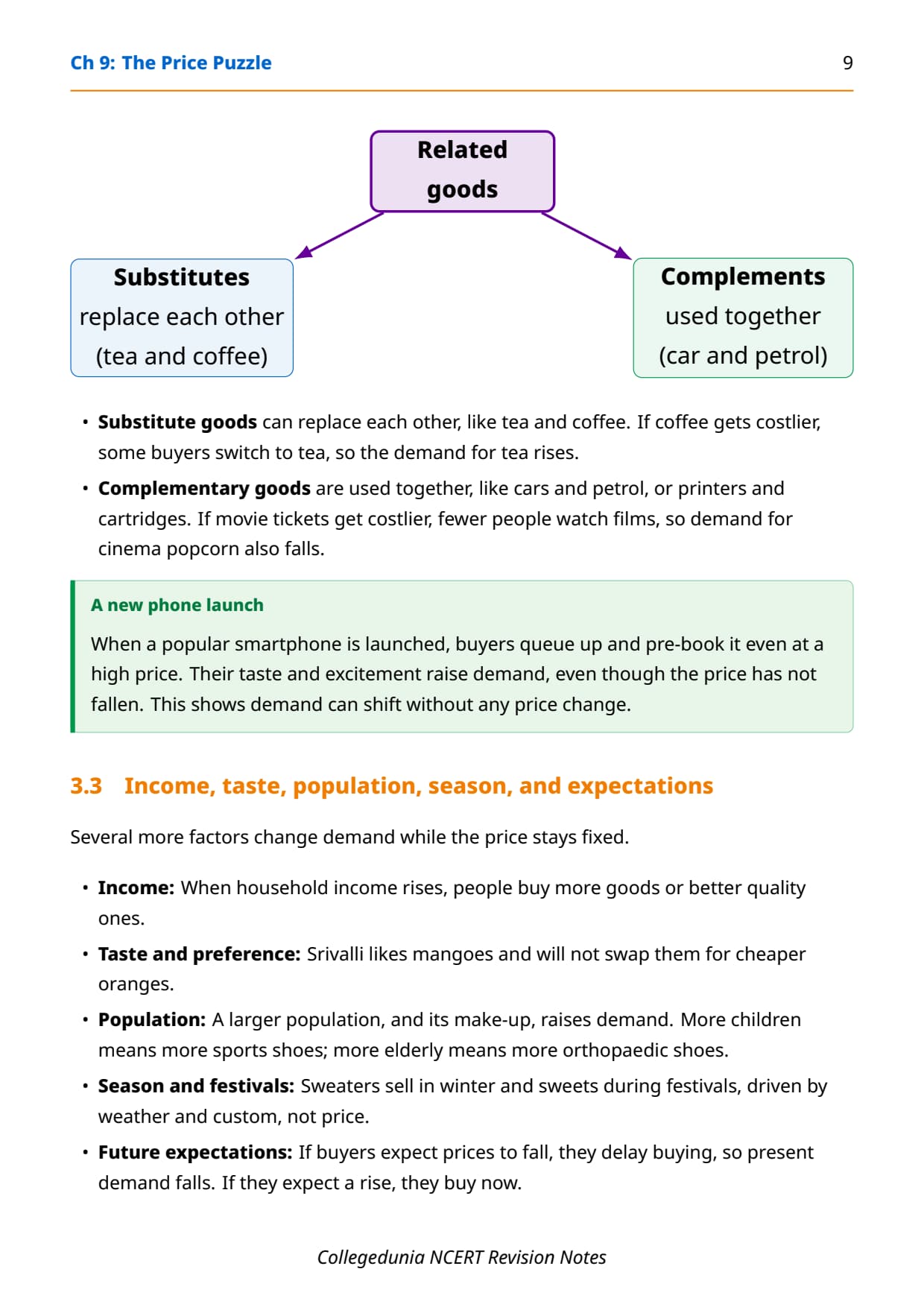
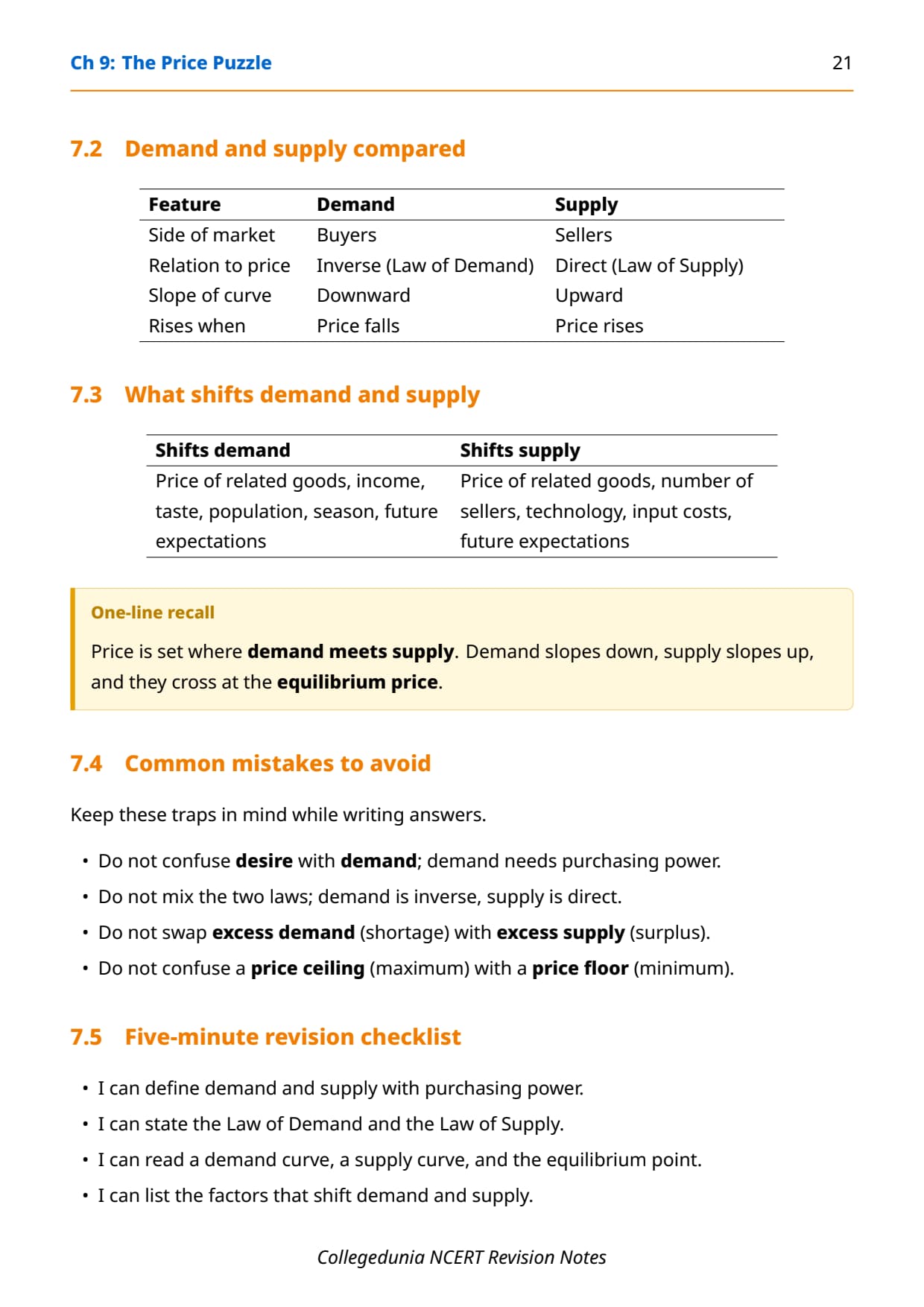
- Price of related goods: if coffee gets costlier, buyers switch to tea (substitutes); if cars get costlier, petrol demand falls (complements).
- Income: when household income rises, people buy more goods or better ones.
- Taste and preference: a new phone launch can raise demand even at a high price.
- Population: a larger population, and its make-up, raises demand.
- Season and festivals: sweaters sell in winter and sweets during festivals.
- Future expectations: if buyers expect prices to fall, they delay buying.
A simple memory line is "Rich Indians Try Products Freely, Seasonally": Related goods, Income, Taste, Population, Future expectations, Season. One more idea is diminishing marginal utility: the extra usefulness from each new unit falls as you consume more, so willingness to pay falls too.
Supply and the Law of Supply in The Price Puzzle Chapter
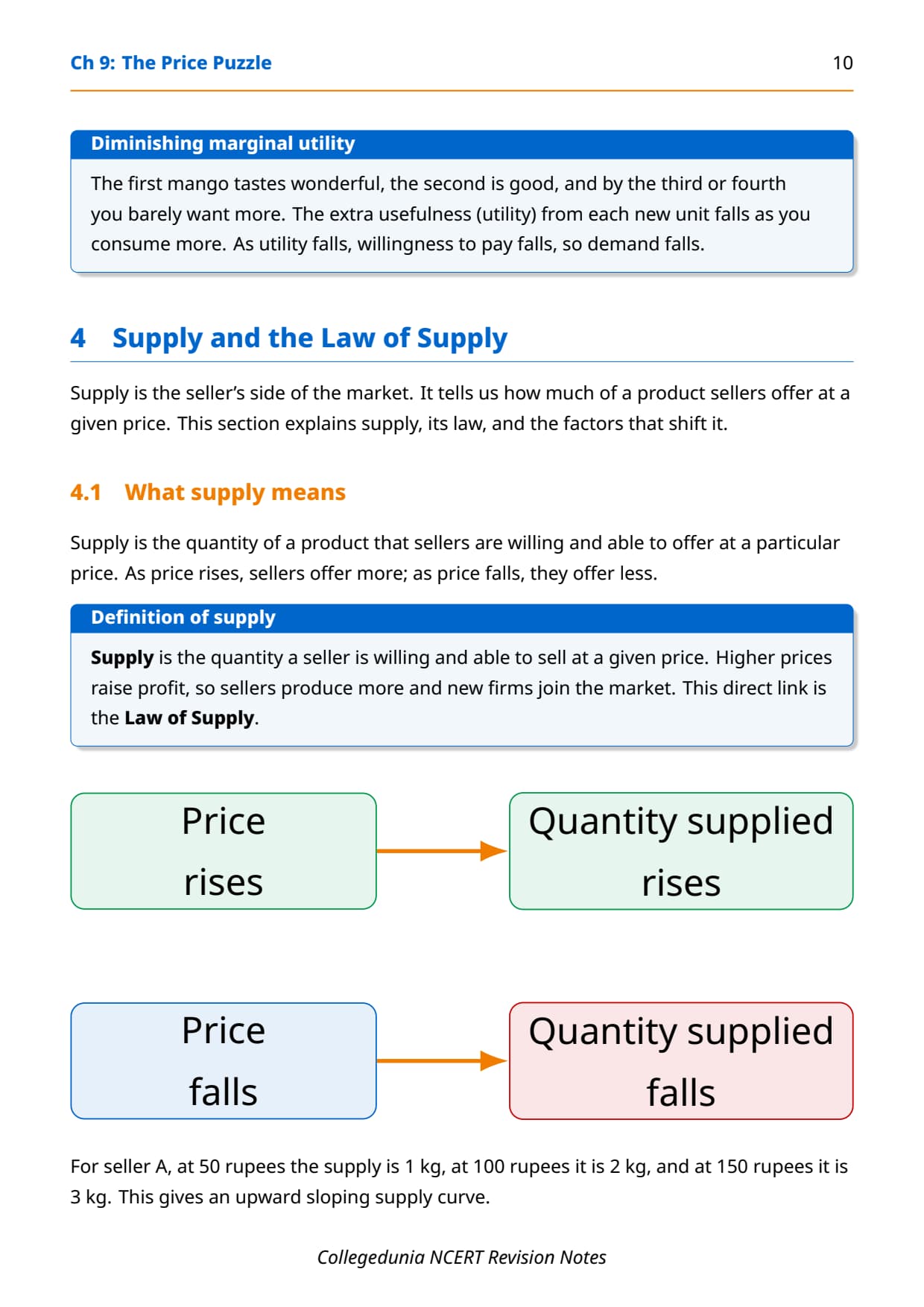
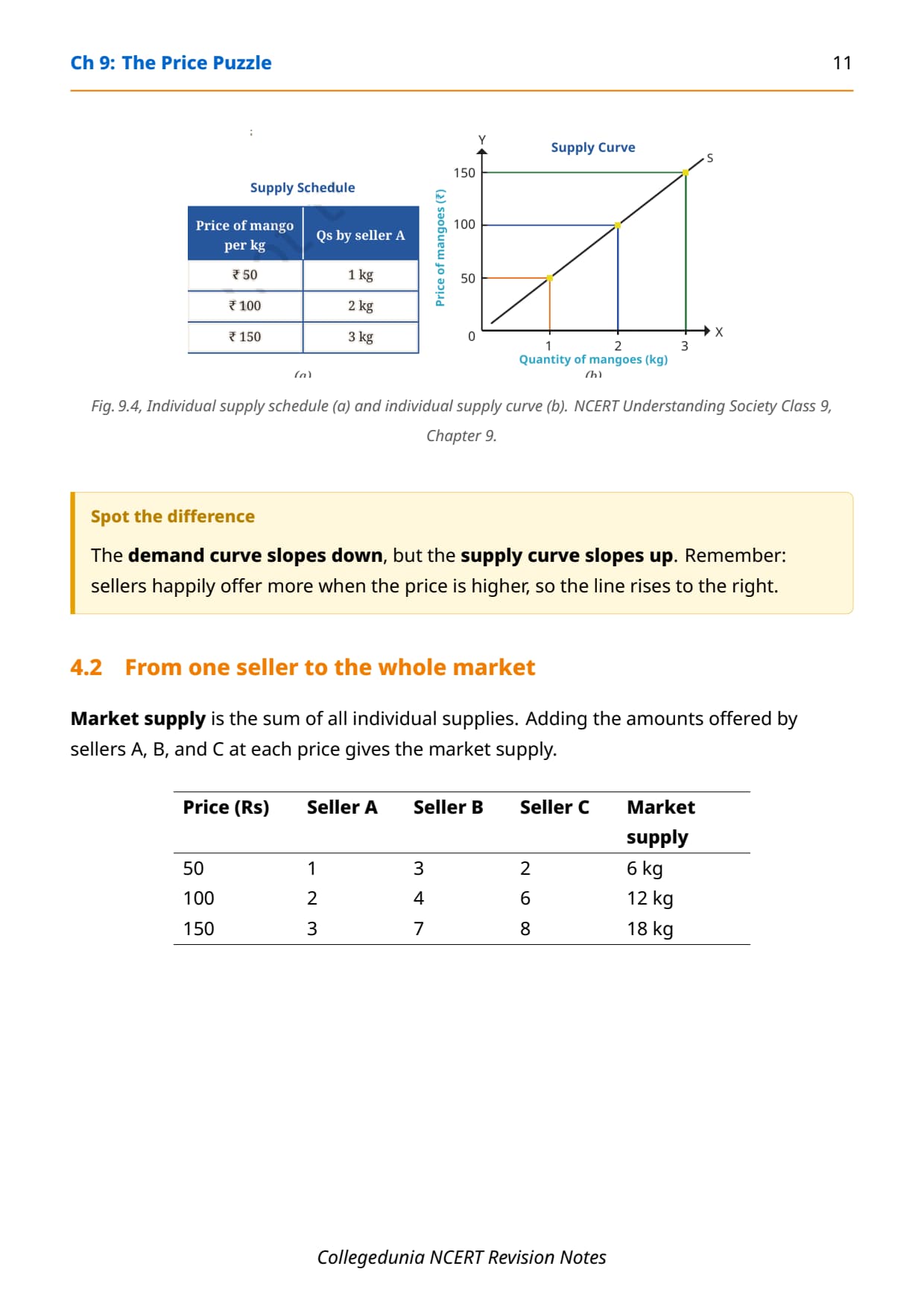
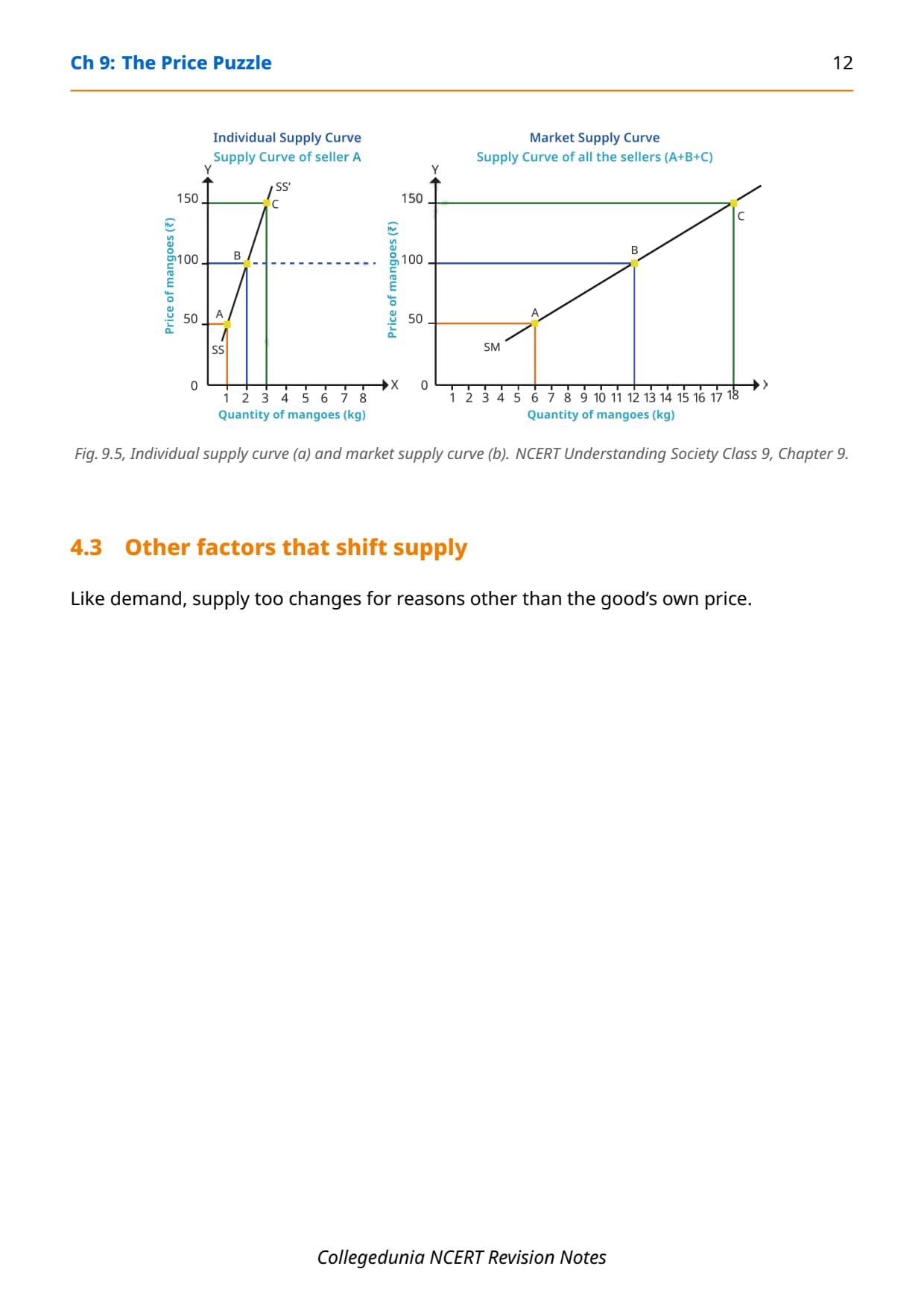
Supply is the seller's side of the market. It is the quantity a seller is willing and able to offer at a given price. As price rises, sellers offer more and new firms join. This direct link is the Law of Supply. Its curve slopes upward from left to right.
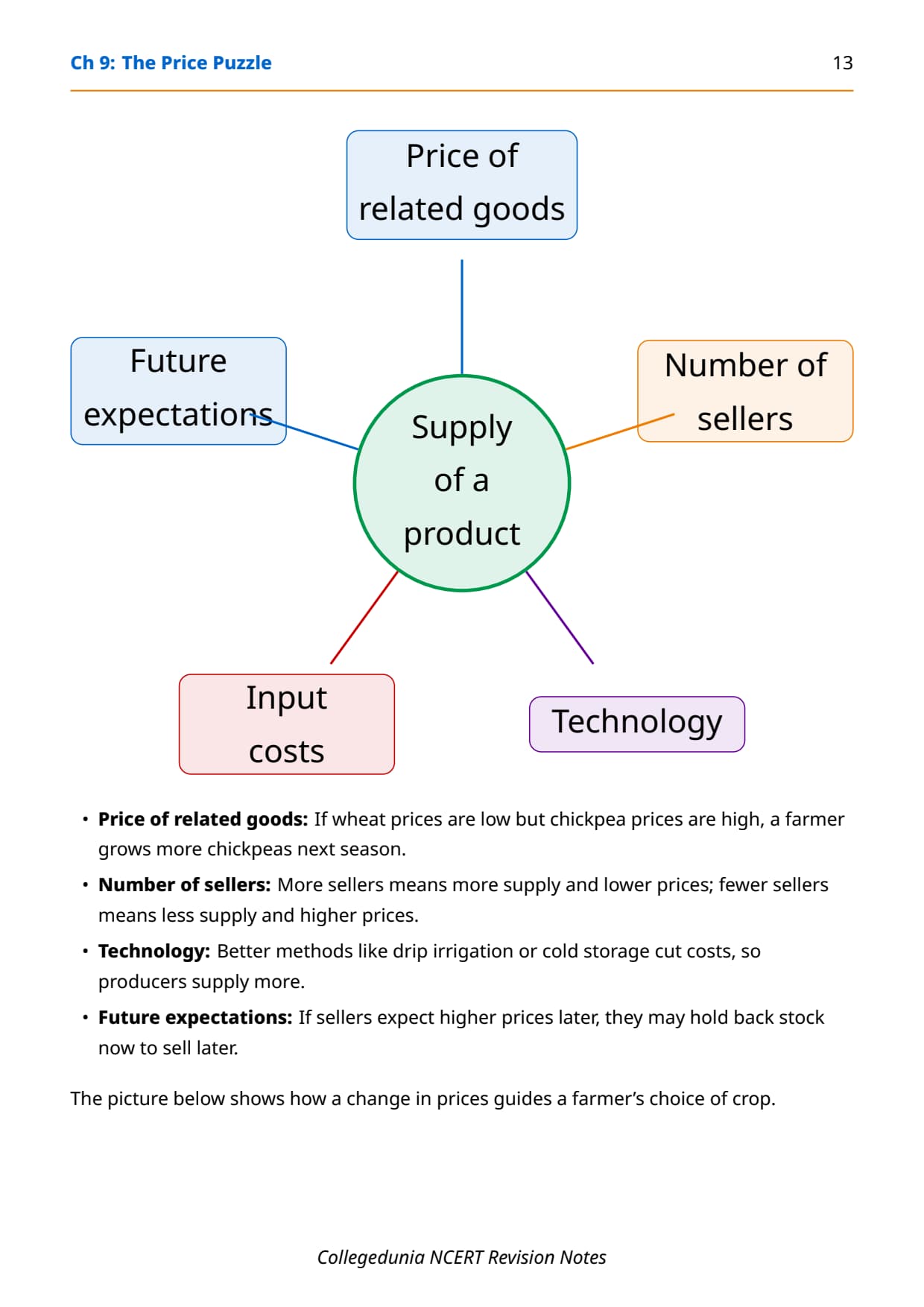
Like demand, supply also changes for reasons other than the good's own price. Keep these supply shifters ready for your revision:
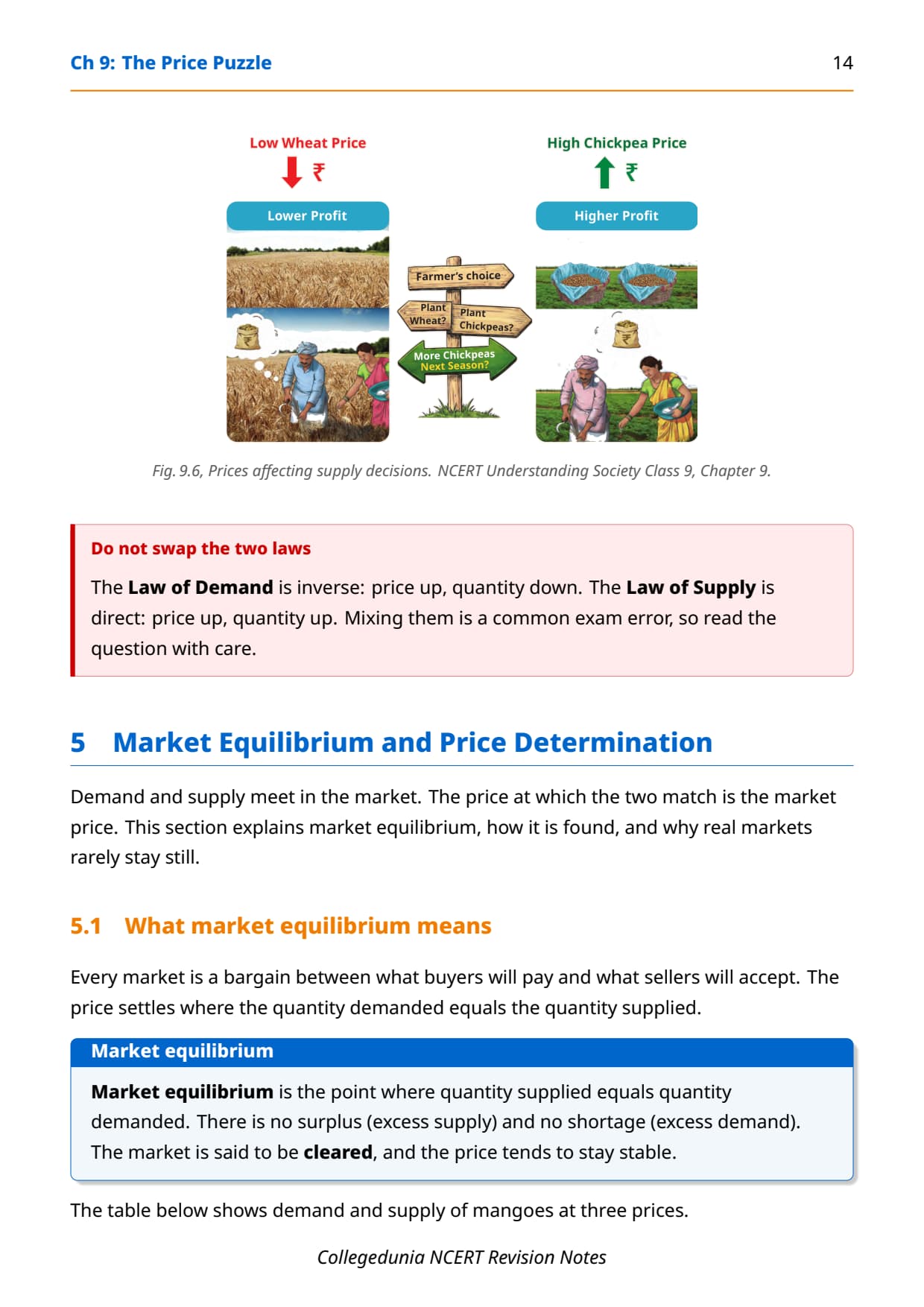
- Price of related goods: a farmer grows more chickpeas when their price is high.
- Number of sellers: more sellers means more supply and lower prices.
- Technology: drip irrigation or cold storage cuts costs, so producers supply more.
- Input costs: costly seeds, fuel, or labour reduce supply.
- Future expectations: sellers may hold back stock if they expect higher prices later.
Market Equilibrium and Price Determination in Class 9 Social Science Chapter 9
Demand and supply meet in the market. The price at which they match is the market price. The Class 9 Social Science Notes Chapter 9 The Price Puzzle What Drives the Market explain this balance step by step, so you can read any demand and supply graph with confidence.
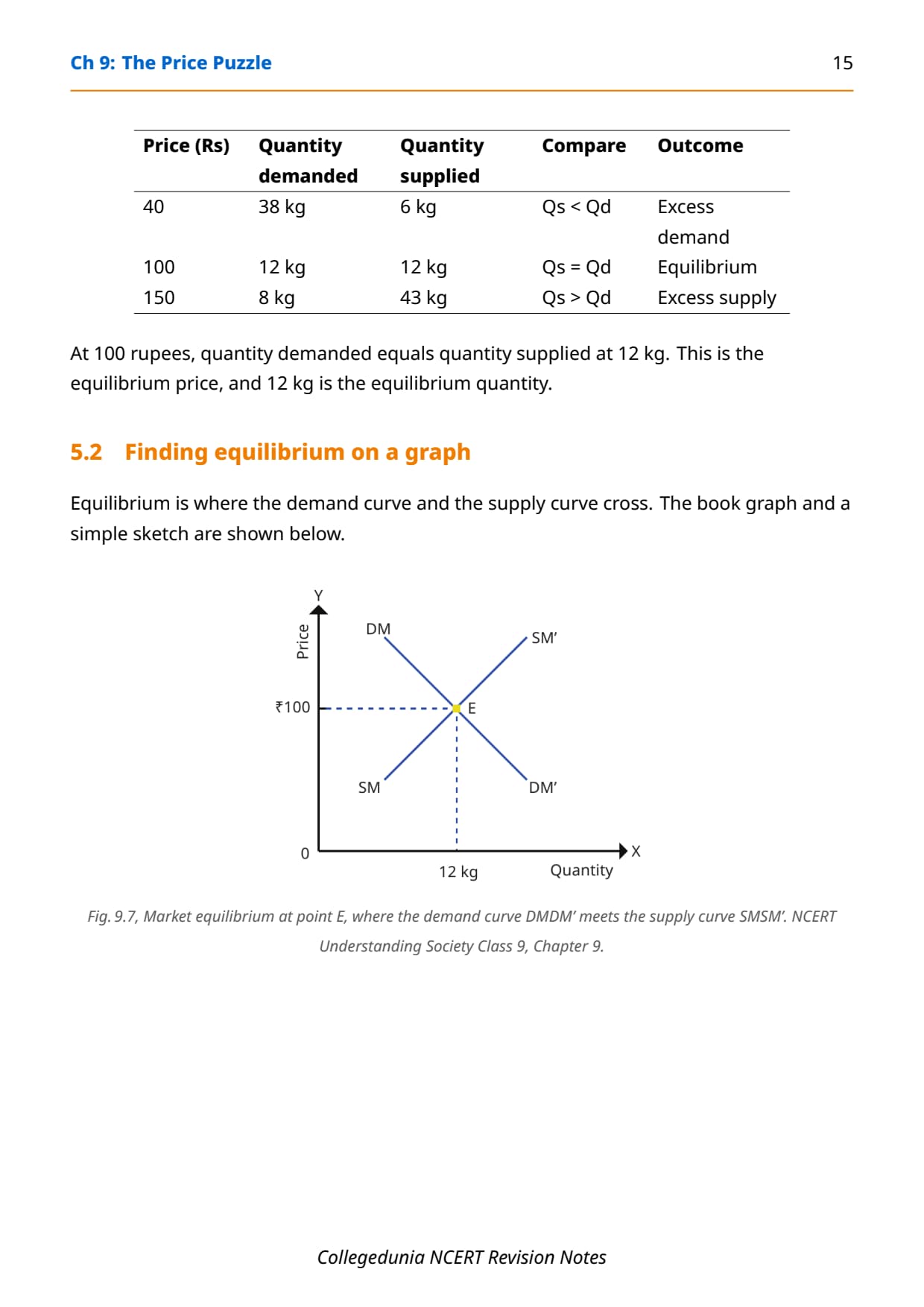
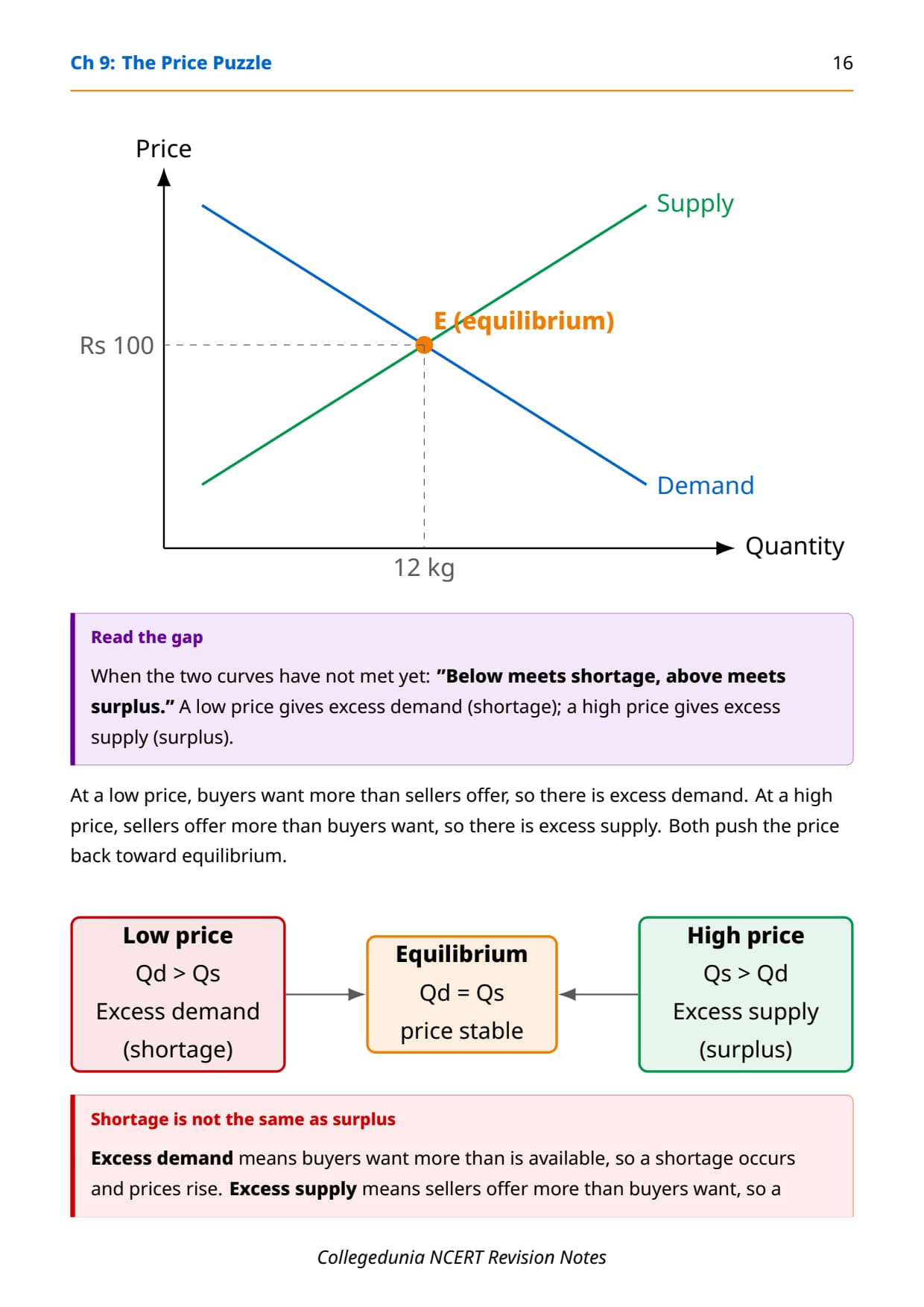
Market equilibrium is the point where quantity supplied equals quantity demanded. There is no surplus and no shortage, so the price stays stable. On a graph, it is where the demand curve and the supply curve cross.
| Price | Compare | Outcome |
|---|---|---|
| Low price | Quantity demanded > quantity supplied | Excess demand (shortage), price rises |
| Equilibrium price | Quantity demanded = quantity supplied | Market cleared, price stable |
| High price | Quantity supplied > quantity demanded | Excess supply (surplus), price falls |
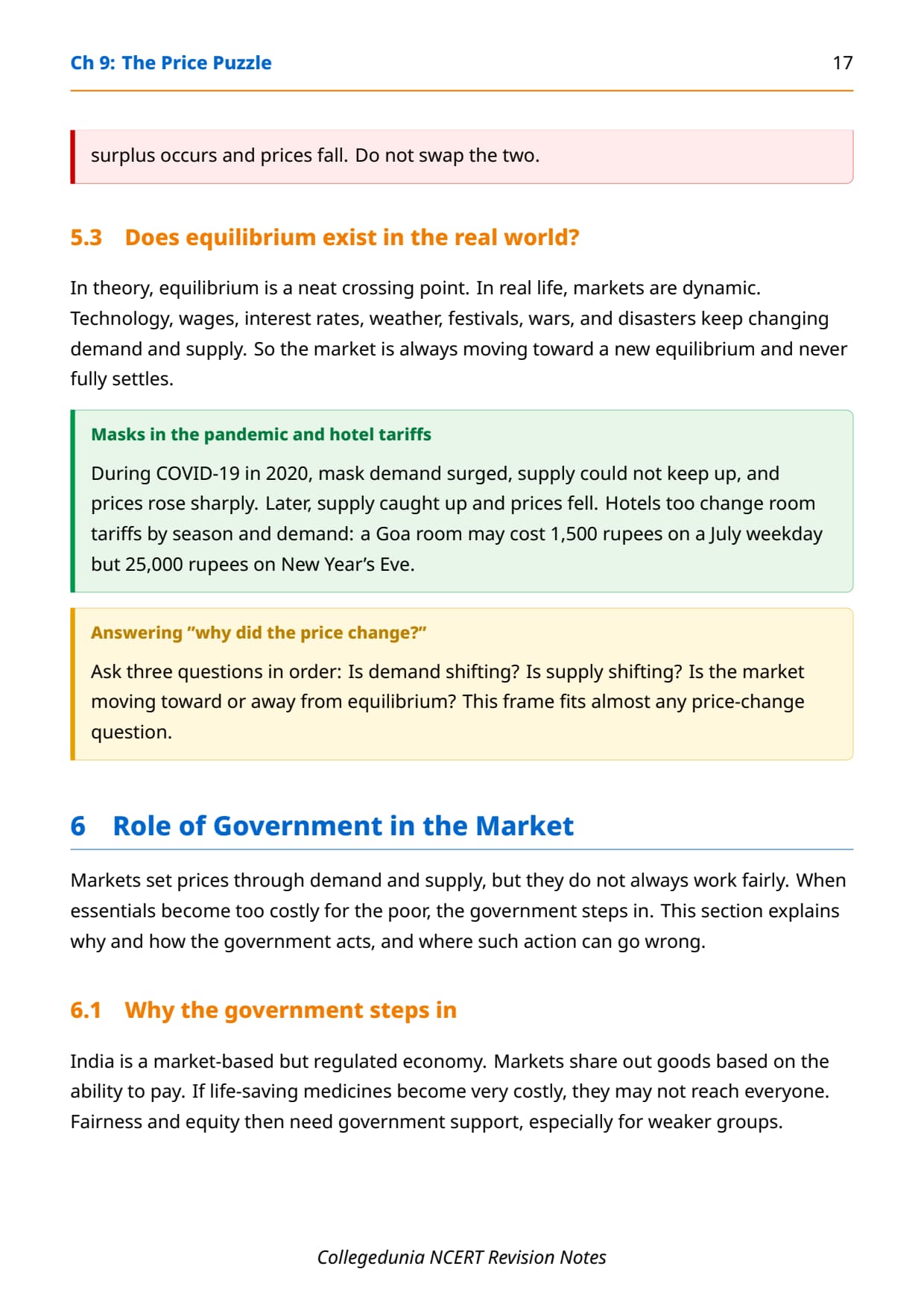
In theory, equilibrium is a neat crossing point. In real life, markets are dynamic. Technology, wages, weather, festivals, and disasters keep changing demand and supply. During COVID-19, mask demand surged, supply could not keep up, and prices rose sharply before falling again later.
Role of Government in the Market: The Price Puzzle Notes
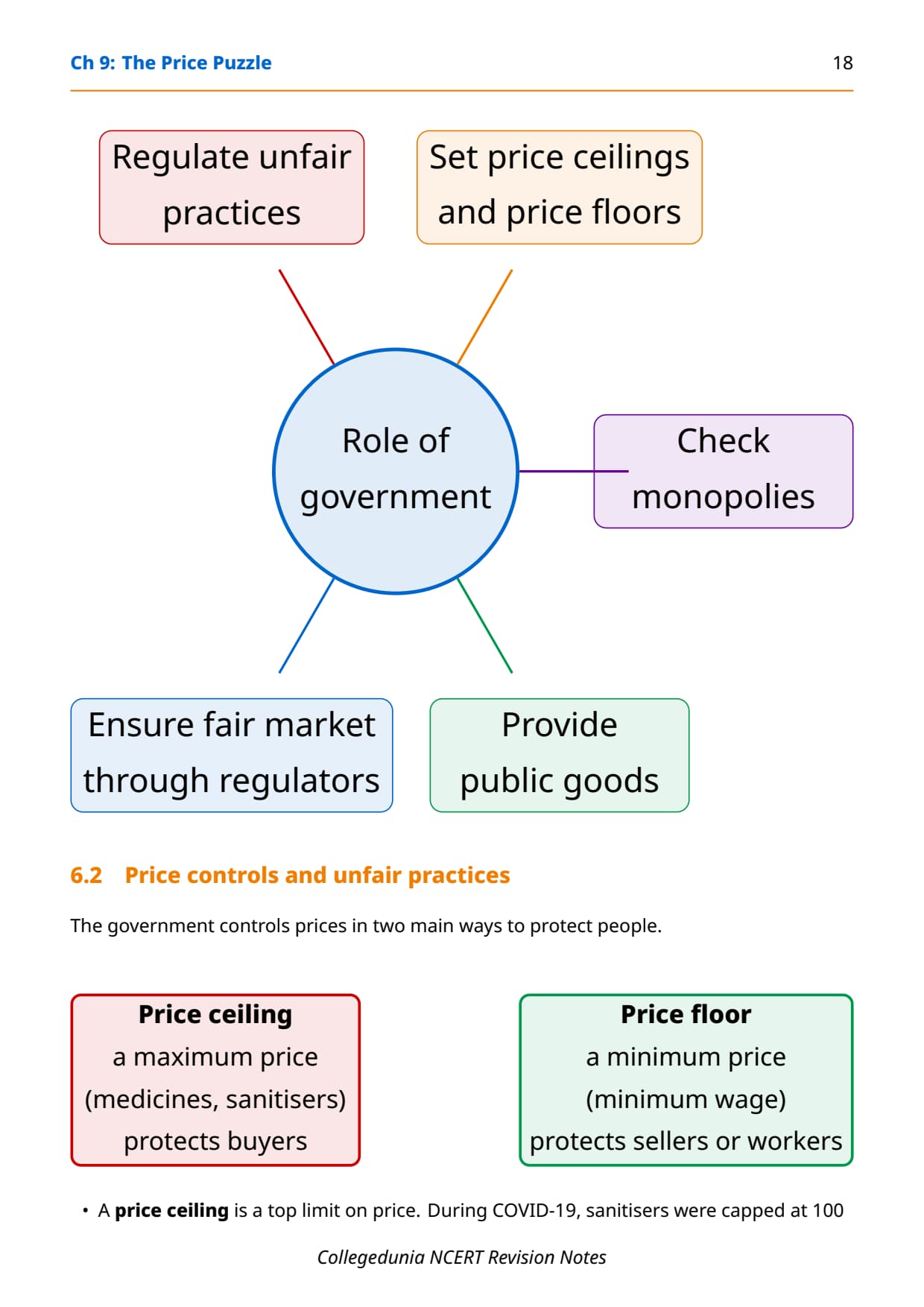
Markets set prices through demand and supply, but they do not always work fairly. India is a market-based but regulated economy. When essentials become too costly for the poor, the government steps in to protect weaker groups and keep the market fair.
- Price ceiling: a legal maximum price. Sanitisers were capped at 100 rupees for a 200 ml bottle during COVID-19.
- Price floor: a legal minimum price. A minimum wage makes sure workers earn enough.
- Check monopolies: a single seller can charge high prices, so the government controls such power.
- Public goods: roads, streetlights, and defence face the free-rider problem, so the government provides them.
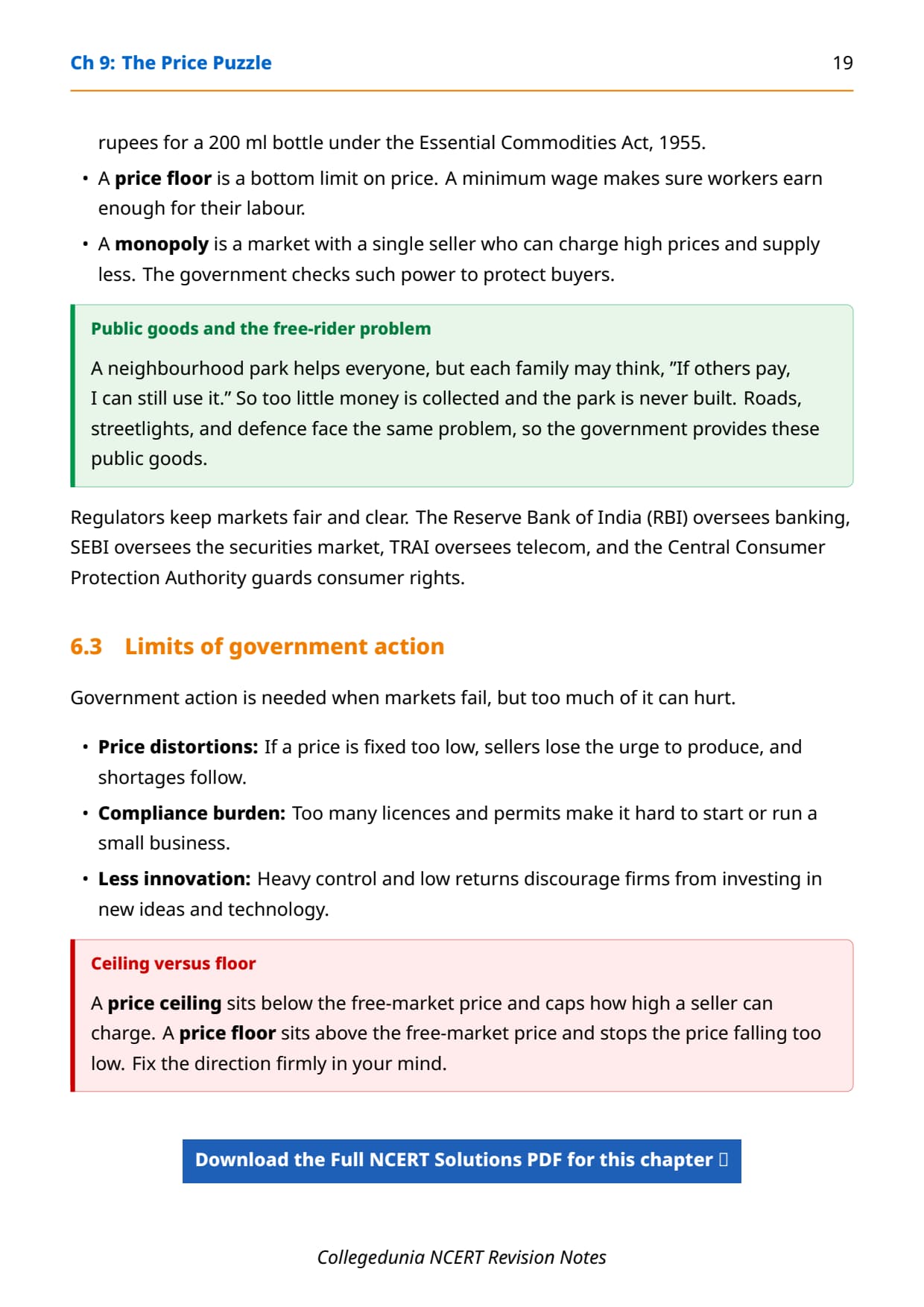
Regulators keep markets fair and clear. The RBI oversees banking, SEBI oversees the securities market, and TRAI oversees telecom. But too much control can also hurt, causing price distortions, a heavy compliance burden, and less innovation.
Key Terms and Quick Revision for Class 9 Social Science Chapter 9
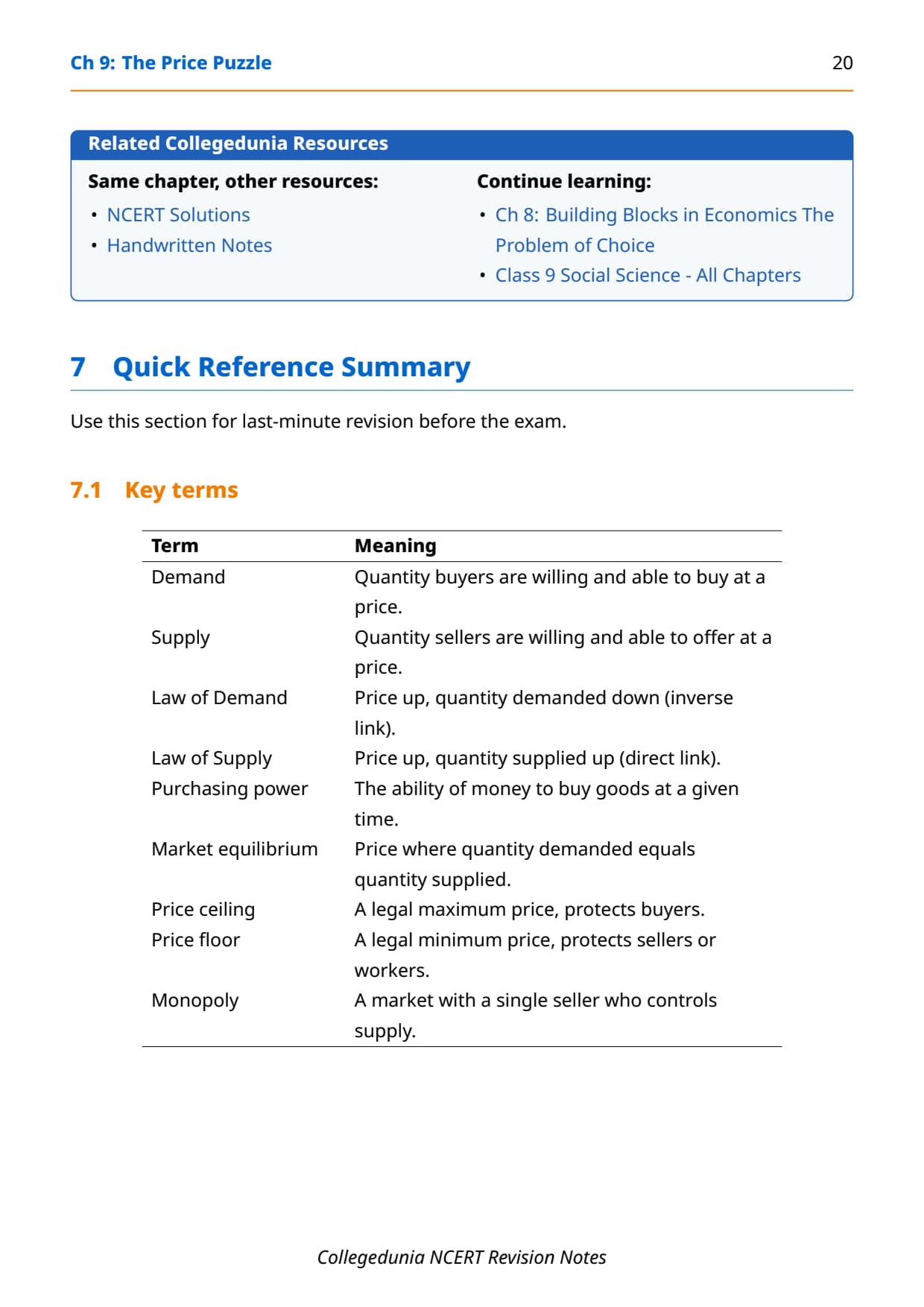
Use this table for last-minute revision before the exam. Each term comes straight from the ideas in the chapter.
| Term | Meaning |
|---|---|
| Demand | Quantity buyers are willing and able to buy at a price. |
| Supply | Quantity sellers are willing and able to offer at a price. |
| Law of Demand | Price up, quantity demanded down (inverse link). |
| Law of Supply | Price up, quantity supplied up (direct link). |
| Market equilibrium | Price where quantity demanded equals quantity supplied. |
| Price ceiling | A legal maximum price, protects buyers. |
| Price floor | A legal minimum price, protects sellers or workers. |
| Monopoly | A market with a single seller who controls supply. |
Common Mistakes to Avoid in The Price Puzzle What Drives the Market
Most lost marks in this chapter come from small slips, not hard ideas. Fix these while you revise and your answers stay clean and correct.
- Confusing desire with demand; demand needs purchasing power.
- Mixing the two laws; demand is inverse, supply is direct.
- Swapping excess demand (shortage) with excess supply (surplus).
- Confusing a price ceiling (maximum) with a price floor (minimum).
How Collegedunia Notes Help You Revise Chapter 9 The Price Puzzle
Collegedunia gives you the full Class 9 Social Science Notes Chapter 9 The Price Puzzle What Drives the Market as clean, short, easy-to-read revision in one place.
- 2026-27 match: every note follows the new Understanding Society textbook.
- Simple English: short lines and everyday words, so a Class 9 student can revise without help.
- Table and diagram ready: demand versus supply, key terms, and the equilibrium idea in one view.
- Free PDF: download the notes and revise offline before your exam.
Other The Price Puzzle Class 9 Social Science Resources
Open the other resources for this chapter to practise questions and read the full textbook alongside these notes.
| Resource | Open |
|---|---|
| Revision Notes | The Price Puzzle What Drives the Market Class 9 Social Science Notes |
| NCERT Solutions | The Price Puzzle Class 9 Social Science NCERT Solutions |
| Handwritten Notes | The Price Puzzle Class 9 Social Science Handwritten Notes |
| NCERT Book PDF | The Price Puzzle Class 9 Social Science NCERT Book PDF |
NCERT Notes for Class 9 Social Science: All Chapters
Use the table below to open the NCERT Notes for any other chapter of the new Class 9 Social Science Understanding Society book.
| Chapter | NCERT Notes |
|---|---|
| Chapter 1 | Understanding Social Science |
| Chapter 2 | Shaping of the Earth's Surface |
| Chapter 3 | Atmosphere and Climate |
| Chapter 4 | Early Humans and Beginning of Civilisation |
| Chapter 5 | State and Society up to 1000 CE |
| Chapter 6 | Democracy |
| Chapter 7 | Elections |
| Chapter 8 | Building Blocks in Economics: The Problem of Choice |
Class 9 Social Science Chapter 9 The Price Puzzle Notes FAQs
Ques. Where can I download the Class 9 Social Science Chapter 9 The Price Puzzle notes PDF?
Ans. You can download the notes PDF free from this page. Both the Normal and HD versions match the 2026-27 Understanding Society textbook.
Ques. What topics do the Class 9 Social Science Chapter 9 notes cover?
Ans. The notes cover demand, supply, the Law of Demand, the Law of Supply, the factors that shift them, market equilibrium, and the role of government in the market.
Ques. What is market equilibrium in The Price Puzzle chapter?
Ans. Market equilibrium is the price where quantity demanded equals quantity supplied. There is no shortage and no surplus, so the market is cleared and the price stays stable.
Ques. What is the difference between a price ceiling and a price floor?
Ans. A price ceiling is a legal maximum price that protects buyers, such as a cap on sanitisers. A price floor is a legal minimum price that protects sellers or workers, such as a minimum wage.



Comments