




The Class 9 Social Science Notes Chapter 5 State and Society up to 1000 CE give you a fast, clear revision of how early India grew from small clans into large empires. These class 9 social science notes chapter 5 State and Society up to 1000 CE cover kingship, dharma, administration, society, and trade in short, easy points.
Prepared by Collegedunia subject experts from the new NCERT Understanding Society textbook for the 2026-27 syllabus.
- Full timeline: follow the change from kin-based janas to janapadas, mahajanapadas, and the Mauryan, Gupta, and Chola empires up to 1000 CE.
- Core ideas ready: society versus State, the chakravarti ideal, dharma, the Saptanga, varna and jati, and the role of guilds.
- Exam friendly: tables, key terms, and revision tips help you answer long questions in the Class 9 Social Science exam.
Student Feedback
In a Collegedunia study of 1,080 Class 9 students, 74% said a one-page timeline of clans to empires helped them most before a test. About 4 out of 5 found the Saptanga and varna-jati tables the easiest way to recall this long chapter.
What You Revise in Class 9 Social Science Chapter 5 State and Society up to 1000 CE
This chapter studies the Indian subcontinent from about 2000 BCE to 1000 CE. You watch small clans slowly grow into kingdoms and then large empires. The class 9 social science notes chapter 5 State and Society up to 1000 CE follow the same order as the NCERT book, so your revision matches the textbook flow.
Start by fixing two basic ideas that the whole chapter rests on:
- Society: a group of people who share a territory and culture, held together mainly by custom and shared practice.
- State: an organised political system based on rules and laws, with rulers, officials, and machinery to keep order.
- The big change: as groups grew larger, custom alone was not enough, so formal States slowly took shape.
From Clans to Empires: Political Journey in Class 9 Social Science Chapter 5
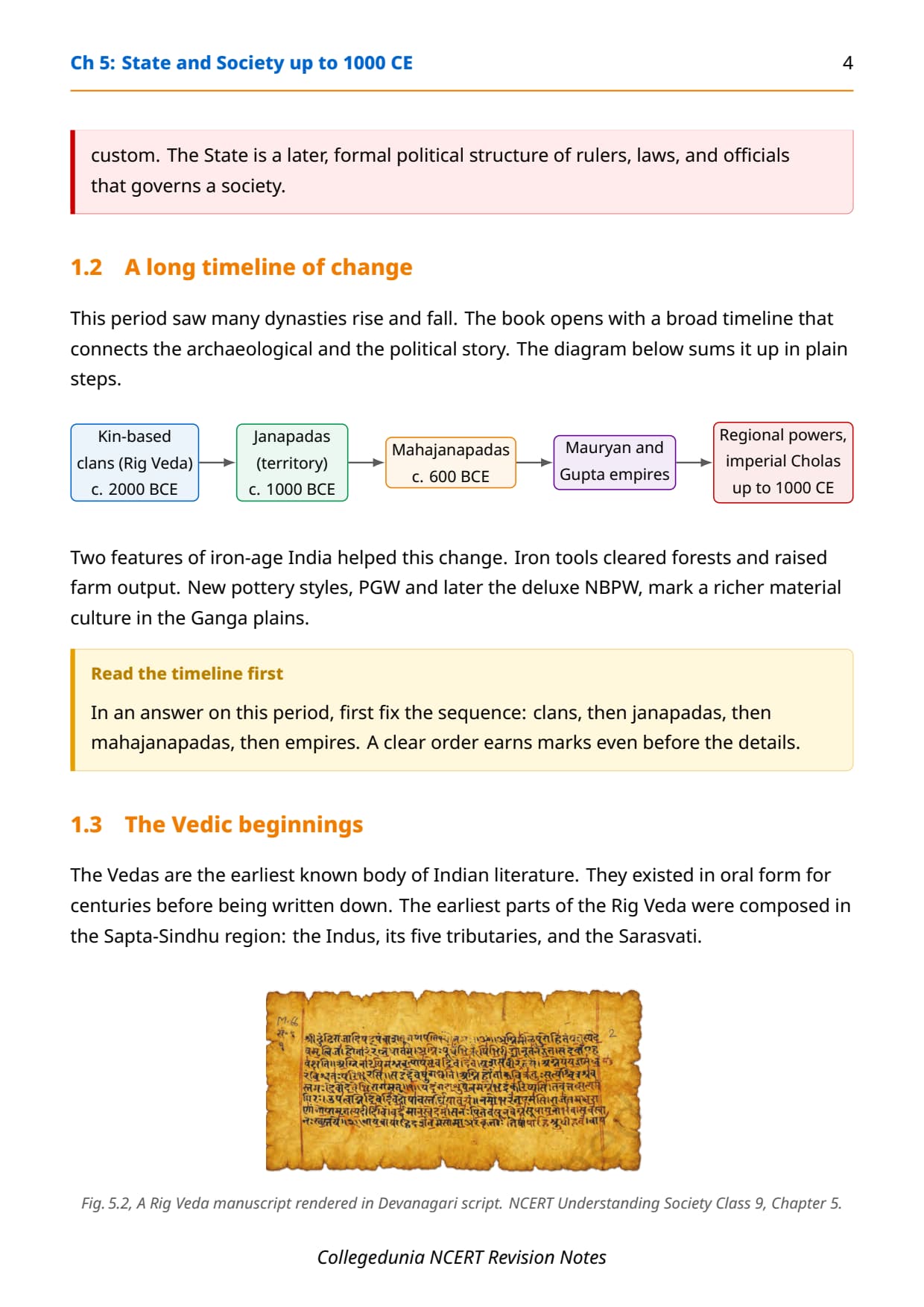
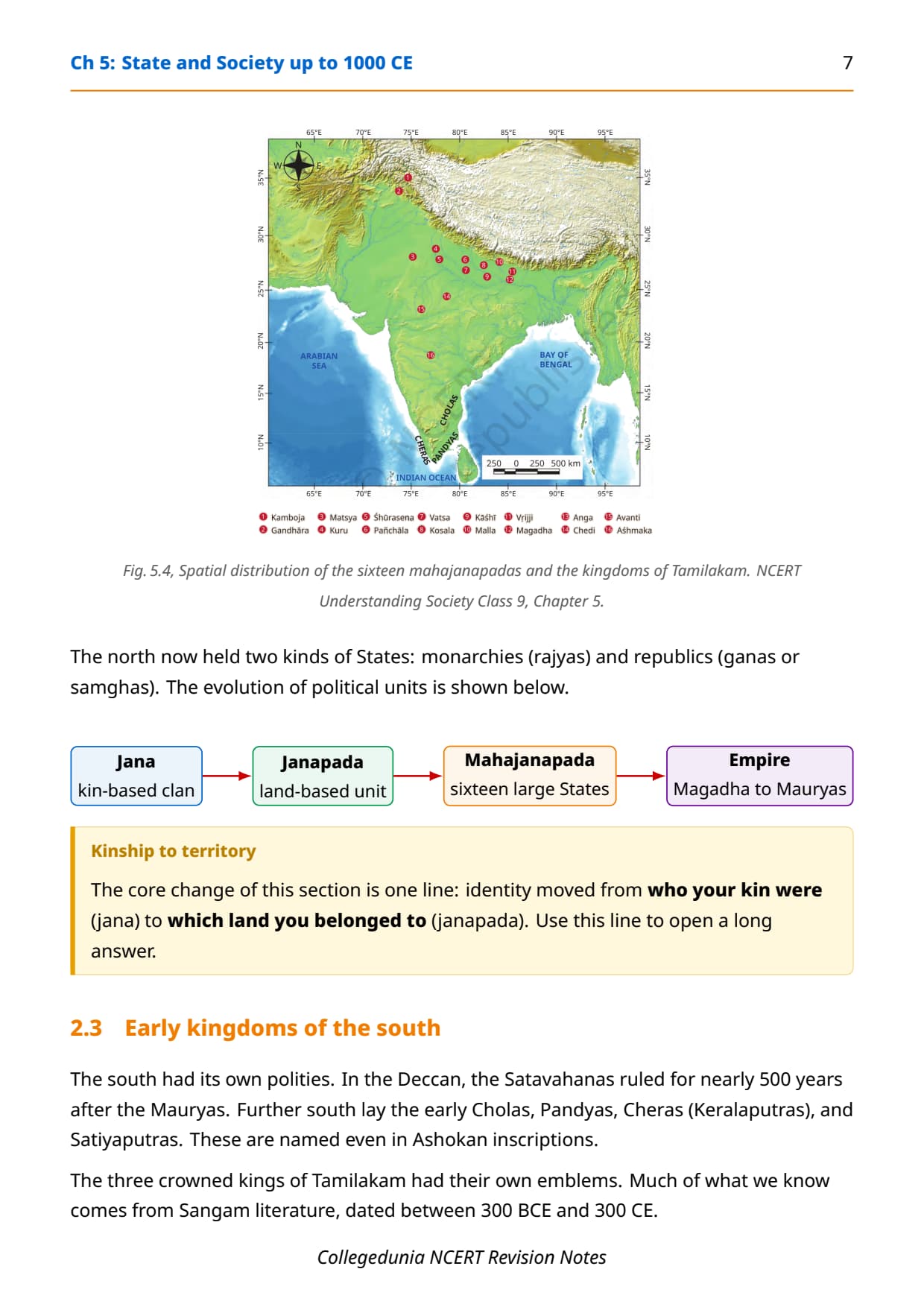
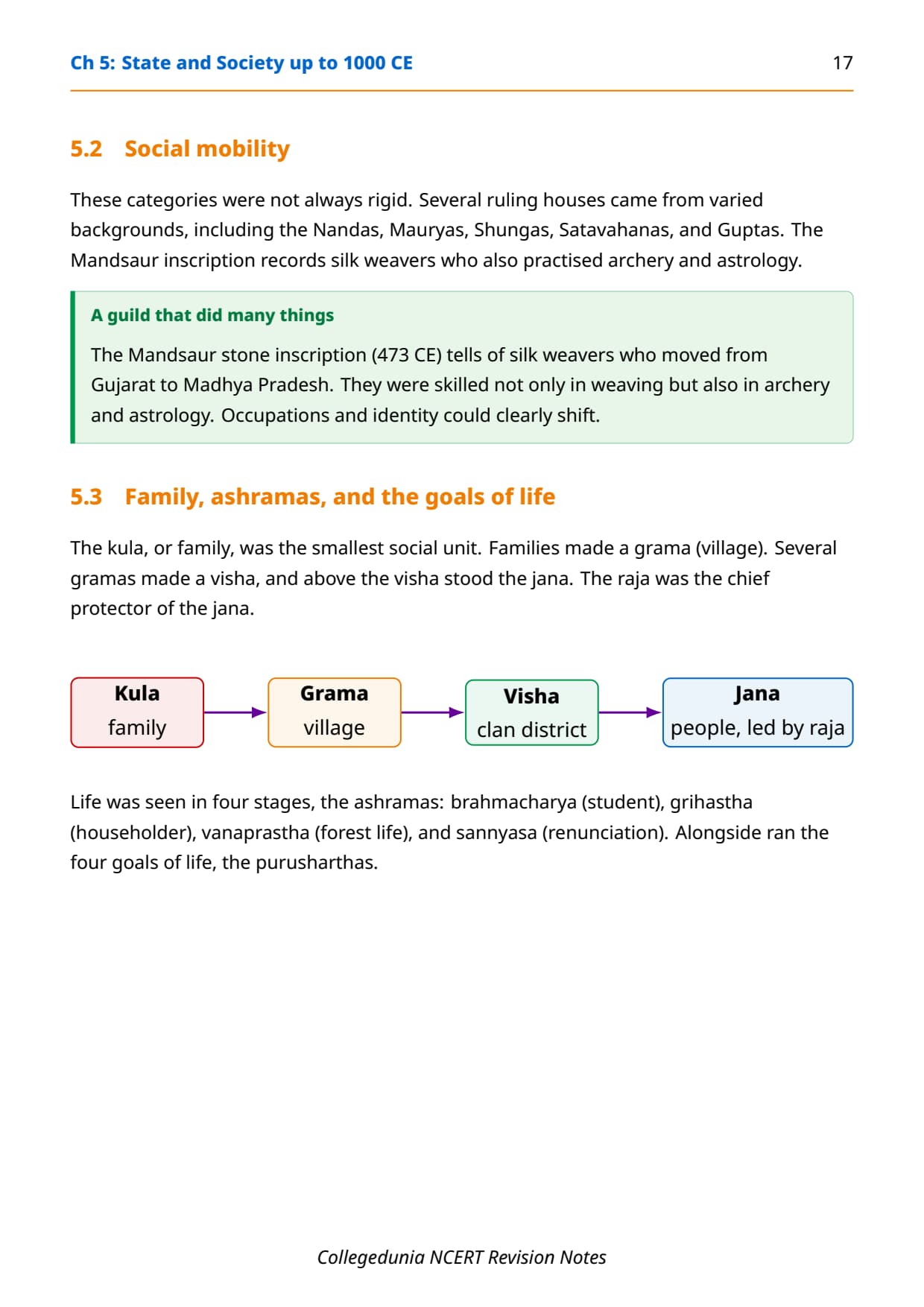
Political life in early India was never fixed. Identity slowly moved from who your kin were to which land you belonged to. The table below shows the stages you must be able to order in an exam answer.
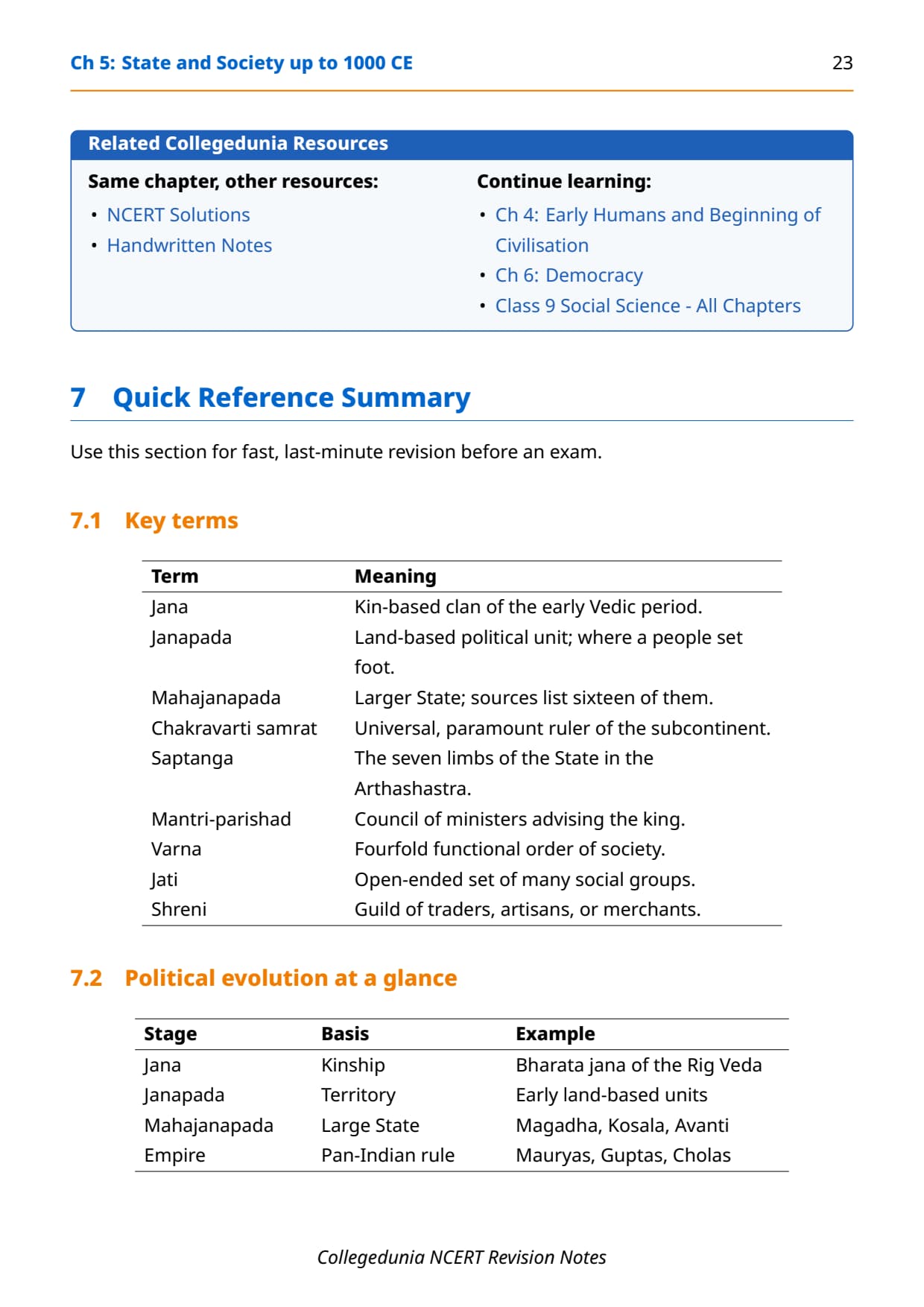
| Stage | Basis | Example |
|---|---|---|
| Jana | Kinship (clan) | Bharata jana of the Rig Veda |
| Janapada | Territory (land) | Early land-based units, around 1000 BCE |
| Mahajanapada | Large State | Magadha, Kosala, Avanti (sixteen in all) |
| Empire | Pan-Indian rule | Mauryas, Guptas, and later Cholas |
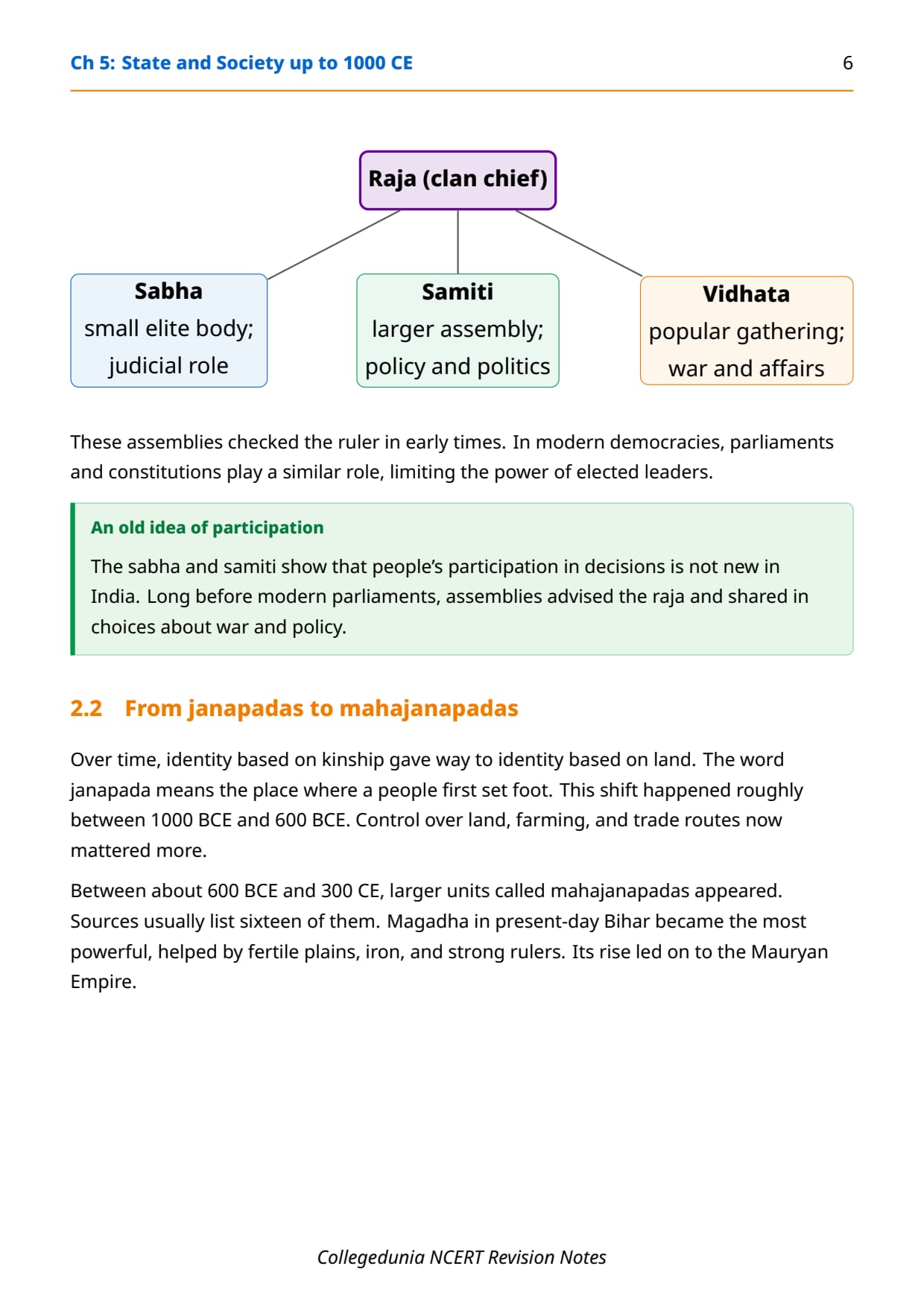
The early raja acted mainly as a clan chief who led the group in war. He did not rule alone. Vedic texts name three assemblies, the sabha, samiti, and vidhata, that shared in decisions and checked the ruler.
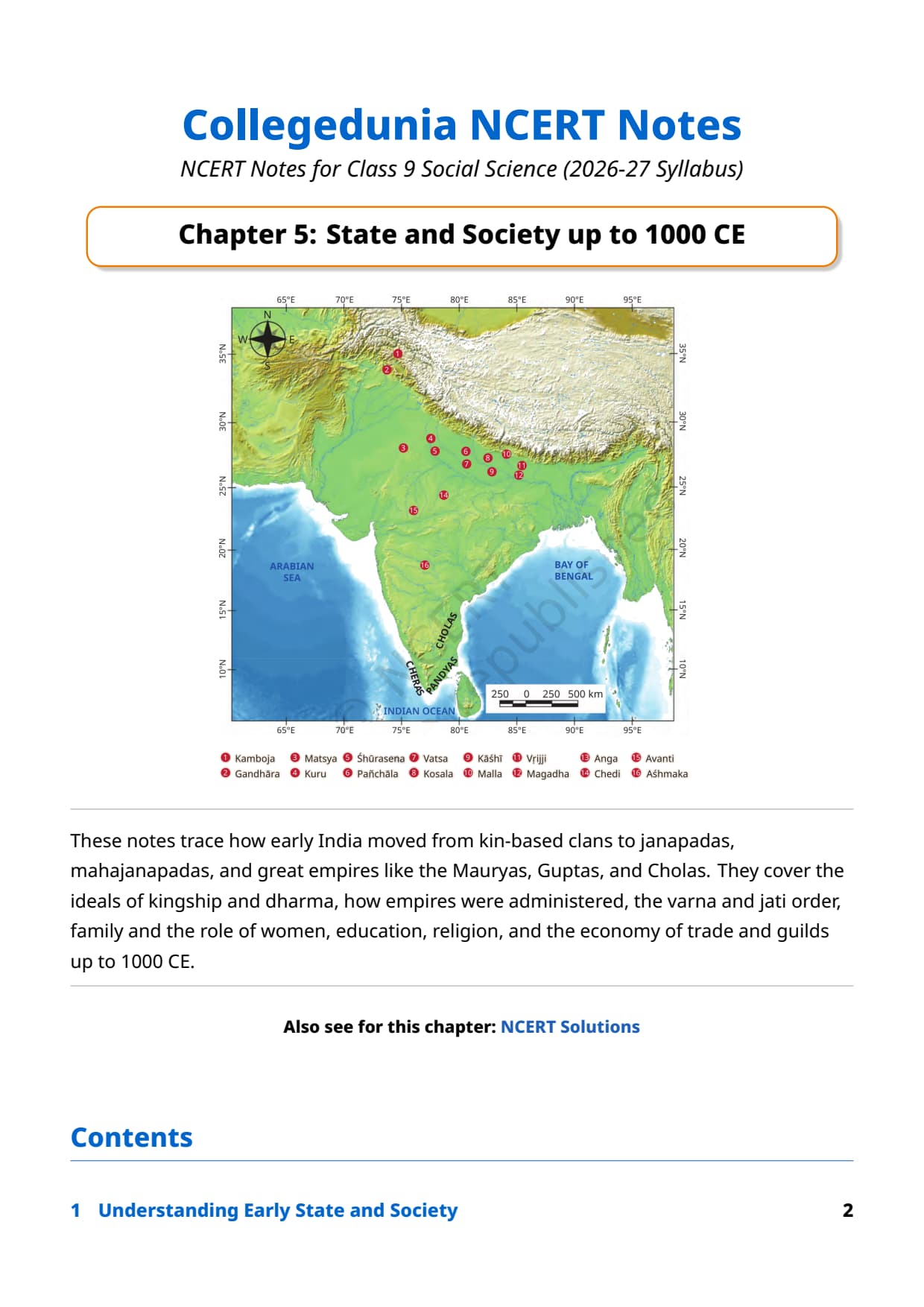
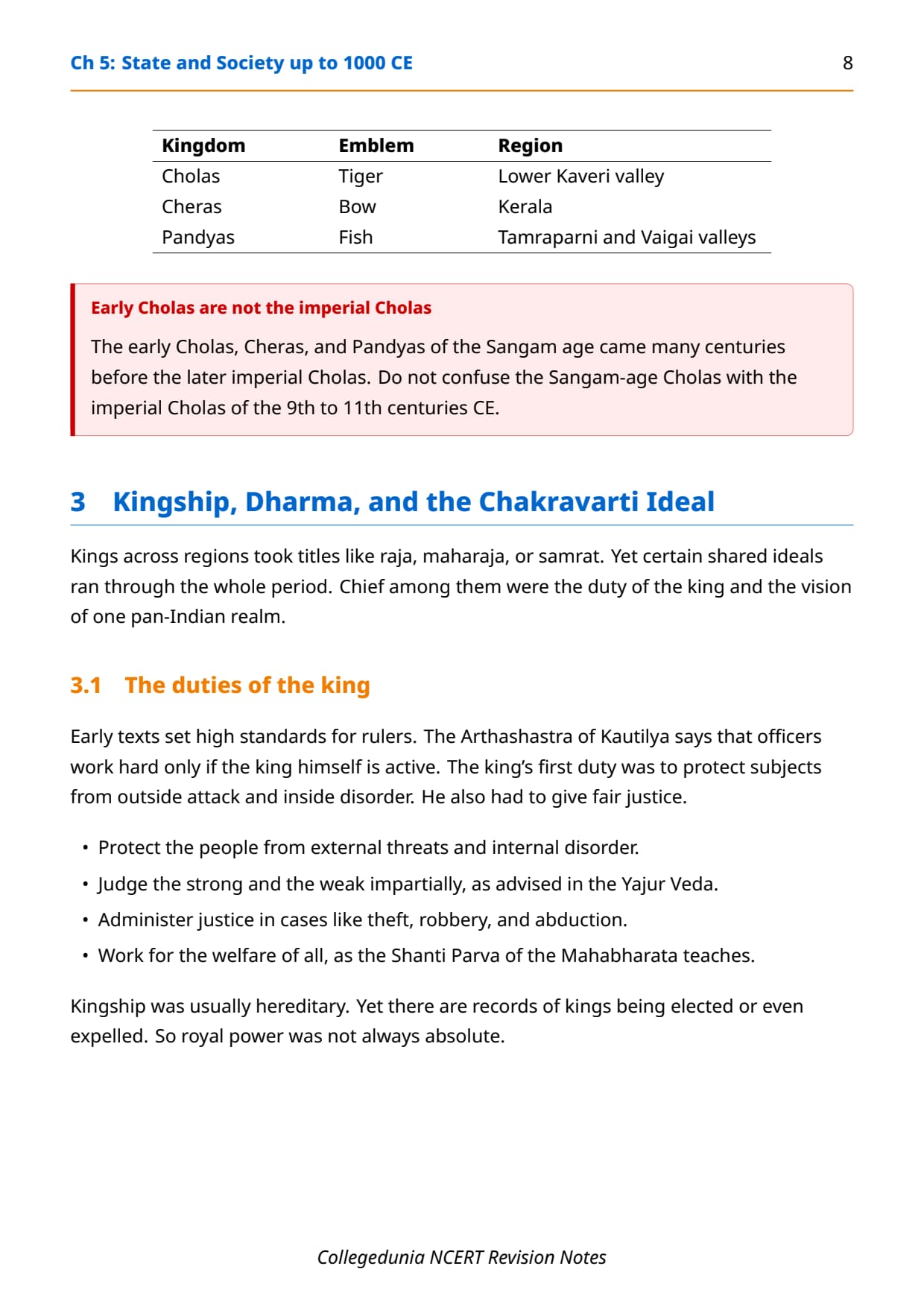
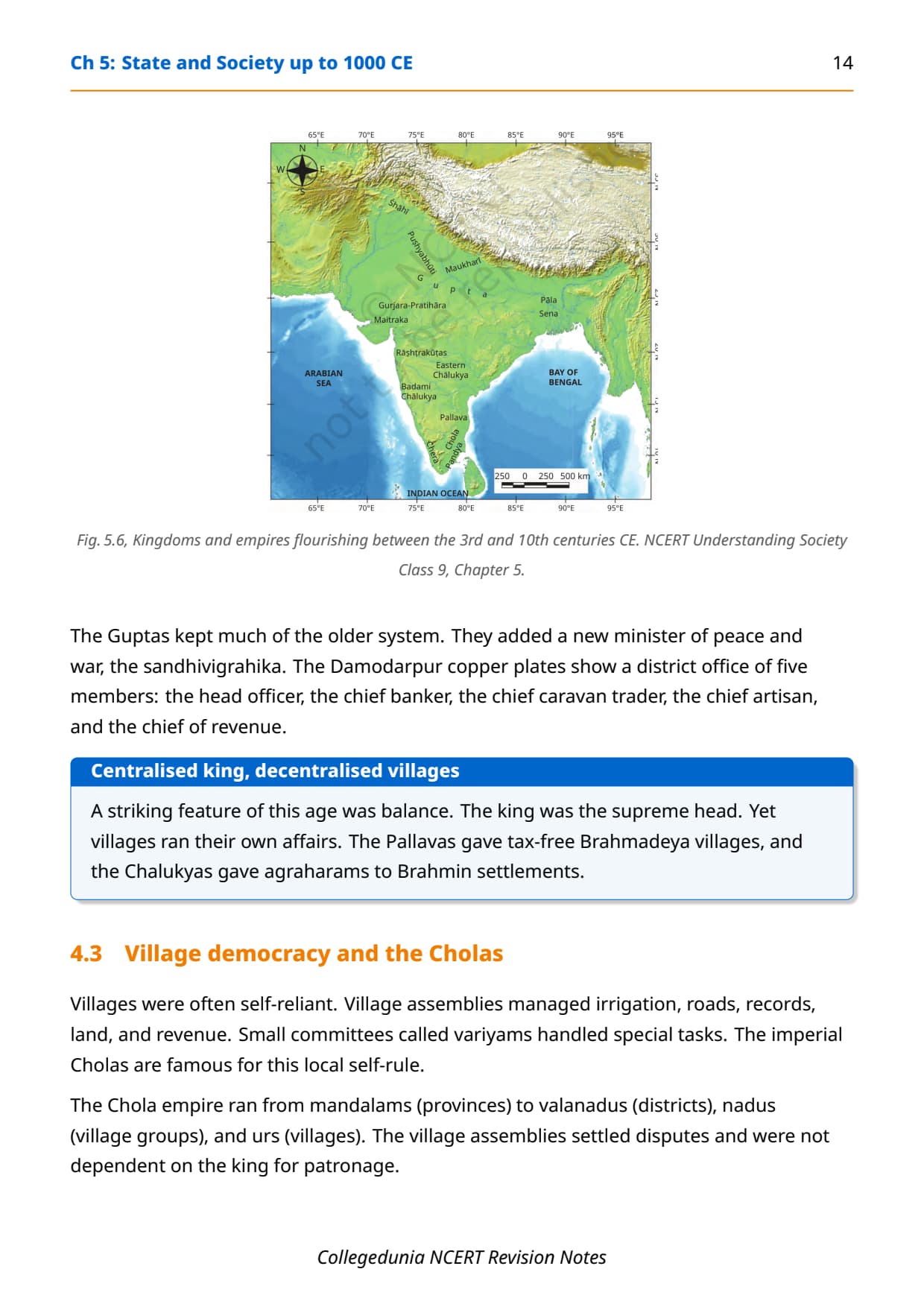
Between about 600 BCE and 300 CE, larger units called mahajanapadas appeared. Magadha in present-day Bihar became the strongest, helped by fertile plains, iron, and able rulers. Its rise led on to the Mauryan Empire. In the south, the Satavahanas ruled the Deccan, while the early Cholas, Cheras, and Pandyas held Tamilakam.
Kingship, Dharma, and Administration in State and Society up to 1000 CE
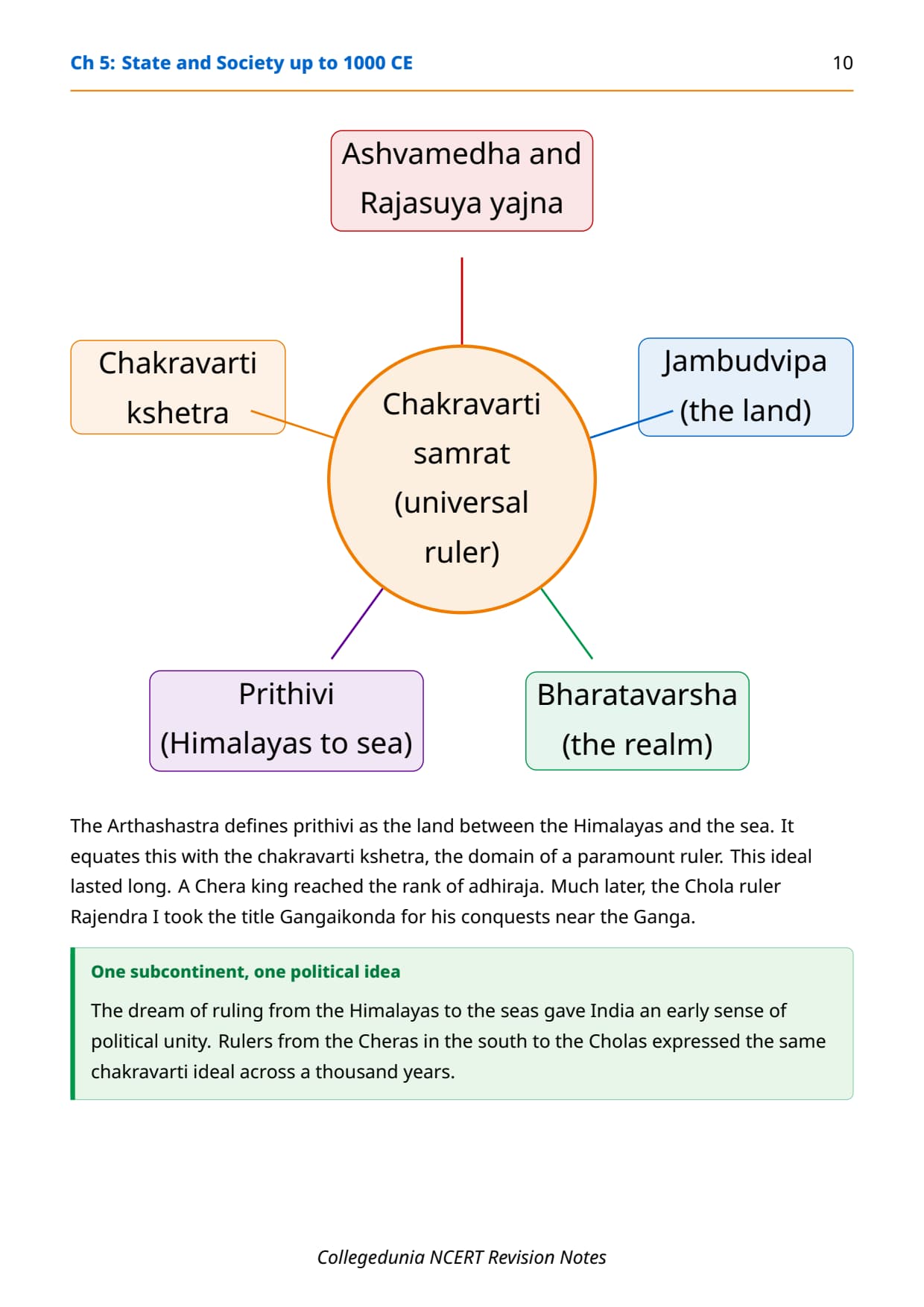
Kings across regions took titles like raja, maharaja, or samrat. Yet shared ideals ran through the whole period. The main ones were the duty of the king, the vision of one pan-Indian realm, and rule guided by dharma.
- Duty of the king: protect the people from outside attack and inside disorder, and give fair justice to strong and weak alike.
- Chakravarti samrat: the ideal of a universal ruler over the whole subcontinent, seen in words like Jambudvipa and Bharatavarsha.
- Dharma: here it means duty, righteousness, and moral conduct, not religion. Ashoka's edicts spread this idea of dhamma.
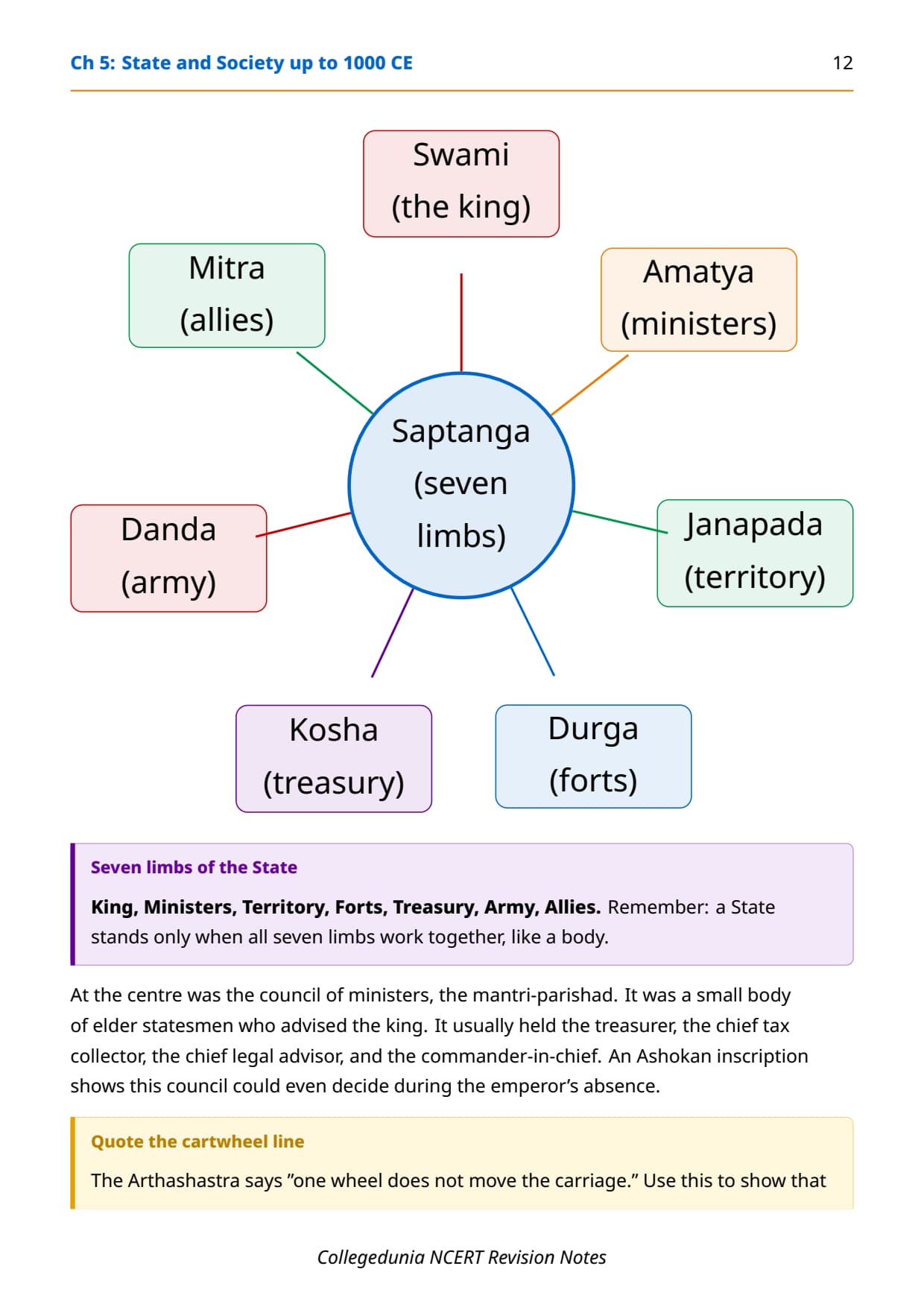
A large empire needs a system, not just a strong king. Kautilya's Arthashastra described the State as an organic whole of seven limbs, the Saptanga. This is a favourite exam topic, so revise the seven parts with the table below.
| Limb | Meaning |
|---|---|
| Swami | The king, the head of the State |
| Amatya | Ministers and officials |
| Janapada | Territory and the people on it |
| Durga | Forts for defence |
| Kosha | Treasury and finance |
| Danda | Army and force |
| Mitra | Allies and friends |
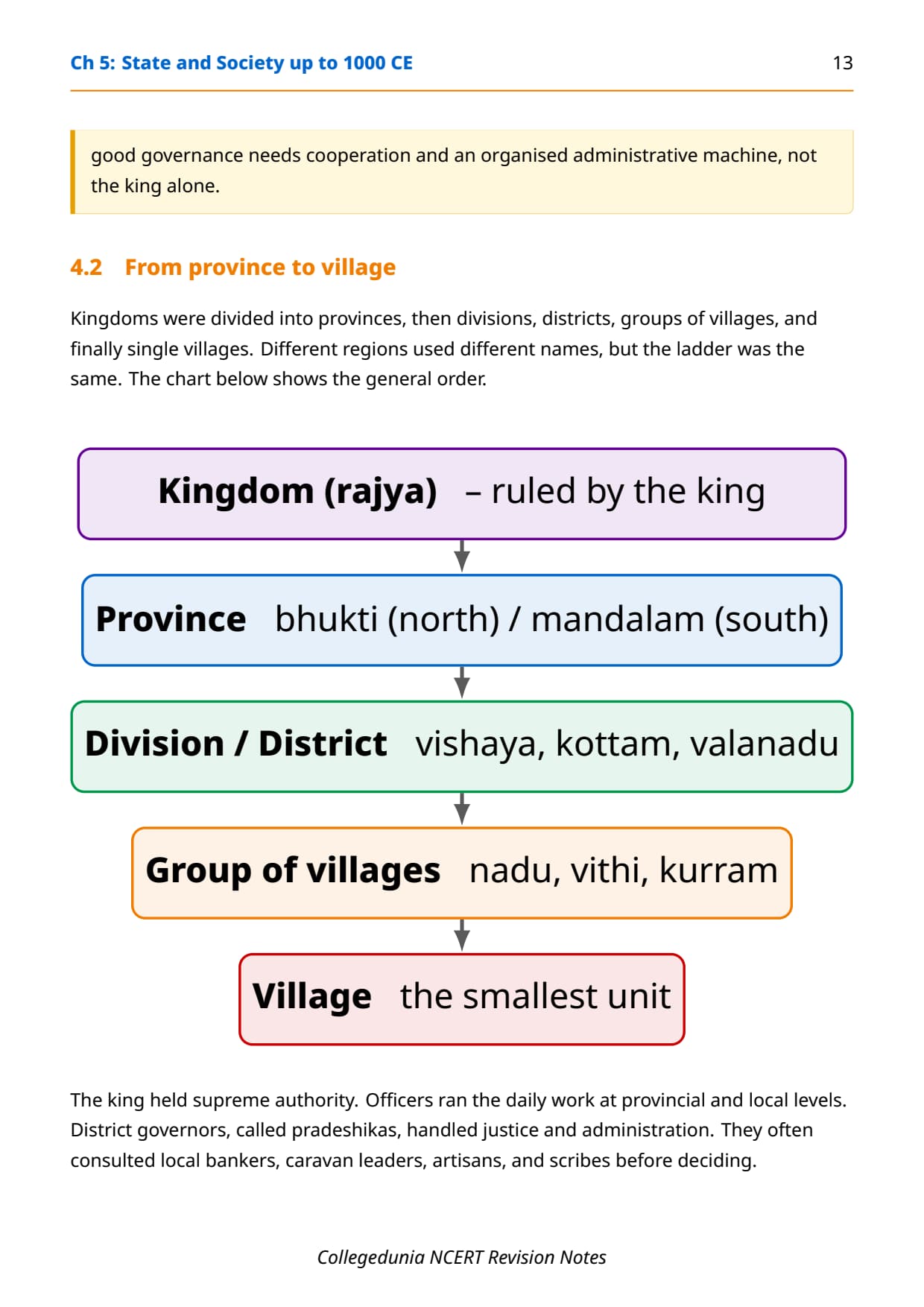
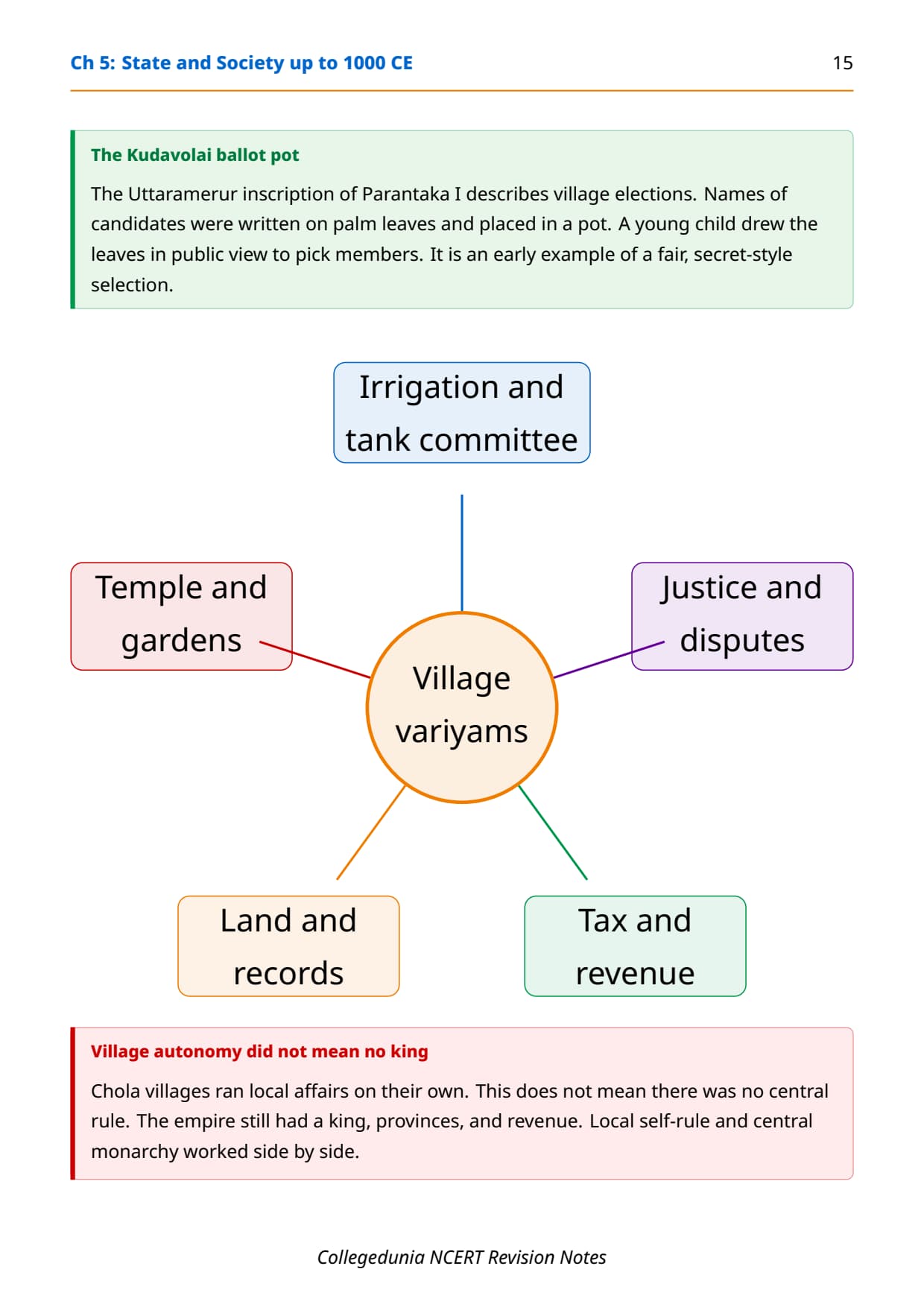
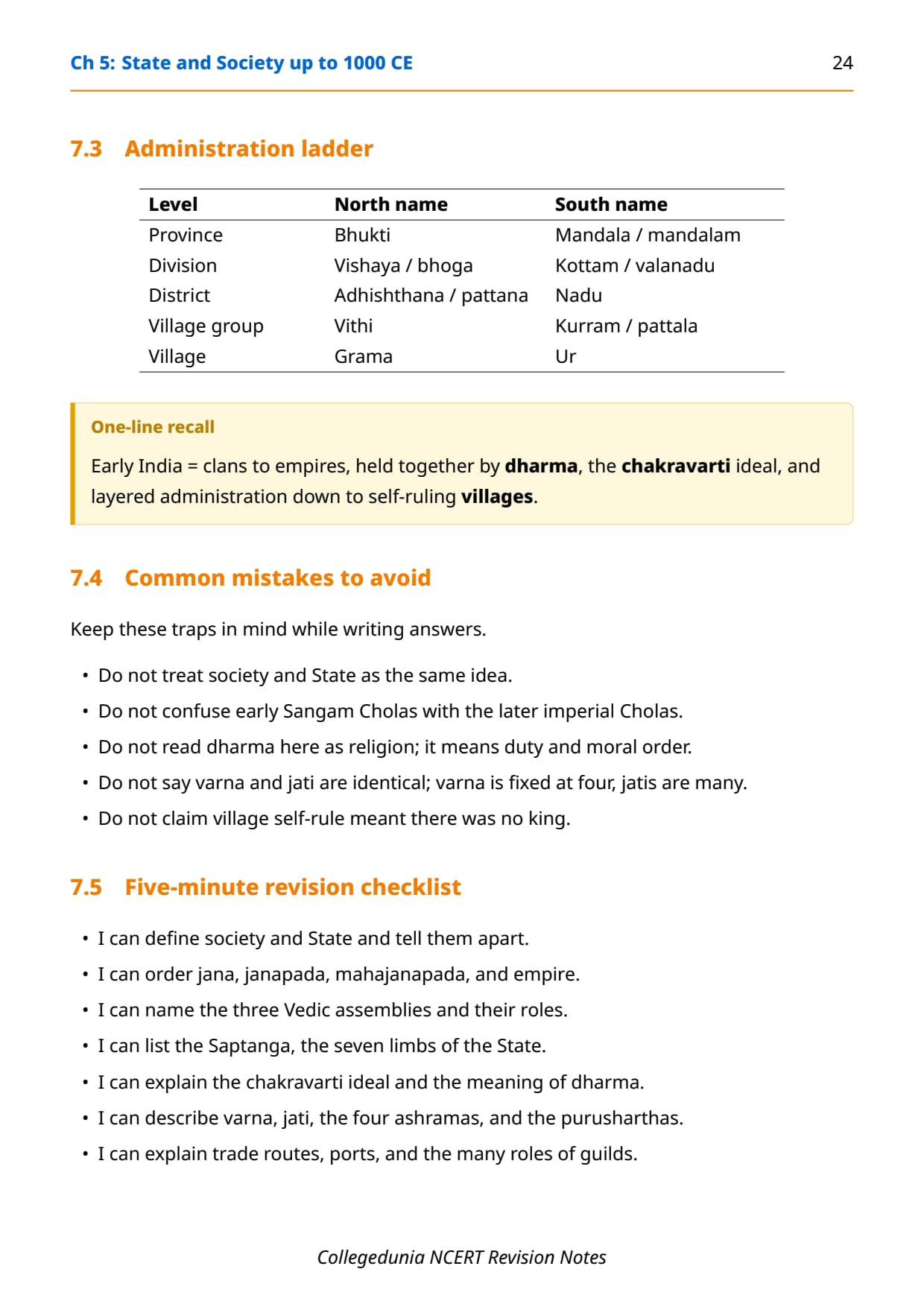
Kingdoms were divided into provinces, districts, groups of villages, and single villages. The king held supreme power, yet villages ran much of their own daily life. The imperial Cholas are famous for this local self-rule. The Uttaramerur inscription even records village elections using the Kudavolai pot, an early example of a fair, secret-style selection.
Society, Economy, and Culture in Class 9 Social Science Chapter 5
Society in early India was ordered but not frozen. The class 9 social science notes chapter 5 State and Society up to 1000 CE explain varna, jati, family, the place of women, and the economy of farming and trade in a few clear points.
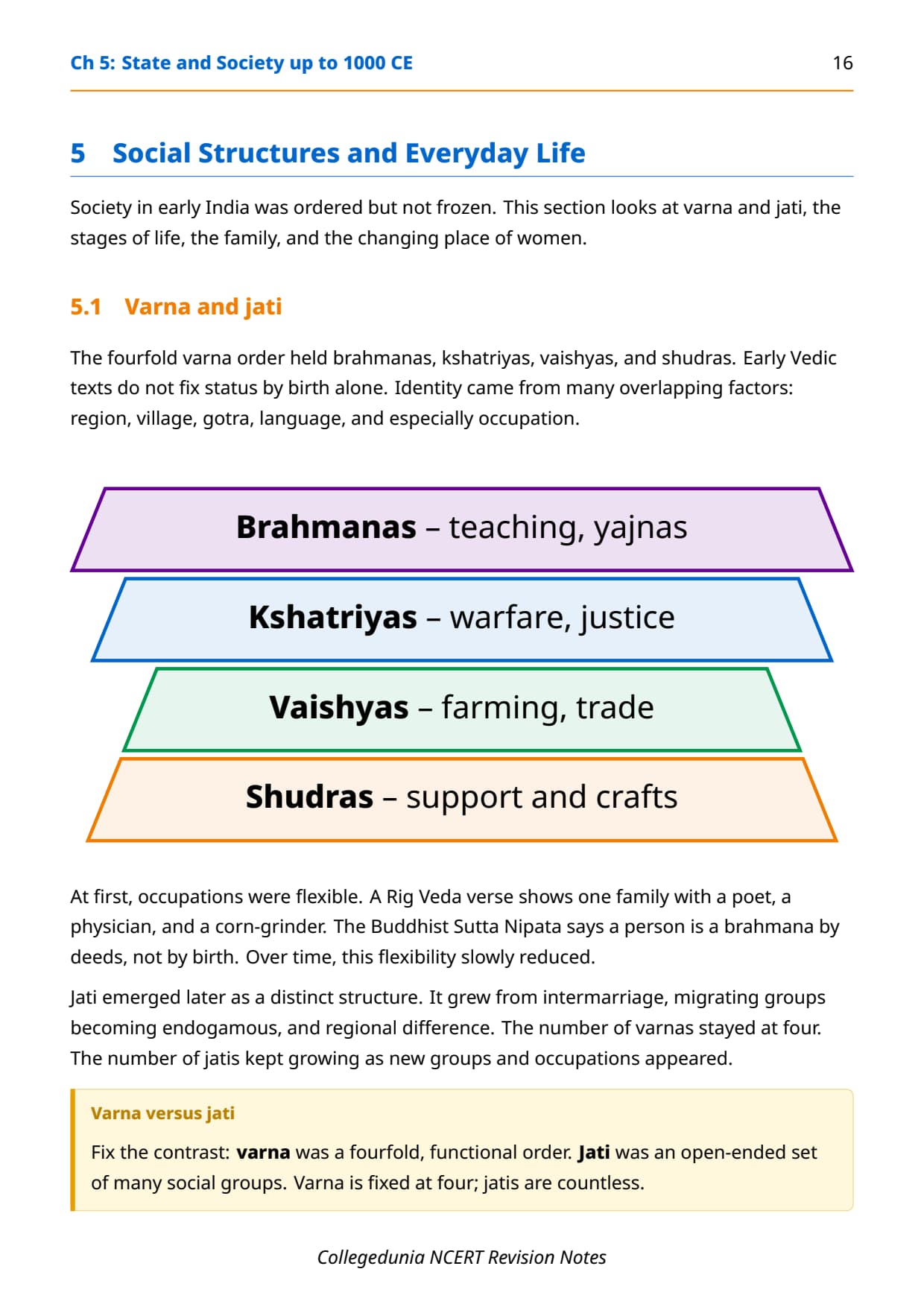
- Varna and jati: varna was a fourfold functional order of brahmanas, kshatriyas, vaishyas, and shudras. Jati grew later as an open-ended set of many social groups.
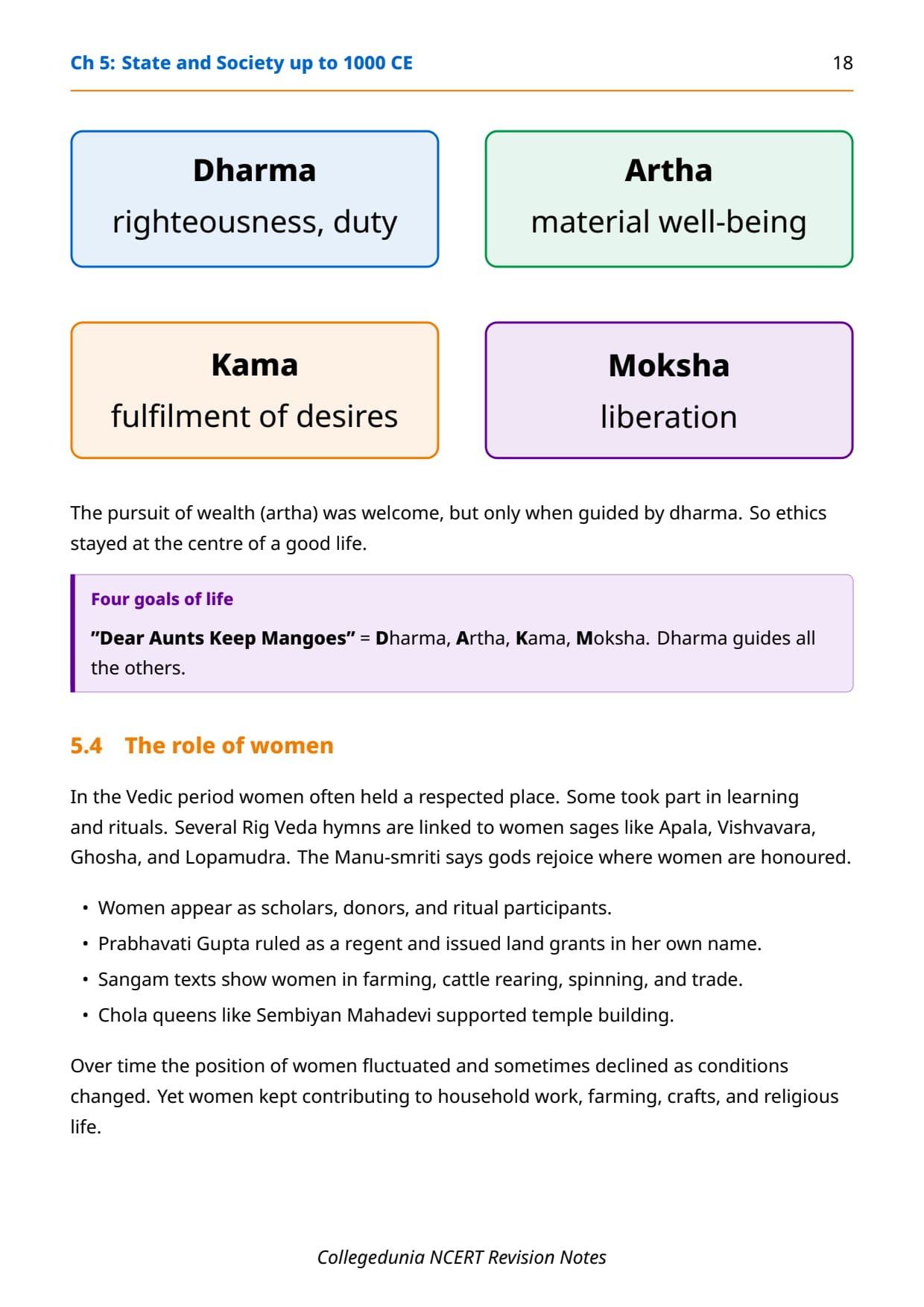
- Family and life stages: the kula (family) was the smallest unit. Life had four ashramas and four goals, the purusharthas: dharma, artha, kama, and moksha.
- Women: women were often respected in Vedic and Sangam times, took part in learning, and some, like Prabhavati Gupta, even ruled as regents.
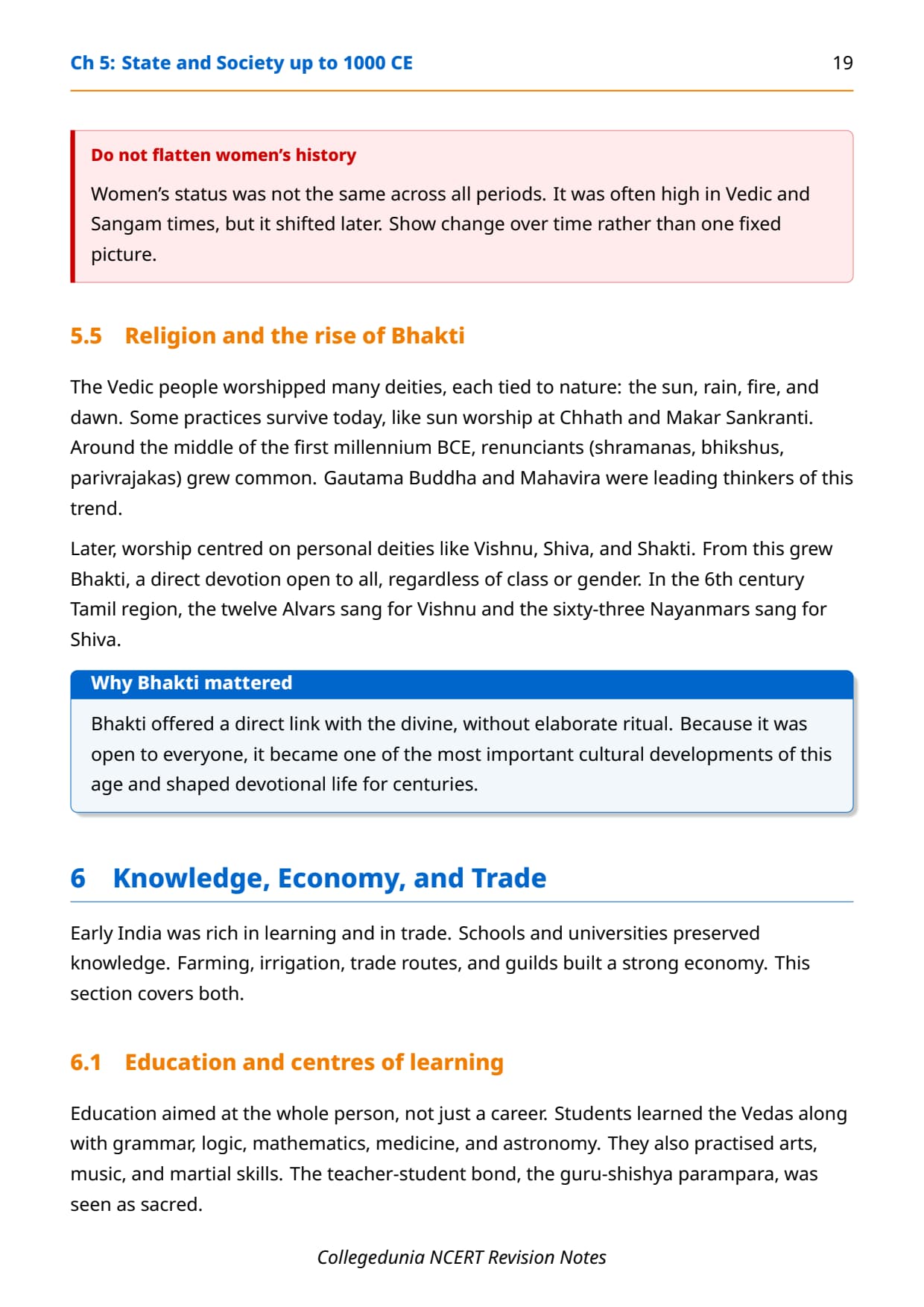
- Religion: worship of nature deities gave way to devotion to Vishnu, Shiva, and Shakti, and later to Bhakti, open to all.
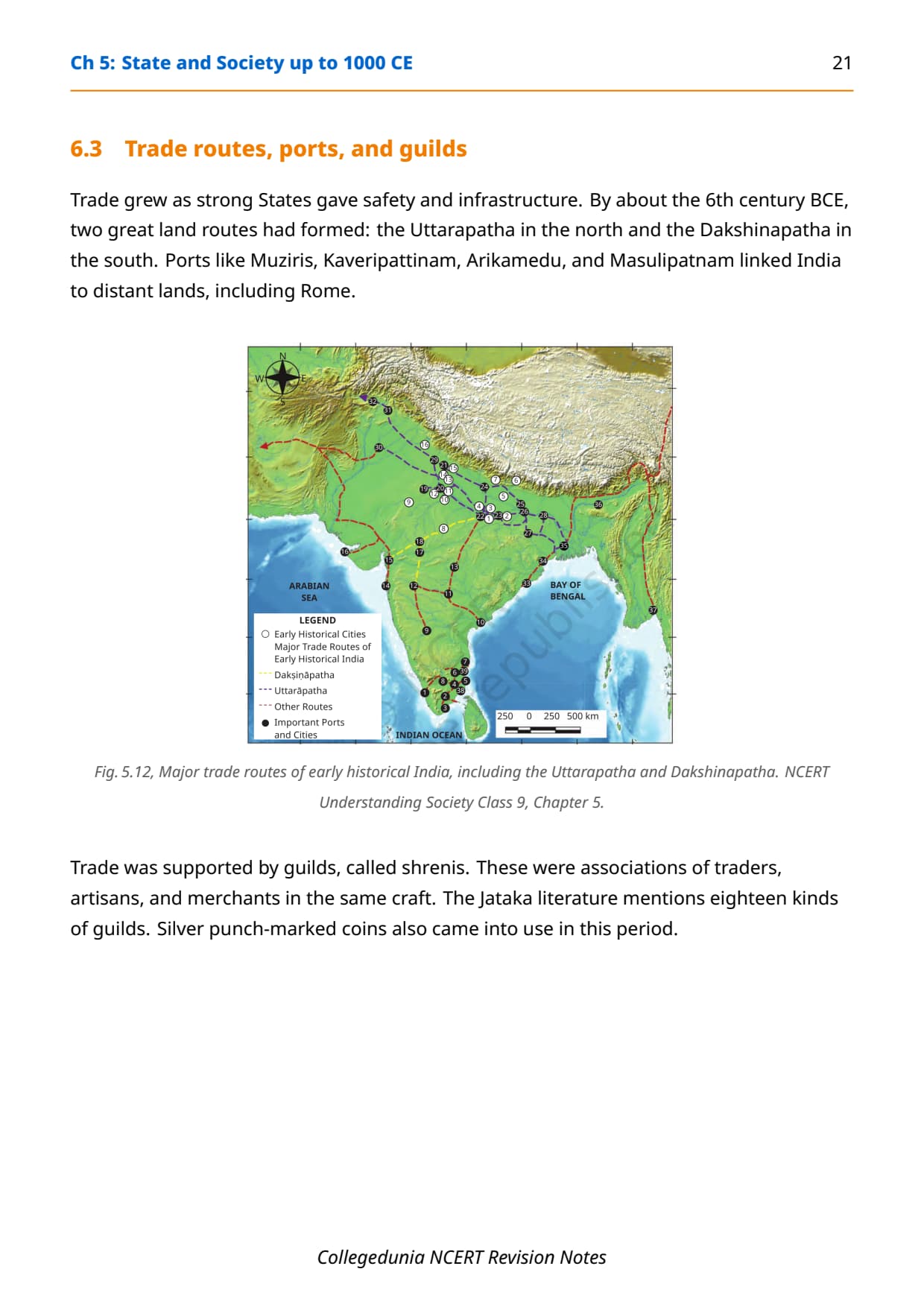
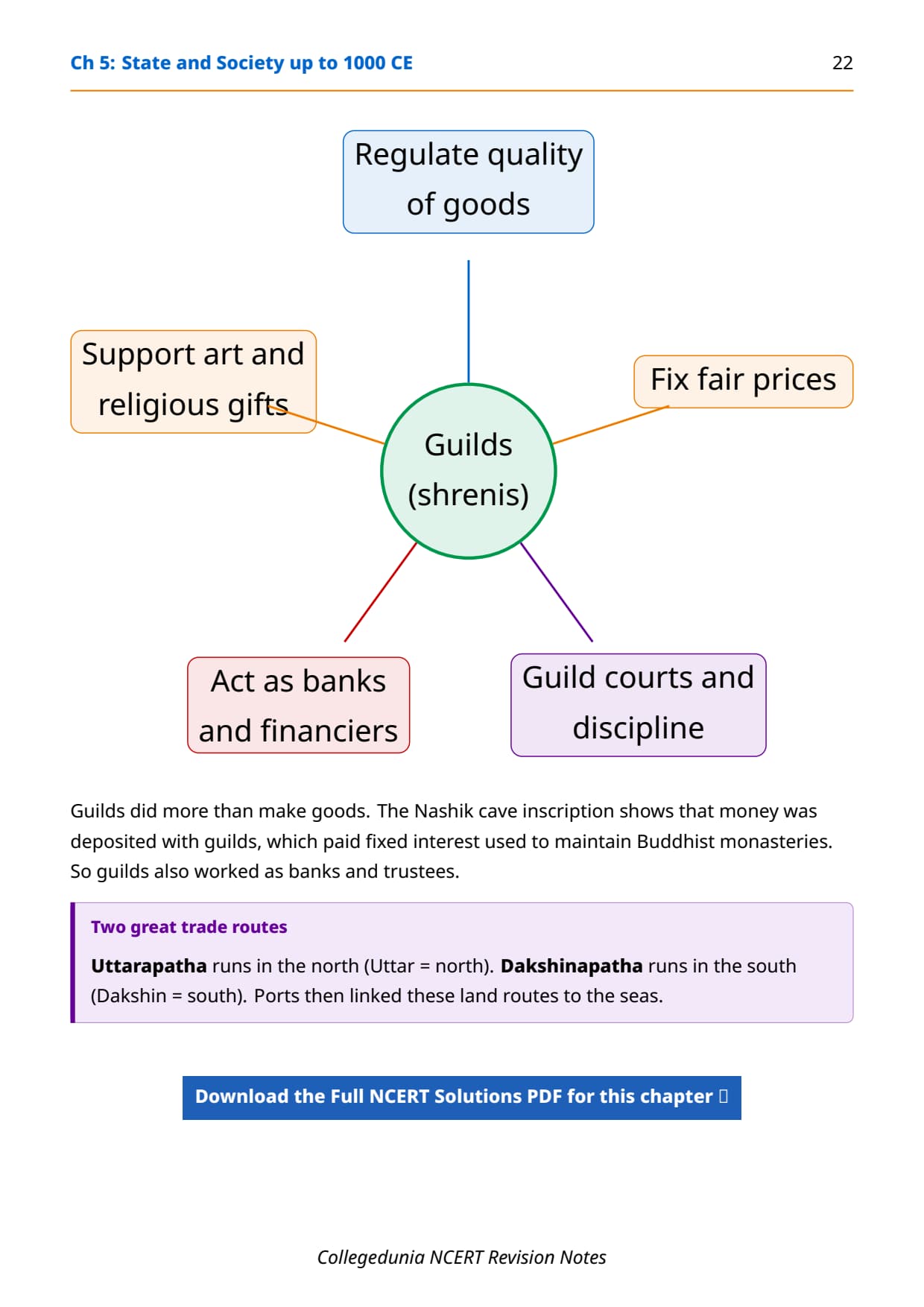
The economy rested on farming, irrigation, and trade. The basic land tax was usually one-sixth of the produce. Two great routes, the Uttarapatha in the north and the Dakshinapatha in the south, carried goods to ports like Muziris and Kaveripattinam. Trade was managed by guilds, called shrenis, which fixed quality and prices and even worked as early banks.
Key Terms to Remember for Class 9 Social Science Chapter 5
Learn these terms by heart. They come up again and again in short-answer and long-answer questions.
| Term | Meaning |
|---|---|
| Jana | Kin-based clan of the early Vedic period |
| Janapada | Land-based political unit, where a people set foot |
| Mahajanapada | Larger State; sources list sixteen of them |
| Chakravarti samrat | Universal, paramount ruler of the subcontinent |
| Saptanga | The seven limbs of the State in the Arthashastra |
| Mantri-parishad | Council of ministers who advised the king |
| Varna | Fourfold functional order of society |
| Shreni | Guild of traders, artisans, or merchants |
Common Mistakes and Revision Tips for State and Society up to 1000 CE
Most lost marks come from small slips, not hard ideas. Fix these traps while you revise and your answers stay clean.
- Treating society and State as the same idea; society rests on custom, the State on formal law.
- Confusing the early Sangam Cholas with the later imperial Cholas.
- Saying varna and jati are identical; varna is fixed at four, jatis are countless.
- Claiming village self-rule meant there was no king; local rule and central monarchy worked side by side.
How Collegedunia Notes Help You Revise State and Society up to 1000 CE
Collegedunia gives you the full class 9 social science notes chapter 5 State and Society up to 1000 CE as clean, short revision in one place.
- 2026-27 match: every note follows the new NCERT Understanding Society textbook and its exercise flow.
- Simple English: short lines and everyday words, so a Class 9 student can revise without help.
- Tables ready: the stages, the Saptanga, and key terms sit in easy tables for last-minute recall.
- Free PDF: download the notes and revise offline before your exam.
Other State and Society up to 1000 CE Class 9 Social Science Resources
Use the table below to open the other resources for this chapter and study it from every angle.
| Resource | Open |
|---|---|
| Revision Notes | State and Society up to 1000 CE Class 9 Social Science Notes |
| NCERT Solutions | State and Society up to 1000 CE Class 9 Social Science NCERT Solutions |
| Handwritten Notes | State and Society up to 1000 CE Class 9 Social Science Handwritten Notes |
| NCERT Book PDF | State and Society up to 1000 CE Class 9 Social Science NCERT Book PDF |
NCERT Notes for Class 9 Social Science: All Chapters
Use the table below to open the NCERT Notes for any other chapter of the new Class 9 Social Science Understanding Society book.
| Chapter | NCERT Notes |
|---|---|
| Chapter 1 | Understanding Social Science |
| Chapter 2 | Shaping of the Earth's Surface |
| Chapter 3 | Atmosphere and Climate |
| Chapter 4 | Early Humans and Beginning of Civilisation |
| Chapter 5 | State and Society up to 1000 CE |
| Chapter 6 | Democracy |
| Chapter 7 | Elections |
| Chapter 8 | Building Blocks in Economics: The Problem of Choice |
| Chapter 9 | The Price Puzzle: What Drives the Market |
State and Society up to 1000 CE Class 9 Social Science Notes FAQs
Where can I download the Class 9 Social Science Chapter 5 State and Society up to 1000 CE Notes PDF?
You can download the State and Society up to 1000 CE Notes PDF free from this page. Both the Normal and HD versions match the 2026-27 NCERT Understanding Society book.
What topics do the Class 9 Social Science Chapter 5 notes cover?
The notes cover society versus State, the growth from janas to empires, kingship and dharma, the Saptanga administration, varna and jati, the role of women, and trade and guilds up to 1000 CE.
What is the difference between varna and jati in this chapter?
Varna was a fourfold functional order with four groups. Jati grew later as an open-ended set of many social groups. Varna stayed at four, while the number of jatis kept rising.
Why are the imperial Cholas different from the early Cholas?
The early Cholas belonged to the Sangam age and came many centuries before the imperial Cholas of the 9th to 11th centuries CE. Students should never confuse the two in an answer.



Comments