




The NCERT Notes for Class 9 Social Science Chapter 7 Elections give you a short, clear revision of the whole chapter in one place. These class 9 social science notes chapter 7 Elections explain why elections matter, how India's electoral system works, the main election laws, the role of the Election Commission of India, and how parties keep a poll free and fair.
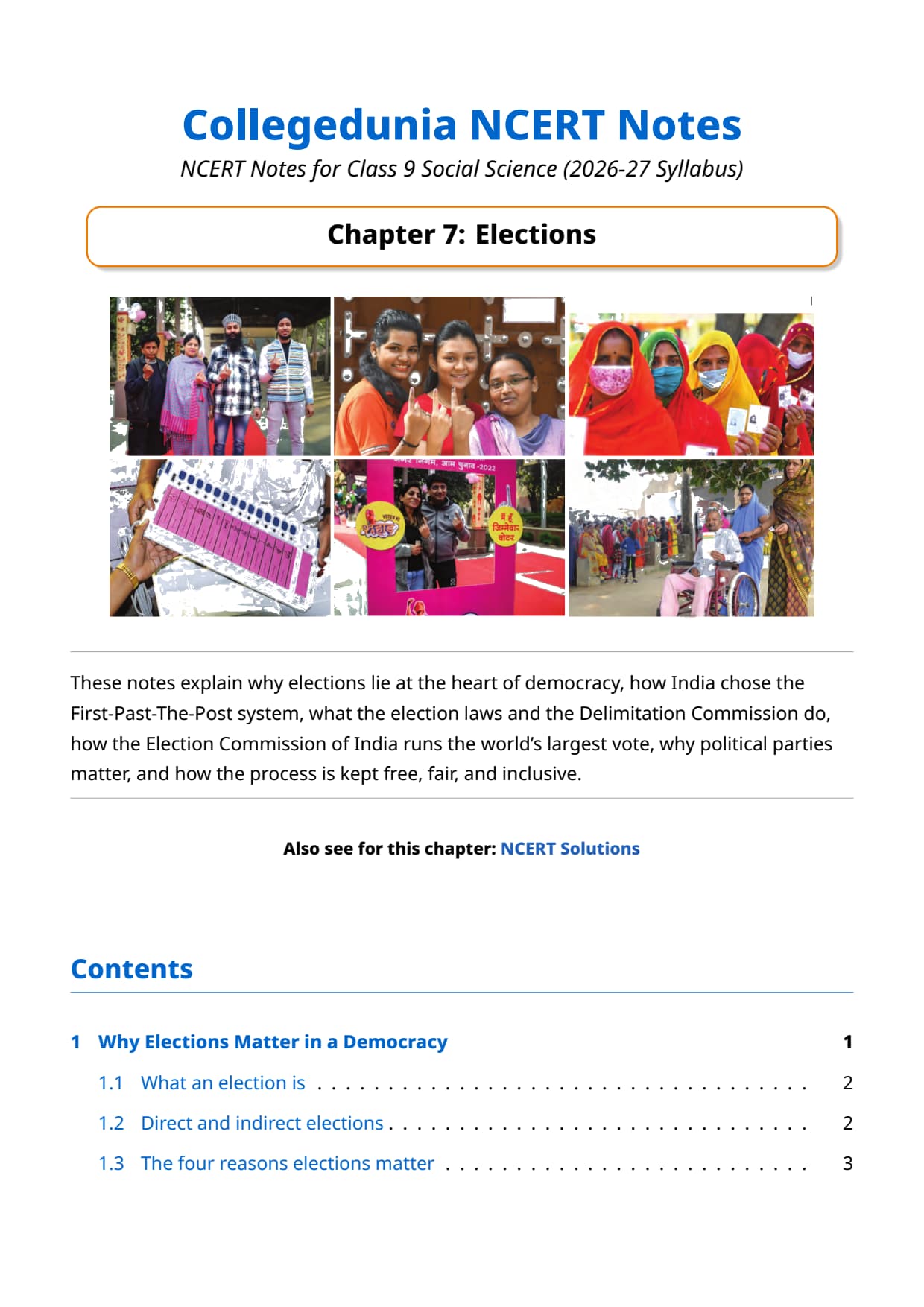
Prepared by Collegedunia subject experts and matched line by line with the 2026-27 NCERT Understanding Society textbook.
- Full chapter revision: elections, direct and indirect voting, FPTP, election laws, the Election Commission, political parties, and free and fair polls.
- Exam-ready terms: delimitation, defection, psephology, SIR, and VVPAT explained in one simple line each.
- Why it matters: Chapter 7 builds directly on the Democracy chapter and is a high-scoring Civics topic for Class 9 exams.
Student Feedback
In a Collegedunia study of 1,080 Class 9 students, 78% said a one-page revision of the Election Commission's functions helped them most before a Civics test. About 4 out of 5 rated the "which system for which house" table the clearest part of these class 9 social science notes chapter 7 Elections.
Source: Collegedunia Class 9 revision survey, 2026.
What Class 9 Social Science Chapter 7 Elections Covers
An election is the process through which citizens vote to choose the people who make decisions on their behalf. Chapter 7 explains why regular elections lie at the heart of a democracy. These class 9 social science notes chapter 7 Elections follow the same order as the NCERT Understanding Society book, so your revision matches the chapter flow.
The chapter moves through five clear ideas:
- Why elections matter: accountability, representation, legitimacy, and equality.
- The electoral system: how votes turn into seats under First-Past-The-Post.
- Rules and referee: election laws, delimitation, and the Election Commission of India.
- Political parties: their role, defection, and national or state recognition.
- Fair and inclusive polls: digital tools and the challenges that remain.
Why Elections Matter in Class 9 Social Science Chapter 7 Elections
In a democracy the people rule through representatives they choose. An election lets citizens make that choice and remove leaders who do not perform. Regular, periodic elections keep a government answerable to the people.
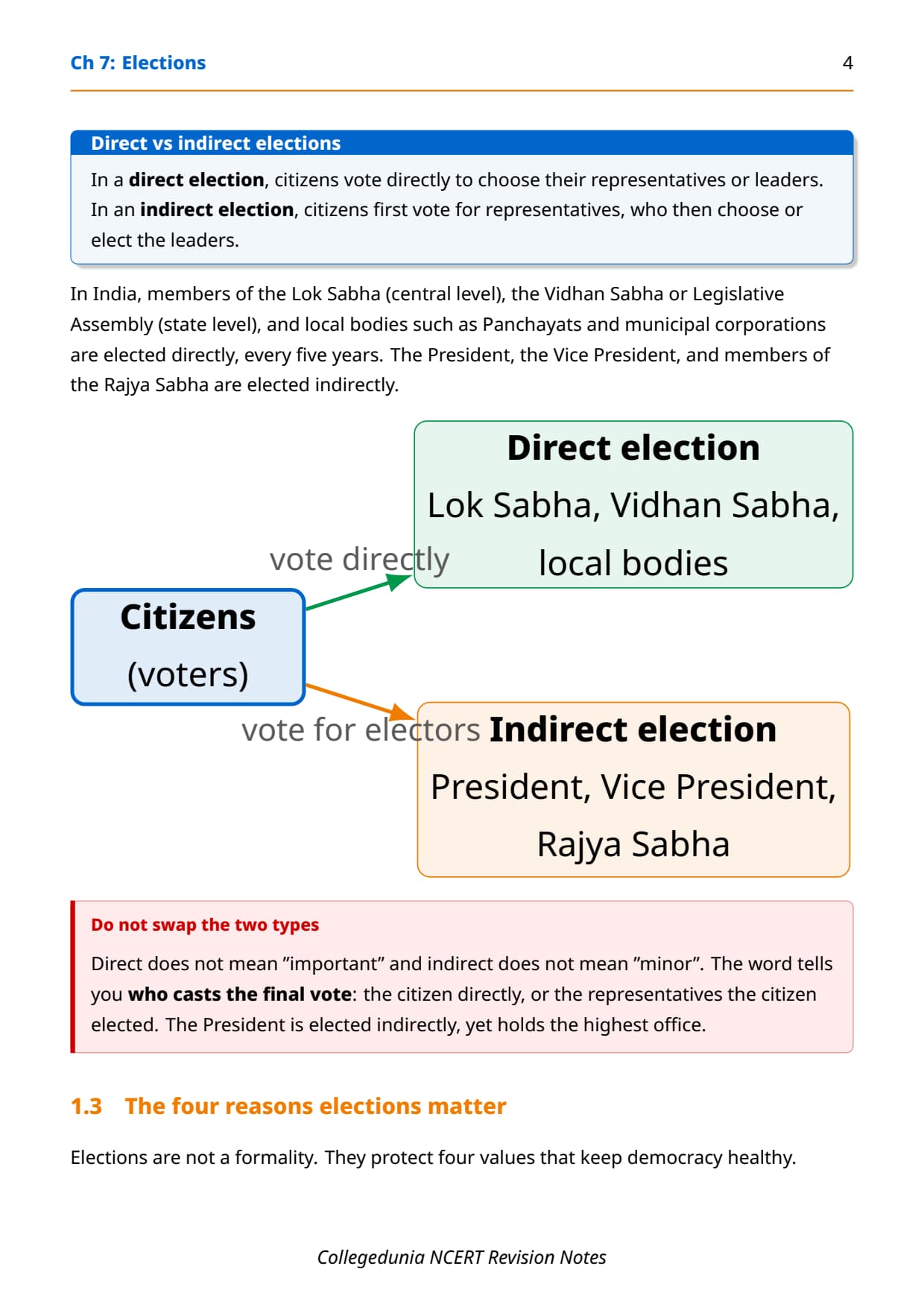
Representatives are chosen in two ways, and telling them apart is a common exam point:
- Direct election: citizens vote straight for the representative. The Lok Sabha, Vidhan Sabha, and local bodies are elected this way, every five years.
- Indirect election: citizens first elect representatives, who then choose the leader. The President, Vice President, and Rajya Sabha members are elected this way.
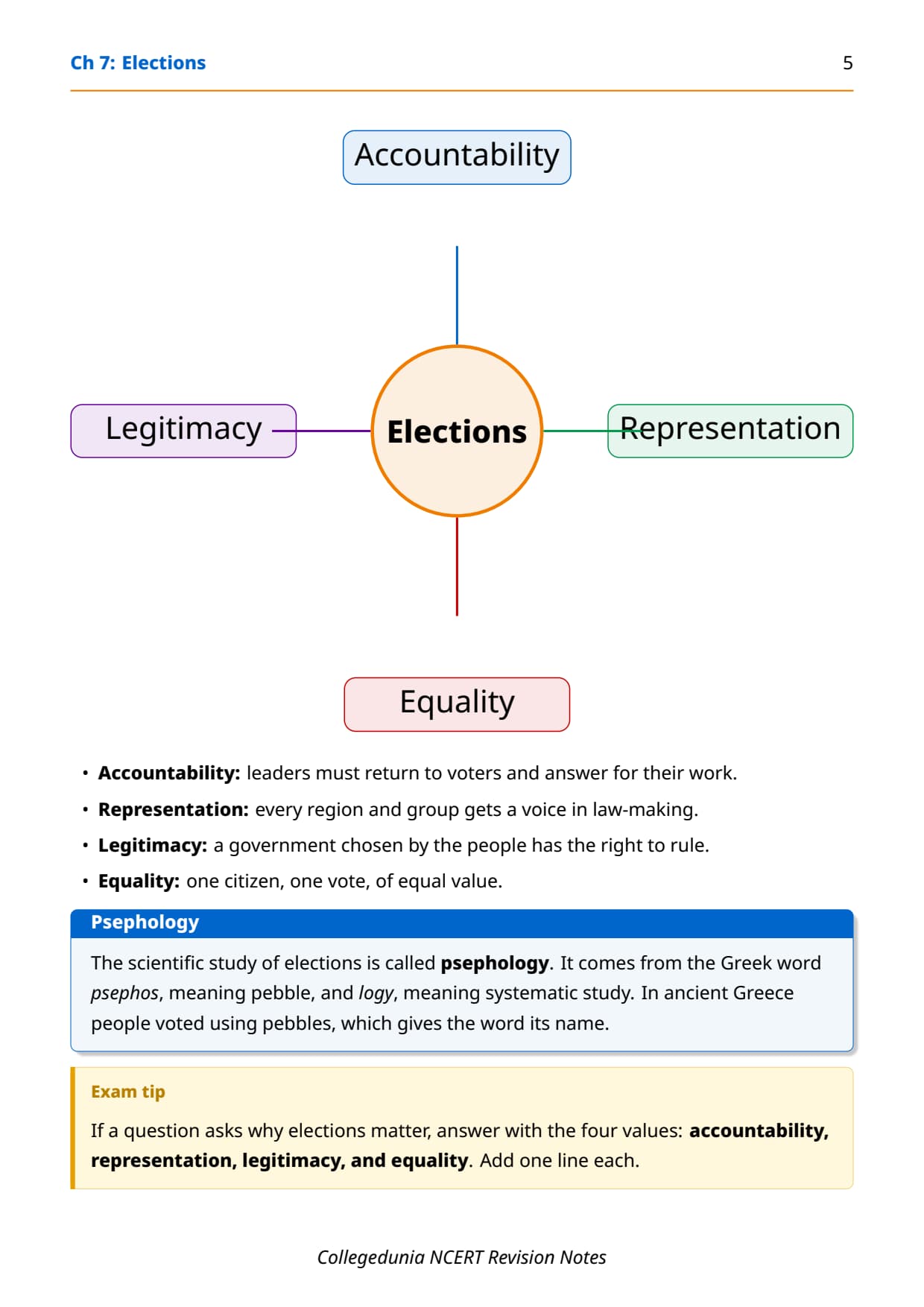
Elections protect four values: accountability (leaders answer for their work), representation (every group gets a voice), legitimacy (a chosen government has the right to rule), and equality (one citizen, one vote of equal value). The scientific study of elections is called psephology, from the Greek word for pebble, since ancient Greeks voted using pebbles.
India's Electoral System in Class 9 Social Science Chapter 7 Elections
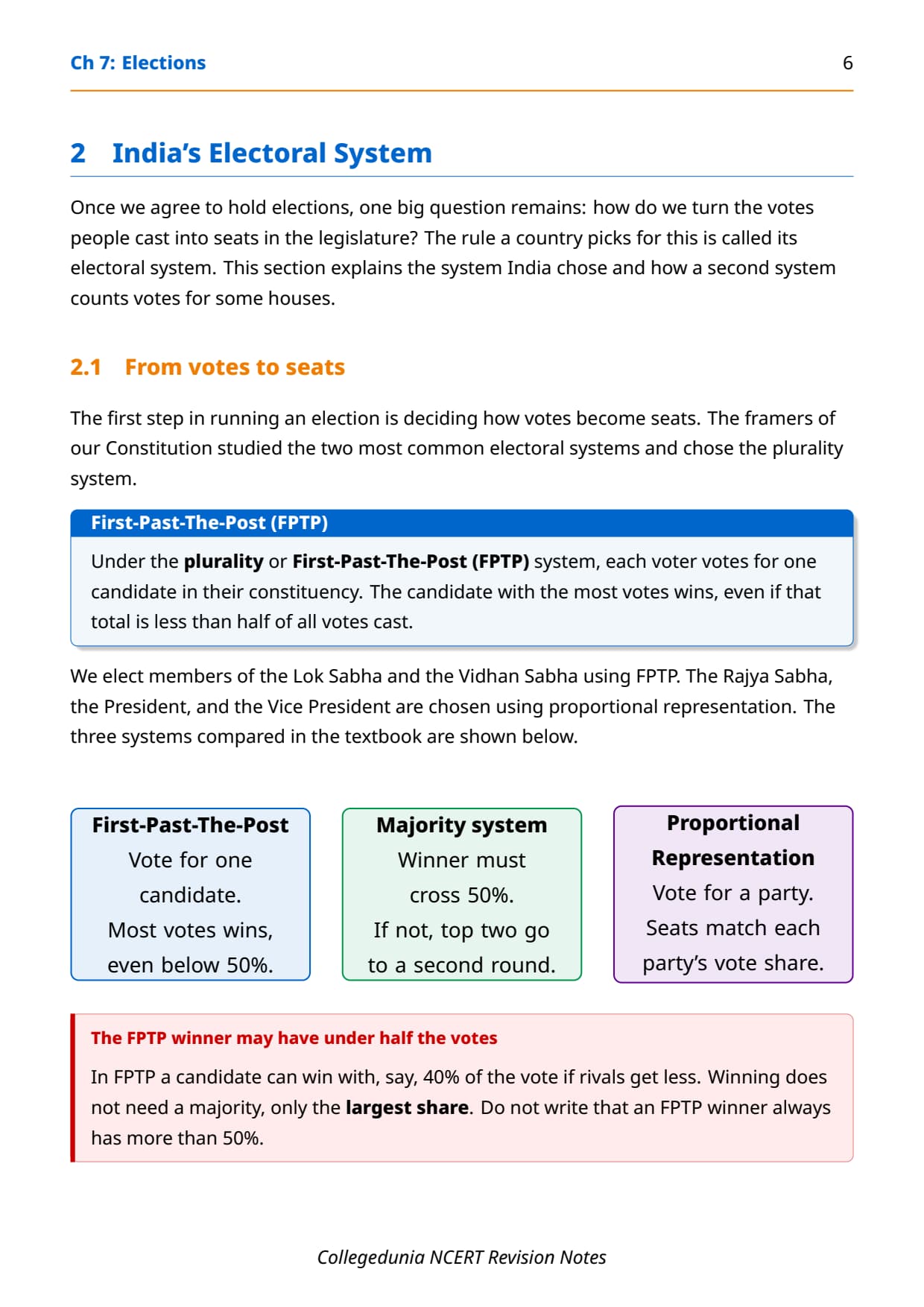
Once a country decides to hold elections, one big question remains: how do votes become seats? The rule chosen for this is the electoral system. Our Constitution makers studied the common systems and picked the plurality system.
Under First-Past-The-Post (FPTP), each voter votes for one candidate in their constituency. The candidate with the most votes wins, even if that total is below half of all votes cast. We use FPTP for the Lok Sabha and the Vidhan Sabha. The Rajya Sabha, President, and Vice President are chosen by proportional representation.
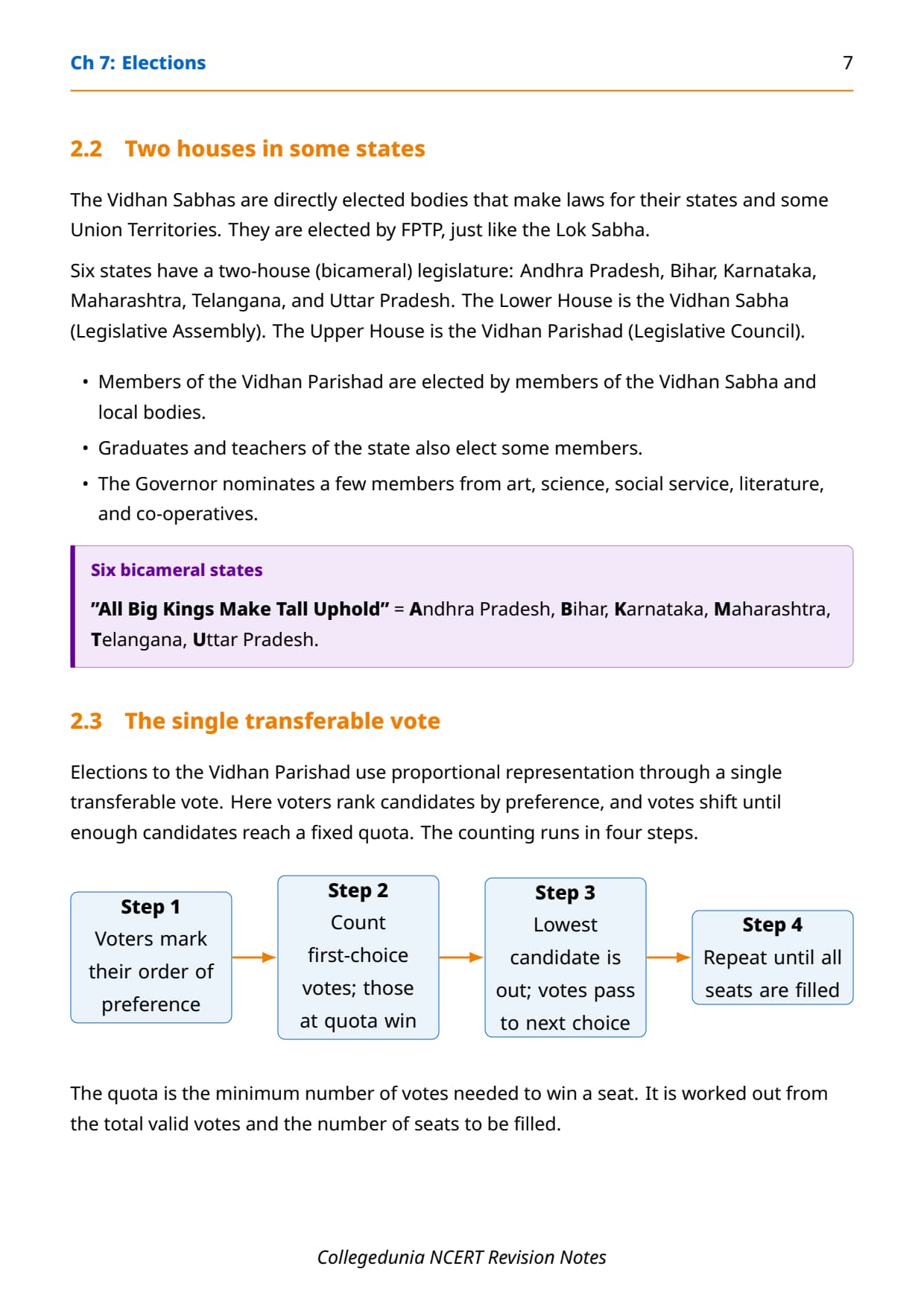
Six states have a two-house (bicameral) legislature: Andhra Pradesh, Bihar, Karnataka, Maharashtra, Telangana, and Uttar Pradesh. Their Lower House is the Vidhan Sabha and the Upper House is the Vidhan Parishad. Members of the Vidhan Parishad are elected by proportional representation through a single transferable vote, where voters rank candidates by preference.
Election Laws, Delimitation, and the Election Commission of India
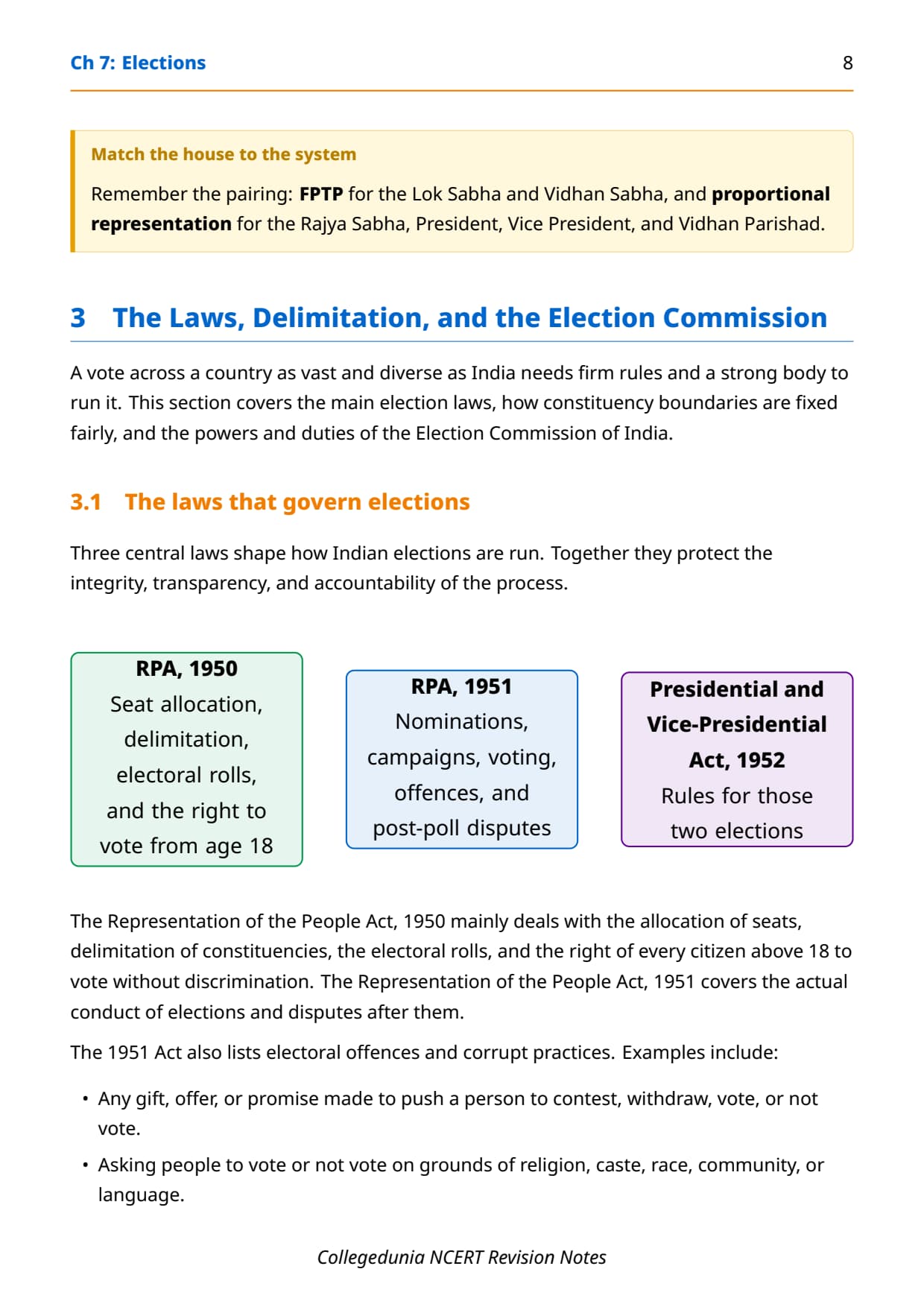
A vote across a country as vast as India needs firm rules and a strong referee. Three central laws shape how our elections run, and one constitutional body oversees the whole process.
| Law or body | What it does |
|---|---|
| RPA, 1950 | Seat allocation, delimitation, electoral rolls, and the right to vote from age 18. |
| RPA, 1951 | Nominations, campaigns, voting, electoral offences, and post-poll disputes. |
| Delimitation Commission | Article 82; fixes the number and boundaries of constituencies. India has had four (1952, 1963, 1973, 2002). |
| Election Commission of India | Set up on 25 January 1950; Articles 324 to 329; runs all major elections. |
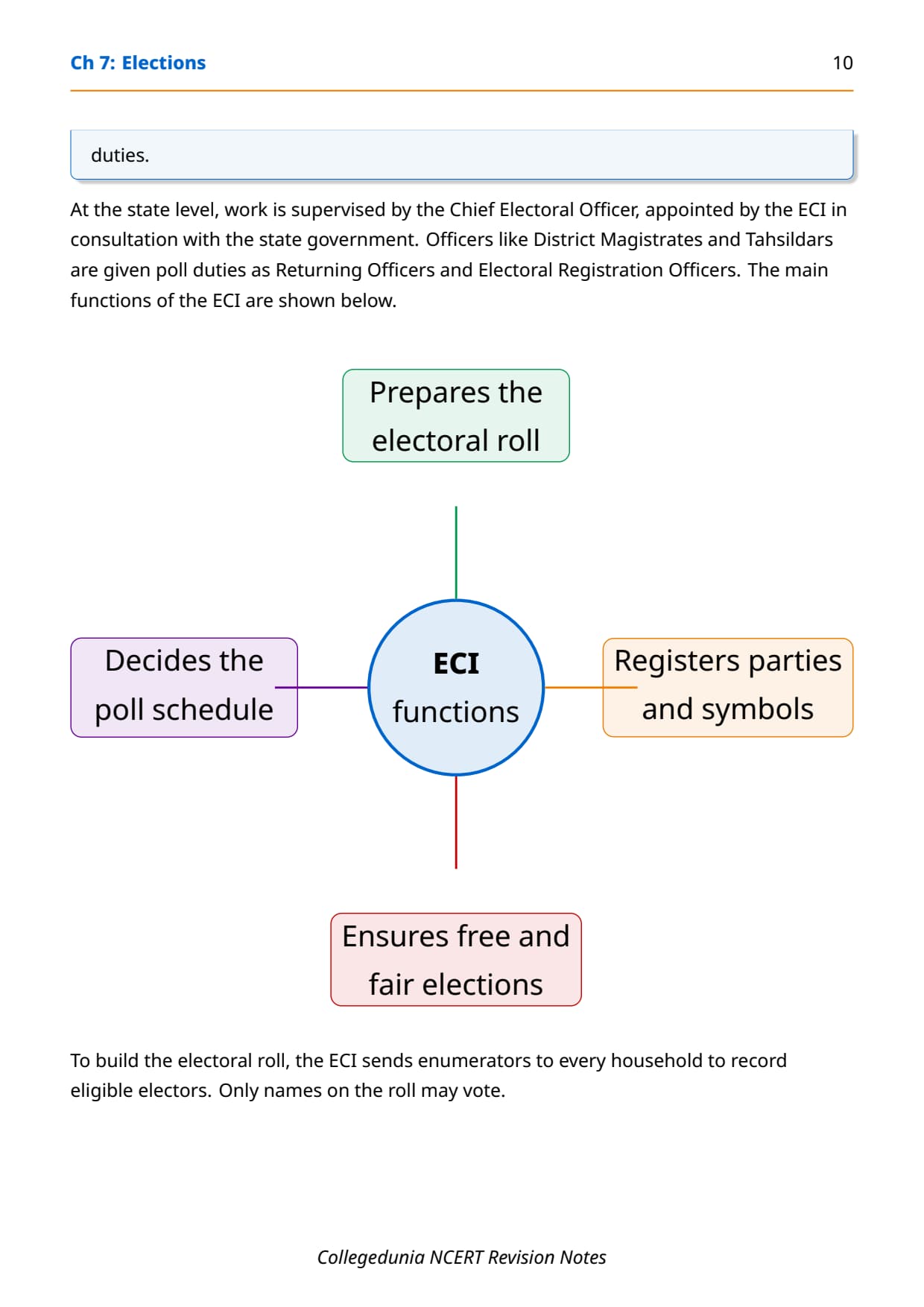
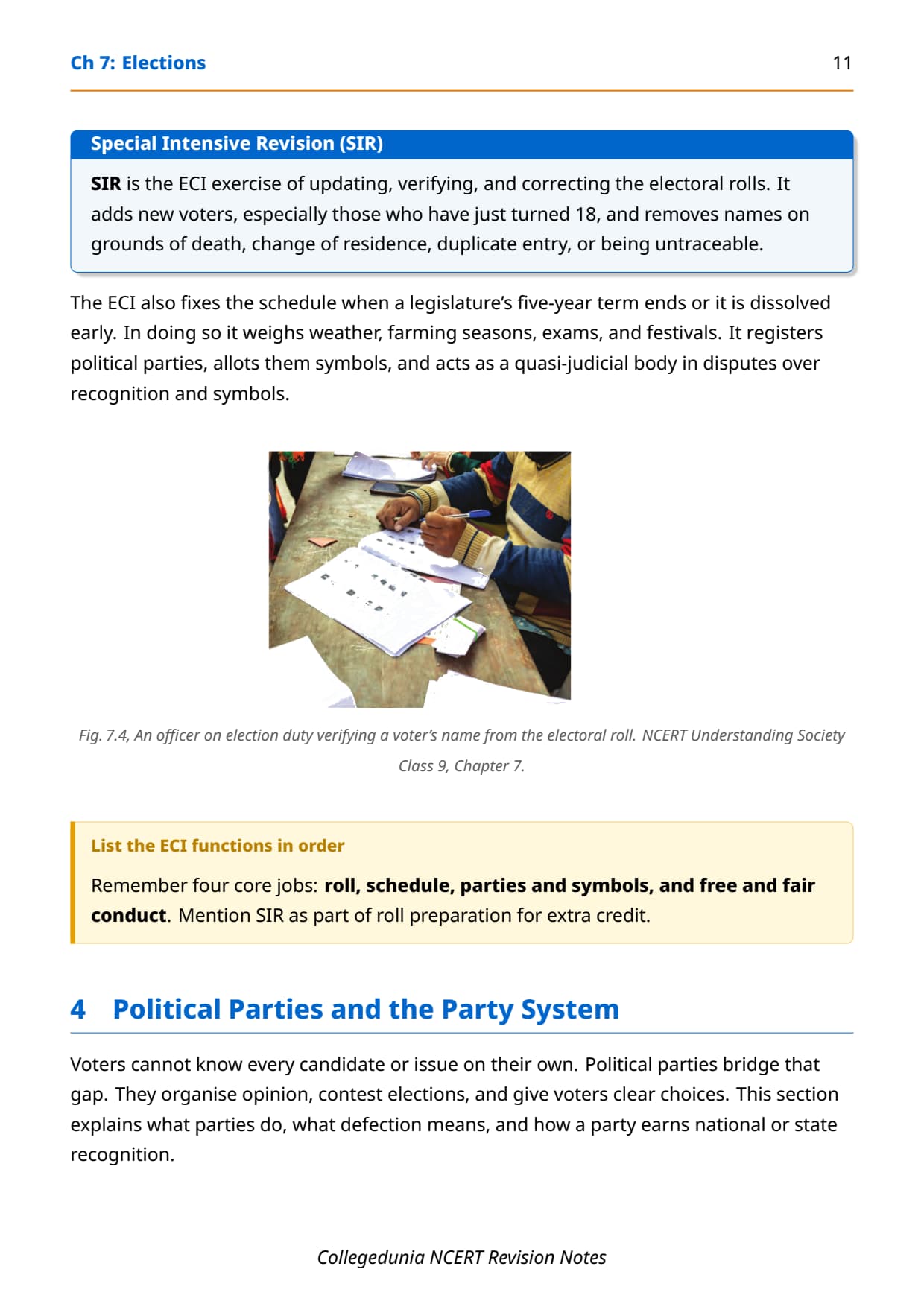
Delimitation is the process of deciding the number of seats and fixing constituency boundaries so that the ratio of seats to population stays fair. The Election Commission of India (ECI) is an autonomous, permanent, constitutional body. It prepares the electoral roll, fixes the poll schedule, registers parties and allots symbols, and ensures free and fair elections. Its update of the rolls is called Special Intensive Revision (SIR).
Political Parties in Class 9 Social Science Chapter 7 Elections
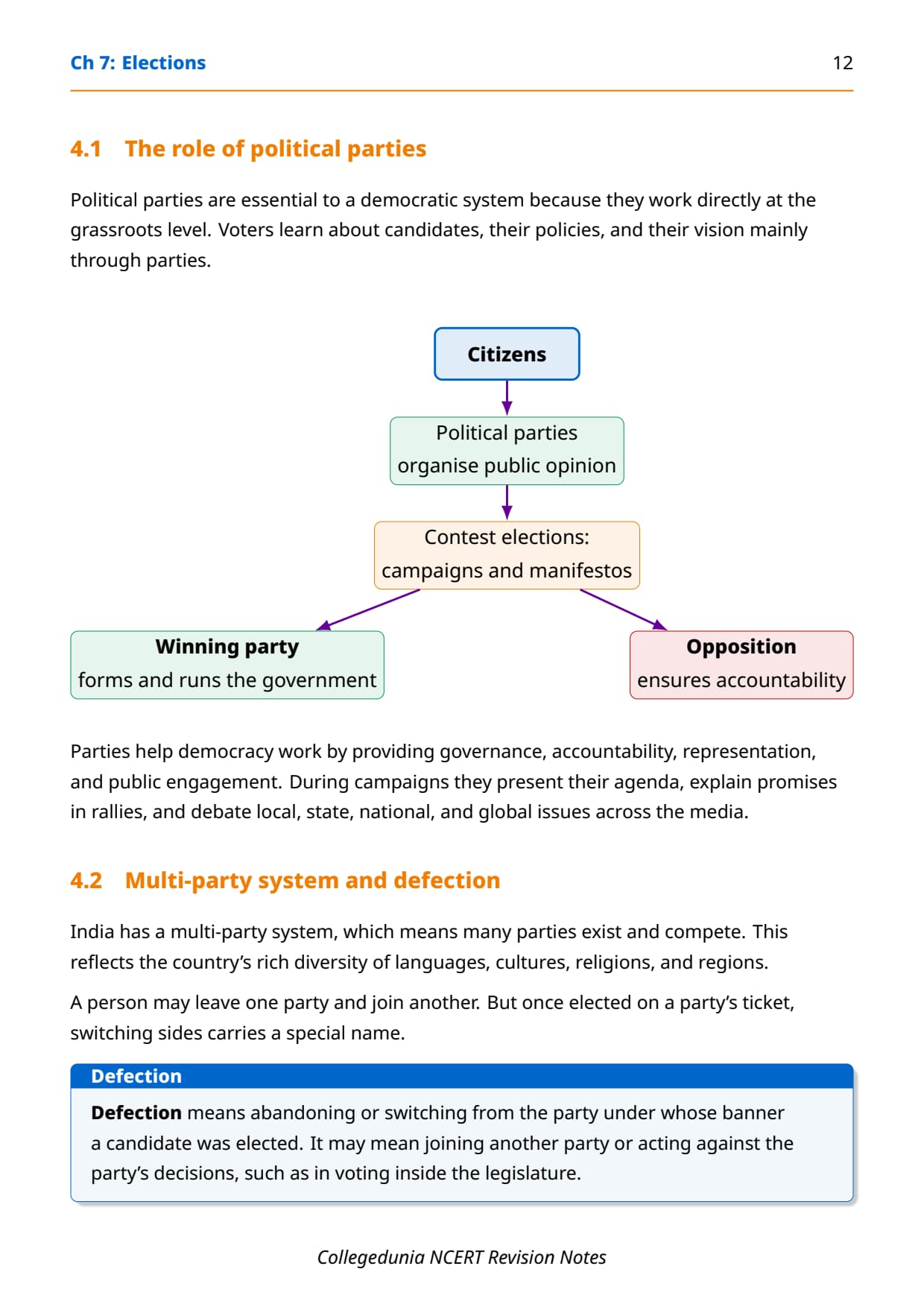
Voters cannot know every candidate or issue on their own, so political parties bridge that gap. Parties organise public opinion, contest elections with manifestos, form the government if they win, and act as the opposition if they lose. India has a multi-party system, which reflects its many languages, cultures, and regions.
Defection means leaving the party on whose ticket a candidate was elected, or voting against the party's decision inside the legislature. The Anti-Defection Law, passed in 1985 through the 52nd Constitutional Amendment, can disqualify such a member and adds stability to elected governments.
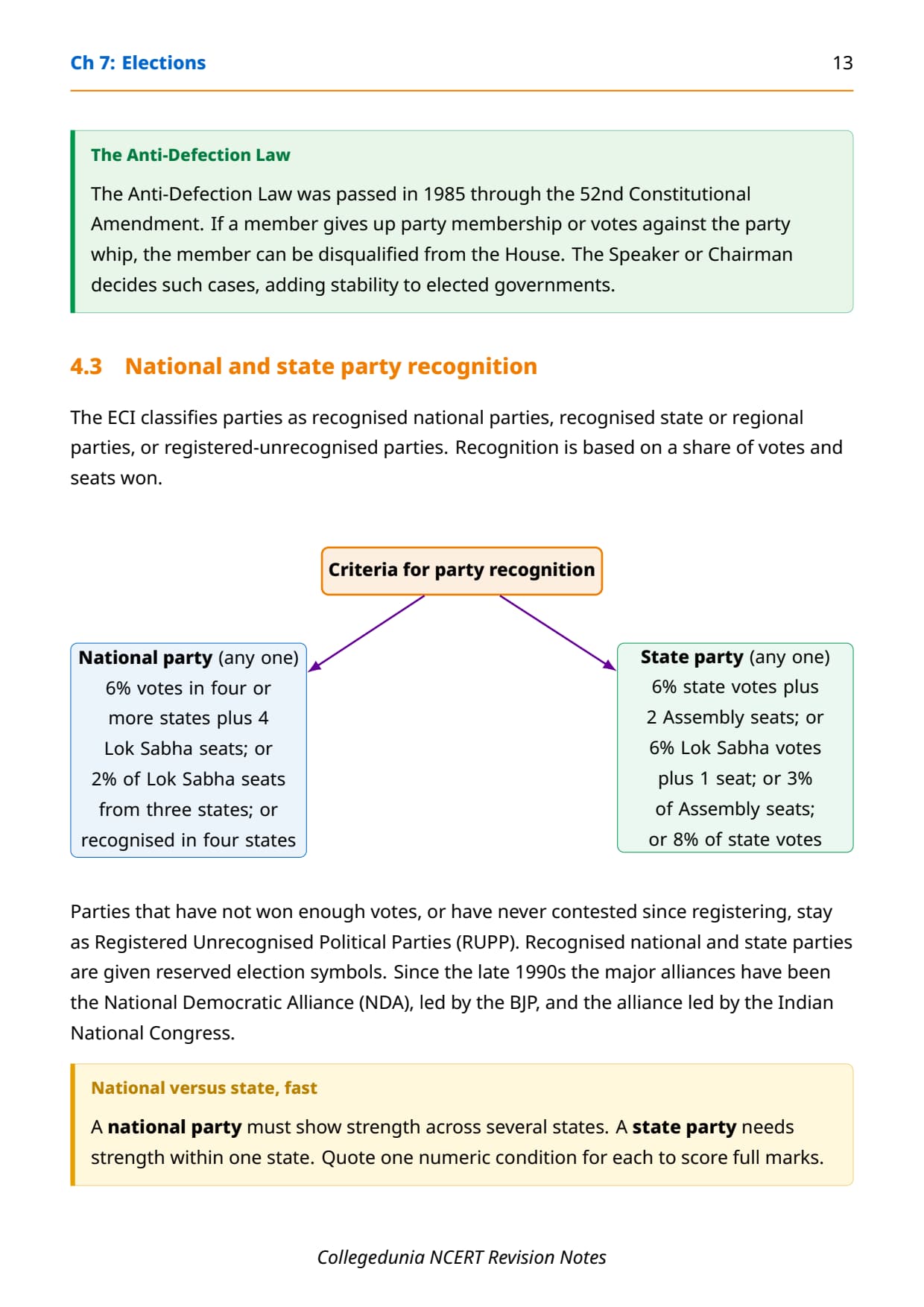
The ECI classifies parties as recognised national parties, recognised state parties, or registered-unrecognised parties (RUPP), based on their share of votes and seats. Recognised national and state parties get reserved election symbols.
Also Check: revise the Democracy chapter first, as Chapter 7 builds on the ideas of representation and accountability you studied there.
Free, Fair, and Inclusive Elections in Chapter 7 Elections
Holding an election is not enough. It must be free, fair, transparent, and open to every voter. India runs the world's largest such exercise, with over 96.8 crore eligible voters in 2024. The ECI has taken many steps so that no voter is left behind.
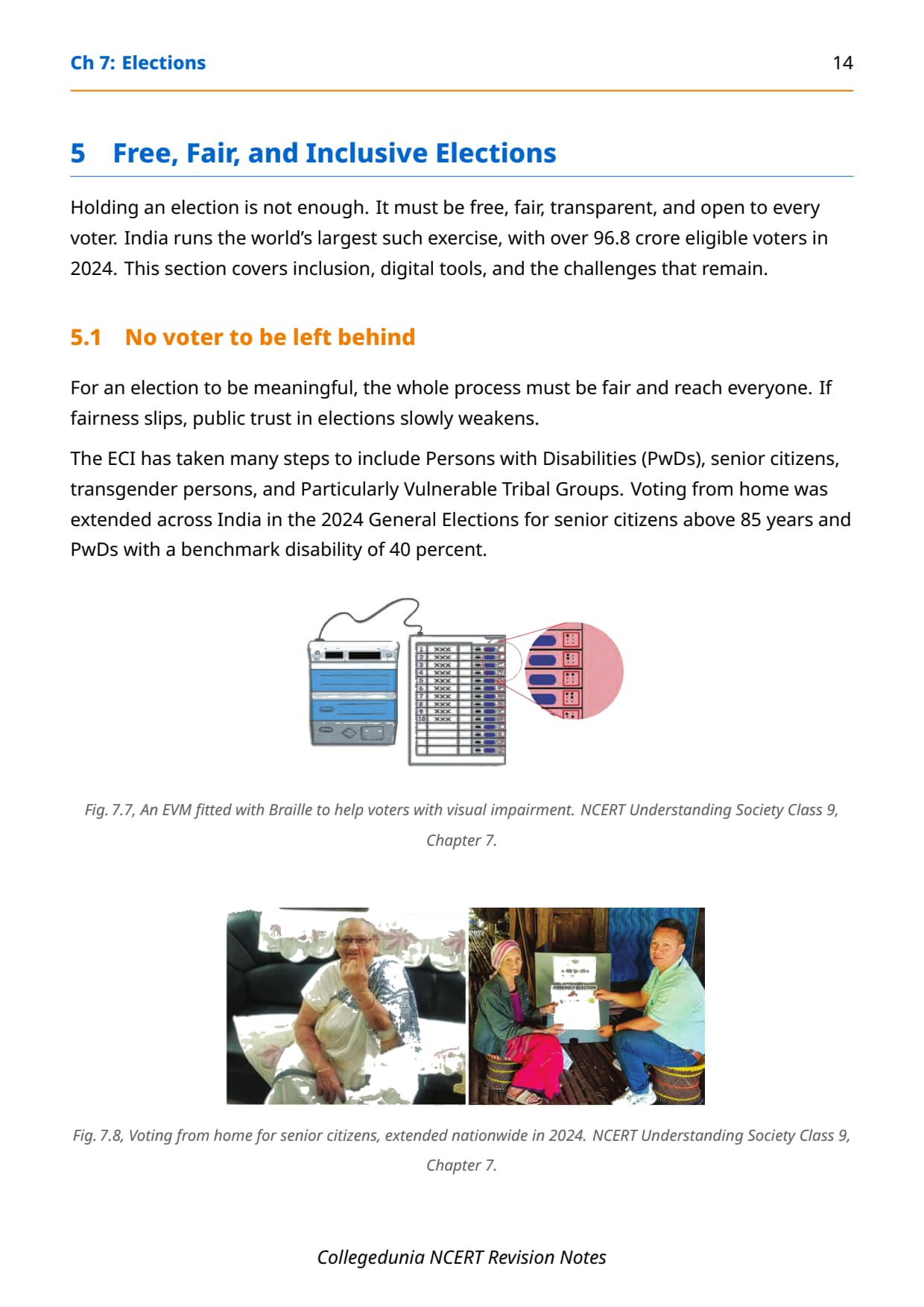
- Inclusion: Persons with Disabilities, senior citizens above 85, transgender persons, and tribal groups get special help, including voting from home and EVMs fitted with Braille.
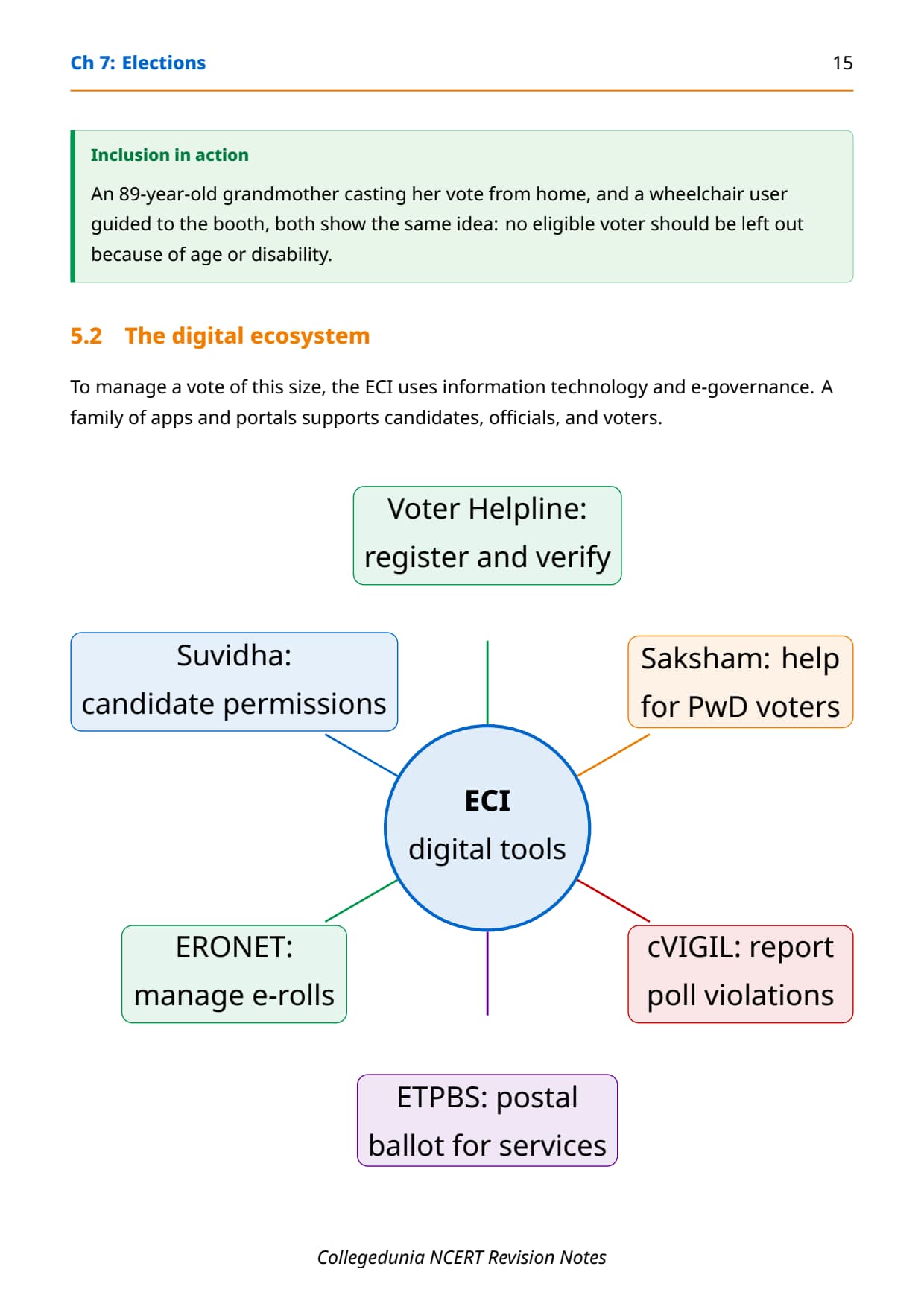
- Digital tools: apps like cVIGIL (report violations), Saksham (help for PwD voters), and ETPBS (postal ballots for service voters) support the process.
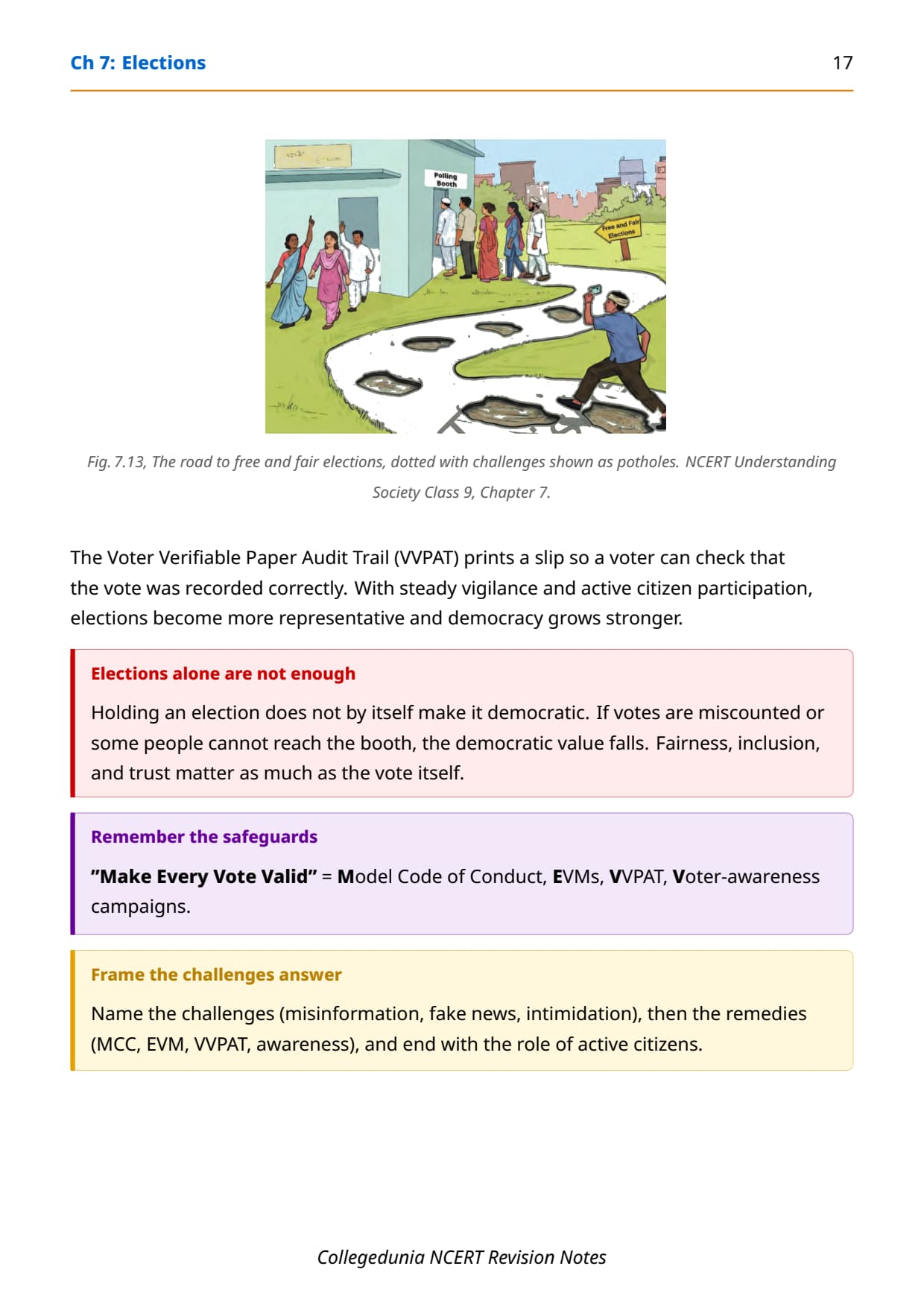
- Safeguards: the Model Code of Conduct, EVMs, and the Voter Verifiable Paper Audit Trail (VVPAT) keep the poll honest.
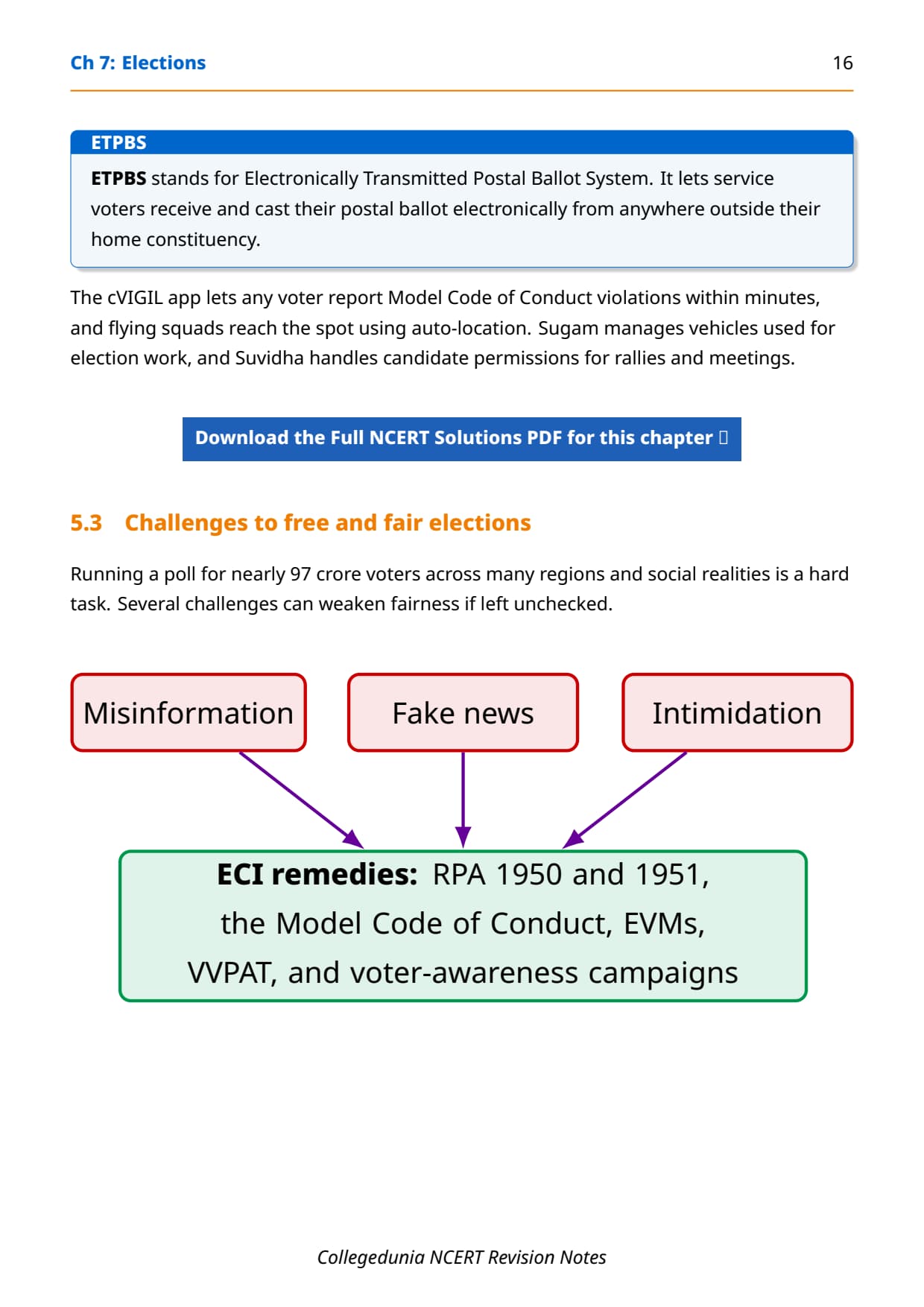
Challenges such as misinformation, fake news, and voter intimidation can still weaken fairness. The ECI meets these with the election laws, the Model Code of Conduct, and voter-awareness campaigns. With active citizen participation, elections stay representative and democracy grows stronger.
Key Terms to Revise in Class 9 Social Science Chapter 7 Elections
Keep this quick glossary ready for last-minute revision. Each term is written in one simple line so you can recall it fast in the exam.
| Term | Meaning |
|---|---|
| Election | Process by which citizens vote to choose their representatives. |
| Direct election | Citizens vote directly for the representative or leader. |
| Indirect election | Citizens elect representatives, who then elect the leader. |
| FPTP | The candidate with the most votes wins, even below 50%. |
| Delimitation | Fixing the number and boundaries of constituencies. |
| SIR | Special Intensive Revision of the electoral rolls. |
| Defection | Leaving the party on whose ticket one was elected. |
| Psephology | The scientific study of elections. |
How to Revise Class 9 Social Science Chapter 7 Elections Fast
Use these notes for a final revision the night before your exam. Follow a simple order so nothing is missed.
- Define an election and tell direct from indirect elections with one example each.
- List the four reasons elections matter and explain FPTP in one line.
- Separate RPA 1950 from RPA 1951, and recall the four functions of the ECI.
- State what defection means and the year of the Anti-Defection Law (1985).
- Name the challenges to fair elections and the safeguards, EVM, VVPAT, and the Model Code of Conduct.
The full Collegedunia PDF of these class 9 social science notes chapter 7 Elections carries the same glossary and tables, so you can download it and revise offline.
Other Elections Class 9 Social Science Resources
Pair these notes with the other Chapter 7 resources listed below for complete preparation.
| Resource | Open |
|---|---|
| Revision Notes | Elections Class 9 Social Science Notes |
| NCERT Solutions | Elections Class 9 Social Science NCERT Solutions |
| Handwritten Notes | Elections Class 9 Social Science Handwritten Notes |
| NCERT Book PDF | Elections Class 9 Social Science NCERT Book PDF |
NCERT Notes for Class 9 Social Science: All Chapters
Use the table below to open the NCERT Notes for any other chapter of the Class 9 Social Science Understanding Society book.
| Chapter | NCERT Notes |
|---|---|
| Chapter 1 | Understanding Social Science |
| Chapter 2 | Shaping of the Earth's Surface |
| Chapter 3 | Atmosphere and Climate |
| Chapter 4 | Early Humans and Beginning of Civilisation |
| Chapter 5 | State and Society up to 1000 CE |
| Chapter 6 | Democracy |
| Chapter 7 | Elections |
| Chapter 8 | Building Blocks in Economics: The Problem of Choice |
| Chapter 9 | The Price Puzzle: What Drives the Market |
Elections Class 9 Social Science Notes FAQs
Ques. Where can I download the NCERT Notes for Class 9 Social Science Chapter 7 Elections PDF?
Ans. You can download the Elections Notes PDF free from this page. Both the Normal and HD versions match the 2026-27 Understanding Society textbook.
Ques. What topics do the Class 9 Social Science Chapter 7 Elections notes cover?
Ans. The notes cover why elections matter, direct and indirect elections, the FPTP system, election laws, delimitation, the Election Commission of India, political parties, and free and fair elections.
Ques. What is the difference between RPA 1950 and RPA 1951?
Ans. RPA 1950 deals with seat allocation, delimitation, and electoral rolls. RPA 1951 deals with the conduct of elections, electoral offences, and post-poll disputes. Naming the wrong Act loses marks.
Ques. Which houses in India are elected by First-Past-The-Post?
Ans. The Lok Sabha and the Vidhan Sabha are elected by FPTP. The Rajya Sabha, President, Vice President, and Vidhan Parishad are chosen by proportional representation.



Comments