




The Class 9 Social Science Notes Chapter 2 Shaping of the Earth's Surface give you a quick, clear revision of the full chapter from the new Understanding Society book. In one place you get the layers of the Earth, plate tectonics, weathering, erosion, the agents of gradation, and the main landform disasters, all in short, simple lines.
Prepared by Collegedunia Social Science experts and matched line by line with the 2026-27 Understanding Society textbook.
- Full chapter revision: Earth's layers, plate tectonics, weathering, erosion, agents of gradation, and landform disasters in one place.
- Diagrams ready: plate boundary types, the weathering versus erosion table, and river landforms you must be able to draw.
- Why it matters: this is a core geography chapter for Class 9 Social Science exams and the base for later map and disaster topics.
Student Feedback
In a Collegedunia study of 1,180 Class 9 students, 74% said a one-page revision of plate boundaries helped them most before a test. About 4 out of 5 rated the weathering versus erosion table the clearest part of the chapter.
Source: Collegedunia Class 9 Social Science revision survey, 2026.
What You Revise in Class 9 Social Science Chapter 2 Shaping of the Earth's Surface
The Earth's surface is not fixed. It keeps changing because of forces that act from inside the planet and on its surface. The Class 9 Social Science Notes Chapter 2 Shaping of the Earth's Surface follow the same order as the Understanding Society book, so your revision flows exactly like the chapter.
These notes help you recall the core points in minutes:
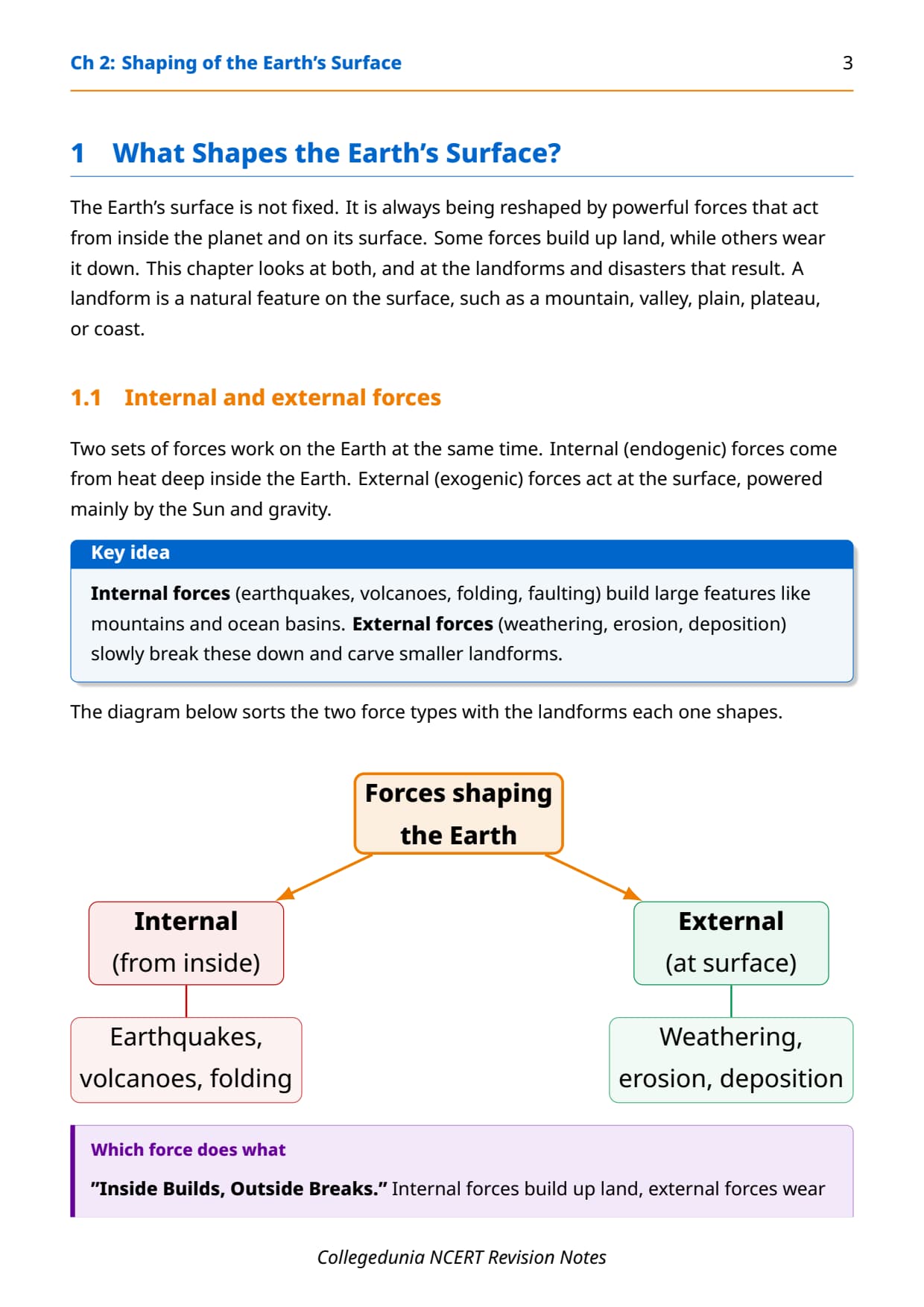
- Forces at work: internal forces build land, external forces slowly wear it down.
- Layers and plates: the crust, mantle, and core, and how the lithosphere breaks into moving plates.
- Wearing and building: weathering, erosion, and the agents that carve and deposit landforms.
- Hazards: earthquakes, volcanoes, and disasters like landslides, avalanches, GLOFs, and dust storms.
Forces That Shape the Earth's Surface: Quick Revision Notes
Start your revision with the two force types, because the whole chapter builds on them. A landform is a natural feature on the surface, such as a mountain, valley, plain, plateau, or coast.
| Feature | Internal (endogenic) forces | External (exogenic) forces |
|---|---|---|
| Source | Heat deep inside the Earth | The Sun and gravity at the surface |
| Action | Build up large features | Break down and carve land |
| Examples | Earthquakes, volcanoes, folding, faulting | Weathering, erosion, deposition |
| Result | Mountains and ocean basins | Valleys, plains, deltas, caves |
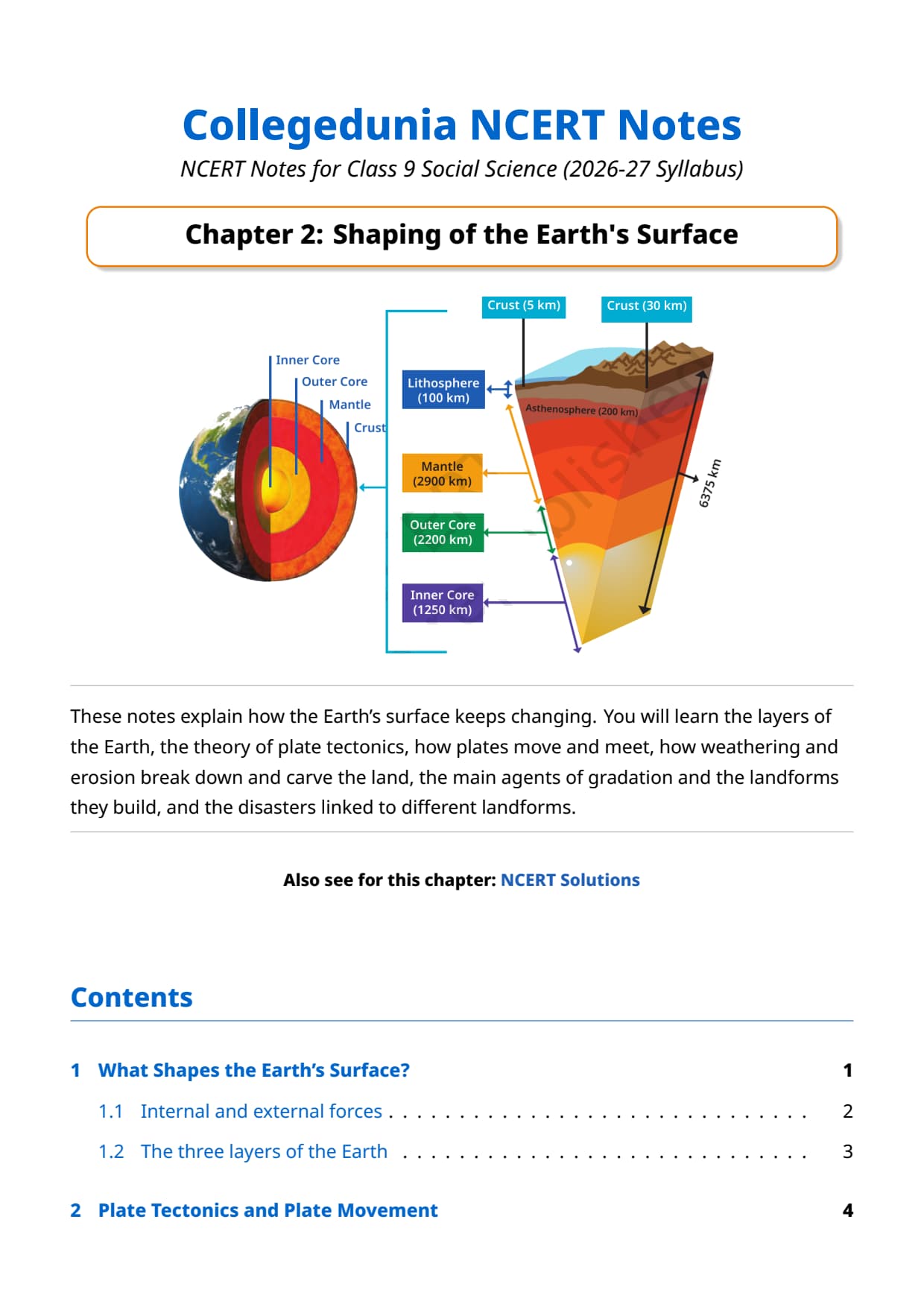
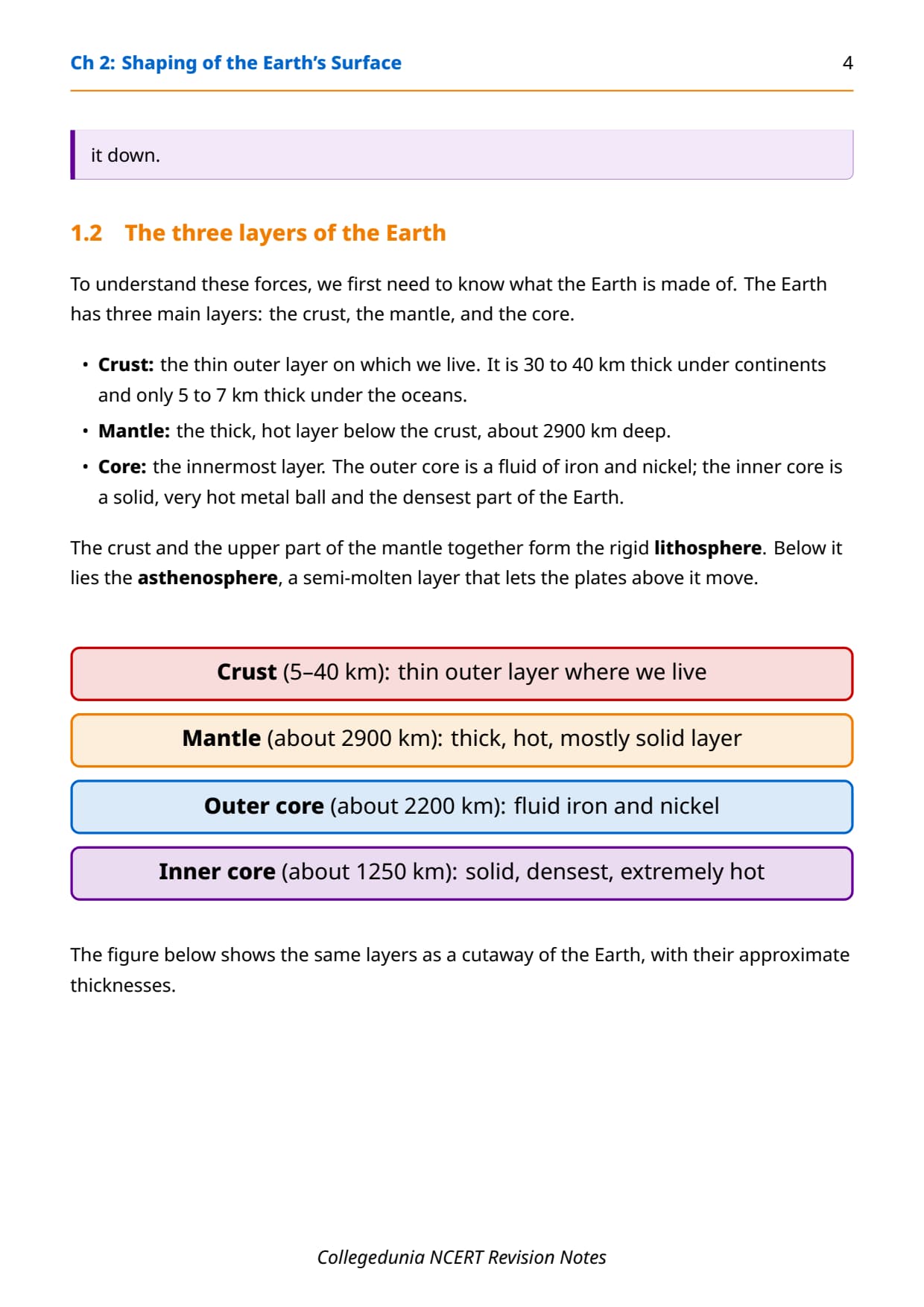
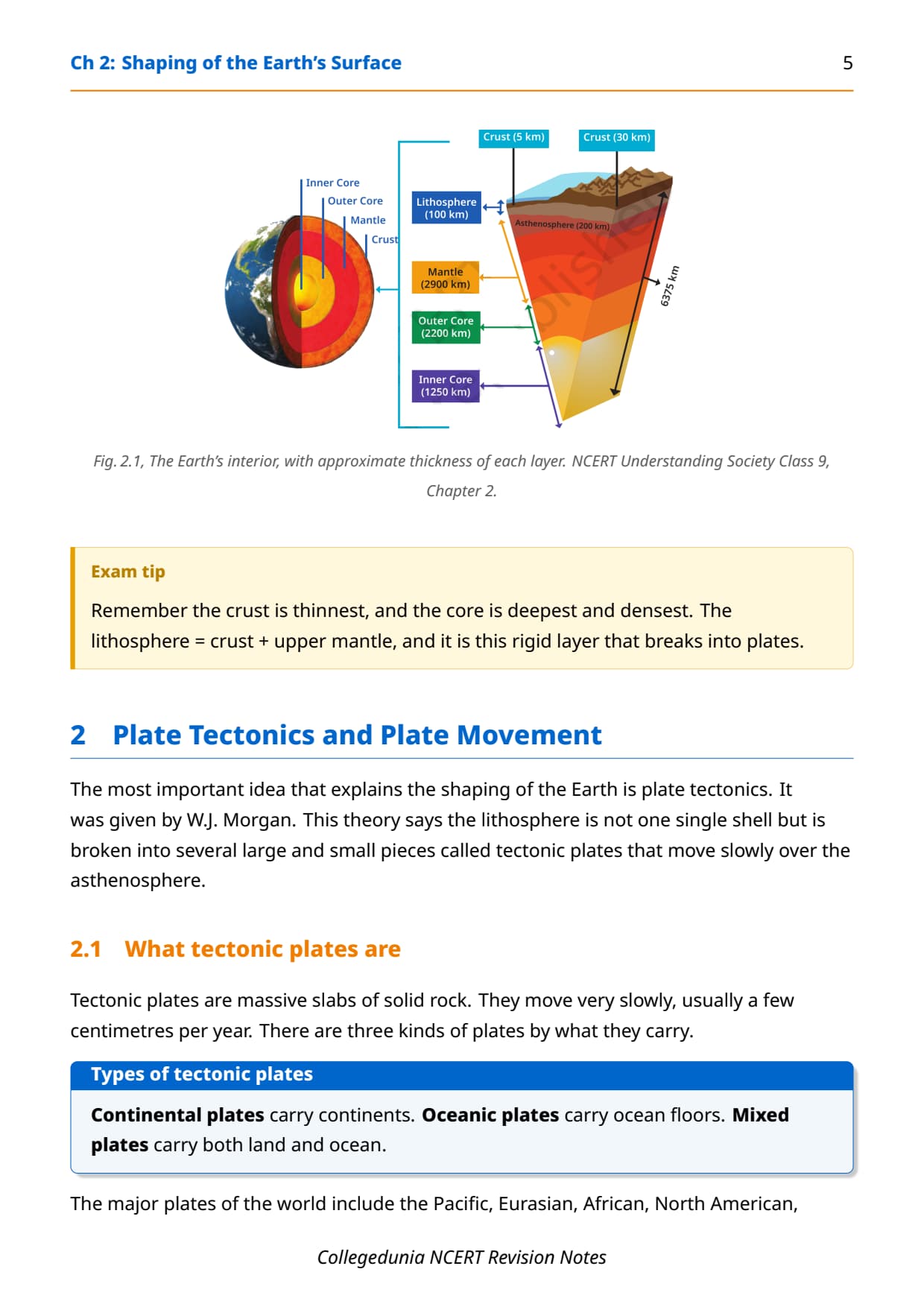
The Earth has three layers. The crust is the thin outer layer where we live. The mantle is a thick, hot layer about 2900 km deep. The core is the innermost part, with a fluid outer core and a solid inner core.
Plate Tectonics and Plate Movement Notes for Class 9
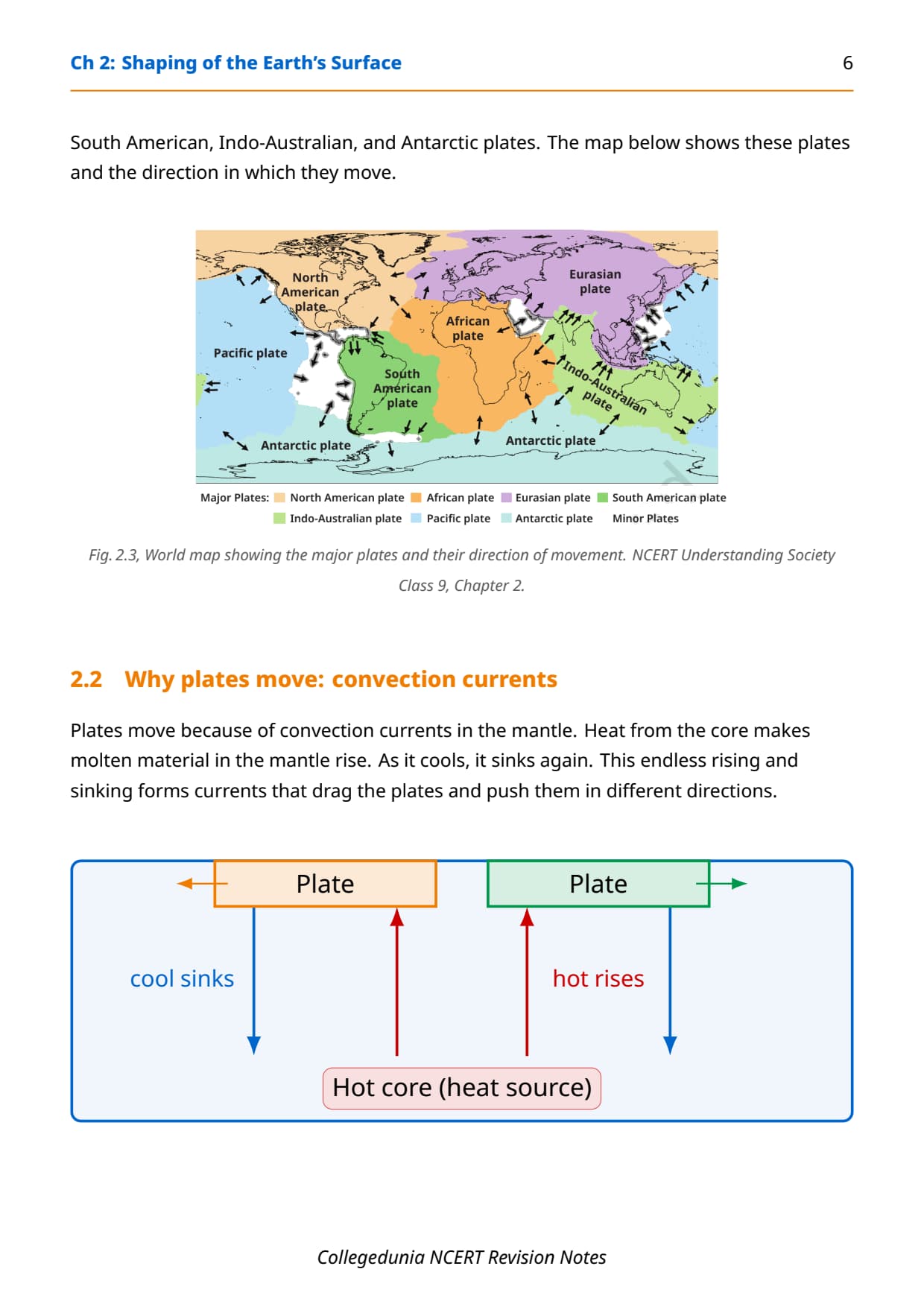
The big idea that explains the Class 9 Social Science Notes Chapter 2 Shaping of the Earth's Surface is plate tectonics, given by W.J. Morgan. The lithosphere is broken into large and small slabs called tectonic plates that move slowly, a few centimetres a year, over the asthenosphere. Plates carry continents, ocean floors, or both.
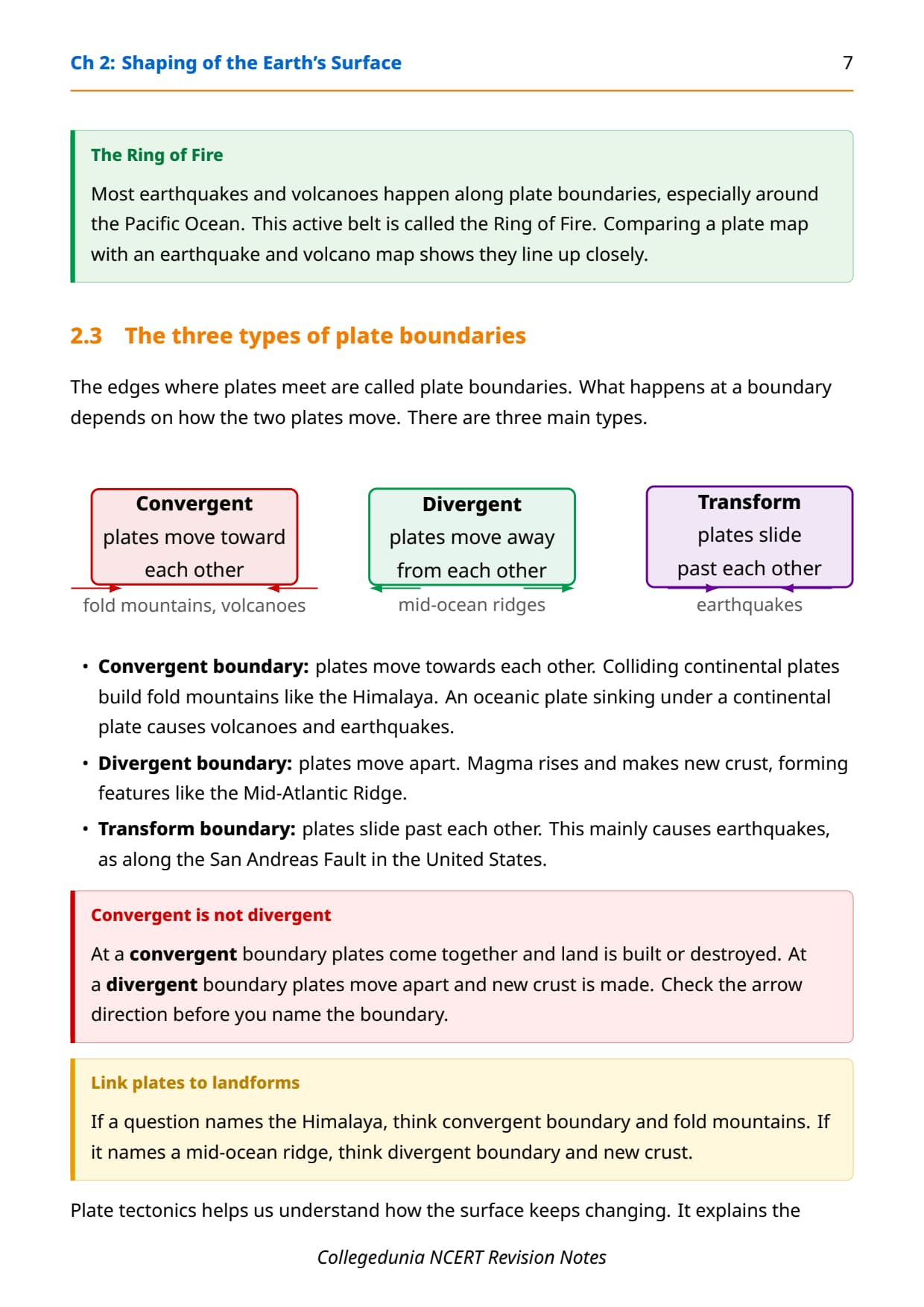
Plates move because of convection currents in the mantle. Heat from the core makes molten material rise; as it cools, it sinks again. This endless cycle drags the plates. Where plates meet, we get plate boundaries, and their motion decides what forms there.
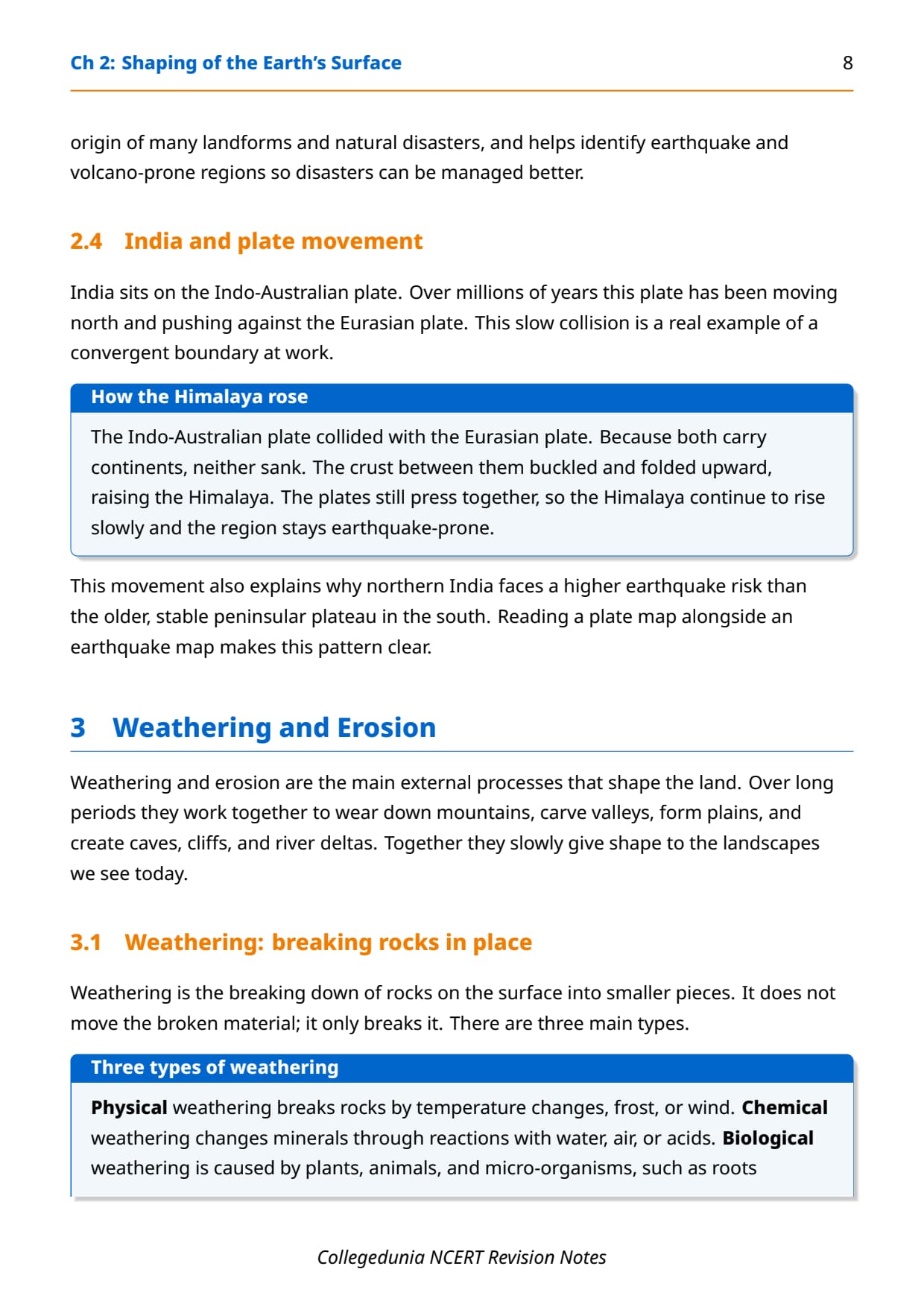
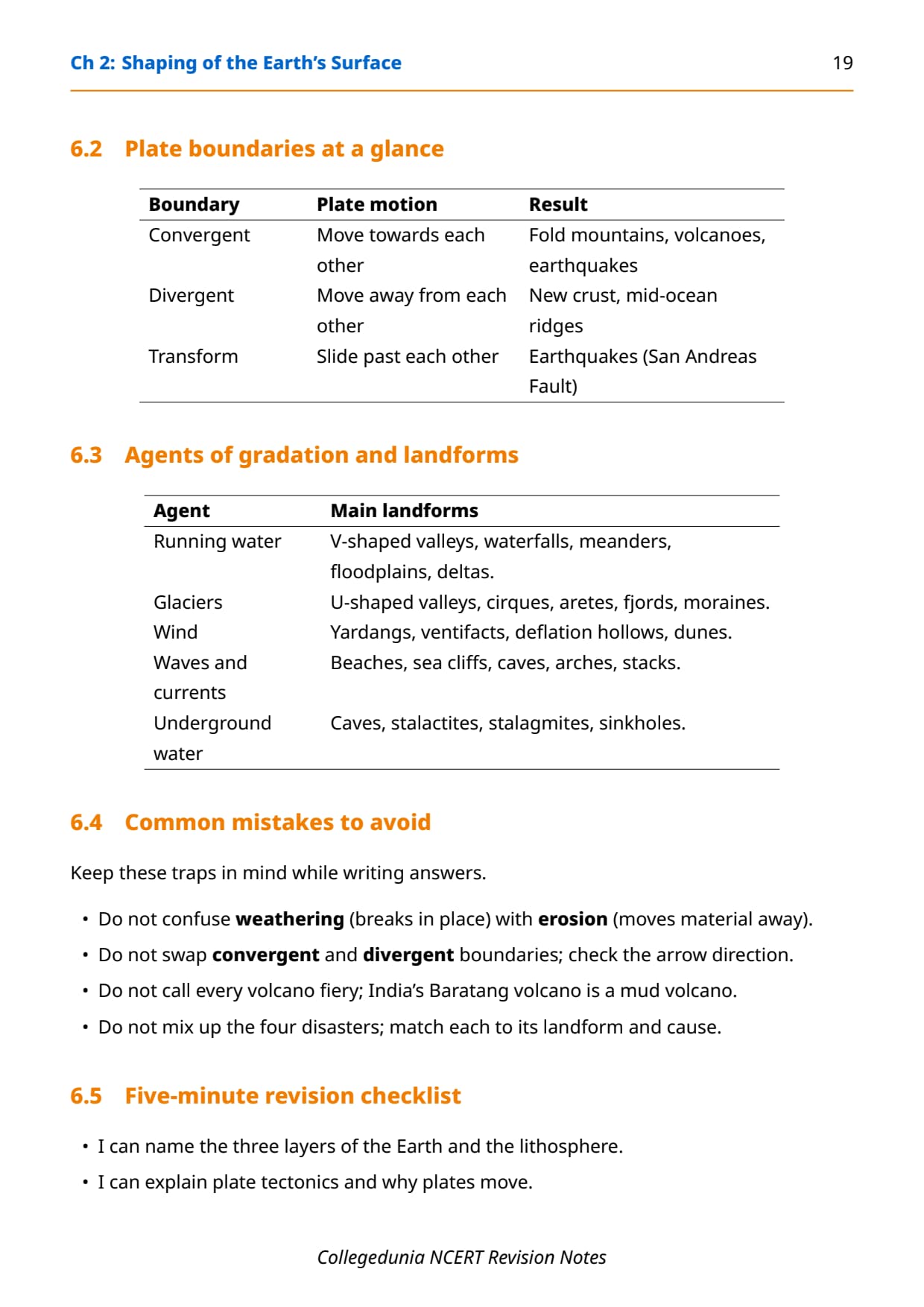
| Boundary | Plate motion | Result |
|---|---|---|
| Convergent | Plates move towards each other | Fold mountains, volcanoes, earthquakes (Himalaya) |
| Divergent | Plates move away from each other | New crust, mid-ocean ridges (Mid-Atlantic Ridge) |
| Transform | Plates slide past each other | Earthquakes (San Andreas Fault) |
India sits on the Indo-Australian plate. Over millions of years it has pushed north into the Eurasian plate. Because both carry continents, neither sinks, so the crust buckled and folded upward to raise the Himalaya. The plates still press together, so the Himalaya keep rising and northern India stays earthquake-prone.
Weathering and Erosion in Class 9 Social Science Chapter 2
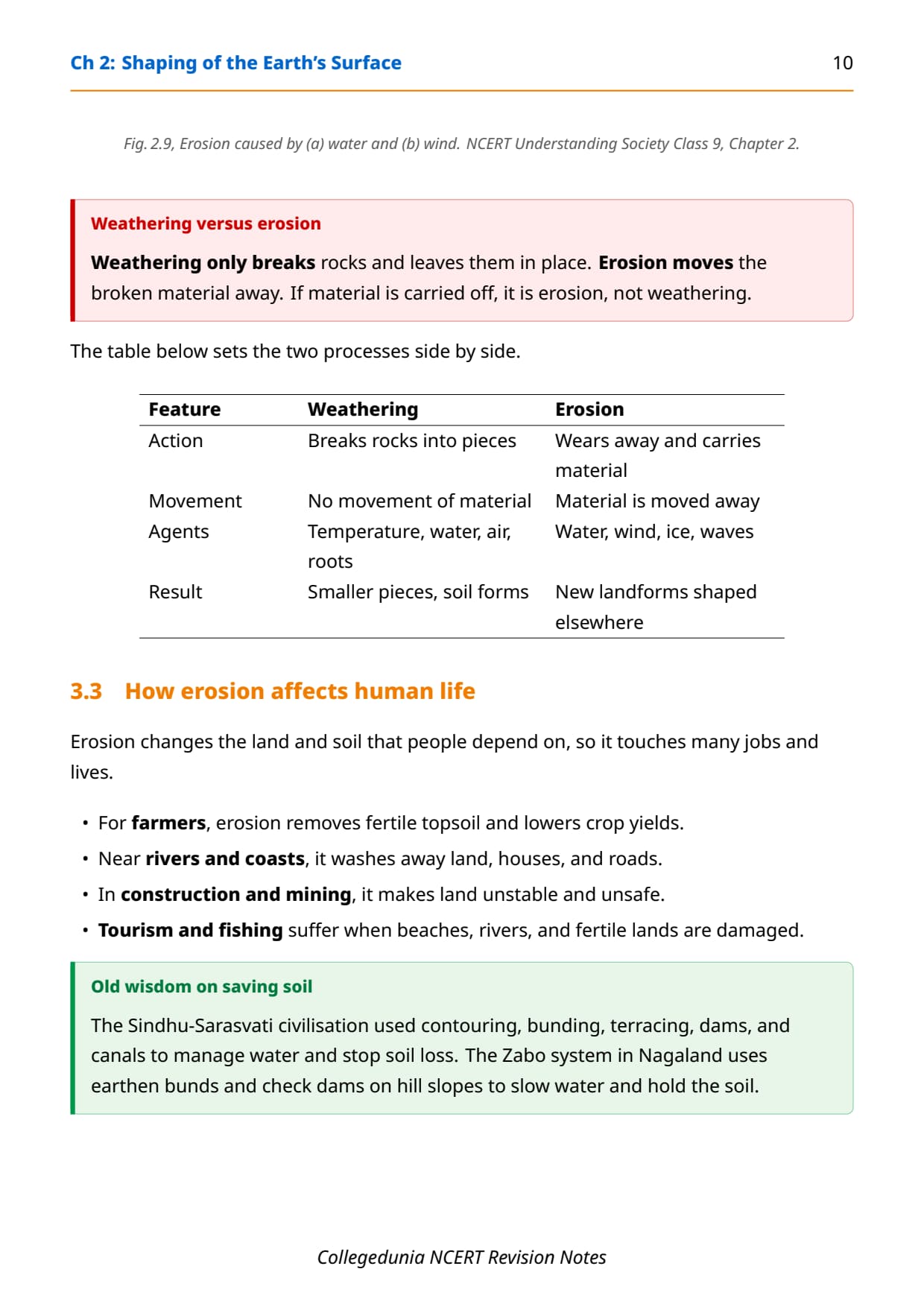
Weathering and erosion are the main external processes that shape the land. They are easy to confuse, so revise the difference carefully. Weathering only breaks rocks in place, while erosion wears away material and carries it to a new place.
| Feature | Weathering | Erosion |
|---|---|---|
| Action | Breaks rocks into pieces | Wears away and carries material |
| Movement | No movement of material | Material is moved away |
| Agents | Temperature, water, air, roots | Water, wind, ice, waves |
| Result | Smaller pieces, soil forms | New landforms shaped elsewhere |
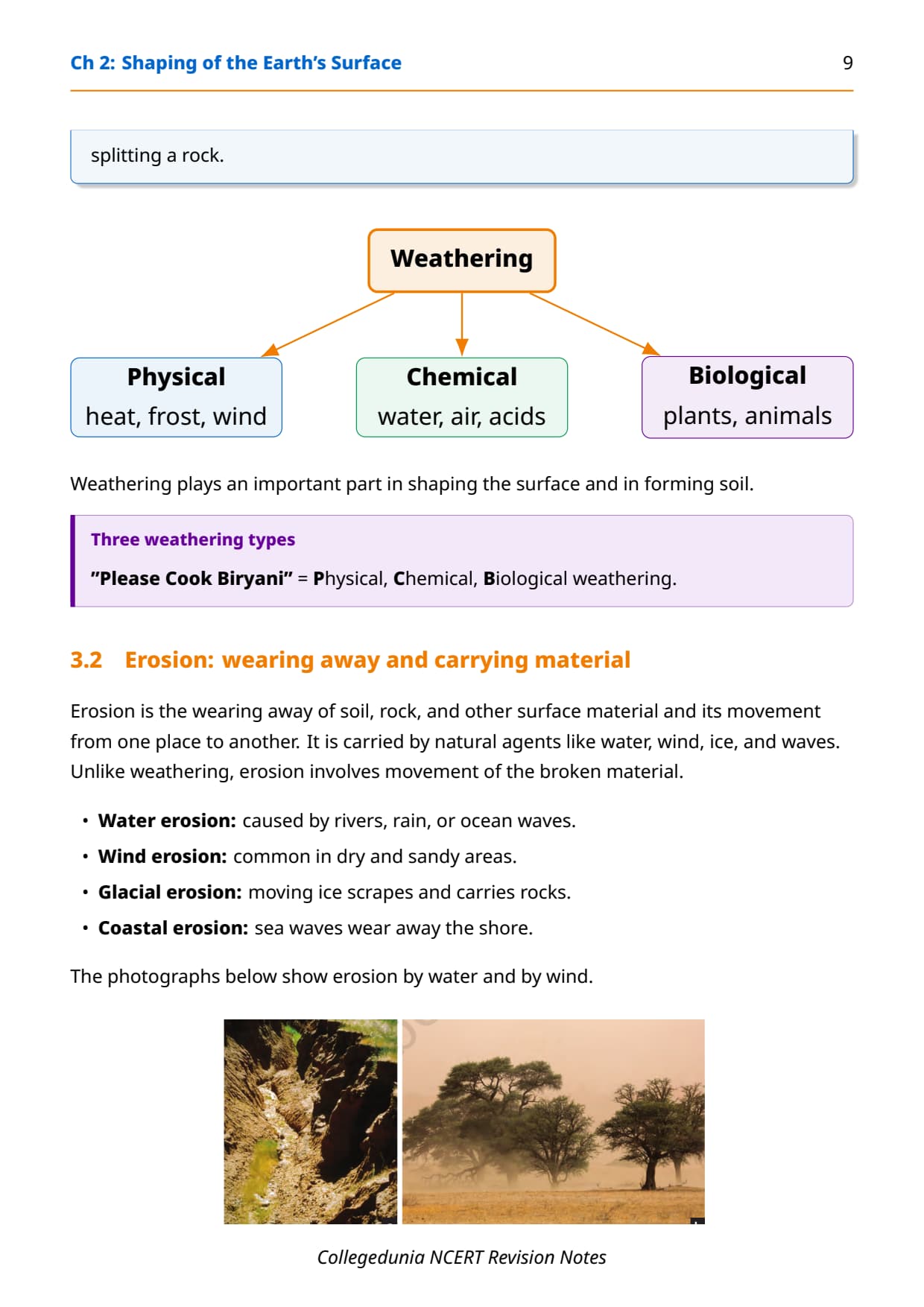
Weathering has three types. Physical weathering breaks rocks by heat, frost, or wind. Chemical weathering changes minerals through reactions with water, air, or acids. Biological weathering is caused by plants, animals, and micro-organisms, such as roots splitting a rock. A simple way to recall them is "Please Cook Biryani" for Physical, Chemical, Biological.
Erosion is carried by natural agents. Water erosion comes from rivers, rain, and waves; wind erosion is common in dry areas; glacial erosion is done by moving ice; and coastal erosion is caused by sea waves. Erosion also affects human life, as it removes fertile topsoil from farms and washes away land, houses, and roads near rivers and coasts.
Agents of Gradation and Landforms to Remember in Chapter 2
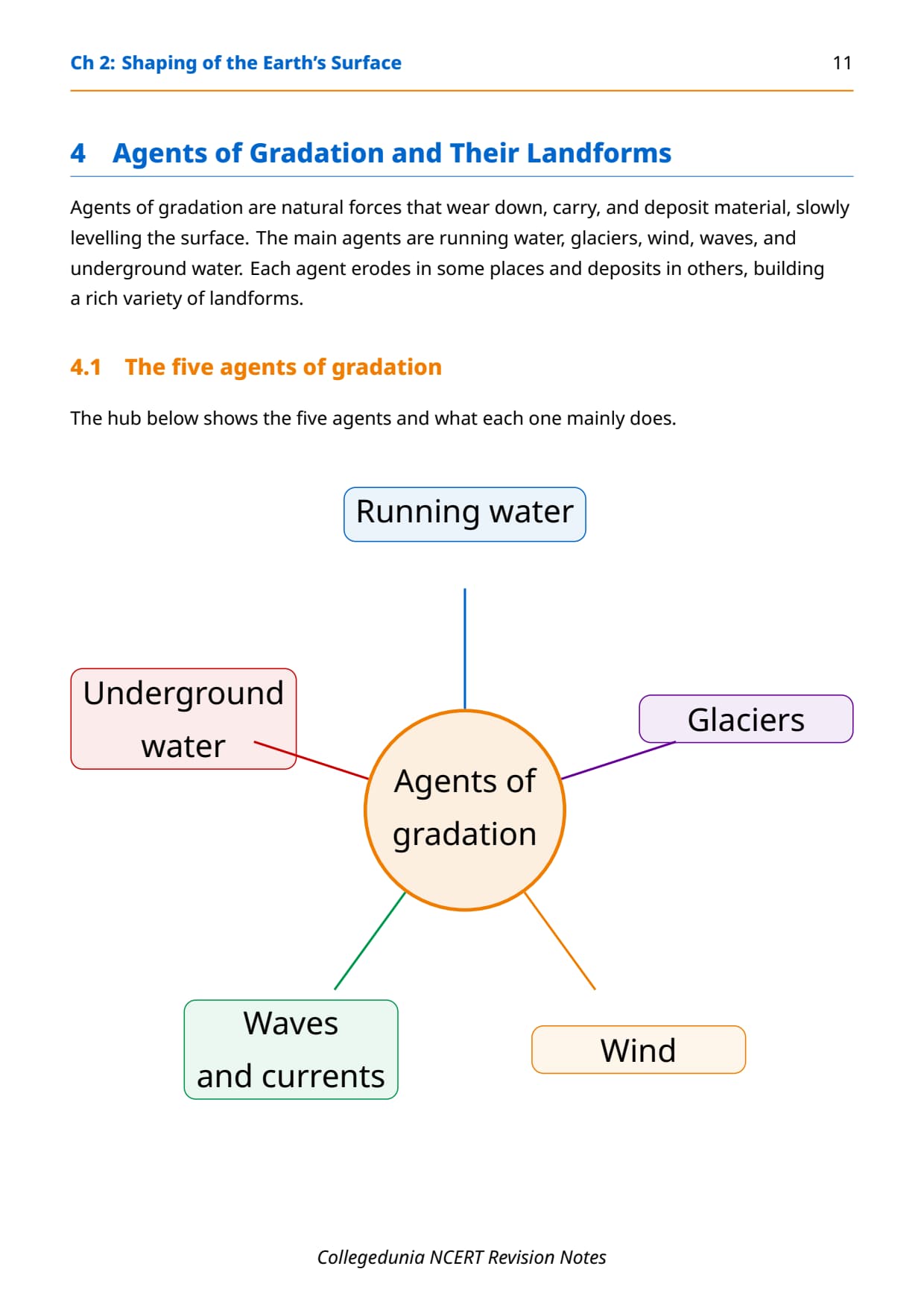
Agents of gradation are natural forces that wear down, carry, and deposit material, slowly levelling the surface. Each agent erodes in some places and deposits in others, so it builds its own family of landforms. Learn the agent with its landforms as a pair.
| Agent of gradation | Main landforms to remember |
|---|---|
| Running water (rivers) | V-shaped valleys, waterfalls, meanders, floodplains, deltas |
| Glaciers | U-shaped valleys, cirques, aretes, fjords, moraines |
| Wind | Yardangs, ventifacts, deflation hollows, dunes |
| Waves and currents | Beaches, sea cliffs, caves, arches, stacks |
| Underground water | Caves, stalactites, stalagmites, sinkholes (karst topography) |
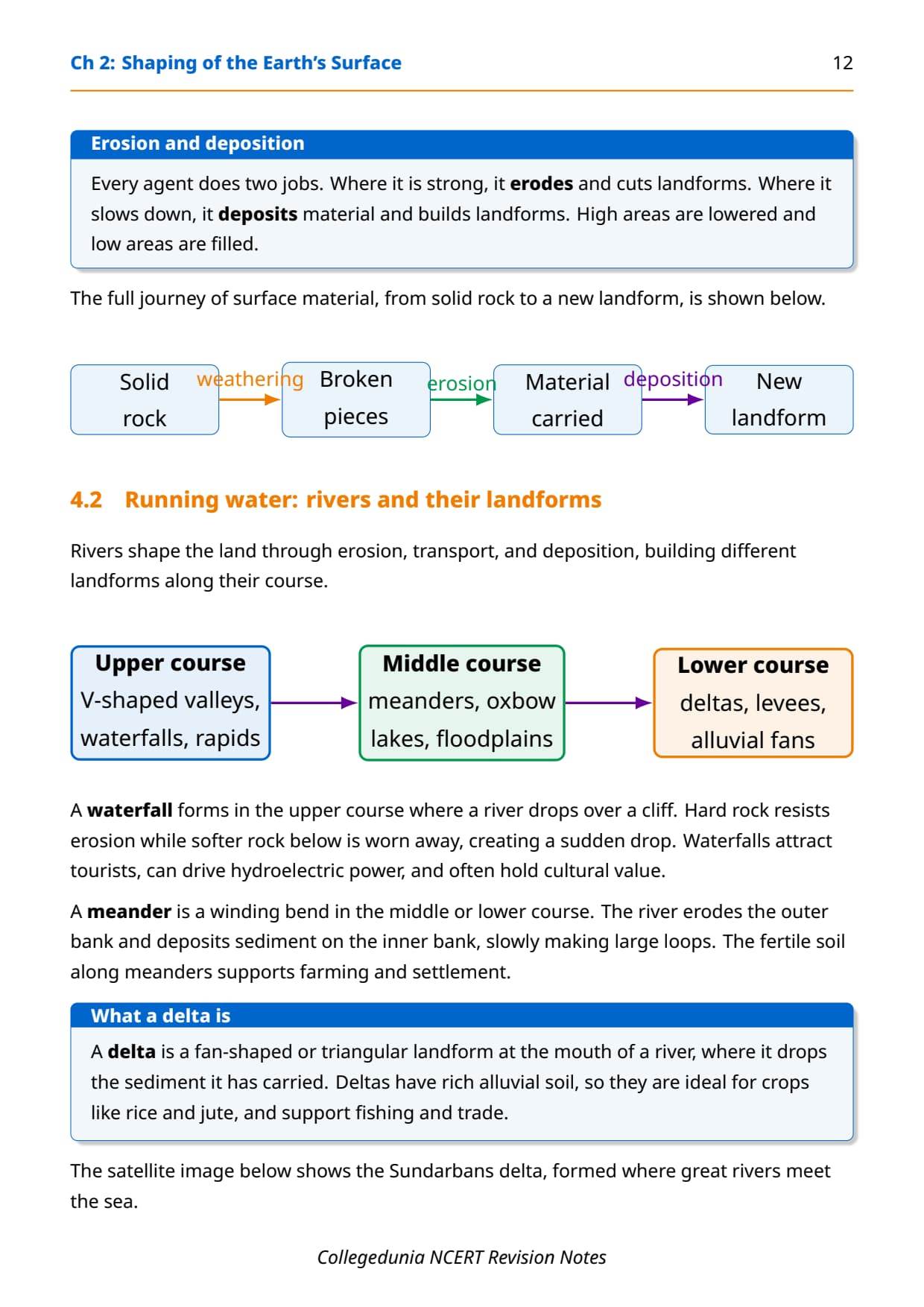
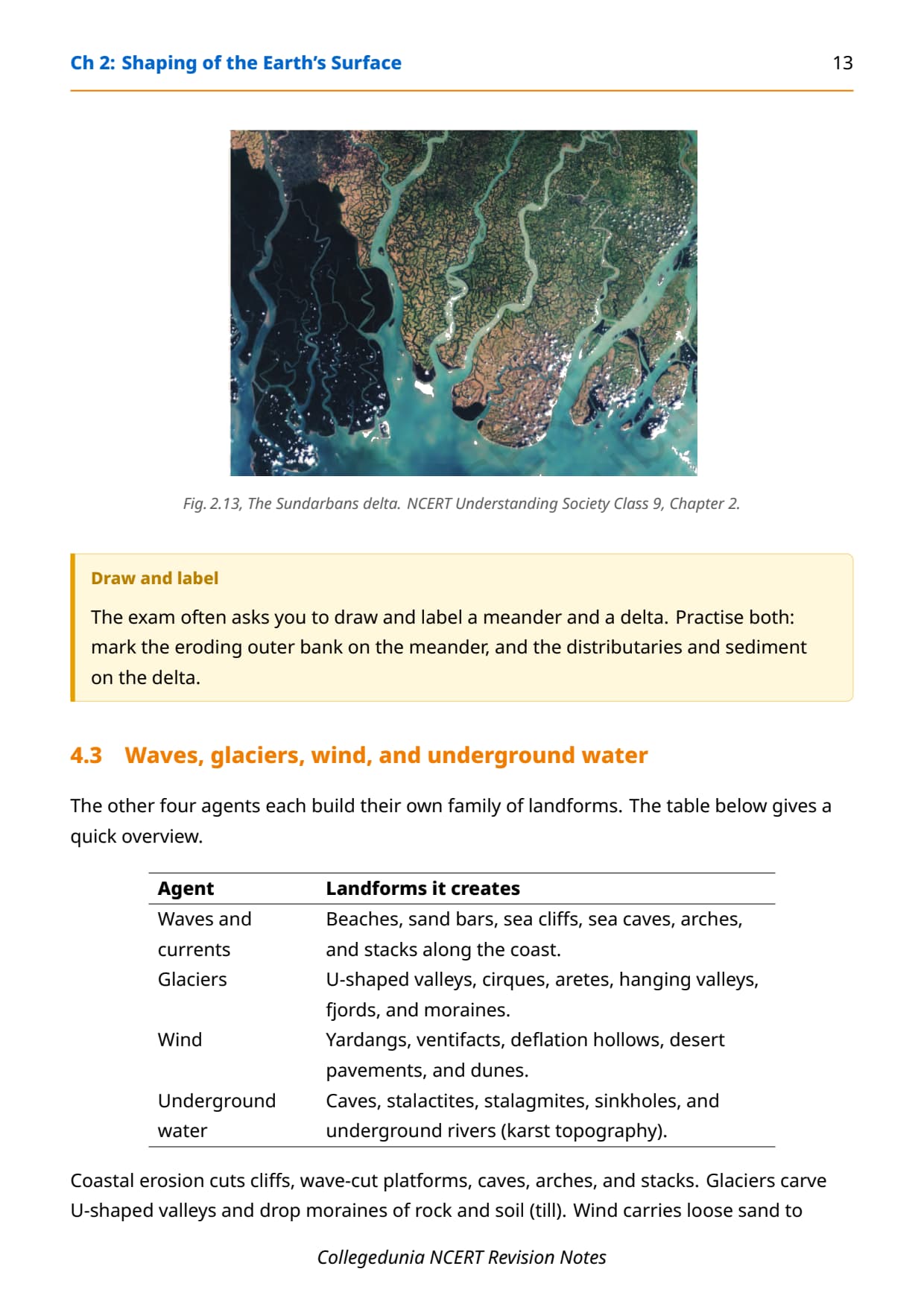
Rivers are the most tested agent. A waterfall forms in the upper course where a river drops over hard rock onto softer rock below. A meander is a winding bend that erodes the outer bank and deposits on the inner bank. A delta is a fan-shaped landform of rich sediment at a river's mouth, ideal for crops like rice and jute.
Earthquakes, Volcanoes, and Landform Disasters in Class 9 Social Science
Internal forces do not only build mountains; they also cause sudden events. An earthquake is a sudden shaking of the ground, usually along plate boundaries. A volcano is an opening where molten material reaches the surface. Both are most common along plate margins, especially the Pacific belt called the Ring of Fire.
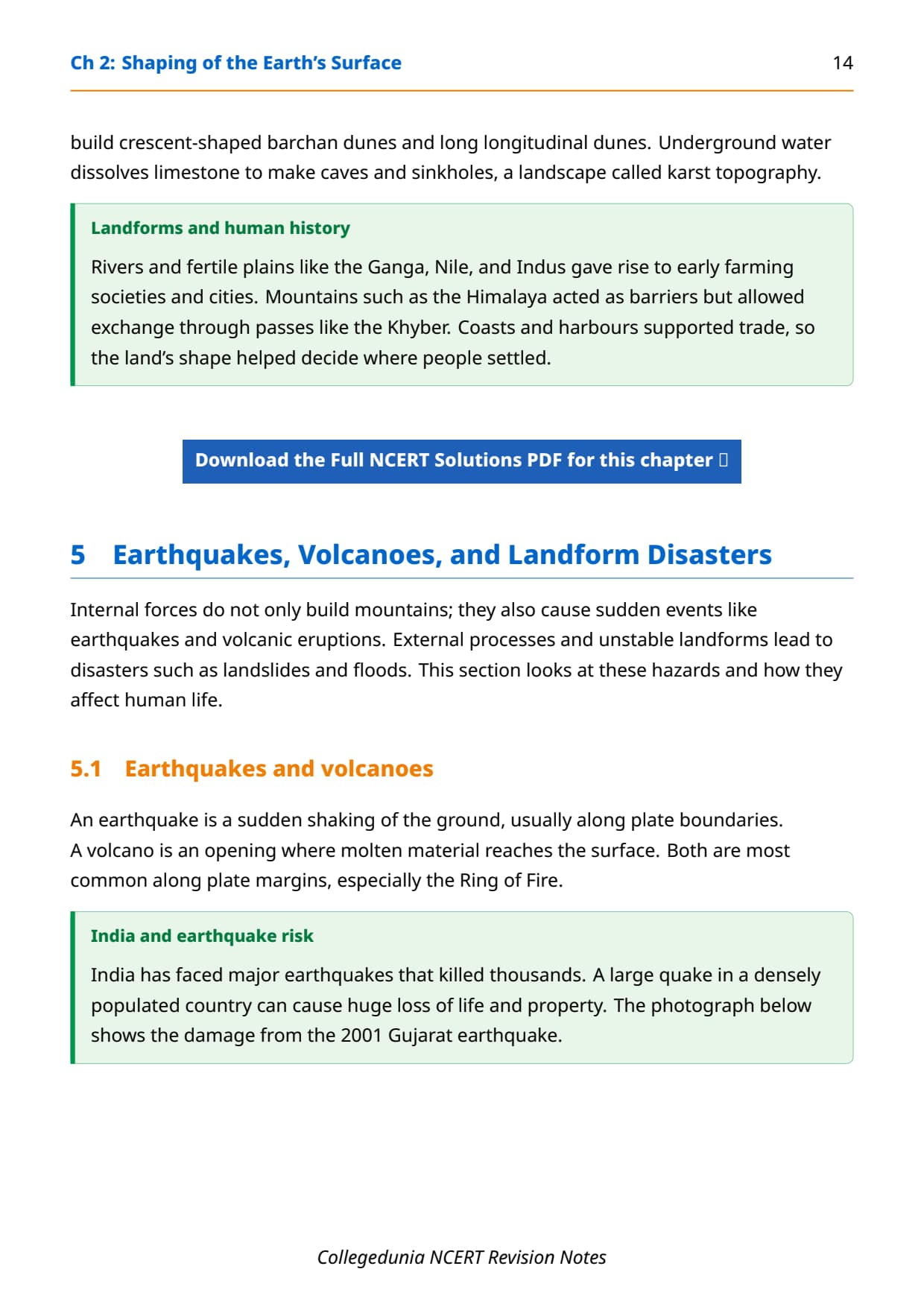
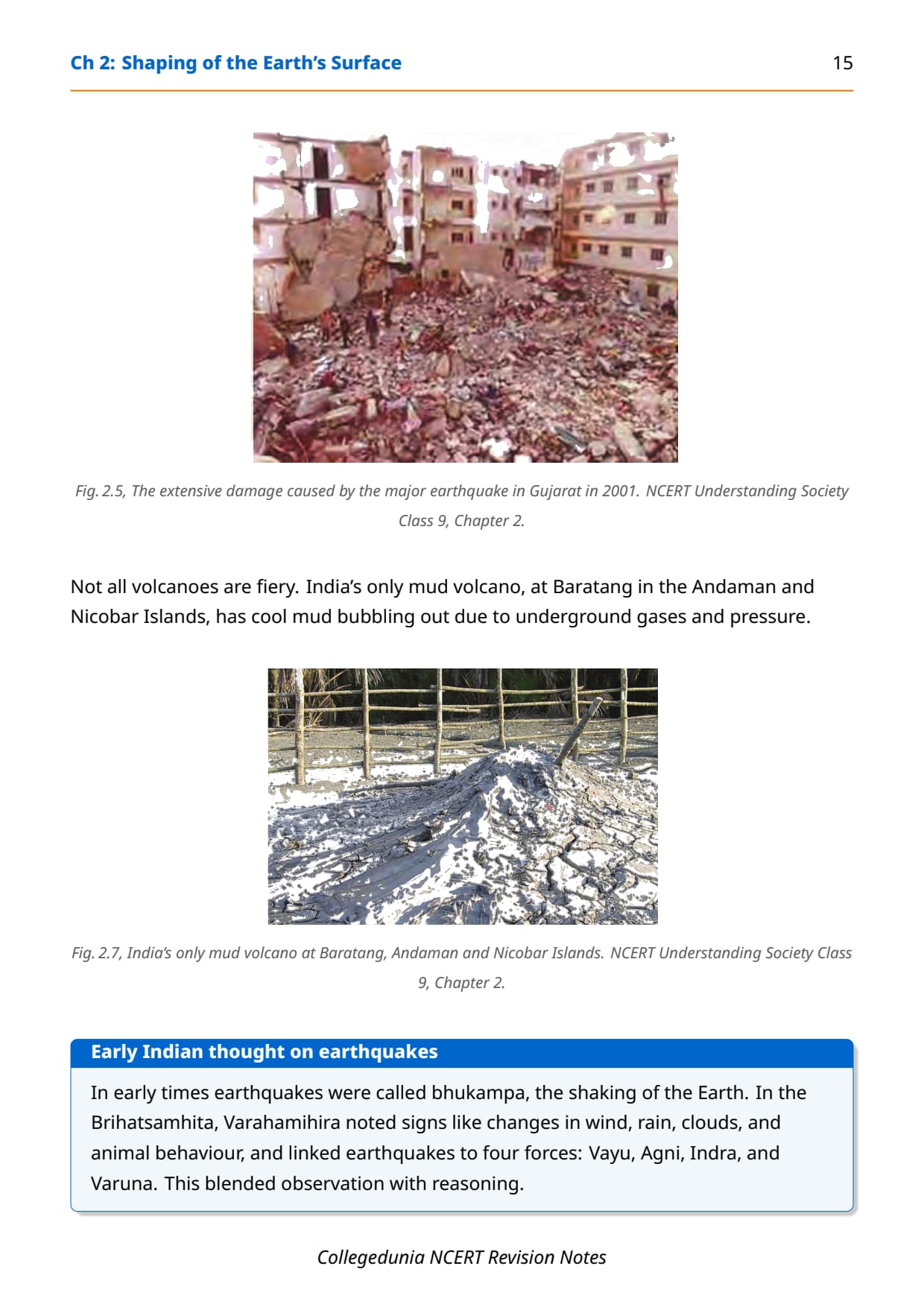
Not every volcano is fiery. India's only mud volcano, at Baratang in the Andaman and Nicobar Islands, has cool mud bubbling out due to underground gases. India has also faced major earthquakes, such as the 2001 Gujarat quake, which caused huge loss of life and property.
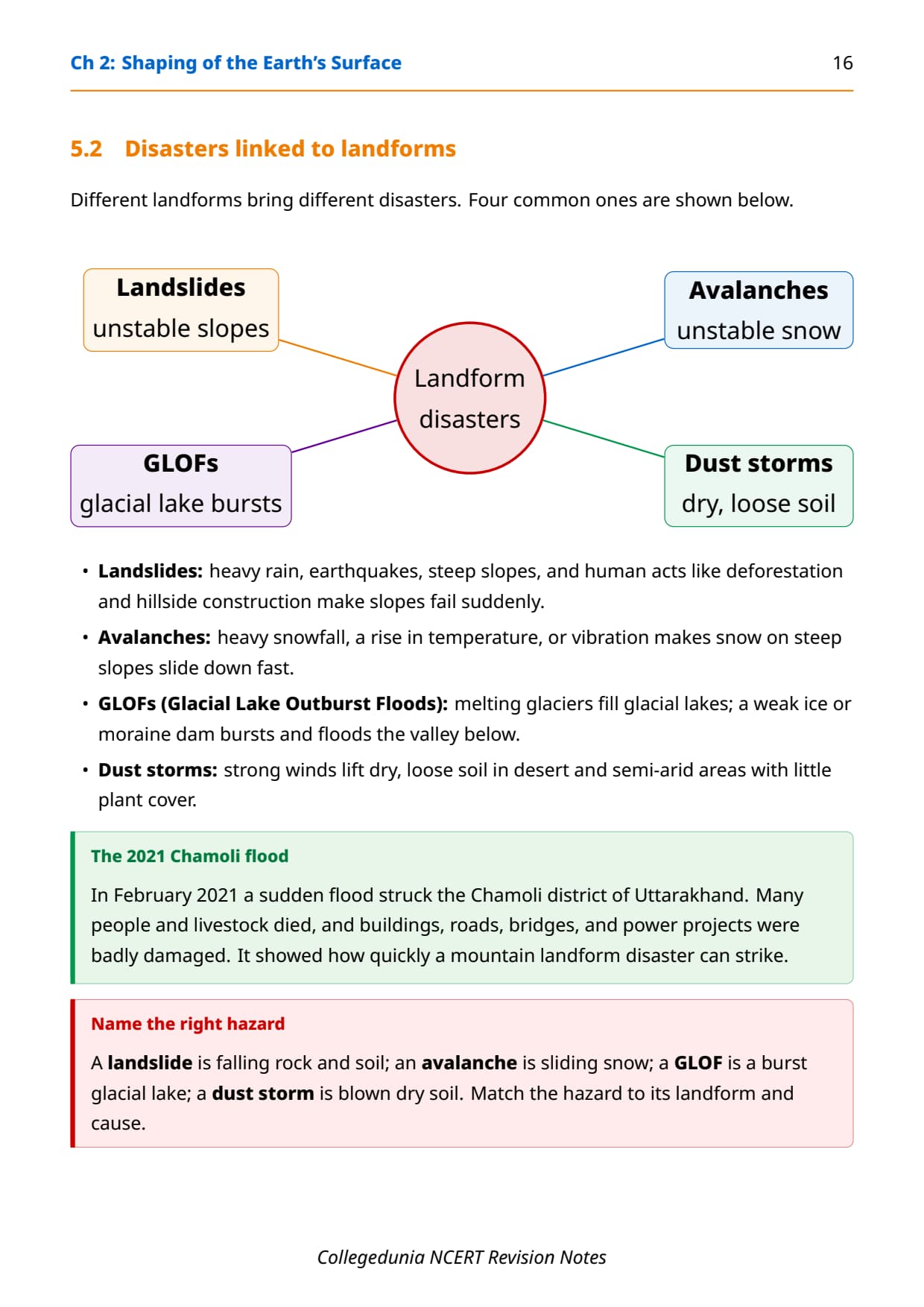
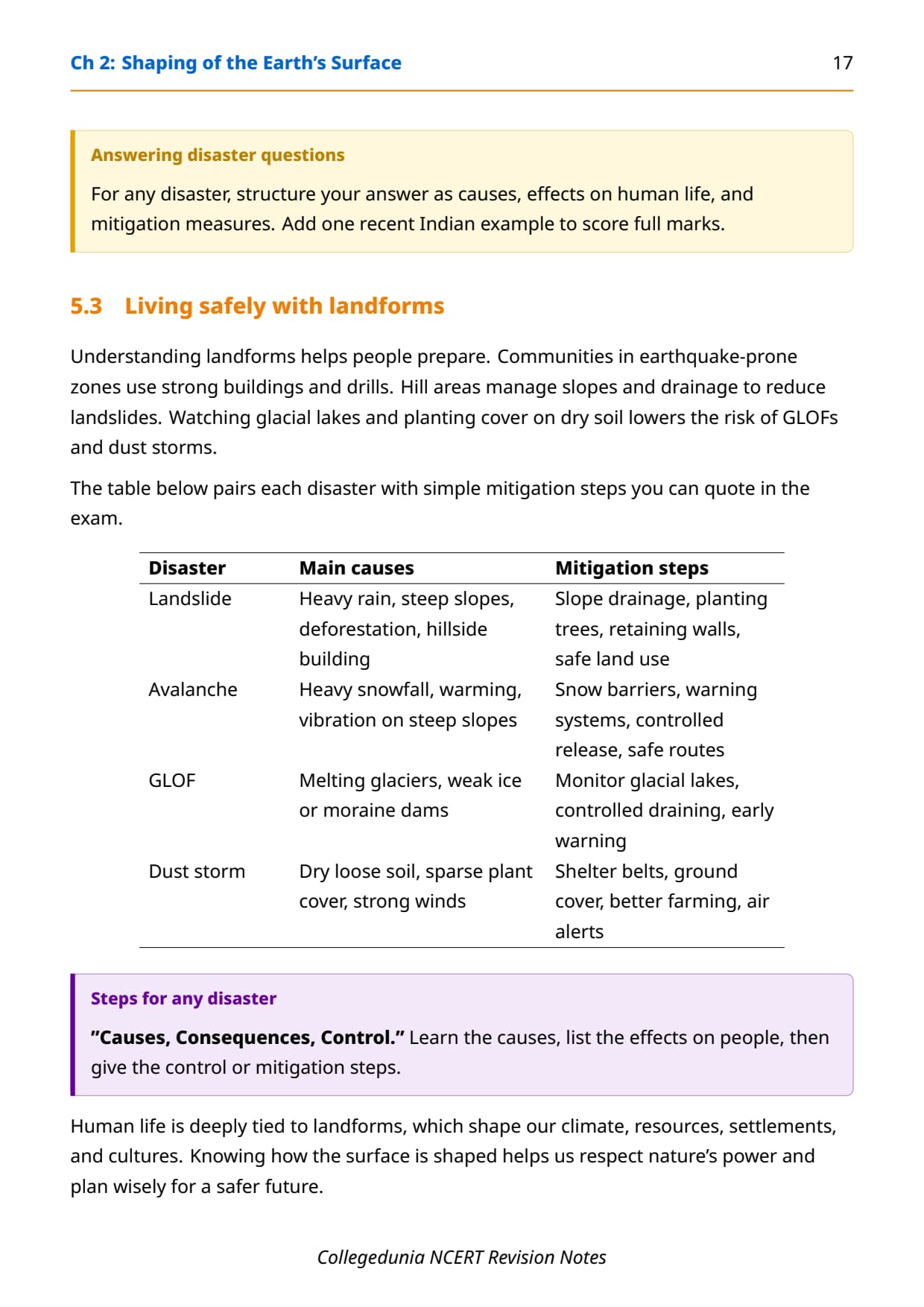
Unstable landforms also lead to disasters. Learn each hazard with its cause:
- Landslides: heavy rain, earthquakes, steep slopes, and human acts like deforestation make slopes fail suddenly.
- Avalanches: heavy snowfall, warming, or vibration makes snow on steep slopes slide down fast.
- GLOFs (Glacial Lake Outburst Floods): a weak ice or moraine dam of a glacial lake bursts and floods the valley below.
- Dust storms: strong winds lift dry, loose soil in desert and semi-arid areas with little plant cover.
For any disaster question, use the pattern "Causes, Consequences, Control": give the causes, the effects on people, and the mitigation steps, then add one recent Indian example like the 2021 Chamoli flood for full marks.
Key Terms and Diagrams to Remember for Chapter 2
Keep this quick list ready for last-minute revision. These are the terms and figures examiners ask about most in this chapter.
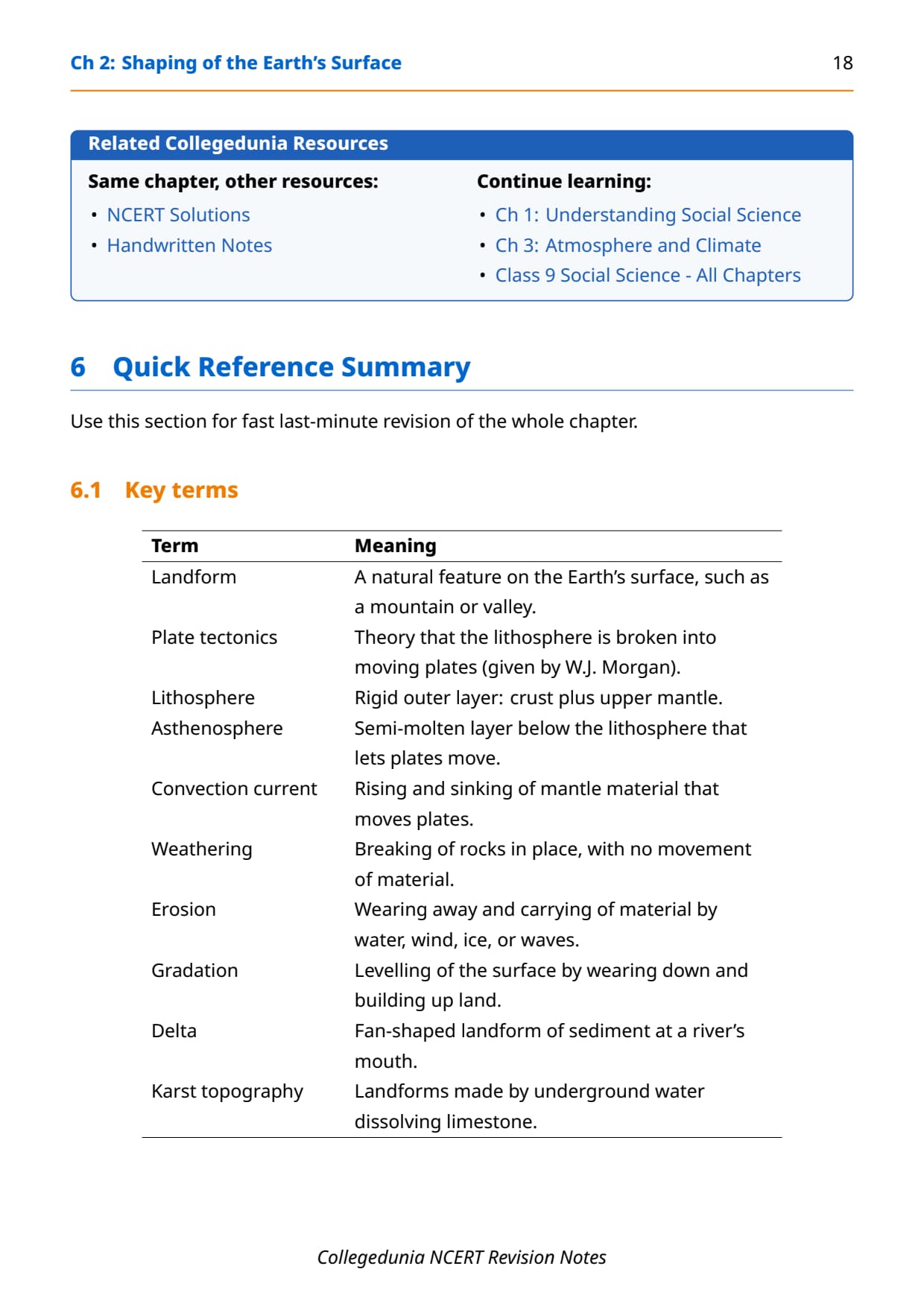
| Term | Meaning |
|---|---|
| Lithosphere | Rigid outer layer: crust plus upper mantle |
| Asthenosphere | Semi-molten layer that lets plates move |
| Plate tectonics | Theory that the lithosphere is broken into moving plates (W.J. Morgan) |
| Convection current | Rising and sinking of mantle material that moves plates |
| Gradation | Levelling of the surface by wearing down and building up land |
| Karst topography | Landforms made by underground water dissolving limestone |
For diagrams, be ready to draw the three layers of the Earth as a cutaway, the three plate boundary types with arrows, and the river landforms of a meander and a delta. These simple labelled sketches often carry easy marks.
Common Mistakes and Revision Strategy for Shaping of the Earth's Surface
Most lost marks in this chapter come from small mix-ups, not hard ideas. Fix these while you revise and your answers stay clean.
- Swapping convergent and divergent boundaries; check the arrow direction first.
- Calling every volcano fiery; India's Baratang volcano is a cool mud volcano.
- Mixing up the four disasters; match each hazard to its landform and cause.
- Forgetting to add a real Indian example, which costs easy marks in long answers.
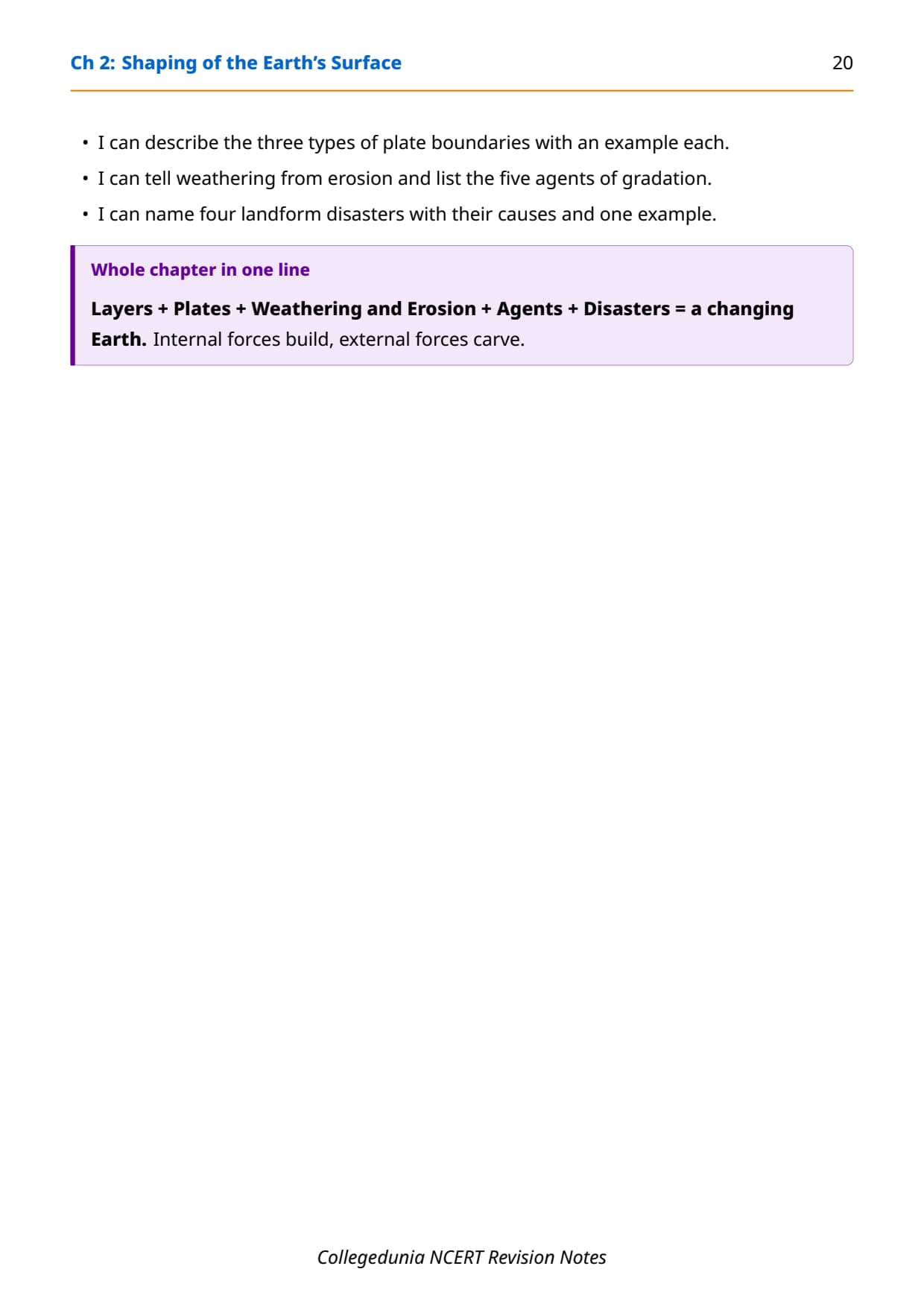
A smart revision plan is to read one section, close the book, and say it aloud in your own words. Then draw the key diagram for that section from memory. Finish with the key-terms table above, so the whole chapter stays fresh before the exam.
How These Notes Help You Revise Shaping of the Earth's Surface
These notes give you the full Class 9 Social Science Notes Chapter 2 Shaping of the Earth's Surface as clean, short revision in one place.
- 2026-27 match: every note follows the new Understanding Society textbook and its topic order.
- Simple English: short lines and everyday words, so a Class 9 student can revise without help.
- Tables and diagrams ready: plate boundaries, weathering versus erosion, and agents of gradation in one view.
- Free PDF: download the notes and revise offline before your test or exam.
More Shaping of the Earth's Surface Class 9 Social Science Resources
Also Check: open the other resources for this chapter to practise questions and revise from the book.
| Resource | Open |
|---|---|
| Revision Notes | Shaping of the Earth's Surface Class 9 Social Science Notes |
| NCERT Solutions | Shaping of the Earth's Surface Class 9 Social Science NCERT Solutions |
| Handwritten Notes | Shaping of the Earth's Surface Class 9 Social Science Handwritten Notes |
| NCERT Book PDF | Shaping of the Earth's Surface Class 9 Social Science NCERT Book PDF |
NCERT Notes for Class 9 Social Science: All Chapters
Related Links: use the table below to open the NCERT Notes for any other chapter of the Class 9 Social Science Understanding Society book.
| Chapter | NCERT Notes |
|---|---|
| Chapter 1 | Understanding Social Science |
| Chapter 2 | Shaping of the Earth's Surface |
| Chapter 3 | Atmosphere and Climate |
| Chapter 4 | Early Humans and Beginning of Civilisation |
| Chapter 5 | State and Society up to 1000 CE |
| Chapter 6 | Democracy |
| Chapter 7 | Elections |
| Chapter 8 | Building Blocks in Economics: The Problem of Choice |
| Chapter 9 | The Price Puzzle: What Drives the Market |
Shaping of the Earth's Surface Class 9 Social Science Notes FAQs
Ques. Where can I download the Class 9 Social Science Chapter 2 Shaping of the Earth's Surface Notes PDF?
Ans. You can download the Shaping of the Earth's Surface Notes PDF free from this page. Both the Normal and HD versions match the 2026-27 Understanding Society book.
Ques. What topics do the Class 9 Social Science Chapter 2 notes cover?
Ans. The notes cover the Earth's layers, plate tectonics and plate boundaries, weathering and erosion, the agents of gradation with their landforms, and landform disasters like landslides, avalanches, GLOFs, and dust storms.
Ques. What is the difference between weathering and erosion?
Ans. Weathering only breaks rocks into smaller pieces in the same place. Erosion wears away the broken material and carries it to a new place using water, wind, ice, or waves.
Ques. Which theory explains the shaping of the Earth's surface?
Ans. Plate tectonics explains it. Given by W.J. Morgan, it says the lithosphere is broken into moving plates. Their movement causes mountains, earthquakes, volcanoes, and many landforms.
Ques. Is Chapter 2 part of the new Class 9 Social Science book?
Ans. Yes. Shaping of the Earth's Surface is Chapter 2 of the new Understanding Society textbook for the 2026-27 syllabus. It is a core geography chapter for later map and disaster topics.



Comments