




The NCERT Solutions Class 9 Social Science Chapter 4 Early Humans and Beginning of Civilisation answer all 13 questions from the Questions and Activities exercise of the 2026-27 Understanding Society textbook. Every answer is written the way you should present it in the exam, covering the Stone Age, the Neolithic shift to farming, and the first river-valley civilisations.
Each solution for Class 9 Social Science Chapter 4 Early Humans and Beginning of Civilisation is written by Collegedunia subject experts, matched to the 2026-27 Understanding Society textbook, and kept in simple exam language.
- 13 solved questions: full answers for every Questions and Activities item, each with an expert version too.
- Core ideas: the three-age system, the Neolithic Revolution, and the four Bronze Age river-valley civilisations.
- Exam skills: how to answer opinion, table, and map questions without losing easy marks.
Student Feedback
In a Collegedunia poll of 8,600 Class 9 students before the 2026 exams, 58% said they lost marks by writing a paragraph when the question asked for a table. The next most common slip was skipping the comparison part of a creative question. Students who practised the 13 solved answers here said the opinion and map questions felt far easier the second time.
Source: 2026-27 Class 9 Social Science student poll. Sample of 8,600 students from CBSE schools across 11 states.
Exercise Coverage in the Early Humans and Beginning of Civilisation Class 9 Solutions
The Questions and Activities exercise has 13 items. The ncert solutions class 9 social science chapter 4 Early Humans and Beginning of Civilisation group them by type, so you know which to write first and which to do as a project. The table below shows the split.
| Question type | Questions | What it tests |
|---|---|---|
| Explain, examine, compare, and discuss | 6 | The three-age system, the environment, Bronze Age civilisations, rivers, the Code of Hammurabi, Egypt versus Mesopotamia |
| Opinion and creative writing | 4 | Farming easier or harder, a day as a Neolithic farmer, a deciphered Harappan script, the one great innovation |
| Table and map based | 2 | A Palaeolithic-Mesolithic-Neolithic table, and a map of rivers and trade links |
| Project and scrapbook activity | 1 | A scrapbook or presentation on one civilisation's innovations |
Start with the explain and examine answers, then draw the stone-age table neatly. Keep the map and scrapbook items for after you know the theory well.
Early Humans and Beginning of Civilisation Weightage for Class 9 Social Science Exams
This is the first history chapter in the new integrated Class 9 book. It sets the base for the later chapters on early states and society. Here is where it sits among the history-side chapters of the 2026-27 Understanding Society book.
| Chapter | Topic | Typical exam focus |
|---|---|---|
| Chapter 4 | Early Humans and Beginning of Civilisation | Stone Age stages, Neolithic Revolution, river-valley civilisations |
| Chapter 5 | State and Society up to 1000 CE | Early states, kingdoms, and social change |
This chapter carries steady marks because it mixes short opinion answers with a table and a map. Learn the three-age order once and the marks come back in every test.
How to Answer Early Humans and Beginning of Civilisation Questions Step by Step
Most marks here come from clear structure, not long writing. The ncert solutions class 9 social science chapter 4 Early Humans and Beginning of Civilisation use the same method for almost every answer. Follow these steps and you will rarely lose an easy mark.
- Name your view first. For an opinion question, such as whether farming made life easier, state your stand in the first line, then support it.
- Give exactly the number of reasons asked. If the question wants two reasons, two clear reasons score more than five vague ones.
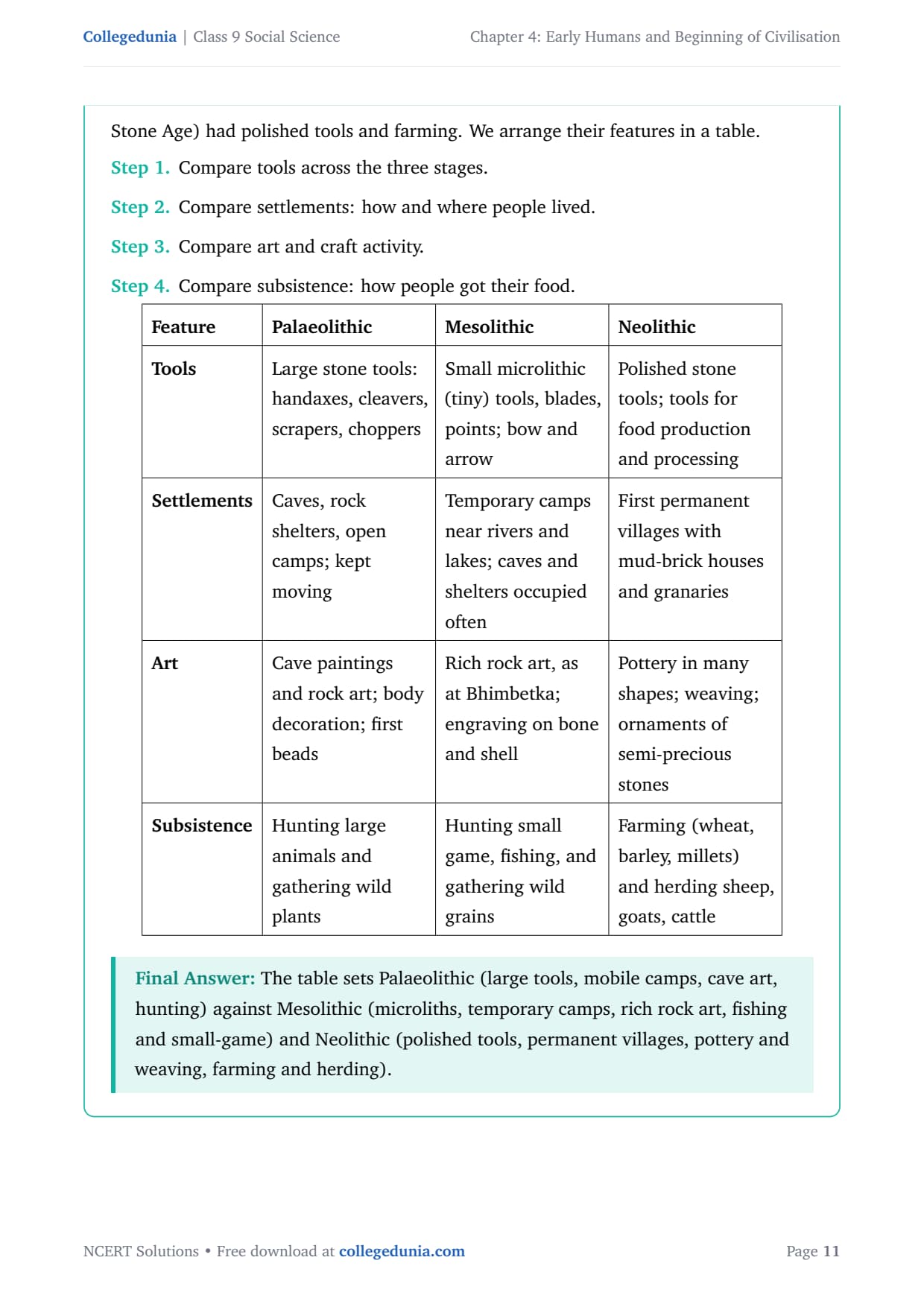
- Draw the table when a table is asked. A neat grid for the Palaeolithic, Mesolithic, and Neolithic earns the presentation marks a paragraph loses.
- Add one real example. Name places like Mehrgarh, Dholavira, Lothal, or the Meluhha trade route so the answer feels complete.
- Finish the comparison part. Creative questions still ask you to compare, so end with the point of difference the examiner wants.
For map work, colour each river valley, label the civilisation, and use one bold arrow for the Harappa-Mesopotamia trade link. A clear key turns a rough sketch into a full-mark map.
Common Mistakes Students Make in Early Humans and Beginning of Civilisation
Most lost marks in this chapter are simple slips, not gaps in understanding. Watch for the four below when you write your answer.
Mistake 1: Writing a paragraph when the question asks for a table. Draw the actual three-column grid for the Palaeolithic, Mesolithic, and Neolithic.
Mistake 2: Skipping the comparison part of a creative question. The Neolithic farmer answer must also say what is harder than for a hunter-gatherer.
Mistake 3: Giving more reasons than asked. If two reasons are wanted, give two sharp reasons, not a long list.
Mistake 4: Mixing up the three-age order or saying all regions entered each age at the same time. The order is stone, then bronze, then iron, and dates differ by region.
Also Check: the full answer for every one of these traps is in the solved questions lower on this page.
Early Humans and Beginning of Civilisation Important Questions and Exam Trends
Exams from this chapter follow a clear pattern. One reasoning question plus a table or map question is the usual mix. The list below shows the types you should be ready for.
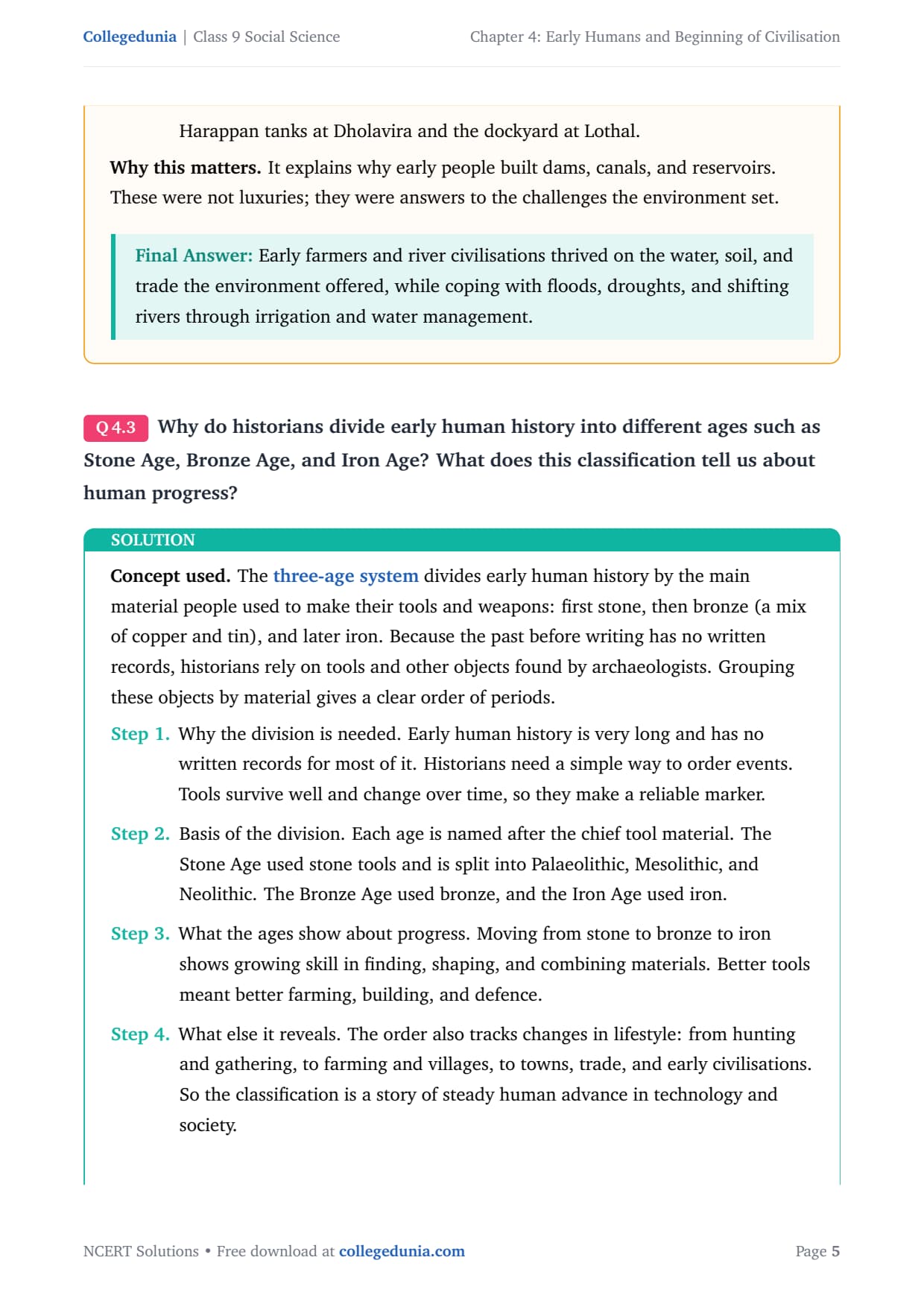
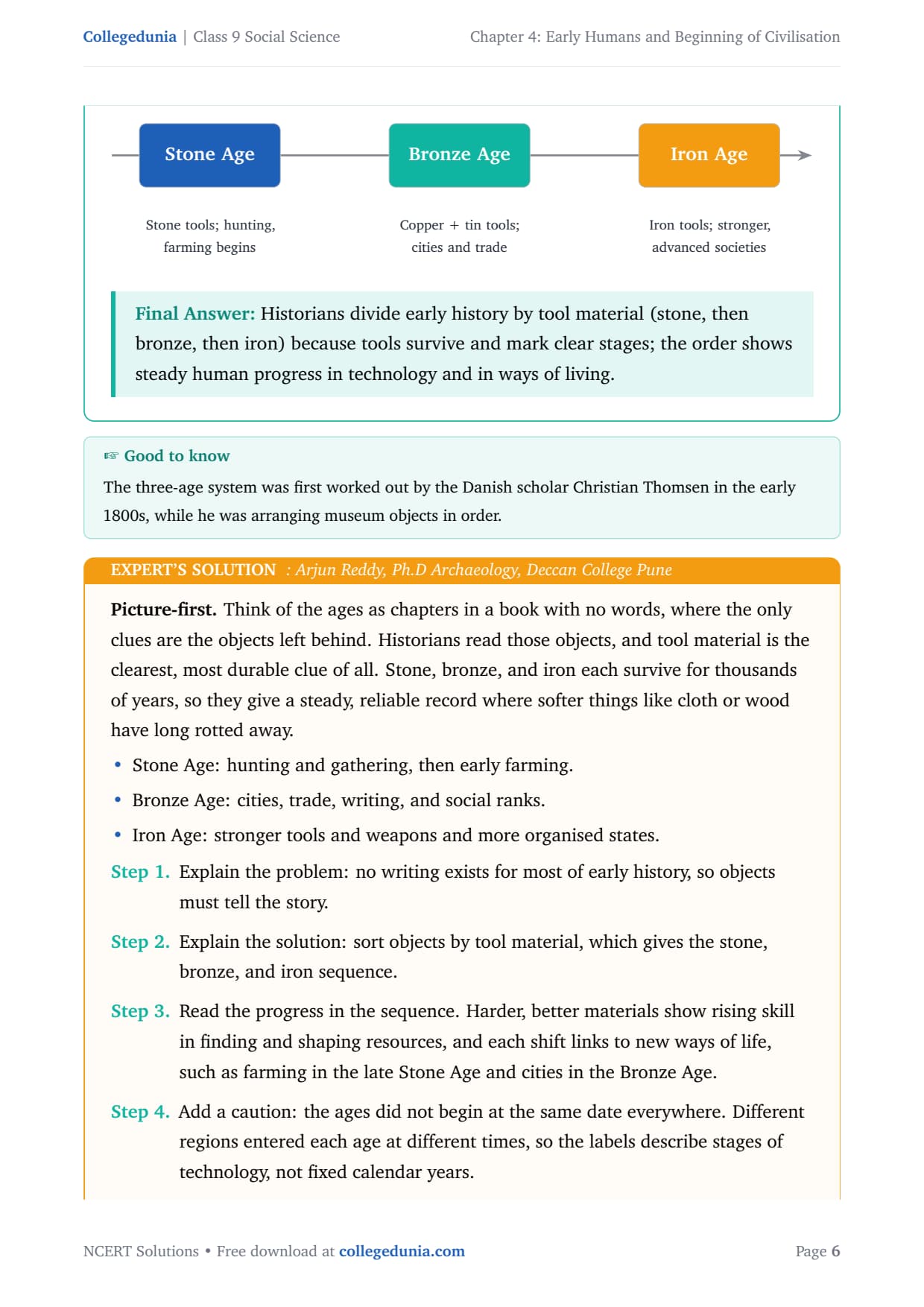
- The three-age system: why historians divide the past into Stone, Bronze, and Iron ages, and what it shows about progress.
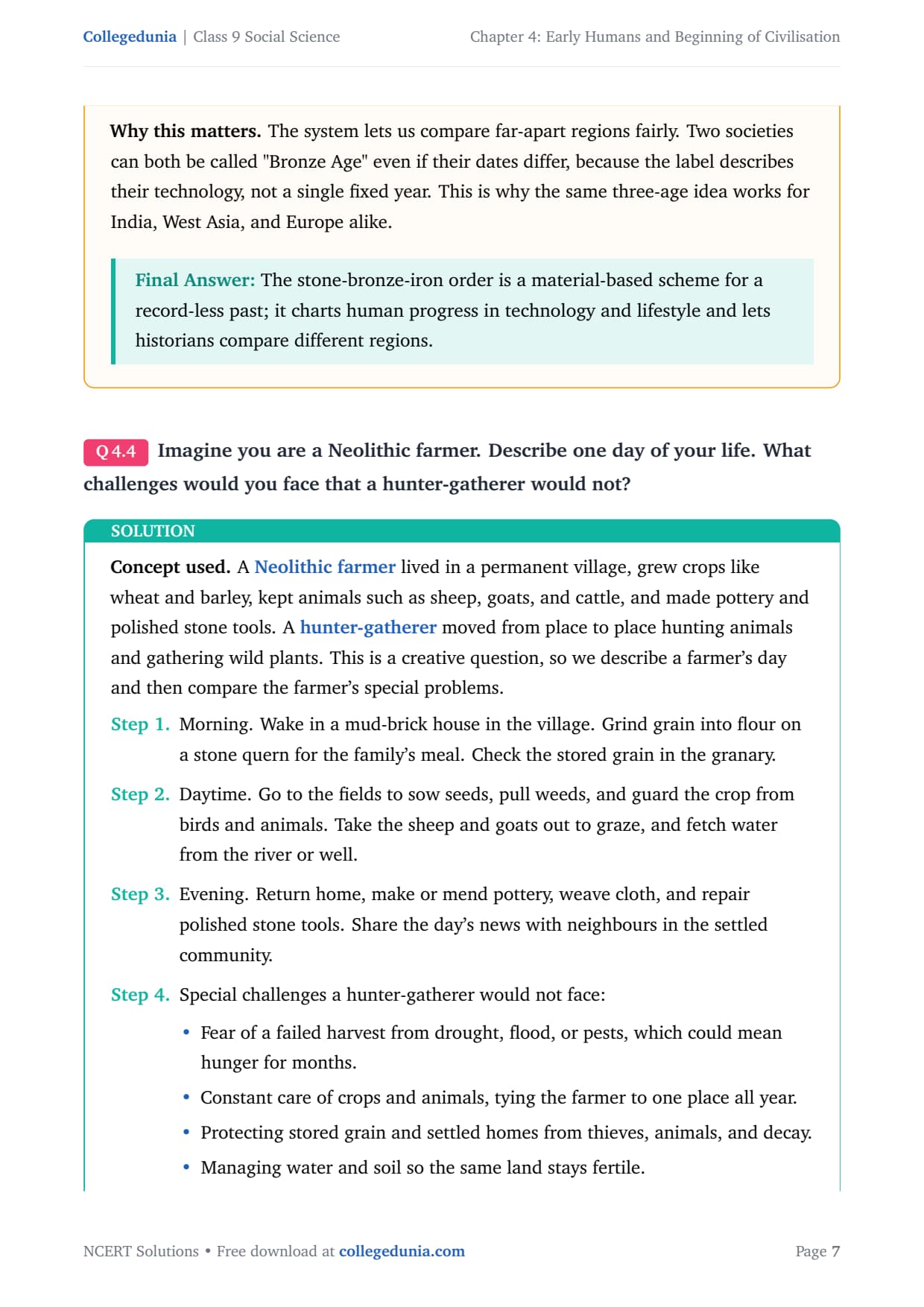
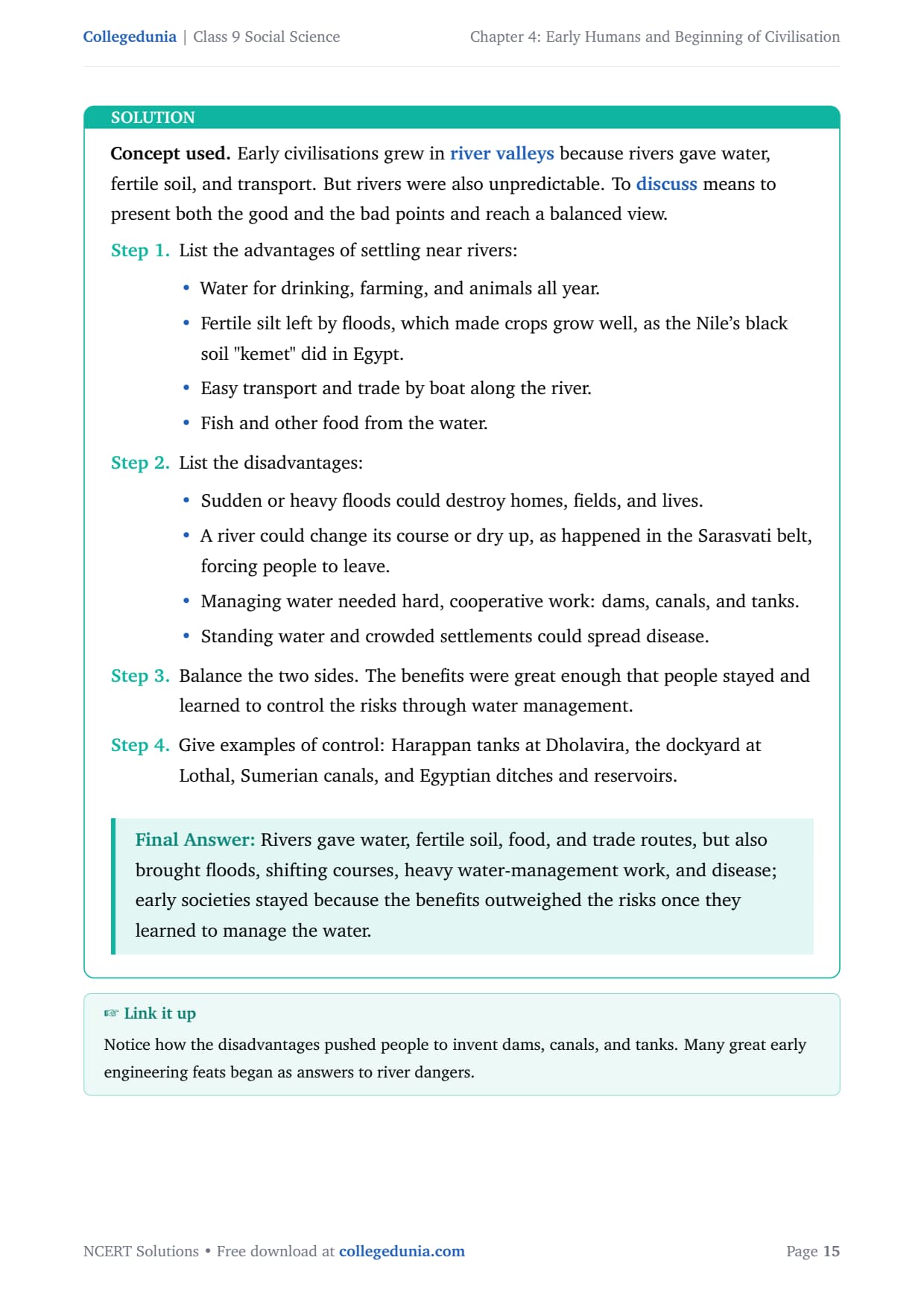
- The Neolithic Revolution: how farming made life both easier and harder for early people.
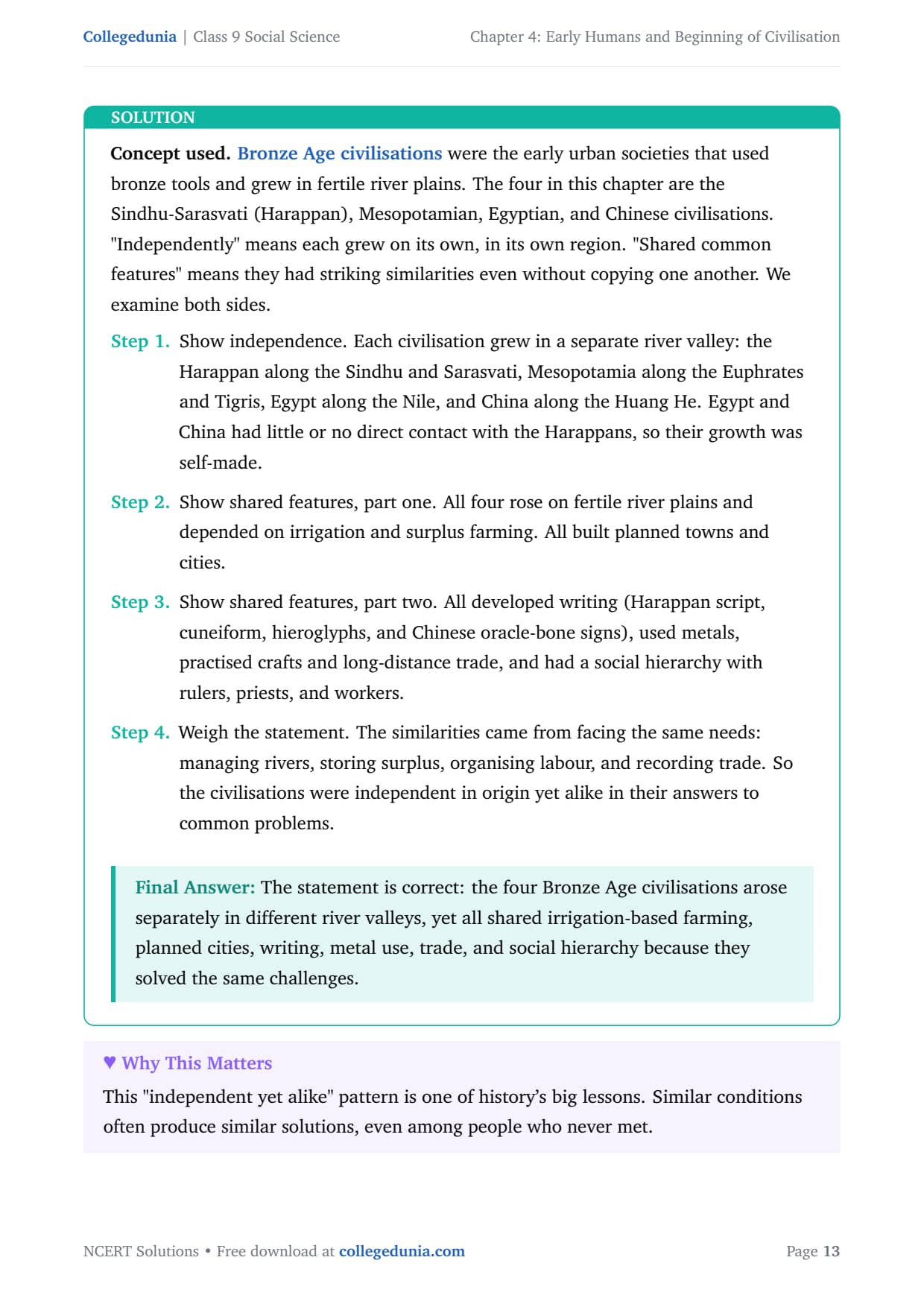
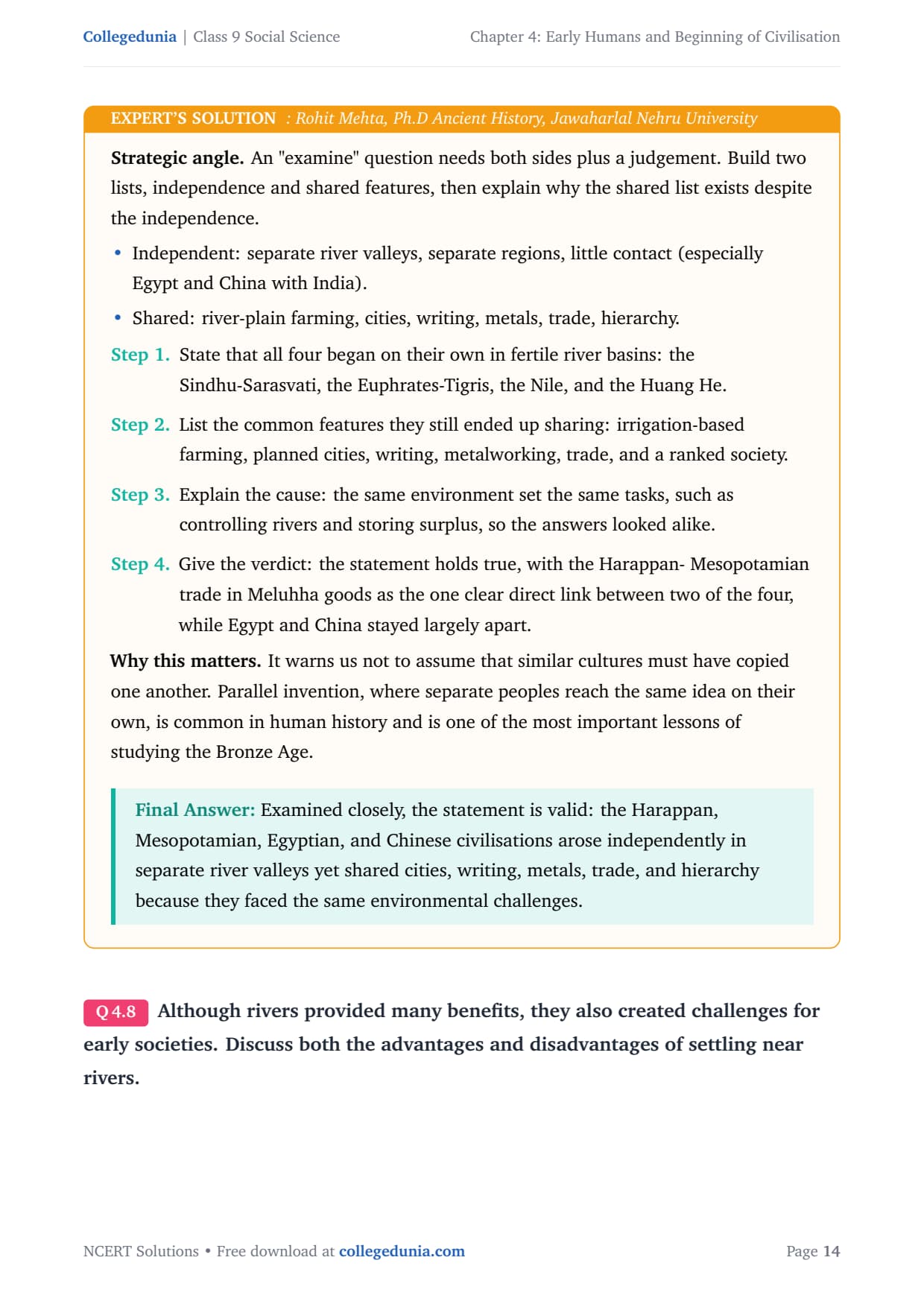
- Bronze Age civilisations: how the Sindhu-Sarasvati, Mesopotamian, Egyptian, and Chinese societies grew independently yet shared features.
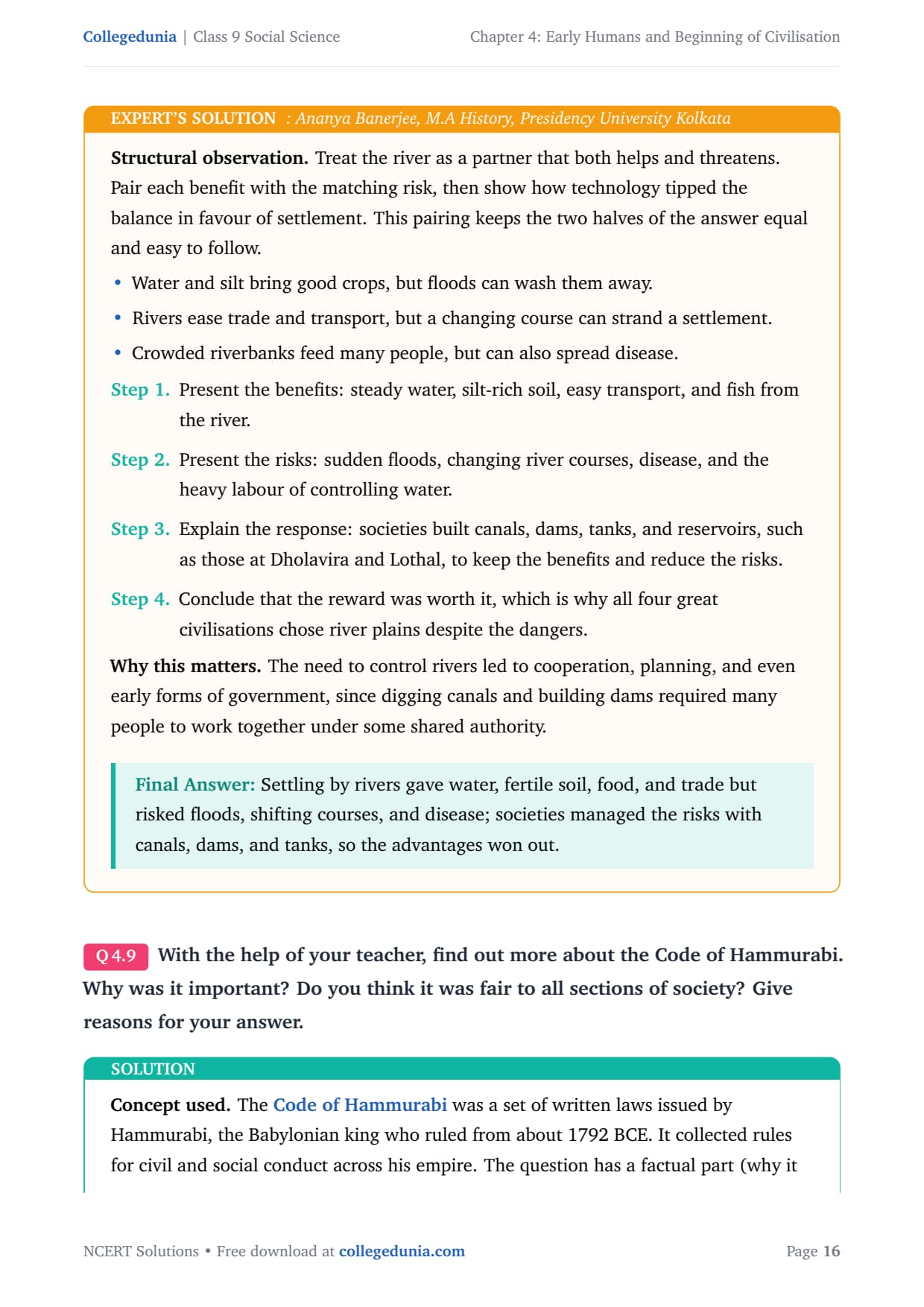
- Writing and law: the importance of writing and of the Code of Hammurabi.
- Map and trade: locating the four river valleys and the Harappa-Mesopotamia link through Meluhha.
The ncert solutions class 9 social science chapter 4 Early Humans and Beginning of Civilisation cover every one of these types in full, so practising the 13 solved questions on this page is enough for the exam.
Questions
NCERT Solutions for Class 9 Social Science: All Chapters
Once you finish this chapter, move to the solutions for the other chapters of the 2026-27 Understanding Society book using the links below.
| Chapter | NCERT Solutions |
|---|---|
| Chapter 1 | Understanding Social Science |
| Chapter 2 | Shaping of the Earth's Surface |
| Chapter 3 | Atmosphere and Climate |
| Chapter 5 | State and Society up to 1000 CE |
| Chapter 6 | Democracy |
| Chapter 7 | Elections |
| Chapter 8 | Building Blocks in Economics: The Problem of Choice |
| Chapter 9 | The Price Puzzle: What Drives the Market |
Early Humans and Beginning of Civilisation Class 9 Solutions FAQs
How many questions are solved in the Class 9 Social Science Chapter 4 solutions?
All 13 questions from the Questions and Activities exercise are solved. Each question has a full Solution and an Expert Solution, so you get two clear ways to write every answer in the exam.
What is the Neolithic Revolution in this chapter?
The Neolithic Revolution was the shift from hunting and gathering to farming and herding. People began to grow crops, keep animals, and settle in permanent villages. It brought a steady food supply but also new work and the risk of crop failure.
Which four Bronze Age civilisations does the chapter cover?
The chapter covers the Sindhu-Sarasvati, Mesopotamian, Egyptian, and Chinese civilisations. Each grew independently along a major river, yet all shared planned cities, writing, metal tools, trade, and a class-based society.
How should I answer the table and map questions?
For the table question, draw an actual three-column grid for the Palaeolithic, Mesolithic, and Neolithic and fill in tools, settlements, art, and food. For the map, colour each river valley, label the civilisation, and mark the Harappa-Mesopotamia trade link through Meluhha.



Comments