



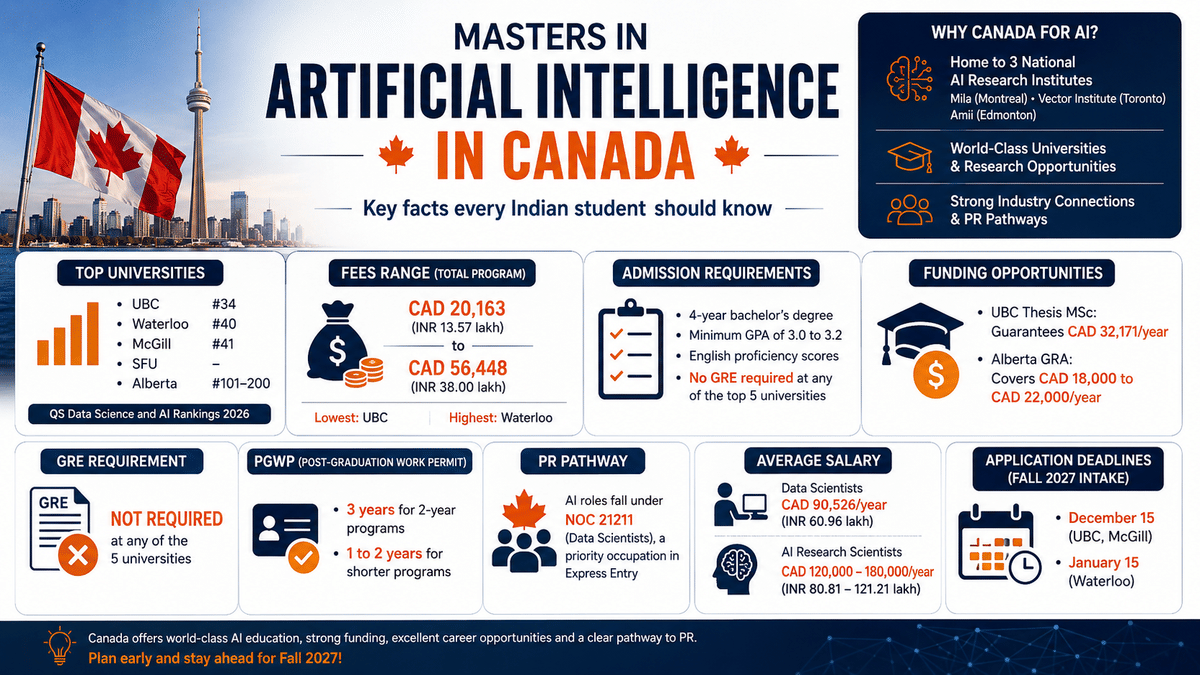
Canada is one of the top destinations for a Masters in Artificial Intelligence in Canada. The country is home to three national AI research institutes: Mila in Montreal, the Vector Institute in Toronto, and Amii in Edmonton. The Artificial Intelligence course in Canada fees range from CAD 20,163 (INR 13.57 lakh) at UBC to CAD 56,448 (INR 38.00 lakh) at Waterloo for the total program. The Masters in Artificial Intelligence in Canada requirements include a 4-year bachelor's degree, a minimum GPA of 3.0 to 3.2, and English proficiency scores. No GRE is required at any of the top 5 universities.
Here are the key facts Indian students should know before applying:
- Top universities: UBC (#34), Waterloo (#40), McGill (#41), SFU and Alberta (#101–200) by QS Data Science and AI Rankings 2026
- Fees range: CAD 20,163 to CAD 56,448 (INR 13.57 lakh to INR 38.00 lakh) total
- GRE: Not required at any of the 5 universities
- Funding: UBC Thesis MSc guarantees CAD 32,171/year; Alberta GRA covers CAD 18,000 to CAD 22,000/year
- PGWP: 3 years for 2-year programs; 1 to 2 years for shorter programs
- PR pathway: AI roles fall under NOC 21211 (Data Scientists), a priority occupation in Express Entry
- Average salary: Data Scientists earn CAD 90,526/year (INR 60.96 lakh); AI Research Scientists earn CAD 120,000 to CAD 180,000/year (INR 80.81 to INR 121.21 lakh)
- Application deadlines: December 15 (UBC, McGill) and January 15 (Waterloo) for Fall 2027 intake
Key Updates for Indian Students Targeting Fall 2027 Intake
- Application window opens now: Most Fall 2027 deadlines fall between October 15 and January 15, 2027. Indian students should begin preparing SOPs, LORs, and transcripts by August 2026.
- Supervisor outreach: For thesis programs at UBC, McGill, and Alberta, contact potential supervisors by September to October 2026. Supervisor confirmation before applying significantly improves admission chances.
- Alberta single intake: Alberta admits only once per year (Fall only). Missing the December 2026 deadline means waiting until Fall 2028.
- Study permit timeline: Canadian study permit processing from India takes 8 to 12 weeks. Apply for your study permit immediately after receiving an offer letter.
- Vector Institute Scholarship: Available only to students in Vector-recognized programs (Waterloo MDSAI). Worth CAD 17,500 (INR 11.78 lakh). Apply early to be considered.
- Co-op work permit: Waterloo MDSAI Co-op students need a separate co-op work permit. Apply for this alongside your study permit.
All fees and costs in this article are converted at CAD 1 = INR 67.34 (July 2026).
- Why Study Masters in Artificial Intelligence in Canada?
- Specializations in Masters in Artificial Intelligence in Canada
- Top Universities for Masters in Artificial Intelligence in Canada
- Masters in Artificial Intelligence in Canada Requirements
- Masters in Artificial Intelligence in Canada Intakes and Application Deadlines
- Masters in Artificial Intelligence in Canada Fees
- Cost of Living for AI Master's Students in Canada
- Scholarships for Masters in Artificial Intelligence in Canada
- Jobs and Salary After Masters in Artificial Intelligence in Canada
- FAQs
Why Study Masters in Artificial Intelligence in Canada?
Canada combines world-ranked AI research, funded programs, no GRE, and a clear PR pathway. No other country offers all of these together for Indian AI students.
- Mila, Vector, and Amii access: Canada has 3 national AI institutes. Students get exclusive scholarships, industry job boards, and research access at Google DeepMind, Meta AI, and Microsoft Research. Vector Institute Scholarship is worth CAD 17,500 (INR 11.78 lakh).
- Waterloo MDSAI Co-op: Includes a paid 4-month work term. Waterloo has 7,000+ employer partners. Indian students graduate with a degree and Canadian work experience.
- Funded research programs: UBC guarantees CAD 32,171/year (INR 21.66 lakh/year). Alberta GRA covers CAD 18,000 to CAD 22,000/year (INR 12.12 to INR 14.81 lakh/year). Net cost can be near zero for admitted students.
- No GRE required: None of the 5 universities require GRE. Indian students save INR 30,000 to INR 50,000 and 3 to 6 months of preparation time compared to US programs.
- Direct PR pathway: AI roles (NOC 21211) are priority occupations in Express Entry. A 3-year PGWP gives Indian graduates time to build Canadian work experience and apply for PR.
Student Insight
According to discussions on Quora, Indian students consistently rank Canada first for AI Master's programs. The combination of research quality, funding, no GRE, and PR pathway makes it more practical than the USA, UK, or Australia.
Specializations in Masters in Artificial Intelligence in Canada
Canadian AI Master's programs offer 6 major specializations. Indian students should choose based on their undergraduate background and target career role.
| Specialization | Best University | Key Courses/Research Areas | Target Roles |
|---|---|---|---|
| Machine Learning and Deep Learning | UBC, McGill | COMP 551, COMP 562, COMP 579 (McGill); ML research groups (UBC) | ML Engineer, AI Researcher at Google DeepMind, Meta AI, Amazon |
| Natural Language Processing and LLMs | McGill, Waterloo | COMP 550, COMP 599 (McGill); Vector Institute NLP connections (Waterloo) | NLP Engineer at Cohere, OpenAI Canada, Microsoft Research |
| Computer Vision and Robotics | UBC, SFU | Vision, graphics, and robotics research (UBC); MSc Computing Science (SFU) | Computer Vision Engineer in autonomous vehicles, medical imaging |
| Data Science and Applied AI | Waterloo | MDSAI Co-op program; Vector Institute industry connections | Data Scientist, ML Engineer, AI Product Manager at Canadian banks and tech firms |
| Statistical Machine Learning | Alberta | MSc SML specialization; Amii and Google DeepMind Edmonton connections | Research roles at AI institutes, quantitative finance, tech companies |
| AI for Healthcare and Bioinformatics | UBC, McGill | COMP 565, COMP 598 (McGill); ML for genomics and cancer biology (UBC) | AI Healthcare Researcher, Bioinformatics Scientist |
Student Insight
According to discussions on Reddit, Indian students from B.Tech ECE backgrounds find Computer Vision and Statistical Machine Learning the most accessible specializations. Students from B.Tech CS backgrounds with strong mathematics tend to do well in Machine Learning and NLP specializations at McGill and UBC.
Top Universities for Masters in Artificial Intelligence in Canada
Canada has 5 leading English-medium universities offering AI and ML-focused Master's programs. All 5 are PGWP-eligible and connected to at least one of Canada's three national AI research institutes.
| University | QS DS and AI Rank 2026 | Program | Duration |
|---|---|---|---|
| University of British Columbia | #34 | MSc Computer Science (AI/ML focus) | 2 years |
| University of Waterloo | #40 | MDSAI (Co-op and Non Co-op), MMath CS | 16 to 20 months |
| McGill University | #41 | MSc Computer Science (Thesis and Non-Thesis, ML stream) | 16 months to 2 years |
| Simon Fraser University | #101 to 200 | MSc Computing Science (Thesis), MSc Big Data | 1.5 to 2 years |
| University of Alberta | #101 to 200 | MSc Computing Science (Thesis), MSc Statistical Machine Learning | 2 years |
Student Insight
According to discussions on Reddit, Indian students who chose Canadian AI programs over US programs highlight three key reasons: no GRE requirement, lower total costs, and a clear PR pathway. Students at Waterloo specifically mention the co-op work term as a major advantage over programs in the UK or Australia.
Masters in Artificial Intelligence in Canada Requirements
None of the top 5 universities require the GRE. Most programs require a minimum GPA of 3.0 to 3.2 out of 4.0, equivalent to approximately 75 to 80% in Indian undergraduate grading.
| University | Program | Academic Eligibility | GRE | IELTS | TOEFL iBT |
|---|---|---|---|---|---|
| UBC | MSc Computer Science | 4-year bachelor's in CS or related; min. B+ (76%) | Not required | 7.0 (min. 6.5 each band) | 100 |
| Waterloo | MDSAI (Co-op and Non Co-op) | Honours bachelor's in CS, Statistics, Math or related; min. 78% | Not required | 7.0 | 90+ |
| McGill | MSc CS (Thesis and Non-Thesis) | Bachelor's in CS or related; min. CGPA 3.2/4.0 | Optional (recommended) | 6.5 overall | 100 |
| SFU | MSc Computing Science / MSc Big Data | Bachelor's in CS or related; min. CGPA 3.0/4.33 | Not required | 7.0 | 93 |
| Alberta | MSc Computing Science (Thesis) | 4-year bachelor's in CS; min. GPA 3.0/4.0 (competitive: 3.5+) | Not required (recommended: min. Quant 155) | 7.0 (min. 6.5 each band) | 100 |
Key Note for Indian Students: A 3-year Indian bachelor's degree is generally not sufficient. A 4-year B.Tech or BE is widely accepted. B.Sc. (3-year) graduates may need to show additional coursework. Indian students from B.Tech CS or ECE backgrounds are well-suited for all 5 programs.
Documents Required for Masters in AI Admission in Canada:
- Academic transcripts from all previous institutions
- Updated CV or Resume with research and technical experience
- 2 to 3 Letters of Recommendation (academic references preferred for research programs)
- Statement of Purpose (SOP); for thesis programs, mention specific supervisor and research alignment
- TOEFL or IELTS scores
- GRE scores (optional at most programs; recommended for Alberta and McGill)
- Research proposal or writing sample (required for thesis programs at UBC and McGill)
- Valid passport copy
- Application fee (CAD 100 to CAD 200 depending on university)
Student Insight
According to discussions on Reddit, students who got into Canadian AI research programs say that contacting a potential supervisor before applying is the most important step for thesis programs. Supervisors at UBC, McGill, and Alberta often informally confirm interest before the formal application, which significantly improves admission chances.
Masters in Artificial Intelligence in Canada Intakes and Application Deadlines
Most Canadian AI Master's programs have December to January deadlines for Fall 2027 intake. Indian students should begin preparing applications by August to September 2026. Alberta admits only once per year, so missing the December deadline means waiting until Fall 2028.
| University | Program | Intake | Application Deadline (Fall 2027) |
|---|---|---|---|
| UBC | MSc Computer Science | Fall (September) and Winter (January) | December 15, 2026 |
| Waterloo | MDSAI (Co-op) | Fall (September) | January 15, 2027 |
| Waterloo | MDSAI (Non Co-op) | Fall, Winter, Spring | Jan 15 (Fall); Jul 1 (Winter); Nov 1 (Spring) |
| McGill | MSc CS (Thesis and Non-Thesis) | Fall (September) primary | December 15, 2026 (International) |
| SFU | MSc CS (Thesis) / MSc Big Data | Fall (September), Spring (January) | January 19, 2027 (Fall) |
| Alberta | MSc Computing Science (Thesis) | Fall (September) ONLY | October 15 to December 15, 2026 |
Visa Note for Indian Students Targeting Fall 2027: Apply for your study permit immediately after receiving an offer letter. Processing from India takes 8 to 12 weeks. Waterloo MDSAI Co-op students also need a separate co-op work permit. Students on a study permit can work up to 24 hours per week during academic sessions and full-time during scheduled breaks.
Student Insight
According to discussions on Reddit, Indian students who missed Alberta's December deadline had to wait a full year for the next intake. Students recommend starting the application process by September, at least 3 months before the deadline, to allow time for supervisor outreach, LOR collection, and SOP drafting.
Masters in Artificial Intelligence in Canada Fees
The Artificial Intelligence course in Canada fees vary between research-based and coursework-based programs. Research programs at UBC and Alberta have total fees under CAD 21,000 (INR 14.14 lakh). Both come with funded packages that cover tuition and provide a living stipend for admitted students.
| University | Program | Duration | Total Tuition (CAD) | Total Tuition (INR) |
|---|---|---|---|---|
| University of British Columbia | MSc Computer Science | 2 years | CAD 20,163 | INR 13.57 lakh |
| University of Waterloo | MDSAI (Co-op) | 16 to 20 months | CAD 56,448 | INR 38.00 lakh |
| McGill University | MSc CS (Non-Thesis) | 16 months | CAD 47,000 to CAD 53,000 | INR 31.65 to INR 35.69 lakh |
| McGill University | MSc CS (Thesis) | 2 years | CAD 31,500 to CAD 42,000 | INR 21.21 to INR 28.28 lakh |
| Simon Fraser University | MSc Big Data | 1.5 to 2 years | CAD 39,000 to CAD 52,287 | INR 26.27 to INR 35.21 lakh |
| University of Alberta | MSc Computing Science (Thesis) | 2 years | CAD 20,035 | INR 13.49 lakh |
Student Insight
According to discussions on Quora, Indian students note that the total cost of a Canadian AI Master's degree, including living expenses, is CAD 50,000 to CAD 100,000 (INR 33.67 to INR 67.34 lakh). This compares to USD 150,000 to USD 200,000 (INR 125 to INR 166 lakh) for MIT, Stanford, or CMU. Students highlight this as a saving of INR 60 to INR 100 lakh with comparable research output and North American career outcomes.
Cost of Living for AI Master's Students in Canada
Edmonton (Alberta) is the most affordable city, with monthly costs of CAD 1,500 to CAD 2,000 (INR 1.01 to INR 1.35 lakh). Vancouver (UBC and SFU) is the most expensive. Montreal (McGill) offers the best combination of low cost and strong AI industry access.
| City | University | Est. Monthly Cost (CAD) | Est. Monthly Cost (INR) |
|---|---|---|---|
| Vancouver, BC | UBC | CAD 2,500 to CAD 3,200 | INR 1.68 to INR 2.15 lakh |
| Waterloo, ON | Waterloo | CAD 1,600 to CAD 2,200 | INR 1.08 to INR 1.48 lakh |
| Montreal, QC | McGill | CAD 1,800 to CAD 2,400 | INR 1.21 to INR 1.62 lakh |
| Burnaby/Vancouver, BC | SFU | CAD 2,200 to CAD 3,000 | INR 1.48 to INR 2.02 lakh |
| Edmonton, AB | Alberta | CAD 1,500 to CAD 2,000 | INR 1.01 to INR 1.35 lakh |
Student Insight
According to discussions on Quora, Indian students at McGill highlight Montreal as the best city for AI students on a budget. The city has the lowest cost of living among Canada's major AI hubs and gives direct access to Mila, the world's largest academic AI research lab.
Scholarships for Masters in Artificial Intelligence in Canada
Canada offers some of the most generous AI-specific funding for graduate students. UBC's Thesis MSc guarantees CAD 32,171/year (INR 21.66 lakh/year) for all admitted students. The Vector Institute Scholarship of CAD 17,500 (INR 11.78 lakh) is exclusively available to students in Vector-recognized programs like Waterloo's MDSAI.
| Scholarship | Value (CAD) | Value (INR) | Eligibility |
|---|---|---|---|
| UBC Guaranteed Funding Package (Thesis MSc) | CAD 32,171/year for 2 years | INR 21.66 lakh/year | All admitted Thesis MSc students at UBC |
| UBC International Tuition Award (ITA) | CAD 3,200/year | INR 2.15 lakh/year | International graduate students at UBC |
| UBC Faculty of Science Master's Tuition Award | CAD 5,515 (1st year only) | INR 3.71 lakh | UBC Faculty of Science Master's students |
| Waterloo International Master's Award of Excellence | CAD 2,500 to CAD 5,000 | INR 1.68 to INR 3.37 lakh | International Master's students at Waterloo |
| Vector Institute Scholarship (MDSAI) | CAD 17,500 | INR 11.78 lakh | Students in Vector-recognized programs (Waterloo MDSAI) |
| McGill McCall MacBain Scholarship | Full tuition + CAD 2,300/month stipend | INR 1.55 lakh/month stipend | Exceptional McGill graduate students |
| McGill TA/RA Funding (Thesis MSc) | CAD 15,000 to CAD 20,000/year | INR 10.10 to INR 13.47 lakh/year | All admitted Thesis MSc students at McGill |
| Alberta Graduate Research Assistantship (GRA) | CAD 18,000 to CAD 22,000/year | INR 12.12 to INR 14.81 lakh/year | Thesis MSc students at Alberta |
| SFU Graduate Fellowships and TA positions | CAD 5,000 to CAD 15,000/year | INR 3.37 to INR 10.10 lakh/year | SFU graduate students; merit-based |
Student Insight
According to discussions on Reddit, Indian students who received the Vector Institute Scholarship at Waterloo note that the CAD 17,500 (INR 11.78 lakh) award significantly offsets the higher MDSAI tuition. Students at UBC and Alberta highlight that guaranteed funding packages make research programs effectively free when stipend income is factored against tuition costs.
Jobs and Salary After Masters in Artificial Intelligence in Canada
AI and ML roles in Canada fall under NOC 21211 (Data Scientists), a priority occupation in Canada's Express Entry system. The 3-year PGWP for 2-year programs gives Indian graduates time to build Canadian work experience and move toward PR. Toronto, Montreal, and Vancouver are among the world's top 10 AI cities.
| Job Role | Average Annual Salary (CAD) | Average Annual Salary (INR) |
|---|---|---|
| Machine Learning Engineer (entry) | CAD 62,400 to CAD 145,000 | INR 42.02 to INR 97.64 lakh |
| Data Scientist (with ML skills) | CAD 90,526 | INR 60.96 lakh |
| AI/ML Engineer (mid-level) | CAD 110,000 to CAD 160,000 | INR 74.07 to INR 107.74 lakh |
| Senior Data Scientist (5 years exp) | CAD 130,000 to CAD 160,000 | INR 87.54 to INR 107.74 lakh |
| AI Research Scientist | CAD 120,000 to CAD 180,000 | INR 80.81 to INR 121.21 lakh |
| NLP Engineer | CAD 100,000 to CAD 150,000 | INR 67.34 to INR 101.01 lakh |
| Computer Vision Engineer | CAD 95,000 to CAD 145,000 | INR 63.97 to INR 97.64 lakh |
Top Recruiters for AI Master's Graduates in Canada:
- Big Tech: Google DeepMind Canada, Meta AI, Microsoft Research, Amazon Canada
- Canadian Tech: Shopify, Cohere, Kinaxis, OpenText
- Finance: RBC AI, TD Bank, Scotiabank, BMO
- AI Startups: Mila spin-offs, Vector Institute portfolio companies, Element AI alumni companies
- Research: Mila, Vector Institute, Amii, National Research Council Canada
Student Insight
According to discussions on Reddit, Indian graduates from Waterloo's MDSAI program note that the co-op work term often converts into a full-time offer. Several students received return offers from RBC, TD, and Shopify before graduation. Students from UBC and McGill note that Mila and Vector Institute connections open doors to research roles at Google DeepMind and Meta AI.
Also Read: Post Study Work Permit in Canada
Indian students targeting Fall 2027 should begin their preparation by August 2026. For thesis programs at UBC, McGill, and Alberta, reach out to potential supervisors by September to October 2026. For Waterloo MDSAI, apply by January 15, 2027. Choose a research program (UBC, McGill, Alberta) if your goal is funded education and a research or PhD pathway. Choose Waterloo MDSAI Co-op if your goal is industry employment and a faster path to Canadian work experience. All 5 programs offer a PGWP and access to Canada's Express Entry system, giving Indian AI graduates one of the clearest PR pathways of any international student cohort.
FAQs
Ques: Which are the best universities for Masters in Artificial Intelligence in Canada?
Ans: The best universities are UBC (#34), Waterloo (#40), and McGill (#41) by QS Data Science and AI Rankings 2026. SFU and Alberta are also strong options, particularly for research-focused students. All 5 universities are connected to Canada's national AI research institutes.
Ques: What is the cost of Masters in Artificial Intelligence in Canada for Indian students?
Ans: Total program fees range from CAD 20,163 (INR 13.57 lakh) at UBC to CAD 56,448 (INR 38.00 lakh) at Waterloo. UBC and Alberta Thesis MSc programs include guaranteed funding that covers tuition and provides a living stipend, making the net cost near zero for admitted students.
Ques: What are the requirements for Masters in Artificial Intelligence in Canada?
Ans: Requirements include a 4-year bachelor's degree in CS or a related field, a minimum GPA of 3.0 to 3.2, and English proficiency of IELTS 6.5 to 7.0 or TOEFL 90 to 100. No GRE is required at any of the top 5 universities. Indian students with a 4-year B.Tech or BE are widely accepted.
Ques: Is GRE required for Masters in AI in Canada?
Ans: No. GRE is not required at UBC, Waterloo, SFU, McGill, or Alberta. McGill and Alberta recommend GRE for international applicants but do not make it mandatory. This is a major advantage over US AI programs where GRE is typically required.
Ques: What is the application deadline for Masters in AI in Canada for Fall 2027?
Ans: UBC and McGill have a deadline of December 15, 2026. Waterloo MDSAI Co-op deadline is January 15, 2027. Alberta's application window is October 15 to December 15, 2026. Indian students should begin preparing by August 2026.
Ques: What is the salary after Masters in Artificial Intelligence in Canada?
Ans: Data Scientists earn an average of CAD 90,526/year (INR 60.96 lakh). AI Research Scientists earn CAD 120,000 to CAD 180,000/year (INR 80.81 to INR 121.21 lakh). Entry-level ML Engineers earn CAD 62,400 to CAD 145,000/year (INR 42.02 to INR 97.64 lakh).
Ques: Can Indian students get PR after Masters in AI in Canada?
Ans: Yes. AI roles fall under NOC 21211 (Data Scientists), a priority occupation in Canada's Express Entry system. The 3-year PGWP for 2-year programs gives Indian graduates time to build Canadian work experience and achieve the CRS score needed for PR. Indian AI graduates are among the most competitive Express Entry candidates.
Ques: What is the difference between Waterloo MDSAI Co-op and Non Co-op?
Ans: The Co-op version includes a mandatory paid 4-month work term with one of Waterloo's 7,000+ employer partners. The Non Co-op version has 3 intakes per year (Fall, Winter, Spring) and is faster to complete. Indian students targeting Canadian work experience and PR should choose the Co-op version.
Ques: Which is better for Indian students: UBC MSc CS or Waterloo MDSAI?
Ans: UBC MSc CS is better for students targeting research, a PhD pathway, or fully funded education, as it guarantees CAD 32,171/year (INR 21.66 lakh/year). Waterloo MDSAI Co-op is better for students targeting industry employment, as it includes a paid work term and Vector Institute connections. Both offer a PGWP and Express Entry PR pathway.
Found 9 universities







.jpeg?h=90&w=185&mode=stretch)








SUBSCRIBE TO OUR NEWS LETTER


