




NEST is a national-level entrance exam for admission to the 5-year Integrated M.Sc. programme at NISER Bhubaneswar and UM-DAE CEBS Mumbai. The NEST 2027 exam is tentatively scheduled for the first Saturday of June 2027.
NEST 2027 registration is expected to begin in the first week of January 2027, with the application window likely continuing until April. Candidates must have passed Class 12 in 2025 or 2026, or be appearing in 2027, with the Science stream. At least 3 of the 4 subjects Physics, Chemistry, Mathematics, and Biology are required.
- NEST 2027 will be a CBT with 80 single-correct MCQs, carrying 240 marks in total.
- Each correct answer carries +3 marks, an incorrect answer carries -1 mark, and an unattempted question carries 0 marks.
- Although all four subjects are tested, the merit score is calculated using the best three qualifying sections, giving an effective maximum of 180 marks.
- The NEST 2027 syllabus is based on the rationalised NCERT Class 11 and 12 curriculum.
- The Section-wise Minimum Admissible Score (SMAS) is calculated separately for each subject, and candidates must clear it in at least 3 of the 4 sections.
- NEST counselling is conducted separately by NISER and CEBS, with independent registration, allotment, and admission processes.
- NISER offers 200 regular seats, while CEBS offers 57 regular seats with +2 supernumerary J&K seats each.
- Selected students also receive a ₹5,000 monthly scholarship and a ₹20,000 annual summer internship grant.
- High-performing graduates may get opportunities for BARC Training School interviews.
Related Links:
- NEST Exam Pattern 2027: 80 Questions, 240 Marks, Marking Scheme and Paper Structure
- NEST 2027 Application Form, Check Important Dates, Fee, and Process
- NEST 2026 Question Paper: Download Answer Key with Solution PDF
Key Summary
- NEST is conducted for admission to the 5-year Integrated M.Sc. programme at NISER Bhubaneswar and UM-DAE CEBS Mumbai, both autonomous science institutes under the Department of Atomic Energy (DAE).
- The exam is tentatively scheduled for the first Saturday of June 2027, around June 5, 2027. Registration is expected to begin in the first week of January 2027.
- Candidates must have passed Class 12 in the Science stream with at least 3 out of 4 subjects among Physics, Chemistry, Mathematics, and Biology.
- Candidates generally need at least 60% aggregate marks in Class 12, while the minimum requirement is 55% for SC/ST/Divyangjan candidates.
What is NEST Exam?
The NEST (National Entrance Screening Test) is an entrance exam conducted jointly by NISER Bhubaneswar and UM-DAE CEBS Mumbai. It is conducted for admission to their 5-year Integrated M.Sc. programme in basic sciences. Both institutes are under the Department of Atomic Energy (DAE), Government of India.
- Scholarship: Selected students receive ₹5,000 per month plus a ₹20,000 annual summer internship grant.
- BARC Opportunity: High-performing NISER and CEBS graduates can get opportunities to appear for the BARC Training School interview.
- Eligibility: Candidates must pass Class 12 Science with at least 3 of 4 subjects: Physics, Chemistry, Biology, and Mathematics.
| Parameter | Details |
|---|---|
| Exam Name | National Entrance Screening Test (NEST) |
| Conducting Body | Jointly conducted by NISER Bhubaneswar and UM-DAE CEBS Mumbai |
| Exam Level | National-level entrance exam for premier 5-year Integrated M.Sc. programs |
| Subjects Covered | Biology, Chemistry, Mathematics, and Physics |
| Exam Mode | Computer-Based Test (CBT) / Online |
| Total Questions | Generally 60–70 questions (divided equally across 4 subject sections) |
| Total Marks | 240 marks total (60 marks per section) |
| Marking Scheme |
|
| Passing Criteria |
|
| Basic Eligibility | Passed Class 12 Science stream with at least 60% aggregate marks (55% for SC/ST/Divyangjan) |
| Age Limit | No upper age limit restriction |
| Application Mode | Online only |
| Official Website (NEST Official Website) | NESTexam.in |
Ques. What is NEST exam and what is it for?
Ans. NEST exam is for admission into the 5-year Integrated M.Sc. programme in basic sciences at NISER Bhubaneswar and UM-DAE CEBS Mumbai, and it is jointly conducted by both institutes under the Department of Atomic Energy.
Ques. What is the NEST exam full form?
Ans. NEST stands for National Entrance Screening Test, the national-level entrance exam that determines admission into NISER and UM-DAE CEBS's integrated science programmes.
Also Read:
NEST Exam: Important Dates 2027 (Tentative)
The National Entrance Screening Test (NEST) 2027 official notification is expected to drop in the first week of January 2027.
Based on historical trends from prior iterations, here are tentative NEST exam dates, from initial registration to the final campus counseling rounds.
| Phase & Event | Expected Timeline (Tentative) |
|---|---|
| Official Notification Release | First week of January 2027 |
| Online Registration Commences (NEST Exam Registration) | First week of January 2027 |
| Last Date for Form Submission | First week of April 2027 |
| Last Date for Fee Payment | Second week of April 2027 |
| Application Correction Window | Third week of April 2027 |
| Official Mock Test Released | Mid-April 2027 |
| Admit Card Download Begins | Third week of May 2027 |
| NEST 2027 Exam Date | First Saturday of June 2027 (Tentatively June 5, 2027) |
| Provisional Answer Key Release | Early June 2027 (2–3 days post-exam) |
| Answer Key Objection Window | Second week of June 2027 |
| Final Answer Key Release | Late June / Early July 2027 |
| Result & Scorecard Declaration | Fourth week of June 2027 |
| Submission of Expression of Interest (EOI) | Early July 2027 |
| Admission Counseling Rounds | Mid-July to August 2027 |
Ques. What is the NEST exam date for 2027?
Ans. The NEST exam date for 2027 is tentatively the first Saturday of June 2027, around June 5, 2027, though the confirmed NEST exam dates will be published with the official notification in January 2027.
Also Read: NEST 2027 Exam Dates @nestexam.in; Application Starting soon
What's New in NEST Exam 2027?
While the exam tests four subjects (240 marks), your final merit rank is calculated using your best three section scores (out of 180). This allows you to completely maximize scores in your strong areas.
- Earlier, NEST was conducted for 3.5 hours. For NEST 2027, the duration has been reduced to 3 hours.
- The previous NEST pattern had 17 questions per subject. NEST 2027 will have 20 questions per subject, making 80 questions in total.
- SMAS: The Section-wise Minimum Admissible Score (SMAS) requirement continues, so candidates must meet the required sectional threshold for ranking.
| Parameter | Pattern Until 2023–2024 | Current Pattern (2027) |
|---|---|---|
| Exam Duration | 3 hours 30 minutes | 3 hours (180 minutes) |
| General Section | Included (tested general science awareness; carried 30 marks) | Completely Removed |
| Question Formats | MCQs + MSQs (Multiple Select Questions with multiple right answers) | MCQs Only (Single correct option) |
| Total Marks & Questions | 230 Marks / 98 Questions | 240 Marks / 80 Questions (20 per subject) |
| Marking Scheme |
|
|
| Merit Rank Criteria | General Section score and Best 3 core subjects | Evaluated strictly on the Best 3 core subjects (Out of 180 marks) |
| Upper Age Limit | Capped at 20 years for general category candidates | No Upper Age Limit |
Ques. Is NISER Bhubaneswar the only institute accepting NEST scores?
Ans. No, though NISER Bhubaneswar (NISER BBSR) and UM-DAE CEBS Mumbai are the two primary NEST colleges; a handful of other universities also accept NEST scores as a secondary eligibility route.
Check Out:
NEST Exam Eligibility Criteria 2027
To secure admission into the 5-year Integrated M.Sc. programme at NISER Bhubaneswar and UM-DAE CEBS Mumbai via the NEST 2027 exam, candidates must satisfy four core requirements of NEST exam eligibility:
| Eligibility Criteria | Requirements |
|---|---|
| Qualifying Examination | Class 12 or equivalent from a recognized board |
| Eligible Passing Years | Passed Class 12 in 2025 or 2026, or appearing for Class 12 in 2027 |
| Subject Stream | Science stream in Class 11 and Class 12 |
| Required Subjects | At least 3 out of 4 subjects: Physics, Chemistry, Mathematics, and Biology |
| Minimum Marks – General/OBC-NCL/EWS | 60% aggregate in Class 12 or equivalent grade |
| Minimum Marks – SC/ST/PwD | 55% aggregate in Class 12 or equivalent grade |
| Board Requirement | Passing certificate and aggregate marks should be from a single recognized central or state board in India |
| Age Limit | No upper age limit mentioned in the provided criteria |
| Nationality | Indian citizen |
| 2027 Board Candidates | Eligible to apply; admission remains provisional until the Class 12 passing result/scorecard is submitted during counselling |
| PCM/PCB Eligibility | Both PCM and PCB students are eligible, as both have at least three of the four required science subjects |
Ques. What is the NEST exam eligibility for PCB students?
Ans. PCB (Physics, Chemistry, Biology) students meet NEST exam eligibility just as PCM students do, since the requirement is any 3 of the 4 core subjects: Physics, Chemistry, Mathematics, Biology, with a 60% aggregate (55% for SC/ST/PwD).
Check Out:
NEST Exam Fees 2027
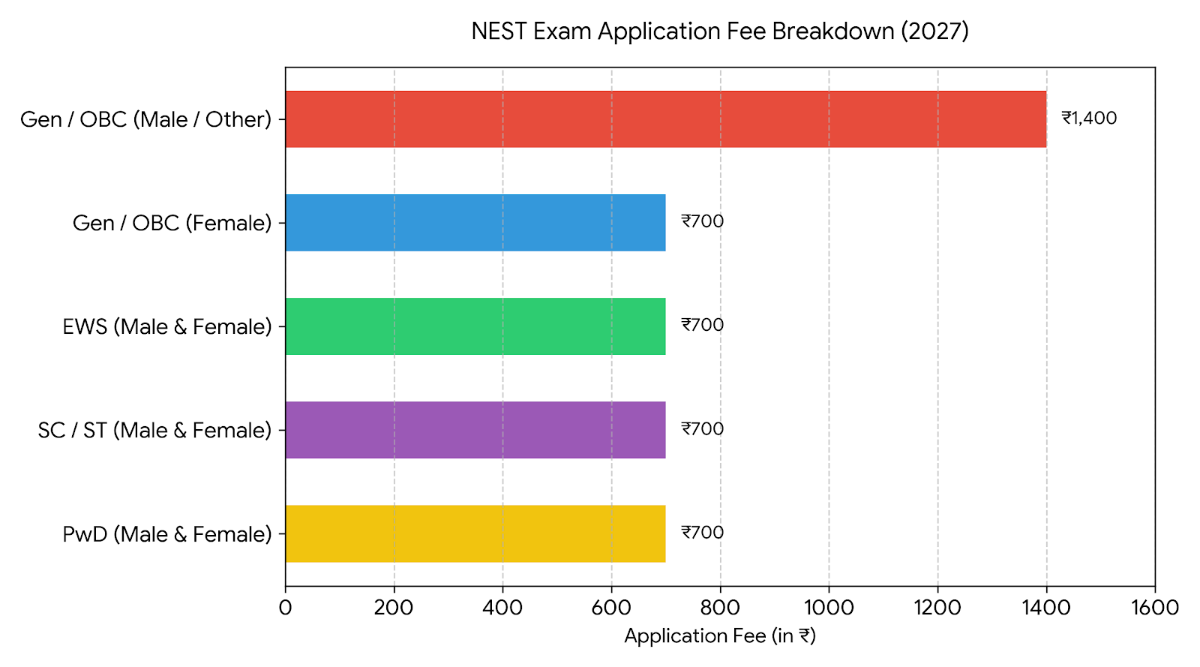
The NEST 2027 application fee structure relies on a combination of both gender and social category. The registration fee must be submitted via the online application portal using online modes such as UPI, Credit/Debit cards, or Net Banking. NEST exam fees are entirely non-refundable under all circumstances.
- All female applicants, irrespective of their caste category (General, OBC, SC, ST, or EWS), pay a flat, subsidized rate of ₹700.
- Historically, NEST keeps its registration portal active for about three months, with a buffer of a few extra days to clear pending application fees if a transaction fails near the final registration date.
| Category | Gender | Application Fee |
|---|---|---|
| General (Unreserved) / OBC | Male / Other | ₹1,400 |
| General (Unreserved) / OBC | Female | ₹700 |
| Economically Weaker Section (UR-EWS) | Male & Female | ₹700 |
| Scheduled Caste (SC) / Scheduled Tribe (ST) | Male & Female | ₹700 |
| Divyangjan (PwD / PwBD) | Male & Female | ₹700 |
Check Out:
NEST Exam Registration 2027
NEST exam registration details and process are entirely handled online through the NEST official website, NESTexam.in.
- Category Certificates: Candidates do not need to upload caste or reservation certificates during January registration. These are verified during the July counselling process.
- No Changes Allowed: Details such as Name, Email ID, Mobile Number, and Category cannot be changed during the April correction window.
| Step | NEST Registration Stage | Key Details |
|---|---|---|
| 1 | Create Account & Verify |
|
| 2 | Fill Application Form |
|
| 3 | Upload Documents |
|
| 4 | Pay Application Fee |
|
| 5 | Submit & Save Confirmation |
|
Ques. Where do I complete NEST exam registration?
Ans. NEST exam registration is completed entirely online through the NEST official website at NESTexam.in; no offline application mode is available.
Check Out:
- NEST 2026 Application Form (Out), Check Important Dates, Fee, and Process
- NEST 2016 Question Paper with Answer Key PDFs (May 28)
- NEST 2015 Question Paper with Answer Key PDFs (May 30)
This video discusses the process of NEST Registration Application filling, Personal Details, Qualification Details, Exam City, Document Details, and Payment Details to fill their NEST application form.
Documents Required for NEST 2027
For NEST registration, the following documents are required:
- Class 10 marksheet/certificate: Required for entering name, date of birth, and Class 10 roll number/registration number exactly as on the certificate (these details cannot be changed later).
- Class 12 marksheet (if passed): For academic qualification details. Candidates appearing in 2026 can select the “appearing” option.
- Recent passport-size colour photograph (scanned) and Scanned signature.
- Category certificate (if applicable): For SC, ST, OBC-NCL, or EWS. Must be valid and issued by a competent authority.
- PwD / Disability certificate (if applicable): Or UDID certificate, mentioning the percentage of disability (usually ≥40%).
- Valid photo ID proof details: Any one of: Aadhaar, Passport, Voter ID, PAN Card, Driving Licence, etc. Name must match the application.
- J&K / Ladakh domicile certificate (if claiming the supernumerary seats).
- Active email ID and mobile number.
- Debit/credit card, net banking, or UPI for the application fee.
Document specifications for uploading:
| Document | Format Requirement | File Size Window | Specifications |
|---|---|---|---|
| Passport-size Photograph | JPG / JPEG only | 1 KB to 80 KB | Recent photo (less than 6 months old) with a clear white background. No hats, masks, or sunglasses |
| Scanned Signature | JPG / JPEG only | 1 KB to 80 KB | Must be written using a blue or black ink pen on clean white paper |
Also Read:
NEST Exam Pattern 2027
The exam features exactly four subject-specific sections: Biology, Chemistry, Mathematics, and Physics.
- Exam Mode: NEST 2027 will be conducted as a Computer-Based Test (CBT) in online mode.
- Duration: Candidates will get 3 hours (180 minutes) to complete the exam.
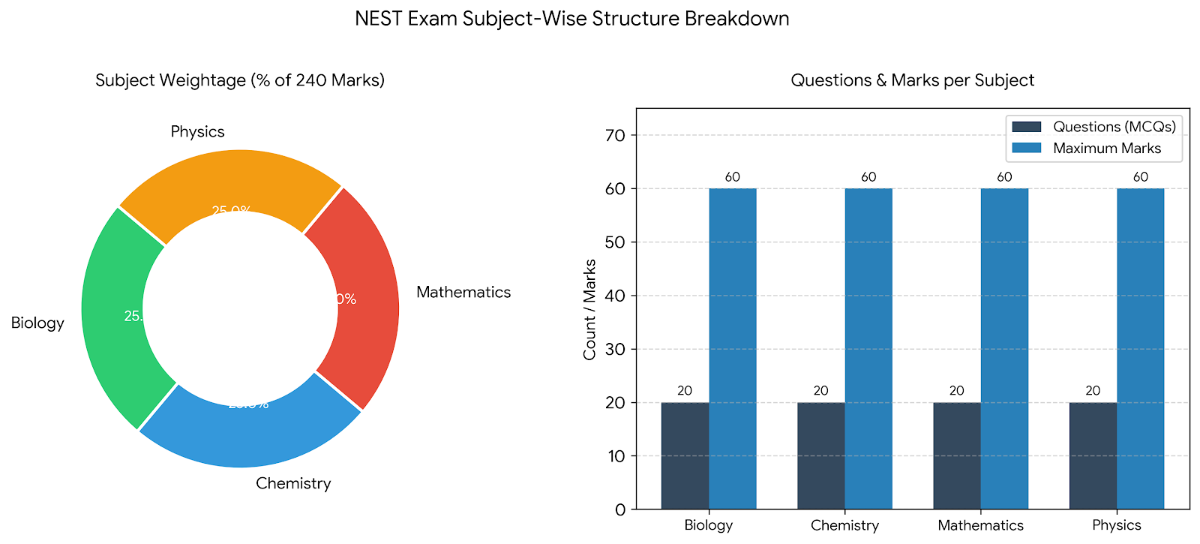
- Question Pattern: The paper will have 80 MCQs, with 20 questions each from the four sections.
- Marks & Medium: The exam carries 240 marks, with 60 marks per section, and is conducted in English and Hindi.
| Feature | Details |
|---|---|
| Exam Mode | Computer-Based Test (CBT) / Online |
| Total Test Duration | 3 Hours (180 minutes) |
| Question Type | Multiple Choice Questions (MCQs) with 4 options (single correct answer) |
| Total Questions | 80 questions (20 questions per section) |
| Total Test Marks | 240 marks (60 marks per section) |
| Medium of Exam | English and Hindi |
NEST Subject-Wise Weightage Breakdown
- Correct Answer: Candidates receive +3 marks for every correct answer.
- Incorrect Answer: An incorrect response results in a -1 mark penalty across all four sections.
- Unattempted: 0 marks are awarded or deducted for questions left unanswered.
| Section | Subject | Number of Questions | Maximum Marks |
|---|---|---|---|
| Section 1 | Biology | 20 MCQs | 60 Marks |
| Section 2 | Chemistry | 20 MCQs | 60 Marks |
| Section 3 | Mathematics | 20 MCQs | 60 Marks |
| Section 4 | Physics | 20 MCQs | 60 Marks |
| Total | All 4 Domains | 80 Questions | 240 Marks |
NEST Sample Paper: Download PDF
Download the NEST 2027 sample paper PDFs by section. Subject-wise sample papers with solutions are listed below.
| NEST Subject-wise Sample Paper | Direct Link |
|---|---|
| NEST Physics Sample Paper | Download PDF |
| NEST Biology Sample Paper | Download PDF |
| NEST Chemistry Sample Paper | Download PDF |
| NEST Mathematics Sample Paper | Download PDF |
NEST Exam Syllabus 2027
The NEST syllabus aligns with the rationalised NCERT Class 11 and Class 12 curriculum for Physics, Chemistry, Mathematics, and Biology.
- Physics: Focus on Mechanics, Thermodynamics, Electricity & Magnetism, Optics, and Modern Physics, along with Waves and Oscillations.
- Chemistry: The syllabus covers Physical, Inorganic, and Organic Chemistry, including Equilibrium, Chemical Bonding, Coordination Compounds, Hydrocarbons, and Biomolecules.
- Mathematics & Biology: Mathematics includes Algebra, Calculus, Coordinate Geometry, Vectors, Statistics and Probability, while Biology covers Cell Biology, Physiology, Genetics, Reproduction, Biotechnology, and Ecology.
| Subject | Major Topics Covered |
|---|---|
| Physics |
|
| Chemistry |
|
| Mathematics |
|
| Biology |
|
Ques. What is the NISER exam syllabus based on?
Ans. The NISER exam syllabus, tested through NEST, is based on the rationalised NCERT Class 11 and 12 curriculum across Physics, Chemistry, Mathematics, and Biology, with an emphasis on conceptual depth over rote formula application.
Ques. Is there a separate NEST exam syllabus for PCB students?
Ans. There isn't a formally separate syllabus, but the NEST exam syllabus for PCB students in practice means focusing on Physics, Chemistry, and Biology deeply while covering only the essential Mathematics topics needed to clear the Section-wise Minimum Admissible Score.
NEST Physics Sample Papers: Download PDF
| NEST Physics Sample Paper | Direct Link |
|---|---|
| NEST Physics Sample Paper 1 | Download PDF |
| NEST Physics Sample Paper 2 | Download PDF |
| NEST Physics Sample Paper 3 | Download PDF |
| NEST Physics Sample Paper 4 | Download PDF |
| NEST Physics Sample Paper 5 | Download PDF |
NEST Chemistry Sample Papers: Download PDF
| NEST Chemistry Sample Paper | Direct Link |
|---|---|
| NEST Chemistry Sample Paper 1 | Download PDF |
| NEST Chemistry Sample Paper 2 | Download PDF |
| NEST Chemistry Sample Paper 3 | Download PDF |
| NEST Chemistry Sample Paper 4 | Download PDF |
| NEST Chemistry Sample Paper 5 | Download PDF |
NEST Mathematics Sample Papers: Download PDF
| NEST Mathematics Sample Paper | Direct Link |
|---|---|
| NEST Mathematics Sample Paper 1 | Download PDF |
| NEST Mathematics Sample Paper 2 | Download PDF |
| NEST Mathematics Sample Paper 3 | Download PDF |
| NEST Mathematics Sample Paper 4 | Download PDF |
| NEST Mathematics Sample Paper 5 | Download PDF |
NEST Biology Sample Papers: Download PDF
| NEST Biology Sample Paper | Direct Link |
|---|---|
| NEST Biology Sample Paper 1 | Download PDF |
| NEST Biology Sample Paper 2 | Download PDF |
| NEST Biology Sample Paper 3 | Download PDF |
| NEST Biology Sample Paper 4 | Download PDF |
| NEST Biology Sample Paper 5 | Download PDF |
NEST Preparation Tips 2027
NEST 2027 preparation should focus on strong concepts, smart subject selection, accuracy, and regular PYQ practice rather than rote learning.
- Choose Your 3 Target Pillars Early: Decide whether your primary scoring combination will be PCM or PCB. Focus 80% of your energy on mastering these three subjects to perfection.
- Do Not Skip the 4th Subject Completely: Thanks to the SMAS rule, you must score a baseline minimum (usually around 4–5 marks out of 60) in all four sections to avoid disqualification.
- Accuracy > Speed: You have 3 hours to solve 60 core questions, 3 minutes per question. Avoid guessing wildly because the -1 negative marking can quickly destroy your rank.
| Subject | Preparation Tips |
|---|---|
| Physics |
|
| Chemistry |
|
| Mathematics |
|
| Biology |
|
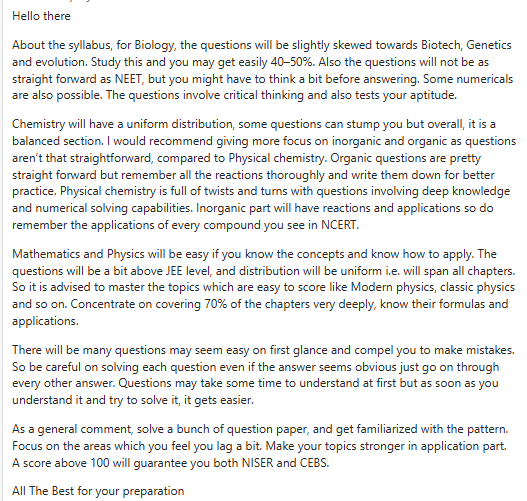
Students on Quora share the following tips for effective NEST preparation:
- Biology: Master Biotechnology, Genetics, and Evolution to secure 40–50% of the section, focusing on critical thinking and numerical problem-solving over simple recall.
- Chemistry: Memorize written Organic reactions, learn NCERT Inorganic compound applications, and practice complex Physical Chemistry numericals.
- Physics & Math: Deeply master at least 70% of the JEE-plus level syllabus—focusing on scoring areas like Modern Physics—by practicing core formulas and application.
- General Strategy: Solve past papers to avoid trap options and target a score above 100 to secure admission to both NISER and CEBS.

Source: Quora
Ques. How many years of NEST PYQs should I solve before the exam?
Ans. Most mentors recommend solving at least the last 5–6 years of NEST previous year question papers and NISER previous year question papers, since the conceptual style of questioning has stayed fairly consistent even as the exact pattern (duration, marking scheme) has evolved.
NEST Previous Year Question Papers with Answer Key PDF
| Exam Date | Session | Question Paper PDF |
|---|---|---|
| NEST 2023 Question Paper | Session 1 | Check here |
| NEST 2023 Question Paper | Session 2 | Check here |
| NEST 2022 Question Paper | Session 1 | Check Here |
| NEST 2022 Question Paper | Session 2 | Check Here |
| NEST 2021 Question Paper | Session 1 | Check Here |
| NEST 2021 Question Paper | Session 2 | Check Here |
| NEST 2020 Question Paper | Session 1 | Check Here |
| NEST 2020 Question Paper | Session 2 | Check Here |
NEST Exam Admit Card 2027
The NEST 2027 Admit Card will be released online in the third week of May 2027. It is a mandatory document issued only to candidates who complete their application and fee payment before the April deadline. It will contain:
- Candidate Details: Full Name, Roll Number, Category, and Photograph/Signature.
- Exam Logistics: Date of the Exam (first Saturday of June 2027), Allocated Session/Shift Timing.
- Test Center Details: Exact name and geographic address of your assigned Computer-Based Test (CBT) center.
- Exam Day Instructions: Code of conduct and list of prohibited items.
Also Read:
NEST Exam Result and Scorecard 2027
The NEST 2027 Results and Scorecards are expected to be declared in the fourth week of June 2027. Once the evaluation is complete, the merit lists will be published online, and candidates can download their individual scorecards from the portal.
How to Check NEST 2027 Results & Download Scorecard:
- Visit the official NEST website.
- Log in to the NEST application portal using your application details.
- Check your result, marks and merit rank.
- Download the scorecard, if made available, and keep a copy for counselling.
How NEST Calculates Your Score:
- SMAS: The Section-wise Minimum Admissible Score is 20% of the average of the best 100 scores in each section for the UR category. The 2026 brochure specifies reduced SMAS levels for reserved categories: 90% for OBC and 50% for SC/ST of the UR SMAS.
- Best Three Sections: A candidate must meet the SMAS in at least 3 of the 4 sections. The total score is then calculated using the three qualifying sections with the highest scores.
- Merit Ranking: NEST does not use a 50% of the top-100 average MAS as stated in your draft. Instead, it calculates a category-wise percentile from the total score and applies a Minimum Admissible Percentile (MAP) for preparing the rank list.
Because the computer-based exam is conducted in two separate sessions (Shift 1 and Shift 2), NEST uses a standard percentile-based score normalisation process, so your final scorecard displays both raw scores and a normalised percentile rank relative to your specific shift.
Also Read: NEST Result 2027: Expected June–July at nestexam.in, Counselling, Cutoff and Marks vs Rank
NEST Exam Cutoff 2027
The NEST 2027 cutoff is based on two key criteria rather than the total score alone: the Section-wise Minimum Admissible Score (SMAS) and the Minimum Admissible Percentile (MAP).
Minimum Admissible Percentile (MAP):
- General/EWS/J&K: Candidates need to secure at least the 95th percentile to meet the MAP requirement.
- OBC-NCL: The minimum MAP requirement is the 90th percentile.
- SC/ST/Divyangjan (PwD): Candidates must secure at least the 75th percentile.
| Category | MAP Cutoff Requirement (Percentile) |
|---|---|
| General / EWS / J&K | ≥ 95th Percentile |
| OBC-NCL | ≥ 90th Percentile |
| SC / ST / Divyangjan (PwD) | ≥ 75th Percentile |
Section-wise Minimum Admissible Score (SMAS):
SMAS is calculated separately for Physics, Chemistry, Mathematics, and Biology. For the General category, it is based on 20% of the average score of the top 100 candidates in each section.
- Section Requirement: Candidates must clear the SMAS in at least 3 of the 4 sections.
- Typical Range: Historically, General-category SMAS has been around 7–11 marks per section, compared with about 3.5–5.5 marks for SC/ST candidates.
- Institute Cutoffs: NISER and CEBS have different cutoffs because their seat intakes differ, with NISER having 200 seats and CEBS 57 seats.
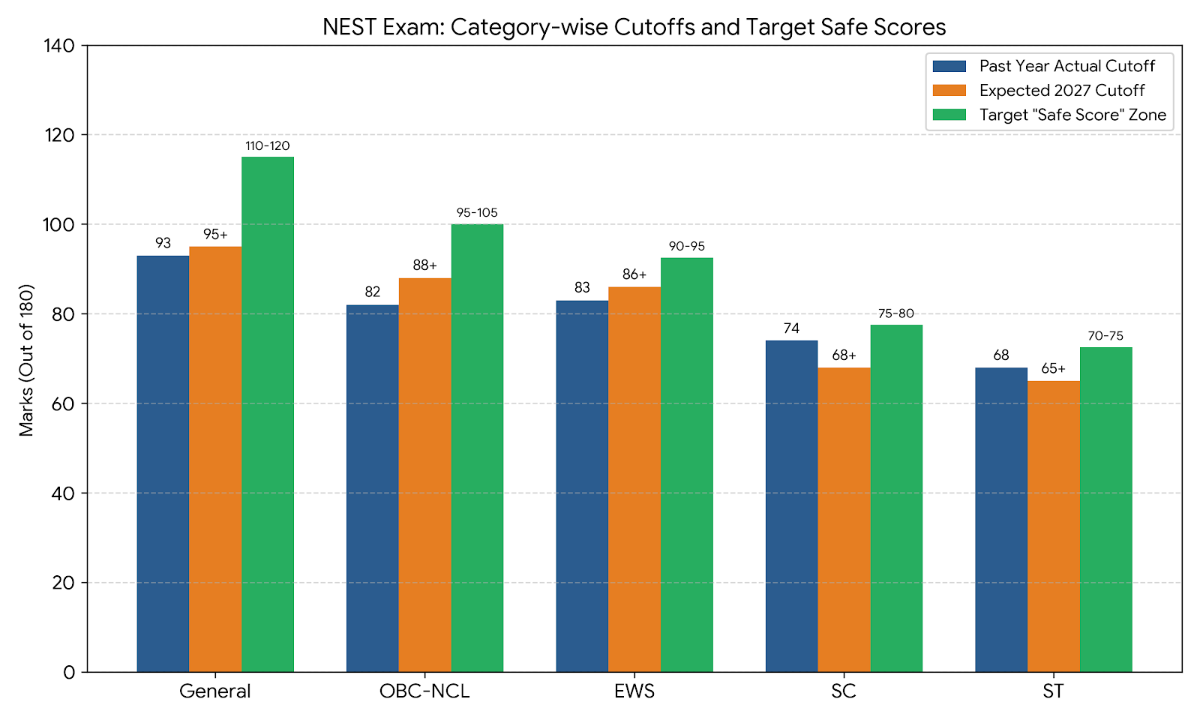
| Category | Past Year Actual Cutoff (Out of 180) | Expected NEST 2027 Admission Cutoff | Target "Safe Score" Zone |
|---|---|---|---|
| General | 93+ | 95+ Marks | 110 – 120 Marks |
| OBC-NCL | 82+ | 88+ Marks | 95 – 105 Marks |
| EWS | 83+ | 86+ Marks | 90 – 95 Marks |
| SC | 74+ | 68+ Marks | 75 – 80 Marks |
| ST | 68+ | 65+ Marks | 70 – 75 Marks |
NEST 2027: Marks vs Rank
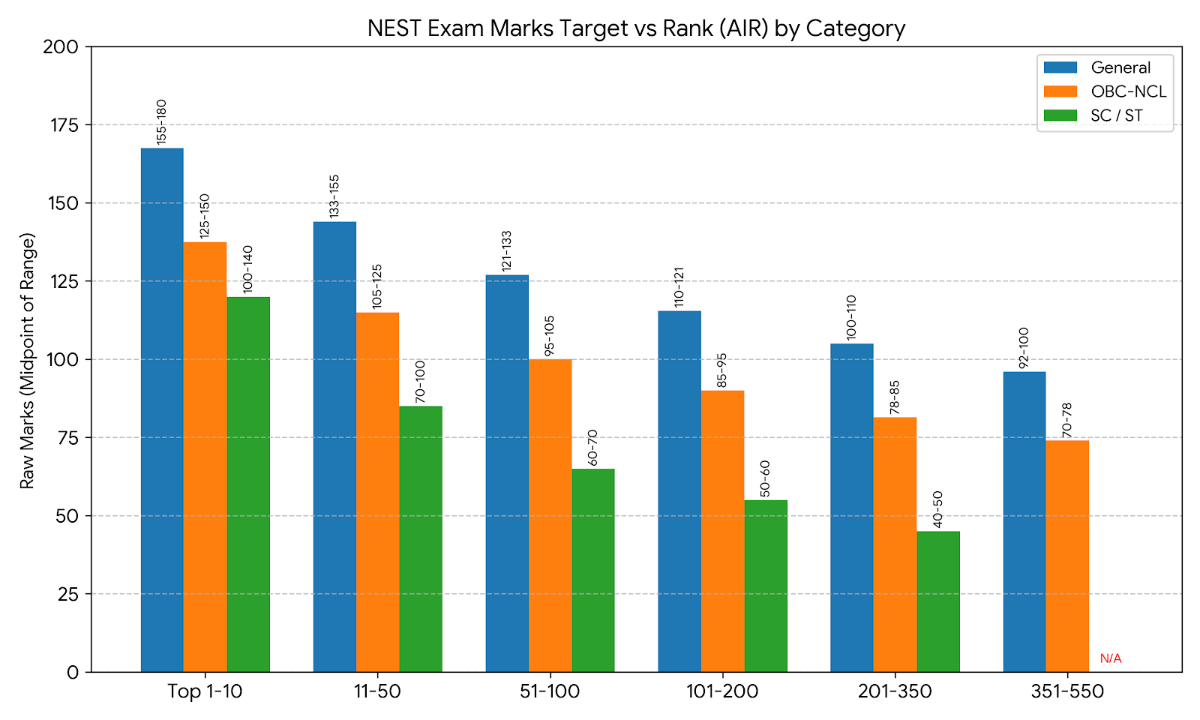
For NEST 2027, understanding the correlation between your marks and All India Rank (AIR) is unique because your rank is calculated out of an effective score of 180 marks, even though the question paper contains 80 questions totaling 240 marks.
- The NISER Safety Zone (AIR < 550): To ensure a first-round seat at NISER Bhubaneswar, General category students should target 110+ marks.
- The CEBS Safety Zone (AIR < 900): A score in the 95 to 105 marks bracket remains highly competitive for late-round seat allocations at UM-DAE CEBS Mumbai.
- The Qualifying Floor: Scoring below 80 marks in the General category makes it very difficult to clear the overall MAP requirement.
| Target Rank (AIR) | General (Raw Marks) | OBC-NCL (Raw Marks) | SC / ST (Raw Marks) |
|---|---|---|---|
| Top 1 – 10 | 155 – 180 | 125 – 150 | 100 – 140 |
| 11 – 50 | 133 – 155 | 105 – 125 | 70 – 100 |
| 51 – 100 | 121 – 133 | 95 – 105 | 60 – 70 |
| 101 – 200 | 110 – 121 | 85 – 95 | 50 – 60 |
| 201 – 350 | 100 – 110 | 78 – 85 | 40 – 50 |
| 351 – 550 | 92 – 100 | 70 – 78 | N/A (Seats full) |
Also Read:
NEST 2027: Counselling and Admission
NEST 2027 counselling is conducted separately by NISER and CEBS, with each institute following its own admission process and schedule.
- Separate Counselling: There is no common centralised counselling portal; NISER and CEBS conduct admissions independently.
- Multiple Rounds: Both institutes may release multiple admission/allotment lists to fill vacant seats.
- Seat Vacancies: Withdrawals after initial allotment can lead to further rounds of admission in July.
| Step | Admission Stage | NISER Bhubaneswar | UM-DAE CEBS Mumbai |
|---|---|---|---|
| 1 | EOI/Registration | Qualified candidates submit EOI online. | Candidates register online and select stream preferences. |
| 2 | Merit/Queue | Admission queue is prepared based on NEST rank. | Online merit/allotment lists are released. |
| 3 | Stream Allocation | Common first year; major selected later. | Major allocated at admission. |
| 4 | Seat Allotment | On-campus allotment with seat fee payment. | Online allotment with online fee payment. |
| 5 | Verification | Physical verification during admission. | Physical verification after online seat acceptance. |
| 6 | Waiting List | Vacancies filled from the verified waiting list. | Further online merit rounds fill vacant seats. |
Check Out:
Top NEST Colleges in India Accepting NEST Exam Score
The National Entrance Screening Test (NEST) is a highly specialized exam, and its scores are officially accepted by only two premier NISER colleges in India for admission into their flagship 5-year Integrated M.Sc. programmes, with a few additional universities accepting NEST as a secondary eligibility route.
- NISER Bhubaneswar: Offers 200 regular seats (+2 supernumerary J&K seats) for its 5-year Integrated M.Sc.
- UM-DAE CEBS Mumbai: Offers 57 regular seats (+2 supernumerary J&K seats) for its 5-year Integrated M.Sc.
| Institute | Programme | Real Seat Intake | Actual Target Score Details |
|---|---|---|---|
| NISER Bhubaneswar | 5-Year Integrated M.Sc. | 200 regular seats (+2 supernumerary for J&K) | ~120+ marks out of 180 |
| UM-DAE CEBS Mumbai | 5-Year Integrated M.Sc. | 57 regular seats (+2 supernumerary for J&K) | ~110+ marks out of 180 |
NEST Exam FAQs
Ques. What is NEST exam and which course does it lead to?
Ans. NEST exam is for admission into the 5-year Integrated M.Sc. programme in Biology, Chemistry, Mathematics, or Physics at NISER Bhubaneswar and UM-DAE CEBS Mumbai.
Ques. Is NISER university a good option compared to IITs or IISERs?
Ans. NISER Bhubaneswar (NISER BBSR) is a DAE-run, research-focused institute distinct from IITs and IISERs, though its route (NEST) and IISER's route (the IISER entrance exam / IAT) both lead to similar integrated science degrees; the choice depends on individual research interests and institute preferences.
Ques. What are the NEST exam dates I should track for 2027?
Ans. Key NEST exam dates for 2027 include registration opening in the first week of January, the exam itself on the first Saturday of June, and results in the fourth week of June — all subject to confirmation in the official notification.
Ques. What is the NEST exam registration process and fee?
Ans. NEST exam registration is completed online via NESTexam.in, with fees ranging from ₹700 (for female candidates across all categories, and EWS/SC/ST/PwD candidates) to ₹1,400 (for General/OBC male candidates).
Ques. Which NEST colleges in India accept the NEST score?
Ans. The primary NEST colleges are NISER Bhubaneswar and UM-DAE CEBS Mumbai; a few other universities like Visva-Bharati University (ISERC), Azim Premji University, and ITM University Gwalior also accept NEST scores as part of broader eligibility criteria.







Comments
Found 1 Comment
The notification for the regsitration process of NEST 2023 has not been released yet. The registration process for NEST 2023 is expected to begin in February 2023 and the examination to be conducted in June 2023.