



Education Journalist | Study Abroad Lead
Amphibians are a species of animals such as frogs, toads and salamanders that belong to Chordata phylum of the kingdom Animalia. They are vertebrates, which means they have backbones, and they are cold-blooded like reptiles. Amphibians, unlike reptiles, do not have scaly skin. Rather, their skin is usually soft and supple. The word amphibian comes from the Greek word ‘double-life’ referring to the fact that amphibians begin their lives in the water and breathe through their gills before evolving into lung-breathing land creatures, though most never leave the water. There are around 3000 species in this class. They are the earliest cold-blooded animals to appear on the surface of the earth.
| Table of Contents |
Key Terms: Vertebrates, Terrestrial, Evolution, Life Cycle, External Fertilisation, Poikilothermic, Tetrapods, Species, Animalia
Amphibia: Scientific Classification
[Click Here for Sample Questions]
The scientific classification of Amphibians is mentioned below:
- Kingdom: Animalia
- Phylum: Chordata
- Clade: Batrachomorpha
- Class: Amphibia
- Order: Anura, Caudata, Gymnophiona
Read More: Classification of Animal Kingdom

Classification of Kingdom Animalia
Evolutionary History
[Click Here for Sample Questions]
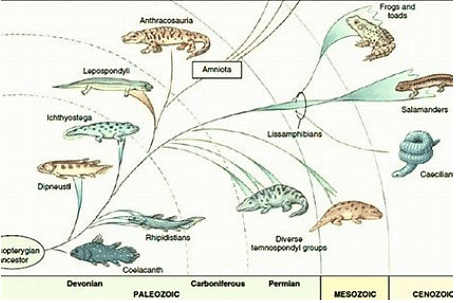
There are around 8,100 species of live amphibians. They were among the earliest animals to diverge from ancestral fish-tetrapod stock during the transition of animals from purely aquatic to terrestrial forms, first appearing roughly 340 million years ago during the middle Mississippian Epoch. The evolution of tetrapods from fishes signified a fundamental shift in body design from organisms that breathed and swam in water to organisms that breathed air and migrated onto land over a 50-million-year period during the Devonian period.
Microclimates arose as plants grew more abundant in the latter half of the Paleozoic, and ecosystems began to shift. Vertebrates travelled from the water to the land as plants and ecosystems grew and became more sophisticated. The presence of shoreline vegetation could have aided vertebrate migration onto land.
According to one theory, aquatic vertebrates' fins were employed to manoeuvre through this flora, paving the way for fin movement on land and the development of limbs. The late Paleozoic was a period of vertebrate diversification, as amniotes evolved and split into two distinct lines that gave rise to mammals on the one hand, and reptiles and birds on the other. Many marine vertebrates were extinct near the end of the Devonian period, about 360 million years ago, and both marine and terrestrial vertebrates were ravaged by a mass extinction 250 million years ago. Frogs and toads (order Anura), newts and salamanders (order Caudata), and caecilians (order Caudata) are the most common amphibians today (order Gymnophiona). Latimeria, a living fossil, now represents this ancestor.
Evolution of Amphibians
Read More: Origin of Life
Classification of Amphibia
[Click Here for Sample Questions]
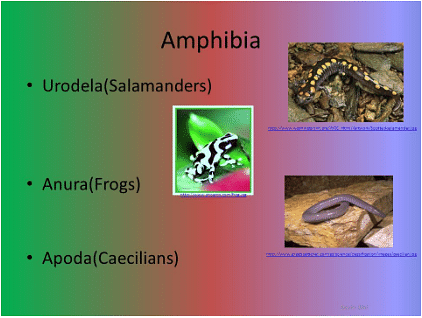
Amphibians are classified into three groups as mentioned below:
-
Apoda (Gymnophiona or Caecilia): The characteristics of Apoda are as follows:
- Apoda is a Greek word that means ‘without legs’. These organisms are limbless and have scales on their bodies.
- Because their eyes are covered by skin or bone, they are sometimes known as "blind-worms."
- The chemosensory sensors on their heads assist them in detecting their underground prey. Caecilians are an example.
- They have venom glands on their bodies.
- To prevent water loss, they release mucus.
-
Urodela (Caudata): The characteristics of Urodela are as follows:
- These are the creatures that have a tail, with an elongated body and four limbs of similar size.
- Internal fertilisation is accomplished using spermatophores.
- There aren't many disparities between male and female.
- They primarily breed in the winter in the southern United States.
- They live in leaf litter, soil and water.
- Their primary food sources are insects and worms. Salamanders are an example.
- The skin is smooth with the presence of poisonous glands and hidden gills.
-
Anura (Salientia): The characteristics of Anura are as follows:
- They are made up of four limbs. The front limbs have been lengthened and changed to allow for jumping.
- The head and trunk have become one.
- The tail is only present in the larval stage and disappears in adults.
- The eggs are laid in water after external fertilisation. Frogs and toads, for example.
Classification of Amphibia
Read More: Phylum Chordata Classification
Characteristics of Amphibians
[Click Here for Sample Questions]
The general characteristics of amphibians are as follows:
- Amphibians are creatures that can live both on land and in water. They have two modes of existence.
- Amphibians were the first vertebrates to migrate from an aquatic to a terrestrial lifestyle.
- Their bodies range in size from large to little, long to short, and cylindrical. The head, neck, trunk, and tail are the four sections that make up the body. In certain amphibians, the neck is missing.
- Amphibians are poikilothermic and the majority of its varieties hibernate during the winter. During the dry summer, some of them aestivate.
- Amphibians can be found in a variety of habitats, including freshwater and wetlands. There are no shapes that are found in the sea. Some frogs prefer to live in trees. Hyla (Tree Frog) is a good example.
- The skin has toxic glands and is smooth and wet, with a lot of multicellular mucus. In most species, it is very vascular and respiratory. The majority of the scales are missing (except Apoda).
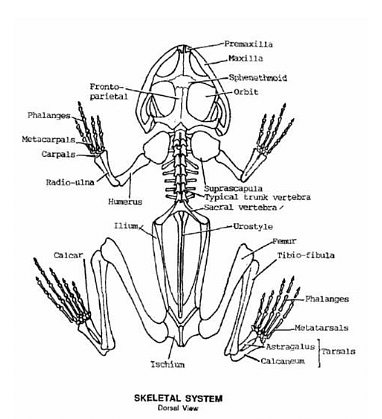
The skeletal system characteristics of amphibians are:
- Endoskeleton: It's mostly made up of bones. The skull is cacodylic, meaning it has two occipital condyles. The notochord does not last. The first vertebra is designed to give the head some movement.
- Appendages: Pentadactyl limbs come in two pairs, each with four to five pure digits. Legs are missing in certain amphibians (Apoda). For leaping, hindlimbs are larger than the four limbs found in frogs and toads. These are similar in size to those found in salamanders and newts. Claws, nails, and hoofs are absent from the digits, which are commonly covered in webs.
Skeletal System of Frog
Nervous System: The cranial nerves are divided into ten pairs. There is no ear on the outside. The middle ear which is protected by the tympanum has a single auditory ossicle in addition to the internal ear. Larvae and aquatic species both have lateral line sense organs.

Nervous System of Frog
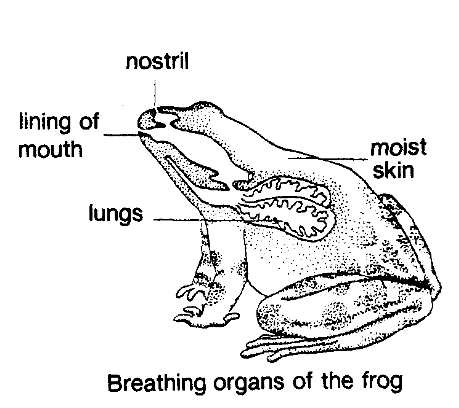
Respiratory System: Respiration is carried out by the lungs (pulmonary respiration), the buccopharyngeal cavity (buccopharyngeal respiration), the skin (cutaneous respiration), and the gills (Branchial respiration).
Respiratory System of Frog
Circulatory System: The heart is made up of three chambers: two auricles and one ventricle. This is a step forward from the two-chambered fish heart. The left and right auricles, respectively, receive blood from the lungs and the remainder of the body. The mixed blood is pumped out of the ventricle. There are sinus venosus and truncus arteriosus. The renal portal system has advanced significantly. Biconvex, oval, and nucleated RBC cells.
Read More: Circulatory System

Heart of Amphibians
Digestive System: The mouth is big, and the upper or both jaws are loaded with teeth. Teeth are acrodont, which means they are curved. Frogs and toads were the first vertebrates to develop a genuine tongue. In frogs and toads, a real tongue is a soft mucus-coated tongue that is attached at the front end. The cloaca is connected to the alimentary canal.

Digestive System of Frog
Reproductive System, Fertilisation & Development: The reproductive characteristics of amphibians are:
- Colada is the result of gonoducts.
- Sexual dimorphism is distinct from sexes.
- Males are devoid of a copulatory organ.
- They are oviparous, meaning they lay eggs. An aquatic larva (tadpole) is frequently found in amphibians' life history.
Read More: Difference between Frog and Toad

Reproductive System of Frog
Life Cycle of Amphibians
[Click Here for Sample Questions]
The detailed life cycle of amphibians is mentioned below:
- Amphibians have a biphasic life cycle, with aquatic eggs and larvae transforming into terrestrial or semi aquatic juveniles and adults.
- They commonly lay enormous numbers of eggs in water; the tiger salamander (Ambystoma tigrinum) can lay up to 5,000 eggs in a clutch, while giant bullfrogs (L. catesbeianus) can lay up to 45,000 eggs.
- The size of the egg and the temperature of the water both have an impact on how quickly an embryo develops.
- Many anuran species' eggs only take one or two days to develop in warm water, whereas eggs put in cold alpine lakes or streams may take 30 to 40 days to hatch.
- Salamander eggs take longer to develop, with hatching taking anywhere from 20 to 270 days following fertilisation.
Economic & Biological Significance of Amphibians
[Click Here for Sample Questions]
The economic and biological significance of amphibians is mentioned below:
- Amphibians are important members of the ecology as they play a vital role in many environmental food webs.
- Amphibians can outnumber all other terrestrial vertebrates, including birds, mammals, and reptiles, in temperate and tropical climates. Amphibians are significant invertebrate predators. Frogs, for example, regulate insect populations and provide food for a variety of larger creatures.
- Amphibians are also important because a considerable drop in amphibian diversity can result in a significant reduction in ecosystem health and sustainability, which can lead to a decline in human quality of life. Pest management, water filtering, and medical research are all made possible by amphibians.
- Amphibians play a vital role in our surroundings and the ecosystems in which they dwell. They are sensitive to pollution because their skins are naturally permeable, allowing them to absorb pollutants rapidly.
- A diversified group of amphibians indicates that the region is healthy and contributes to the survival of the animals and plants that herps require for food and cover.
- Some amphibians, such as snakes that devour rats and other rodents, operate as predators to keep the population of prey in check.
Read More: Difference between Reptiles and Amphibians
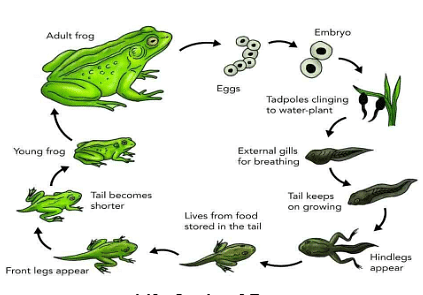
Life Cycle of Frog
Read More:
Things to Remember
- Amphibians are tetrapod vertebrates that include frogs, salamanders, and caecilians. They were the first terrestrial tetrapods that originated during the Devonian period.
- Amphibians have a moist, permeable skin that is maintained by mucus glands that keep the skin moist, allowing for exchange of oxygen and carbon dioxide with the environment (cutaneous respiration).
- The majority of amphibians reside on the ground, in marshes, or in woods; however, some species live in trees, and a few may survive in deserts and other arid environments. They prefer to live in a swampy environment with moist ground and warm water.
- There are around 6,770 species of amphibia that live in tropical and temperate locations around the world. Urodela, Anura, and Apoda are the three clades of amphibians.
- Amphibians respond to their surroundings' temperature by becoming that temperature. Frogs, for example, go through a metamorphosis process.
- Kidneys filter blood in adult amphibians. Urea is excreted as a nitrogen waste product (therefore, amphibians are ureotelic organisms).
- The larvae of these insects are aquatic and release ammonia.
Sample Questions
Ques. Which chordate family represents evidence of vertebrates transitioning from an aquatic to a terrestrial environment? (2 marks)
Ans. Amphibians are entirely aquatic as larvae and only partly terrestrial as adults. As a result, they are thought to be intermediary creatures in the evolution of vertebrates from aquatic to terrestrial environments. Amphibians are also the first tetrapod animals, meaning they are the first vertebrates to have two pairs of limbs. The term "amphibian" stems from the fact that these animals have a dual existence (aquatic as larvae and somewhat terrestrial as adults).
Ques. How does a fish's respiration differ from that of an adult amphibian? (2 marks)
Ans. Gas exchange occurs in fish when water comes into direct contact with the branchiae (gills). The gills allow gases to enter and exit circulation. Adult amphibians breathe through both their moist and permeable skin (cutaneous respiration) and their lungs, which are made up of a series of tiny airway terminations coupled to highly vascularized tissue specialised in gas exchange. The axolotl is a rare amphibian that lives in water and breathes through its gills even as an adult.
Ques. How does the heart of an amphibian vary from that of a fish? What characteristics of amphibians make them water-dependent for survival? (3 marks)
Amphibians have permeable skin, a dehydrated body, external fertilisation, eggs without shells, and a larval stage with branchial respiration, all of which make them reliant on water to thrive.
Ques. Using representative species, fundamental morphology, skin, respiration, circulation, nitrogen waste, heat regulation, and reproduction types, how may amphibians be classified? (2 marks)
Ans. Frogs, toads, and salamanders are examples of representative species. Two pairs of arms, eyelids, and hydrodynamic larvae make up the basic morphology. Mucous glands, wet and porous skin During the larval stage, the larvae have cutaneous and pulmonary respiration, which is branchial. Circulation: the heart is closed and completed, with three chambers and no interventricular septum. Urea is a nitrogen waste product. Heterothermic thermal control. Sexual, water-dependent, external fertilisation, and aquatic larval stage are the several types of reproduction.
Ques. Is amphibian fertilisation external or internal? Are amphibians more closely related to fish or reptiles in this regard? (2 marks)
Ans. Fertilisation occurs externally in the majority of amphibian species. This is also seen in bony fishes, indicating that amphibians have acquired the reproductive system and embryonic development from osteichthyes. Amphibian males and females copulate to induce the release of sperm and egg cells, despite the fact that they use external fertilisation. Because the gametes combine in water, this process is not categorised as internal fertilisation.
Ques. What's the difference between reptiles and amphibians? (3 marks)
Ans. One of the most notable differences between amphibians and reptiles is that juvenile amphibians go through a metamorphosis process during which they switch from using their gills to using their lungs for respiration. Another notable distinction is that reptiles have scaly skin, whereas amphibians have wet skin. Reptiles reproduce by laying leathery or soft hard eggs on land or keeping them in their bodies until they hatch.
Soft eggs are frequently placed in water or medium by amphibians. The yolk sac of an amphibian egg is encased in one or more layers of a jelly-like coating. The self-contained reptile egg protects the embryo against dehydration. Alligators, lizards, snakes, and turtles are reptiles. Amphibians include frogs, toads, salamanders, and newts.
Ques. Name some animals belonging to class Amphibia? (3 marks)
Ans. Amphibians are a class of animals that belong to the phylum chordata of kingdom animalia. Among other things, animals in the Chordata phylum have a backbone, hence, they are vertebrates. This class has three sub-groups. The animals of this class possess some unique characteristics such as internal gills, external fertilisation, and three chambered hearts. Examples of animals belonging to class Amphibians are :
- Northern Leopard Frog: This frog is tailless, mostly nocturnal amphibian with a spotted body that is covered with ridges. It is found mainly in North America.
- Wood Frog: These are also tailless amphibians found mostly in the woods of North America. They feed on various small animals.
- Common Frog: These are squat tailless amphibians usually found on land, mostly in Europe. They feed on various small animals.
Read More:



Comments