



Content Curator
Amplitude modulation (AM) is a modulation technology used for communication purposes, mainly for radio wave transmission.
- Amplitude modulation includes changing the amplitude of the wave (signal intensity) in accordance with the message signal, such as an audio signal.
- This technology is different from angle modulation, in which either the frequency of the carrier wave is changed (frequency modulation), or its phase (phase modulation) in accordance with the message signal.
- The first audio modulation technique used in radio broadcasting was AM. Roberto Landell de Moura and Reginald Fessenden developed it in 1900 with their radiotelephone experiments.
- The original form of AM is sometimes referred to as double-sideband amplitude modulation (DSBAM).
Key Terms: Modulation, Bandwidth, Waves, Modulation index, Demodulation, Amplitude modulation, Frequency, Phase, Amplitude, Need of modulation
Modulation
[Click Here for Sample Questions]
The process of mounting or superimposing a very low-frequency signal over a high-frequency signal or carrier wave is known as modulation.
Different types of modulation are
- Amplitude Modulation: It is a type of modulation in which the frequency and phase of the carrier wave are constant but the amplitude of the carrier wave varies in accordance with the amplitude of the very low-frequency signal.
- Frequency Modulation: It is a type of modulation in which the amplitude and phase of the carrier wave are constant but the frequency of the carrier wave varies in accordance with the frequency of the very low-frequency signal.
- Phase Modulation: It is a type of modulation in which the frequency and amplitude of the carrier wave are constant but the phase of the carrier wave varies in accordance with the phase of the very low-frequency signal.

Types of modulation
Amplitude Modulation
[Click Here for Previous Year Questions]
Amplitude modulation or simply AM is generally defined as a type of modulation in which the magnitude of the carrier wave changes in accordance with the modulating data or signal.
- One of the first modulation techniques used for radio communication is amplitude modulation.
- This method was developed in the 20th century when Landell de Moura and Reginald Fessenden were performing tests with a radiotelephone in the 1900s.
- The modulation technique was created and employed in electronic communication after several successful efforts.
- In this process the voltage and the power level of the information to be sent change the amplitude of the carrier wave.
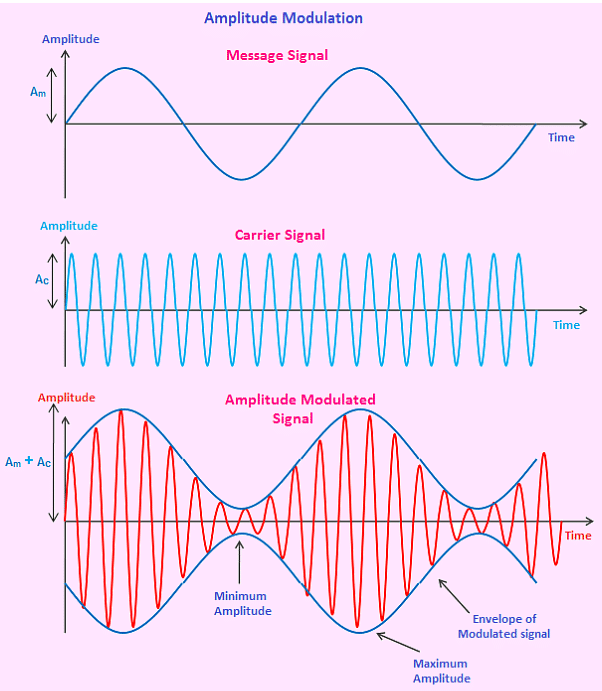
Amplitude modulation
Types of Amplitude Modulation
[Click Here for Sample Questions]
There are mainly three types of amplitude modulation
- Double Sideband-suppressed Carrier Modulation (DSB-SC): Double Sideband Full Carrier is a modulation technique used for the transmission of a signal that consists of a carrier along with two sidebands.
- Single Sideband Modulation (SSB): It is an amplitude modulation technique in which only a single sideband is transmitted through the channel. It is also known as Single Sideband Suppressed Carrier (SSB-SC).
- Vestigial Sideband Modulation (VSB): This technique of amplitude modulation involves modulating one sideband and the vestige portion of the signal.
Designations by ITU
In 1982, the International Telecommunication Union (ITU) categorized many amplitude modulation methods. These are
| Designations | Descriptions |
|---|---|
| R3E | Single-sideband reduced-carrier |
| J3E | Single-sideband suppressed-carrier |
| C3F | Vestigial-sideband |
| A3E | Double-sideband a full-carrier |
| H3E | Single-sideband full-carrier |
| B8E | Independent-sideband emission |
| Lincompex | Linked compressor and expander |
Expression for Amplitude Modulated Wave
[Click Here for Previous Year Questions]
The carrier wave can be represented by
ec = Ec sin ωct
Where
- ec is the instantaneous voltage
- ωc is the angular frequency
The modulating signal can be represented by
em = Em sin ωmt
Thus, the amplitude-modulated (AM) wave is represented by
e = (Ec + em) sin ωct
⇒ e = (Ec + Em sin ωmt) sin ωct
⇒ e = Ec [1+ Em/Ec sin ωmt] sin ωct
⇒ e = Ec [1+ ma sin ωmt] sin ωct
⇒ e = Ec sin ωct + Ec ma sin ωmt sin ωct
Where ma = Em/Ec is the modulation index
Using sin A + sin B = 1/2[cos (B - A) - cos (B + A)], we get
e = Ec sin ωct + (maEc)/2 cos (ωc - ωm)t - (maEc)/2 cos (ωc + ωm)t
Here (ωc - ωm) and (ωc + ωm) are respectively called lower side and upper side frequencies.
Frequencies of Amplitude-Modulated Wave
[Click Here for Sample Questions]
The amplitude-modulated wave contains three frequencies f1, f2, and f3 corresponding to ωc, (ωc - ωm), and (ωc + ωm). Where
- ωc corresponds to f1 known as carrier wave frequency.
- (ωc - ωm) corresponds to f2 known as lower sideband frequency.
- (ωc +ωm) corresponds to f3 known as upper sideband frequency.
The frequency spectrum of AM wave is shown in the figure

The frequency spectrum of AM wave
Bandwidth
The difference between the highest and lowest frequencies of the amplitude-modulated signal is known as its bandwidth.
Bandwidth, BW = Upper sideband frequency (fmax) - Lower sideband frequency (fmin)
⇒ BW = (fc + fm) - (fc - fm) = 2fm
Hence, the bandwidth of the amplitude-modulated signal is twice the frequency of the modulating signal.
Modulation Index
[Click Here for Previous Year Questions]
The modulation index determines the quality of the modulated wave. It is given by the ratio of the amplitude of the modulating signal (Am) to the amplitude of the carrier wave (Ac).
Modulation index, ma = Am / Ac = (Emax - Emin) / (Emax + Emin)
- If ma = 0, then there is no modulation.
- If ma = 1/2, then Emax is three times the Emin
- If ma = 1, then Emin becomes zero
- If ma > 1, then there is over-modulation, in this case, the negative portion of AM wave is absent and hence the information contained will be distorted.
Read More:
| Relevant Concepts | ||
|---|---|---|
| Difference Between AM and FM | Pulse Amplitude Modulation | Ground Wave Propagation |
Why Do We Need Modulation?
[Click Here for Sample Questions]
Low-frequency signals cannot travel large distances. The other factors responsible for not allowing the transmission of baseband signals from one place to another are:
- Height of the antenna
- Effective power radiated by an antenna
- Mixing up of signals from different transmitters
Height of the antenna
The height of the transmitting antenna must be of the order of wavelength λ of the transmitting signal. The minimum height of the transmitting antenna for transmitting the voice frequency signal is λ/4.
If a 15 kHz signal is to be transmitted, then the wavelength corresponding to this signal is given by
λ = c/f = (3 x 10⁸) / (15 x 103) = 2 x 10⁴ m = 20 km
Hence the minimum height of the antenna = λ/4 = 20/4 = 5 km
It is impossible to erect such a tall antenna.
On the other hand if a 106 Hz (1 MHz) signal is to be transmitted, then the wavelength corresponding to this signal is given by
λ = c/f = (3 x 10⁸) / (1 x 10⁶) = 300 m
Hence the minimum height of the antenna = 300/4 = 75 m
The antenna of such height is practicable.
Thus, we conclude that a signal of low frequency can be transmitted easily through a transmitting antenna if we manage to use high-frequency waves for transporting the signal.
Effective Power Radiated by Antenna
Power radiated by a dish antenna is given by
P = 6(D/λ)2
Where
- D is the diameter of the disc
- λ is the wavelength of the radiation
Similarly power radiated by the linear antenna is proportional to P ∝ 1/λ2
This indicated that power radiated is more for shorter wavelength i.e. for high-frequency waves.
For covering more area, power radiated should be more which is possible with high-frequency transmission.
Mixing up of signals from different transmitters
Another problem of transmitting very low-frequency signals directly is that various voice frequency signals from different transmitters get mixed up and it is difficult to distinguish these signals at receiving station.
For differentiating signals, a particular portion of the frequency spectrum has to be assigned to a particular signal so that only the desired signal is selected at the receiving station and the remaining signals are rejected.
Detection of an Amplitude-Modulated Wave
[Click Here for Previous Year Questions]
The process of extracting the audio signals from the modulated waves is known as Demodulation. The device used for demodulating the signal is known as a demodulator.
The process of demodulation is
- A receiving antenna receives the AM signal.
- This high-frequency signal is amplified and then fed to the intermediate frequency stage to change it to a low-frequency signal before sending it to the demodulator.
- The demodulator extracts the audio frequency signal from the high-frequency carrier wave.
- Ans then the audio frequency wave is amplified by an amplifier.
- The amplified audio frequency signal is the required output of the receiver.
Applications of Amplitude Modulation
[Click Here for Sample Questions]
The following are the applications of amplitude modulation
- Broadcasting transmissions using AM are made using short, medium, and long wavebands. Amplitude modulation radio receivers are consequently simpler and more affordable to produce since AM is simple to demodulate.
- Many airborne applications, such as ground-to-air radio communications or two-way radio connections for ground staff workers, utilize AM in VHF broadcasts.
- Single side-band amplitude modulation is used for point-to-point or HF radio communication. AM makes better use of the transmitted power and has a smaller bandwidth.
- Data can be transmitted using quadrature amplitude modulation through short-range wireless networks like Wi-Fi to cellular telephones, among other methods.
Advantages of Amplitude Modulation
[Click Here for Previous Year Questions]
The advantages of amplitude modulation are
- Amplitude modulation is inexpensive.
- Amplitude-modulated signals are reflected by the earth from the ionosphere layer, allowing them to travel further and cover a larger region.
- The required carrier frequency is minimal.
- It requires the use of a basic transmitter and receiver.
- As a result, audio signal transmission and reception are simplified.
- The use of a circuit with minimal components makes amplitude-modulated signal demonstration less difficult.
Disadvantages of Amplitude Modulation
[Click Here for Sample Questions]
The disadvantages of amplitude modulation are
- Amplitude-modulated communications are extremely vulnerable to background noise.
- It is difficult for receivers of these signals to differentiate between signals and noise.
- As a result, the audio signal's quality is low.
- If the amplitude-modulated signal is weak, a complex configuration is required for the receiver.
- In terms of bandwidth utilization, amplitude modulation is less efficient.
- The modulated signal's bandwidth is twice the frequency of the signal wave.
- Amplitude modulation is similarly inefficient in terms of power consumption.
- Only the sideband power is used.
Things to Remember
- Modulation is the process of superimposing a very low-frequency signal over a high-frequency signal.
- Amplitude modulation is a type of modulation in which the frequency and phase of the carrier wave remain unchanged but the amplitude of the carrier wave varies in accordance with the amplitude of the very low-frequency signal.
- The three types of amplitude modulation are Double Sideband-suppressed Carrier Modulation, Single Sideband Modulation, and Vestigial Sideband Modulation.
- The amplitude-modulated wave is represented by
e = Ec sin ωct +(maEc)/2 cos (ωc - ωm)t - (maEc)/2 cos (ωc + ωm)t
- The bandwidth of the amplitude-modulated signal is twice the frequency of the modulating signal.
- The modulation index is given by the ratio of the amplitude of the modulating signal to the amplitude of the carrier wave.
Previous Year Questions
- Extraction of metal from the ore cassiterite involves...[JEE Advanced 2011]
- Commonly used vectors for human genome sequencing are...[NEET UG 2014]
- Interfascicular cambium and cork cambium are formed due to..
- Pneumotaxic centre is present in...[UP CPMT 2007]
- Reaction of HBr with propene in the presence of peroxide gives….[NEET UG 2004]
- Assuming the expression for the pressure exerted by the gas on the walls of the container, it can be shown that pressure is...[MHT CET 2016]
- Which among the following is the strongest acid?...[TS EAMCET 2017]
- Isopropyl alcohol on oxidation forms..
- A vector is not changed if..
- Which of the following arrangements does not represent the correct order of the property stated against it?...[JEE Main 2013]
- The major product of the following reaction is...[JEE Main 2019]
- Major product of the following reaction is..[JEE Main 2023]
- The percentage of nitrogen in urea is about..
- The electric field at a point is
- Which of the following statements is true?..[JKCET 2006]
Sample Questions
Ques. What is modulation? (2 Marks)
Ans. The technique of transforming data into radio waves by adding information to an electrical or optical carrier signal is known as modulation. A carrier signal has a consistent height or amplitude and frequency and a stable waveform.
Ques. What is amplitude modulation? (2 Marks)
Ans. Amplitude modulation (AM) is a modulation method used in electronic communication, mainly for delivering messages using a radio carrier wave. The amplitude (signal intensity) of the carrier wave changes in proportion to that of the message signal, such as an audio signal, in amplitude modulation.
Ques. What is the main difference between AM and FM? (2 Marks)
Ans. Amplitude modulation (AM) and frequency modulation (FM) are methods of transmitting data that involve changing a carrier signal. The main difference between the two modulations is that in frequency modulation, the carrier wave frequency varies according to the sent data. whereas, in amplitude modulation, the amplitude of the carrier wave changes.
Ques. What are the applications of amplitude modulation? (3 Marks)
Ans. The applications of amplitude modulation are
- Because it can receive many signals on the same channel, AM is more widely used for pilot-to-ground control communications than other systems like as FM.
- AM continues to service the long, medium, and short wave bands. Even though the equipment is simple to demodulate and has a low production cost, it is less costly.
- A single sideband of amplitude modulation waves has traditionally been used in high-frequency radio links. Lower bandwidth is also used, which allows for more efficient use of transmitted power. Many high-frequency point-to-point lines still use this technology.
Ques. What is the demodulation process? (2 Marks)
Ans. Demodulation is the process of separation of the original information or signals from the modulated carrier signal. In the case of amplitude or frequency modulation, a device known as a demodulator or detector generates a signal that corresponds to instantaneous changes in amplitude or frequency, respectively.
Ques. What is the process of demodulation of an AM signal? (3 Marks)
Ans. The demodulation process of AM wave is
- The AM signal is received by a receiving antenna.
- This high-frequency signal is amplified and then sent to the intermediate frequency stage, where it is converted to a low-frequency signal before being sent to the demodulator.
- The audio frequency signal is extracted from the high-frequency carrier wave by the demodulator.
- The audio frequency wave is then amplified using an amplifier.
- The receiver's necessary output is the amplified audio frequency signal.
Ques. What are the different types of amplitude modulation? (2 Marks)
Ans. There are mainly three types of amplitude modulation
- Double Sideband-suppressed Carrier Modulation (DSB-SC)
- Single Sideband Modulation (SSB)
- Vestigial Sideband Modulation (VSB)
Ques. What are the advantages of amplitude modulation? (3 Marks)
Ans. The advantages of amplitude modulation are as follows:
- Amplitude modulation is a low-cost technology.
- The earth reflects amplitude-modulated signals from the ionosphere layer, allowing them to travel further and cover a larger region.
- The needed carrier frequency is really low.
- It requires the use of a simple transmitter and receiver.
- As a result, audio signal transmission and reception become more simple.
For Latest Updates on Upcoming Board Exams, Click Here: https://t.me/class_10_12_board_updates
Check-Out:



Comments