



Education Content Expert
Antimatter is a matter made up of the antiparticles of the corresponding particles in ordinary matter. It is a substance made up of subatomic particles that have the mass, electric charge, and magnetic moment of electrons, protons, and neutrons but have the opposite sign of the electric charge and magnetic moment.
- Antimatter was created alongside matter following the Big Bang.
- The concept of antimatter developed from a theoretical examination of the duality of positive and negative charge.
- Antimatter is extremely rare in the universe in today’s time.
- Antimatter is made up of antiparticles, which are charged in the opposite direction as regular particles.
Read More: Mass Energy Equivalence
Key Terms: Antimatter, Antiparticles, Matter, Electron, Positron, Big Bang Theory, Protons, Electron, Subatomic Particles
What is Antimatter?
[Click Here for Sample Questions]
Antimatter is a substance composed of contaminants that have a similar mass, electric charge, and magnet moment as bad particles, protons, and neutrons. Positrons are the antimatter particles that correspond to electrons, protons, and neutrons. They are denoted by positrons e+, antiprotons by p, and antineutrons by n.
- They are collectively referred to as antiparticles. The electrical properties of antimatter are opposed to those of ordinary matter.
- A negatively charged electron, for example, has an antimatter partner known as a positron.
- Some positron can be an electron that is charged by having an ion and whose mass is equivalent to regarding the electron.
- The positron has a positive charge and the antiproton has a negative charge.
- Antineutron, despite being electrically neutral, has a magnetic moment with the same opposite sign as the neutron.
- Antimatter is identical to ordinary matter except for its opposite electric charge.
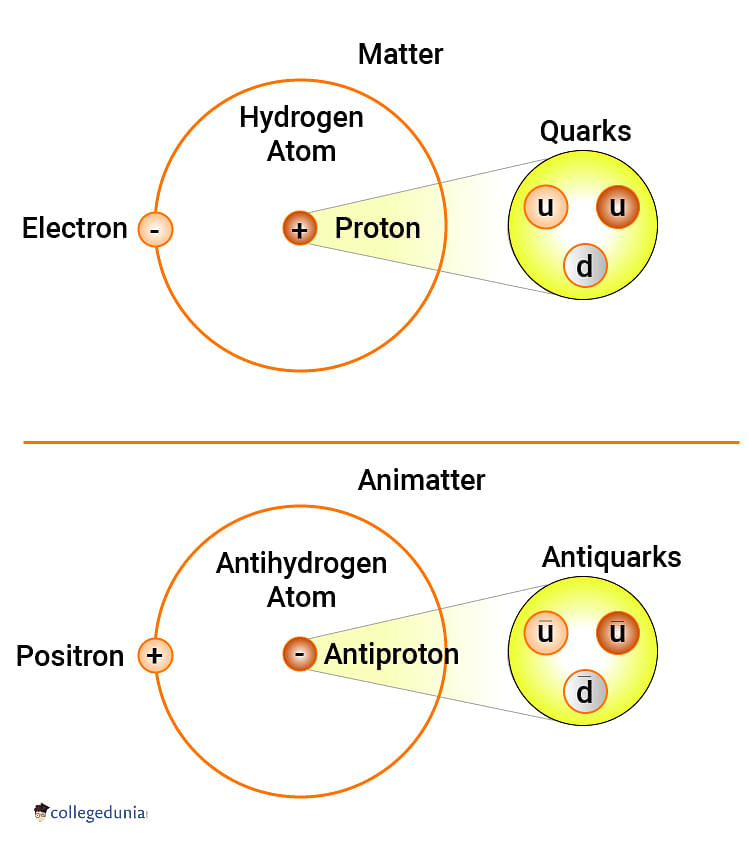
Antimatter
Antimatter Predicted by Paul Dirac
[Click Here for Sample Questions]
Paul Dirac combined special relativity and quantum theory in 1928 to decipher the nature of an electron traveling at a relativistic speed.
- This equation has two possible solutions- one for a negative-energy electron and one for a positive-energy electron.
- However, classical physics at the time concluded that a particle's energy should always be positive.
- To solve this problem, Dirac dissected the equation and concluded that each particle has a corresponding antiparticle.
- It has the same properties as the particle but has the opposite charge.
- An electron and its antiparticle, the positron, for example, share the same properties but have opposite charges.
- This prediction opens up an entirely new realm of possibilities, including celestial bodies and other universes made of antimatter.
Read More:
| Relevant Concepts | ||
|---|---|---|
| Beta Decay | Alpha Decay | Nucleon |
| Neutron Mass | Nucleation | Binding Energy Formula |
| Polonium | Plutonium | Carbon Dating |
What are Antiparticles?
[Click Here for Sample Questions]
Antiparticle is a subatomic particle with the same mass as its normal particle counterpart but the opposite magnetic moment and electric charge.
- A positron, for example, is an electron's antiparticle.
- It is simply a particle with all of the characteristics of an electron except the charge.
- Neutron is an uncharged subatomic particle with a speed very close to that of light.
- When viewed from behind, it spins anticlockwise.
- On the other hand, antineutrino rotates clockwise.
- A particle and its antiparticle annihilate each other to create energy.

Antiparticle
Matter and Antimatter
[Click Here for Sample Questions]
The primary distinction between matter and antimatter is that they have opposing electrical charges. Antimatter is the polar opposite of matter, but they share all properties except electrical charge.
Matter
- Matter is everything that is made up of protons (positively charged subatomic particles), electrons (negatively charged subatomic particles), and neutrons (subatomic particles with no charge).
- All of these particles combine to form what we consider atoms.
- The protons and neutrons make up the nucleus, which is the core of the atom, and the electrons orbit the nucleus like a planet orbiting a star.
Antimatter
- In antimatter, each particle's charge is inverted.
- An anti-proton with a negative charge is the antimatter analog of a proton.
- Instead of an electron, its antimatter counterpart is referred to as a positron with a positive charge.
- The neutron is an exception to this rule, as its antimatter twin, the anti-neutron, possesses the same characteristics (since a neutron has no charge, its anti-form would retain no charge).
Cern’s Antimatter
[Click Here for Sample Questions]
Prof. Walter Oelert and a global team from Jülich IKP-KFA, Erlangen-Nuernberg University, GSI Darmstadt, and Genoa University succeeded for the first time in synthesizing antimatter atoms from component antiparticles in September 1995.
- Over the course of three weeks, nine of these atoms were created by collisions between antiprotons and xenon atoms.
- Each one existed for around forty billionths of a second, traveled at nearly the speed of light across a ten-meter course, and was subsequently obliterated by regular matter.
- The annihilation provided a signal indicating the formation of anti-atoms.
Many experiments at CERN produce antimatter. Because of their high energy, the antiparticles produced in collisions at the Large Hadron Collider cannot be trapped and annihilated harmlessly in the detectors. CERN's antiproton decelerator creates much slower antiprotons that can be trapped. These antiprotons can then be studied to find out whether antiparticles fall upward.
How to Make Antimatter?
[Click Here for Sample Questions]
First, a very good vacuum is required so that the antimatter does not accidentally collide with a stray atom in the air. Then keep it away from the edges of the container, which are also formed of matter. Magnetic bottle employs electric and magnetic forces to confine antimatter.
- Protons with an energy of 26 GeV (about 30 times their rest mass) collide with nuclei inside a metal cylinder known as a target at CERN.
- Four proton-antiproton pairs are produced for every million collisions.
- Using magnetic fields, antiprotons are separated from other particles and guided to the antiproton decelerator, where they are slowed from 96% to 10% of the speed of light.
- They are ejected and transported through beam pipes into experiments, where they are trapped and stored.
Antimatter and Big Bang
[Click Here for Sample Questions]
Various theories in Physics claim that the universe emerged from a singularity about 13 billion years ago. During that moment, the antimatter and matter co-existed in equal quantities because laws of nature point towards the creation of antimatter and matter in equal pairs. However, there was a certain imbalance. Just after the big bang, ordinary matter started to dominate.
- There existed a billion and one particle for every billion antiparticles.
- Thus, there was enough ordinary matter to begin the creation of the universe.
- Every billion antimatter had been destroyed with a billion ordinary matter just a few nanoseconds after the big bang.
- Owing to the strange imbalance, the ordinary matter that was left started to build atoms, molecules, galaxies, planets, stars and everything in this universe.

Big Bang
Antimatter in Real World
[Click Here for Sample Questions]
Antimatter is detected in nature several times in cosmic rays. New particles are formed as cosmic rays zip into the Earth’s atmosphere.
- In 1932, Carl Anderson analyzed tracks created by cosmic rays in a cloud chamber in 1932.
- A weird phenomenon took place in which one particle generated a track like an ordinary electron, but the path was bent in the magnetic field.
- The bent depicted that it was a positively charged particle.
- This particle has been later named the positron.
- Antiprotons, positrons, and antineutrons all have been created in laboratories.
- Positrons can also be created by lightning.
- Artificial Positrons are used by Positron Emission Tomography (PET) in medical scans.
Check More:
Things to Remember
- Antiparticle is a subatomic particle with the same mass as one of the conventional matter particles but the opposite electric charge and magnetic moment.
- Any matching particle and antiparticle pair may be formed whenever there is enough energy to give the appropriate mass-energy.
- Any antimatter produced in the laboratory quickly vanishes when it collides with identical matter particles and annihilates.
- Antimatter cannot be held in a container constructed of conventional matter.
- Antiparticles are formed whenever high-energy particle collisions occur in the cosmos.
For Latest Updates on Upcoming Board Exams, Click Here: https://t.me/class_10_12_board_updates
Sample Questions
Ques. Who predicted the existence of Antimatter? (5 Marks)
Ans. Paul Dirac created a theory that combines quantum mechanics, which describes the subatomic world, and Einstein's special relativity, which states that nothing moves faster than light. Dirac was able to combine these diverse theories through complicated mathematical computations.
- The equation describes how extremely small and very fast objects act - in this example, electrons close to the speed of light. This was a great accomplishment in and of itself, but the possibilities did not end there.
- His equation does not simply apply to electrons with a negative charge. It also works for a particle with a positive charge that behaves like an electron.
He eventually realized that his equation predicted something completely new to science: antiparticles. He went on to claim that every particle has a mirror-image antiparticle with virtually similar characteristics, but for a different electric charge. In the same way as protons, neutrons, and electrons unite to create atoms and matter, antiprotons, antineutrons, and anti-electrons (known as positrons) combine to produce anti-atoms and antimatter. He concluded from his research that there may possibly be a mirror world for antimatter.
Ques. What is an Antiparticle? (3 Marks)
Ans. An antiparticle is a subatomic particle with the same mass as one of the ordinary matter particles but the opposite electric charge and magnetic moment.
- As a result, the positron (positively charged electron) is the negatively charged electron's antiparticle.
- The spinning antineutron has the same net electric charge as the ordinary neutron, but its magnetic polarity is opposite that of a similarly spinning neutron.
- When viewed from behind, the neutrino, an uncharged particle that travels very close to the speed of light, spins counterclockwise, whereas the antineutrino spins clockwise.
- A particle and its antiparticle annihilate each other to produce energy.
Ques. What are examples of Antiparticles? (2 Marks)
Ans. A positron is an electron's antiparticle. It is simply a particle with all of the characteristics of an electron except the charge. Neutrino is an uncharged subatomic particle with a speed very close to that of light. When viewed from behind, it spins anticlockwise. Antineutrino, on the other hand, rotates clockwise.
Ques. What is Big Bang Theory? (5 Marks)
Ans. Georges Lemaître, an astronomer, had a big idea in 1927. He claimed that the universe began as a single point a very long time ago. He claimed that the universe stretched and expanded to become as large as it is now and that it could continue to stretch.
Only two years later, an astronomer named Edwin Hubble observed other galaxies moving away from us. That is not all. The galaxies farthest away were moving faster than those closer to us. This meant that the universe was still expanding, as Lemaître predicted. If things were separating, it meant that not long ago, everything was close together.
Two assumptions support the big-bang theory.
- The first is that Albert Einstein's general theory of relativity accurately describes all matter's gravitational interaction.
- The second assumption, known as the cosmological principle, argues that an observer's vision of the cosmos is independent of both the direction he looks and his position.
- This concept only applies to the universe's large-scale features, but it does indicate that the cosmos has no edge, implying that the big-bang origin happened not at a specific spot in space, but rather across space at the same time.
Ques. What is Antimatter Used For? (5 Marks)
Ans. Antimatter has only a few medical applications. These medicinal applications make use of either positrons or antiprotons. PET scans, or positron emission tomography, are a technique and method that uses and detects positrons (e+) to make medical scans and images. Antiprotons are used to treat cancer. Antiprotons are utilized in the same way that proton or ion therapy is, with the particles aimed against tumors.
Since antimatter annihilates with a great deal of energy released, it has a higher energy density than other fuels. The energy released by matter-antimatter collisions is orders of magnitude larger than the energy released by chemical reactions such as rocket fuel combustion. As a result, antimatter has been proposed as a potentially powerful and efficient fuel for interplanetary travel or star travel. The fuel would most likely use the annihilation of protons and antiprotons to produce particles such as charged pions that may be magnetically focussed to generate propulsion.
Ques. What are the properties of Antimatter? (3 Marks)
Ans. Antiparticles have the same mass as their ordinary matter counterparts. As a result, positrons (e+) and electrons (e₋) have the same mass.
- Antiparticles have the opposite magnetic charge as their ordinary matter counterparts. As a result, positrons (e+) are positively charged and electrons (e−) are negatively charged.
- The AEGIS project, which stands for "Antihydrogen Experiment: Gravity, Interferometry, Spectroscopy," is investigating the effects of gravity on antimatter. The experiment explores the idea that when antiparticles interact with Earth's gravity, they will exhibit antigravity qualities or behave differently.
- Matter and antimatter cannot coexist because they annihilate and decay into light photons and gamma rays. The decay lifetimes of antiparticles are the same as those of ordinary matter particles.
Ques. What is Cern’s Antimatters? (2 Marks)
Ans: Antimatter is stated in many CERN trials. Due to their high energy, antiparticles produced by crashes at the Significant Hadron Collider cannot be trapped in the detectors. The antiproton decelerator at CERN is able to produce much slower anti-protons. Antiprotons are then examined to see if antiparticles fall upwards
Ques. How to make Antimatters? (5 Marks)
Ans: The main idea behind creating antimatter is simply obtaining enough energy in a collision to allow the particles to form. If you accelerate electrons and throw them at a target, which should be made of atoms with a high atomic number, you will get a shower of electrons, positrons (anti-electrons), and photons.
- While some antimatter was formed in the Big Bang, it can also be created in continuing phenomena.
- Vacuum polarization is a phenomenon that occurs when particle-antiparticle pairs such as electrons and positrons emerge spontaneously from a vacuum.
- Antiparticles have also been found to be produced during various forms of radioactive decay and cosmic ray occurrences.
- Antiparticles are also created in massive particle accelerators and colliders.
- However, the total quantity of antimatter generated by particle accelerators on Earth is only a few nanograms.
- It might hypothetically be possible to build an antimatter reactor if scientists could synthesize or get a larger amount of antimatter.
- A nuclear fusion reactor would be significantly more efficient and long-lasting than an antimatter reactor.
Ques. Elaborate on the idea of the Big Bang Theory. (3 Marks)
Ans. According to the big-bang theory, the universe expanded swiftly from a highly compressed primordial state, resulting in a dramatic reduction in density and temperature. Soon after, mechanisms that forecast proton decay may have established matter's supremacy over antimatter.
- Many different sorts of elementary particles could have been present at this point.
- After a few seconds, the cosmos had cooled sufficiently to allow the production of specific nuclei.
- According to the idea, specific amounts of hydrogen, helium, and lithium were generated.
- Their abundances match what we see today.
- After around a million years, the universe had cooled enough for atoms to form.
- Radiation, which had previously filled the cosmos, was now free to travel through space.
Ques. Explain the Sign Convention in Antimatter. (3 Marks)
Ans. Antimatter particles have the same charge as matter particles, but the sign is reversed. That is, an antiproton has a negative charge, whereas an antielectron (positron) has a positive charge. Neutrons have no net charge; however, their constituent quarks do. The baryon number of protons and neutrons is +1, while the baryon number of antiprotons and antineutrons is -1. Similarly, electrons have a lepton number of +1, while positrons have a lepton number of -1. When a particle and its antiparticle collide, both are converted into energy.
Check-Out:



Comments