



Education Journalist | Study Abroad Lead
Asymmetric relation defines relations between a given set of numbers. An example of asymmetric relation is a “less than” relation between real numbers. A “less than” relation is denoted by the symbol ‘<’. This relation explains that if a number, say x, is less than another number, say y, then it satisfies a relation (x < y) and thus y will never be less than x. Asymmetric relations are opposite of symmetric relations. “Less than”, “greater than” and “minus” are all examples of asymmetric relations.
Key Terms: Asymmetric Relation, Symmetric Relation, Antisymmetric Relation, Domain and Range, Real Numbers, Binary Relations
What is Asymmetric Relation?
[Click Here for Sample Questions]
In terms of mathematics, an asymmetric relation is a kind of binary relation R on a set X where all a, b ∈ X, if a is related to b and b is not related to a. In other words, it is a binary relation on X is any subset R of X*X. Given, a, b ∈ X, write aRb if (a, b) ∈ R, which means that aRb is shorthand for (a, b) ∈ R. The relation R will be called asymmetric if for all a, b ∈ X, if aRb is true and bRa is false. Example of asymmetric relation is “less than” relation (‘<’) between real numbers as if a < b then it is necessary that b is not less than a.
Properties of Asymmetric Relation
[Click Here for Sample Questions]
Some important properties of asymmetric relations are given below:
- A relation is considered as asymmetric if and only if it is both antisymmetric and irreflexive.
- A relation is transitive and asymmetric if it is a strict partial order.
- Restrictions and converses of asymmetric relations are also asymmetric.
- A transitive relation is asymmetric if it is irreflexive.
- An asymmetric relation doesn’t have the connex property. For example, the strict subset relation is asymmetric, and neither of the sets {1, 2} and {3, 4} is the strict subset of the other.
- It is not necessary that all asymmetric relations are strict partial orders.
Read Also:
Domain and Range
[Click Here for Sample Questions]
Domain and Range are the sets of all the x-coordinates and the y-coordinates of ordered pairs which are defined for a relation respectively. For example, if the relation X is given as X = {(1, 2), (2, 2), (3, 3), (4, 3)}, then:
Domain = set of all x-coordinates i.e. = {1, 2, 3, 4}
Range = set of all y-coordinates i.e. = {2, 3}
The domain and range of any function can be found algebraically or graphically. They are written from the smaller values to the larger values. The domain is written from left to right whereas the range is written from the top of the graph to the bottom.
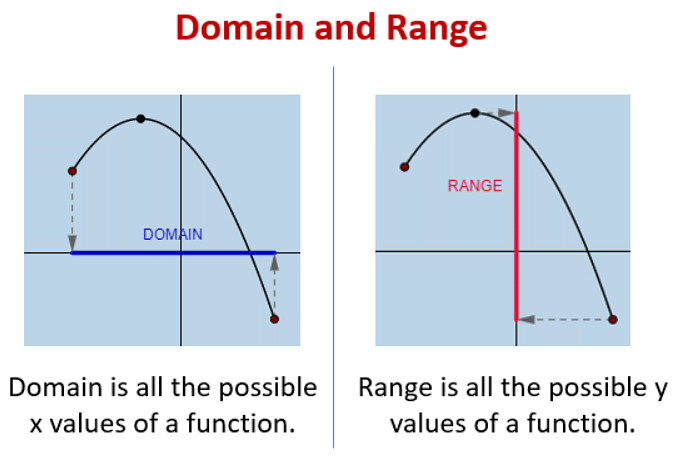
Domain and Range of a Function
Read Also:
Things to Remember
[Click Here for Sample Questions]
- A relation is considered as a connection between a collection of sets of ordered pairs that are in domain and range respectively.
- Relations and converses of asymmetric relations are also asymmetric.
- Every asymmetric relation is also an antisymmetric relation. But the converse is not true.
- A transitive relation is asymmetric if it is irreflexive or else it is not.
- An asymmetric relation should not have the convex property.
Also Read:
Sample Questions
Ques. Explain different types of Relations in brief. (5 Marks)
Ans. Different types of Relations are:
- Empty Relation: If no element of any set X is mapped or related with any element of X, then the relation is considered to be an empty relation.
- Universal Relation: A relation R in a set such as A is a universal relation if each element of A i.e. R = A*A. It is also known as full relation.
- Identity Relation: In this, every element of any set is related to itself only. I = {(a, a), ∈ A}.
- Inverse Relation: Let R be a relation defined from set A to set B. A relation R-1 is said to be an inverse relation if R-1 from set B to A is denoted by R-1 = {(b, a):(a, b) ∈ R}.
- Reflexive Relation: If each element of a set X maps to itself, the relation is said to be a reflexive relation.
- Transitive Relation: A relation in a given set A is transitive if, (a, b) ∈ R, (b, c) ∈ R, then (a, c) ∈ R for all a, b, c ∈ A.
- Equivalence Relation: A relation is said to be an equivalence relation if and only if it is reflexive, symmetric and transitive.
Ques. If X = (3, 4) and relation R on a set X is (3, 4), so prove that the relation is asymmetric. (2 Marks)
Ans. Given, X = {3, 4} and {3, 4} ∈ R
Here, 3 is less than 4 but 4 is not less than 3, so
{3, 4} ∈ R => {4, 3} ∉ R
Therefore, it is proved that the relation on set X is symmetric.
Ques. If Y = (7, 9) and relation R on a set Y is (7, 9), so prove that the relation is asymmetric. (2 Marks)
Ans. Given, Y = {7, 9} and {7, 9} ∈ R
Here, 7 is less than 9 but 9 is not less than 7, so
{7, 9} ∈ R => {9, 7} ∉ R
Therefore, it is proved that the relation on set Y is symmetric.
Ques. How can we say that a relation is symmetric? (2 Marks)
Ans. A symmetric relation between two or more elements of a given set is such that if the first element is related to the second element, then the second element will also be related to the first element as defined in the relation.
Ques. How can we prove that a relation is antisymmetric in nature? (2 Marks)
Ans. Assume that (x, y) and (y, x) are in a relation and then we have to show that x is equal to y. So, to prove x = y, we need to show that x is divisible by y and y is divisible by x to prove for the relation to be antisymmetric.
Ques. Show that the relation R in the set {1, 2, 3} given by R = {(1, 2), (2, 1)} is symmetric but neither reflexive nor transitive. (3 Marks)
Ans. Let A = {1, 2, 3}
A relation R on A is defined as R = {(1, 2), (2, 1)}
It is seen that (1, 1), (2, 2), (3, 3) ∈ R
So, R is not reflexive.
Now, as (1, 2) ∈ R and (2, 1) ∈ R, then R is symmetric.
Now, (1, 2) and (2, 1) ∈ R
Therefore,
(1, 1) ∉ R
R is not transitive.
Hence, R is symmetric but neither reflexive nor transitive.
Ques. Check whether the relation R defined in the set {1, 2, 3, 4, 5, 6} as R = {(a, b): b = a+1} is reflexive, symmetric or transitive. (5 Marks)
Ans. Let A = {1, 2, 3, 4, 5, 6}
A relation R defined on set A is:
R = {(a, b): b = a+1}
R = {(1, 2), (2, 3), (3, 4), (4, 5), (5, 6)}
We can find (a, a) ∉ R where a ∈ A
Essentially,
(1, 1), (2, 2), (3, 3), (4, 4), (5, 5), (6, 6) ∉ R
So, R is not reflexive.
We can see that (1, 2) ∉ R but (2, 1) ∉ R
So, R is not symmetric.
Now, (1, 2), (2, 3) ∉ R
But, (1, 3) ∉ R
Hence, R is not transitive
Therefore, R is neither reflexive, nor symmetric, nor transitive.
Ques. Show that relation R in the set A of all the books in a library of college, given by R = {(x, y): x and y have the same number of pages} is an equivalence relation. (5 Marks)
Ans. Set A is the set of all books in the library of a college.
R = {x, y}: x and y have same number of pages
Now, R is reflexive since (x, x) ∈ R as x and x will have the same number of pages.
Let (x, y) ∈ R => x and y will have the same number of pages.
=> y and x have the same number of pages.
=> (y, x) ∈ R
Hence, R is symmetric.
Now, let (x, y) ∈ R and (y, z) ∈ R
=> x and y will have the same number of pages and y and z will have the same number of pages.
=> x and z will have the same number of pages.
=> (x, z) ∈ R
Hence, R is transitive.
Therefore, R is an equivalence relation.
Ques. Find the domain and range of the function (x+1) / (3-x). (5 Marks)
Ans. Initially, we will set the denominator to 0, then we will solve for x.
3-x = 0
-x = -3 => x = 3
So, 3 will be excluded from the domain.
The domain will be the set of real numbers x, where (x<3) and (x>3)
Now, we will find the range of y=(x+1)/(3-x)
Solving the above equation,
(3-x)y = x+1
3y-xy = x+1
3y-1 = x+xy
x(1+y) = 3y-1
x = (3y-1)/(1+y)
The final equation obtained will be a fraction but the fraction is undefined when its denominator is zero.
So, 1+y ≠ 0 => y ≠ -1
Therefore, the range of a given function is set of all real numbers excluding -1.
Domain = (-∞, 3) ? (3, ∞)
Range = (-∞, -1) ? (-1, ∞)
Ques. Show that the relation X in X defined as X = {(a, b): a ≤ b}, is reflexive and transitive but not symmetric. (3 Marks)
Ans. X = {(a, b): a≤b}
Clearly, (a, a) ∈ R as a=a
So, R is reflexive
Now, (2, 4) ∈ R as (2 < 4)
But, (4, 2) ∉ R as 4 is greater than 2.
So, R is not symmetric
Now, let (a, b), (b, c) ∉ R
Then, a≤b and b≤c => a≤c
(a, c) ∈ R
So, R is transitive.
Therefore, R is reflexive, transitive but not symmetric.
For Latest Updates on Upcoming Board Exams, Click Here: https://t.me/class_10_12_board_updates
Read Also:



Comments