



Content Curator
Domain and Range of trigonometric functions can be represented by the angle θ as well as the resultant value. The domain of trigonometric functions can be represented as the angles in degrees or radians. Similarly, the range in this case is a real number.
- Trigonometric functions are mathematical functions which help to relate the angles and sides of a right triangle.
- Some of the most common trigonometric functions are sine, cosine, tangent, cosecant, secant, and cotangent.
- Each of these functions has a specific domain and range, helping determine the values they can take as inputs and outputs.
- The domain of a function, in mathematics, is the set of all possible input values (independent variables) for which the function is defined.
- The range of functions refers to the following values which the dependent variable can possess as x keeps on changing throughout the domain.
Read More: NCERT Solutions for Class 11 Mathematics Trigonometric Functions
Key Terms: Trigonometric Functions, Sine, Tangent, Trigonometric Equations, Binomial Theorem, Euler’s Formula, Functions, Domains, Inverse Trigonometric Functions, Step Function
What are Functions?
[Click Here for Sample Questions]
A mathematical function is a rule that uses one or more independent variables to determine the value of a dependent variable. A function can be represented in a variety of forms, including a table, graph, formula, and so on.
- Simply, a function is a relation between a set of inputs (which is also called the domain) and a set of possible outputs (also called the range) with the property that each input is related to exactly one output.
- The domain of a function refers to the range of values that it can accept as input. The collection of outputs that a function can generate, given its domain, is referred to as the function's range.
- For instance, for the function a = f(b), the domain of the function is all the values that "b" can take, and the range of the function is all the output values that "a" can take.
What is Domain?
[Click Here for Previous Year Questions]
In mathematics, the domain of a function can be expressed as the set of every possible input value (usually represented by the variable x) for which the function is defined.
- Simply, it can be shown as a set of values for which the function produces significant results or output values.
- For instance, the domain of the function f(x) = 1/x is all real numbers except for x = 0, since dividing by zero is undefined.
- The domain of the function g(x) = √x is all non-negative real numbers, since the square root of a negative number is not a real number.
Domain and range of trigonometric functions Video Explanation
Check Also:
What is Range?
[Click Here for Sample Questions]
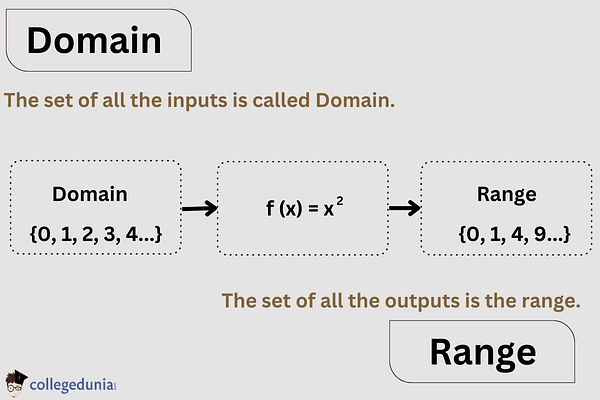
The range of a function, in mathematics, refers to the set of all possible output values that the function can produce for its input values.
- For example, assume the function f(x) = x2. The domain of this function is all real numbers, and the range is all non-negative real numbers (i.e., y ≥ 0) because any negative value of y cannot be produced by squaring a real number.
- Therefore, the range of f(x) = x2 is [0, ∞).
Domain and Range
Finding Range of a Function:
- The range can be expressed as a spread of values of a function’s output.
- In case we can calculate the maximum and the minimum values of the function, it can yield the range of the function.
Trigonometric Functions
[Click Here for Previous Year Questions]
Trigonometry is a discipline of mathematics concerned with the application of certain functions of angles to calculations. In trigonometry, there are six functions of an angle that are often utilized. Sine (sin), cosine (cos), tangent (tan), cotangent (cot), secant (sec), and cosecant (csc) are the six functions of trigonometry. The diagram below can be used to describe these functions:
Sine (sin) and Cosecant (cosec)
The opposite divided by the hypotenuse is defined as sin(x). The reciprocal of sin(x) is cosecant, or cosec(x), which is defined as the hypotenuse divided by the opposite.
- sin (x) = \(\frac{\text{opposite}}{\text{hypotenuse}}\)
- cosec (x) = 1 / sin (x) = \(\frac{\text{hypotenuse}}{\text{opposite}}\)
Cosine (cos) and Secant (sec)
The adjacent divided by the hypotenuse is defined as cos(x). The reciprocal of cos(x) is secant, or sec(x), which is defined as the hypotenuse divided by the adjacent.
- cos (x) = \(\frac{\text{adjacent}}{\text{hypotenuse}}\)
- sec (x) = 1 / cos (x) = \(\frac{\text{hypotenuse}}{\text{adjacent}}\)
Tangent (tan) and Cotangent (cot)
The opposite divided by the adjacent is defined as tan(x). The reciprocal of tan(x) is cotangent, or cot(x), which is defined as the adjacent divided by the opposite.
- tan (x) =\(\frac{\text{opposite}}{\text{adjacent}}\)
- cot (x) = 1 / tan (x) = \(\frac{\text{adjacent}}{\text{opposite}}\)
Listed below are a few important trigonometric identities:
- sin2 \(\theta\) + cos2 \(\theta\) = 1
- 1 + cot2 \(\theta\) = cosec2 \(\theta\)
- tan2 \(\theta\) + 1 = sec2 \(\theta\)
Also Read: Sin Cos Formulas
Domain and Range of Trigonometric Functions
[Click Here for Sample Questions]
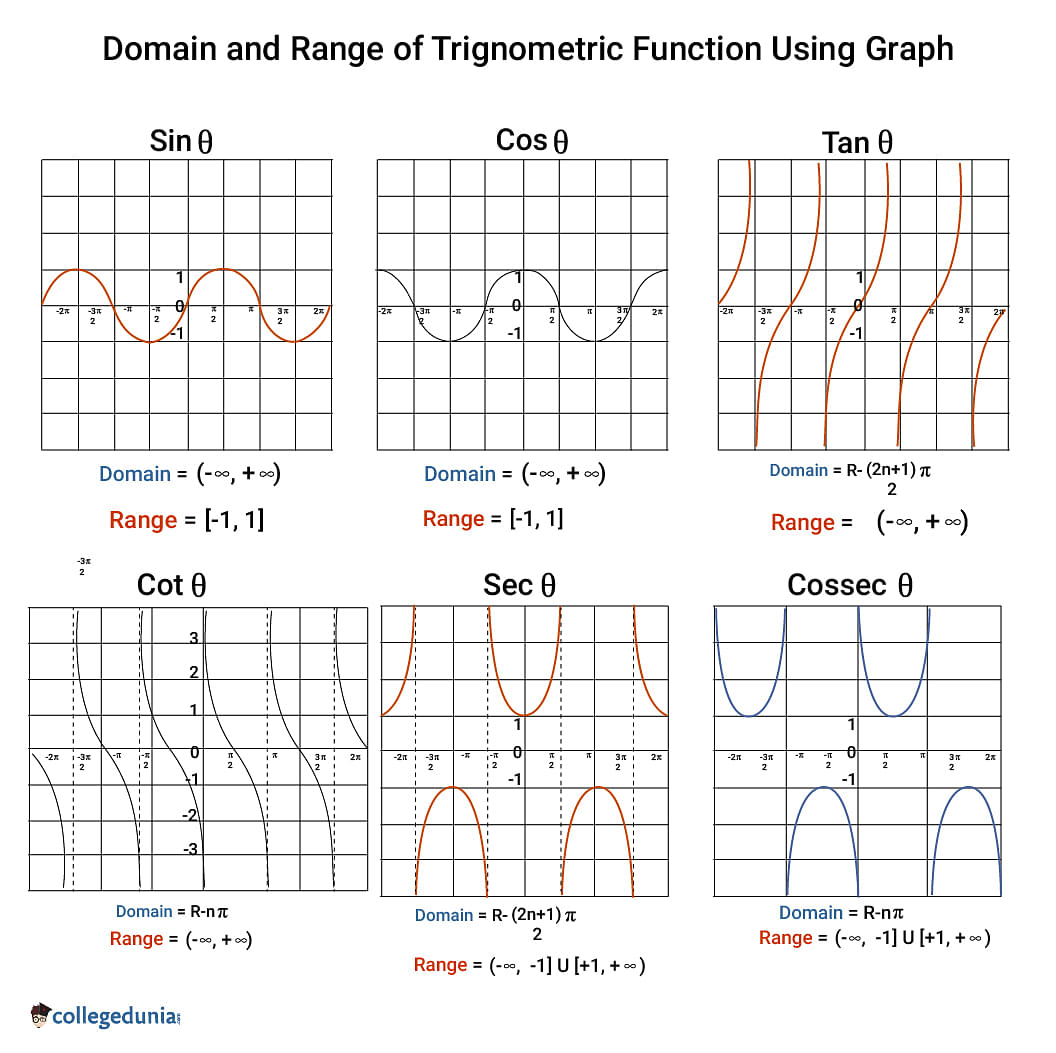
Tabulated below are domain and ranges of common and useful trigonometric functions:
| Function | Range | Domain |
|---|---|---|
| f (x) = sin (x) | [-1,1] | (-∞, +∞), All real numbers |
| f (x) = cosec (x) | [-∞, -1] U [1, +∞] | All real numbers except n* |
| f (x) = cos (x) | [-1,1] | (-∞,+∞), All real numbers |
| f (x) = sec (x) | [ -∞, -1] U [1, +∞] | All real numbers except /2 + n* |
| f (x) = tan (x) | [-∞, +∞] | All real numbers except /2 + n* |
| f (x) = cot (x) | [-∞, +∞] | All real numbers except n* |
Trigonometric functions are functions of an angle and have a periodic nature. Therefore, the domain and range of trigonometric functions are determined by the type of function and the angle's unit of measure. Note that the domain and range of these functions can be modified if the angle's unit of measure is different, such as radians or degrees. The domain and range of trigonometric functions can further be represented using a graph. Thus,
Domain and Range of trigonometric functions Using Graph
Domain and Range of Inverse Trigonometric Functions
[Click Here for Previous Year Questions]
The domain and range for inverse trigonometric functions are:
| Inverse Trigonometric Functions | Domains | Ranges |
|---|---|---|
| Sin-1x | [-1, +1] | [-π/2, π/2] |
| Cos-1x | [-1, +1] | [0, π] |
| Cot-1x | (-∞, + ∞) | (0, π) |
| Tan-1x | (-∞, + ∞) | (-π/2, π/2) |
| Sec-1x | (−∞,−1] U [1,∞) | [0, π/2) U (π/2, π] |
| Cosec-1x | (−∞,−1] U [1,∞) | [-π/2, 0) U (0, π/2] |
Read Also: Differentiation and Integration Formula
Solved Examples
[Click Here for Sample Questions]
| Ques. Determine the domain and range of y = 3 tan x. Solution: We are aware domain and range of trigonometric function tan x can be represented by, Domain = R - (2n + 1)π/2, Range = (-∞, +∞) The domain, in this case, is denoted by values x can carry, meaning that the domains of tan x and 3 tan x are similar. Thus, the domain of y = 3 tan x is R - (2n + 1)π/2 The range of tan x is (-∞, +∞) ⇒ -∞ < y < ∞ ⇒ -∞ < tan x < ∞ ⇒ -∞ < 3 tan x < ∞ [Since the multiplication ∞ by 3 results ∞] Hence, the range of y = 3 tan x is (-∞, ∞). |
Things to Remember
- Domain and Range of trigonometric functions are signified by the angle θ as well as the resultant value.
- The range of a function can be explained as the set of all possible output values it can generate.
- The cosecant function's domain excludes all angles with a sine value of 0: 0°, 180°, 360°, and so on.
- When it comes to tangent and cotangent functions, the definition of tangent is tan \(\theta\) = y/x because of which angles with an x-coordinate of 0: 90°, 270°, and so on are excluded from the domain.
- Since the cotangent function is defined as cot \(\theta\)= x/y, the domain of this function excludes angles with a y-coordinate of 0: 0°, 180°, 360°, and so on.
Previous Year Questions
- The height (in mm) of the lamp-post is:….(JEE MAIN 2019)
- If L= sin2(16π) − sin2(8π) and , M = cos2(16π) − sin2(8π), then :….(JEE MAIN 2020)
- If the sum of all the solutions of the equation...(JEE MAIN 2018)
- Considering only the principal values of inverse functions...(JEE Mains 2019)
- The value of sin251∘ + sin239∘ is...(KCET 2020)
- If 0≤x<π/2, then the number of values of x for which... (JEE Mains 2019)
- ABCD is a trapezium such that AB… (JEE Main 2013)
Also Read:
Sample Questions
Ques. What is meant by a function? (2 marks)
Ans. A mathematical function is a rule that uses one or more independent variables to determine the value of a dependent variable. A function can be represented in a variety of forms, including a table, graph, formula, and so on.
Ques. What is meant by trigonometric functions? (2 marks)
Ans. Trigonometry is a discipline of mathematics concerned with the application of certain functions of angles to calculations. In trigonometry, there are six functions of an angle that are often utilized. Sine (sin), cosine (cos), tangent (tan), cotangent (cot), secant (sec), and cosecant (csc) are the six functions of trigonometry.
Ques. What is meant by domain and range? (2 marks)
Ans. The domain of a function refers to the range of values that it can accept as input. The collection of outputs that a function can generate, given its domain, is referred to as the function's range.
Ques. Find the domain and range of y = cos (x) - 3 (2 marks)
Ans. The domain and range of y = cos (x) - 3 is:
Domain: x ∈ R
Range: -4 ≤ y ≤ - 2, y ∈ R
Ques. Find the values of the other five trigonometric functions if cot x = 2/4, where x is in the third quadrant. (3 marks)
Ans. As stated before, cot x = 1 / tan x.
⇒ tan x = 1 / cot x = 1/(2/4) - 4/2
As stated before, sec2 x = 1 + tan2 x = 1 + (4/2)2 = 1 + 16/4 = 20/4
∴ sec x = ± 5
Since x lies in the third quadrant, the value of sec x will be negative. Which implies sec x = - 5
Since, cos x = 1 / sec x = 1 / (-5/1) = - 1 / 5
Next, tan x = sin x / cos x
Therefore, sin x = tan x X cos x = (4/2) X (- 1/5) = - 4/10 = - 2/5
And, csc x = 1 / sin x = 1 / (-2/5) = - 5 / 2
Ques. Find the domain range of y = 3 tan x. (3 marks)
Ans. The domain and range of trigonometric function tan x:
Domain = R - (2n+1)/2
Range = (-, +)
The domain range of tan x and 3 tan x are similar since the domain is given by the values that can be acquired by x. Therefore the domain of y = 3 tan x is R - (2n+1)/2
The range of tan x = (-, +) -< y <
- < Tan x <
- < 3 tan x < (When is multiplied by 3 it comes to only.)
Therefore range of y = 3 tan x is (-, +)
Ques. Determine the domain and range of y = sin x - 3 (3 marks)
Ans. Domain and range of sin x are (-, +) and (-1,1) respectively.
Since sin x stands for all real numbers and y = sin x - 3 stands for all real numbers, the domain for y = sin x - 3 is (-, +).
To know the range we have to determine the interval for y.
We know -1sin x1
-1-3sin x - 31 - 3
- 4sin x - 3-2
-4y-2.
Hence the range of y = sin x - 3 is [-4, -2]
Ques. What is the Range of Cos Square theta? (2 marks)
Ans. We are aware that Cos θ has a range of [-1,1]. Thus, the range of cos²θ is [0,1].
Since the values of cos²θ can range from 0 to 1, the minimum value of the range is 0, and the maximum value is 1.
Ques. How can the range of a function be found? (3 marks)
Ans. One can find the range of a function by the following steps:To find the range of a function, you can follow these general steps:
- Determine the domain of the function. The domain can be defined as the set of all possible input values.
- Evaluate the function for each input value in the domain.
- Gather all of the output values that were acquired in step 2.
- Identify the smallest and largest output values. These values signify the lower and upper bounds of the range.
- Write the range using interval notation or set notation.
- Represent the same through a sketch.
Ques. What is the domain and range of y = sin x – 3? (3 marks)
Ans. We are aware that the domain and range of sin x are (-∞, + ∞) and [-1, 1], respectively.
Since sin x can be defined for all real numbers, it can be seen that y = sin x - 3 is defined for all real numbers. This means that the domain for y = sin x - 3 is (-∞, + ∞).
Now, in order to determine the range, we are required to determine the interval for y.
Now, we have with us,
-1 ≤ sin x ≤ 1
⇒ -1 - 3 ≤ sin x - 3 ≤ 1 - 3
⇒ -4 ≤ sin x - 3 ≤ -2
⇒ -4 ≤ y ≤ -2.
Hence, the range of y = sin x - 3 is [-4, -2].
For the Latest Updates on Upcoming Board Exams, Click Here: https://t.me/class_10_12_board_updates
Also Check:



Comments