



Education Journalist | Study Abroad Lead
Coloured shadows refer to the different colours of the shadow of an object other than black colour.
- A shadow is a dark region caused by an object blocking light from a light source.
- It occupies the whole three-dimensional volume behind an object with light in front of it.
- The cross-section of a shadow is a two-dimensional shape.
- When different colours of light strike an object, some of it is absorbed and the rest is reflected.
- The wavelengths of light that are not absorbed by the object determine the colour of the reflected light.
- For example, a red object absorbs all wavelengths of light except red, therefore it reflects red light.
- If the surface where the shadow appears is also illuminated with coloured light, the shadow will appear to be a combination of the two colours.
- For example, if a red object produces a shadow on a green surface illuminated by blue light, the shadow will appear cyan (a combination of blue and green).
| Table of Content |
Key Terms: Shadow, Wavelength, Dispersion of light, Colours, Light, Prism, Colored shadows, Primary colours
What is Shadow?
[Click Here for Sample Questions]
Shadows are formed when light is blocked by an opaque object (an object through which light does not pass).
- The emitted light from a source is unable to pass through a solid surface, producing a shadow on the ground.
- The shape and size of the shadow are determined by the position of the light from the solid object.
- The produced shadow is much darker than its surroundings.
- The shape and size of the shadow of the same object may vary.
- The shadow formed by an object can sometimes be misleading. An ice cream cone, for example, can be shaped into a triangle.
Also Read:
| Related Links | ||
|---|---|---|
| LIGHT SOURCES | Transmission, Absorption and Reflection of Light | Wave Theory of Light |
| Pinhole camera | Difference between reflection and refraction | Plane Mirror |
Coloured Shadows
[Click Here for Previous Year Questions]
The fact that visible light has wavelengths ranging from 400 to 700 nanometers provides scientific support to colour.
- When light incident on an object, part of it is absorbed and the rest is reflected.
- We know that the white light we see is a mixture of various colours such as violet, indigo, blue, green, yellow, orange, and red.
- The process of dispersion splits the white light into its constituent colours.
- This process can be observed by using a prism.
- When lights of different colours strike the same place, preferably on a white surface, the light reflecting off that place equals the sum of the lights that incident on it.
- As a result, we observe multiple coloured shadows on the white surface with varying colour combinations. This is referred to as the coloured shadow.
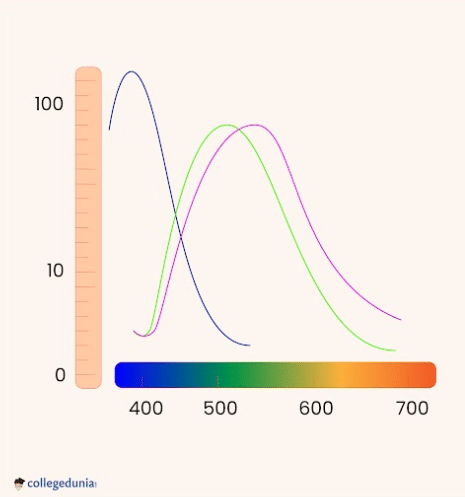
Colour Sensitivity
Formation of Coloured Shadows
[Click Here for Sample Questions]
The retina of the eye is responsible for concentrating light and helps in vision.
- The retina consists of rods and cones that help in both day and night vision.
- Cones are classified into three categories, each of which is sensitive to red, green, and blue light.
- These three colours are known as additive primaries of light.
- Seven different types of colours may be formed by combining these three colours in various combinations.
- Blue, red, green, yellow, magenta, cyan, and black are the seven different colours.
- Cones selects colours based on the sensitivity of each cone and are responsible for our multicoloured vision.
- Green cones help in the perception of blue, green, purple, yellow, and orange colours.
- Red cones help in the perception of purple, blue, green, yellow, orange, and red colours.
- We can observe a wide spectrum of colours formed when colours overlap by using the sensitivities of the three cones of the eye.
- A representation of colour sensitivity is displayed below.
Coloured Shadow Experiment
[Click Here for Previous Year Questions]
This basic experiment will demonstrate how to produce coloured shadows using primary colour-producing sources (light bulbs). This experiment will be carried out in a dark room.
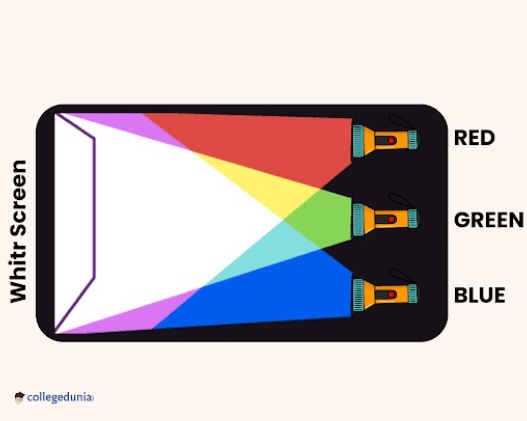
Coloured shadow experiment
Materials Required
- 3 light bulbs of colours green, red, and blue
- A white background
- A couple of objects
Procedure
- Arrange the bulbs so that they all fall on the same region of the white screen.
- Turn on all of the light bulbs and adjust their positions until you get the brightest and whitest light on the screen.
- Adjust the distance between the screen and any thin opaque object until you see three separate colours (green, blue, and red) on the screen.
- Remove the object and turn off one of the coloured lights. The changes in colours are easily visible. Place the object again and see how the colour of the shadow changes.
- Try moving the object closer to the screen to notice how the shadows overlap. The combination of colours can be seen here.
- For example, if you block two colours of light, you will see the shadow of the third colour.
Also, try these combinations:
- When the green and red lights are blocked, a blue shadow appears.
- A dark shadow results from blocking all three lights.
- When you block one of the three lights, you get a shadow that is a combination of the other two colours.
- When you combine blue and green colours, you get cyan.
- When you combine blue and red colours, you get magenta.
- When you combine green and red colours, you get yellow.
Things to Remember
- The shadow of an object is the area where light from a light source is blocked by the object.
- The shadow of an object may be dark or coloured.
- When the light used to illuminate the object and the surface on which the shadow can be seen is coloured, the shadow appears coloured.
- The shape of the shadow depends on the shape of the object producing the shadow as well as the angle of the light source.
- The size of a shadow is determined by the distance between the object, the light source, and the surface on which the shadow is produced.
- The process of splitting white light into different colours is known as dispersion.
Also Read:
| Related Links | ||
|---|---|---|
| Rectilinear propagation reflection of light | Wave Particle Duality | Polarization of Light |
| Light Emitting Diode | UV Light | Particle Nature of Light: The Photon |
Previous Year Questions
- In the given circuit, what will be the equivalent resistance between the points…. [JIPMER 2006]
- How to adjust a system of three identical capacitors to get high electrostatic energy with the given battery… [UPSEE 2006]
- The surface charge density of the Earth…. [DUET 2009]
- A point dipole with dipole moment... [KEAM]
- The time of fall of the electron, in comparison to the time of fall of the proton is….[NEET 2018]
- An electric dipole of dipole moment is placed in a uniform external electric field…. [KEAM]
- An infinite number of charge, each of charge…
- Infinite charges of magnitude q each are lying at… [JKCET 2004]
- Two long current carrying thin wires, both with current… [JEE Main 2015]
- Identify the wrong statement… [KEAM]
- An electron enters a uniform electric field maintained by parallel plates and… [KEAM]
- When a soap bubble is charged… [KCET 2020]
- Two pith balls carrying equal charges are suspended from a common point by… [NEET 2013]
- A glass rod rubbed with silk is used to change a gold leaf electroscope… [JEE Advanced 2011]
- A copper rod AB of length l is rotated about end A with a constant angular… [VITEEE 2021]
- Two charges of equal amount +Q are placed on a line… [WBJEE 2016]
Sample Questions
Ques. What is a shadow? (2 Marks)
Ans. A shadow is a space or region where there is no light because light rays are blocked by an opaque object. The position and intensity of the light source determine the characteristics of the type of shadow formed.
Ques. How is the shadow formed? (3 Marks)
Ans. A shadow is produced through the combination of an opaque object, a light source, and a screen.
- The light source generates light that strikes a solid object, producing a shadow, which is basically darkness caused by the absence of light.
- That shadow appears on a surface directly behind the object.
Ques. Why shadows are black in colour? (2 Marks)
Ans. When light from a light source gets blocked by an object, a shadow is formed. A shadow appears when an object absorbs all of the light emitted by a light-producing source. As a result of the absorption or absence of light, a shadow is formed, which is black in colour.
Ques. Which one of the following is the natural source of light? (1 Mark)
(a) Tube light
(b) Sun
(c) Electric bulb
(d) Moon
Ans. The correct answer is b. Sun
Explanation: The sun is the natural source of light. The moon illuminates due to the light of the sun. Tube lights and electric bulbs are the artificial sources of light.
Ques. What are the properties of a shadow? (5 Marks)
Ans. The following are the properties of a shadow
- Apart from the shape of the object by the shadow cast by that object, no other details can be determined.
- The distance between the light source and the angle at which the light rays strike the object determines the size of the shadow.
- The shadow is larger when the light source is closer to the object than when it is farther away.
- The shadow can only be seen on a screen. In everyday life, shadows are screened by the ground, room walls, a building, or other comparable surfaces.
- The colour of opaque objects has no effect on shadows, which are black. Therefore, a red and yellow rose will both have the same black shadows.
Ques. What factors affect the size and shape of a shadow? (2 Marks)
Ans. The size and shape of a shadow are affected by the following factors:
- The shape of the object
- The distance between the object, the light source, and the surface on which the shadow is cast
- The angle of the light source
Ques. What is a coloured shadow? (2 Marks)
Ans. A coloured shadow is one that appears to be of a different colour than the object casting it. The most common way to produce this effect is to illuminate the object and the surface on which the shadow is cast with coloured light.
Ques. In a coloured shadow experiment, when you block all three (red, green, and blue) lights, which colour do you get? (1 Mark)
Ans. In the coloured shadow experiment, if we block all three lights, then the colour of the image appears as black.
Ques. What is an image? (1 Mark)
Ans. An image is the point at which light rays from an object meet or appear to meet after reflection or refraction.
Ques. Name the light receptors of the eye. (1 Mark)
Ans. Cones and rods present inside the retina of the eye are the light receptors.
Ques. What are the properties of light? (5 Marks)
Ans. The following are the properties of light
- Reflection: Light obeys the law of reflection, which states that the angle of incidence is equal to the angle of reflection.
- Refraction: It occurs when the velocity of a light beam varies as it passes from one medium to another. The refractive index of the medium measures how much light refracts.
- Dispersion: When white light passes through a prism, it separates into multiple colours based on its wavelength is known as the dispersion of white light.
- Diffraction: It is the bending of light around the corners of an obstacle.
- Polarization of light: Original light resonates perpendicular to the transmission of light in all directions. Polarized light is defined as light that is limited to vibrating in just one plane.
- Interference of light: The phenomenon of changing the intensity of light by rearranging the light energy sources in a combination of two or more visible light sources.
Ques. Can an object have more than one shadow? (2 Marks)
Ans. Yes, an object may project multiple shadows at once. If a light illuminates an object from multiple angles, we can get many shadows. The number of shadows is determined by the number of light sources. Because of the intensity of the light, certain shadows may be fainter than others. However, if the number and intensity of light from all directions are the same, there will be no shadow formation.
Ques. What is the difference between an image and a shadow? (5 Marks)
Ans. The following are the differences between an image and a shadow
| Image | Shadow |
|---|---|
| Images are formed due to the intersection of reflected rays. | A shadow forms when light does not reach behind an object. |
| Images can be seen when the reflected rays of light from an object reach the eyes of the observer. | A shadow can be observed when no light reaches the eyes of the observer. |
| With the help of an image formed by an object, the colour and size of the object can be known. | With the help of a shadow, no information about the object can be known except the size of the object. |
| Images can be inverted. | It cannot be inverted. |
Ques. Define Light. (2 Marks)
Ans. Light is the visible part of the electromagnetic spectrum of wavelengths ranging from 380 nm to 700 nm which produces the sensation of sight in our eyes.
Ques. What are the necessary conditions for the formation of shadow? (2 Marks)
Ans. The necessary conditions for a shadow to form are:
- A light source
- An opaque object
- A surface on which the shadow can be cast
For Latest Updates on Upcoming Board Exams, Click Here: https://t.me/class_10_12_board_updates
Check-Out:



Comments