



Education Journalist | Study Abroad Lead
Cone is a three-dimensional shape with a smooth transition from a flat base, usually a circular base, to the point at the top, also known as the apex or vertex. A cone is made up of line segments that connect the apex (vertex), the common point, to every point of a circular base (which does not contain the apex). Cone can also be defined as a pyramid which has a circular cross-section, unlike a pyramid which has a triangular cross-section.
Key Terms: Cone, Total Surface Area, Curved Surface Area, Volume, Right Circular Cone, Oblique Cone, Vertex, Slant Height
Definition of Cone
[Click Here for Sample Questions]
A cone can be defined as a three-dimensional shape formed using a set of line segments or the lines that connects the apex or vertex (common point) to all the points of the circular base, which does not contain the apex.
- Height of Cone: The distance of the apex or vertex of the cone to the base is referred to as the height of the cone.
- Radius of Cone: The value of the radius is measured from the circular base.
- Slant Height of Cone: The length of the cone from apex to any point on the circumference of the base is the slant height. The formula for the slant height of the cone is given as l = √(r2+h2), where l denotes slant height, r denotes radius and h denotes the height of the cone.
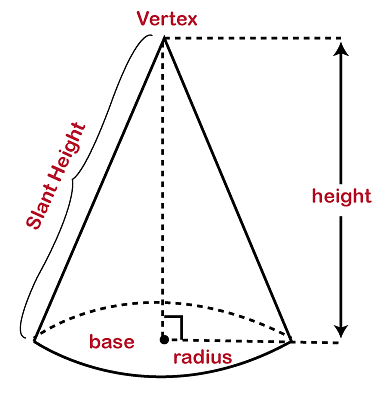
Cone
Also Read:
Properties of Cone
[Click Here for Sample Questions]
- A cone has one face only, which is the circular base of the cone.
- A cone has no edges.
- A cone has only one apex or vertex point.
Types of Cones
[Click Here for Sample Questions]
There are essentially two types of cones. The right circular cone is one, and the oblique cone is another.
-
Right Circular Cone
The vertex of a right circular cone is located on the other side of the base. The radius-perpendicular line that represents the cone's height passes through the centre of the base circle.
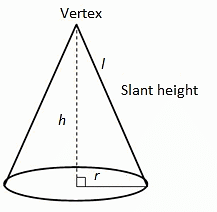
Right Circular Cone
-
Oblique Cone
The vertex of an oblique cone is not located precisely across from the circular base. The base circle's centre is not intersected by the line that represents the cone's height.

Oblique Cone
Read More: Surface Area of Right Circular Cone
Surface Area of Cone
[Click Here for Sample Questions]
The amount of space that a cone's surface takes up is known as its surface area. A cone is a three-dimensional shape with a circular base. This indicates that a radius or diameter makes up the base. The height of the cone is measured from the centre of the base to the topmost piece of the cone. There are two approaches to calculating the cone's surface area:
- Total Surface Area
- Curved Surface Area
- TSA of Cone = π r(r + l)
- CSA of Cone= πrl
Read More: Surface Areas and Volumes Important Questions
Volume of Cone
[Click Here for Sample Questions]
The amount of room or capacity a cone takes up is known as its volume. Cones' volume is expressed in cubic units such as cm3, m3, in3, etc. The volume of a cone, whose radius is 'r' and height is 'h' will be calculated as Volume of Cone = (1/3) πr2h cubic units Apart from that, the volume of a cone is one-third of the volume of a cylinder.
Volume of Cone = (1/3) × Volume of Cylinder Applications of Cone Here are some everyday items where we can see the conical shape:
- Traffic Cones
- Prism
- Birthday Caps
- Ice-Cream Cones
- Funnel
- Megaphones
Read More: Difference between Area and Volume
Things To Remember
- A cone is a three-dimensional shape that has a curved surface. It is formed using a set of line segments which connects the apex or vertex to all the points of a circular base.
- A cone can be categorized as either an oblique cone or a right circular cone. In contrast to an oblique cone, which has a vertex that is not vertically above the base centre, the right circular cone has a vertex that is vertically above the centre of the base.
- The perpendicular height is the distance from the centre of the base to the vertex. The circular base of the cone has a measured value of radius.
- Slant Height of the cone is the distance between the vertex and the edge of the circular base of the cone is the slant height of the cone. The slant height of a cone is calculated using the formula l = √(h2+r2).
- The total surface area (TSA) of the cone is πr(l + r), whereas, the curved surface area (CSA) of the cone is πrl.
- The volume of the cone is calculated as ⅓ πr2h cubic units.
Read More: Surface Areas and Volumes
Sample Questions
Ques. Find the volume of a cone, if the radius is 4 cm and the height is 9 cm. (3 Marks)
Ans. Radius r = 4 cm
Height h = 9 cm
Using the volume of a cone formula,
Volume of cone =1/3 (π r2h) Volume of cone = 1/3 x 3.14 x 4² x 9 Volume of cone = 150.72 cm³
Ques. The circumference of the base of a 12 m high wooden solid cone is 44 m. find the volume. (3 Marks)
Ans. Circumference of cone = 44 m Height (h) = 12 m
2πr = 44 2 x (22/7) x r = 44 r = 44 x (1/2) x (7/22) r = 7 cm
Volume of cone = (1/3)πr²h = (1/3) x (22/7) x 72 x 12 = (1/3) x (22/7) x 7 x 7 x 12 = 616 cm3
The volume of the cone = 616 cm3
Ques. A vessel is in the form of a frustum of a cone. Its radius at one end is 8 cm and the height is 14 cm. If its volume is 5676/3 cm3, then find the radius at the other end. (3 Marks)
Ans. Volume of the frustum cone = (5676/3) cm3
Let r be the required radius Radius (R) = 8 cm
Height (h) = 14 cm
(1/3)πh (R2+r2+Rr) = (5676/3) (1/3) ⋅ (22/7) ⋅ (14) (82+ r2+8r) = 5676/3 r2+8r+64 = 129 r2+ 8r+64-29 = 0 r2+8r-65 = 0 (r+13) (r-5) = 0 r = -13, r = 5 cm (r= -13 is rejected as radius can never be negative)
So, the required radius = 5 cm
Ques. The perimeter of the ends of a frustum of a cone is 44 cm and 8.4π cm. If the depth is 14 cm, then find its volume. (3 Marks)
Ans. Perimeter of upper end = 44 cm
Perimeter of lower end = 8.4π cm
Height of frustum cone = 14 cm 2πR = 44 2 x (22/7) x R = 44 R = 44 x (1/2) x (7/22) R = 2 x (1/2) x 7 R = 7 2πr = 8.4π r = 8.4π x (1/2Π) r = 4.2
Volume of the frustum cone = (1/3)πh (R2+r2+Rr) = (1/3) x (22/7) x 14 (72+4.22+7(4.2)) = (44/3) (49+29.4+17.64) = (44/3) (96.04) = (44) (32.013) = 1408.57 cm3
The volume of the frustum cone = 1408.57 cm3
Ques. Calculate the curved surface area, total surface area and volume of the given cone. (3 Marks)

Ans. Here,
Height of cone (h) = 8 cm
Slant height (l) = 10 cm
Now, Curved surface area (CSA) = πrl = 22/7 × 6 × 10 = 188.57 cm2
Total surface area (TSA) = πr(r + l) = 22/7 × 6 (6 + 10) = 301.71 cm2
Volume of cone (V) = πr2h/3 = 1/3 × 22/7 × 62 × 8 = 22/21 × 36 × 8 = 301.71 cm3
Ques. If the total surface area of a cone is 704 cm2 and the radius of its base is 7 cm, find the volume of the cone. (3 Marks)
Ans. Here, Radius of cone (r) = 7 cm
Total surface area of cone = 704 cm2 Πr (r + l) = 704 22/7 × 7 (7 + l) = 704 22 (7 + l) = 704 154 + 22l = 704 22l = 704 – 154 l = 550/22 l = 25 cm
Now, Volume of cone (V) = πr2h/3 = 1/3 × 22/7 × 72 × 24 = 1232 cm3
Ques. The radius of a cone is 3 cm and the vertical height is 4cm. Find the slant height of the cone. (3 Marks)
Ans. We have r = 3cm, h = 4 cm Let l cm be the slant height of the cone.
Then Slant height = √r2+h2 = √32+42 = √9 + 16 = √25 l = 5 cm
Thus, the slant height of the cone calculated as 5 cm.
Check Out:



Comments