



Education Journalist | Study Abroad Lead
3D-shapes are three-dimensional objects or solid having three dimensions- length, width and height. They are fundamentally different from two-dimensional figures as the 2D figures have only length and breadth but no height. Thus, 3D objects always occupy some space known as volume. In our daily lives, we come across multiple objects of different sizes and shapes like footballs, cell phones, ice-cream cones, soft drinks cans etc. All of them are examples of 3D objects. Those shapes and objects are classified as cube, cuboid, pyramid, sphere etc. based on their 3D manifestation. The shapes and the properties of the three-dimensional shapes can be well understood by using a 2D shape that can be folded in a specific way to form a 3D shape. It is called a geometrical net.
| Table of Content |
Key Takeaways: 3D Shapes, Edges, Faces, Vertices, Geometrical Net, Polyhedron, Pyramid, Sphere, Prism, Volume, Rectangle, Cuboid
What are 3D Shapes?
[Click Here for Sample Questions]
In Geometry, 3D-shapes are known as three-dimensional objects or solids having three dimensions. These three dimensions are length, width and height. Unlike two-dimensional figures, 3D-shapes have thickness or depth. Thus, they occupy some volume. Some of the 3D shapes have their bases or cross-sections as 2D-shapes. For example, a cuboid has its face in the shape of a rectangle. Some of the real-life examples of 3D geometric shapes are football, a bucket, book, measuring cylinder etc.
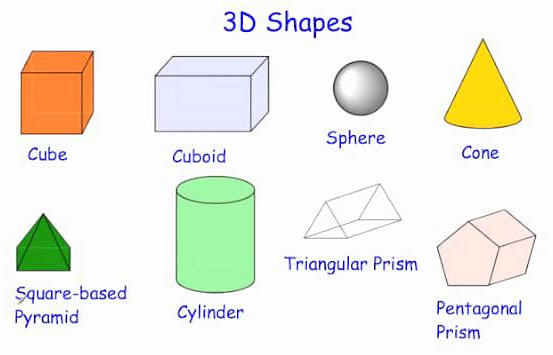
3D Shapes
Read More :
| Related Articles | ||
|---|---|---|
| Coordinate geometry | Difference Between Area and Volume | Angle between Two Lines |
| Plane | Angle between Two Planes | Angle between a Line and a Plane |
Types of 3D Shapes
[Click Here for Previous Year Questions]
The 3D shapes are mainly of two broad types: a curved-shaped solid and the straight-sided polygon called polyhedron.
Curved Solids
The 3D objects that have curved surfaces are called curved solids. The following are the curved solid structures-
Sphere
A sphere is the 3D geometrical analogue to a 2D circle. It is the set of points that are equidistant from a given point. The given point is called the center and the distance is named radius. A common example of a sphere is a soap bubble in equilibrium. The planet Earth is nearly spherical, often called a spheroid. Here are some characteristics of sphere-
- Spherical objects are perfectly symmetrical.
- Every point on the surface of the sphere is equidistant from the centre.
- It has one face, no vertices and no edges.
- It is not considered a polyhedron as it does not have a flat face.

Sphere
Cone
A cone is a three-dimensional structure that has a flat circular base and a pointed tip at the top. The pointed tip is named ‘apex’. It also has a curved surface. A cone can be further classified as a right circular cone and oblique cone. Here are some characteristics of cones-
- A cone has a circular/oval base with an apex which is also its vertex.
- A cone can be considered as a rotated triangle.
- If the apex of a cone is perpendicular to the base, it is called a right circular cone. If the apex lies anywhere away from the center of the base it is called an oblique cone.
- A cone has both height and radius. Apart from that it also has a slant height which is measured as the distance between apex and any point on the circumference of the circular base of the cone.

Cone
Cylinder
A Cylinder can be described as a 3D-shape having two circular faces, one at the bottom and one at the top, and a curved surface. Thus, a cylinder has a radius and height. The height is the perpendicular distance between the top and the bottom faces. Here are some important characteristics of a cylinder-
- It has two identical ends that are either circular or oval.
- It has one curved face.
- A cylinder having both circular bases lying on the same line is called a right cylinder. The one in which the base is placed away from another is called an oblique cylinder.

Cylinder
Read Also: Surface Area of Rectangular Prism
Polyhedrons
Polyhedrons are 3D-shapes having straight sides. The fundamental properties of polyhedrons are-
- They have straight edges.
- They have flat sides called the faces.
- They have corners called vertices.
The following are the common polyhedrons-
Cube and Cuboids
Cube and cuboid are three-dimensional shapes having the same number of faces, vertices and edges. The main difference between the two objects is that all the six faces of a cube are squares whereas the faces of the cuboid are rectangles. They have different volumes and have different surface areas. The length, width and height of a cube are always the same while for a cuboid they are different.

Cube and Cuboid
Pyramid
A Pyramid is a polyhedron with a polygon as its base and an apex with straight edges and flat faces. Based on the alignment with the center of the base, they can be classified into regular and oblique pyramids.
- A pyramid with a triangular base is called a Triangular pyramid.
- A pyramid with a quadrilateral base is termed a Square pyramid.
- A pyramid with the base of a pentagon is named a pentagonal pyramid.
- A pyramid with a regular hexagon as its base is called a hexagonal pyramid.
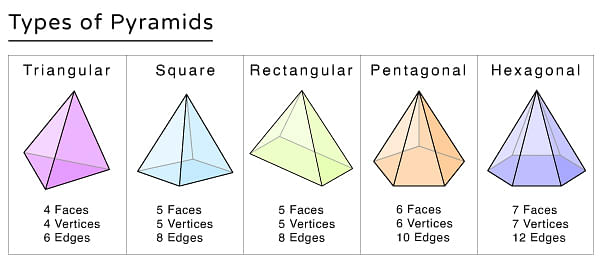
Types of Pyramid
Prism
Prisms are solid three-dimensional shapes with identical polygon ends and flat parallelogram sides. Here are the characteristics of a prism-
- It has the same cross-section all along with the shape.
- They are broadly classified into regular prisms and oblique prisms.

Prism
Read Also: Volume of Sphere
Edges, Faces and Vertices of 3D Shapes
[Click Here for Sample Questions]
Due to the presence of three dimensions- length, breadth and height, 3D shapes have faces, edges and vertices.
Faces
- It refers to any single flat or curved surface of a solid shape.
- There can be more than one shape in a 3D object.
Edges
- An edge refers to the line segment on the boundary joining the adjacent vertex.
- It serves as the junction of two faces.
Vertices
- It is the point where two or more edges meet.
- It is also known as the corner.
- Here is the table showing the faces, edges and vertices of 3D shapes.

Edges, Faces and Vertices of 3D Shapes
Read More: Difference Between Cube and Cuboid
Properties of 3D Shapes
[Click Here for Previous Years Questions]
The following is a table of some of the 3D shapes with their properties -
| 3D Shapes | Properties |
|---|---|
| Sphere | It has no vertices or edges. It has only one curved surface. It is perfectly symmetrical. All the points on the surface are equidistant from the center. |
| Cylinder | It has a flat base and a flat top. The bases are parallel and congruent It has one curved side. |
| Cone | It has one pointed vertex at the top and a flat base . |
| Cube | There are six faces, each in the shape of a square All sides are of equal length Total number of diagonals is 12. |
| Cuboid | It has six faces, each of them is rectangular in shape. Thus, all sides are not equal. There are a total of 12 diagonals. |
| Pyramid | It is a polyhedron with a polygon base and an apex with straight lines. Based on the apex alignment they can be classified into regular and oblique pyramids. |
| Prism | It has identical polygonal ends and flat faces It has the same cross-section along the length. |
Read Also: Chapter 11 Three Dimensional Geometry
3D Shapes Formulas
[Click Here for Sample Questions]
All three-dimensional shapes have surface area and volume. The surface area refers to the area covered by a 3D-structure at the bottom, top and all the faces including the curved surfaces. On the other hand, volume refers to the amount of space a 3D-structure occupies. Here is a table of different 3D shapes and their formulae.
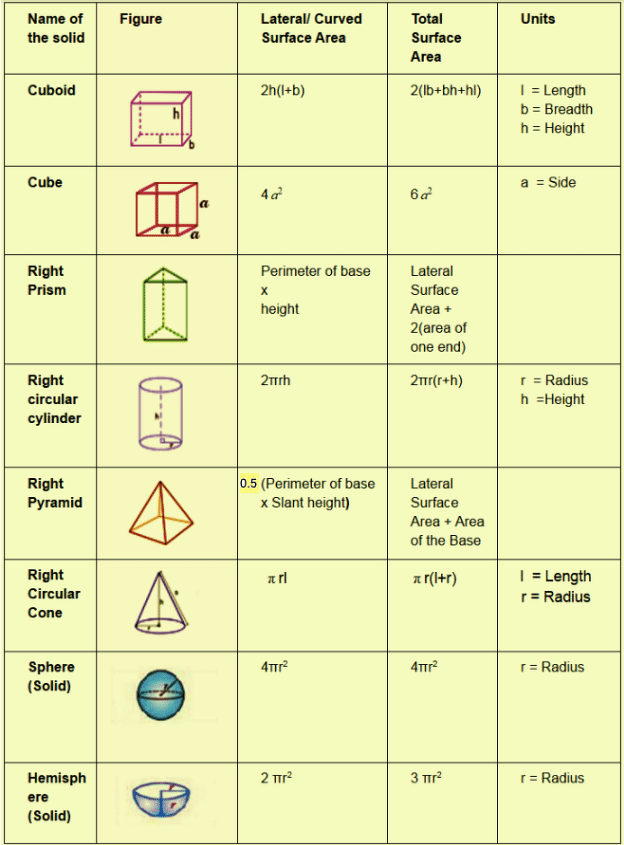
3D Shapes Formula
Read Also: Section Formula 3 Dimension
3D Shapes Nets
[Click Here for Sample Questions]
The shapes and the properties of the three-dimensional shapes can be well understood by using nets. Here, a 2D-shape can be folded in a specific way to form a 3D-shape. It is called a geometrical net. Nets can also be described as an unfolded 3D-figure. A single solid may have different nets.
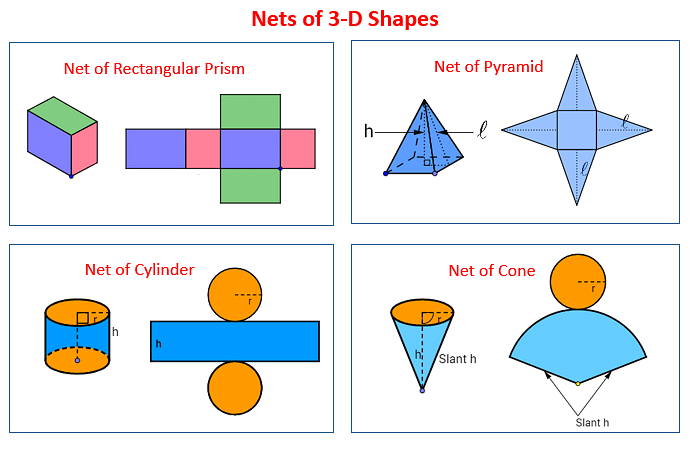
3D Shape Net
Things to Remember
- 3D shapes are those objects or solids having three dimensions- length, width and height.
- Unlike two-dimensional figures, 3D shapes have thickness or depth. Thus, they occupy some volume.
- The three-dimensional shapes are mainly of two broad types: curved-shaped solid and straight-sided polygon called polyhedrons.
- Sphere, cone, cylinders are some of the examples of curved solids while cubes, cuboids, prisms, pyramids are some of the examples of straight-sided solids.
- A 2D shape can be folded in a specific way to form a 3D shape. It is called a geometrical net.
Also Read:
Previous Year Questions
- The locus represented by…. [KCET 2018]
- Foot of the perpendicular drawn from the point...[KCET 2019]
- Acute angel between the line...[KCET 2019]
- The distance of the point (1, 2, 1) from the line…..[KCET 2019]
- XY - plane divides the line joining the points A…..[KCET 2019]
- A vector perpendicular to the plane containing the points….[KCET 2007]
- The angle between two diagonals of a cube is...[KCET 2014]
- The angle made by the vector with the positive direction of….[KCET 2010]
- Equation of line passing through the point….[KCET 2015]
- Equation of the plane perpendicular to the line…. [KCET 2014]
- The angle between the straight lines….[KEAM]
- Equation of the plane perpendicular to the line…..[KCET 2014]
- The angle between the straight lines…..[KEAM]
- If a straight line makes angles…..[KEAM]
- A plane makes intercepts a,b and c….[KEAM]
Sample Questions
Ques. What are 3D shapes? (2 Marks)
Ans. 3D shapes are three-dimensional objects or solids having three dimensions- length, width and height. These objects occupy some spaces that give them their volumes. Some of the examples of 3D shapes are cube, cuboid, cone, cylinder, sphere etc.
Ques. What is the difference between 3D and 2D shapes? (3 Marks)
Ans. The main differences between 3D and 2D shapes are given below-
- 3D shapes have a length, breadth and height while a 2D shape has only length and breadth.
- 3D shapes have a volume as they occupy some space however, 2D shapes have no volume but only a surface area.
Ques. What is Face, Vertex and Edge in a 3D shape? (3 Marks)
Ans. A description of the face, vertex and edge is given below-
Faces - It refers to any single flat or curved surface of a solid shape.
Vertices - It is the point where two or more edges meet. It is also known as a corner.
Edges - An edge refers to the line segment on the boundary joining the adjacent vertex.
Ques. Can a 3D geometric shape have a flat surface only? (2 Marks)
Ans. No, a 3D geometric shape cannot have a flat surface only. However, a 3D structure may have only a curved surface. For instance, a sphere has only one curved angle.
Ques. What are the common properties of 3D Geometric shapes? (2 Marks)
Ans. The common properties of the 3D geometric shapes are given below-
- 3D shapes have length, width and height.
- 3D shapes may or may not have faces, vertices, edges and curved surfaces.
Ques. What is the difference between lateral surface area and curved surface area of a three-dimensional object? (3 Marks)
Ans. Lateral surface area refers to the area of all the surfaces of a 3D object excluding the top and the bottom surfaces while curved surface includes an area of the curved surface only. For instance, a cube has 6 faces, its lateral surface area covers the area of all 4 faces excluding top and bottom surfaces. On the other hand, a cylinder has two flat faces and one curved surface.
Ques. What is the surface area of a cube, if the edge length is 40 cm? (3 Marks)
Ans. Given, the edge of cube = 40cm
Now, the surface area of a cube =6a2 (a= the edge-length)
Thus, the surface area of the cube is 6 (40)2 = 9600 sq.cm
Ques. Find the volume of the cylinder if the radius = 10 cm and height is 15 cm. (3 Marks)
Ans. Given, the dimensions of cylinder are:
Radius = 10 cm
Height = 15 cm
Now, the volume of cylinder = \(\pi\)r2h
=3.14 (102)15
= 4710 cc.
For Latest Updates on Upcoming Board Exams, Click Here: https://t.me/class_10_12_board_updates
Check-Out:



Comments