



Education Journalist | Study Abroad Lead
Congruent Figures are those figures which are identical in shape and size, that is, they have congruency. It is not necessary for congruent figures to be turned the same way or face the same direction in order to be congruent. The two triangles are said to be congruent if they are copies of each other and if they are placed on top, they are directly attached to each other. In other words, two triangles are parallel when the sides and angles of one triangle are equal to the sides and the corresponding angles of the other triangle.
Key Terms: Congruent Figures, Congruent Triangles, Congruent Angles, Congruency Rule, SSS Congruency, Triangle, Angles
Congruent Figures
[Click Here for Sample Questions]
The word congruent means equality in all aspects or figures and the dimensions of both are the same for example, two identical radio circles are compatible. And the two squares of the same sides are parallel.
The sign of congruence is denoted by the symbol “\(≅\)”.
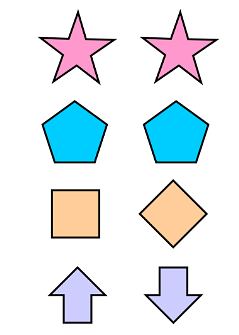
Congruent Figures
How to Draw Congruent Figures?
[Click Here for Sample Questions]
You can take a sheet of paper and draw two similar numbers on it. Cut out the figures and place them on top of each other. Both figures will match if you place one image on top of the other. In Geometry, if we say that one number (A) equals figure (B), we write it down as figure A \(≅\) to get B.
How to Get Congruence of Two Figures?
[Click Here for Sample Questions]
Use the following method to determine whether these two figures are congruent or not:
- Take a tracing sheet and trace the outline of figure A.
- Cut out the shape of picture A and place it on top of picture B.
- You can set the paper over figure B or flip it over and place it on figure B.
- When both figures are completely covered, they are parallel. You can represent it figuratively, as in picture A says \(≅\) to get B.
Read More: Transversal and Angles
Congruent Triangles
[Click Here for Sample Questions]
The two triangles are aligned if and only if one of them can be made to be placed on top of the other so that it covers exactly. Therefore, it can be said that two triangles are said to be congruent if their sides have the same length and angles have the same measure.

Congruent Triangles
In the given figure, \(Δ\) ABC and\(Δ\) PQR are congruent triangles. Here,
- A and P, B and Q, and C and R are the same.
- AB=PQ, QR= BC and AC=PR
- ∠A = ∠P, ∠B = ∠Q, and ∠C = ∠R
Congruency Rules for Triangles
[Click Here for Sample Questions]
The different rules of congruency for triangles are as follows.
SAS Congruence Rule
Two triangles are parallel if two sides and the inserted angle of one triangle are equal to two sides and the inserted angle of the other triangle. The example as shown in the figure satisfies the SAS Congruence Law.

SAS Congruence Rule
ASA Congruence Rule
Two triangles are connected if two angles and the inserted side of one triangle is equal to two angles and the combined side of the other triangle.

ASA Congruence Rule
AAS Congruence Rule
Two triangles are parallel when two pairs of angles and one pair of parallel sides are equal

AAS Congruence Rule
Read More: Isosceles Triangle Theorems
SSS Congruence Rule
If three sides of one triangle are equal to three sides of another triangle then the two triangles are parallel. The example as shown in the diagram satisfies the SSS congruency rule:

SSS Congruence Rule
RHS Congruence Rule
If the hypotenuse and one side of one right triangle are equal to the hypotenuse and one side of the other right triangle, it means that the two triangles are parallel.
The example shown below satisfies the condition of RHS compliance.

RHS Congruence Rule
Read More: Right Angle Triangle Theorem
Congruent Angles
[Click Here for Sample Questions]
Congruent angles are two or more angles similar to each other. Therefore, the ratio of these angles is equal. The type of angles does not make any difference to the interaction of angles, which means they can be angular, dense, external, or internal angles.

In the diagram provided above, ∠A \(≅\) ∠A also reads “Angle A is congruent to angle B”.
If ∠A and ∠B are the same size, it means they are equal or compatible. That means that ∠A corresponds to ∠B and ∠A = ∠B or ∠A ≅ ∠B.
Read more:
Rules for Congruent Angles
[Click Here for Sample Questions]
- The only condition is that the two angles are parallel and that the measurement angle measurements are the same.
- The length and direction of the two arms that make up these joint angles are not important.
Read More: Corresponding Angles Axioms
Read More: Transversal and Angles
Things To Remember
- Congruent Figures refer to those figures which are identical in shape and size. In short, the figures that have congruency are known as congruent figures.
- Two triangles are said to be congruent when all sides and angles of the triangles are equal in proportion.
- The corresponding triangles have the same angle measurements and lateral lengths. The conditions for a triangular congruency are:
- SSS (Side-Side-Side)
- SAS (Side-Angle-Side)
- ASA (Angle-Side-Angle)
- AAS (Angle-Angle-Side)
- RHS Congruence Rule
- Two or more angles similar to each other are referred to as congruent angles.
Sample Questions
Ques. In the picture provided, AB || CD and O are in the middle of AD.
Show that
(i) ΔAOB \(≅ \)DOC.
(ii) O is the centre of BC (3 Marks)
Ans.

(i) In ▲AOB and ▲DOC,
∠BAO = ∠CDO (Alternate internal angles, AB || CD)
AO = OD (Given, O central AD)
∠AOB = ∠DOC (Direct angles, i.e., Vertically Opp. Angle)
∴ In terms of ASA rule,
ΔAOB ≅ ▲DOC
(ii) ∵ ▲AOB ≅ ▲DOC [From (i)]
∴ BO = CO (CPCT)
Therefore, O is in the middle of BC.
Ques. In the diagram provided, two parallel lines l and m are interrupted by two parallel lines p and q.
Show ΔABC ≅ ΔCDA. (3 Marks)
Ans.

At ΔABC and ΔCDA,
∠BAC = ∠DCA (Other internal angles, p ∥ q)
∠BCA = ∠DAC (Other internal angles, l ∥ m)
AC = CA (Common side)
∴ In terms of ASA compliance,
ΔABC ≅ ΔCDA
AD is the length of the isosceles ΔABC when AB = AC.
Ques. Show that (i) AD divides twice BC, (ii) AD divides ∠A. (3 Marks)
Ans.

(i) In ΔABD and ΔACD,
∠ADB = ∠ADC = 90 ° (As, AD⊥BC)
AB = AC (Given)
AD = AD (Standard side)
∴ In terms of RHS congruence,
ΔABD ≅ ΔACD
∴ BD = CD (CPCT)
Therefore, AD divides twice in BC.
(ii) ∵ ΔABD ≅ ΔACD [From (i)]
∴ ∠BAD = ∠CAD (CPCT)
Therefore, AD divides into two ∠A.
Ques. In the below-given image, if x = y and AB = CB, prove AE = CD. (3 Marks)
Ans.

Consider the AEB and CDB triangles.
∠EBA = ∠DBC (Normal angle) ... (i)
In addition, we have:
∠BEA = 180 – y
∠BDC = 180 – x
As x = y, we have:
180 − x = 180 − y
⇒∠BEA = ∠BDC ... (ii)
AB = CB (Given) ... (iii)
From (i), (ii) and (iii),
△ BDC≅ △ BEA (By AAS)
∴ AE = CD (CPCT)
Therefore, it has been proven.
Ques. What pairs of corresponding angles? (3 Marks)
Ans. When the intersections are drawn in two lines (either parallel or inconsistent), then the following pairs of angles correspond.
- Internal angles
- External angles
- Pairs of matching angles
- A pair of other indoor angles
- A pair of other outer angles
- Pear angles inside on the same transversal side
Ques. In the figure given below, AE = AD & BD = CE. Show that ΔAEB ≅ ΔADC. (5 Marks)
Ans.

Given that AE = AD … (a)
& CE = BD … (b)
Adding (a) and (b),
We get AE + CE = AD + BD
So, AC = AB … (c)
In ΔAEB & ΔADC,
It is given that AE = AD
AB = AC (from (c))
∠A is common in both the triangles.
So, using SAS congruence criteria,
ΔAEB is congruent to ΔADC
Ques. In ΔABC, D is a mid point of AC side so that BD = 1/2AC. Show that ∠ABC is the right angle. (5 Marks)
Ans.

In ΔADB,
AD = BD (As, BD = ½(AC))
Let,
⇒∠DAB = ∠DBA = x (Angle opposite to equal sides are equal)
Similarly, in ΔDCB,
BD = CD (Provided)
Let,
⇒∠DBC = ∠DCB = y
At ΔABC,
∠ABC + ∠BCA + ∠CAB = 180 ° (Angle sum property)
⇒x + x + y + y = 180 °
⇒2 (x + y) = 180 °
⇒x + y = 90 °
⇒∠ABC = 90 °
So, ∠ABC is the right angle.
Ques. P is a point in the Bisector of ∠ABC. If the line passing through P, corresponding to BA meets BC in Q, prove ΔBPQ is an isosceles triangle. (3 Marks)
Ans.

∵∠1 = ∠2 (Given, BP is the ∠ABC separator)
Also, ∠1 = ∠3 (Alternate internal angles)
∴ ∠ 2 = ∠ 3
So, PQ = BQ (opposite sides is equal.)
But these are the sides of ΔBPQ.
Therefore, ΔBPQ is an isosceles triangle.
The ∠B bisectors and the ∠ C of an isosceles ▲ABC, where AB = AC are opposite in
Ques. Show that the outer angle adjacent to ∠ABC is equal to ∠BOC. (5 Marks)
Ans.

At ΔABC,
= AB = AC (Given)
∴ ∠ACB = ∠ABC (Angle opposite to equal sides are equal)
⇒1/2∠ACB = 1/2∠ABC
⇒∠OCB = ∠OBC ..... (i)
(Given, BO and CO are double angles of ∠ABC and ∠ACB, respectively)
In ΔBOC,
∠OBC + ∠OCB + ∠BOC = 180 ° (Angle sum property triangle)
⇒∠OBC + ∠OBC + ∠BOC = 180 ° [From (i)]
⇒2∠OBC + ∠BOC = 180 °
⇒∠ABC + ∠ ° BOC = 18 (BO double angle ∠ABC) ..... (ii)
Also, DBC is a straight line.
Thus, ∠ABC + ∠DBA = 180 ° (Line pair) ..... (iii)
From (ii) and (iii), we find
∠ABC + ∠BOC = ∠ABC + ∠DBA
∴ ∠BOC = ∠DBA
For Latest Updates on Upcoming Board Exams, Click Here: https://t.me/class_10_12_board_updates
Check More:



Comments