



Education Journalist | Study Abroad Lead
Constructive interference are the waves that are set to be constructive, when two or more waves have interference at the same wavelength, frequency and in phase.
- In Physics, a wave is defined as the continuous locus of all particles of a medium which are vibrating in the same phase.
- In case of constructive interference there are two or more waves that are travelling in the same direction and are in the same wavelength, frequency and in phase with each other.
- The displacement of an upward wave happens due to the waves that undergo constructive interference
- The upward displacement is medium and is greater than the displacement of the two interfering pulses.
Key terms: Constructive Interference, Destructive Interference, Young’s Module, Interference of light
What is Constructive Interference?
[Click Here for Sample Questions]
When two or more waves have interference at same wavelength, frequency and in phase, it results in a mutual reinforcement and produces a single amplitude equal to the sum of the amplitudes of the individual waves. This is known as Constructive Interference.
- Also, when there are two crests or troughs of a wave that are aligned to each other it gives a resultant amplitude that is higher.
- The two waves that have the same amplitude and frequency (ω) can be described by the following equation:
y1 = cos (kx – ωt) and y2 = cos (kx – ωt + δ)
where δ is the phase difference between the waves,
k is the wavenumber,
x is the wave position, and t is time.
What is Destructive Interference?
[Click Here for Previous Year Questions]
When two or more waves have interference & displacement in the opposite direction i.e.,they are 180 degrees out of phase, where a positive displacement of one wave is cancelled exactly by a negative displacement of the other wave, it is called destructive interference.
What is Wave Interference?
[Click Here for Sample Questions]
Wave Interference is a phenomenon when two coherent waves meet while travelling along the same medium. The resultant of the wave is given by the sum of the individual waves.
The interferences are of two types:
- Constructive Interference
- Destructive Interference
Models of Constructive Interference
[Click Here for Previous Year Questions]
These are the following phase difference between waves that must be zero for constructive interference:
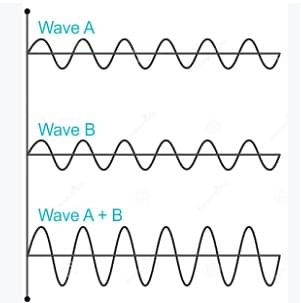
Models of Constructive Interference
Read More: Electromagnetic Waves
Condition for Constructive and Destructive Interference
[Click Here for Sample Questions]
Let there be two coherent sources of light that is represented as:
y1 = a sin ꙍ t -------------- 1)
y2 = b sin (ꙍ t + Ø) ------------ 2)
where a and b are the respective amplitudes of the two waves and Ø is the constant phase angle by which the second wave leads the first wave.
According to the superposition principle, the displacement 9y) of the resultant wave at time (t) would be given by
y = y1 + y2 = a sin ꙍ t + b sin (ꙍ t + Ø) = a sin ꙍ t + b sin ꙍ t cos Ø + b cost ꙍ t sin Ø
y = sin ꙍ t (a + b cos Ø) + cos ꙍ t. b sin Ø ------------ 3)
Put (a + b cos Ø) = R cos Ɵ --------------- 4)
b sin Ø = R sin Ɵ ---------------- 5)
y = sin ꙍ t . R cos Ɵ + cos ꙍ t . R sin Ɵ
y = R sin (ꙍ t + Ɵ) ---------------- 6)
Thus the resultant wave is Harmonic wave of amplitude R
Squaring 40 and 5) and adding, we get:
R2 (cos2 Ɵ + sin2 Ɵ) = (a+ b cos Ø)2 + (b sin Ø)2
R2 x 1 = a2 + b2 cos2 Ø + 2ab cos Ø + b2 sin2 Ø
R = √ a2 + b2 + 2ab cos Ø ---------------- 7)
As resultant intensity I is directly proportional to the square of the amplitude of the resultant wave:
Therefore,
I ∝ R2
I ∝ ( a2 + b2 + 2 ab cos Ø) ---------------- 8)
For constructive interference
I should be maximum, for which
cos Ø = max = + 1
Therefore Ø = , 2π, 4π….
Ø = 2nπ
Where n = 0,1,2
Constructive Interference Between Two Plane Waves
[Click Here for Previous Year Questions]
The two waves that have the same frequency and amplitude propagate through vacuum with an angle of 2∝ formed between their wave vectors k1, k2
- One wave is travelling horizontally and the other wave is travelling at an angle of Ɵ.
- The first two waves are in phase with point A.
- The relative phase changes along the x-axis.
The phase difference at the first point is given as,
∆ = \(\frac{2 \pi d}{\lambda}= \frac{2 \pi xsin \theta}{\lambda}\)
The waves are in phase with each other, then,
\(\frac{xsin \theta}{\lambda}\) = ± 0,1,2…..
They are a half cycle out of phase, then,
\(\frac{xsin \theta}{\lambda}\) = ± \(\frac{1}{2}\) ± \(\frac{3}{2}\)
The constructive interference occurs when the waveforms are in phase whereas in destructive interference they are out of phase.
\(d_f = \frac{\lambda}{sin \theta}\)
Where, df – fringe spacing, with the increase in fringe spacing, wavelength also increases.
Read More: Faraday's Law
Difference between Constructive Interference and Destructive Interference
[Click Here for Sample Questions]
These are the following differences between constructive and destructive interference:
| Constructive Interference | Destructive Interference |
|---|---|
| The crest of one wave meets with the crest of another one. | The crest of one wave meets with the trough of another one. |
| In case of Constructive interference, the two waves sum up when they meet each other. | In case of Destructive interference, the two waves cancel out when they meet each other. |
| There is zero phase difference between the two waves. | There is 180 degree of phase difference between the two waves. |
| The intensity of the wave increases | The intensity of the wave decreases |
| Here the waves are in phase. | Here the waves are out of phase. |
Formula of Constructive Interference
[Click Here for Previous Year Questions]
The resultant wave which is a harmonic wave of amplitude R where in R = √ a2 + b2 + 2ab cos Ø.
As resultant intensity I is directly proportional to the square of the amplitude of the resultant wave.
Therefore I ∝ R2
i.e. I ∝ ( a2 + b2+ 2ab cos Ø)
For constructive interference
I should be maximum, for which
cos Ø = max = + 1
Therefore Ø = 0, 2π, 4π, ……..
Ø = 2nπ
Where n = 0,1,2………..
If x is the path difference between the two waves reaching point P, cross ponding to phase difference Ø, then
\(x = \frac{\lambda}{2\pi} \theta = \frac{\lambda}{2\pi} (2n\pi) = n\lambda\)
x = nʎ
Hence the condition for constructive interference at a point is the phase difference between the two waves reaching the point should be zero or an even integral multiple of π.
Equivalently, path difference between two waves reaching the point should be zero or an integral multiple of full wavelength.
Examples of Constructive Interference
[Click Here for Sample Questions]
There are several examples where constructive interference occurs, where two or more waves have interference at same wavelength, frequency and in phase which means that crests and troughs aligns:
- Sound Waves: When two speakers emit sound waves of the same frequency and are placed together, they produce waves that are of higher sound intensity, resulting in a louder sound.
- Musical Instruments: There are instruments that have strings such as guitar or violin, plucked or bowed to produce waves that can interfere constructively.
- Double-Slit Experiment: This is the experiment that demonstrates constructive interference with light waves where a beam of light passes through two closely spaced slits which creates a pattern of alternating light and dark bands on a screen.
- Soap Bubbles: There are bubbles that are obtained due to the result of constructive interference. The surface of the bubbles leads to the colourful pattern.
- Laser Interference: Lasers emit coherent light waves used in holography to create three-dimensional images.
- Radio Broadcasting: These are the radio waves that transmit the same signal from different antennas.
Application of Constructive Interference
[Click Here for Previous Year Questions]
The application of constructive interference is mentioned below:
- In the case of Acoustics, a beat is produced as an interference pattern which produces sounds of slightly different waves.
- Constructive interference measures the physical properties of a sound wave.
- Constructive interference is a periodic variation in volume whose rate is the difference between two frequencies and when two tones are in close pitch, the difference in frequency generates a beat.
- Contractive interference used to calibrate the wavelength standards and also as an Optical interferometry, in Michelson Morley experiment.
- In the case of a telescope, it is used to create a combined image.
- In the case of Radio Interferometry, two waves in the same phase, add each other up.
Also Read:
| Relevant Concepts | ||
|---|---|---|
| Maxwell Equations | Impedance of free space | Scintillation Counter |
| Electromagnetic Waves MCQ | Types of Radiation | Magnetic field lines |
Things to Remember
- Interference is the phenomenon of redistribution of light energy in a medium on account of superimposition of light waves from two coherent sources.
- The waves are said to be constructive interference when the crest of one wave coincides with the crest of another wave.
- Young's double slit experiment produces bright and dark fringes that are placed alternately and they are equally spaced. These bands are called Interference fridges.
- Constructive interference measures the physical properties of a sound wave.
- The resultant of the wave is given by the sum of the individual waves.
- In the case of Radio Interferometry, two waves in the same phase, add each other up.
- When there are two crests or troughs of a wave that are aligned to each other that gives a resultant amplitude that is higher
Previous Year Questions
- Nascent hydrogen consists of..
- In which of the following reactions the hydrogen peroxide acts as a reducing agent?..[JEE MAIN 2023]
- Major product of the following reaction is..[JEE MAIN 2023]
- The total current supplied to the circuit by the battery is...[AIEEE 2004]
- The reading of voltmeter in the circuit shown is….[Rajasthan PMT 2023]
- The oxidation of toluene to benzaldehyde by chromyl chloride is called...[NEET UG 1996]
- An aggregate fruit is one which develops from..[NEET UG 2014]
- The order of stability of the following carbocations..[JEE MAIN 2013]
- Complete hydrolysis of cellulose gives...[BITSAT 2012]
- Which one among the following metals is the weakest reducing agent?..[JEE MAIN 2023]
Sample Questions
Ques: What are Coherent Sources (1 mark)
Ans : The source of light, which emits continuous light waves of same wavelength, same frequency and in the same phase or having a constant phase difference are called coherent sources.
Ques : Which phenomena establishes the wave nature of light? (1 mark)
Ans : Interference, diffraction, and polarization of light establishes the wave nature of light.
Ques : What is interference of light? (1 mark)
Ans : Interference of light is the phenomenon of redistribution of light energy in a medium on account of suspension of light waves from two coherent sources.
Ques: What are the uses of constructive interferences? (3 marks)
Ans: These are the following uses for constructive interference:
- In the case of Acoustics, a beat is produced as an interference pattern which produces sounds of slightly different waves.
- Constructive interference measures the physical properties of a sound wave.
- Contractive interference used to calibrate the wavelength standards and also as an Optical interferometry, in Michelson Morley experiment.
Ques : What are the conditions for obtaining two coherent sources? (3 marks)
Ans : These are following condition by which coherent sources can be obtained:
- Coherent sources of light should be obtained from a single source by some device.
- The two sources should give monochromatic light.
- The path difference between light waves from two sources should be small.
Ques : Widths of two slits in Young’s experiment are in the ratio of 25:1. What is the ratio of the amplitude of light waves from them? (3 marks)
Ans: The width for two slits from intensities are:
w1/w2 = I1/I2 = a2/b2
As per the formula, putting the values:
a2/b2 = 25/1
a/b = √25/1 = 5/1
The ratio of the amplitude of light between slits is 5:1.
Ques : What are the conditions for sustained interference of light? (5 marks)
Ans : These are the following conditions for obtaining sustained interference of light such as:
- The two sources of light must be coherent i. e they should emit continuous light waves of same wavelength or frequency which have either the same phase or constant phase difference.
- The two sources should be strong with less background.
- The amplitude of waves from two sources should preferably be equal.
- The two sources should preferably be monochromatic.
- The coherent sources must be very close to each other.
Ques: Two waves of intensity ratio 1:9 cross each other at a point. Calculate the ratio of resultant intensities at a point, when (a) Waves are in coherent, (b) Wave are coherent and differ in phase by 60°? (5 marks)
Ans: The width for two slits from intensities are:
w1/w2 = I1/I2 = a2/b2
As per the formula, putting the values:
a2/b2 = 1/9
a/b = √1/9 = 1/3
(a) When the source is incoherent, no interferences occur, Resultant intensity at any point is the sum of the intensities of individual waves. i.e., I = I1 + I2 = K (a2 + b2).
(b) When the sources are coherent, and the constant phase difference Ø = 60°
I’ = K (a2 + b2 + 2ab cos Ø) = K (a2 + b2 + 2ab cos 60°)
= K (a2 + b2 + ab)
Therefore I/I’ = K (a2 + b2)/ K (a2 + b2 + ab) = 10 a2 / 13a2 = 10/13
Ques: Two coherent sources are 0.18mm apart and the fringes are observed on a screen 80 cm away. It is found that with a certain source of light, the fourth bright fringe is situated at a distance of 10.8mm from the central fridge. Calculate the wavelength of light? (3 marks)
Ans: Here d = 0.18mm = 18 x 10-5m, D = 80cm = 0.8m
n= 4 (for fourth bridge fridge), x = 10.8 mm = 10.8 x 10⁻³ m
For bright fringes x = nʎ/Dd , ʎ = xd/nD = 10.8 x 10-3 x 18 x 10-5/ 4 x 0.8 = 60.75 x 10⁻⁸m
ʎ = 6075 A°
Ques: Two straight narrow parallel slits 3mm apart are illuminated with monochromatic light of wavelength 5900 x 10-8cm. Fringes are observed at a distance of 3m from the slits. Find the width of the fringes? (2 marks)
Ans. Here, d=3mm = 3 x 10⁻³m, D=3m, ʎ = 5900 x 10-8 cm = 5900 x 10-10 m
β = D/ʎd = 3 x 5900 x 10-10/ 3 x 10-3 = 5.9 x 10⁻⁴m
For Latest Updates on Upcoming Board Exams, Click Here: https://t.me/class_10_12_board_updates
Check-Out:



Comments