



Content Curator
Density of gas formula is widely used to calculate the density of gases. In chemistry, we can determine the molar mass of the substance if we know the density of that substance. Density is an essential property of any gas and it helps in calculating many factors. The density of any gas varies with the change in temperature and pressure. Any gas can change the volume significantly with change in pressure due to its high compressibility.
Apart from this, gas density is basically defined as the mass of the gas occupying a certain volume under specific temperature and pressure conditions.
Check out: Formulas in Physics
| Table of Content |
Key Takeaways: Density of Gas, Volume, Temperature, Pressure, Ideal Gas Equation
What is the Density of Gas?
[Click Here for Sample Questions]
Density of Gas is referred to as the mass per unit volume of a substance under specific conditions of temperature and pressure. In other words, mass divided by its volume is known as density of gas. The density of gas varies with the change in temperature and pressure. Density of gas is denoted as ‘ρ’. Mathematically,
ρ = m / V
Where,
m = mass of gas
V= volume of gas
Apart from this, the molar mass of the substance can be calculated if we know the density of the gas.
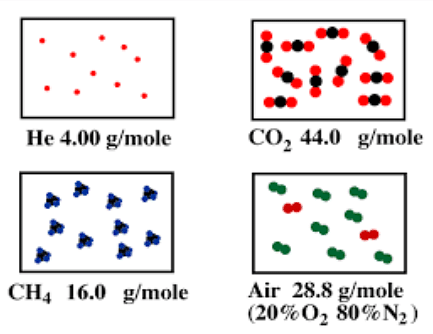
Density of Gases with Molar Mass
Read More:
Derivation of Gas Density Formula
[Click Here for Sample Questions]
Density of gas is equal to the mass divided by its volume. To calculate the molar mass then consider the ideal gas equation.
According to ideal gas equation,
PV = nRT
Where,
P = refers the pressure of the gas
V = refers the volume of the gas
n= indicates the number of moles
R = indicates the gas constant ( R =8.32 Joule)
T = indicates the temperature
We know that,
n = m / M
Where,
m = indicates the mass of the gas
M = refers the molecular mass of the gas
Therefore,
PV = m RT/ M
⇒ P = m RT/ MV
Also, we know that mass divided by the volume is called density. Sometimes, density is denoted as ‘d’ also. Hence,
P = ρ RT/ M
Or
M = ρ RT / P (This equation is for molar mass)
Or
d = PM/RT (This equation is for density of gas)
The above equation is also referred to as the ideal gas density formula.
Read More: Derivation of Ideal Gas equation
Different Units to Measure Densities
[Click Here for Sample Questions]
The standard way to determine the quantity in SI units. But, there are some other units which are also used to measure the densities. Such as:
- Kilogram per litre- Kg/L ( SI unit)
- Gram per millimetre - g/mL
- Metric ton per Cubic metre - t/m3
Read More:
Things to Remember
[Click Here for Sample Questions]
- Density of gas is calculated by simply dividing mass to the volume of the substance or gas.
- Density of any gas varies with respect to the change in temperature and pressure.
- Ideal gas equation describes the relation between four variables which tell us the state of any gas.
- Ideal gas is that gas which strictly obeys Boyle's law, Charles’ law and Avogadro's law.
- Due to high compressibility, the volume of any gas varies significantly with the change in pressure.
Read More:
Sample Questions
Ques. What do you mean by density of gas? [2 marks]
Ans. Density of gas is defined as the mass per unit volume under the specific conditions of temperature and pressure. With the change in temperature and pressure, the density of any gas also varies. The density of gases is lesser than solid. Density is an important property of gases which helps in calculating the molar mass of the substance. Density of gas is denoted as ‘ρ’.
Mathematically,
ρ = m / V
Where, ρ = indicates the density of gas
m= indicates the mass of the gas
V = denotes the volume of the gas
Ques. What is an Ideal gas? Write down the ideal gas equation. [2 marks]
Ans. Ideal gas is defined as the gas which strictly follows Boyle's law, Charles’ law and Avogadro’s law. Ideal gas is hypothetical in nature. This is a very rare condition where any gas obeys these laws. This is only possible under certain temperature and pressure conditions.
Ideal Gas Equation:
ρ= PM/RT
Where,
ρ = refers to density of ideal gas ( Kg/L)
P= refers to pressure of the gas (atm)
M= refers to molecular mass of the gas (g/mol)
R= refers to Gas constant ( 8.32 Joule)
T= refers to temperature ( K)
Ques. Calculate the density of a gas at temperature of 60o C under the pressure of 10 atm and having the molar mass of 20.17 g/mol. [3 marks]
Ans. Given,
Temperature of the given gas(T) = 60o C
Pressure of the given gas (P) = 10 atm
Molecular Mass of the gas (M) = 20.17 g/mol.
Density of gas (p) = ?
Also, Gas constant (R ) = 8.32 Joule
By using the ideal gas density formula,
ρ= MP/RT
ρ= 20.17 x 10 / 8.32 x 60
ρ= 201.7 /499.2
ρ= 0.4040 Kg/L
Therefore, the density of gas is .04040 Kg/l .
Ques. Determine the value of gas constant for one mole of H2 .Also, 0.5 g of H2 occupies 5.6 litres at S.T.P. [3 marks]
Ans. Given, volume of the gas = 0.5 g
We know that, PV = nRT
For 1 mole of gas, n =1
∴ PV = 1 X RT
∴ P = RT /V
Now, 0.5 g of H2, at S.T.P occupy = 5.6 litres.
∴ 1 mole or 2g of H2 at S.T.P would occupy(P) = (5.6 / 0.5) x 2
= 22.4 litres
Therefore, R = PV /T
R= 22.4 x 1 / 273
R= 0.082 litre atmosphere degree -1 mole-1 .
Therefore, the value of gas constant is 0.082 litre atmosphere degree -1 mole-1 .
Ques. Determine the density of a gas with molecular mass of 17 at temperature of 20oC and pressure of 2 atm. Using gas constant = 0.082 atm litre K-1 mol-1 . [3 marks]
Ans. Given,
Temperature of the gas(T) = 20o C
Pressure of the given gas (P) = 2 atm
Molecular Mass of the gas (M) = 17 g/mol.
Density of gas (p) = ?
Also, Gas constant (R ) = 0.082 atm litre K-1 mol-1
Now, T = 273+ 20 = 293 K
By using the ideal gas density formula,
ρ= MP/RT
ρ= 17 x 2 / 0.082 x 293
ρ= 34 /24.026
ρ= 1.415 g/L
Therefore, the density of gas is 1.415 g/L
Ques. Determine the density of carbon tetrachloride(CCl4) at 710 torr and temperature of 1200 C. [3 marks]
Ans. Given,
Pressure (P) = 710 torr = (710/760) atm
temperature(T) = 1200C = 273+120 = 393 K
Gas constant (R)= 0.082 atm litre K-1 mol-1
Molecular mass of carbon tetrachloride(CCl4) = 154
According to ideal gas density equation,
ρ= MP/RT
ρ= 157 x 710/760 x 0.0821 x 393
ρ= 111470/24521.628
ρ= 0.46 g/L.
Hence, the density of carbon tetrachloride(CCl4) is 0.46 g/L.
Ques. Determine the density of ammonia(NH4) at a temperature of 30oC and having a pressure of 5 Bar. [3 marks]
Ans. Given,
Pressure (P) = 5 bar
Temperature(T) = 30oC = 273+30 = 303 K
Gas constant (R)= 0.082 atm litre K-1 mol-1
Molecular mass of ammonia(NH4) = 17
According to ideal gas density equation,
ρ= MP/RT
ρ= 17 x 5/0.082x 303
ρ= 85/24.846
ρ= 3.42 g dm=3.
Hence, the density of ammonia(NH4) is 3.42 g dm=3.
Ques. The density of a gas is given as 3.85 g/L at STP.Determine its density at 27oC and pressure of 700mm. [3 marks]
Ans. Given,
density of a gas d1 = 3.85 g/L
If there are two different tem[erture for the same gas then apply the equation
ρ= MP/RT
Ρ or d= MP/RT
d1/ d2 = P1 X T2 / P2 X T1
Here, d1 = 3.85 g/L
d2 = ?
P1 = 760 (STP)
P2 = 700 mm
T1 = 273 K
T2 = 273+27= 300 K
Now,
3.80/ d2 = 760 x 300/700 x 273
3.80/ d2 = 228000/191100
3.80/ d2 = 1.1931
d2 = 3.80/ 1.1931
d2 = 3.185 g dm-3
Hence, the density of given gas at 27oC is 3.185 g dm-3 .
Ques.Determine the mass of 100 ml of N2 at temperature of 150oC and 740 Hg pressure. [3 marks]
Ans. Given,
Temperature (T) = 150 + 273 = 423 K
Pressure(P)= 740 mm= 740/760 atm
Volume (V)= 100ml = 100/1000 litre
Gas constant(R)= 0.0821atm litre K-1 mol-1
Molecular mass of N2 = 28
Also, the number of moles is taken as,
n= Mass(m)/ Molecular mass(M)
According to Gas equation,
PV = nRT
PV =m RT/M
⇒ m = PVM/RT
m= 740 x 100 x 28/ 760 x 1000 x 0.0821 x 423
m=2072000/26393508
m= 0.078 g.
Therefore, the mass of 100 ml N2 is 0.078 g.
Read More:



Comments