



Content Curator
Lens maker formula gives the relationship between the focal length (f) of the lens, the refractive index of the material of the lens (μ), and the radii of the curvature of its surface (R1 and R2).
- A lens is a piece of transparent material bounded by two refracting surfaces out of which at least one is curved.
- There are two types of lenses: 1) Concave lens and 2) Convex lens
- If the central portion of a lens is thinner than its edges, it behaves as a divergent lens known as a concave lens.
- If the central portion of a lens is thicker than its edges, it behaves as a convergent lens known as a convex lens.
| Table of Content |
Key Terms: Lens maker formula, Concave lens, Convex lens, Focal length, Radius of curvature, Center of curvature, Convergent lens, Divergent lens
Lens Maker Formula
[Click Here for Sample Questions]
The lens maker formula is given by
\(\frac{1}{f} = (\mu -1)[ \frac{1}{R_1}-\frac{1}{R_2}]\)
Where
- f is the focal length of the lens
- µ is the relative refractive index of the lens with respect to the rarer medium or air
- R1 and R2 are the radii of curvature of surfaces of the lens
Assumptions Used in the Derivation of Lens Maker Formula
[Click Here for Previous Year Questions]
The following are the assumptions used in the derivation of lens maker formula
- Consider a lens made of material of absolute refractive index µ2.
- This lens is placed in a medium of absolute refractive index µ1, such that µ1 < µ2.
- The lens is bounded by two spherical refracting surfaces.
- C1 and C2 be centers of curvature, and R1 and R2 be their radii of curvature respectively.
- C is the optical center of the lens.
Read More:
| Related Topics | ||
|---|---|---|
| Snell’s Law | Toric Lens | Specular diffuse reflection |
| Macro lens | Fermats Principle | Aberration of lens |
Derivation of Lens Maker Formula For a Convex Lens
[Click Here for Sample Questions]
For the first refracting surface XP1Y, I1 is the real image of the object O. Therefore
– \(\frac{\mu_1}{u} + \frac{\mu_2}{v}= \frac{\mu_2- \mu_1}{R_1}\) ……(i)

Convex Lens
For the second refracting surface XP2Y, the point I1 acts as a virtual object placed in the denser medium. Therefore
\(-\frac{\mu_2}{v_1} + \frac{\mu_1}{v} = \frac{\mu_1-\mu_2}{R_2}\) ……(ii)
Adding equations (i) and (ii), we get
\(-\frac{\mu_1}{u} + \frac{\mu_1}{v} = (\mu_2- \mu_1)[\frac{1}{R_1}-\frac{1}{R_2}]\)
⇒ \(-\frac{1}{u} + \frac{1}{v} = [\frac{\mu_2}{\mu_1}-1][\frac{1}{R_1} - \frac{1}{R_2}]\)
But µ2 / µ1 = µ (relative refractive index of the lens with respect to rarer medium or air).
⇒ \(-\frac{1}{u} + \frac{1}{v} = [\mu -1][\frac{1}{R_1} - \frac{1}{R_2}]\)
If the object is at infinity, the image is formed at the principal focus of the lens i.e.
if u = - ∞ then v = f
⇒ \(-\frac{1}{\infty} + \frac{1}{v} = [\mu -1][\frac{1}{R_1} - \frac{1}{R_2}]\)
Since 1/∞ = 0, therefore we can write
\(\frac{1}{f} = (\mu -1)[ \frac{1}{R_1}-\frac{1}{R_2}]\)
This is lens maker formula derivation.
Derivation of Lens Maker Formula For a Concave Lens
[Click Here for Previous Year Questions]
Consider a concave lens of two refracting surfaces X1P1Y1 and X2P2Y2.
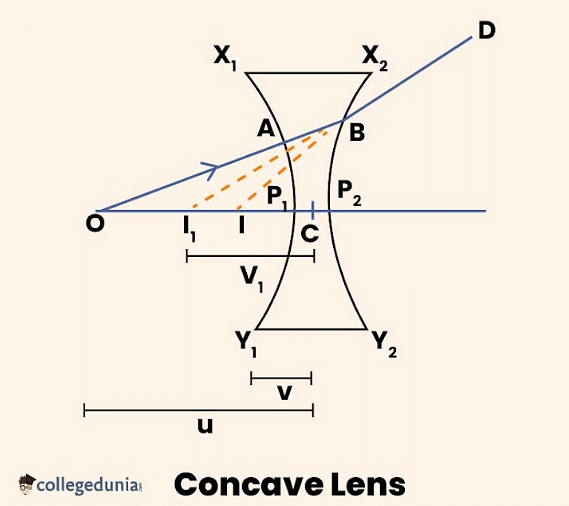
Concave Lens
For the first refracting surface X1P1Y1 object lying in the rarer medium and I1 is the virtual image of the object O. Therefore
\(-\frac{\mu_1}{u} - \frac{\mu_2}{v_1} = \frac{\mu_2-\mu_1}{R_2}\) ……(i)
For the second refracting surface X2P2Y2 the point I1 acts as the virtual object and point I act as the virtual image of object O. Therefore
\(-\frac{\mu_2}{v_1} - \frac{\mu_1}{v}= \frac{\mu_1- \mu_2}{-R_1}\) ……(ii)
Adding equations (i) and (ii), we get
\(-\frac{\mu_1}{u} - \frac{\mu_1}{v} = (\mu_2- \mu_1)[\frac{1}{R_1}-\frac{1}{R_2}]\)
⇒ \(-\frac{1}{u} - \frac{1}{v} = [\frac{\mu_2}{\mu_1}-1][\frac{1}{R_1} - \frac{1}{R_2}]\)
But µ2 / µ1 = µ (relative refractive index of the lens with respect to rarer medium or air).
⇒ \(-\frac{1}{u} - \frac{1}{v} = [\mu -1][\frac{1}{R_1} - \frac{1}{R_2}]\)
If the object is at infinity, the image is formed at the principal focus of the lens i.e.
if u = - ∞ then v = - f
⇒ \(-\frac{1}{\infty} + \frac{1}{f} = [\mu -1][\frac{1}{R_1} - \frac{1}{R_2}]\)
Since 1/∞ = 0, therefore we can write
\(\frac{1}{f} = (\mu -1)[ \frac{1}{R_1}-\frac{1}{R_2}]\)
Read More: Formation of Convex and Concave Lenses
Limitations of The Lens Maker Formula
[Click Here for Sample Questions]
The followings are the limitations of the lens maker formula
- Ideally, the lens should be thin so that there is a minimal gap between the two refracting surfaces.
- There should always be the same medium used on both sides of the lens.
Solved Examples
[Click Here for Previous Year Questions]
Ques. The radius of curvature of the faces of a double convex lens is 10 cm and 15 cm. If the focal length of the lens is 12 cm, find the refractive index of the material of the lens.
Ans. Given
- The radius of curvature of the first surface, R1 = 10 cm
- The radius of curvature of the second surface, R2 = - 15 cm
- Focal length of the lens, f = 12 cm
Using the lens maker formula
\(\frac{1}{f} = (\mu -1)[ \frac{1}{R_1}-\frac{1}{R_2}]\)
⇒ \(\frac{1}{12} = (\mu -1)[ \frac{1}{10}+\frac{1}{15}] = \frac{\mu - 1}{6}\)
⇒ \(\frac{1}{12}= \frac{\mu -1}{6}\)
⇒ μ = \(\frac{3}{2}\) = 1.5
Ques. The focal length of an equi-convex lens is equal to the radius of curvature of either face. What is the refractive index of the material of the lens?
Ans. Let R be the radius of curvature of the faces of the lens, then
- Focal length of the lens, f = R
- The radius of curvature of the first face, R1 = +R
- The radius of curvature of the second face, R2 = -R
Using the lens maker formula
\(\frac{1}{f} = (\mu -1)[ \frac{1}{R_1}-\frac{1}{R_2}]\)
⇒ \(\frac{1}{R} = (\mu -1)[ \frac{1}{R}+\frac{1}{R}] = \frac{2(\mu - 1)}{R}\)
⇒ 2μ – 2 = 1
⇒ μ = \(\frac{3}{2}\) = 1.5
Also Read:
Things to Remember
- Lens maker formula gives the relationship between the focal length, the refractive index, and the radii of the curvature of the lens.
- A piece of transparent material bounded by two refracting surfaces out of which at least one is curved is called a Lens.
- Concave and Convex are the two types of lenses.
- Concave lens is also known as Divergent lens
- Convex lens is also known as Convergent lens
- The lens maker formula is applicable for any type of lens.
- The lens maker formula is given by \(\frac{1}{f} = (\mu -1)[ \frac{1}{R_1}-\frac{1}{R_2}]\)
Previous Year Questions
- Extraction of metal from the ore cassiterite involves...[JEE Advanced 2011]
- Commonly used vectors for human genome sequencing are...[NEET UG 2014]
- Interfascicular cambium and cork cambium are formed due to..
- Pneumotaxic centre is present in...[UP CPMT 2007]
- Reaction of HBr with propene in the presence of peroxide gives….[NEET UG 2004]
- Assuming the expression for the pressure exerted by the gas on the walls of the container, it can be shown that pressure is...[MHT CET 2016]
- Which among the following is the strongest acid?...[TS EAMCET 2017]
- Isopropyl alcohol on oxidation forms..
- A vector is not changed if..
- Which of the following arrangements does not represent the correct order of the property stated against it?...[JEE Main 2013]
Sample Questions
Ques. What are the uses of the lens? (2 Marks)
Ans. The common uses of the lens are
- It is used to correct the vision defects of the human eye
- It is used in microscopes, telescopes, cameras, projectors, etc.
Ques. Define Lens. (1 Mark)
Ans. A lens is a piece of glass or other transparent material bounded by two refracting surfaces out of which at least one is curved.
Ques. What are the different types of concave lenses? (2 Marks)
Ans. The different types of concave lenses are
- Equiconcave lens
- Biconcave lens
- Plano concave lens
- Convexo concave lens
Ques. What are the different types of convex lenses? (2 Marks)
Ans. The different types of convex lenses are
- Equiconvex lens
- Biconvex lens
- Plano-convex lens
- Concavo-convex lens
Ques. The radius of curvature of the faces of a double convex lens is 15 cm and 20 cm. If the focal length of the lens is 12 cm, find the refractive index of the material of the lens. (5 Marks)
Ans. Given
- The radius of curvature of the first surface, R1 = 15 cm
- The radius of curvature of the second surface, R2 = - 20 cm
- Focal length of the lens, f = 12 cm
Using the lens maker formula
\(\frac{1}{f} = (\mu -1)[ \frac{1}{R_1}-\frac{1}{R_2}]\)
⇒ \(\frac{1}{12} = (\mu -1)[ \frac{1}{15}+\frac{1}{20}] = \frac{7(\mu - 1)}{60}\)
⇒ \(\frac{1}{12} = \frac{7(\mu - 1)}{60}\)
⇒ μ = \(\frac{12}{7}\) = 1.7
Ques. The focal length of an equi-convex lens is half of the radius of curvature of either face. What is the refractive index of the material of the lens? (3 Marks)
Ans. Let R be the radius of curvature of the faces of the lens, then
- Focal length of the lens, f = R/2
- The radius of curvature of the first face, R1 = +R
- The radius of curvature of the second face, R2 = -R
Using the lens maker formula
\(\frac{1}{f} = (\mu -1)[ \frac{1}{R_1}-\frac{1}{R_2}]\)
⇒ \(\frac{1}{R/2} = \frac{2}{R} = (\mu -1)[ \frac{1}{R}+\frac{1}{R}] = \frac{2(\mu - 1)}{R}\)
⇒ 2μ – 2 = 1
⇒ μ = 1
Ques. What are the first and second principal foci of a lens? (3 Marks)
Ans. The position of an object on the principal axis of the lens for which the image is formed at infinity is called the first principal focus of the lens.
The position of the image on the principal axis of the lens whose object is lying at infinity is called the second principal focus of the lens.
Ques. What is the lens maker formula? (3 Marks)
Ans. The lens maker formula is given by
\(\frac{1}{f} = (\mu -1)[ \frac{1}{R_1}-\frac{1}{R_2}]\)
Where
- f is the focal length of the lens
- µ is the relative refractive index of the lens with respect to the rarer medium or air
- R1 and R2 are the radii of curvature of surfaces of the lens
For Latest Updates on Upcoming Board Exams, Click Here: https://t.me/class_10_12_board_updates
Check-Out:



Comments