



Education Journalist | Study Abroad Lead
Relation Between Critical Angle and Refractive Index states that the Critical Angle is inversely proportional to Refractive Index. Critical angle in optics is the angle of incidence at which the angle of refraction is 90°. A refractive index is the ratio of the velocity of a light beam in the air to the velocities of the specified medium.
| Table of Content |
What Is Critical Angle?
[Click Here for Sample Questions]
Critical angle is a term used in optics to refer to a specific angle of incidence that results in a 90-degree angle of refraction. A water-air border also has a critical value of 48.6 degrees. The critical angle for the crown water and glass boundary is 61.8 degrees, while the critical angle for the crown water and glass border is 61.8 degrees.
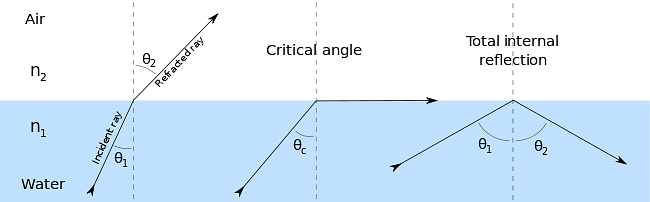
Critical Angle
The critical angle, on the other hand, is always determined by the media on both sides of a border.
Furthermore, the critical angle equation is:
| θcric = sin-1 nr / ni |
The critical angle of refraction is θcric, while the refraction index and incidence indexes are nr and ni, respectively.
| Frequently Asked Questions Ques. What is critical angle and its formula? (2 Marks) Ans. Critical Angle gives a value of 90 degrees. If this is substituted in the Snell's Law equation, a generic equation can be obtained to predict the critical angle. Critical Angle = Inverse Function of the sine (refraction index / incident index). Ques. Why is critical angle always 90 degrees? (2 Marks) Ans. Critical angle is the angle of incidence where angle of refraction is 90°. The light should travel from an optically that is more dense medium to an optically less dense medium. Figure 5.15: When the angle of incidence is equal to the critical angle, the angle of refraction is equal to 90°. Ques. Give examples of Critical Angles. (2 Marks) Ans. (i) Critical Angle of Water: Critical angle for water is measured between the beam and a line perpendicular to the surface, and is 490. (ii) Critical Angle of Glass: Light travels from glass to air. Angle of refraction is greater than angle of incidence. All light waves, which hit the surface beyond this critical angle, are effectively trapped. The critical angle for most glass is about 42°. |
Also Read:
| Related Articles | ||
|---|---|---|
| Optics | Optical Instruments | Mirror Formula |
| Use of Optical Fibre & Applications | Wave Particle Duality | Critical Angle Formula |
| Uses of Concave Mirror | Uses of Convex Mirror | Biconvex Lens |
What is Refractive Index?
[Click Here for Previous Year Questions]
Refractive index is the degree to which light rays bend as they travel from one media source to another. The letter 'n' is used to signify the refractive index. It can also be expressed as n = c/v, where ‘c' is the light speed or velocity of a certain wavelength in the medium air. In other mediums, however, v represents the velocity or speed of light.
This refractive index is also determined by three factors: medium nature, light color, and physical conditions.

Refractive Index
An optically rarer medium is one in which light moves at a faster rate. An optically denser medium, on the other hand, is one in which light travels more slowly.
| Frequently Asked Questions Ques. Define refractive index and its important? (2 Marks) Ans. Refractive index is the measurement of propagation of light through a material. Higher refractive index leads to slower light travel. This causes a correspondingly increased change in the direction of the light within the material. Ques. Which Colour has highest refractive index? (2 Marks) Ans. The index of refraction varies with frequency. The index doesn't change as light travels from one medium to another. Since violet color has the shortest wavelength and so the refractive index is maximum for it. Ques. What does low refractive index indicate? (2 Marks) Ans. Lower refractive index indicates lesser bend of light by material. It also reduces the focusing power, the reflective effect, and the light dispersion. Thus, the polymer of an optical plastic must possess lower value of refractive index. |
Relation between Critical Angle and Refractive Index
[Click Here for Sample Questions]
Their relationship is mathematically represented as:
| sinC= 1/ µab |
Here, C denotes the critical angle, µ denotes the refractive index, and a and b denote the two media through which light flows.

Also, take a look at the following derivation!
The relationship between critical angle and refractive index is calculated using Snell’s Law (also known as the Second Law of Refraction).

Snell’s Law
Assume a light ray with an incidence angle of i, a refractive angle of r = 90 degrees, a critical angle of C, and refractive indexes of µa and µb for rarer and denser media, respectively.
So, using the second law of refraction, also known as Snell's Law:
| sin i / sin r = µa / µb |
As a result, µb sinC = µa sin90o
As a result, µb / µa = 1 / sinC
The critical angle and refractive index relationship can so be described using this equation:
| µab = 1/ sinC |
Things to Remember
- In optics, the critical angle refers to a precise angle of incidence that produces a 90-degree angle of refraction.
- The refractive index refers to how much light bends as it travels from one media source to another.
- The equation of critical angle is: θcric = sin-1 nr / ni
- The equation of refractive index is: n=c/v
Also Read:
Sample Questions
Ques. What is the significance of the critical angle? What are the circumstances in which a critical angle occurs? (3 marks)
Ans. The greatest angle at which a beam of light traveling through one transparent media can strike the border between that medium and a second of the lower refractive index without being completely reflected within the first medium is known as the critical angle in optics.
Conditions: The critical angle is the angle of incidence at which the refraction angle is 90 degrees. The light must go from a more dense optical medium to a less dense optical medium. The angle of refraction is equal to 90° when the angle of incidence is equal to the critical angle.
Ques. What is the relationship between the critical angle and the refractive index? When light strikes the critical angle, what happens? (3 marks)
Ans. A refractive index is the ratio of the velocity of a light beam in the air to the velocities of the specified medium. The critical angle is inversely proportional to the refractive index, hence the relationship between the critical angle and the refractive index may be determined.
When the critical angle is reached, the light acts in a way that is "something in between" refraction and reflection: it continues in a direction that is tangent to the mediums' boundaries. Refraction occurs when the angle is less than the critical angle.
Ques. Does the color of light affect the critical angle? What is the process of forming a critical angle? (3 marks)
Ans. Yes, the critical angle is determined by the refractive index, which is determined by the wavelength of light, hence the critical angle is determined by light color. The refractive index is inversely proportional to the critical angle. When the critical angle is increased, the wavelength of the light is also increased.
Waves transitioning from a dense to a less dense medium accelerate as they approach the boundary between them. When light rays move from glass to air at an angle other than 90 degrees, they bend. All waves reflect back into the glass beyond a particular degree, known as the critical angle.
Ques. What role does the refractive index play? What factors influence the refractive index? (3 marks)
Ans. The higher the refractive index, the slower light travels, causing a proportionately greater change in light direction within the material. In terms of lenses, this means that a higher refractive index material may bend light more and allow for a smaller lens profile.
The refractive index is commonly calculated at room temperature. When a liquid is heated to a greater temperature, it becomes less thick and viscous, allowing light to move faster through the medium. As a result of the reduced ratio, the refractive index has a lower value.
Ques. How does the refractive index come into play in everyday life? What happens when the refractive index gets higher? (3 marks)
Ans. The refractive index describes how light behaves in various materials. The index is used to determine a material's focusing power, such as lenses. It can also be used to determine how many particles are dissolved in a solution.
A substance's index of refraction value is a number that specifies how many times slower a light wave would be in that material than in a vacuum. As the index of refraction increases, so does the optical density, and the speed of light in that substance drops.
Ques. Why is gold's refractive index less than one? Is the refractive index affected by temperature? (3 marks)
Ans. If the phase velocity of the light in the medium is higher than the speed of light, refractive indices less than one can occur. This frequently occurs near the material's absorbance resonances.
The refractive index does not change as a function of temperature; rather, it changes as a function of density. Because most materials expand when heated, the increased temperature usually reduces density (but some contract)
Ques. What effect does the refractive index have on wavelength? Does the color of light affect the refractive index? (3 marks)
Ans. As a result, we can deduce that the wavelength of a wave is inversely proportional to the refractive index of the medium through which it travels. It's worth noting that the frequency of the wave changes inversely with the wavelength.
A material's refractive index can be affected by the wavelength (color) of light. To split light into colored bands, glass prisms are constructed to have different refractive indices at different wavelengths (called dispersion).
Ques. What effect does the refractive index have on frequency? What is the principle involved in refractive index analysis? (3 marks)
Ans. "The index of refraction of any material (excluding vacuum) increases significantly with light frequency: the higher the frequency, the greater the index of refraction." Because red light has a lower frequency than violet, it has a lower index of refraction.
The refraction depending on the speed of light passing through different mediums is the primary principle involved in refractometry. Light is twisted as it travels from the light denser medium to the high denser media. The term "refraction" refers to the bend of a light ray.
Ques. Is the refractive index a one-of-a-kind property? What are the two different sorts of refractive indexes? (3 marks)
Ans. The refractive index of a medium is determined by its electric and magnetic properties, and as a result, it is extremely unique. It is determined by how the medium responds to electric and magnetic fields.
The refractive index of a material is defined as the ratio of its refractive index to that of The refractive index is known as the relative refractive index when light flows from one medium to another. Absolute refractive index: The refractive index of light traveling from a vacuum to another medium is known as the absolute refractive index.
Ques. If the critical angle is 30, what is the refractive index? Why do diamonds glow in the dark? (3 marks)
Ans. When the ratio of the angle of incidence to angle of refraction is 90°, the angle is said to be a crucial angle. When their critical angle is 30 degrees, the liquid's refractive index is 2.
Diamonds sparkle because of the flow of light through them, which is occasionally fragmented and shattered. Refraction is the only reason for this.... Refraction and dispersion occur depending on where the light strikes the diamond's planes, resulting in natural light and some dark areas.
Ques. What factors influence the refractive index of a medium? What is the relationship between refractive index and light speed? (3 marks)
Ans. The wavelength of light determines the refractive index of a material. The refractive index will be greater if the wavelength of light is shorter. Second, it is determined by the substance's density. The refractive index of a substance is affected by the intermolecular force between its molecules.
A medium's refractive index (n) is equal to the speed of light (c) divided by the velocity of light passing through it (v). We can see the relationship between v and rearranging the equation. The faster the light travels, the lower the refractive index.
Previous Year Questions
- An object approaches a convergent lens from the left of the lens… [KCET 2020]
- A fish, looking up through the water, sees the outside world contained in a… [JIPMER 2010]
- Which of the following is true for rays coming from infinity… [DUET 2006]
- A point source of light S, placed at a distance L in front of the centre of a plane… [DUET 2000]
- A girl of height 150cm with her eye level at 140cm stands in front of… [KCET 2019]
- A given ray of light suffers minimum deviation in an equilateral prism… [NEET 2001]
- Rainbow is formed due to… [NEET 2000]
- A biconvex lens has a radius of curvature of magnitude… [NEET 2011]
- A converging beam of rays is incident on a diverging lens… [NEET 2011]
- A lens having focal length f and aperture of diameter d forms an image of… [NEET 2010]
- A person can see clearly objects only when they lie between… [NEET 2016]
- A plane convex lens fits exactly into a plane concave lens… [NEET 2013]
- A ray is incident at an angle of incidence i on one surface of a small angle… [NEET 2020]
- A ray of light traveling in a transparent medium of refractive index… [NEET 2010]
- A rod of length 10cm lies along the principal axis of a concave mirror of… [NEET 2012]
- A thin prism having refracting angle 10∘ is made of glass of refractive index… [NEET 2017]
- A thin prism of angle 15∘ made of glass of refractive index (μ1=1.5 is combined with another prism… [NEET 2011]
- An air bubble in a glass slab with refractive index… [NEET 2016]
- An astronomical refracting telescope will have large angular magnification… [NEET 2018]
- An astronomical telescope has objective and eyepiece of focal lengths… [NEET 2016]
For Latest Updates on Upcoming Board Exams, Click Here: https://t.me/class_10_12_board_updates
Do Check Out:



Comments