



Content Curator
Endocytosis and exocytosis are the mechanisms by which cells transport items. The items transported are generally too big to pass straight through the lipid bilayer of the cell membrane. Exocytosis and endocytosis transport large molecules, bacteria, and waste items across the cell membrane. Endocytosis and exocytosis are the bulk transport systems used by eukaryotes. Because these transport mechanisms require energy, they are referred to as active transport processes.
Also Read: Cell Biology
Key Terms: Endocytosis, Exocytosis, Molecules, Bacteria, Lipid, Cell Membrane, Energy, Eukaryotes, Active Transport Process
Endocytosis
[Click Here for Sample Questions]
Endocytosis is the process by which materials enter a living cell through invagination of the cell membrane, resulting in the formation of a vacuole. This vacuole is known as an endocytic vacuole. In the endocytic vacuole, the internalised material is surrounded by a section of the plasma membrane.

Endocytosis
Types of Endocytosis
[Click Here for Sample Questions]
Endocytosis is classified into two types: ingestion of solid particles and ingestion of fluids containing solutes. Phagocytosis refers to the swallowing of solid particles, while pinocytosis refers to the intake of fluids containing solutes.
Phagocytosis
In unicellular eukaryotes such as amoebas, phagocytosis is also known as cell devouring. Phagocytosis is used by amoeba to ingest food particles. Phagocytosis is carried out by specialised phagocytes in higher eukaryotes by swallowing either cell debris, bacteria, viruses, or even entire cells. Particles that bind to receptors on the plasma membrane will start the process by generating pseudopodia that surround the particle. The cell surface's actin-based motions generate these pseudopodia. The developing vesicle is known as a phagosome. The phagosome is being drawn towards a lysosome. The phagolysosome is formed by the fusion of a lysosome and a phagosome. The ingested substance is digested by the action of hydrolytic enzymes in the lysosome. Phagocytosis is the process by which invading pathogens such as bacteria and viruses are destroyed in multicellular organisms. Professional phagocytes include macrophages and neutrophils.
Pinocytosis
Pinocytosis is a type of receptor-mediated endocytosis in which fluids are taken up by the cell together with dissolved solutes. Clathrin-coated pits are regions of the plasma membrane with concentrated receptors. The macromolecules to be taken up are bound to specific receptors in these locations. Cell sipping is another name for pinocytosis.
Exocytosis
[Click Here for Sample Questions]
Exocytosis is the process by which material in the Golgi apparatus is exported into the external environment via secretory vesicles. The Golgi apparatus material is exported to transport vesicles. These vesicles migrate to the plasma membrane, where their contents are discharged into the external environment as the plasma membrane fuses. Exocytosis is the process through which digestive enzymes and hormones are secreted from the cell. Exocytosis is also engaged in waste elimination within the cell.
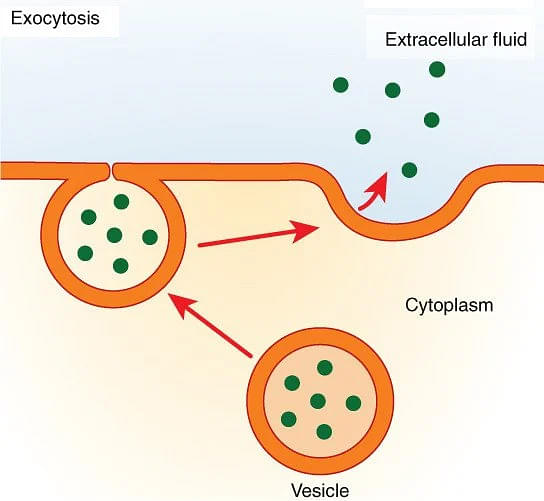
Exocytosis
Types of Exocytosis
[Click Here for Sample Questions]
Exocytosis involves two types of secretory routes: constitutive secretory pathways and controlled secretory pathways.
Constitutive Secretory Pathway
The constitutive secretory route secretes protein molecules in the Golgi apparatus that are not tagged with signal peptides. Secretory vesicles are where the cell's secreted products are kept. Because these vesicles have a dense core, they are also known as dense-core vesicles. Cells release small chemicals such as histamine and proteins such as hormones and digestive enzymes. Secretory proteins are proteins that are intended for secretion. After being loaded into secretory vesicles, these secretory proteins undergo post-translational changes such as the releasing of active molecules by proteolysis.
Regulated Secretory Pathway
Extracellular signals can also be used to stimulate secretion. The controlled secretory route refers to this regulated exocytosis. Mast cells produce histamine after a soluble stimulant known as the ligand binds to receptors on the mast cell's surface. Histamine causes sneezing and itching, as well as allergic reactions. The controlled secretory route also secretes neurotransmitters.
Differences between Endocytosis and Exocytosis
[Click Here for Sample Questions]
The difference between Endocytosis and Exocytosis is as follows:
| Endocytosis | Exocytosis |
|---|---|
| It helps in nutrient absorption for cellular function and getting rid of pathogens. It also helps to get rid of old/damaged cells | It helps in getting rid of poisons or waste products and helps in the repair of the cell membrane. It also helps in increasing cell-cell communication. |
| There are two types- Phagocytosis and Pinocytosis. | There are two types of exocytosis- Regulated exocytosis and Constitutive exocytosis. |
| A vesicle is formed around the foreign substance. Internal vesicle phagosomes are formed during the process. | Vesicles are fused with the plasma membrane. Secretory vesicles are formed in the process. |
| Endocytosis has two mechanisms: phagocytosis and pinocytosis. | Exocytosis can take place through either a constitutive or a controlled secretory pathway. |
| White blood cells engulfing and killing a virus are an example of endocytosis. | For cellular communication, releasing a neurotransmitter is an example of exocytosis. |
Things to Remember
- Transportation of macromolecules such as proteins and polysaccharides in and out of the cell is known as bulk transport.
- There are two types of bulk transport: exocytosis and endocytosis. Both of these modes of transportation necessitate the use of energy in the form of ATP.
- Endocytosis occurs via two mechanisms: phagocytosis and pinocytosis.
- Exocytosis can take place via either the constitutive secretory pathway or the controlled secretory pathway.
Sample Questions
Ques. What are the types of Endocytosis? (5 Marks)
Ans. There are two main types:
- Phagocytosis: The process by which cells absorb big particles or cells, such as damaged cells and germs, is known as phagocytosis. Phagocytosis is the process by which immune cells absorb and kill hazardous pathogens or poisonous chemicals in the human body and other mammals. The two principal phagocytes are macrophages and neutrophils, both types of white blood cells. These white blood cells are in charge of removing ageing and damaged cells as well as pathogenic germs.
- Pinocytosis: Cell drinking, also known as pinocytosis, is prevalent in plant and animal cells. During pinocytosis, the cell takes in extracellular fluid substances that it requires to function. Water and fertilisers are examples of this. Pinocytosis with receptor-mediated endocytosis is a subtype of pinocytosis. Macromolecules bind to receptors on the cell's plasma membrane during receptor-mediated endocytosis. The uptake of cholesterol is an example of receptor-mediated endocytosis.
Ques. What are some examples of the Endocytosis process? (2 Marks)
Ans. Although, the body uses the mechanism of endocytosis to neutralise infections. Endocytosis, specifically receptor-mediated endocytosis, is used by some harmful intracellular parasites to acquire access and establish themselves intracellularly in the host cell. Pathogens such as Epstein-Barr virus (EBV), influenza virus, Listeria monocytogenes, and Streptococcus pneumonia use receptor-mediated endocytosis to deceive the immune system and establish themselves in host cells.
Ques. What are the types of Exocytosis? (4 Marks)
Ans. There are two types of pathways of the exocytic process:
- Constitute Exocytosis: Extracellular signals are not required for constitutive exocytosis. This pathway is used by the vast majority of molecules going to the plasma membrane. Some exocytotic vesicles are absorbed into the plasma membrane following exocytosis (complete vesicle fusion), whereas others return to the cell's interior after their contents have been discharged.
- Regulated Exocytosis: The majority of exocytotic vesicles contain endoplasmic reticulum which produced compounds for usage elsewhere in the body, such as neurotransmitters or hormones. These chemicals are subsequently wrapped within a membrane layer known as a vesicle. These vesicles are transferred to the Golgi apparatus (also known as the Golgi complex) for additional modification after being ejected from the endoplasmic reticulum. The chemicals are subsequently repackaged in a vesicle that travels to the plasma membrane. The evacuation of these molecules from the cell is known as regulated exocytosis because it is controlled or regulated by extracellular signals that produce membrane depolarization.
Ques. Give some examples of exocytosis processes. (3 Marks)
Ans. Glucagon and insulin are stored in pancreatic secretory vesicles in the islets of Langerhans. When blood glucose levels are low, the islets alpha cells emit glucagon, which is transported by secretory vesicles into the liver cells and released by exocytosis for further processing and usage. Exocytosis is a process by which the pancreas releases digestive enzymes.
Ques. Why are the processes of Exocytosis and Endocytosis important? (5 Marks)
Ans. Endocytosis and exocytosis are critical systems for transporting chemicals in and out of cells. Exocytosis is the process through which cells secrete proteins. Many proteins synthesised on the rough endoplasmic reticulum and processed by the Golgi apparatus are segregated into vesicles bound for the plasma membrane. The vesicles fuse with the plasma membrane, causing the vesicles' contents to leak outside the cell. The proteins lodged in the membrane of the vesicle become part of the plasma membrane. Endocytosis is the process through which chemicals enter the cell. There are three forms of endocytosis. Certain protists and white blood cells may ingest very big particles using phagocytosis. Cells constantly take in dissolved chemicals and liquids from the outside through pinocytosis. Animal cells take in certain chemicals that can bind to specific receptors on their plasma membranes via receptor-mediated endocytosis.
Receptor-mediated endocytosis is a vital method by which the body removes cholesterol from the bloodstream. People with hypercholesterolemia, a hereditary illness, lack normal LDL receptors and, as a result, have dangerously high levels of circulating cholesterol. Because their livers are unable to eliminate the circulating LDL particles, the load of cholesterol tends to build on the walls of their arteries, eventually obstructing blood flow.
Ques. What are the mechanisms of bulk transport in cells called? (3 Marks)
Ans. Endocytosis and exocytosis are the bulk transport mechanisms used in eukaryotes. These transport processes are known as active transport processes since they require energy. Cell membranes are semi-permeable, which means that certain tiny molecules and ions can pass through them passively. Other tiny molecules are able to enter and exit the cell via carrier proteins or channels.
However, certain compounds are too big to get through the cell membrane utilising these techniques. A cell may need to engulf a bacterium or produce a hormone at times. Bulk transport systems are required in these situations.
Ques. Explain the vesicle function of endocytosis and exocytosis. (3 Marks)
Ans. Larger compounds or huge packages of tiny molecules are carried via vesicles through the cell membrane, also known as the plasma membrane, during bulk transport. A lipid bilayer makes up cell membranes. Vesicle walls are likewise composed of a lipid bilayer, which allows them to fuse with the cell membrane. The fusion of vesicles and the plasma membrane allows for bulk transit into and out of the cell.
Check-Out:



Comments