



Content Curator
Cells are the basic fundamental unit of life. Cells are a basic unit of structure and function in life. The cell was discovered by Robert Hooke. Cells are broadly classified into plant and animal cells. Each cell has organelles that help them to perform certain functions. Several cells can work together to form tissues and organs.
Read More: What Are Tissues?
Key Takeaways: Cell, Cell Organelles, Plant cell, Animal Cell, Prokaryotic Cell, Eukaryotic Cell
History of Cells
[Click Here for Sample Questions]
Living organisms perform biological processes that support them. A cell is a small and basic form of life. Robert Hooke, one of the first scientists to use a microscope, discovered a cell in 1665. In all forms of life, including germs, plants, animals, and humans, the cell was defined as the basic unit of structure and function.
Read More: Discovery of cell

Animal Cell
Based on scientific experiments over the next 150 years, scientists developed a molecular theory, applied to all living things, no matter how simple or complex. In 1855, Rudolf Virchow advanced the cell hypothesis that all cells came from pre-existing cells. New cells are made up of existing cells, which divide into two parts. Therefore, it was proved that several cells combine to form organs and tissues.
Also Read:
| Related Articles | |
|---|---|
| Endosmosis and Exosmosis | Reverse Osmosis |
| Electrosmosis | Passive Transport in Living Organisms |
Parts of Cell
[Click Here for Sample Questions]
The different parts of a cell and their functions are explained below.
Cell Membrane
Cell Membrane is the outer cover of the cell that separates the contents of the cell from its outer surface. Plasma membranes allow the entry and exit of substances and thus it is called the selective cell membrane. Other substances such as CO2 or O2 gases can travel through the cell membrane through a process called diffusion.
Read More: Difference between Plasma Membrane and Cell Membrane

Cell Membrane
The movement of water molecules (fluids) through an easily permeable membrane is called osmosis. Osmosis is the transfer of water from one body through a slow-moving membrane to another body by the action of gravity. If the medium around the cell has a higher water concentration than the cell, the cell will receive water through osmosis. Such a type of solution is known as a hypotonic solution.

Osmosis Process
Cell wall
Plant cells, in addition to the plasma membrane, have another solid outer covering called the cell wall. Cell wall is outside the plasma membrane. Cell wall of plants mainly consists of cellulose. Also, it is complex and provides structural strength to plant cells. When a living plant loses water through osmosis there is a decrease or contraction of the cell contents away from the cell wall. This condition is known as plasmolysis. The cell wall is absent in animal cells.

Cell wall in plant cells
Read More: Plant Cell
Nucleus
Nucleus has a two-layer cover called a nuclear membrane. Nuclear membranes have holes that allow for the transfer of substances from inside the nucleus to the outside of it, that is, to the cytoplasm. The nucleus contains chromosomes, which appear as rod-shaped structures only when the cell is about to divide.

Nucleus
Cytoplasm
Cytoplasm is a fluid inside the plasma membrane. It also contains many specialized cell organelles. Each of these organelles performs a specific function of the cell.
Cell Organelles
[Click Here for Sample Questions]
Each cell has a membrane around it to keep its contents separate from the outside environment. Different parts of a cell perform different functions and these parts are called cell organelles. The different cell organelles present inside the cells are as follows.
- Endoplasmic Reticulum: The main function of Endoplasmic reticulum is to synthesize proteins for the effective functioning of the cell.
- Golgi Apparatus: Golgi apparatus is a central intracellular membrane-bound organelle that helps in processing and distributing the secreted proteins and lipids from the ER.
- Lysosomes: These are also called as Suicide bags. Lysosomes are the digestive system of the cell and they digest the waste and degraded component from the cell.

Cell Organelles
- Mitochondria: Mitochondria is the powerhouse of the cell. The energy thus produced in mitochondria is stored as ATP.
- Plastids: Plastids in plants capture the sunlight and store it for the production of food and energy.
- Vacuoles: Vacuoles are responsible for storing water and nutrients. They also store the waste products and thus prevent the cell from contamination.
Also Read:
Difference between Plant cell and Animal cell
[Click Here for Sample Questions]
As we already know, Cells are broadly classified into plant cells and animal cells. The key differences between them are tabulated below.
| Plant cell | Animal cell |
|---|---|
| Plant cell has a cell wall. | Animal cell does not have a cell wall. |
| Plant cell has chloroplasts. | Animal cells do not have chloroplasts. |
| Plant cell contains large vacuoles. | Animal cells have small vacuoles. |
| Higher plants do not have centrioles. | Animal cells have centrioles. |

Plant and Animal Cell
Difference between Prokaryotic and Eukaryotic cells
[Click Here for Sample Questions]
Cells are also classified into Prokaryotic and Eukaryotic cells based on their protein synthesis. The key differences between the two are tabulated below.
| Prokaryotes | Eukaryotes |
|---|---|
| Cell structure is unicellular. | It has a multicellular cell structure, but some of them are unicellular. |
| Nucleus is absent. | The nucleus is present. |
| Cell membrane-bound organelles are absent. | Cell membrane-bound organelles are present. |
| DNA formation is circular. | DNA formation is linear. |
| Cell size is smaller (0.1 - 5μm). | Cell size is larger (10-100μm). |
| Example - Bacteria and Archaea. | Example - Animals, plants, fungi, etc. |
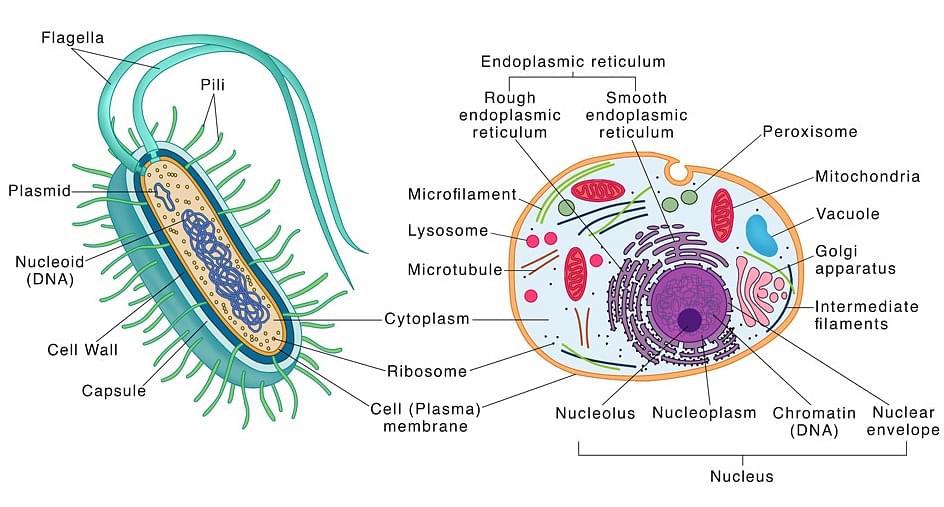
Prokaryotic and Eukaryotic Cells
Read Also: Stem cells
Things to Remember
- Cells are regarded as the fundamental unit of life.
- Cells are divided into plant and animal cells.
- Depending upon protein synthesis, they are classified into Prokaryotic and Eukaryotic cells.
- Cells have different organelles that perform various functions.
- Golgi apparatus is called the post office of the cell because they transport the protein across the cytoplasm.
- Cells are living organisms, single-celled organisms that absorb nutrients, excrete waste, see and respond to their environment, move, breathe, grow and reproduce.
- Cellular respiration is a process in which food releases energy from the mitochondria. Cells absorb sugar from food and heat it to produce energy.
Also Read:
Sample Questions
Ques. Why is a cell called a structural unit of life? (2 marks)
Ans. The cell can independently perform all the vital functions of life. Therefore, they are called the basic or structural unit of life. All the cells are surrounded by a structure called the cell membrane - which, like the walls of the house, acts as a clear boundary between the inner and outer space of the cell.
Ques. Explain prokaryotes and eukaryotes cells. (2 marks)
Ans. Prokaryotic cells are unicellular and the nucleus is absent in them. Instead of that, they have a nucleoid region in the cell. Also, ribosomes are present in them but they are smaller and spherical in size. On the other hand, eukaryotic cells are multicellular and the nucleus is present in them. Ribosomes are present and they are larger in size and linear in shape. Moreover, the cytoplasm is present in both cells.
Ques. Enumerate the function of vacuoles in a cell. (2 marks)
Ans. Both plant and animal cells contain vacuoles, which are chambers bound by membranes. These are the last solid or liquid containers. In animal cells, they are smaller, and in plant cells, they are larger. Plant cells with fluid-filled vacuoles provide the cell with density and strength. Water, waste, and compounds including amino acids, carbohydrates, and proteins are all stored in these organelles. Special vacuoles play an important role in the disposal of large amounts of water and waste from cells in some cellular organisms.
Ques. Why are mitochondria is considered the ‘powerhouse of the cell’? (2 marks)
Ans. Mitochondria are called the ‘powerhouse of the cell.’ The energy required for the various chemical reactions required for life is released by the mitochondria in the form of ATP molecules (Adenosine Triphosphate). ATP is known as the cellular energy source. Mitochondria have two membranes instead of just one. The outer membrane has many holes while the inner membrane is deeply folded. They can make some of their protein.
Ques. Where are plastids present? Explain the role of plastids. (2 marks)
Ans. Plastids are only present in plant cells. There are two types of plastids - chromoplasts and leucoplasts. Chromoplasts are plastids with existing colours on leaves, flowers, and fruits. Plastids containing pigment chlorophyll are known as chloroplasts. They are essential for photosynthesis in plants. Chloroplasts also contain a variety of yellow or orange pigments in addition to chlorophyll. Leucoplasts are mainly found in organelles, which store such substances as starches, fats, and protein granules.
Ques. Why are lysosomes are considered ‘suicide bags’? (2 marks)
Ans. Lysosomes are a type of waste disposal and cellular waste disposal system. Lysosome helps keep the cell clean by digesting any foreign material and ageing cells. External substances that enter cells such as bacteria or food, as well as older organelles, end up in the lysosome, breaking them down into smaller pieces. They can do this because they contain powerful digestive enzymes that break down all living things. Under normal circumstances, when a cell breaks down, lysosomes may burst and enzymes digest their cell. Thus, they are also known as ‘suicide bags’.
Ques. What are the key similarities between prokaryotes and eukaryotes cells? (2 marks)
Ans. Similar features which are present in prokaryotic and eukaryotic cells are as follows -
- DNA
- Plasma membrane
- Ribosomes
- Cytoplasm
Ques. Explain the features of the Golgi apparatus and its function. (2 marks)
Ans. Golgi apparatus is a living eukaryotic organelle that transports molecules from the endoplasmic reticulum to their destination. The organelle also converts endoplasmic reticulum products into their final form. Golgi apparatus contains a series of flat sacs from the endoplasmic reticulum. All activities are associated with moving molecules from the endoplasmic reticulum to their storage space and the repair of certain products along the way. The main function of Golgi sacks serves as separate chambers for chemical reactions. As the products of the endoplasmic reticulum travel to the Golgi machine, they are continuously transmitted to new areas, and the reaction may be different.
For Latest Updates on Upcoming Board Exams, Click Here: https://t.me/class_10_12_board_updates
Check More:



Comments