



Education Journalist | Study Abroad Lead
Animal Cell is a eukaryotic cell that lacks a cell wall and has a membrane-bound nucleus along with other cell organelles. An animal cell is enclosed by the plasma membrane. They are smaller in comparison to plant cells. They are generally irregular in shape due to the lack of a cell wall, therefore they can be round, oval, rod-shaped, spherical, or rectangular. The absence of a cell wall allows animal cells to develop a great diversity of cell types, tissues, and organs.
- A cell is the smallest structural and functional unit of life. All living organisms are made up of cells.
- Some organisms are single-celled (Unicellular Organisms) while others are made up of more than one cell (Multicellular Organisms).
- The cells that build up an animal are called Animal Cells and those that constitute plants are known as Plant Cells.
Read More: NCERT Solutions For Class 9 Science The Fundamental Unit of Life
Key Terms: Animal Cell, Cells, Plant Cell, Cell Wall, Cell Membrane, Cell Organelles, Nucleus, Mitochondria
What is Animal Cell?
[Click Here for Sample Questions]
Animal Cell is the basic structural and functional unit of life in animals. They are eukaryotic cells with a true nucleus and membrane-bound organelles suspended in the cytoplasm enclosed by a plasma membrane. Animal cells do not have plant-specific organelles such as cell walls or chloroplasts.
- There are several cell organelles present in an animal cell that carry out specific functions necessary for a cell to function properly.
- DNA is present inside the nucleus of an animal cell. These cells range from a few microscopic microns to a few millimetres in size.
- They are either flat, oval, rod-shaped, spherical, concave or rectangular.
- Animal cells are generally microscopic in size and can only be seen with the help of a microscope.
- The largest animal cell is the ostrich egg stretching over 5.1 inches across and weighing about 1.4 kilograms.
- Animals are multicellular – they have multiple cells that work together to form an organism.
- In complex organisms like humans, the cells are highly specialized to perform vital functions, hence they look different from one another.
Read More:
| Chapter-Related Topics | ||
|---|---|---|
| Cell Biology | Fundamental Unit of Life | Cellular Organization |
| Plant Cell Model | Difference between Cell and Tissue | Nucleoplasm |
Animal Cell Diagram
[Click Here for Previous Year Questions]
Animal cells can easily be distinguished from plant cells through the presence or absence of a cell wall. There are several membrane-bound organelles surrounding the nucleus in these cells.
- Though an animal cell can be of various types, the diagram of animal cell is used to understand the primary organelles and the internal structure of most cells.
- Given below is the structural organization of an animal cell diagram with clearly marked and labelled organelles:
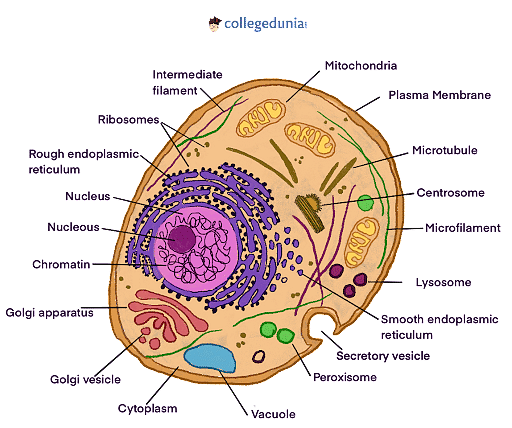
Labelled Diagram of Animal Cell
Structure of Animal Cell
[Click Here for Sample Questions]
An animal cell is a eukaryotic cell in which several membrane-bound organelles such as the nucleus, lysosomes, ribosomes, mitochondria, Golgi apparatus, endoplasmic reticulum, and others are enveloped by the cell membrane. The various components of an animal cell are:
Cell Membrane
The cell Membrane is a semipermeable or selectively membrane layer made up of lipids and proteins that surrounds the cell.
- It protects the cell from its surroundings.
- It controls the entry and exit of nutrients and other microscopic entities in and out of the cell.
Nucleus
The nucleus is the most integral organelle in an animal cell.
- The nucleus contains several other sub-organelles namely chromosomes, nucleolus, nuclear bodies, and nucleosol.
- It is surrounded by a well-defined membrane called the nuclear membrane.
- It contains DNA and most of the genetic material of an animal.
- It also controls various cellular activities such as metabolism, growth, and reproduction.
Read More: Difference Between Nucleus and Nucleoid
Cytoplasm
The cytoplasm is a jelly-like material that is surrounded or enveloped by the cell membrane.
- It contains all the cell organelles including the nucleus, enclosed within the cell membrane.
- It offers a platform for other organelles to operate within the cell.
- All cellular functions for cell expansion, growth, and replication are carried out in the cytoplasm only.
Endoplasmic Reticulum
Endoplasmic Reticulum (ER) is an interconnected network of flattened sacs or tubules originating from the nucleus.
- There are two types of endoplasmic reticulum- Rough Endoplasmic Reticulum (RER) and Smooth Endoplasmic Reticulum (SER).
- The endoplasmic reticulum which has ribosomes attached to it is known as the rough endoplasmic reticulum.
- The endoplasmic reticulum with no attached ribosomes is called the smooth endoplasmic reticulum.
- RER helps in protein synthesis whereas SER helps in lipid synthesis.
Read More: Difference Between Smooth and Rough Endoplasmic Reticulum

Animal Cell Organelles
Golgi Apparatus
The Golgi apparatus is a cell organelle that is comprised of stacks of cisternae.
- It helps in the manufacturing, storing, packing, and transporting of biomolecules such as proteins, glycosylation, and lipid.
- Golgi complex is the collective term used for all the Golgi apparatus within the cell.
Mitochondria
Mitochondria is a spherical or rod-shaped double membrane organelle.
- It has its own genetic material and DNA.
- Mitochondria is known as the powerhouse of the cell it is involved in energy synthesis by means of the citric acid cycle.
Read More: Diagram of Mitochondria
Lysosomes
Lysosomes are single-membraned cell organelles that contain various digestive enzymes.
- It helps in digestion, excretion, and cell renewal process.
- They are also known as the suicide bags of the cell as they engulf their own cell due to the powerful digestive enzymes.
Vacuole
Vacuoles are membrane-bound organelles present in animal cells that help in maintaining shape and storing water, food, waste, etc.
- Vacuoles in animal cells are not as prominent as they are in plant cells.
- They help in osmoregulation, intracellular secretion, storage, and excretion.
Centrosomes
The centrosome is a small organelle that is found near the nucleus.
- It has a thick centre with radiating tubules.
- Centrosomes are the sites of the production of microtubules.
Ribosome
Ribosomes are small organelles made up of both RNA and protein.
- They are the location or site of protein synthesis in the cell.
- They read the messenger RNA (mRNA) sequence and translate that genetic code into a specified string of amino acids, which grow into long chains that fold to eventually form proteins.
Read More:
| Related Topics | ||
|---|---|---|
| Types of White Blood Cells | Centriole | Cytoskeleton |
| Cell Cycle and Cell Division | Difference Between Cytosol and Cytoplasm | Difference Between DNA and RNA |
Types of Animal Cells
[Click Here for Previous Year Questions]
There are various types of animal cells that are designed to work for a specific function. Given below are the most common types of animal cells found in various organisms:
- Skin Cells: Melanocytes, Merkel cells, keratinocytes, and Langerhans cells.
- Muscle Cells: Myocyte, Tendon cells, Cardiac muscle cells, Myosatellite cells.
- Blood Cells: Leukocytes, erythrocytes, platelet.
- Nerve Cells: Schwann cells, glial cells, etc.
- Fat Cells: Adipocytes.
Animal Cells differ from plant cells as animals need to adapt to an active lifestyle. They do not have chloroplasts as they need to acquire their own food.
Read More: Difference between Monocytes and Lymphocytes
Things to Remember
- Animal cell is a eukaryotic cell that has a true nucleus and membrane-bound organelles.
- Animal cell lacks a cell wall and is surrounded by the cell membrane.
- They are generally smaller than plant cells and have various shapes depending on their location and function.
- There are several membrane-bound organelles in an animal cell performing a specific function.
- Mitochondria, Ribosomes, Golgi Apparatus, Lysosomes, and Endoplasmic Reticulum are some integral cell organelles in an animal cell.
- There are various types of animal cells such as skin cells, muscle cells, blood cells, etc.
Previous Years’ Questions (PYQs)
- Nucleolus is formed by… (CUCET 2006)
- The nucleolus is the site of the formation of…
- An outer covering membrane is absent over… (NEET 1992)
- During mitosis, ER and nucleolus begin to disappear at… (NEET 2010)
- Endoplasmic reticulum is in continuation with… (DUET 2009)
- The surface of the Endoplasmic Reticulum (ER) is covered with… (JKCET 2005)
- The Golgi complex participates in… (NEET 2018)
- Golgi apparatus is absent in… (AIIMS 2018)
- Mitochondria are called 'power houses' of the cell…
- Continuity of cytoplasm from cell to cell is maintained… (COMEDK UGET 2012)
Sample Questions
Ques. What is the difference between plant and animal cells? (5 Marks)
Ans. The difference between plant cells and animal cells is tabulated below:
| Plant Cell | Animal Cell |
|---|---|
| Plant cells are surrounded by a rigid cell wall after the cell membrane. | Animal cells do not have a cell wall and are enveloped by a cell membrane only. |
| There is a large central vacuole in plant cells. | There are very small vacuoles as compared to plant cells seen in animal cells. |
| Plant cells are usually larger in size. | Animal cells are comparatively smaller in size. |
| Plastids are present in plant cells. | Plastids are absent in animal cells. |
| Centrosomes are not present in plant cells. | Centrosomes are present in animal cells. |
Ques. What are animal cells? (3 Marks)
Ans. Animal cells are the basic structural and functional unit of life in organisms of the kingdom Animalia. Animal cells are eukaryotic cells which means they have a true nucleus and specialized structures called organelles to carry out different functions. However, animal cells do not have specialized plant-specific organelles like cell walls, which support the plant cell, or chloroplasts, the organelle that carries out photosynthesis.
Ques. Mention the differences between eukaryotic and prokaryotic cells. (3 Marks)
Ans. Eukaryotic cells and prokaryotic cells are two different types of cells present in living organisms of different types. Eukaryotic cells differ from prokaryotic cells by the presence of a defined nucleus and other membrane-bound organelles, like mitochondria, endoplasmic reticulum, and Golgi apparatus. Whereas, Prokaryotic cells do not have a defined nucleus. Also, they do not have membrane-bound organelles too.
Ques. What is a nucleus? What is its function? (2 Marks)
Ans. The nucleus is a central organelle present in cells that contains all the genetic material in a cell which is called deoxyribonucleic acid (DNA). The nucleus works like the manager of the cell. It controls the activities of the cell. Nuclear is surrounded or enveloped by a membrane called a nuclear membrane that separates it from the rest of the cell.
Ques. What are ribosomes? (3 Marks)
Ans. Ribosomes are membrane-bound cell organelles present in both plant and animal cells. It is found in both prokaryotic as well as eukaryotic cells. Ribosomes are like mini machines which help in the synthesis of all the proteins in the cell. There are around 10 million ribosomes in a single animal cell. This organelle forms the manufacturing department of the cell.
Ques. Elaborate on Endoplasmic Reticulum. (3 Marks)
Ans. Endoplasmic Reticulum (ER) is defined as a network of flattened, membrane-bound sacs that helps in the production, processing, and transport of proteins synthesized by ribosomes. It is like the assembly line of the cell, where the products synthesized by the ribosomes are processed and assembled. There are two main types of endoplasmic reticulum which are:
- Rough Endoplasmic Reticulum: It has ribosomes attached to it and thus helps in protein synthesis.
- Smooth Endoplasmic Reticulum: It does not have ribosomes attached and works for the storage, synthesizing lipids, or removing toxic substances.
Ques. Why is mitochondria called the powerhouse of the cell? (3 Marks)
Ans. Mitochondria are autonomous cell organelles present in the cell that is also known as “the powerhouse of the cell.” They are the energy-producing organelles in which the process of cellular respiration occurs. The process involves the breakdown of sugars and fats through a series of chemical reactions, releasing energy in the form of adenosine triphosphate (ATP), the energy currency of the cell.
Ques. What is a cell membrane? Why is it called a selectively permeable membrane? (3 Marks)
Ans. The cell membrane is the outermost covering of an animal cell that surrounds the entire cell and separates its components from the outer environment. It is a double layer made up of phospholipids. The cell membrane is also referred to as a selectively permeable membrane as it only allows certain molecules to enter and exit. For instance, oxygen and carbon dioxide pass through easily, while larger molecules must go through special channels, bind to receptors, or be engulfed.
Ques. Name the reproductive cells in animals. (3 Marks)
Ans. The cells that are involved in sexual reproduction are called sex cells. The sperm cell is the mature and functional sex cell in males whereas the egg cell is the sex cell in females. The sex cells in humans are the only haploid cells; the rest of the animal cells are diploid and are referred to as somatic cells.
Ques. Explain the structure of an animal cell. (3 Marks)
Ans. An animal cell has various components such as cell organelles, cytoplasmic structures, cytosol, and cell membrane. Cell organelles are the membrane-bound structures inside the cell each of which plays a distinctive role. The cytoplasm is the jelly-like structure in which all the organelles float and work on their tasks. The cell membrane functions to separate the inner components of the cell from its surroundings.
Read More:



Comments