



Content Curator
Environment and ecology are two distinct essential topics that are sometimes misunderstood. The latter is the scientific study of living beings' interactions with one another and their physical and chemical surroundings and ecosystems. An environment may have no life, but Ecology mainly deals with biological and non-biological entities. Differences between Environment and Ecology have been made on the basis of habitat, functions, characteristics, and other aspects, and they are significant components in our surroundings.
| Table of Content |
Key Terms : ecology, environment, population, organisms, biological components
What is Environment?
[Click Here for Sample Questions]
The environment comprises all water bodies, such as oceans, rivers, seas, and lands that allow humanity to live on Earth. All physical, chemical, and natural forces make up the environment. It refers to the surroundings in which we live. The biotic and abiotic components of the environment are both present in the surroundings.
The biological components are those that are made up of plants and other microorganisms that can be found in the environment. Abiotic components in specific environments include soil, rain, mountains, seas, oceans, deserts, etc. Natural cycle disruption occurs as a result of climatic and weather changes, resulting in disturbance of a healthy environment, ecological, and diversified ecosystems.

Fig. Components of Environment
What is Ecology?
[Click Here for Sample Questions]
Reiter came up with the term "ecology" for the first time. The term "Ecology" is credited to Ernst Haeckel, who coined and defined it. Odum, the “Father of Modern Ecology,” defined it as the study of the structure and function of ecosystems. It is the study of how living organisms interact with their surroundings. Individuals, species, populations, societies, and ecosystems are the main components of ecology, defined based on resources such as sunshine, heat, water, nutrients.
| Important Topics | ||
|---|---|---|
| acclimatization | Organisms and Populations | Population |
| Population interactions | Mutualism | Predation |
On the other hand, it can also be defined as studying the interactions and other features of biological creatures and non-biological things in the environment. For example, when two or more non-biological components interact (such as when two tectonic plates collide), a new environment is created, resulting in drastic changes in biological and non-biological components.
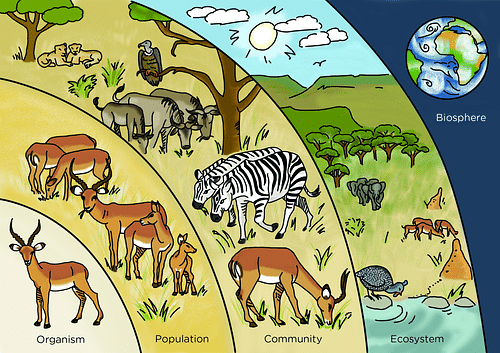
Fig. What is Ecology?
Difference Between Environment and Ecology
[Click Here for Sample Questions]
The below table differentiates between ecology and environment.
| Environment | Ecology |
|---|---|
| The interaction of physical, chemical, and biological components is referred to as the environment. | The study of how organisms interact with their surroundings is called ecology. It is a group of living beings that is separate. |
| It is the set of circumstances that surround a living thing. | It is the relationship between organisms and their surroundings. |
| The environment can be both huge and tiny. | It is a broad range that encompasses a variety of smaller habitats. |
| Its goal is to investigate the internal and external factors that have an impact on the environment. | Its goal is to gain a better understanding of life processes, adaptations, distribution, and biodiversity. |
| Pollution, global warming, deforestation, and other more significant challenges are among the environmental causes. | Population size, dispersion of organisms, diversity, and competition among them are all ecological factors. |
| Temperature, water, light, air, soil, and nutrients are all environmental elements. | Ecology is the study of various ecosystems and how creatures rely on one another to thrive. |
| It's the space in which living organisms live, whether made up of biotic or chemical elements. | Eco refers to something beneficial to the environment and does not hurt any particular species or substance. |
| The term "environment" refers to all abiotic or nonliving environmental components that surround an organism. | It includes studying the physical features of species surroundings as small as nucleic acids and cells, including the human population interactions and habitats in the context of communities and ecosystems to promote human health and conserve natural resources. |
| Humans have a significant impact on various ecosystems, which has an impact on the global environment. The study of the environment, for example, figures out ways to reduce waste, safeguard coral reefs, and eradicate pollution. | Organismal ecology, Population Ecology, Community Ecology, Ecosystem Ecology, and Biosphere Ecology are examples of different levels of organization in ecology. |
| It aims to safeguard both people and the environment from adverse effects such as pollution and climate change. | It aims to comprehend how ecosystems develop, how humans might hurt them, and lessen that damage. |
Things to Remember
[Click Here for Sample Questions]
- Many people believe that an environment and ecology are the same things. However, this is not the case. They differ in terms of habitat, functions, and qualities, as well as other significant characteristics. Both are major components that we observe in our surroundings.
- Ecology is described as studying the interactions and other properties of biological organisms and non-biological items in the environment. In contrast, an environment is defined as a surrounding containing living and nonliving things that coexist.
- For the first time, Reiter coined the term "ecology." Ernst Haeckel is credited with defining it. Ramdeo Misra is renowned in India as the "Father of Ecology."
- An organism's environment changes when it moves from one location to another, whereas an ecology stays the same for an organism no matter where it goes.
- Ecology provides a relationship between the elements, whereas an environment allows the elements to exist.
| Chapter Related Topics | ||
|---|---|---|
| Parasitism | Growth | Commensalism |
| Ecology | Homeostasis | what is adaptation |
| Thermoregulation | Diapause | Population Interaction |
Sample Questions
Ques. What role does the environment play in our lives? (2 Marks)
Ans. Ecology is the study of the interactions between living organisms, such as humans, and their physical environment, to understand the vital connections between plants and animals and the environment. Ecology also teaches us about the benefits of ecosystems and how humans might use the Earth's resources in ways that protect the environment for future generations.
Ques. What is the importance of ecology?
Ans. Ecology is beneficial to our planet and essential to human enjoyment and growth. It contributes to our understanding of the relationship between people and nature, essential for food production, clean air and water, and biodiversity conservation in a changing climate.
Ques. List three differences between environment and ecology?
Ans.
| The environment refers to the interaction of components present in the surroundings. | It is the study of the relationship between organisms and their environment. |
| Pollution, deforestation, global warming, and other more significant issues are among the environmental concerns. | Population size, diversity, distribution of organisms, and competition between them are all ecological concerns. |
| Its goal is to protect both humans and the environment from negative consequences like pollution and climate change. | Its goal is to understand better how ecosystems develop, how humans may harm them, and mitigate that harm. |
Ques. Who defined the term Ecology? (2 Marks)
Ans. For the first time, Reiter coined the term "ecology." Later, Ernst Haeckel is credited for defining the term "Ecology."
Ecology is split into two sections:
Autecology- the study of an organism or species and its adaptations and interactions with its surroundings.
Synecology- the study of the interactions between different species living in a community and their surroundings.
Ques. Define the environment and State its functions. (2 Marks)
Ans. The term "environment" refers to the total of all living and non-living elements, as well as their effects on human life. Non-living or abiotic elements include water, land, sunshine, rocks, and air, while all live or biotic elements are animals, plants, forests, fisheries, and birds.
Functions of environment:
- Supplies resources
- Sustains life
- Assimilates waste
- Enhances the quality of life
Ques. What is the ecosystem's significance? (2 Marks)
Ans. Ecosystems keep the environment in check. It provides clean air to breathe and helps to regulate the climate by sequestering carbon. It circulates nutrients through multiple biogeochemical cycles, ensuring that we have clean drinking water without expensive techniques. A variety of living organisms rely on it for sustenance and shelter. It also supplies raw materials for a variety of industrial and home applications.
Do Check:



Comments