



Content Writer
Predators are one of the six types of population interactions which involve a predator and a prey. In predation, the predator eats part or everything of the living, or currently living, body of another organism, the prey. This interaction is advantageous for the predator, but on the other hand, is harmful for the prey.
- Predators belong to the family of feeding behaviours.
- It is responsible for promoting the responsible cycle of predators.
- On this planet, every species depends on each other for their survival.
- Plants and animals are interdependent for their survival.
- When populations of two different species interact, this leads to interspecific interactions.
- Such interactions may either benefit or harm or become a neutral effect on one another.
- Predators are considered solitary hunters.
- They actively search for or pursue the prey before consuming.
Read More: Morphology of Flowering Plants
Key Terms: Predator, Predation, Prey, Parasitism, Herbivores, Carnivores, Chemical Defense Mechanism, Energy, Plants, Animals
What are Predators?
[Click Here for Sample Questions]
Predators are species that prey on other species. This interaction between predators and prey is called predation. Apart from the energy transfer, these predators keep the prey population in control. Predation helps in the transfer of energy from one trophic level to another.
- In animal and water kingdoms, the predator actively searches or, pursues or waits for its prey.
- When it is able to detect its prey, the predator accessing the situation goes for attack.
- If the attack is successful, the predator kills its prey and eats it.
- For plants, herbivores are predators, and for them, carnivores are.
- If the number of prey increases, then the predator is absent.
- It may cause instability in the ecosystem.
- Predators are there to maintain species diversity and minimise the intensity of the competition among the prey.
- They have an acute sense of vision, smell or hearing.
- Preys have developed defence mechanisms over the years to lessen the impact of predation.

Chemical defense mechanisms
Read More: Biome
Examples of Predation
|
Read More: Discovery of Cells
Types of Predators
[Click Here for Sample Questions]
The types of predators are as follows:
Herbivores
Herbivores belong to the class of animals that get their nutrition from plants and plant-based products. It includes cows, buffaloes, goats and sheep. They are primary consumers in the food chain.
Carnivores
Carnivores belong to the class of animals who get their nutrition from eating animals, whether live or dead. It includes a tiger, lion and leopard. They are secondary or tertiary consumers in the food chain.
Read More: Nutrition in Amoeba
Parasites
Parasites belong to the class of animals who live in the host's body for survival. They get their nutrition by feeding the body of the prey. It includes Roundworms, leeches, ticks, lice, and mites.
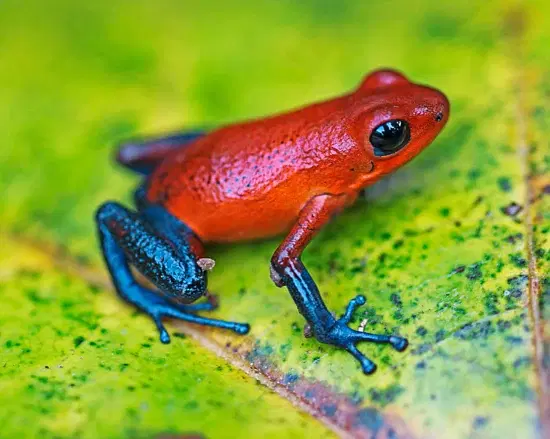
Strawberry Dart Frog
Read More: Prokaryotic and Eukaryotic Cells
Predator Adaptations
[Click Here for Sample Questions]
Predators have adapted in following ways to attack and catch their prey:
Physical Adaption
Physical Adaptation, also known as behavioural adaptation, involves an animal's response to survive in the environment. Predators have evolved naturally for detecting, killing, catching and digesting prey. These include speed, agility, sharp claws, teeth and digestive system. They have a well-developed sense of smell, vision and hearing.
Anti-predator Adaptation
Anti-predator Adaptation is a process of evolution that helps a prey to save against predators. To keep one safe, prey develop a great variety of defence mechanisms. They can detect their predators and warn others of their presence. They can avoid detection by their morphological traits and colouration, making it difficult for the predator to search for its prey.
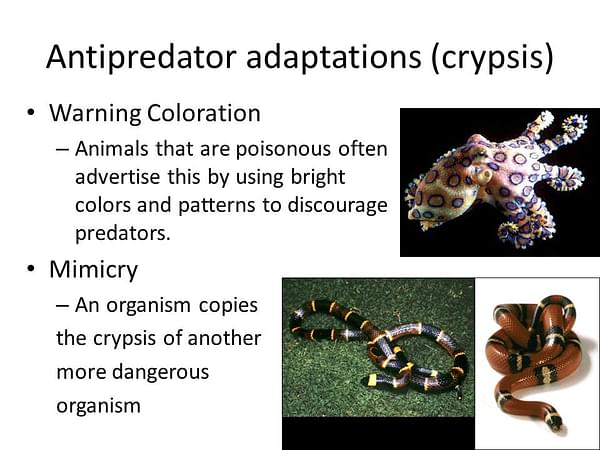
Anti-predator Adaptation
Read More: What are Tissues
Predator Examples
[Click Here for Sample Questions]
The examples of predators are as follows:
Large Predators
Large predators are types of predators that cause mass destruction. They have special abilities to pursue and kill their prey. Some examples of large predators include polar bears, whales, and white sharks. Polar bears largely prey on seals; white sharks are the most dangerous ocean predators.
Small Predators
Small Predators do not cause any mass-scale destruction. They eat a mixture of meat and veg. Some examples of small predators include sea stars, ladybugs, dogs and snakes. Sea Stars mostly prefer to feed on shellfish.
Read More: Living & Non-living thing
Avoiding an attack from Predators
[Click Here for Sample Questions]
There are various ways to avoid an attack from predators which are as follows:
Signalling unprofitability
Signalling that they are not killing by giving them an honest signal or by aposematically coloured or patterned such that they signal they are distasteful or can defend themselves.
Forming group
By forming groups, the prey can reduce attacks on the predators. It confuses the predator, and it cannot concentrate on one single prey.
Fending off an attack
Chemical defence such as toxins or poison. Mechanical defence includes a sharp spine, hard shells, tough leathery skin or exoskeleton, all of which are very hard for the prey to eat.
Escaping the attack
When the predator approaches for the attack, the prey can flee by running, jumping, climbing, burrowing or swimming. Prey can either include other strategies like playing dead or uttering the distress call. Therefore, in nature, species co-exist and show various interspecific interactions, predation being the most common among them.
Read More:
Things to Remember
- Predation is a type of biological interaction that involves the killing of one organism by another for food.
- Predatory animals are born hunters who actively search for their prey.
- The level of fitness of a prey is quite low.
- The interaction between both predators and prey is advantageous to the community.
- Herbivores, Carnivores and Parasites are different types of predators.
Read More: Biotic and abiotic factors
Sample Questions
Ques: What is predation? (2 marks)
Ans: The interaction between predators and prey is called predation. Apart from the energy transfer, these predators keep the prey population in control. Predation helps in the transfer of energy from one trophic level to another. When one species, called a predator, preys on another species, it is called predation.
Ques: What are the important defence mechanisms used by plants against herbivores? (1 mark)
Ans: The predation process involves one animal, a predator, killing and consuming other animals, the prey. Morphological defence like Thrones, Chemical defence like poison, toxin.
Ques: What are the significant roles predation plays in nature? (2 marks)
Ans: In predation, the predator eats part or everything of the living, or currently living, body of another organism, the prey. This interaction is advantageous for the predator but, on the other hand, is harmful for the prey. They keep the target in control. They help maintain species diversity in a community by reducing the intensity of competition among prey species.
Ques: What is the importance of predation? (2 marks)
Ans: Predation helps transfer energy from one trophic level to another. When it can detect its prey, the predator accessing the situation goes for attack. If the attack is successful, the predator kills its target and eats it. Strawberry poison dart frogs possess a bright colouration to warn predators. Some species of frogs or insects are cryptically coloured to avoid being detected by predators.
Ques: Give an example of predator and prey? (2 marks)
Ans: Predators are those species that hunt and consume other organisms to obtain energy. They belong to the food chain and are responsible for ecosystem conservation. Animals and plants control the food chain in several different ways. Predator: Lion and Prey: Deer.
Ques: How do plants protect themselves from prey? (2 marks)
Ans. To plants, herbivores are predators. Plants cannot move like animals; however, they have evolved a unique way to make their predators stay away from them, which is their morphological and chemical defence. Like thorns are the most morphological defence mechanism they use, for example, Cactus. Many plants store their poison in them, so they either become sick or even kill them when the predator feeds on them. Plants may produce chemicals such as nicotine, caffeine, quinine, strychnine or opium for defence.
Ques. Explain the types of predators? (3 marks)
Ans. The types of predators are as follows:
- Herbivores: Herbivores belong to the class of animals that get their nutrition from plants and plant-based products. It includes cows, buffaloes, goats and sheep. They are primary consumers in the food chain.
- Carnivores: Carnivores belong to the class of animals who get their nutrition from eating animals, whether they come live or dead. It includes a tiger, lion and leopard. They are secondary or tertiary consumers in the food chain.
- Parasites: Parasites belong to the class of animals who live in the host's body for survival. They get their nutrition by feeding the body of the prey. It includes Roundworms, leeches, ticks, lice, and mites.
Ques. Give examples of predators? (2 marks)
Ans. The examples of predators are as follows:
- Large Predators: Large predators are types of predators that cause mass destruction. Some examples of large predators include polar bears, whales, and white sharks.
- Small Predators: Small Predators do not cause any mass-scale destruction. They eat a mixture of meat and veg. Some examples of small predators include sea stars, ladybugs, dogs and snakes.
Ques. What are the strategies to avoid an attack from predators? (4 marks)
Ans. Different strategies to avoid an attack from predators are as follows:
- Signalling unprofitability: Signalling that they are not killing by giving them an honest signal or by aposematically coloured or patterned such that they signal they are distasteful or are able to defend themselves.
- Forming group: By forming groups, the prey can reduce attacks on the predators. It confuses the predator and cannot concentrate on one prey.
- Fending off an attack: Chemical defence such as toxins or poison. Mechanical defence includes a sharp spine, hard shells, tough leathery skin or exoskeleton, all of which are very hard for the prey to eat.
- Escaping the attack: When the predator approaches for the attack, the prey has the option to flee either by running, jumping, climbing, burrowing or swimming.
Ques. What are the various types of adaptation methods performed by predators? (2 marks)
Ans. The various types of adaptation methods performed by predators are as follows:
- Physical Adaption: Physical Adaptation, also known as behavioural adaptation, involves an animal's response to survive in the environment. Predators have evolved naturally for detecting, killing, catching and digesting prey.
- Anti-predator Adaptation: Anti-predator Adaptation is a process of evolution that helps a prey to save against predators. To keep one safe, prey develop a great variety of defence mechanisms. They can detect their predators and warn others of their presence.
Ques. What is the difference between predators and parasitism? (4 marks)
Ans. The difference between predators and parasitism are as follows:
| Predators | Parasitism |
|---|---|
| Predaotors kills their prey instantaneously. | Parasitism does not cause their host to perish easily. |
| They feed on their preys. | They ingest nutrients from their prey. |
| They do not depend on prey for metabolism. | They do depend on prey for metabolism. |
| Predators are strong and fast. | Parasitism are weak and small. |
For Latest Updates on Upcoming Board Exams, Click Here: https://t.me/class_10_12_board_updates
Do Check Out:



Comments