



Content Curator
Primary and Secondary Succession are both types of Ecological Succession. Ecological succession is the steady and gradual change in a species of a given area with respect to the changing environment. Our nature consists of both abiotic and biotic factors. When these abiotic and biotic factors interact with each other to develop natural communities they give rise to such successions.
To understand these successions, we need to imagine and trace back to the time when an ecological system started thriving. There are many stages in the growth of an ecological system but while talking about primary and secondary succession we need to focus on the initial growth of ecological succession. The first to occupy the land are small species like microorganisms. They undertake the task of breaking down rocks and thus forming soil which then further becomes the initial constituent of other biotic communities.
Key Terms: Ecological Succession, Pioneer Species, Microorganisms, Seral Communities, Climax Community, Primary Succession, Secondary Succession
Ecological Succession
[Click Here for Sample Questions]
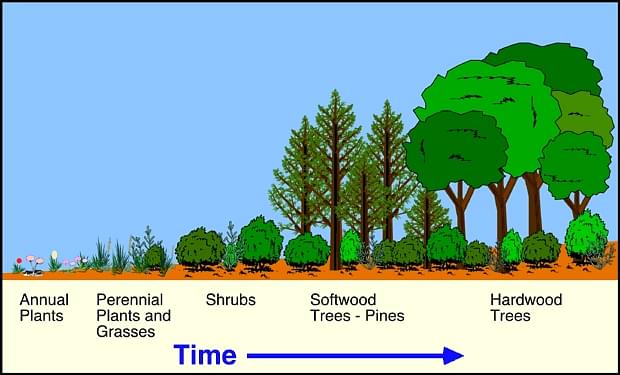
When land is left on its own for years, it starts being occupied by microorganisms followed by wild shrubs and other large plants, thus giving rise to a new ecosystem. The series of stages is quite predictable and inevitable. To understand what primary and secondary succession is, we need to be clear about what ecological succession is as they are its types. This succession aims to bring about equilibrium in the ecosystem. When this aim is achieved, it is called a climax community.
Ecological Succession
The number of species to survive is then decided based on achieving the equilibrium. In such an area these changes in a community happen in a sequence, and such a community is known as a seral community. A seral community is an intermediate stage of ecological succession advancing towards the climax community. All the succession begins with a pioneering species. The pioneer species or the first species build an initial biological community that is simpler in form. The initiation of this ecological succession separates it into three types –
- Primary succession
- Secondary succession
- Cyclic Succession
The above picture depicts the growth of an ecosystem towards a climax community.
Primary Succession
[Click Here for Sample Questions]
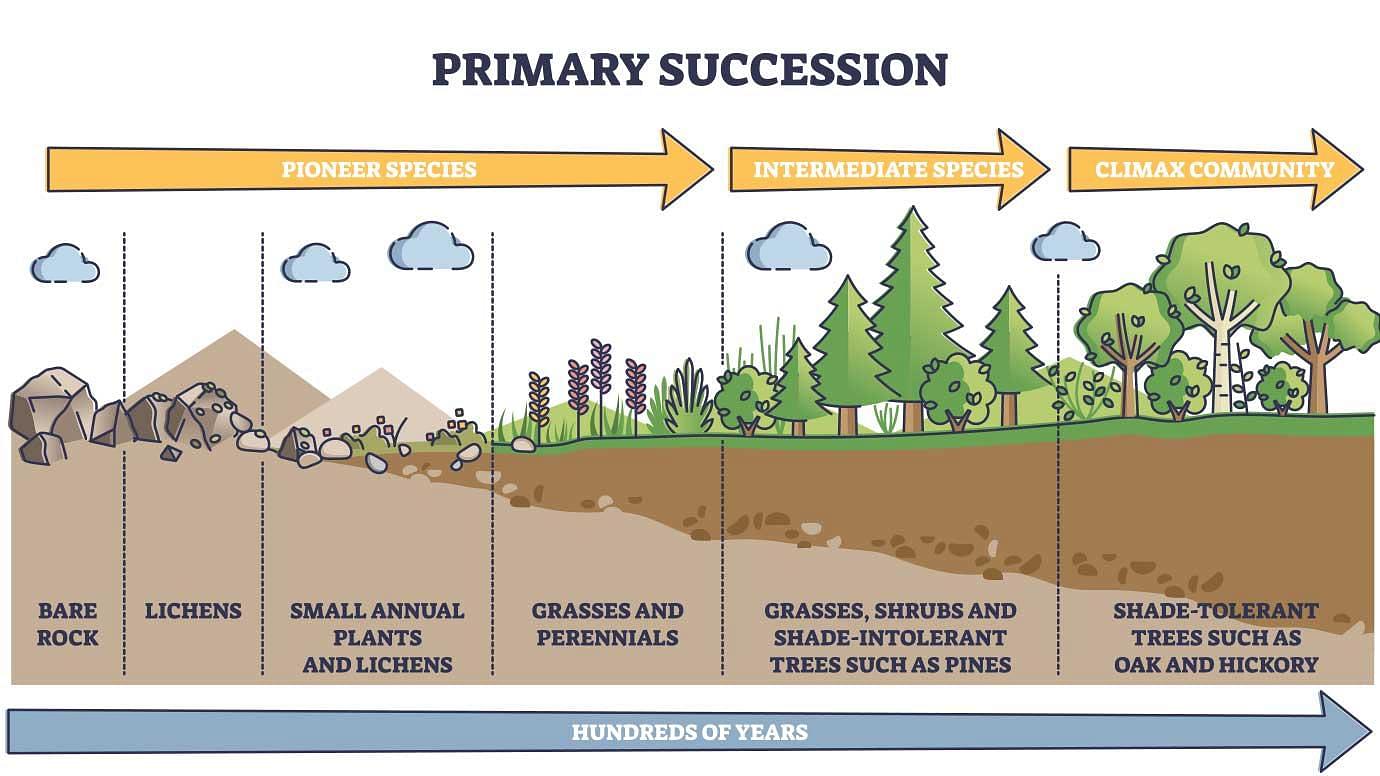
Primary succession is a type of ecological succession that takes place in an environment that is recently formed and lacks habitable soil but then is colonized for the first time by living organisms. This succession is when the initiation of colonizing of biotic factors starts from breaking and eroding rocks into the soil and thus adapting it. Plants and other developed micro-organisms start living in the thus created soil, creating an ecosystem.
Primary Succession
Secondary Succession
[Click Here for Sample Questions]
Secondary succession is a type of ecological succession that occurs in an environment with an already established ecosystem that gets disrupted due to some events like fire or hurricane and is then re-colonized by other organisms. The secondary succession initiates as shown in the following picture.

Secondary Succession
Also Read:
| Relevant Concepts | |
|---|---|
| Biofortification | Biomass, Energy Pyramids |
| Energy flow in Ecosystem | Food Chains and webs |
Difference between Primary and Secondary Succession
[Click Here for Sample Questions]
The difference between Primary and Secondary Succession is as follows:
| Primary Succession | Secondary Succession |
|---|---|
| It occurs in areas that were previously not inhabited | It occurs in areas that were previously inhabited |
| The succession begins with the breakdown of rocks into soil | The succession already has the presence of soil |
| Absence of initial vegetation | Presence of initial vegetation |
| It is the base of all the ecosystems | It occurs only if a primary succession is destroyed |
| Life starts with nothing thus it is a slow process | It already has a head start as compared to primary succession, thus it is comparatively a fast process |
| It takes about 1000 years or more for primary succession to reach the climax community | It takes about 50-200 for secondary succession to reach the climax community |
| Due to the absence of soil, the pioneer species-humus is not present in the initial stages. It enters the succession through external sources | Humus is present as the succession contains soil that has decomposed products in it. |
| The pioneering species found here are liches, fungi, or algae | Grass or other higher pioneering species of the previous communities are already present in the ecosystem |
| Absence of organic matter in the environment | Presence of organic matter in the environment |
| Numerous seral communities can be found in this succession | Fewer seral communities can be found in this succession |
| The succession began in uninhabitable conditions, extreme conditions | The succession began in habitable conditions |
| Areas after volcanic eruptions, glaciers outbursts, sand, nuclear eruptions are good examples of the land ready for a primary succession | Areas after fires, abandoned land, harvested areas, deforested areas, affected by natural calamities, logging, flooded land, etc are good examples of the land undergoing secondary succession. |
Things to Remember
- Evolution and Ecological succession are different.
- The succession and the evolution of the species occur simultaneously.
- The decomposition of the pioneering species adds to the organic content of the soil thus making it fit to adapt more species.
- As the succession continues the older species are then replaced by the new species as per the environment. These species aim to achieve the climax community.
- Factors like soil texture, pH level, landscape structure, climate, bulk density, seed dispersal, etc affect the course of secondary succession.
- During succession, some species undergo extinction, some species increase in number, while some decomposer species adapt changes- all with an aim to achieve equilibrium.
Sample Questions
Ques. What are the types of ecological succession? (3 Marks)
Ans. The three types of ecological succession are primary, secondary, and cyclic succession. Primary and Secondary succession is well explained in the above article thus Cyclic succession can be defined as the change in the pattern of vegetation wherein a small number of species tend to replace each other over time in the absence of large-scale disturbances.
Ques. What is a pioneering community? (2 Marks)
Ans. It is a community that cannot withstand extreme weather and forms the first species to occupy the land undergoing primary succession. They mostly contain microorganisms.
Ques. What are the causes of ecological succession? (2 Marks)
Ans. Ecological successions can be caused by the sudden wipeout of all the species of the land due to natural or man-made disasters. Climate changes, soil erosion, fires, wind, etc are some examples of natural disasters. Nuclear blasts, deforestation, etc are some man-made disasters.
Ques. What is the importance of ecological succession? (2 Marks)
Ans. There is equilibrium in nature due to constant ecological succession. Each of the different species contributes equally to the survival of the ecosystem and to maintaining a balance. This makes ecological succession very important.
Ques. Which species are the pioneering species in water in primary succession? (1 Mark)
Ans. Phytoplankton are the pioneering species in water (aquatic) in primary succession
Ques. Name the components of an ecosystem. (2 Marks)
Ans. The ecosystem involves abiotic and biotic components. Abiotic components include air, water, wind, soil, temperature, and rainfall. Biotic factors include producers, consumers, and decomposers.
Ques. Define ecological pyramids. (2 Marks)
Ans. An ecological pyramid is a graphical representation designed to show the biomass at each trophic level in the given ecosystem. Producers are marked at the base of the pyramids followed by primary consumers, secondary consumers, third-level consumers, and apex predators.
Ques. Define Decomposition. (2 Marks)
Ans. Decomposition is a process where the dead organic matter is broken down to simpler organic or inorganic matter through biological and chemical processes.
Check-Out:



Comments