



Education Journalist | Study Abroad Lead
Ecological Succession is a sequence of changes that occur in an ecological system over a considerable period of time. It is the sequence of colonization of biological species in an ecosystem from an unfertile barren land. The first species to inhabit a barren area are lichens and tiny mosses. These simpler species make the region suitable for the growth of advanced plant species like herbs, creepers, shrubs, climbers, and trees. Ecological succession is very vital for the growth and development of a progressing entire ecosystem as a whole. It is essential for new areas to be colonized, and deteriorated ecosystems to be recolonized. Plant succession makes the organisms easily adapt and adjust to the constant changes in the environment and continue to survive well for many generations.
| Table of Content |
Key Terms: Ecological Succession, Primary Succession, Secondary Succession, Sere, Community, Lichens, Mosses, Cyclic Succession
What is Ecological Succession?
[Click Here for Sample Questions]
Ecological succession is the continuous and step-by-step transformation of a biological species of a given region with respect to the ever-changing environment. It is an inevitable change and is a regular process in nature as all the biotic factors have to adjust to the continuous changes in the environment.
The chief aim of this phenomenon is to gain equilibrium in the natural ecosystem. The biological community that achieves this target is called a climax community. In the process of reaching this equilibrium, some biological species increase in their number while some others decrease.
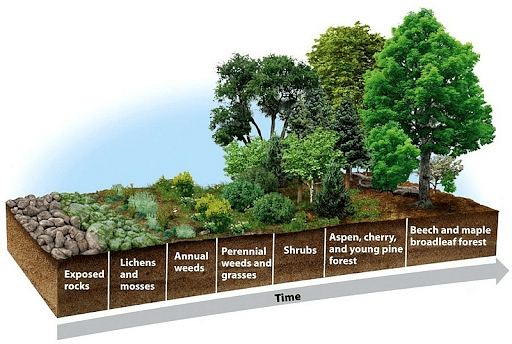
Ecological Succession
In a given region, the sequence of communities that undergo a considerable change is called a sere. Hence, each biological community that changes is called a seral stage or seral community.
All the biological communities undergo succession over a period of time since their origin. So, evolution takes place simultaneously with ecological succession. The origin of life on earth is also considered the result of the succession process.
Read More: Heredity and Evolution
Types of Ecological Succession
[Click Here for Previous year Questions]
There are different types of ecological succession as follows:
Primary Succession
[Click Here for Sample Questions]
Primary succession is the kind of succession that starts in barren areas such as regions that lack fertile soil or the areas where the soil is unfit to sustain life. The first biological species that came into existence during primary succession is called the pioneer species.
When the earth was first formed there was no fertile soil to sustain life. The earth was only composed of rocks. These rocks were later broken down by physical and biological factors like microorganisms and eroded to form loose soil. The soil then became the foundation of terrestrial plant life. These plants later help in the migration, and survival of different animals and progress from primary succession to the climax community. If the primary ecosystem is destroyed, the secondary ecosystem takes place.
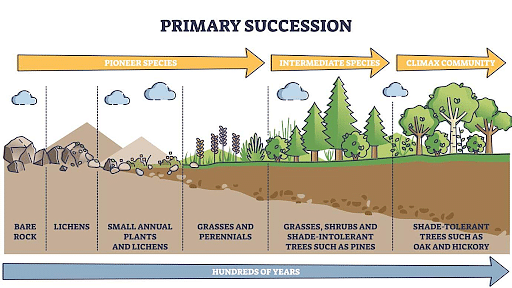
Primary Succession
Also Read:
Secondary Succession
[Click Here for Previous year Questions]
Secondary succession takes place when the primary ecosystem gets completely or partially destroyed. For instance, if a climax community (forest) gets destroyed by fire, it gets re-colonized after the destruction. This is called secondary ecological succession. Small plants emerge first out of the ash, followed by larger plants in succession. The tall trees later block the sunlight to smaller ones and change the total structure of the flora and fauna below the tree canopy. Finally, some climax community will be formed.
It is evident that primary succession is a rather very slow process as life has to start from nothing; whereas secondary succession is comparatively faster as it starts at a location that had already supported life before.
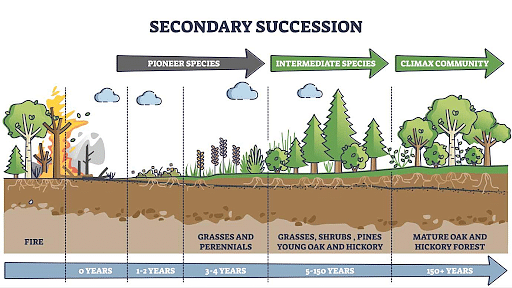
Secondary Succession
Read More: Difference between Primary and Secondary Succession
Cyclic Succession
[Click Here for Sample Questions]
The change in the structure of an ecosystem on a cyclic basis is called cyclic succession. Some plants like Tribulus remain dormant in the soil for the rest of the year and emerge all at once after showers. This one drastically changes the structure of a fresh ecosystem.
Seral Community
[Click Here for Previous year Questions]
The intermediate stage of ecological succession advancing towards the climax community is called the Seral community. A seral community is always replaced by subsequent communities. It consists of simple food chains and less complex food webs. It shows a very low degree of biological diversity. Both the individual species and the nutrient quantities are less.
There are seven different types of seres:
| Types of Seres | Explanation |
| Hydrosere | Plant succession in aquatic habitats. |
| Xerosere | Plant succession in dry or desert habitats. |
| Lithosere | Plant succession on a bare rock surface. |
| Psammosere | Plant succession on big sandy areas. |
| Halosere | Plant succession in saline soil or saline water. |
| Senile | A succession of microorganisms on dead and decaying organic matter. |
| Eosere | Development of any vegetation in an era or period of time. |
Read More: Asexual Reproduction In Plants
Examples of Ecological Succession
[Click Here for Sample Questions]
Some important examples of ecological succession are given below:
Acadia National Park
It is a 47,000-acre Atlantic coast recreation park area primarily on Maine's Mount Desert Island. This particular national park suffered a huge wildfire in the past. Restoration of the burnt forest was left to nature. In the beginning, only small plants grew up on the burnt ash. After several years, the forest showed a huge diversity in plant and other tree species. The difference was that the majority of trees before the fire were evergreen, while the trees that grew after the fire were deciduous.

Acadia National Park
Read More: Forest Conservation
Ecological Succession of Coral Reefs
[Click Here for Previous year Questions]
Coral reefs have polyps that belong to Cnidaria. Small coral polyps colonize only the rocks. These polyps grow and divide in large numbers to form coral colonies. The color and shape of the coral reefs attract many small fishes and crustaceans that will be food for the larger fish. Likewise, a fully functional coral reef exists.

Coral Reefs
Read More: Hydrarch Succession
Things to Remember
- Ecological succession can be defined as the continuous and step-by-step transformation of a biological species in a given region.
- If we consider some regions where life begins from a very small quantum the process of succession is known as primary succession.
- The life that starts at a place after the region has lost all the life forms existing there is called secondary succession.
- The change in the structure of an ecosystem on a cyclic basis is called cyclic succession.
- The Seral community is described as the intermediate stage of ecological succession advancing towards the climax community is called the Seral community.
Previous Year Questions
- Plants growing in acidic soil are termed as: [JIPMER 2002]
- The correct sequence of plants in a hydrosere is… [NEET 2009]
- The primary succession refers to the development of communities on a… [NEET 1995]
- The upright pyramid of numbers is absent in… [NEET 2012]
- Climax community is a state of:… [KCET 2017]
- The pioneer species in Xerarch and Hydrarch succession are respectively… [KCET 2015]
- An inverted pyramid of number and an inverted pyramid of biomass are respectively seen in… [KEAM]
- strong>Pyramid of numbers in a pond ecosystem is … [NEET 1993]
Sample Questions
Ques. Define what does standing crop of a trophic level represent in an ecosystem. (1 Mark)
Ans. Standing crop depicts the total mass of living material or energy content of all the organisms of a trophic level at a particular time and particular location
Ques. What is a detritus food chain composed of? How does it meet its energy and nutritional requirements? (2 Marks)
Ans. It is composed of decomposers, i.e. some actinomycetes, bacteria and fungi. It meets its energy and nutrient requirements by decomposing the dead organic matter of detritus
Ques. What is the role of pioneer species in primary succession on rocks? (2 Marks)
Ans. Lichens (fungus+algae) are the pioneer species in the succession on rocks. They secrete carbonic acids to dissolve the rock and help in weathering and soil formation. Later pave the way for small plants like bryophytes.
Ques. List any two ways of measuring the standing crop of a trophic level. (2 Marks)
Ans. The standing crop can be measured as
- Biomass of living organisms in a unit area.
- Number of organisms in a unit area
Ques. Apart from being a part of the food chain, many predators play other important roles in the food chain. Mention any two such roles of predators supported by examples. (3 Marks)
Ans. Apart from being a part of the food chain, predators play important role in
- Maintenance of the prey population and also the regulation of intraspecies competition.
- Indication of ecological disturbances when predators are small in number and highly sensitive to ecological changes owing to the excessive adaptation of predators.
Ques. It is possible that a biological species may occupy more than one trophic level in the same ecosystem at the same time. Explain with the help of one biological example. (3 Marks)
Ans. Yes, the trophic level of a biological species represents the functional level of the species in the energy flow. The preference for food habits depends on the available food and worms. A single biological species may occupy more than one trophic level at the same time in the ecosystem. For example, the herbivorous bird is a primary consumer when it eats seeds and a secondary consumer when it feeds on some insects and worms.
Ques. What is a standing crop in an ecosystem? Sketch out a pyramid of biomass when a small standing crop of phytoplanktons supports a large standing crop of zooplankton in the sea. (3 Marks)
Ans. The standing crop depicts the total biomass of living matter or energy content of all the organisms of a trophic level at a particular time and particular location

The above-inverted pyramid of biomass small standing crop of phytoplankton supports a large standing crop of zooplankton.
Ques. Draw a grazing food chain and detritus food chain using the following 5 links each. Earthworm, bird, snake, vulture, grass, grasshopper, frog, and decaying plant matter. (3 Marks)
Ans. Grazing food chain:
Grass — > Grasshopper — > Bird — >Snake -> Vulture
Detritus food chain:
Dead and decaying plant matter — >Earthworm — >Bird — > Snake Vulture
Ques. What are the pioneer species on a bare rock? How do pioneer species help in establishing the next type of vegetation? What is the type of climax community that will ultimately get established? (3 Marks)
Ans. Lichens (symbiosis between algae and fungi) are the pioneer species on bare rock.
- Rhizines of lichens secrete carbonic acid to dissolve rock and help in weathering and fertile soil formation.
- Smaller bryophyte plants invade and hold a small amount of soil.
- The bryophytic plants are succeeded by herbs, shrubs and big trees.
- A stable climax forest will be formed.
- Mesophytic climax forest will be established from the xerophytic habitat.
Ques. (i) With some suitable examples, explain the energy flow through different trophic levels in an ecosystem. What does each bar in the ecological pyramid represent?
(ii) Write two limitations of ecological pyramids. (5 Marks)
Ans. (i) Energy flows unidirectionally from the first trophic level (producers) to the last trophic level (top carnivores). As energy flows from one trophic level to another, some energy is lost. The amount of energy flow decreases at each successive trophic level. The pyramid of energy is always upright. Each bar in the pyramid indicates the amount of energy present at that trophic level in a particular time or per unit area.
(ii) The two limitations of ecological pyramids are:
- They do not take into account the same single species operating at two or more trophic levels. Simple food chains that do not exist in nature. They do not accommodate the food web.
- Saprophytes, osmotrophs, detritivores and decomposers are not given any place in pyramids.
For Latest Updates on Upcoming Board Exams, Click Here: https://t.me/class_10_12_board_updates
Check-Out:



Comments