


Rocks and minerals are the building blocks of our planet Earth. They are responsible for the formation of landscapes, which give all of the vital materials required in our environment. The knowledge these structures will allow us to learn about the events that have shaped our planet and those that will continue to shape it. The terms 'rocks and minerals' are often used interchangeably but they are different from each other. Rocks are composed of minerals, but minerals are not composed of rocks. However, it is critical to recognize the distinction between rocks and minerals. Let's talk about rocks and minerals and their significance.
Also Read: Minerals and Energy Resources
Key Terms: Rocks, Minerals, Igneous Rocks, Mineral Rock, Metamorphic Rock, Sedimentary Rocks, Metallic Minerals
What are Rocks?
[Click Here for Sample Questions]
A rock is an inorganic hard material. The formation of rock is a natural process. In other terms a rock is a mineraloid substance or mineral rock. It is made up of two or more mineral grains. Rocks vary in shape, size, and texture.

Rocks
Read More:
| Relevant Concepts | |
|---|---|
| Rubidium | Ruthenium |
| Silver Carbonate | Sodium Citrate |
Types of Rocks
[Click Here for Sample Questions]
Geologists divide rocks into three types: igneous, sedimentary, and metamorphic. The type of rocks are discussed below:
Igneous Rocks
Igneous rocks are those created as a result of the cooling and solidification of magma or lava. The term igneous is derived from the Latin word "ignis," which means "fire." Igneous rock can occur either above or below the Earth's surface. Intrusive igneous rock is the igneous rock that originates beneath the surface. This type of rock cools slowly and contains huge crystals of various minerals that may be viewed with the naked eye.

Igneous Rocks
Sedimentary Rocks
Sedimentary rocks are created as a result of sediment accumulation. They are composed of mineral layers, rock particles, or organic components. The strata form through time when elements carried by water are deposited at the bottom of lakes, rivers, and oceans, or are moved around the Earth's surface by wind or ice.

Sedimentary Rocks
Metamorphic Rocks
Metamorphic rocks are the rocks that originate as a result of a physical or chemical alteration to an existing rock. The process by which the metamorphic rocks originate is known as metamorphism. The term "metamorphosis" refers to a change in shape.

Metamorphic Rocks
Read More:
What are Minerals?
[Click Here for Sample Questions]
Minerals are important components of our daily lives since they make up the majority of the planet. They are naturally occurring compounds with a crystalline structure. They are typically inorganic and solid in character, generated by geological processes. There are also a few organic materials in the earth's crust, such as silver, gold, and diamond.
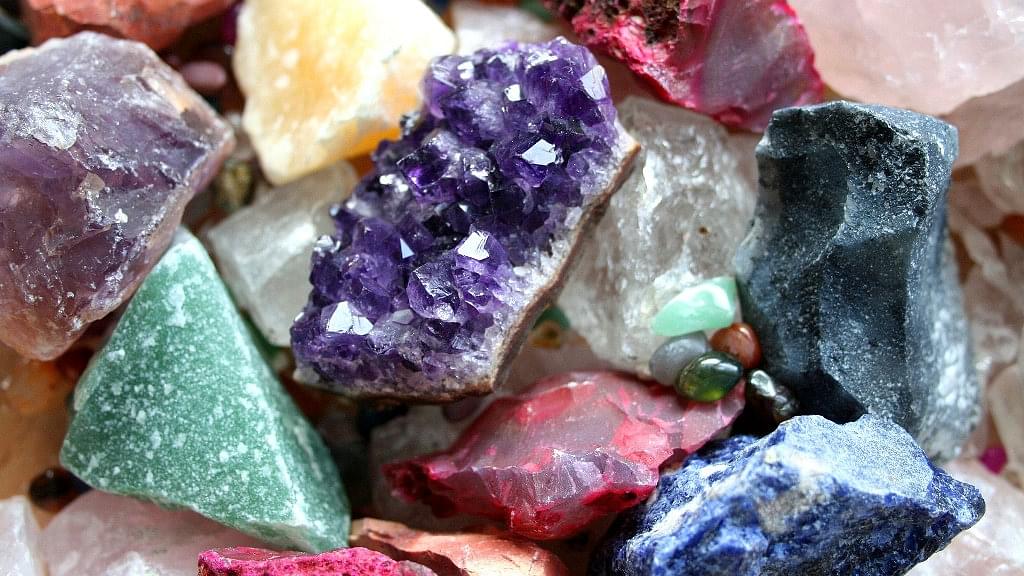
Minerals
Types of Minerals
[Click Here for Sample Questions]
The crystal shape and chemistry of minerals are used to classify them. Minerals are classified into two types: metallic and non-metallic.
Metallic Minerals
Metallic minerals have a lustrous appearance and are made up of metals. These minerals can be mined for metal and serve as a storehouse for metals. Metallic minerals, such as manganese, iron ore, and bauxite, are classified as ferrous or non-ferrous. Non-ferrous minerals are those that do not contain iron whereas ferrous minerals are those that contain iron.

Metallic Minerals
Non-metallic Minerals
Non-metallic minerals have a non-metallic shine. Non-metallic minerals include limestone, gypsum, and mica. Bauxite ore is found predominantly in badly worn rocks. In some areas, bauxite deposits are found in volcanic rocks. Iron metal is derived from iron ore. It is never found in pure form and must be produced from iron ore by removing impurities.

Non-metallic Minerals
Also Read: Properties of Nylon
Difference between Rocks and Minerals
[Click Here for Sample Questions]
Rocks and minerals are two phrases that are frequently used interchangeably to refer to sedimentary substances found on Earth, despite the fact that there is a significant difference between these components.
| Rocks | Minerals |
|---|---|
| Rocks are naturally occurring aggregates of minerals. | Minerals are naturally occurring solid inorganic substances. |
| The chemical composition of a rock is unknown. | Minerals have a certain chemical composition. |
| Rocks are formed by the arrangement of minerals. | Elements combine to produce compounds that are known as minerals. |
| Igneous and metamorphic rocks make up 90-95 percent of the earth's crust. | Mineral deposits arise naturally on the ground. |
| Rocks cannot be eaten. | Minerals may be eaten. For example, salt. |
| Rocks have no atomic structure or chemical content. | Minerals have a distinct chemical content. |
| Rocks come in a variety of forms, sizes, and colours. | Minerals also have different shapes and colours. |
| For example, basalt, granite, and so on. | For example, iron, silicon, and so on. |
Also Read: Difference Between Elements And Compounds
Uses of Rocks and Minerals
[Click Here for Sample Questions]
We are surrounded by rocks and minerals. They aid in the development of new technologies and are used in our daily lives. Rocks and minerals are used in a variety of applications, including construction, cosmetics, automobiles, highways, and appliances. Minerals are consumed on a regular basis by humans in order to maintain a healthy lifestyle and build the body.
Uses of Rocks
Rocks are used for a variety of functions, some of which we may observe in our daily lives are listed below:
- Making Limestone Cement (Sedimentary Origin)
- Writing (Chalk) (Sedimentary Origin)
- Sandstone (Building Material)
- Pumice Bath Scrub (Igneous Origin)
- Granite curbstone (Igneous Origin)
Uses of Minerals
The uses of minerals are:
- Iron is used in the construction of buildings and other massive structures.
- Clay is used to make bricks and roofing tiles.
- Slate is used for roofing tiles.
- Cement contains limestone, clay, shale, and gypsum.
- Silica sand can be found in window glass.
Things to Remember
- Rocks are relatively hard and naturally occurring inorganic materials.
- Rocks are classified into three types- Igneous rocks, sedimentary rocks and metamorphic rocks.
- Minerals are naturally occurring compounds with a crystalline structure. They are inorganic compounds generated by geological processes.
- Minerals are of two types- Metallic Minerals and Non-metallic minerals.
- The chemical composition of a rock is unknown whereas the minerals have a certain chemical composition.
Sample Questions
Ques. What are the five applications of igneous rocks? (2 Marks)
Ans. Pumice is used to make toothpaste and cosmetics, whereas basalt is used to make statues and structures. When magma solidifies under the earth's surface, intrusive igneous rocks develop. For example, granite. Granite is utilised in countertops, statuary, and tombstones because of its durability.
Ques. Can we consider gold as a mineral? (2 Marks)
Ans. Native gold is both a mineral and an element. People esteem it for its appealing hue, rarity, resistance to tarnish, and several distinctive features, some of which are unique to gold. Although there are around twenty different gold minerals, they are all extremely uncommon.
Ques. What exactly is the Emerald mineral? (2 Marks)
Ans.Emerald is a gem variety of the mineral beryl. Gems receive their colour from trace metals or impurities in the material, and in the case of emeralds, they include traces of chromium, or occasionally vanadium, giving them a strong green colour.
Ques. What is the world's most valuable stone? (2 Marks)
Ans: Painite is not only the rarest gemstone, but also the rarest mineral on the planet, and it holds the Guinness World Record for it. For several decades after its discovery in 1951, there were only two examples of Painite.
Ques. (a) Is pearl a kind of mineral?
(b) Is marble a type of mineral? (2 Marks)
Ans. (a) Pearls are composed of overlapping platelets of the mineral aragonite, which is a calcium carbonate that crystallises in the orthorhombic system. Although the pearl is a mineral, its biological origin prevents it from being classed with minerals.
(b) Marble is a metamorphic rock made up of recrystallized carbonate minerals, the most common of which being calcite or dolomite. There are certain exceptions to the rule that marble is not foliated. Marble is a popular sculptural material as well as a construction material.
Ques. What is the economic value of minerals? (3 Marks)
Ans. Minerals are important natural resources which are also economically important.
- Minerals are used to produce different necessary chemical compounds.
- Energy minerals are used to generate power, fuel for transportation, heat homes and businesses, and make polymers.
- Rare minerals have high resale values in the market.
- Minerals are also used in different manufacturing procedures.
Ques. (a) How are rocks formed?
(b) Is every rock a mineral?
(c) Which are the three hardest rocks? (3 Marks)
Ans. (a) Layers of sediment are formed as soil and surface materials erode over time. Layer upon layer of sediments build over extended periods of time, placing great strain on the earliest strata. Lower layers of sediments eventually transform into rocks under extreme pressure and heat.
(b) Minerals and rocks are both solid, naturally created things found in or on the earth. Minerals do not form rocks, and rocks do not form minerals. Minerals are unique in that they have a distinct chemical makeup and crystalline form.
(c) Diamond is the hardest mineral and is constantly at the top of the scale. On the Mohs scale, there are ten minerals: talc, gypsum, calcite, fluorite, apatite, feldspar, quartz, topaz, corundum, and diamond, which is the hardest.
Check-Out:



Comments