



Content Curator
Transpiration and Guttation are two processes that take place in plants. Transpiration can be defined as the process by which plants exhale water vapours through stomata. On the other hand, Guttation can be defined as the process of secretion of water droplets from the pores of vascular plants such as grass.
| Table of Content |
Keyterms: Transpiration, Guttation, Plants, Water Droplets, Vascular plant, Grass, Metabolism, Root, Excretory system, Nutrients
Transpiration
Transpiration can be defined as the process by which water is lost from the aerial parts of the plant in the form of water vapours. As water is an essential element for the growth and metabolism of plants but only a small amount of water is taken up by the roots of the plant for growth and metabolism process the remaining 95-99% of water is lost by the process of Transpiration and Guttation in plants.
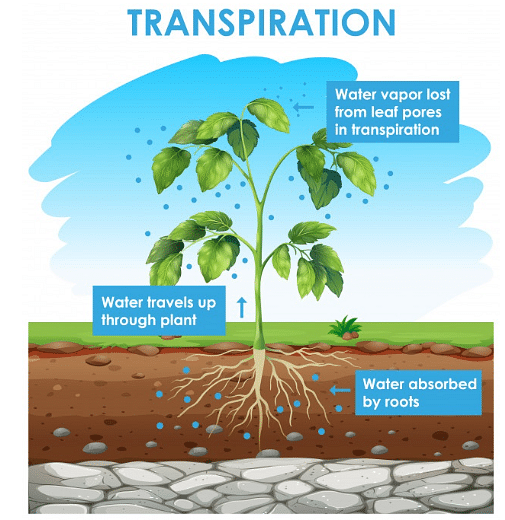
Transpiration Process
All living organisms like humans, plants also have an excretory system which helps them to excrete excess water. In plants, this process of removing excess water is known as transpiration. In the process of transpiration, water is generally removed from the aerial parts of the plant. Transpiration changes the osmotic pressure of plants, cools the plant, and it also enables mass flow of nutrients and water from roots to shoot. There are three different kinds of transpiration in plants:
- Lenticular Transpiration
- Stomatal Transpiration
- Cuticular Transpiration
Read More:
Guttation
Guttation can be defined as the process by which water is lost in the form of water droplets from the leaves of intact plants. It is also called exudation. Guttation is different from dew, which condenses from the atmosphere onto the land surface. Guttation usually occurs due to high water pressure and low evaporation rate which helps them balance the water in their system.

Water is lost through Hydathode in Guttation process
Guttation occurs at night when the soil is moist, and it becomes easier for the plants to absorb water. As there is more water content, the pressure in the roots causes the excess water to pinch out of the plant and it moves to the tip of the non-woody leaves, during this process it picks up enzymes, minerals, and other chemicals, and it is called xylem sap.
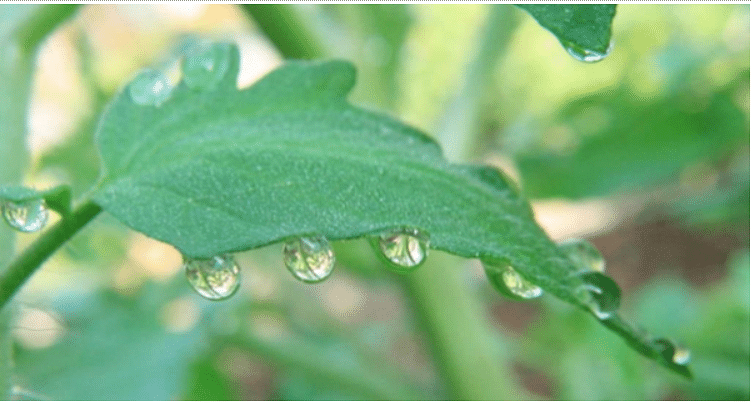
Guttation Process
Guttation is often confused with Dew, but Guttation is not dew, dew is just the condensed moisture formed on the surface of the leaves or grass and it is pure water. Whereas guttation is an endogenous process in plants in which excess water is lost from the leaves and it contains xylem sap.
Read More:
Difference Between Transpiration And Guttation
Following are the major differences between the process of Transpiration and Guttation in Plants.
| Transpiration | Guttation |
|---|---|
| It is a process by which plants exhale water vapour through the stomata. | It is a process of secretion of water droplets from the pores of vascular plants such as grass. |
| Transpiration occurs through stomata and lenticels. | Guttation occurs through Hydathodes, which are commonly found in angiosperms. |
| In this process, only pure water is evaporated. | It eliminates amino acids, salts, and sugars. |
| It is favoured by dry conditions. | It is resisted by dry conditions. |
| Water is lost as water vapours. | Water is lost as liquid. |
| In this process, root pressure is not involved. | In this process, root pressure plays an important role. |
| Transpiration occurs during the day. | Guttation occurs during the early morning or at night. |
| Transpiration occurs in terrestrial and herbaceous plants. | Guttation only occurs in herbaceous plants. |
| Excessive transpiration results in wilting i.e loss of rigidity of non-woody plants. | It never results in wilting. |
| It takes place at a high temperature. | It takes place at a low temperature. |
| Transpiration rate is reduced during humid days. | Humidity increases the rate of Guttation. |
| Water is lost through simple diffusion in the Transpiration process. | Water that is lost in guttation is not through diffusion. |
| Transpiration can be checked by opening or closing of the stomata. | It can not be regulated as hydathodes do not open or close. |
Read More: Aestivation in Plants
Things to Remember
- Transpiration is the process of removing excess water from the aerial parts of the plants.
- Transpiration also helps in the growth and development of the plant. It controls the temperature of the plants.
- Transpiration allows the movement of minerals from the soil to different parts of the plant.
- Guttation is the process in which water is released in the form of water droplets of xylem sap.
- At night when the pressure of the roots are high, water droplets tend to exit the vessels with the help of openings called "Hydathodes".
- Humidity increases the rate of Guttation.
- Guttation usually takes place at low temperatures.
- Guttation only occurs in Herbaceous plants.
Read More:
Sample Questions
Ques 1: What is Guttation? Explain the process in about 50 words. (2 marks)
Ans: Guttation is the process in which water is secreted in the form of water droplets from Xylem sap on the edges of small herbaceous plants such as grasses, or plants that are non-woody in nature. It usually occurs in the combination when root pressure is high and low evaporation rate. Guttation occurs at night when the soil is moist, and it becomes easier for the plants to absorb water. Because of more water content, the pressure in the roots causes the excess water to pinch out of the plant and it moves to the tip of the non-woody leaves, during this process it picks up enzymes, minerals, and other chemicals, and it is called xylem sap.
Ques 2: Define Transpiration. (2 marks)
Ans: Transpiration is a biological process in which excess water is removed from the aerial parts of the plants in the form of water vapours is called transpiration. The excess water is removed through minute pores called stomata. All living organisms like humans, plants also have an excretory system which helps plants to excrete excess water, this process of removing excess water from the plants is known as transpiration. In the process of transpiration, the water is generally removed from the aerial parts of the plant. Transpiration also changes the osmotic pressure of the plants, cools the plant, and it also enables mass flow of nutrients and water from roots to shoot.
Ques 3: How is Guttation different from Transpiration? (3 marks)
Ans: Transpiration mainly occurs during the day and has a cooling effect, while guttation occurs mainly at night and has no cooling effect. Perspiration occurs through the stomata, cuticles, and lenticels, while guttation is facilitated by "hydathodes". The state in which water is lost in transpiration is vapor, while in guttation the loss of water is in the form of water droplets (liquids). Transpiration is good for plants as it helps them to regulate their body temperature; Guttation is a less favourable process for plants and sometimes harmful due to the accumulation of salts on the tips of the leaves after the evaporation of the discharged water. Transpiration is not sustained by humidity, while guttation is dependent on humidity. Water lost in the process of transpiration is in the form of vapour and is therefore pure, while water lost through guttation is made of many organic and inorganic compounds.
Read More:
Ques 4: How is Transpiration Important to the plants? (2 marks)
Ans: The process of transpiration is important to the plants because it cools the surface of the leaves, keeps the cell turgid, and helps in the movement of minerals from the soil to the different parts of plants. It is an important process for the survival, productivity, growth and development of the plants. In agriculture, transpiration rate determines yields.
Ques 5: What is the function of Hydathodes? (2 marks)
Ans: Hydathodes play an important role in the process of guttation, they are special structures that discharge water from the interior of the leaf to the surface. Hydathodes are the organ of the plants, the organs which are responsible for the process of guttation in vascular plants that is the release of water droplets at the leaf surface. It connects the plant vasculature to the external environment.
Ques 6: State 5 key differences between Transpiration and Guttation. (5 marks)
Ans: Following are the important difference between the process of Transpiration and Guttation:-
| Transpiration | Guttation |
|---|---|
| Transpiration is a process by which plants exhale water vapours through stomata. | Guttation is a process of secretion of water droplets from the pores of vascular plants such as grass. |
| It occurs in terrestrial and herbaceous plants. | It only occurs in herbaceous plants. |
| Transpiration rate is reduced on humid days. | Humidity increases the rate of Guttation. |
| In transpiration water is lost as water vapours. | In guttation water is lost as liquid water. |
| Excessive transpiration results in wilting i.e loss of rigidity of non-woody plants. | Guttation never results in wilting. |
Read More:
Ques 7: Write down 3 disadvantages of Transpiration in plants? (3 marks)
Ans: Disadvantages of Transpiration are:-
- It results in unwanted water loss in plants.
- Excessive transpiration in plants results in wilting of plants which is injurious to plants.
- It raises the level of acidity, alkalinity and aridity in soil.
Ques 8. What are the factors affecting the rate of diffusion? (3 marks)
Ans. Factors affecting the rate of diffusion are:
- Density – Rate of diffusion of a substance is inversely proportional to the square root of its relative density (Graham’s Law).
- Permeability of medium – Rate of diffusion decreases with density of the medium.
- Temperature – A rise in temperature increases the rate of diffusion with Q10 = 1.2 -1.3. Because of it sugar crystals do not dissolve easily in ice cold water while they do so easily in warm water.
- Diffusion pressure gradient – Rate of diffusion is directly proportional to the difference of diffusion pressure at the two ends of a system and inversely proportional to the distance between the two.
Ques 8. Explain why pure water has the maximum water potential. (3 marks)
Ans: Water molecules possess kinetic energy. In liquid and gaseous form they are in random motion that is both rapid and constant. The greater the concentration of water in a system, the greater is its kinetic energy or ‘water potential’. Hence, it is obvious that pure water will have the greatest water potential. Water potential is denoted by the Greek symbol Psi or ψ and is expressed in pressure units such as pascals (Pa). By convention, the water potential of pure water at standard temperatures, which is not under any pressure, is taken to be zero. If some solute is dissolved in pure water, the solution has less free water and the concentration of water decreases, reducing its water potential. Hence, all solutions have a lower water potential than pure water.
Ques 9. What role does root pressure play in water movement in plants? (3 marks)
Ans. As various ions from the soil are actively transported into the vascular tissues of the roots, water flows (its potential gradient) and increases the pressure inside the xylem. This positive pressure is called root pressure and can be responsible for pushing up water to small heights in the stem. Root pressure only provides a modest push in the overall process of water transport. They obviously do not play a major role in water movement in tall trees. The greatest contribution of root pressure may be to re-establish the continuous chains of water molecules in the xylem which often break under the enormous tensions created by transpiration.
Read More:



Comments