



Content Curator
Violet and Purple are often confused as the colors that are closely related to one another. Understanding the basic difference between violet and purple can contribute to simplifying the true range of the color spectrum. In a nutshell, it is significant to identify the variation of colors between the two colors so as to understand their key properties.
| Table of Content |
Newton’s Color Wheel
Newton’s color wheel, also often referred to as the disappearing color disc, has been around for a long time now. It helps experiment with a rotating disc with small portions of different colors.
The primary colors used are usually red, orange, yellow, green, blue, indigo and violet that tend to appear as white when spun fast. Sir Isaac Newton evidently proved that all seven colors are mainly the constituent of the white color.
Although the colors should really appear one following another when the wheel is spun, it is not the case after all. What really appears is a lack of any color at all, emitting close white or a typical off-white color as the base.
Humans are constrained to perceiving colors individually, on their own. But, naturally, the visual perception does face difficulty to differentiate high-speed movements.
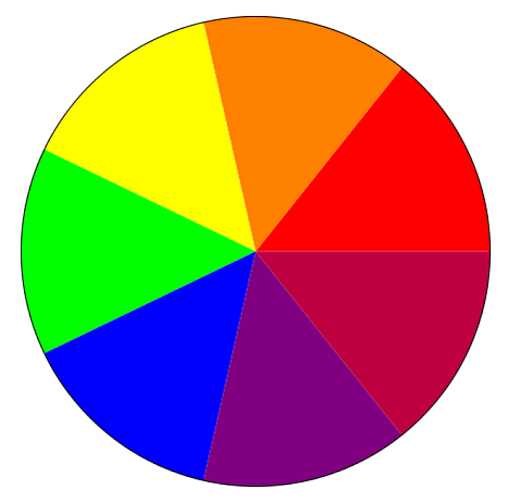
Newton’s Color Wheel
Also Read:
Key Differences Between Violet and Purple
Here are the key differences between Violet and Purple:
| Violet | Purple |
|---|---|
| Violet is a spectral color that appears to be noticeable in our surroundings having a wavelength range of 380 nm to 450 nm. | Purple, however, is not a spectral color |
| Violet can be usually identified in nature since it is one of the dominating wavelengths in the spectrum of colors. | Purple is an unnaturally appearing color, typically man-made that is a combination of red and blue. |
| Newton’s color wheel considered violet to be one of the primary colors. | Newton’s color wheel does not actually approve purple to be one of the primary colors. |
| Violet is known to contain a single shade (single wavelength range). | Purple, however, is known to carry several shades (various wavelengths). |
| Violent is not really as perceptible as Purple is. | Purple, on the flipside, has been marked to carry a bold and distinct color on its own. |
Violet, however, comes with the shortest wavelength, unlike the other distinct colors of the spectrum. The colors we naturally perceive tend to differ, slightly to more, based on their wavelength. Violet and purple, both the colors vary, based on their components, nature and electromagnetic spectrum.
Also Check: Tyndall Effect
Things to Remember
- Newton’s color wheel, also often referred to as the disappearing color disc, helps experiment with a rotating disc with small segments of different colors.
- The wavelength of Violet usually ranges from between 380 nm to 450 nm.
- Violet is a natural color, existing in nature. Purple, however, is not apparently a spectral color.
- Purple is a typical mixture of red and blue, forming the color that is basically man made and not true in nature.
- The electromagnetic spectrum is continuous, helping generate seven different colors that come with different wavelengths.
- The color violet and purple correlate to one another on the same range but with a slight difference between their wavelengths.
Sample Questions
Ques. Is Violet a man-made color? Explain reasons if not. (2 marks)
Ans. Violet is not a man-made color. It is known to exist naturally in the environment. Violet is a spectral color that appears to be noticeable in our surroundings, all by itself. However, the color that is man-made is purple, which is a mixture of red and blue. Violet can be produced with the help of a prism. This means that when white light is made to pass through a glass prism, it causes it to split into different colors, with violet being one among them.
Ques. Define Newton's Color Wheel (or disc). (2 marks)
Ans. Newton’s color wheel, also often referred to as the disappearing color disc, helps experiment with a rotating disc with small segments of different colors that, when sun, produces a typical white or off-white color. The primary colors used are usually from the class of red, orange, yellow, green, blue, indigo and violet that tend to appear as white when spun fast. Sir Isaac Newton evidently proved that all seven colors are mainly the constituent of the white color.
Ques. The color of the sunset appears to be yellowish when the atmosphere is typically free of impurities. State the reason why. (3 marks)
Ans. During sunset, the sun usually is placed at the horizon, which is why the sunlight has to travel a greater distance. When the sunlight travels, the blue color gets dispersed, leaving behind yellow, red and orange lights to enter our eyes. Now, when the atmosphere is free of impurities, it appears to be yellow. If the atmosphere contains absolutely no form of dust particles, then the sky naturally occurs to exhibit a yellowish color because the sunlight gets dispersed through more air particles, typically molecules. Which means, the more the molecules, the less the scattering of violet and blue lights.
Ques. Which color, among violet and purple, is known to exhibit a bold and distinct tinge. State why. (2 marks)
Ans. Purple has been known widely to carry a bold and distinct color on its own. This is due to the fact that purple is a man made color, unnaturally occurring after mixing two different colors, which are red and blue (and often even violet itself). The color purple, in a nutshell, is known to exhibit several individual wavelengths, producing more than one shade. This is the reason why it is not deemed as a spectral color.
Ques. Why do the colors violet and purple look so similar to the human eye when they are not? (3 marks)
Ans. Violet and purple, even being different from one another, are still often confused to be similar to the human eye. The reason behind the two distinct colors seeming to be very alike in nature is due to the fact that they stimulate our cones in a possibly similar manner. We possess three types of color sensitive cells in our eyes, also known as cones. These don’t just process one wavelength, but many. Most other animals, on the contrary, are known to not have the same types of cones like we do. Purple, to humans, looks like a saturated tinge of violet. However, figures that are really violet in color are extremely different, and are not any close to the color purple.
Ques. How did Sir Isaac Newton first produce the color Violet? (2 marks)
Ans. Violet, unlike purple, can be produced by the help of a glass prism, as was first experimented and proved by Sir Isaac Newton. When white light is made to pass through a prism, it causes it to split into different colors, violet being one among them. The dispersion of light in a glass prism is the reason why we know that violet is one of the primary colors. The phenomenon of white light splitting into seven different wavelengths when passed through a prism is referred to as dispersion.
Ques. What are the three major differences between the colors Violet and Purple? (3 marks)
Ans. Here are the major differences between the colors Violet and Purple,
| Violet | Purple |
|---|---|
| Violet is a spectral color that appears to be noticeable in the environment. | Purple, however, is not a spectral color |
| Violet can be identified in nature since it is one of the dominating wavelengths in the spectrum of primary colors | Purple is an unnaturally appearing color, typically man-made, that is a mixture of red and blue (and often violet itself. |
| Newton’s color wheel considered violet to be one of the primary colors. | Newton’s color wheel does not actually approve purple to be one of the primary colors. |



Comments