



Education Journalist | Study Abroad Lead
Rainbow is a kind of spectacular optical effect that results in one of the amazing shows of light on Earth. It refers to an arc of multiple colors or a spectrum of light that is formed in the sky as a result of reflection, refraction, and the dispersion phenomenon of light in the water droplets. We can observe rainbows in the sky after rainfall when the sunlight strikes a raindrop. We can also see rainbows around sea spray, fog, or even waterfalls. It does not exist in a particular spot in the sky and therefore it is an optical illusion. The view of the rainbow depends on various factors such as the angle of sunlight and the place you are standing at. In this article, we will have a look at the formation of the rainbow and an experiment pertaining to the formation of a rainbow.
Read More: Applications of Thermodynamics
| Table of Content |
Read More: Wave Power
What is a rainbow?
Rainbow is a well-known optical phenomenon that leads to the formation of a glorious sight of a multicolor arc in the sky. This spectrum is formed due to the process of refraction of sunlight from a droplet of rain. It is a great demonstration of the fact that light has a spectrum of wavelengths, which is each associated with a different color. Rainbow can be observed not only on rainy days but on sunny days too when one is near a fountain or a waterfall.
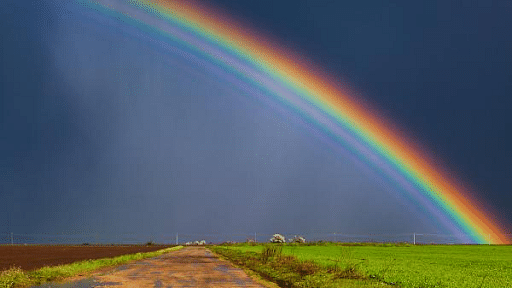
Rainbow
A rainbow's radius can be determined by the refractive index of the water droplet through which the sunlight passes. Here, the refractive index can be understood as the measure of the bending of a ray of light which is also referred to as refraction as it passes from one medium to another for instance from air to water. A droplet having a higher refractive index will produce a rainbow with a small radius. Rainbows that are formed from sea spray are smaller than the ones formed by rain droplets. This is because salt water has a higher refractive index than freshwater.
Also Read:
Colors of Rainbow
Rainbows are formed as a result of the dispersion of white light which splits into seven colors after passing through a raindrop. The seven primary colors of the rainbow are arranged in a band one above the other in a horizontal manner. The seven colors are:
- Violet
- Indigo
- Blue
- Grey
- Yellow
- Orange
- Red
The acronym used to remember the order of the colors of the rainbow is VIBGYOR.
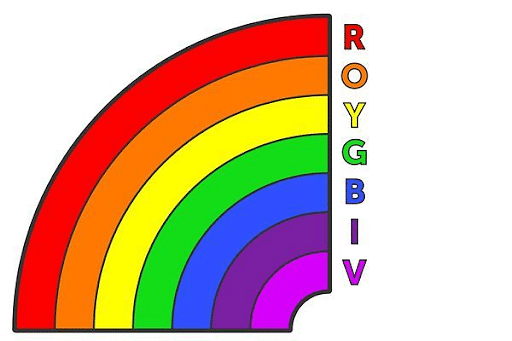
Colors of Rainbow
However, many a time "indigo" color is too similar to blue to be truly distinguished. When all the colors of the rainbow mix together, it appears to us as white light. For instance, sunlight appears white to us. When sunlight hits a droplet of water, some part of the light is reflected. Light with different wavelengths comes together to comprise the electromagnetic spectrum. All the colors are reflected at varying angles. Therefore, a spectrum is dispersed in order to produce a rainbow.
- The red color has the longest wavelengths of all the colors, i.e. approximately 650 nanometres. It is on the outer side of the rainbow.
- Violet color has the shortest wavelength which is about 650 nanometers and therefore it usually appears in the inner arch of the rainbow.
Read More:
Formation of a Rainbow
Rainbows are formed when sunlight, a white light, gets scattered by a droplet of water such as fog or raindrop by a process known as refraction. When the light from the sun changes its direction as it passes from a denser medium (denser than air) like a raindrop. The refracted light then enters the raindrop and is reflected from the back of its surface and again undergoes refraction as it leaves the drop to reach our eyes.
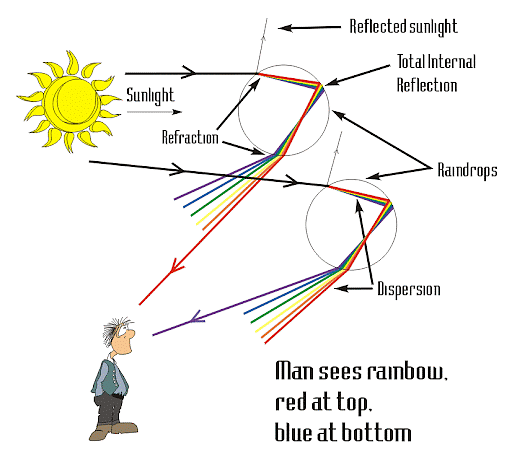
Formation of a Rainbow
Our sunlight is formed of light of various wavelengths and colors which travel at varying speeds when they pass through a medium. Hence, the white light splits into different colors. The colors with longer wavelengths are towards the red end of the spectrum while the shorter wavelengths have a blue or violet hue. When the sunlight passes through the raindrop at angles that are approximately equal to two degrees, the color gets split from red to violet. The colors do seem to mix and merge and therefore might appear as a blur. Each rainbow is unique in its aspect as each angle of scattering of light is different.
Read More:
Rainbows actually are in full circles. The center of that circle is the antisolar point. However, people standing on the ground can only see a part of the rainbow as the horizon blocks our other view. So, no one is able to see the complete circle of the rainbow from the ground. From aircraft, however, circular rainbows can be seen.
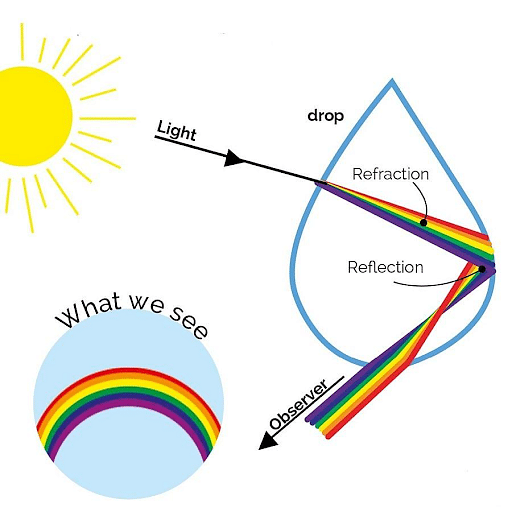
Reflection and Refraction inside the raindrop
The inside of a rainbow appears brighter than the outer part of the rainbow. This is because towards the edges, the rainbow colors overlap each other and hence a sheen of white light is produced. Only a part of the rainbow is in the form of visible light. Beyond the visible light of red color, infrared radiation exists while ultraviolet radiation exists beyond the light of violet color. Radio waves, x-rays, and gamma radiation also exist. These invisible parts of the rainbow are studied by scientists using an instrument known as the spectrometer.
Read More:
Conditions for the Visibility of Rainbow
A person has to be at a certain angle with respect to the source of light i.e. the sun, in order to view a rainbow. The conditions for the visibility of a rainbow are:
- Water droplets must be present in the environment around the observer such as the presence of raindrops or fog.
- The person should be standing with their backs towards the sun.
- The arc of the rainbow will be more observable, the lower the sun is positioned in the sky. It should be placed at an angle less than 42 degrees in the sky.
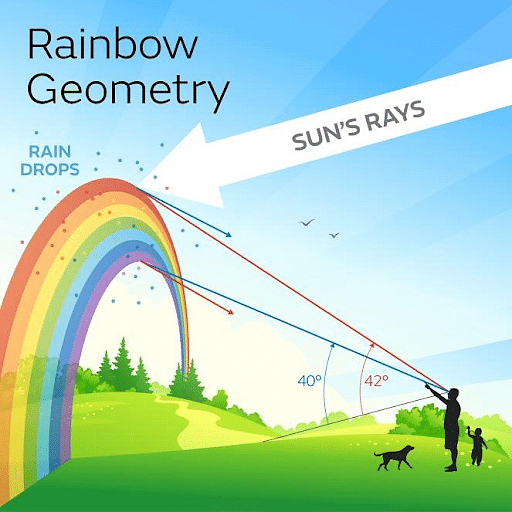
Conditions to view rainbow in the sky
Double Rainbow
A double rainbow can be observed in the sky when the light from the sun undergoes reflection twice. It is a spectacular phenomenon that entails a faint secondary rainbow that appears just above the primary rainbow.
Read More: Newton's Universal Law of Gravitation and Gravitational Force
Due to the second reflection of light inside the raindrop, the spectrum of colors for the secondary rainbow in the sky gets reversed. Therefore, the red color appears in the inner section of the arch while the violet color is towards the outside.
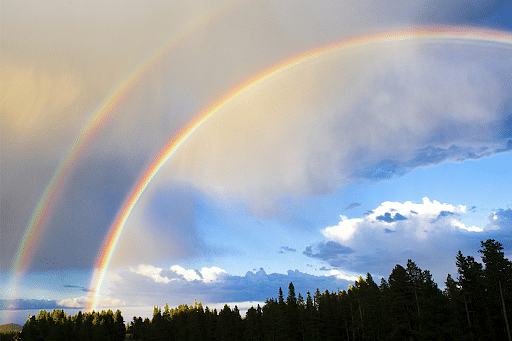
Double Rainbow
How to Make a Rainbow?
Isaac Newton discovered that white light consists of a spectrum of various colors that lie in the visible spectrum. Refraction is the process that splits the white light into multiple colors. Mainly, prisms were used to refract the visible light, however, water can also be used for the same purpose. We will use the concepts of density in the following experiment to form a rainbow in a jar. Are you ready to make some rainbows? Let us now look into the experiments that can help you make rainbows at home:
Read More:
Rainbow Experiment 1
Objective
The aim of the experiment is to make use of the concepts of density to form a rainbow in a jar.
Material Required
- One or two measuring spoons or tablespoon
- A cup of granulated sugar
- Food coloring tablets or food color of good quality
- A water container
- Five or six glasses
Procedure
- Take five glasses and place them in a row.
- Add one tablespoon of sugar to the first glass.
- Then, in the first four glasses, add three tablespoons of sugar each.
- Continuing the procedure in the same way with a little difference, we now add two tablespoons of sugar to the second glass, three tablespoons to the third glass, and four tablespoons of sugar to the fourth glass.
- Now, stir all the glasses until the sugar completely dissolves.
- Then, add varying food colors to different glasses.
- Pour one-fourth of the solution of glass four into glass five.
- Now, carefully pour the next layer of the solution in glass five from glass three.
- Be careful that the two layers don’t mix with each other. You can ensure the same by placing a spoon on the 1st layer and pouring the next mixture on the spoon in a gentle manner to avoid or at least minimize the splashes of color.
- Repeat the same procedure for the first and the second glass.
Read More: Measurement of Time
Things to Keep in Mind
- Pour the mixtures in the fifth glass gently. The more gentle and patient you are, the better results you will get.
- Ensure that the width of the mixtures you are pouring in glass five is the same for all the colors.
Result
When different amounts of sugar are added to different glasses, a difference in density is created. You will observe that the layer at the bottom of the glass is the heaviest and the density varies for each layer that is placed on top of one another thereafter. Sooner or later, due to the concept of dynamics, the layers do mix with each other. However, if there is a greater difference in the density of the solutions, the phenomenon will last for a longer duration.
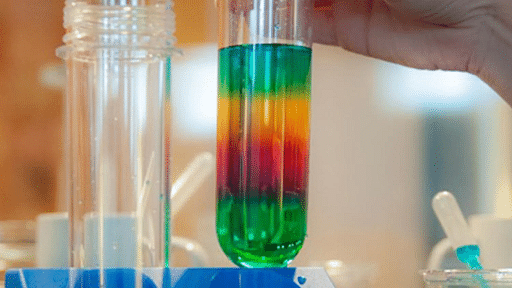
Sugar-Water Density Experiment to form a rainbow
Rainbow Experiment 2
Objective
The aim of the experiment is to make use of a glass prism to form a rainbow on a canvas or a sheet of white paper.
Read More: Advanced Sunrise and Delayed Sunset
Material Required
- Canvas or a white paper
- Thumbtacks
- A glass prism
- Sunlight or a source of light
Procedure
- Secure your canvas or the white paper with thumbtacks on a surface.
- Make sure the sheet is smooth and has no wrinkles so that the rainbow can appear nicely.
- Hold the glass prism in your hand in front of the paper capturing the sunlight.
- In the light beam, turn the prism around so that the light falls on the paper.
Things to Keep in Mind
- The prism should be kept in the light beam so that the rainbow can be formed.
- The canvas or the paper should be laid in a flat and smooth manner without any creases.
Result
The light will refract through the prism and we will observe a rainbow on the white paper.
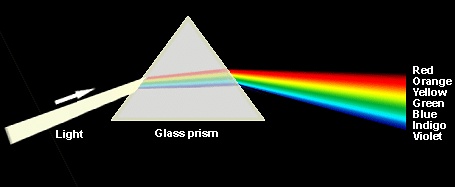
Formation of Rainbow with a Glass Prism
Rainbow Experiment 3
Objective
The aim of the experiment is to make use of a flashlight and a glass of water to form a rainbow.
Material Required
- A clear glass filled with water.
- A tape
- Flashlight emitting strong white light
- A piece of white paper
Procedure
- With two pieces of the masking tape, cover the flashlight in a way that there is just a slit in the middle through which the light emits.
- Keep the glass of water ahead of the flashlight and shine the flashlight through it on a piece of white paper.
- You will be able to observe a rainbow on the white paper.
Read More:
Things to keep in mind
- The result and the colors of the rainbow will be observed in a better manner if the experiment is conducted in a dark room.
- You can shift the angle of light till you get a proper rainbow.
Result
You will be able to observe a spectrum of light on the white sheet of paper.
The light that is emitted from the flashlight i.e. the white light is formed of all the colours of the light (Red, Orange, Yellow, Green, Blue, Indigo, and Violet). When light is shined through the water, the light bends or undergoes refraction. It then splits into its seven constituent colors. The color is split because of the different wavelengths of different colors.
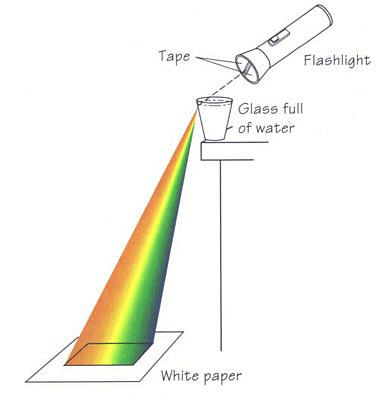
Formation of Rainbow with a flashlight
Things to Remember
- Rainbow is a well-known optical phenomenon that leads to the formation of a glorious sight of a multicolor arc in the sky.
- Rainbow can be observed not only on rainy days but on sunny days too when one is near a fountain or a waterfall.
- Rainbows are formed when sunlight, a white light, gets scattered by a droplet of water such as fog or raindrop by a process known as refraction.
- The colors with longer wavelengths are towards the red end of the spectrum while the shorter wavelengths have a blue or violet hue.
- The acronym used to remember the order of the colors of the rainbow is VIBGYOR.
- A Rainbow is formed in the sky as a result of reflection, refraction, and the dispersion phenomenon of light in the water droplets.
- Using the concepts of varying densities of the solution, we can form a rainbow in a jar.
- With the help of a glass prism, we can observe the splitting of white light into different colors, also known as the process of dispersion which leads to the formation of rainbows.
- Each rainbow is unique in its aspect as each angle of scattering of light is different
Also Read:
Sample Questions
Ques. How are rainbows formed in the sky? (3 marks)
Ans. White light or sunlight is a mixture of lights of various wavelengths which are associated with different colors. When it passes from one medium of a definite density to another medium that is denser, the rays of the light bends. For instance, when light travels from air to water. This phenomenon of bending of light on traveling through a denser medium is known as refraction. The shorter the wavelength of light is, the more it bends.
- When sunlight enters a droplet of water, it undergoes refraction.
- After entering the droplet, the ray of light is reflected back to the surface.
- The light ray again gets refracted when it leaves the droplet to reach our eye.
Hence, this is how a rainbow can be observed.
Read More:
Ques. What are the conditions necessary to observe a rainbow? (3 marks)
Ans. To see a rainbow, our backs must face the sun as the rainbow is only observed in the sky opposite to where the sun is. Amongst the spectrum of visible light, red color has the longest wavelength, hence it bends the least. The angle between the line of sight and incident light to observe red light is 42 degrees. Therefore, we can observe the color red at the very top of the rainbow.
As the violet color has the shortest wavelength, it bends the most. The angle between the line of sight and the incident light to observe violet is around 40 degrees. Therefore, the color violet appears at the bottom of the rainbow.
Ques. Why do rainbows seem arched? (3 marks)
Ans. A rainbow can be observed when the angle between the incident light and the line of sight is between 40 to 42 degrees. Therefore, all the raindrops that produce the colors of the rainbow exist in a 3-D cone at whose tips our eyes exist. Therefore, the rainbows appear arched to us. The circular shape of the rainbows that exist below the ground is not visible to us.
Read More:
Ques. Why can’t we see the indigo color in the rainbow? (1 mark)
Ans. Though indigo is a part of the spectrum of the rainbow, we are not able to see the color as our eyes are not sensitive to indigo color.
Ques. Is there an end to the rainbow? (2 marks)
Ans. Rainbows are full circles spread over the entire sky, they have no end, and they extend even beyond the horizon. As the horizon blocks our view, we are only able to see a part of the rainbow. It is impossible to see the full circle.
Ques. What are the 7 colors of a rainbow? (2 marks)
Ans. The acronym used to remember the order of the colors of the rainbow is VIBGYOR.
- Violet
- Indigo
- Blue
- Grey
- Yellow
- Orange
- Red
Ques. List down the conditions for the visibility of a rainbow. (3 marks)
Ans. The conditions for the visibility of a rainbow are:
- Water droplets must be present in the environment around the observer such as the presence of raindrops or fog.
- The person should be standing with their backs towards the sun.
- The arc of the rainbow will be more observable, the lower the sun is positioned in the sky. It should be placed at an angle less than 42 degrees in the sky.
Read More:
Ques. Do rainbows appear the same to everyone? (2 marks)
Ans. No one sees the same rainbow as another person. This is because every person has a different antisolar point and each person views the rainbow from a different point and thus has a different horizon. Someone might see an extended rainbow where another person saw its end.
Ques. What are double rainbows? How are they formed? (3 marks)
Ans. Many times a double rainbow can be observed by a person in the sky. This double rainbow phenomenon entails a faint secondary rainbow that appears just above the primary rainbow.
The formation of these double rainbows takes place as the light reflects twice inside the rain droplet. Due to this second reflection, the spectrum of colors for the secondary rainbow in the sky gets reversed which means red color appears in the inner section of the arch of the rainbow while violet color is towards the outside.
Ques. Can a rainbow be seen at night time? (3 marks)
Ans. Yes, rainbows can be seen during the night time although it is a quite rare phenomenon. This is because the moon is bright enough to form a rainbow. However, since it is not nearly as bright as a sun, the rainbow that is formed by the moon is much fainter or weaker than a rainbow produced during the daytime by a sun. The night rainbow will also appear gray in color, this is due to the fact that our eyes see dim things and objects as black and white instead of seeing them in color.
Also Read:



Comments