



Content Writer
Dams are mammoth infrastructures built by humankind. The sole purpose of the dam is to hold back flowing water from streams and rivers and prevent floods, store water and generate electricity. The essence of dams had been realized by former civilizations too. The ancient engineers built dams to channel water rivulets to agricultural land and cities for human consumption and industrial usage. Moreover, the reservoirs thus created were used for aqua farming and as waterways. Although the dam is known to create welfare for human societies through economic upliftments and water availability in cities, their existence has become disputable. So, here we will learn about the disadvantages of dams and discuss some important questions.
Key Terms: dams, hydroelectricity, environmental impacts, environment, people, water conservation, disadvantages of dams, fauna, flora, ecology
Impacts of Dams on the Environment
Dams obstruct the natural water flow of rivers and this man-made blockage disturbs the ecological balance of the associated flora and fauna. Time and again environmentalists, human rights activists, and concerned natives have agitated against dams and their construction. Narmada Bachao Andolan is a well-known social movement led by the natives against several dam construction projects across the Narmada river, which is regarded as the lifeline of states Gujarat and Madhya Pradesh in India.
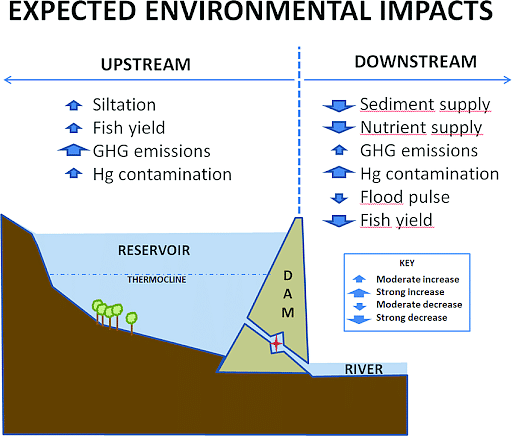
Impacts of Dams on the Environment
Today, the dams mainly are used to generate hydroelectricity and to prevent waterlogging in flood-prone areas. Additionally, the water stored in the reservoirs is used for domestic and industrial purposes, to channel water into dry spell areas, and for recreational activities like rafting, boating, to name a few. Though the advantages of dams, it has several disadvantages and negative impacts on the environment. The advancements in engineering and construction have reduced the impacts but some consequences are yet to be addressed. Some of the negative impacts are mentioned below:
- Habitat Fragmentation: Dams present an unnatural barrier to flowing rivers and the aquatic life in them. Especially the migratory fishes who breed and reproduce upstream and downstream along the river. This directly affects the population of the species and consequently degrades the count of preceding and succeeding life forms in the food chain. Specifically engineered dams have to be constructed to let fish and other organisms pass through them.
- Destruction of surrounding habitat: Downstream reservoirs stretch to engulf the surrounding lands and flood the habitats of the life forms that co-existed along the banks of the river. Such encroachment kills plants and displaces wildlife and humans, hence degrading the overall quality of fauna and flora.
- Changes in the gas compositions of water: The submerged area around the dams kills the trees and plants and their decomposition depletes the oxygen level of water. Because decomposing plants and trees release a large amount of carbon into the atmosphere. As the river water is stagnant the natural oxygen level depletes and consequently, a situation arises where methane, a greenhouse gas is produced at the bottom of reservoirs and then released into the atmosphere adding to global warming.
- Sediment deposition behind the dam: The rivers and streams deposit sediments down the river increasing the fertility of the soil along the banks. But as being dammed the sediment load is deposited behind the dam and forms new deltas, banks, braided channels, etc. These changes in sedimentation affect plant life and their distribution.
- Downstream Sediment erosion: The sediments that would have settled downstream get accumulated behind the dam. As a result, it causes sediment load deficiency down the river and increases downstream erosion. This lack of sediment causes the riverbed to deepen and shrink over time. This riverbed deepens by several meters in the first decade of being dammed. The changes in sediment accumulation have a negative impact on various physical processes and habitats of the downstream life forms. Moreover, seasonal farmlands formed previously due to sedimentation downstream have become rare.
- Lowering of groundwater table: The deepening downstream water channel lowers the groundwater table. This increases water scarcity for the plants, trees and human communities that depend on groundwater. The construction of dykes (barriers to hold back water without letting it flow) in Egypt has increased the salt and mineral deposition on stoneworks. And changes in the water table within the area have been dampening and damaging the ancient monuments.
- Acting as a source of production of methyl-mercury: The stagnant water in the reservoirs is remineralized and can act as a source of methyl-mercury. The reservoirs create a situation where the decaying organic matter can transform mercury into methyl-mercury. Methyl mercury is an extremely toxic compound and its accumulation in plants, aquatic animals and humans has toxic effects.
- Impact on aquatic life: The dammed rivers have a negative impact on aquatic life forms and may cause the extinction of the local fish population. The reasons can be the hindrance in their migratory routes, remineralization of the water body, depletion of oxygen levels, turbidity, temperature variations, and change in local plants.
- The decomposition of organic matter behind the dams consumes large amounts of oxygen. In some cases, stagnant water in the reservoirs can trigger the algae population. They feed upon those decaying materials consuming dissolved oxygen to such levels that the water bodies can not support the survival of the aquatic lives.
- The water temperature in the reservoirs greatly varies over depths and surface, making it difficult for aquatic life to survive. Further, when the oxygen-deprived dammed water with an unnatural temperature gradient is released downriver, it damages the downriver environment.
Read Also:
Impact of Dams on People
Along with degrading the quality of life in and around the dam, it has also affected the people living around the reservoirs. Some of the impacts that dams have on people are as follows:
- Relocation: Local inhabitants in the depression zone are subject to frequent displacement as water from the reservoirs encroaches into their homes and lands. And they lose their farms and businesses creating economic depression. In some cases, natives are unethically displaced for land acquisitions for dam construction.
- Man-made flood: When reservoirs are filled to alarming levels the dam operators open floodgates, which may lead to untimed flood downriver. These man-made floods affect the mobility of cities and damage them economically.
- Ecological damage: As seen in the case of Hoover Dam in the US. The construction of the dam brought about frequent earthquakes and depressed the earth’s surface. This is certainly alarming and otherwise causes large-scale devastation.
- Longevity of dams: Old dams are known to rupture and cause heavy floods down the river and have caused the deaths of many. Though new technologies and safety protocols are addressed in newly constructed dams.
- Expensive process: Anyhow dam construction and maintenance remains an expensive and time taking process. A dam project may cost up from Rs 372cr to Rs 7,777cr in India and create an economic burden on the nation.
- Can cause dispute among nations: Dams built across rivers that flow between two countries has caused national disputes. The dammed river can cause water scarcity in the neighboring country causing it to retaliate. As seen in the case of India and Pakistan or West Bengal, an eastern state in India, and Bangladesh.

Impact of Dams on People
Read More: Ecosystem
Points to Remember
- Dams are used to generate hydroelectricity and to prevent waterlogging in flood-prone areas. Additionally, the water from the reservoirs is used for domestic and industrial purposes, to channel water into dry spell areas, and for recreational activities like rafting, boating, etc.
- Dammed rivers flood the surrounding lands and habitats of the organisms. Such encroachment kills plants and displaces wildlife and humans.
- The decaying matter in the stagnant water of reservoirs produces large amounts of carbon depleting the water oxygen level.
- A situation arises where methane is produced at the bottom of reservoirs contributing to global climate change.
- The reservoirs are remineralized and can act as a source of methyl-mercury. Methyl mercury is an extremely toxic compound and is a bio-accumulation toxicant.
- The water temperature in the reservoirs greatly varies over depths and surface, making it difficult for aquatic life to survive.
- Dams cause people to relocate, man-made floods damage cities and assets and create an economic burden on the nation.
Read Also:
Sample Questions
Ques: Name the five largest dams in India. (5 marks)
Ans: The five largest dams in India are:
- Tehri Dam, Uttarakhand
- Hirakud Dam, Odisha
- Sardar Sarovar Dam, Gujarat
- Bhakra Nangal Dam, Himachal Pradesh
- Nagarjuna Sagar Dam, Andhra Pradesh
Ques. What are the disadvantages of dams? (5 marks)
Ans. The disadvantages of dams are the following:
- Dams fragment habitats of aquatic lives.
- It prevents the migration of migratory fishes, affecting their population.
- Dammed rivers flood the surrounding lands and habitats of the organisms, killing or displacing them.
- The stagnant water of reservoirs depletes the water oxygen level.
- Methane, a GHG, is produced at the bottom of reservoirs contributing to global climate change.
- Dammed rivers can act as a source of methyl-mercury, a toxic compound.
- It causes downstream sediment erosion.
- It depletes the population of local fishes and makes the survival of aquatic life hard.
- Dams cause people to relocate, man-made floods damage cities and assets and create an economic burden on the nation.
Ques. Describe the impact of dams on migratory fish. (3 marks)
Ans. Dams present an unnatural barrier to flowing rivers and the aquatic life in them. Especially the migratory fishes who breed and reproduce upstream and downstream along the river. This directly affects the population of the species and consequently degrades the count of preceding and succeeding life forms in the food chain.
Read More: Plasma vs Serum
Ques. How do the reservoirs created by dams act as a source of methyl-mercury? (2 marks)
Ans. The stagnant water in the reservoirs is remineralized and can act as a source of methyl-mercury. The reservoirs create a situation where the decaying organic matter can transform mercury into methyl-mercury.
Methyl mercury is an extremely toxic compound and its accumulation in plants, aquatic animals and humans has toxic effects.
Ques. Describe the impact of dams on people. (5 marks)
Ans.
- Local inhabitants in the depression zone of dams are subject to frequent relocation as water from the reservoirs encroaches into their homes and lands.
- When reservoirs are filled to alarming levels the dam operators open floodgates, which may lead to untimed man-made flood downriver.
- The construction of dams brought about frequent earthquakes and depressed the earth’s surface. This is certainly alarming and otherwise causes large-scale devastation.
- Rupture of old dams cause heavy floods down the river and deaths of many people
- A dam project may cost up from Rs 372cr to Rs 7,777cr in India and create an economic burden on the nation.
- The dammed river can cause water scarcity in the neighbouring country leading to national disputes.
Ques: How do dams affect the environment? (5 marks)
Ans: The effects of dams on the environment are as follows:
- Dams present an unnatural barrier to flowing rivers and the aquatic life in them. Especially the migratory fishes who breed and reproduce upstream and downstream along the river.
- Downstream reservoirs kill plants and displace wildlife and humans, hence degrading the overall quality of fauna and flora.
- The submerged area around the dams kills the trees and plants and their decomposition depletes the oxygen level of water.
- The changes in sediment accumulation have a negative impact on various physical processes and habitats of the downstream life forms. Moreover, seasonal farmlands formed previously due to sedimentation downstream have become rare.
- The dammed rivers have a negative impact on aquatic life forms and may cause the extinction of the local fish population.
Read More: Thermoregulation
Ques: What are the advantages of dams? (5 marks)
Ans: There are many advantages of dams, some of the advantages are:
- Electricity can be easily generated at a steady rate, with the help of hydroelectricity or hydroelectric power,
- For future purposes, water is preserved.
- For irrigation purposes, water sports, or even other types of activities, the lake or water reservoir built behind the dam may play a pivotal role.
- The buildup of water within the lake ensures that the energy can be stored when required and also when water is released for electricity production.
- The electricity generated by the dams does not generate greenhouse gases and therefore does not cause pollution.
Ques: What are dams? (3 marks)
Ans: A dam is a structure that is built on rivers, streams, or estuary in order to conserve water. It directly helps to supply adequate water for consumption, industrial and irrigation purposes.
In a broad sense, there are two types of modern dams– concrete dams and embankments. Concrete dams or masonry dams basically block streams that run through narrow gorges, while on the other hand, embankments control streams and rivers which flow through broad valleys.
Ques: What are the uses of dams? (4 marks)
Ans: There are various uses of dams. Some of the most common uses are as follows –
- The water that is conserved in reservoirs supplies freshwater to residential, industrial, and mining areas.
- The conserved water satisfies irrigation purposes.
- Dams also facilitate the process of generating energy from renewable sources, such as hydropower.
- Moreover, dams help to regulate the flow of water of rivers and streams and protect communities residing down in the valley.



Comments