



Content Curator
Satellites orbiting in space can either go in circular or elliptical paths. These satellites are launched from the surface of the earth to revolve around the earth. The satellite moves in a certain orbit and is continuously under the action of the gravitational energy or forces of the earth. Therefore, there is an adequate amount of energy that is required by the satellite so that it can continue to revolve around in an orbit around the earth. This energy is called the orbiting energy of the satellite.
| Table of Content |
Key takeaways: Kinetic energy, Potential energy, Orbiting energy, Gravitational force, Centripetal force
The Energy Of Circular Orbiting Satellite
[Click Here for Sample Questions]
When the satellite revolves around the earth’s orbit in a circular orbit, the radius of the trajectory is always constant. The radius of the orbit and the tangential velocity of the satellite have a relation with each other and since the radius of the circular orbit is always constant, therefore the tangential velocity of the satellite also remains constant. The kinetic energy of the satellite also remains constant due to its dependency on the radius of the orbit and the tangential velocity of the satellite.

Tangential Velocity of Satellite
Moreover, since the satellite revolves around the earth’s orbit in a circular orbit at a fixed distance from the earth’s ground, the potential energy of the satellite also remains constant. Therefore, the total mechanical energy of a satellite that revolves around the earth’s orbit in a circular orbit remains constant.
Mechanical energy = constant, as kinetic energy, and potential energy = constant
Read More:
Since there is an amount of motion that is being executed by the satellite, the energy that comes into play is kinetic energy. Also, the satellite is designed to revolve around the earth at a certain height from the ground surface and is under the action of the gravitational energy of the earth, so, the satellite possesses potential energy as well.
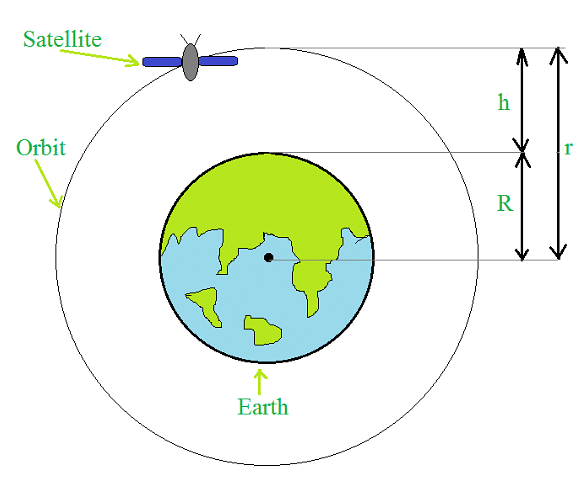
Satellite Orbit around Earth
The work and energy theorem for satellite revolving in an orbit around the earth under the influence of gravitational energy can be written as:
Initial (kinetic energy + potential energy) = final ( kinetic energy + potential energy)
Energy Of Elliptical Orbiting Satellite
[Click Here for Sample Questions]
When the satellite is exhibiting motion in an elliptical orbit, the energy of the satellite changes from one form to another, but the total mechanical energy of the satellite which revolves around the earth in an elliptical orbit tends to remain constant, similar to what the satellite has in the case of a circular orbit.

Energy Of Elliptical Orbiting Satellite
The relation between the tangential velocity of the satellite revolving around the earth’s orbit has a relation with the square root of the radius of the orbit. As the height or the radius of the orbit is not constant throughout, therefore, the kinetic energy and the potential energy of the satellite both vary, but the total energy remains the same.
Read More:
Derivation of energy of orbiting satellite
[Click Here for Sample Questions]
Let the orbit of the satellite be circular.
For the potential energy of the satellite, consider,
Mass of satellite = m
Mass of earth= M
Initial distance of satellite from the centre of the earth = r1
Final distance of satellite from the centre of the earth = r2
A small distance dr be covered and the force which acts is F and is in the opposite direction of the distance being travelled dr. Since, force F is perpendicular to dr, therefore, F.dr=0.
Now, potential energy PE is the negative integration of F.dr over the limits r1 to r2.
Introducing gravitational constants,
The final expression for the potential energy of the satellite is:
GMm (1/r1 – 1/r2)
or
PE = – GMm/r
Now, for the kinetic energy of the satellite, consider,
Mass of satellite = m
Mass of earth = M
Radius of orbit = r
The velocity of satellite = v
Gravitational force and centripetal force are acting while the satellite is executing kinetic motion.
The gravitational force, Fg = Mm/r.r
The centripetal force, Fc = mv.v/r
Now since the gravitational force and centripetal force are equal,
Fg=Fc
Mm/r.r= mv.v/r
Now, we find the value of v2 from the above equation and substitute it in the equation of kinetic energy, which is, ½ m v2
So,
KE = 1/2 GMm/r
The total mechanical energy of the satellite is the sum of the kinetic energy and the potential energy.
ME = PE + KE
ME = 1/2 GMm/r + ( – GMm/r)
The total energy of a satellite is,
ME = – 1/2 GMm/r
We also observe that the kinetic energy of a satellite revolving around the earth in a fixed orbit is half the gravitational potential energy of the same satellite being considered.
Also, the total energy of the satellite revolving around the earth in a fixed orbit is negative.
The tangential velocity of the satellite revolving around the earth’s orbit is given by v = sqrt (GM/r+h)
And the kinetic energy of the satellite is, KE = GMm/2 (r + h)
The potential energy of the satellite is, PE = – GMm/r + h
Read More:
Things to Remember
- The motion of a satellite revolving in space can be either circular or an ellipse.
- The work and energy theorem for satellite revolving in an orbit around the earth under the influence of gravitational energy can be written as: Initial( kinetic energy + potential energy)= final( kinetic energy + potential energy)
- The satellite tends to revolve around the earth at a certain amount of speed or velocity which is usually tangential and is at a certain height from the surface of the earth.
- When the satellite revolves around the earth’s orbit in a circular orbit, the radius of the trajectory is always constant
- The total mechanical energy of a satellite that revolves around the earth’s orbit in a circular orbit remains constant.
- When the satellite is exhibiting motion in an elliptical orbit, the energy of the satellite changes from one form to another, but the total mechanical energy of the satellite which revolves around the earth in an elliptical orbit tends to remain constant.
- The total energy of a satellite is ME= – 1/2 GMm/r
Read More:
Sample Questions
Ques. How does a circular orbit affect the energy of a satellite? [2 marks]
Ans. The radius of the circular orbit is always constant; therefore the tangential velocity of the satellite also remains constant. The kinetic energy of the satellite also remains constant. The satellite revolves around the earth’s orbit in a circular orbit at a fixed distance from the earth’s ground, so the potential energy of the satellite also remains constant.
Ques. Is the negative kinetic energy of the satellite possible? [2 marks]
Ans. The mass of the satellite, m and the square of the velocity are the quantities that cannot be negative. Therefore, the kinetic energy of the satellite cannot be negative.
Ques. How are the potential and kinetic energy of a satellite revolving in an orbit related? [2 marks]
Ans. The kinetic energy of a satellite revolving around the earth in a fixed orbit is half the gravitational potential energy of the same satellite being considered.
Ques. How does the total energy for a satellite in elliptical orbit remain constant? [3 marks]
Ans. The relation between the tangential velocity of the satellite revolving around the earth’s orbit has a relation with the square root of the radius of the orbit. As the height or the radius of the orbit is not constant throughout, therefore, the kinetic energy and the potential energy of the satellite both vary, but the total energy remains the same.
Ques. What is the total mechanical energy of a satellite that revolves around a fixed orbit? [3 marks]
Ans. The total mechanical energy of the satellite is the sum of the kinetic energy and the potential energy.
ME = PE + KE
ME = 1/2 GMm/r + ( – GMm/r)
The total energy of a satellite is ME = – 1/2 GMm/r
Ques. What is the energy of the orbiting satellite? [2 marks]
Ans. The amount of energy that is required by the satellite so that it can continue to revolve around in an orbit around the earth is called the orbiting energy of Satellite.
Ques. What forces act on the satellite when it executes a kinetic motion? [2 marks]
Ans. There are 2 forces that act on the satellite when it executes a kinetic motion:
Centripetal force and Gravitational force.
Ques. What is meant by energy of a satellite? [2 marks]
Ans. The minimum amount of energy required for a satellite to escape from earth's gravitational influence is called Binding Energy of a satellite.
Read More:



Comments