



Content Writer
Mass is a basic characteristic property of matter which is independent of all other variables such as temperature, pressure, and the object's position in space. Matter is defined as everything that has mass and takes up space and that is tangible. Mass is the measure of matter and every object has mass. Weight is the unit measure of gravity acting on the object. It is measured in Newtons.
- Mass of an object is always constant.
- Weight of an object differs with the place.
- Mass is an intrinsic property of a thing, it is unaffected by external forces.
- Weight is determined by the mass attracting the object and the force with which it is being attracted.
Read More: Subatomic Particles of an Atom
| Table of Content |
Key Terms: Mass, Weight, Inertia, Acceleration, Resistance, Temperature, Newton’s Second Law of Motion, Gravity
What is Mass?
[Click Here for Sample Questions]
Mass is defined as an object's quantity of inertia (resistance to acceleration) or the proportion between force and acceleration according to Newton's Second Law of Motion. The greater the mass of a thing, the greater the force required to move it.
- Mass is the base quantity.
- It is represented by “M”.
- The mass of the body is always constant.
- It is a scalar quantity.
- SI unit of mass is Kilogram(kg).
The formula of Mass is given as,
| Mass = Volume x Density |
Units and Measurements Detailed Video Explanation
A kilogram can be divided into 1000 grams. Kilogram serves the function of everyday use perfectly well but it becomes infeasible as a unit in the case of both extremely large and tiny masses. The strength of a body's mutual gravitational attraction to other bodies, and its resistance to acceleration owing to a force, Inertia, and mass can also be used to calculate the energy content of a sample using Albert Einstein's E = mc2 formula.
Read More: Moment of Inertia

Read More: Class 11 Newton's Third Law of Motion
Atomic Mass Unit
[Click Here for Previous Year Questions]
For small and larger units we can use other units:
- Tonne (Metric Ton) is equal to 1000 kg
- When dealing with atoms and molecules whose masses are so small that the kilogram is inconvenient, the Atomic Mass Unit is used. One atomic mass unit is defined as 1/12th the mass of a Carbon-12 atom. The value of a single atomic mass unit is 1.66 x 10⁻²⁷.

How to Measure Mass?
[Click Here for Sample Questions]
A common balance, such as one seen at a grocery store, can be used to determine the mass of widely available objects. Large masses in the universe, such as planets and stars, can be measured using the gravitational method, which is based on Newton's law of gravitation.
Mass spectrographs are employed to measure minuscule masses of atomic/subatomic particles. For example, in which the radius of the trajectory is proportional to the mass of a charged particle traveling in a homogeneous electric and magnetic field.

Read More: Difference between Force and Pressure
What is Weight?
[Click Here for Previous Year Questions]
Weight is the measure of the force put on the mass of the body owing to gravity, whereas mass is the inherent attribute of the body. The terms "mass" and "weight" are not interchangeable. Weight is a localized interpretation of an object's mass, whereas mass refers to the object's universal worth.
- It is a derived quantity.
- It has both magnitude and direction. Hence, it is a vector quantity.
- SI Unit of weight is Newton (N).
- It is represented by “W”.
As weight is the result of gravity, we use the formula to explain:
| W = Mass x Acceleration due to gravity |

Difference Between Mass and Weight
[Click Here for Previous Year Questions]
The difference between mass and weight are tabulated below:
| Mass | Weight |
|---|---|
| Mass can never be zero. | Weight can be zero. If no gravity operates on an item in space, its weight becomes zero. |
| Mass is a scalar quantity. It has magnitude. | Weight is a vector quantity. It has a large size and is aimed at the Earth's core or another gravity well. |
| Kilograms and grams are the most prevalent units of mass measurement. | Weight is commonly measured in Newtons. |
| Mass doesn’t change according to location. | Weight varies according to location. |
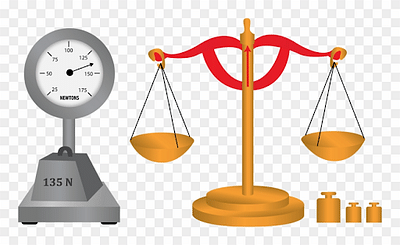
| The mass may be measured using an ordinary balance. | Weight is measured using a spring balance. |
Read More:
| Related Topics | ||
|---|---|---|
| Earth Satellites | Law of Inertia | Viscosity |
| Weightlessness | Surface Energy | Oscillations |
Things to Remember
- Mass is the quantity of inertia or the relationship between force and acceleration that characterizes an object.
- As mass is a quality that is inherent to an object, it is unaffected by outside factors.
- The Atomic Mass Unit is used for describing atoms and molecules whose masses are too small to be measured in kilograms.
- Weight measures the force that gravity exerts on a body's mass.
- Weight varies from place to place.
- All things that are tangible, have mass, occupy space, and are classified as matter.
Previous Years’ Questions
- A screw gauge has the least count of 0.01 mm and there are 50 divisions … [NEET – 2020]
- Dimensions of stress are...[NEET – 2020]
- Lumen is the unit of… [UPSEE – 2019]
- A quantity z, to be estimated has a dependency on the variables… [TS EAMCET – 20219]
- A student measured the diameter of a small steel ball using… [NEET – 2018]
- A physical quantity of the dimensions of length that can be formed… [NEET – 2017]
- Planck’s constant (ℎ), speed of light in vacuum (c) and Newton”s gravitational constant… [NEET – 2016]
- Which of the following is the smallest unit… [UPSEE – 2010]
- Body weighs 22.42 g and has a measured volume of 4.7… [WBJEE – 2010]
- A student measures the distance traversed in free fall… [NEET – 2010]
Get Live Updates on Board Exams 2023: Telegram Channel
Sample Questions
Ques: The mass of a box is 1 kg and acceleration due to gravity is 9.8 m/s2. Find (a) the weight and (b) the horizontal component and the vertical component of the weight. (2 marks) 
Ans. Weight : w = m g = (1 kg)(9.8 m/s2) = 9.8 kg m/s2 = 9.8 Newton
The horizontal component of the weight :
wx = w sin 30o = (9,8 N)(0,5) = 4.9 Newton
The vertical component of the weight :
wy = w cos 30o = (9.8 N)(0.5√3) = 4.9√3 Newton
Ques. The mass of a box measured by a grocer’s balance is 2.300 kg. Two gold pieces of masses 20.15 g and 20.17 g are added to the box. What is (a) the total mass of the box? (2 Marks)
Ans. Mass of the box,m=2.3kg
Mass of one gold piece,m1=20.15g=0.02015kg
Mass of other gold pieces,m2=20.17=0.02017kg
Total mass m + m1 + m2=2.3kg + 0.02015kg + 0,02017kg=2.34032kg
Ques. Define Mass and Weight. (2 Marks)
Ans. Mass: A substance's mass is a measurement of its amount of matter.
Weight: Weight is a fundamental characteristic of all living things and is the measurement of the force that gravity exerts on a body's mass.
Ques. The mass and volume of a body are 4.237 g and 2.5 cm3, respectively. The density of the material of the particular body in correct significant figures is: (3 Marks)
i) 1. 6048 g cm-3
ii) 1. 69 g cm-3
iii) 1. 7 g cm3
iv) 1. 695 g cm3
Ans. The answer to the multiplication or division is estimated to be the same number of significant figures as possessed by the least precise term used in the calculation. The final outcome should retain as many significant figures as possible in the original number with the least significant figures. In the given question, the density must be reported to two significant figures.
Density = 4.237 g/ 2.5 cm3 = 1. 6948
After rounding off the number, the density we get is 1.7
Ques. Name the device which is used for measuring the mass of atoms and molecules. (1 Mark)
Ans: A mass spectrograph is a device that is used for measuring the mass of atoms and molecules.
Ques. Express unified atomic mass unit in kg. (3 Marks)
Ans: The Atomic Mass Unit is used for describing atoms and molecules whose masses are too small to be measured in kilograms.
- The unified atomic mass unit in the standard unit is used in order to indicate mass on an atomic or molecular scale (atomic mass).
- One unified atomic mass unit implies approximately the mass of one nucleon (either a single neutron or proton) and is numerical equivalent to 1 g/mol.
- It is defined as one-twelfth of the mass of an unbound neutral atom of carbon-12 in its nuclear and electronic ground state.
Ques. State the difference between mass and weight. (5 Marks)
Ans. The difference between mass and weight is as follows:
| Mass | Weight |
|---|---|
| Mass can never be zero. | Weight can be zero. If no gravity operates on an item in space, its weight becomes zero. |
| Mass is a scalar quantity. It has magnitude. | Weight is a vector quantity. It has a large size and is aimed at the Earth's core or another gravity well. |
| The two most often used units of mass measurement are kilograms and grams. | Weight is commonly measured in Newtons. |
| The location has no influence on mass. | Weight varies based on geographic area. |
| Using a standard balance, the mass can be determined. | A spring balance is used to calculate the weight. |
Ques. Amin has a box that has a mass of 2.2 kg. What is the weight of the box on the Earth? (3 Marks)
Ans. Mass of box = 2.2 kg and acceleration due to gravity = 9.8 m/s2.
Weight formula = mass×acceleration due to gravitymass×acceleration due to gravity
Weight of box = 2.2kg×9.8m/s2=2.2kg ×9.8 m/s2.
Weight of box = 21.56 N
Therefore, the weight of the box on Earth is 21.56 N.
Ques. The mass of an object is 12,000 pounds. Calculate its mass in tons. (2 Marks)
Ans. Given, 1 ton = 2000 pounds.
Thus, 12,000 pounds
= 12000/2000
= 6 tons.
Ques. How do the mass and weight change when taken from the pole to the equator? (2 Marks)
Ans. The mass remains the same wherever you go on the earth or out in space but the weight changes because weight varies according to the gravitational pull in that place. Hence, Earth's gravitational pull is greater on the equator so the weight will show more at the equator, and when moved towards the pole it will show a decrease in the weight.
Check-Out:



Comments